http://ijaedu.ocerintjournals.org 229
STUDENTS INVOLVEMENT IN INTERDISCIPLINARY DEVELOPMENT OF
INNOVATIVE HEALTH SOLUTIONS: A SWOT ANALYSIS
Elsa Marta Soares
1*, Ana Querido
2, Cidália Pereira
3, Maria dos Anjos Dixe
41
PhD, Center for Innovative Care and Health Technology (ciTechCare), School of Health Sciences,
Polytechnic Institute of Leiria, PORTUGAL, [email protected]
2
PhD, MsC, RN, Center for Innovative Care and Health Technology (ciTechCare), School of Health
Sciences, Polytechnic Institute of Leiria, PORTUGAL, Centre for Research in Health Technologies
and Information Systems (CINTESIS), University of Porto, PORTUGAL
3
PhD, Center for Innovative Care and Health Technology (ciTechCare), School of Health Sciences,
Polytechnic Institute of Leiria, PORTUGAL,
4
PhD, MsC, RN, Center for Innovative Care and Health Technology (ciTechCare), School of Health
Sciences, Polytechnic Institute of Leiria, PORTUGAL
*Corresponding Author
Abstract
Background: Interdisciplinary research has the potential to optimize communication, accelerate discoveries and their translation into practice. Interdisciplinary collaboration is useful in bringing together professionals from different disciplines in order to share new ideas, express different perspectives and create new solutions that emerge from interdisciplinary collaboration and catalyse scientific innovations (VanWormer, Lindquist, Robiner, & Finkelstein, 2012). Little is known about student’s involvement in interdisciplinary practice-based research specially concerning their perception about their participation in this kind of research process. This paper is part of a larger interdisciplinary practice-based research project named Help2Care. Help2Care involves students, teachers and stakeholders aiming to empower the informal caregiver and the dependent person by integrating multimedia resources and technology in healthcare. Students were involved in the development of resources that optimize care among caregivers, dependent person and health care professionals, integrating networks of formal and informal care. Objectives: the main objective is to analyze the experience of students involved in an interdisciplinary team, collaborating in the design of multimedia resources that impact the quality of life of informal caregivers of the dependent person. Methods: This is a qualitative study, using thematic content analysis. Ethical issues were taken into account according to Helsinki declaration. Students from different health backgrounds (nursing, nutrition and rehabilitation) participated and were interviewed in an online (20 students) and in a face to face interview (7 students). After the free-floating reading, data were analyzed independently by each of the two researchers according to Bardin (2004). Afterwards the researchers cross-checked the categories in order to assure the validity of the content analysis. Results: The students express positive feelings regarding this experience. The exchange of knowledge, experiences and contributions regarding different health themes is highlighted. The contact with each other allowed them to perceive that they have different visions taking into account the same health topics which enabled them to develop a complementary and integrated vision. Considering the SWOT
http://ijaedu.ocerintjournals.org 230 analysis strengths, weaknesses, opportunities and threats were identified, regarding the collaborative team work in the development of innovative health solutions. Conclusions: This research reveals the importance of implementing interdisciplinary teaching-learning processes in health professions higher education.
Keywords: Higher Education in Health, Teaching Methods, Interdisciplinary Research, Collaborative
Learning.
1 INTRODUCTION
1.1 Interdisciplinary Collaboration
Interdisciplinary collaboration within health services enables professionals from different areas to share objectives, make decisions collectively, display shared responsibility and power, and work together to solve health problems. Interdisciplinary collaboration is quite different from multidisciplinary collaboration. Many believe that just working together with other health professionals is interdisciplinary collaboration. But collaboration not only involves agreement and communication but most of all, creation and synergy (Manias, 2018). As World Health Organization (WHO) stated “collaboration occurs when two or more individuals from different backgrounds with complementary skills interact to create a shared understanding that none had previously possessed or could have come to on their own. When health workers collaborate together, something is there that was not there before” (World Health Organization, 2010, p.36). Research demonstrates that health professionals working collaboratively can positively address current health challenges, strengthening the health system and improving health outcomes (Farrell, Luptak, Supiano, Pacala, & De Lisser, 2018; Manias, 2018). Joining together information from different backgrounds, sharing professional expertise and achieving shared understanding enables the production of new and more sophisticated knowledge (Lavin et al., 2001). Beyond impacting research results, interdisciplinarity and collaboration influence the individual social learning processes (individual learning), social capital outcomes (ability to interact, interpersonal connectivity, shared understanding) and human capital outcomes (new knowledge). Interdisciplinary research skills require the ability of clarification, harnessing differences and managing potential conflict (Carr, Loucks, & Blöschl, 2018). However, working collaboratively may be challenging as many barriers may hinder this approach. Having different clinical approaches, discipline- specific identities and the desire of some professionals to defend their backgrounds instead of sharing knowledge, are some examples of the potential barriers (Liberati, Gorli, & Scaratti, 2016).
1.2 Collaborative Learning
In this way, applying collaborative work principles in health care professions is easier when professionals have the opportunity to experience this paradigm as students, during academic training (Pollard, 2008; WHO, 2010). For that students must contact with a wide range of health professionals, their roles, participate in planned interdisciplinary experiences and merge in a health school that models effective interdisciplinary collaboration that allows discovering, constructing and transforming knowledge (Lavin et al., 2001). Collaboration, the 21st century trend, is a collective process from the beginning where all group members are jointly involved for task performance (Roselli, 2016). As defined by Panitz (1999) cited by Laal & Laal (2012), collaboration is a philosophy of interaction and personal lifestyle in which each individual is responsible for his/her actions, including learning and respect the skills and contributions of their peers. For Johnson et al. (1990) referred by Laal & Laal (2012) collaborative learning implies 5 main aspects: positive interdependence - each group member clearly perceives that only by working together will the group succeed in the achievement of a common goal; high levels of interaction – members share experiences, knowledge, ideas, they encourage and support each other in the process of constructing knowledge; individual and group accountability - all students in a group are held accountable for sharing the work and for mastery of all material to be learned; social skills – students are supported and encouraged to develop and practice trust-building, leadership, decision-making, communication and conflict management skills; group self-evaluation – team members assess periodically the team’s performance and if they are achieving the group goals identifying the changes that have to be done in order to improve the group’s effectiveness (Laal & Laal, 2012).
In collaborative learning students - organized in pairs, in small groups or in classes - are challenged both socially and emotionally once they deal with different perspectives and beliefs considering the same theme,
http://ijaedu.ocerintjournals.org 231 points of view, and are required to converse, discuss, argue, defend their ideas and reach consensus with other team mates. This process is part of a social constructivist paradigm that allows learners to jointly construct meanings, developing their own conceptual framework, also enabling the creation of new products and solutions (Laal & Laal, 2012; Roselli, 2016). In collaborative work the differentiation of roles is a natural process that results from the spontaneous emergence of interactive dynamics (Roselli, 2016). Evidence reveals that students involved in collaborative learning are more interested, develop higher levels of thought and critical thinking and retain information for more time when compared with students who develop their work individually, in a more passive way (Laal & Laal, 2012).
Collaborative teaching approach provides a significant shift from a typical teacher centered to a more student’s centered learning process, implying that they are actively engaged in their own learning process (Laal & Laal, 2012). This is also challenging to teachers once they have to change their roles from expert transmitters of knowledge to expert designers of collaborative experiences, promoting exchange and participation of each student so that they can effectively build a shared cognition (Laal & Laal, 2012; Roselli, 2016).
Beyond collaborative interdisciplinary learning, undergraduate research is also considered a very important pedagogy for the 21st century (Scott, 2015). In fact, while developing research projects, health students develop process skills (problem formulation and solving, for example), presentation skills (effective use of language, debating and arguing), management skills (working with others, coping with crisis) and personal skills (originality, accepting criticism, for example).
As so joining the advantages of collaborative interdisciplinary learning with the ones of undergraduate research, seems to impact positively the training of future health professionals (Oden, Mirabal, Epstein, & Richards-Kortum, 2010). Interdisciplinary research preparation and education are central to future competitiveness, because knowledge creation and innovation frequently occur at the interface of disciplines (Bililign, 2013).
In fact, the multidisciplinary and complex nature of health challenges and the importance of preparing students for future interdisciplinary collaborative work and research stresses out the importance of collaborative interdisciplinary research (Oden et al., 2010).
1.3 Help2Care and Innovative Health Solutions
In Portugal, the high percentage of hospital readmissions poses a national health challenge. Beyond the economic impact, this reality also influences, at various levels, the dependent person and his/her caregivers. In order to contribute to this problem’s solution, the Center for Innovative and Health Technology - Polytechnic of Leiria developed a research project, Help2Care.
Help2Care is an action research project characterized by interdisciplinarity, collaboration and involves students from different areas of knowledge that are connected considering the development of new health solutions that can contribute to decrease hospital readmissions by empowering caregivers, enabling them to care for their dependent relatives after discharge. Help2Care’s main goal is to develop materials and resources that address the dependent person and caregivers needs at discharge concerning self-care domains: hygiene and comfort, mobility and balance, feeding, communication, symptom and medication management and simultaneously address caregiver’s exhaustion. Materials produced included instruments to access caregivers needs and printed manuals as well as digital platforms (website and app) that optimize care, improve communication between the caregiver and the health professional and the communication among health professionals.
As a collaborative interdisciplinary research, this project integrated students of the Polytechnic Institute of Leiria from School of Health Sciences - (Dietetics, Nursing, Physiotherapy, Occupational Therapy and Speech Language Pathology), students from the Professionals Courses of Illustration and Graphic Production and bachelor students from Graphic Design and Multimedia (Superior School of Arts and Design). As referred by Oden et al. (2010), it is crucial to encourage students from a broader range of disciplines to develop together new solutions considering the health challenges provided by the developing world. This is also a potential way of motivating students to be concerned and interested in the impact of present and future health problems while understanding public health and socioeconomic influences on health and also developing awareness of the importance of the team contribution to effective solutions. As these health problems were identified by health care institutions and their users, their involvement as partners is crucial. Students and their tutors/supervisors were challenged to work closely with them to assure that the problem is really understood and the product design needs and constraints are taken into consideration (Oden et al., 2010).
http://ijaedu.ocerintjournals.org 232 The main objective of this research is to analyse the experience of students involved in an interdisciplinary team, collaborating in the design of health solutions (resources and materials) that impact the quality of life of informal caregivers of the dependent person. Specifically, this part of the research intends to identify the strengths, weaknesses, opportunities and threats of interdisciplinary collaboration perceived by the students participating in Help2Care project.
2 METHODOLOGY
The research team was composed by three PhD professors from the ciTechCare research group with background in Nursing, Speech Language Pathology and Dietetics. All of the researchers had previous contact and a formal relationship with the participants in the context of school activities prior to this study development. The research team members were also integrated in Help2Care project but were not involved in the specific activity reported in this content analysis. All of the researchers were female with a large experience in research and teaching (over 5 years). Two of the authors conducted the interviews assuring that none of the participants were from similar background or had a previous teacher/ student relationship, in order to control bias.
This is a qualitative study, using thematic content analysis according to Bardin (2004).
2.1. Participants
Participants were selected from the group of bachelor students participating in Help2Care project, specifically in the activities and involved in collaborative multidisciplinary group activities. A convenience sample was selected according to the following criteria: Attending the last year of the bachelor (4th year); formal participation in collaborative multidisciplinary group activities; accept to participate in the research by sharing experiences after informed consent.
Prior to the allocation to the study participants were informed about study goals and asked to participate in both an online open-ended question form and face-to-face on-line interviews. Ethical issues were taken into account according to Helsinki declaration. Informed consent was given in a written form to all participants after exposing verbally the goals and the proceedings of the study. The study was submitted and approved by a Ethical Committee (nr. 04 - 2017/05/02) and was also reported and approved by the National Committee of data protection (nr. 3289/ 2017).
A link to access the on-line form was sent to 32 participants. The questions were responded by 20 participants revealing a drop-out rate of 37,5%. In addition, seven of the students showed availability to share in-depth perspectives about the experience. Students chose to be interviewed in their homes using a private computer. All of the participants were alone at the moment of the interview. The time and duration of the interviews were negotiated between the participants and the researchers. Each interview ended when the participant had no more information to add. The minimum duration of each interview was 30 minutes and the maximum was one hour.
2.2. Data Collection and Analysis
For data collection we both use an on-line open-ended survey and on-line face-to-face semi-structured interviews. The script for the on-line survey was developed by a group of experienced researchers in both qualitative research and interdisciplinary learning. A pretest was conducted in a sample of 10 nursing students from other Portuguese school of health sciences. The script for the face-to-face on-line interviews was based on literature review, addressing complementary questions. Each of them was audio recorded and literally transcript by the interviewers.
After the free-floating reading, data were first analysed independently by each of the two main authors according to Bardin (2004). Important conditions were considered when coding the material produced by the interviews: each quotation was coded exclusionary with one type of code; codes were organized in categories to characterize a specific topic and included more than one sentence and more one participant. The coding scheme and ambiguities were discussed between the coders. Afterwards the researchers cross-checked the categories in order to determine inter-coder reliability. The coding process was developed using WebQDA® - qualitative analysis on-line software, allowing the discussion between researchers considering the construction and description of the coding tree. The inter-coder agreement was 0,9. Discrepancies among researchers were discussed until consensus.
Both deductive (top-down) and inductive (bottom-up) approaches were used during the coding process. Using the top down strategy, a SWOT matrix (Strengths, Weakness, Opportunities and Treats) was used as a model to categorize the data in themes, followed by a inductive approach to all of the material produced by
http://ijaedu.ocerintjournals.org 233 the interviews and survey. In this phase, all categories derived from the data, using a bottom-up approach. The sample that filled-in the open-ended question form (n=20) was composed by 35% of nursing students, 25% of Dietetics and nutrition students, 15% of speech and language pathology students, 10% occupational therapy students, 15% physiotherapy students, aged between 20 and 23 years old, all female.
3 FINDINGS AND DISCUSSION
From data analysis it was possible to identify a set of categories and subcategories that characterize students’ perception considering their participation in interdisciplinary development of innovative health approaches within Help2Care project. Categories were grouped in four main themes according to SWOT matrix: strengths, weaknesses, opportunities and threats.
3.1 Strengths
Strengths reflect the advantages of students being integrated in Help2Care project as a teaching/learning methodology. It was found that all the students share the common opinion that working together in interdisciplinary groups was a very remarkable experience which brought them satisfaction in learning. Four categories emerged from data: learning motivation, acquisition of new knowledge and skills, personal and professional development, and collaborative learning.
Most students sustained that participating in this interdisciplinary project had the power to increase their learning motivation. As an example, one of the students referred:
“Sharing different experiences and perspectives between colleagues from different courses motivates to learn more, to search subjects that didn´t seem interesting”.
Another category emerged from data linked to learning motivation - Acquisition of new knowledge and skills in an open leaning environment. Students acknowledge those acquisitions by sharing experiences, searching for new concepts and exploring new possibilities, illustrated by the following quotation:
“We learn through sharing… We shared things from the classes, we talked about some clinical experiences from different places… it might have allowed us to observe different areas… hospital, clinic and also some personal experiences. All contribute to improve knowledge”.
Students perceived Help2Care as an interdisciplinary experience similar to an out-of-class motivational learning experience described by (Sulaiman, Mahbob, & Azlan, 2011). By studying the experience of out of class learning environments, they concluded that student centered out-of-class teaching enables learning motivation by increasing students interest and attitudes to learn as well as satisfaction in learning (Sulaiman et al., 2011). Also, students who value new skills have established favorable motivational beliefs (Boekaerts, 2002) and that seems to be the perception of the study participants.
Most of the students identify professional and personal development as another advantage regarding their participation in this interdisciplinary project. The exchange of knowledge, experiences and contributions regarding different health themes seem to be relevant for their personal and professional role. Some of the students revealed a sense of both professional and personal growth, such as the examples bellow: “…because we acquire more knowledge outside our own professional area that enriches us as health professionals and as people…”;
“I feel I had a personal enrichment by working with others… these are the great contribution I draw from this experience”.
This personal and professional development integrates soft skills that facilitate managing their own learning and growth throughout the professional career. Students perceived the importance of exchange experiences considering professional development as stated by Laal & Laal (2012) and Oden et al. (2010).
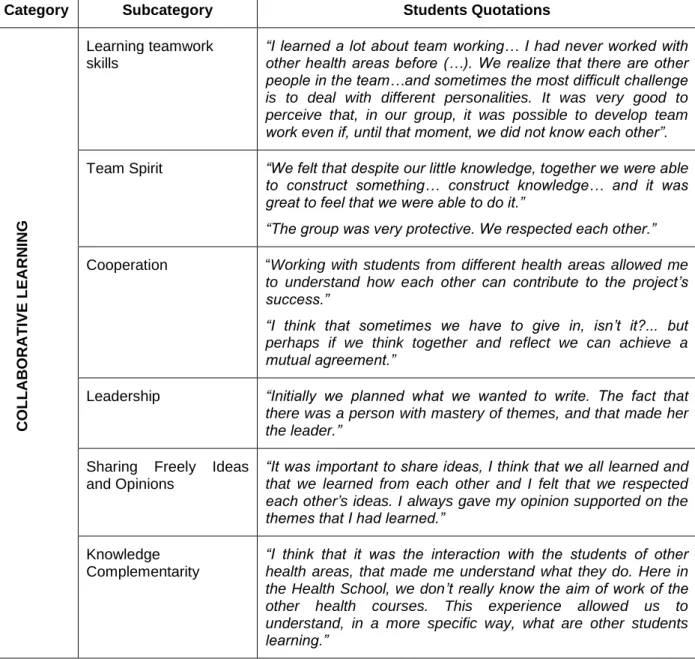
Collaborative learning was the most quoted category derived from data referring strengths associated with interdisciplinary development of health solutions. Collaborative learning comprises all of the skills developed (that were recognized by the students as advantages of learning in an interdisciplinary project such as: teamwork skills, team spirit, and cooperation, leadership, sharing freely ideas and opinions and knowledge complementarity. Table 1 summarizes the set of subcategories and the respective students’ verbatim quotations.
The contact with each other allowed them to perceive that they have different visions taking into account the same health topics. By sharing ideas in a freely and open-minded environment, they experienced the team spirit and could learn how to work in an interdisciplinary team, which enabled them to develop a
http://ijaedu.ocerintjournals.org 234 complementary and integrated vision of health solutions. Cooperation and leadership were highlighted to be part of the strengths of collaborative learning even though the learning of this skills seemed to be an ongoing process.
Table 1 - Collaborative learning category, subcategories and students’ quotations
Category Subcategory Students Quotations
CO L L ABO RAT IV E LEA R NING Learning teamwork skills
“I learned a lot about team working… I had never worked with other health areas before (…). We realize that there are other people in the team…and sometimes the most difficult challenge is to deal with different personalities. It was very good to perceive that, in our group, it was possible to develop team work even if, until that moment, we did not know each other”. Team Spirit “We felt that despite our little knowledge, together we were able
to construct something… construct knowledge… and it was great to feel that we were able to do it.”
“The group was very protective. We respected each other.” Cooperation “Working with students from different health areas allowed me
to understand how each other can contribute to the project’s success.”
“I think that sometimes we have to give in, isn’t it?... but perhaps if we think together and reflect we can achieve a mutual agreement.”
Leadership “Initially we planned what we wanted to write. The fact that there was a person with mastery of themes, and that made her the leader.”
Sharing Freely Ideas and Opinions
“It was important to share ideas, I think that we all learned and that we learned from each other and I felt that we respected each other’s ideas. I always gave my opinion supported on the themes that I had learned.”
Knowledge Complementarity
“I think that it was the interaction with the students of other health areas, that made me understand what they do. Here in the Health School, we don’t really know the aim of work of the other health courses. This experience allowed us to understand, in a more specific way, what are other students learning.”
VanWormer, Lindquist, Robiner and Finkelstein (2012) stated that strong working relations, leadership and cooperation are attributes of collaborative learning that imply positively in interdisciplinary collaboration. The strengths identified by participants in this study corroborate the work of Wellmon, Gilin, Knauss and Inman Linn (2012). They examine qualitatively the experience of graduate students from health and social sciences, engaged in a one-day experience of interdisciplinary work. Similar findings are related to the increased understanding of the professional roles of other disciplines, appreciation of the importance of collaborative work realizing the importance of leadership, understanding that conflict can arise within interdisciplinary teams and the development of increased confidence in one’s ability to collaborate.
3.2 Weaknesses
Weaknesses refer to the disadvantages of participating in Help2Care. One category was found, grouping all the difficulties identified by students which were coded as Different professional languages. Use of jargons, different terminologies and technical terms were pointed out as the major weakness of interdisciplinary learning. Several students focused on the use of technical terms that difficult the learning process and the consensus among the group members, even though they could manage do overcome this perceived
http://ijaedu.ocerintjournals.org 235 weakness. Students’ quotations below illustrate the type of difficulties found and the way they used creativity to gain mastery over it.
“Sometimes technical terms were used and I had to ask what it meant and others had to ask…”;
“There were certain words (…) that we did not quite understand; but there I learned things from Occupational Therapy and they learned Nursing terms; I wrote in a way and they did not realize or understood ... and we had to find a way to understand each other ... deep down It was needed ... We needed to write something directly to our clients and we needed to agree upon some words. Sometimes I needed to say - I do not understand what this is: explain this to me by your words”
“…they asked me: - What is this? - and then we used the internet to show it in images, when I showed them the images they said: " -Ah, it's a heel protection because of pressure ulcers…”.
Disciplinary jargon was also identified by Bililign (2013) as an important communication barrier to interdisciplinary research and education. He stated that each discipline has its own vocabulary and often the professionals need to relearn the notations and jargons to be able to work and learn effectively.
3.3 Opportunities
Opportunities are defined as the positive aspects of the surrounding environment with the potential to develop student’s learning. A set of four categories derived from data: Group environment; Tutoring process, Patient centred care; Learning from applied research
One of the categories that derived from data was related to the experienced group environment, characterized as learning-friendly environment, reinforcing the importance of different skills and of complementary knowledge considering the achievement of the same goal. The following students’ quotations reveal these perceptions:
“There was a peaceful environment with people with different skills and different knowledge, committed to a goal… This is a good way of learning”.
“We all knew what we were talking about ... In the group I felt that I was taking the time to explain my idea and that we always respected each other ... If it was difficult to understand each other? No, it was not. There was always a good atmosphere”.
Being merged in learning-friendly environment was considered positive in students learning process along with the tutoring performed by teachers. The tutoring process was considered necessary and not invasive, “being there when needed”. Regarding tutoring students revealed:
“It was good to have the teacher nearby ... served as a guide ... when we needed guide and guidance. We were able to solve the problems but it was good to know that she was there if we needed and when we need support in specific situations.”
“Sometimes it was important and useful having there the teacher... She served as a guide, more than someone to ask for help to deal with differences.”
These findings are supported by the work of Sulaiman et al. (2011) stating that a friendly-learning environment is positive correlated to quality of learning. Teacher communication skills correlates positively with learning satisfaction. On the other hand, students seemed less dependent on teachers’ encouragement and reward which might mean that they value the learning activity and are committed to the interdisciplinary learning (Boekaerts, 2002).
Patient centred care was the category mostly quoted by students when addressing the positive aspects associated with the external environment. They considered that interdisciplinary collaboration opened up their minds to look into the patient experience and needs before developing and producing materials to clients (patients and families). That was an opportunity to get together different health professionals engaged in patient centred model of care. Typical comments included:
“Different health professionals working together for the same goal, complementing each other are able to care for patient in a way that they would never be able to experiment if care was addressed by different health professionals working on their own”
“Each person is unique and not like everyone else…the treatment is indicated only for that person and not for many others. And then I realized ... it makes sense ... and by the way, we ended up changing all of the materials produced so far…”
http://ijaedu.ocerintjournals.org 236 are engaging to create a shared understanding that none had previously possessed or could have come to on their own. Accordingly, students recognize their ability to experiment such feelings during their bachelor education, facing this challenge as an opportunity to learn how to work collaboratively in their future work focused on patient experience.
Also, students participating in this project reinforce the opportunity they had to learn research from an action practiced-based research project and to contribute to positive health outcomes such as quality of life of dependent patients and their caregivers. The quotations stressed the opportunity to experiment usefulness of research process linked to improvements in patient care.
“Through scientific evidence, health professional can provide the best care to the population. Participating in this project made it possible for me to understand patient care in a more coherent view linking research and practice… it allows me to understand the basis of the whole research process.”
“The opportunity to learn and collaborate to improve the quality of life of dependent users”.
Students recognition of their experience as an opportunity to help patients and families to deal with their dependency in order to improve quality of life reinforce the work of Manias (2018) and Farrell (2018) recognizing the potential of interdisciplinary collaboration to positively address health challenges and improving health outcomes. Liking research into practice could be an opportunity to engage students in learning research process in their bachelors. There is a consensus among educators, university leaders, business leaders, and policy makers, federal agencies, and scientific associations on the need to advance interdisciplinary educational programs and research opportunities for students. Such an education prepares them to be competitive in the global market and provides them with a wider array of employment opportunities (Bililign, 2013).
3.4 Threats
Threats refer to the external negative aspects that can compromise the advantage of learning in the specific teaching/learning context enabled by Help2Care. Four categories emerged as threats to interdisciplinary learning: Ambient conditions; Tutoring and guidance; Discrepancies in students’ selection criteria; Poor Information and team overloaded.
Ambient conditions can negatively affect the advantage of interdisciplinary learning. Students stressed the noise, and quality of the air as compromising the learning context. As example, one student quoted:
“Too many people in the same room, which caused some noise and muffled air”.
Students pointed out that more meetings with teachers were needed. A sample of a quotation illustrates the student’s perspective:
“We need more guidance, more meeting hours with more teachers from different areas. Communication among teachers needed to increase”.
Discrepancies in student´s selection criteria emerged as a threat to interdisciplinary learning. From participants’ perspective, differences in students’ level of knowledge had a negative impact in group work and functioning. One student said:
“The fact that all students of all courses are not on the same academic level is a disadvantage for the group.” In addition, poor information regarding the learning objectives and project objectives were also identified as a threat to interdisciplinary learning. Example of this is illustrated in the quotation:
“At first I felt lost because I did not know very well what they were expecting from me, what tasks would be to do in a group, but ... it was good when they presented the purpose of the work and this facilitated the integration in the group. If I had known before what would happen, I would have given more and more ...” Team being overloaded with work derives from data referring group dynamics and poor project plan schedules. Students quoted difficulties in managing time to develop all the tasks assigned to the group and at the same time manage to accomplish the other scholar activities. Students quotes below, illustrate the category:
“Initially it was a little bit difficult… The most difficult thing was availability to join them and finish the task ...” “There was a lack of commitment of some colleagues and lack of interaction between all of us during the project development period. That is, there were few moments where we could talk together.”
http://ijaedu.ocerintjournals.org 237 It is recognized that a clarification of team roles and expectations (i.e., what needs to get done, when, by whom, and in what manner) increases the likelihood the team will be successful (VanWormer et al., 2012). Ensuring adequate academic training will allow students to be effective team members, capable of participating in research, contributing to the assessment, diagnosis and intervention using the most recent health technology and resources (VanWormer et al., 2012).
4 CONCLUSIONS
This study analysed qualitative data regarding students’ perspectives on participating in interdisciplinary collaborative research-based study.
Nowadays students are expected to develop the 21st century skills in order to be successful in a high demanding and challenging society. Professional, personal, academic, emotional (…) skills are intrinsically connected and education must be transformed in order to support students to achieve this integrated development. The students’ narratives stressed the advantages rather than the disadvantages and weaknesses of interdisciplinary and collaborative learning. Further opportunities should be provided to explore this kind of activities/projects that facilitate skills development beyond the traditional lecture model (Scott, 2015).
This interdisciplinary collaborative research-based experience allowed to perceive that there was a positive impact in students participating in this project considering various skills such as problem solving, critical thinking, developing strategies of communicating effectively, negotiation, collaboration. It was also possible to realize that there are many factors – intrinsic to the student and extrinsic - that interact and influence students’ involvement and must be considered when planning and operationalizing this kind of teaching/learning process. Specifically, and as referred by students, the conditions to succeed in this kind of teaching/learning experience are also dependent on the environment conditions but, above all, teachers, themselves, have to work thoroughly as an interdisciplinary collaborative team that plans with accuracy and far in advance the entire process considering each moment; each problem; the goals to achieve.
Beyond impacting their actual performance, this experience induced students to reflect about its influence in their future role as professionals. The analysis of this experience also allows to perceive that more than only participating sporadically in this kind of projects, students should be involved in interdisciplinary collaborative learning since the first years of their academic training in order to use each experience to reflect about their performance, having the opportunity to gradually improve from experience to experience.
Although the findings were considered to be consistent and stable, there are limitations that may affect their transferability. The study focused on students’ participation one day activity, when applying the results of this study it is important to take into account the specifications of the context as well as the small number of participants. Another limitation concerns the data saturation that was not completely achieved.
Further research is required in relation to students’ perceptions considering also the participation in other interdisciplinary collaborative projects that involve the interaction between students from a broader range of areas.
ACKNOWLEDGEMENTS
This study was supported by Fundação para a Ciência e Tecnologia FCT - Portugal, under the scope of the Help2CARE project: Help2care –Help to care for users and caregivers (POCI-01-0145-FEDER-23762).
REFERENCE LIST
Bardin, L. (2004). Análise de conteúdo. São Paulo: Edições 70.
Bililign, S. (2013). The Need for Interdisciplinary Research and Education for Sustainable Human
Development to Deal with Global Challenges. International Journal of African Development, 1(1), 82-90.
Boekaerts, M. (2002). Motivation to learn. Human Resource Development Quarterly, 15(3), 1–27. https://doi.org/10.1002/hrdq.1103
Carr, G., Loucks, D. P., & Blöschl, G. (2018). Gaining insight into interdisciplinary research and education programmes: A framework for evaluation. Research Policy, 47(1), 35–48.
http://ijaedu.ocerintjournals.org 238 Farrell, T. W., Luptak, M. K., Supiano, K. P., Pacala, J. T., & De Lisser, R. (2018). State of the Science:
Interprofessional Approaches to Aging, Dementia, and Mental Health. Journal of the American Geriatrics Society, 66, S40–S47. https://doi.org/10.1111/jgs.15309
Laal, M., & Laal, M. (2012). Collaborative learning: What is it? Procedia - Social and Behavioral Sciences, 31(June), 491–495. https://doi.org/10.1016/j.sbspro.2011.12.092
Lavin, M. A., Ruebling, I., Banks, R., Block, L., Counte, M., Furman, G., … Holt, J. (2001). Interdisciplinary health professional education: a historical review. Advances in Health Sciences Education : Theory and Practice, 6(1), 25–47. https://doi.org/10.1023/A:1009875017951
Liberati, E. G., Gorli, M., & Scaratti, G. (2016). Invisible walls within multidisciplinary teams: Disciplinary boundaries and their effects on integrated care. Social Science and Medicine, 150, 31–39. https://doi.org/10.1016/j.socscimed.2015.12.002
Manias, E. (2018). Effects of interdisciplinary collaboration in hospitals on medication errors: an integrative review. Expert Opinion on Drug Safety, 17(3), 259–275.
https://doi.org/10.1080/14740338.2018.1424830
Oden, M., Mirabal, Y., Epstein, M., & Richards-Kortum, R. (2010). Engaging undergraduates to solve global health challenges: A new approach based on bioengineering design. Annals of Biomedical
Engineering, 38(9), 3031–3041. https://doi.org/10.1007/s10439-010-0036-0
Pollard, K. C. (2008). Non-formal learning and interprofessional collaboration in health and social care: the influence of the quality of staff interaction on student learning about collaborative behaviour in practice placements. Learning in Health and Social Care, 7(1), 12–26. doi:10.1111/j.1473-6861.2008.00169.x Roselli, N. D. (2016). Collaborative learning: Theoretical foundations and applicable strategies to university.
Propósitos y Representaciones, 4(1), 219–280. https://doi.org/10.20511/pyr2016.v4n1.90 Scott, C. L. (2015). The Futures of Learning 3: what kind of pedagogies for the 21st century? Education
Research and Foresight, 1–21. https://doi.org/10.1016/j.pse.2015.08.005
Sulaiman, W. I. W., Mahbob, M. H., & Azlan, A. A. (2011). Learning outside the classroom: Effects on student concentration and interest. Procedia - Social and Behavioral Sciences, 18, 12–17. https://doi.org/10.1016/j.sbspro.2011.05.003
VanWormer, A., Lindquist, R., Robiner, W., & Finkelstein, S. (2012). Interdisciplinary Collaboration Applied to Clinical Research. Dimensions of Critical Care Nursing, 31(3), 202–210.
https://doi.org/10.1097/DCC.0b013e31824e0307
Wellmon, R., Gilin, B., Knauss, L., & Inman Linn, M. (2012). Changes in student attitudes toward interprofessional learning and collaboration arising from a case- based educational experience. Journal of Allied Health, 41(1), 26.
World Health Organization. (2010). Framework for Action on Interprofessional Education & Collaborative Practice. Practice, 1–63. https://doi.org/10.1111/j.1741-1130.2007.00144.x