IUL School of Social Sciences
Department of Social and Organizational Psychology
Arab Muslims’ Negative Meta-Perceptions and Non-Normative
Collective Action
Elissa Issa
Dissertation submitted as partial requirement for the conferral of
Erasmus Mundus European Master in the Psychology of Global Mobility, Inclusion and Diversity in Society
Supervisors:
Dr. Rita Guerra, Researcher, ISCTE – University Institute of Lisbon
Co-supervisor:
Dr. Jonas Kunst, Associate Professor, UiO – University of Oslo
II
Acknowledgements
I would like to express my gratitude to my wonderful supervisor Dr. Rita Guerra, who has been such an exemplary source of guidance and support throughout this whole process, fully invested in my work while being extremely patient and understanding. I am so lucky to have worked with you and am immensely grateful to you Rita! Thank you for being who you are.
I want to thank my co-supervisor as well, Dr. Jonas Kunst, who has been a dedicated and encouraging advisor to me. Giving more than any co-supervisor would, he was present through all the steps I took and was always responsive any time I needed his help and input. Thank you for everything Jonas!
Also, I would like to thank all the participants who took the time to take the survey, especially those who helped me reach more people to get involved in my study and those who showed genuine interest in my research. I appreciate you all so much!
Moreover, I would like to thank the European Commission (EACEA) for funding my Master program and granting me this once in a lifetime experience. I am forever thankful for the opportunity you have given me to pursue my education and develop more fruitfully through studying in different countries and amongst diverse people.
I want to thank all my friends and family members who have given me the utmost support to be able to realize my potential and push myself to give the best I could; you know who you are! Thank you for being in my life, I am truly blessed.
Finally, and above all, I wish to thank the precious star guiding me through the unknowns of life and lighting my path wherever I go.
III
Abstract
What triggers people to engage in violent collective action has become a major question for everyone living in this day and age, and that social sciences, and social psychology in particular, have been seeking to address. Aimed to help in answering this question, this study investigated whether negative meta-perceptions trigger non-normative violent actions among Arab Muslims. Specifically, we examined if (1) Arab Muslims’ negative meta-perceptions of what Westerners think of them increase their support for violent collective, non-normative action, as well as for normative collective action and (2) if these effects will be stronger for those who endorse extreme forms of identification (i.e., identity fusion and collective narcissism). Participants from Lebanon, Algeria, and Tunisia (N = 174) were randomly assigned to one of the two conditions (control versus negative meta-perceptions). Contrary to expectations, there was no significant effect of negative meta-perceptions on normative or non-normative collective action, and also no significant interactions with collective narcissism and identity fusion. Hence, the manipulation was not effective, and the results of the study are not consistent with previous findings, which we will discuss. However, significant results showing an intriguing negative relation between negative meta-perceptions and non-normative collective action will be also discussed.
Keywords: Meta-perceptions, non-normative collective action, identity fusion, collective
IV Table of Contents Acknowledgements II Abstract III Table of contents IV Index of Tables VI
Index of Figures VII
Introduction 1
Chapter I – Literature Review 3
Normative and Non-Normative Collective Action 3
Meta-Perceptions and Islamophobia 6
Collective Narcissism 7
Identity Fusion 8
Present Study 9
Hypothesis 10
Chapter II – Method 11
Participants and Procedure 11
Manipulation 12
Measures 12
Collective Narcissism. 12
Identity Fusion. 13
Meta-Perceptions. 13
Normative Collective Action. 13
Support for Non-Normative Collective Action. 13
V
Chapter III – Results 16
Manipulation Check 16
Condition, Collective Narcissism and Collective Action 16
Condition, Identity Fusion and Collective Action 18
Meta-Perceptions, Collective Narcissism and Collective Action 20
Meta-Perceptions, Identity Fusion and Collective Action 22
Chapter IV – Discussion 25
Limitations and Future Research 28
Conclusion 29
References 30
VI
Index of Tables
Table 1. Zero Order Correlations, Means and Standard Deviations
Table 2. Hierarchical Regression Coefficients: Condition, Collective Narcissism and Collective Action
Table 3. Hierarchical Regression Coefficients: Condition, Identity Fusion and Collective Action Table 4. Hierarchical Regression Coefficients: Meta-Perceptions, Collective Narcissism and Collective Action
Table 5. Hierarchical Regression Coefficients: Meta-Perceptions, Identity Fusion and Collective Action
VII
Index of Figures
1
Introduction
Today, radical movements have become widespread, threatening all areas the globe with uncontrollable violence. Terrorist organizations such as The Islamic State of Iraq and the Levant (ISIS), or far-right movements across the West, are generating collective fear and instability for everyone living in this day and age. The recent bombings by ISIS in Sri Lanka, on Easter Sunday killing at least 257 people and wounding 500 others (Sri Lanka bombings: All the latest updates, 2019), or the recent Mosque attacks by a far-right supporter in New Zealand during Friday prayer, resulting in the death of 51 people (Graham-McLay, 2019), are two recent examples of the dreadful consequences of radical movements.
What stimulates people to engage in collective action generally, and violent collective action specifically, has been a major question in the social sciences (Tausch et al., 2011). Research has mainly focused on determinants of non-violent, normative collective action. In social psychology, it has been a phenomenon at the center of group behavior theories such as relative deprivation theory which suggests that the gap between what an individual expects to have and what he actually has in terms of political, social and economic status, is what produces collective discontent (Gurr, 1970). Other theories are social identity theory (Tajfel & Turner, 1979) and self-categorization theory (Turner, Oakes, Haslam, & McGarty, 1994), both of which argue that group identification is a powerful factor triggering biased intergroup evaluations, a form of in-group favoritism (Brown, 2000). Even though this research has given valuable insight about the processes underlying collective action, such as injustice appraisals (Tajfel & Turner, 1979), group-based anger (Smith, 1993), collective control (Wright, 2001), emotion and efficacy (van Zomeren, Spears, Fischer & Leach, 2004), it has barely delved into more radical forms of group behavior. There is however some research showing that contempt, disidentification from the system, perception of outgroup’s behavior, and repression of protest play important roles in pushing people towards violent actions (Becker & Tausch, 2015). Nonetheless, most research focusing on collective forms of action has been mainly centered on normative, non-violent forms of action; so, thus far, less is known about non-normative, violent forms of action.
It is therefore critical to have more studies investigating why people engage in violent forms of action. As some research has demonstrated that meta-perceptions are important determinants of negative intergroup interactions (Richeson and Shelton 2007; Vorauer, Hunter, Main & Roy, 2000), we decided to examine in this study whether negative meta-perceptions
2
(i.e., judgments made by the self about what others think about the self) trigger non-normative violent actions among Arab Muslims. Specifically, we will examine if triggering negative meta-perceptions among Arab Muslims regarding what Westerners think of Muslims, increases their support for terrorism as a form of violent collective, non-normative action. This project will hence add to existing knowledge by examining other factors that can predict non-normative, violent forms of collective action. We focused on Muslims/Westerners’ context since the
relationship between Muslim culture and the West is described as one of the most pressing socio-political challenges of our time (Obaidi, Thomsen & Bergh, 2018).
3
Chapter I – Literature Review Normative and Non-Normative Collective Action
Collective action is defined as any action that promotes the interests of one's group or is carried out in political solidarity (e.g., Becker, 2012; Wright, Taylor, & Moghaddam, 1990). Multiple theories have sought to explain why people engage in collective action. Relative deprivation theory (e.g. Walker & Smith, 2002) argues that instead of an absolute standard of deprivation, it is the disparity between expected and achieved social, economic and political standards that pushes people towards political violence (Richardson, 2011). Another theory is Cross’s theory of nigrescence (1971; Cross & Vandiver, 2001), which added to our knowledge regarding group consciousness, as it described the process concerned with politicizing group identification, which is what turns the social group from "a group of itself" ("Klasse an sich") into "a group of and for itself" ("Klasse an und fur sich") in the politics area (Esser, 1993, p. 116). His model includes in its stages factors like power discontent, anger toward society, and rectifying injustice. It clearly illustrates some of the challenges that individuals face while developing their politicized group identifications, which could then be translated into collective action (Duncan, 2012). In line with this idea of “politicizing group identification”, Simon and Klandermans (2001) proposed a triangular model of politized collective identity (PCI), where group members deliberately, mindfully and collectively (or representing the collective) engage in power struggles, conscious that these struggles are occurring and reaching a broader social context and must therefore be organized appropriately. Consequences of politized identity were also discussed, with research on participation in social movements showing that politicized collective identity has a powerful effect on triggering collective action (Simon et al., 1998; Sturmer & Simon, 2001; Sturmer, Simon, Loewy, Duhme, & Jorger, 2001).
Indeed, the importance of politicized identities builds on social identity theory (Tajfel & Turner, 1979), specifically on the idea that collective action was taken as a way for members of low-status groups to maintain positive evaluations of their groups in societies that devalued them. One of the most comprehensive models aimed at explaining engagement in collective action is also built on social identity theory: the integrative social identity model of collective action (SIMCA) encompassed three distinct socio- psychological perspectives: injustice, efficacy and identity (Zomeren, Postmes & Spears, 2008). SIMCA proposed that people engage in
4
to change a group-related problem efficaciously, and when they have a sense of a social
politicized identity (Zomeren, Postmes & Spears, 2008). Three meta-analyses that combined 182 effects of perceived injustice, efficacy, and identity showed that all three predictors had
independent and causal effects on collective action. Importantly, affective injustice and
politicized identity created more effects than those of non-affective injustice and non-politicized identity. Moreover, identity predicted collective action against both incidental and structural disadvantages, while injustice and efficacy predicted collective action against incidental
disadvantages better than against structural disadvantages. Also, identity connected the injustice and efficacy explanations of collective action together (Zomeren, Postmes & Spears, 2008).
There is also recent evidence on the effects of out-group actions throughout protests carried out in repressive contexts such as Egypt and Russia in studies by Ayanian and Tausch (2015a, 2015b), showing that the perceived probability of repression of protest (e.g., arresting protesters or hostile counter-action) in fact increased dedication towards action among activists, thus encouraging collective action even further (Becker & Tausch, 2015).
It is evident that most research in social psychology on collective forms of action has been mainly focusing on normative, non-violent forms of action. However, we can distinguish two forms of collective action: normative and non-normative. Normative collective action is an action that conforms to society’s norms, whereas non-normative action is an action that violates society’s rules (Wright, Taylor & Moghaddam, 1990). When comparing normative and non-normative action, Tausch and colleagues (2011) showed that different emotions underlie different forms of collective action. In fact, it was shown that anger is primarily related to normative action, whereas contempt is predictive of non-normative action. Moreover, it was showed that perceptions of injustice predict both anger and contempt, making perceived injustice indirectly related to normative and non-normative collective action through these emotions (Tausch et al., 2011).
Wright and colleagues showed that non-normative action was selected when the barrier separating a disadvantaged group from an advantaged group cannot be crossed (Wright, Taylor & Moghaddam, 1990). In addition to that, non-normative action takes issue with the legitimacy of the current social system (see Wright, 2010) and aims at a radical social change.
As it is particularly difficult to measure actual collective action, especially if it is non-normative (see van Zomeren, Postmes & Spears, 2008), most research has only assessed the
5
willingness to support non-normative collective action (Tausch et al., 2011). A meta-analysis showed that a medium-to-large change in intention generates a small-to-medium change in behavior, which shows that intentions can be representative of the potential actual behavior (Webb & Sheeran, 2006). Previous research also shows that the intention of supporting
collective actions can serve as a predictor of participation (e.g., de Weerd & Klandermans, 1999; Moskalenko & McCauley, 2009). Especially in terrorism literature, attitudes towards a certain action are extremely significant and must be taken into account, suggesting that public opinion has a real impact on terrorist activity (e.g., Krueger & Malecˇkova ́, 2009; Mascini, 2006).
Recent research focusing on the dehumanization of Muslims—the psychological process of stripping a group from their human qualities thus pronouncing them unworthy of humane treatment— further showed that dehumanizing perceptions trigger hostile responses such as support for violent action and even an unwillingness to assist counterterrorism efforts (Kteily & Bruneau, 2016). Research also shows that meta-dehumanization, that is, perceiving to be
dehumanized by an outgroup, can lead to or prolong menacing forms of hostility and intergroup conflict (Kteily, Hodson, & Bruneau, 2016). As Kteily and Bruneau (2017) phrased it, by “documenting the full ‘vicious cycle,’ we show that minority group members are indeed dehumanized, that they readily perceive it, and that—despite their disadvantaged status and relative disempowerment—they respond with hostility of their own” (p.102). On a more positive note, it has been recently shown that more frequent positive contact is associated with lower support for violent collective action (Saab, Harb, & Moughalian, 2017), suggesting that positive contact can potentially serve as a tool to decrease violent actions. Interestingly, researchers showed that meta-dehumanization is distinct from meta-prejudice, that is, being perceived to be dehumanized is different from being perceived to be disliked, a distinction that was made while examining the effects of both meta-dehumanization and meta-prejudice on predicting
dehumanization (Kteily, Hodson, Bruneau, 2016). This differentiation parallels a similar distinction between dehumanizing and disliking, which have both demonstrated to generate separate effects on intergroup relations (Kteily, Bruneau, Waytz & Cotterill, 2015). Based on these findings, we propose that, in addition to meta-dehumanization, meta-perceptions can also lead to supporting violent collective actions.
6
Meta-Perceptions and Islamophobia
Researchers use the term meta-perceptions to make reference to negative beliefs that one group may bear against another (Frey & Tropp, 2006; Vorauer & Kumhyr, 2000). Especially with President Donald Trump representing Islam and Muslims as a negative phenomenon, Muslims have become even more subject to numerous anti-Islamic and anti-Muslim
discriminatory actions, biases, and sentiments from many Americans (Khan et al., 2019). Indeed, in the West, we witness an epidemic of Islamophobia (Gosselin, 2015), which is—according to the Oxford English dictionary—the dislike of or prejudice against Islam or Muslims.
Islamophobia has consequently led to frequent physical and verbal harassment of Muslims. This rejection and hostility have lately become more direct and undisguised, a menacing
exemplification of blatant prejudice (Pettigrew & Merteens, 1995), where, in the United States alone, the number of anti-Muslims biased incidents just in 2017 were 1302, as documented by the Council on American-Islamic Relations (CAIR). Islamophobia has hence become
dangerously explicit in the United States, especially on account of Donald Trump’s negative speech about Muslims and his Executive Order known as the “Muslim Ban.”
Hence, we decided in this study to focus particularly on Muslims’ meta-perceptions of what Americans think of them. We selected five widespread meta-perceptions that were also used in previous research: that Americans hate Muslims, and think that they are aggressive, criminals, lacking morals, backward and primitive (Kamans, Gordijn, Oldenhuis & Otten, 2009; Kteily & Bruneau, 2017). We were interested in seeing whether activating these negative meta-perceptions would increase Muslims’ support for non-normative collective actions, but also normative collective actions.
Overall, there is strong evidence in the literature about the negative consequences of meta-perceptions (Barlow, Sibley, and Hornsey, 2012; Bourhis, Giles, Leyens & Tajfel, 1979; Finchilescu, 2010; Richeson and Shelton, 2007). More specifically, some studies have shown the adverse effects of meta-perceptions on intergroup interactions, reporting that endorsement of meta-stereotypes may have more significant and severe repercussions on intergroup relations than the stereotypes that in-group members have about out-groups (Richeson & Shelton 2007; Vorauer et al. 2000). An example is the study by Kamans and colleagues (2009) in which Dutch Moroccan teenagers who felt negative about Dutch people and believed that the Dutch had extremely negative stereotypes about them, such as being aggressive or criminals, showed a
7
higher inclination to actualize this negative image by endorsing aggressive behavior towards the Dutch community (Kamans et al., 2009). In addition, in a recent study with Muslims living in Denmark and Sweden, it was shown that when the dominant group was described as seeing the Muslim culture and lifestyle as being backward and divergent from the majority culture, the Muslim participants’ endorsement of extremist violent acts against the West increased (Obaidi, Thomsen & Bergh, 2018). However, still, few studies have looked into the effects of negative meta-perceptions on extremist endorsement of intergroup violence, specifically on collective actions.
In our study, besides examining the impact of negative meta-perceptions on support for non-normative collective action, we will also explore if extreme forms of identification with the in-group amplify these effects. Research has already shown that some forms of positive in-group identification and esteem are more likely than others to occur with out-group hostility (e.g., Brown, 2000). It was also shown that for individuals who are highly group-identified, prejudice against the in-group is a threat against the self (McCoy & Major, 2003). In addition, the
integrative social identity model of collective action (SIMCA) proposed that social identity is essential to collective action, as it directly stimulates collective action and at the same time bridges the injustice and efficacy explications of collective action (Zomeren et al., 2008). Through this study, we aim to go beyond what SIMCA proposed, by examining the possible effects of extreme forms of in-group identification.
We hence hypothesize that extreme forms of identification with the in-group can amplify the impact of negative meta-perceptions on normative and non-normative collective action. We will focus on collective narcissism as a form of extreme identification as well as identity fusion.
Collective Narcissism
Collective narcissism has been defined as “an emotional investment in an unrealistic belief about the greatness and prominence of an ingroup” and has been proven to be related to intergroup bias and aggressiveness (Golec de Zavala, Cichoka, Eidelson & Jayawickreme, 2009, p.1090). Collective narcissists react aggressively to criticism as well as to any position that jeopardizes the positive image of their ingroup (Golec de Zavala, Dyduch-Hazar & Lantos, 2019). In many instances, they think they are being treated unfairly, because for them no recognition or behavior toward their special ingroup is ever good enough (Golec de Zavala, Cichoka, Eidelson & Jayawickreme, 2009). A recent meta-analysis by Golec de Zavala,
Dyduch-8
Hazar, and Lantos (2019) demonstrated that the relationship between collective narcissism and intergroup hostility is small, but significant. Indeed, collective narcissism predicts intergroup prejudice and hostility along with strong individual variables that are associated with intergroup negativity (Golec de Zavala, Cichoka, Eidelson & Jayawickreme, 2009) such as social
dominance orientation (Pratto et al., 1994; Sidanius & Pratto, 1999). In addition, studies show that collective narcissism predicts intergroup enmity, especially towards out-groups that
represent a threat to the in-group’s position (Lyons, Kenworthy & Popan, 2010), particularly in reaction to what is perceived as a threat to the in-group’s positive image (Golec de Zavala, Cichocka & Bilewicz, 2013; Golec de Zavala, Peker, Guerra & Baran, 2016).
Collective narcissism is also related to prejudice. Actually, collective narcissists are prejudiced specifically and only towards out-groups that are deemed menacing to the in-group’s entitled position (Golec de Zavala, Dyduch-Hazar & Lantos, 2019). For example, American collective narcissism was related to prejudice towards Arabs, who are, in comparison to out-groups like Asians or Latinos, the only out-group considered to be nurturing a hostile intention of dominating the United States (Lyons, Kenworthy & Popan, 2010). Thus, we propose that
collective narcissism could fuel the tendency to react with violence when negative meta-perceptions are present. Through measuring collective narcissism as a moderator variable, we can assess how peoples’ self-absorbed feelings about their own group influence their inclination to be aggressive toward other groups when facing a threat to their group’s image (i.e., negative meta-perceptions). Besides collective narcissism, we will also examine the impact of identity fusion, even though it is not commonly seen as a form of extreme identification.
Identity Fusion
Identity fusion refers to an unusually strong, visceral bond with a group (Fredman, Bastian & Swann, 2017). “Rather than focusing on the group as a relatively abstract social category, fused persons perceive it as a ‘family’ consisting of members who all share a common bond” (Gomez et al., 2011, p. 919). This excessive perceived connectedness that a fused
individual feels with his group may generate a strong desire to act on behalf of the group, even if extreme action is necessary (Gomez et al., 2011).
Most research about group processes has been guided by either social identity theory (Tajfel & Turner, 1979) or self-categorization theory (Turner et al., 1994), however ample evidence supports the notion that identity fusion is a stronger predictor of pro-group activities
9
than is identification, especially when the behavioral outcome is extreme (Fredman, Bastian & Swann, 2017). In truth, according to self-categorization theory, identification motivates people to regard ingroup members as being categorically interchangeable with other members of the category, so despite the fact that identified individuals know what they are capable of doing for the sake of their group, they nonetheless hesitate to make extreme sacrifices for their fellow group members (Gomez et al., 2011). It is thus the fusional entity that goes beyond identification with one’s group that would make an individual go to extreme lengths for his group, and not necessarily for the individuals forming it.
Identity fusion is related to support for extreme pro-group behaviors such as fighting and dying for one’s group (Gomez et al., 2011). In a study by Fredman, Bastian, and Swann (2017), it was found that fusion with religion, rather than nation, contributed to endorsing retaliation against Palestinians in reaction to violent attacks; however, religion plays an even more important and discernible role in other Middle Eastern countries than it does in Israel. In fact, identity fusion has already been associated with other conflicts in the Middle East, as it was once shown that strongly fused individuals were especially inclined to serve as front-line combatants during the 2011 Libyan revolution (Whitehouse, McQuinn, Buhrmester, & Swann, 2014). As yet, we can speculate that fusion with religion, rather than country, may predict support for aggressive forms of retaliating actions in some political conflicts. Therefore, we decided in our study to measure identity fusion with one’s religion rather than country.
Present Study
The present study examines whether negative meta-perceptions predict support for non-normative violent actions. Specifically, we will investigate if Arab Muslims’ negative meta-perceptions of what Westerners (Americans specifically) think of them predict increased support for both violent, non-normative collective actions against the West, as well as normative
collective action. Furthermore, we explore whether the effect of negative meta-perceptions on support for collective action is moderated by identity fusion with one’s religion and collective narcissism (regarding religious group). Taking into account previous findings regarding meta-perceptions, identity fusion with one’s religion, collective narcissism, and their connections to both normative and non-normative forms of collective action, we formulated the following theoretical model (Figure 1) and hypothesis.
10
Figure 1. Theoretical Model
Hypothesis
H1a: Negative meta-perceptions will increase the support for normative and non-normative collective action.
H1b: The effect of negative meta-perceptions on normative and non-normative collective action will be stronger for those with high levels of identity fusion or collective narcissism.
11
Chapter II – Method
Participants and Procedure
The study was approved by The Institutional Review Board (IRB) at the Department of Psychology at University of Oslo. One hundred and seventy-four participants were collected through social media platforms, especially Facebook. We aimed for the largest sample size we could acquire in the limited time we had for data collection. An online ad inviting people to participate in an international Psychology study was created with the link to the online survey on the Qualtrics platform, which popped up for Muslims residing in Arab countries. The survey was available in three languages: English, Arabic and French. Originally written in English, it was translated into Arabic by a professional translator and into French by another, both translators experienced in Psychology-related terminology. Out of 222 participants, forty-eight did not meet the participation requirements and were consequently excluded from the analysis: 15 were non-Arab and 33 were under the age of 18. The final sample was comprised of 174 Muslim non-Arabs, 61 of which were Lebanese, 48 were Algerian, 22 were from Tunisia, and the rest were from other Arab countries. The mean age of the participants was 24.75 (SD = 6.43 range: 18-62) and 63.2% were female, 36.3% were male. Regarding the educational level of participants, 45.6% of the participants had a higher university degree (a master’s degree or equivalent) and 36.8% have a college bachelor’s degree. When asked to choose one ethnic group they most strongly identified with (out of four presented options), the majority of participants selected that they identified most with being Muslim (57.1%), 22.4% with being Arab, 12.4% with being Middle Eastern, and only 1.8% with being White/Caucasian. In terms of religiousness, participants were rather religious (M = 4.53, SD = 1.548, range: 1-7). The participants were randomly assigned to one of the two conditions: control (89) versus negative meta-perceptions (85).
Participants consented to participate and were informed that the study was voluntary, anonymous and confidential. After that, they filled in some demographics including their level of religiosity and which ethnic group they most identified with, as well as the two moderator
variables (identity fusion and collective narcissism). Then, they were randomly assigned to one of the conditions, read a text, filled in our dependent measures and a social desirability measure. Lastly, participants received a clear debriefing, explaining the purpose of the project, providing links to the articles used for the experimental condition that some participants have read while taking the survey, and giving researchers’ contact information in case of any needed further
12
clarifications. As an incentive, participants were also presented with the option to take part in a raffle to win an Amazon gift card.
Manipulation
The manipulation consisted of reading a text. Those assigned to the control condition were presented with a text about football (Encyclopædia Britannica, 2018), which is available in the appendix (see page 37), whereas those assigned to the experimental condition were presented with a text found online in a newspaper article (Pirani, 2018) depicting some extremely negative stereotypes and other perceptions that Americans have about Muslims (the lengths of both texts are about the same). The experimental text reads as follows:
Current public perceptions of American Muslims are distinctly unfavorable. That’s according to multiple surveys from the Democracy Fund Voter Study Group, including the 2017 Views of the Electoral Research (VOTER) Survey, which assessed viewpoints of 5,000 Americans, all of whom had been previously surveyed in 2011, 2012 and 2016.The Democracy Fund Voter Study Group is a collaboration of nearly two dozen analysts and scholars from across the political spectrum. In the group’s new “Muslims in America: Public Perceptions in the Trump Era” report published in June 2018, researchers found that on average, Americans believe that only 51 percent of Muslim Americans respect American ideals and laws. Many Americans would even deny Muslims who are U.S.
citizens the right to vote. According to the report, many Americans consider Islam a “false religion” and Muslims as both not willing to fit in and sympathetic to terrorism. They also saw Muslims as willing to engage in terrorist acts. The most prevalent Muslim stereotypes that crossed partisan and ideological lines included their religiosity, outdated views of women and views of gays and lesbians.
Measures
Collective Narcissism. Collective Narcissism was assessed with the shorter five-item
Collective Narcissism Scale adapted from the original nine-item scale (Golec de Zavala, Cichoka, Eidelson & Jayawickreme, 2009) (α =.79). Participants indicated on a 6-point Likert scale (1 = I strongly disagree to 6 = I strongly agree) how much they agreed with five
13
statements: “Muslims deserve special treatment,” “not many people seem to fully understand the importance of Islam,” “it really makes me angry when others criticize Muslims,” “if Muslims had a major say in the world, the world would be a much better place,” “I will never be satisfied until Muslims get the recognition they deserve.” The items were averaged such that higher values indicate higher collective narcissism.
Identity Fusion. We used the seven-item Identity Fusion Scale (Gomez et al., 2011), that
was shown to predict endorsement of extreme pro-group behaviors. Statements read: “I am one with Islam,” “I feel immersed in Islam,” “I have a deep emotional bond with Islam,” “my religion is me,” “for Islam, I’ll do for more than any of the other group members would do,” “I am strong because of Islam,” “I make my religion strong.” For each item, respondents indicated the extent to which they felt that the statement reflected their relationship with their religion, Islam, on a scale ranging from 0 (strongly disagree) to 7 (strongly agree) (α =.91). The items were averaged such that higher values indicate higher identity fusion.
Meta-Perceptions. Participants indicated on a 7-point Likert scale the extent to which
they agreed or disagreed with five selected meta-perceptions that Americans held against them as Muslim Arabs (Kamans et al., 2009; Kteily & Bruneau, 2017). More specifically, they indicated the extent to which they thought Americans think that Muslim Arabs are aggressive, criminals, that they hate Muslim Arabs, are lacking morals, and are backward and primitive (1 = strongly disagree to 7 = strongly agree, α =.91). The items were averaged such that higher values indicate more negative meta-perceptions.
Normative Collective Action. Respondents indicated how willing they were to engage in
the 3 actions to change Western foreign policies toward Muslim countries: “sign a petition to the government,” “join in a peaceful public rally, protest, or demonstration in support of Muslims,” and “lobby a member of Parliament” (1 = not at all willing, 9 = very willing). These items had been averaged to yield an index of normative collective action intentions (Tausch et al., 2011) (α =.68).
Support for Non-Normative Collective Action. Support for non-normative collective
action was measured by seven items related to both attacks against military forces in Muslim countries and attacks against civilians in Western countries (Tausch et al., 2011). Respondents expressed the extent to which they could understand the reasons why some groups might resort to violence to force Western military forces out of Muslim countries (1 = don’t understand at all,
14
7 = understand completely), the extent to which they could understand the reasons why some young Muslims might want to carry out suicide operations in the West (1 = don’t understand at
all, 7 = understand completely), the extent to which they felt that it is justified for groups to use
violence to force Western military forces out of Muslim countries (1 = not justified at all, 7 =
completely justified), the extent to which they felt like the 9/11 attacks were justified or
unjustified (1 = not justified at all, 7 = completely justified), the extent to which they liked or disliked Muslims who fight against Western military forces (1 =I dislike them a lot, 7 = I like
them a lot), the extent to which they supported martyrdom attacks (1 =Oppose completely, 7 = Support completely), and finally the extent to which they supported violence against civilian
targets in the West (1 =Oppose completely, 7 = Support completely). We conducted an EFA with Principal Axis Factoring and oblimin rotation with Kaiser normalization on the items. Scree plot analysis determined the number of retained factors, and pattern matrices were examined for factor loadings (Costello & Osborne, 2005).
Initially, a three-factor solution explaining 46.3 % of variance was revealed, but its proprieties were not satisfactory (e.g., item cross-loading, low loadings). Consequently, we decided to run an EFA on all collective action items (normative and non-normative together), aiming to find a clearer two factor solution (i.e., normative, non-normative). The screeplot indicated a four-factor solution, but again had several cross-loadings (items loading >.30 in more than one factor). After removing the problematic items, we replicated the EFA, and this resulted in a clearer two-factor solution, with non-normative collective action as a factor (5 items, α =.61) and normative collective action as a second factor (3 items, α = .61), explaining 35.5% of total variance. To sum up, through conducting EFAs that ultimately led us to exclude two items measuring non-normative collective action, we ended up with two clear scales, measuring two distinct factors: normative collective action and non-normative collective action.
Social Desirability. The ten-item version of The Marlowe-Crowne Social Desirability
Scale was used to measure participants’ level of social desirability (Vésteinsdóttir et al., 2017) at the end of the survey. Acknowledging that our survey’s content tackles a delicate and sensitive subject, it was deemed important for us to control for social desirability, as it is a factor that could evidently affect our participants’ truthfulness in answering our survey’s questions. The scale’s Cronbach Alpha in the study is .60. The scale, which is dichotomous, consists of ten true/false items; 5 are positioned in the true direction (attribution items) and the other 5 in the
15
false direction (denial items). Responses in the keyed direction are coded as one, and responses that are not in the keyed direction are coded as zero. The highest possible score on this MCSDS is therefore 10 and the lowest is zero, with higher scores indicating more social desirability in responses.
16
Chapter III – Results
Descriptives and zero order correlations can be seen in Table 1.
Manipulation Check
A one-way ANOVA (analysis of variance), showed that the condition had no significant effect on meta-perceptions, M = .4.44, SD = 1.59, SE = .12, F (1, 172) = .141, η2 = .001, p =.708;
contrary to the expected, participants in the experimental condition did not exhibit more negative meta-perceptions than participants in the control condition. We conducted additional, exploratory ANCOVAs (analyses of covariance), to control for the potential effects of participants’ sex and identification with ethnic group. Both ANCOVAS, controlling for sex and ethnic identification, still did not reveal significant effects of condition, F (1,171) = .05, p = .825; F (1, 168) = .52, p = .473, respectively.
Condition, Collective Narcissism and Collective Action
We conducted a 3-stage hierarchical multiple regression analysis using IBM SPSS 25 to test our hypotheses. The hypotheses were tested in three steps: the first model included only the experimental condition, the second model added the moderator variables (i.e., identity fusion or collective narcissism), and the third model included the predicted interaction between the Table 1. Zero Order Correlations, Means and Standard Deviations
1 2 3 4 5 6 7 8 9 M SD
1- Condition - - -
2- Identification with Being Muslim -.08 - .56 .50
3- Religiosity .01 .41** - 4.53 1.55
4- Negative Meta-perceptions .03 -.23** -.01 - 4.44 1.59
5- Identity Fusion -.13 .44** .57** -.07 - 5.05 1.39
6- Collective Narcissism -.09 .31** .26** .02 .58** - 6.15 1.93
7- Social Desirability -.13 .04 .22** -.21** .17* .03 - 5.63 2.14
8- Normative Collective Action -.05 .13 .24** .081 .33** .25** .10 - 4.09 1.13
9- Non-normative Collective Action -.07 .21** .13 -.18* .25** .27** -.08 .11 - 2.79 1.49 Note: **. Correlation is significant at the 0.01 level (2-tailed).
*. Correlation is significant at the 0.05 level (2-tailed).
17
experimental condition and the respective moderator. All predictors were mean centered. Coefficients are presented in Tables 2 and 3.
The results of the first step, including the experimental condition only, indicated that, contrary to our predictions, condition did not significantly affect non-normative collective action (see Table 2 for coefficients). Hence, the explained variance of the model was also not
significant, R2= .005, F (1,172) = .866, p = .353. In the second step, the results of the regression indicated that including collective narcissism significantly increased the explained variance (7.3%, R2= .073, F (1,171) = 12.476, p = .001). Specifically, collective narcissism significantly predicted non-normative collective action, which is consistent with our hypothesis. That is, higher levels of collective narcissism predicted higher support for non-normative collective action (see Table 2 for coefficients). The last step included the interaction between condition and collective narcissism. However, the inclusion of the interaction term did not significantly
increase the explained variance (R2= .073, F (1,170) = .015, p = .903), and the interaction did not have a significant effect on non-normative collective action (see Table 2 for coefficients).
We conducted similar analyses to test the effects on normative collective action this time. The results of the first step, including the experimental condition only, indicated that, contrary to our predictions, condition did not significantly affect normative collective action (see Table 2 for coefficients). Hence, the explained variance of the model was also not significant, R2= .003, F (1,172) = .502, p = .480. In the second step, the results of the regression indicated that including collective narcissism significantly increased the explained variance (6.3%, R2= .063, F (1,171) = 10.897, p = .001). Specifically, collective narcissism significantly predicted normative collective action, which is consistent with our hypothesis. That is, higher levels of collective narcissism predicted higher support for normative collective action (see Table 2 for coefficients). The last step included the interaction between condition and collective narcissism. However, the
inclusion of the interaction term did not significantly increase the explained variance (R2= .065,
F (1,170) = .372, p = .543), and the interaction did not have a significant effect on normative
18
Table 2. Hierarchical Regression Coefficients: Condition, Collective Narcissism and
Collective Action
Dependent Variable Model Variables B SE β t p
Non-Normative Collective Action 1 (Constant) .042 .068 .620 .536 Condition -.090 .097 -.071 -.930 .353 2 (Constant) .027 .066 .408 .684 Condition -.059 .094 -.046 -.628 .531 Collective Narcissism .147 .042 .261 3.532 .001 3 (Constant) .026 .066 .398 .691 Condition -.059 .094 -.046 -.626 .532 Collective Narcissism .152 .060 .271 2.536 .012 Condition X Collective Narcissism -.010 .083 -.013 -.122 .903 Normative Collective Action 1 (Constant) 6.255 .205 30.541 .000 Condition -.208 .293 -.054 -.709 .480 2 (Constant) 6.212 .200 31.125 .000 Condition -.120 .286 -.031 -.418 .677 Collective Narcissism .418 .127 .245 3.301 .001 3 (Constant) 6.220 .200 31.038 .000 Condition -.120 .287 -.031 -.418 .677 Collective Narcissism .338 .182 .199 1.852 .066 Condition X Collective Narcissism .155 .254 .065 .610 .543
Condition, Identity Fusion and Collective Action
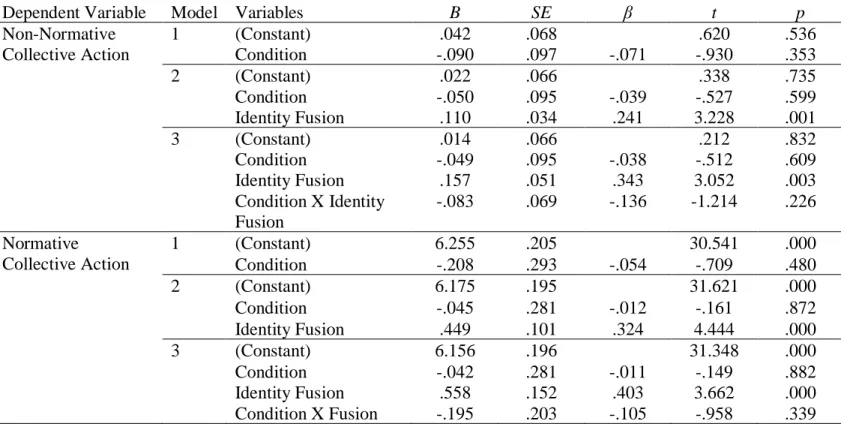
We conducted similar analyses, now testing the moderator role of identity fusion. The predicted model was tested in three steps: the first model included only the experimental condition. The second model added identity fusion, and the third model included the predicted interaction between the experimental condition and identity fusion. Coefficients are presented in Table 3.
The results of the first step, including the experimental condition only, indicated that, contrary to our predictions, condition did not significantly affect non-normative collective action (see Table 3 for coefficients). Hence, the explained variance of the model was also not
significant, R2= .005, F (1,172) = .866, p = .353. In the second step, the results of the regression indicated that including identity fusion significantly increased the explained variance (6.2%, R2= .62, F (1,171) = 10.429, p = .001). Specifically, identity fusion significantly predicted non-normative collective action, which is consistent with our hypothesis. That is, higher levels of
19
identity fusion predicted higher support for non-normative collective action (see Table 3 for coefficients). The last step included the interaction between condition and identity fusion. However, the inclusion of the interaction term did not significantly increase the explained variance (R2= .054, F (1,170) = 1.474, p = .226), and the interaction did not have a significant effect on non-normative collective action (see Table 3 for coefficients).
We conducted similar regression analysis to test the effect on normative collective action this time. The results of the first step, including the experimental condition only, indicated that, contrary to our predictions, condition did not significantly affect normative collective action (see Table 3 for coefficients). Hence, the explained variance of the model was also not significant,
R2= .003, F (1,172) = .502, p = .480. In the second step, the results of the regression indicated
that including identity fusion significantly increased the explained variance (10.6%, R2= .106, F (1,171) = 19.746, p < .001). Specifically, identity fusion significantly predicted normative
collective action, which is consistent with our hypothesis. That is, higher levels of identity fusion predicted higher support for normative collective action (see Table 3 for coefficients). The last step included the interaction between condition and identity fusion. However, the inclusion of the interaction term did not significantly increase the explained variance (R2= .095, F (1,170) = .918, p = .339), and the interaction did not have a significant effect on normative collective action (see Table 3 for coefficients).
In sum, the experimental condition had no effect on either of our dependent variables (normative and non-normative collective action). We only detected a positive relation between our moderators (identity fusion and collective narcissism) and our dependent variables. The higher the level of identity fusion or collective narcissism, the higher is the support for normative and non-normative collective action. Given the non-significant effects of our condition on the dependent variables, we looked at zero-order correlations between our main variables (see Table 1).
One significant result we found is, interestingly, a negative correlation between perceived negative perceptions and non-normative collective action. In fact, the more negative meta-perceptions participants had, the less they supported non-normative collective action (r = -.181, p = .017).
Identification with being Muslim was positively related to support for non-normative collective action (r = .209, p = .006); that is, the more participants identified as being Muslim the
20
more they supported non-normative collective actions. Additionally, the more participants identified as being Muslim the less they endorsed negative meta-perceptions (r = -.226, p = .003). Religiosity was also positively associated with collective narcissism, identity fusion, and normative collective action, but not with non-normative collective action (see Table 1). For other significant correlations between variables, check Table 1 above. After looking at zero-order correlations, we explored if participants’ perceived negative meta-perceptions (assessed by the meta-perceptions scale we used) were related to our outcome variables.
Table 3. Hierarchical Regression Coefficients: Condition, Identity Fusion and Collective Action
Dependent Variable Model Variables B SE β t p
Non-Normative Collective Action 1 (Constant) .042 .068 .620 .536 Condition -.090 .097 -.071 -.930 .353 2 (Constant) .022 .066 .338 .735 Condition -.050 .095 -.039 -.527 .599 Identity Fusion .110 .034 .241 3.228 .001 3 (Constant) .014 .066 .212 .832 Condition -.049 .095 -.038 -.512 .609 Identity Fusion .157 .051 .343 3.052 .003 Condition X Identity Fusion -.083 .069 -.136 -1.214 .226 Normative Collective Action 1 (Constant) 6.255 .205 30.541 .000 Condition -.208 .293 -.054 -.709 .480 2 (Constant) 6.175 .195 31.621 .000 Condition -.045 .281 -.012 -.161 .872 Identity Fusion .449 .101 .324 4.444 .000 3 (Constant) 6.156 .196 31.348 .000 Condition -.042 .281 -.011 -.149 .882 Identity Fusion .558 .152 .403 3.662 .000 Condition X Fusion -.195 .203 -.105 -.958 .339
Meta-Perceptions, Collective Narcissism and Collective Action
We conducted a 3-stage hierarchical multiple regression analysis using IBM SPSS 25 to explore if negative meta-perceptions would relate to non-normative and normative collective action, and if these effects were moderated by collective narcissism. The first model included only the measured negative meta-perceptions, the second model added collective narcissism, and the third model included the predicted interaction between meta-perceptions and collective narcissism. Coefficients are presented in Tables 4 and 5.
21
The results of the first step, including perceptions only, indicated that
meta-perceptions significantly affected non-normative collective action negatively as we have already seen (see Table 4 for coefficients), explaining 3.3% of variance of the model, R2= .033, F
(1,172) = 5.806, p = .017. In the second step, the results of the regression indicated that including collective narcissism significantly increased the explained variance (10.6%, R2= .106, F (1,171) = 13.929, p < .001). Specifically, collective narcissism significantly predicted non-normative collective action, which is consistent with our hypothesis. That is, higher levels of collective narcissism predicted higher support for non-normative collective action (see Table 4 for coefficients). The last step included the interaction between meta-perceptions and collective narcissism. However, the inclusion of the interaction term did not significantly increase the explained variance (R2= .106, F (1,170) = .022, p = .882), and the interaction did not have a significant effect on non-normative collective action (see Table 4 for coefficients).
We conducted similar analyzes to test the effect on normative collective action this time. The results of the first step, including the meta perceptions only, indicated that, contrary to our predictions, meta-perceptions did not significantly affect normative collective action (see Table 4 for coefficients). Hence, the explained variance of the model was also not significant, R2= .007,
F (1,172) = 1.133, p = .289. In the second step, the results of the regression indicated that
including collective narcissism significantly increased the explained variance (6.7%, R2= .067, F (1,171) = 11.142, p = .001). Specifically, collective narcissism significantly predicted normative collective action, which is consistent with our hypothesis. That is, higher levels of collective narcissism predicted higher support for normative collective action (see Table 4 for coefficients). The last step included the interaction between meta-perceptions and collective narcissism.
However, the inclusion of the interaction term did not significantly increase the explained variance (R2= .069, F (1,170) = .255, p = .614), and the interaction did not have a significant effect on normative collective action (see Table 4 for coefficients).
22
Table 4. Hierarchical Regression Coefficients: Meta-Perceptions, Collective Narcissism and
Collective Action
Dependent Variable Model Variables B SE β t p
Non-Normative Collective Action 1 (Constant) -.002 .048 -.044 .965 Meta-Perceptions -.073 .030 -.181 -2.410 .017 2 (Constant) -.002 .046 -.045 .964 Meta-Perceptions -.075 .029 -.187 -2.586 .011 Collective Narcissism .152 .041 .270 3.732 .000 3 (Constant) -.002 .046 -.049 .961 Meta-Perceptions -.076 .030 -.190 -2.546 .012 Collective Narcissism .153 .041 .271 3.713 .000 Meta-Perceptions X Collective Narcissism .004 .026 .011 .149 .882 Normative Collective Action 1 (Constant) 6.153 .146 42.088 .000 Meta-Perceptions .098 .092 .081 1.064 .289 2 (Constant) 6.153 .142 43.311 .000 Meta-Perceptions .091 .090 .075 1.016 .311 Collective Narcissism .420 .126 .247 3.338 .001 3 (Constant) 6.152 .142 43.192 .000 Meta-Perceptions .081 .092 .066 .874 .383 Collective Narcissism .427 .127 .251 3.367 .001 Meta-Perceptions X Collective Narcissism .040 .080 .039 .505 .614
Meta-Perceptions, Identity Fusion and Collective Action
We conducted similar analyses now testing the potential moderator role of identity fusion. The first model included only the measured meta-perceptions. The second model added identity fusion, and the third model included the predicted interaction between meta-perceptions and identity fusion. Coefficients are presented in Table 5.
The results of the first step, including perceptions only, indicated that meta-perceptions significantly affected non-normative collective action negatively (see Table 5 for coefficients), explaining 3.3% of variance of the model, R2= .033, F (1,172) = 5.806, p = .017. That is, the more participants endorsed negative meta-perceptions the less they supported non-normative, violent, collective action. In the second step, the results of the regression indicated that including identity fusion significantly increased the explained variance (7.7%, R2= .077, F (1,171) = 10.283, p = .002). Specifically, identity fusion significantly predicted non-normative collective action, which is consistent with our hypothesis. That is, higher levels of identity fusion
23
predicted higher support for non-normative collective action (see Table 5 for coefficients). The last step included the interaction between meta-perceptions and identity fusion. However, the inclusion of the interaction term did not significantly increase the explained variance (R2= .095,
F (1,170) = 1.388, p = .240), and the interaction did not have a significant effect on
non-normative collective action (see Table 5 for coefficients).
We conducted a similar regression to test the effect on normative collective action this time. The results of the first step, including meta-perceptions only, indicated that, contrary to our predictions, meta-perceptions did not significantly affect normative collective action (see Table 5 for coefficients). Hence, the explained variance of the model was also not significant, R2= .007,
F (1,172) = 1.133, p = .289. In the second step, the results of the regression indicated that
including identity fusion significantly increased the explained variance (11.7%, R2= .117, F (1,171) = 21.338, p < .001). Specifically, identity fusion significantly predicted normative
collective action, which is consistent with our hypothesis. That is, higher levels of identity fusion predicted higher support for normative collective action (see Table 5 for coefficients). The last step included the interaction between meta-perceptions and identity fusion. However, the inclusion of the interaction term did not significantly increase the explained variance (R2= .119,
F (1,170) = .405, p = .525), and the interaction did not have a significant effect on normative
24
Table 5. Hierarchical Regression Coefficients: Meta-Perceptions, Identity Fusion and Collective
Action
Dependent Variable Model Variables B SE β t p
Non-Normative Collective Action 1 (Constant) -.002 .048 -.044 .965 Meta-Perceptions -.073 .030 -.181 -2.410 .017 2 (Constant) -.002 .046 -.045 .964 Meta-Perceptions -.066 .029 -.164 -2.245 .026 Identity Fusion .107 .033 .235 3.207 .002 3 (Constant) -.006 .047 -.136 .892 Meta-Perceptions -.056 .031 -.139 -1.817 .071 Identity Fusion .111 .034 .243 3.308 .001 Meta-Perceptions X Identity Fusion -.028 .024 -.090 -1.178 .240 Normative Collective Action 1 (Constant) 6.153 .146 42.088 .000 Meta-Perceptions .098 .092 .081 1.064 .289 2 (Constant) 6.153 .138 44.506 .000 Meta-Perceptions .126 .088 .104 1.443 .151 Identity Fusion .461 .100 .333 4.619 .000 3 (Constant) 6.146 .139 44.245 .000 Meta-Perceptions .143 .092 .118 1.563 .120 Identity Fusion .467 .100 .337 4.651 .000 Meta-Perceptions X Identity Fusion -.045 .071 -.048 -.636 .525
25
Chapter IV – Discussion
This study examined the impact of negative meta-perceptions on non-normative violent actions. More specifically, we investigated whether priming Arab Muslims with negative meta-perceptions of what Westerners (Americans particularly) think of Muslims would predict an increased support for violent, non-normative collective actions. We also wanted to see if the effect of negative meta-perceptions on support for collective action was moderated by identity fusion and collective narcissism.
Contrary to the expected, there was no significant effect of negative meta-perceptions on normative or non-normative collective action, and also no significant interactions with collective narcissism and identity fusion. We were thus unable to validate our hypothesis. The results of the study are not consistent with previous findings, which have provided substantial evidence about the negative consequences of meta-perceptions (Barlow, Sibley, and Hornsey, 2012; Bourhis, Giles, Leyens & Tajfel, 1979; Finchilescu, 2010; Richeson and Shelton, 2007), especially in regard to their harmful impact on intergroup interactions (Richeson and Shelton 2007; Vorauer et al. 2000).
The reason why our manipulation failed, as the experimental text did not trigger any negative feelings strong enough to have any effect on participants’ responses, could be related to the fact that the text is less relevant to Muslims living in the Arab world, since it only describes how negatively American Muslims are perceived, not Muslims living in the Arab world like our participants. In addition to that, the inefficiency of the manipulation could also be related to the fact that our participants are Muslim Arabs living in the Arab world, a distinction that could be an important factor to understand why a previously used manipulation was not successful. Indeed, in previous studies, the Muslim participants were Muslims living in the West, a completely different context to the Arab world, where our Muslim participants lived. Meta-perceptions that Muslim Arabs have about what Westerners think of them may be more anchored and normalized for Muslims who live in the Arab world than for those who live in the West. This is especially because of Arabs’ everyday reality that is impacted by the political relationship between Arab countries and some Western countries, that are often meddling in the internal affairs of Arab countries. Besides, being a Muslim not living in the West, hence having no direct contact with the Western world and potentially being less exposed to direct discrimination, reading a text may have not been sufficiently strong to impact them as expected. However, in
26
previous studies about meta-perceptions and non-normative collective action (e.g., Kamans et al., 2009; Obaidi, Thomsen & Bergh, 2018), the experimental text is coming from the West, the place that Muslim participants inhabit and that is supposed to be their “home”. We can only speculate then that it may be more perturbing and threatening for Muslims living in the West to read such negative and derogating opinions coming from the place they actually live in and try to be a part of; therefore it would make sense that this could be why such manipulations work more effectively when dealing with Muslims living in the West.
In fact, to help support our argument, there is some evidence that Muslims who have moved to the West have the tendency to use a separation strategy by forming a stronger bond with their own ethnic group, heritage, culture of origin and religion (Khawaja, 2016). It was shown that social interactions with people from the host culture increased Muslims’ awareness of the prejudices and biases that exist about them in the host society (Awad, 2010). It is relevant to note here how the media portrayal of Muslims has been truly destructive in Western countries (Al Wekhian, 2016). Consequently, the majority of Muslims living in the West recognize the creation of a hostile “us versus them” situation (Blackwood, Hopkins, & Reicher, 2015), resulting in Muslims living in the West to feel directly persecuted (Bux, 2007).
We did, however, have some significant findings in our study. Intriguingly, the more negative meta-perceptions participants had, the less they supported non-normative collective action. While this was an unexpected finding, some research actually suggests that when facing a stereotype threat, people may have specific coping strategies to counterbalance the performance implications of a negative stereotype (Pennington, Heim, Levy, & Larkin, 2016). In fact, one indicator of coping is cognitive appraisal, by which people assess the importance of a situation in addition to their capacity to control it (Lazarus & Folkman, 1984). In this case, individuals put more effort into the task when the situation is presented to them as a challenge (Drach-Zahavy & Erez, 2002; White, 2008). Then, studies by Berjot, Roland-Levy and Girault-Lidvan (2011) showed that perceiving the situation as a challenge significantly mediated the relationship between stereotype threat and performance, so participants who evaluated stereotype threat as a challenge performed better than those who did not. These results are relevant for our findings, because they show that individuals can make an effort to face up to intellectual challenges instead of avoiding them, hence modifying the stereotypes held by members of an out-group in a favorable direction (Cohen & Garcia, 2005). This could potentially explain why our participants
27
who endorsed negative meta-perceptions showed less support for non-normative, violent collective action, as they may have faced the negative stereotypes as a challenge and altered the reaction that was expected of them, hence striving to prove wrong the perceptions held against them. Furthermore, this explanation could be in alignment with our finding regarding social desirability being negatively related to meta-perceptions, which shows that the less participants had social desirability bias, the more negative meta-perceptions they had.
In alignment with previous research, collective narcissism was significantly and positively related with support for normative and non-normative collective action (Golec de Zavala, Dyduch-Hazar & Lantos, 2019), which shows us that collective narcissism does indeed fuel the support for violent forms of collective action, but also encourages the engagement in normative collective actions. In addition to that, identity fusion was positively related with support for both normative and non-normative collective action, which contributes further to what we know from previous research. In fact, identity fusion has already been shown to be related to supporting extreme pro-group behaviors like fighting and dying for the ingroup (Gomez et al., 2011), yet in our study, the direct correlation with normative and violent forms of collective action is strongly manifest.
Another significant finding in our study showed that the more participants identified with being Muslim the more they supported non-normative collective action. This goes in line with the positive correlations we found in our study between identification with being Muslim and both collective narcissism and identity fusion, which are themselves positively correlated with non-normative collective action. In fact, recent studies have shown that ingroup identification is associated with intergroup hostility insofar as it overlaps with collective narcissistic views relating to the ingroup (Golec de Zavala, Dyduch-Hazar & Lantos, 2019). However,
interestingly, the degree of religiosity was not related to non-normative collective action. These two findings prompt us to ask: if support for non-normative action is not connected to
religiousness, is it then just related to the social identity of labeling oneself as “Muslim”? This question is definitely worth looking into in future research to further clarify and explain our results.
It is important to note that, nonetheless, religiosity was positively associated with collective narcissism, identity fusion, and normative collective action. The fact that the higher the level of religiousness, the higher is the support for normative collective action, and not
28
violent non-normative collective action is a positive finding that could thus refute people’s misconceptions about connecting being violent to being religious in our post 9/11 world. It is thus a hopeful finding as it shows that the more religious participants were, the more they supported engaging in solely normative, constructive, collective action.
Limitations and Future Research
Our study certainly has its weaknesses. First of all, a larger sample size would have brought more power to the study, to better detect the predicted effect among the Arab Muslims population. In addition, we did not include any type of attention check to make sure that participants really have read the texts presented to them, which is a serious limitation.
Since the manipulation was not effective in the case of our participants, it is important to take note of that and consider another experimental procedure in future research with Muslims living in Arab world. For instance, something more triggering than a negative article, maybe visuals would be more effective than reading for instance (e.g., video about islamophobia in the U.S, testimonies from Muslims in the West). Potential differences between Muslims living in the West and Muslims living in the Arab world could also be examined in future research, to
examine and compare the differences between both groups in regard to their reactivity towards negative meta-perceptions. This way, it could be clarified how an indirect way of facing
discriminatory perceptions could differ from facing direct ones, and how that could consequently affect individuals’ reactions when subjected to negative meta-perceptions. Such research would help find the right and effective manipulations for other research corresponding to the
participants’ socio-geographical contexts.
Also, the measures for non-normative collective action (Tausch et al., 2011) were not precise enough (as some items were cross loading or had low loadings) and should thus be adjusted or modified for future research to better ascertain that the measure is clear and relevant. Moreover, like other research on collective action (see van Zomeren et al., 2008), we could only measure behavioral intentions and support for action. Despite the fact that intentions have been proven to be representative of actual behavior and tendency towards actual participation in collective action (e.g., de Weerd & Klandermans, 1999; Moskalenko & McCauley, 2009; Webb & Sheeran, 2006), this line of research would produce more powerful findings by examining and measuring actual participation in normative and non-normative collective action (Tausch et al., 2011).
29
Finally, for feasibility limitations in the case of a master dissertation, our study was only able to focus on Arab Muslims’ meta-perceptions of what Westerners think of them. However, it would be more enriching to have a broader approach and also look at Westerners’
meta-perceptions of what Muslim Arabs think of them. In fact, it would be interesting to examine to what extent Westerners’ meta-perceptions of what Arabs think of them could be related to their support of violent, extremist actions; an example would be supporting strict immigration policies (e.g., Donald Trump’s executive order banning Muslims from entering the US from six Muslim majority nations).
Conclusion
Despite the lack of significant effects, the present research adds to the existing literature on meta-perceptions and non-normative collective action by showing that Arab Muslims’ endorsement of negative meta-perceptions is related to less support for non-normative, violent collective action. We could only speculate, based on previous research on stereotype threat, that this finding may be related to perceiving this threat to the ingroup identity as a challenge, consequently changing the response that was expected. This finding shows us how Muslim Arabs may really try to disprove the negative perceptions held against them, a finding that could serve as a realistic portrayal of Muslims today, ceaselessly dealing with their tainted reputation in a post 9/11 world.