ISSN 1518-3483 Licenciado sob uma Licença Creative Commons
[T]
A meta-understanding about the
research in Mathematical Modelling in
Brazilian Mathematics Education
Sobre a pesquisa em Modelagem na Educação
Matemática brasileira
Tiago Emanuel Klüber[a], Dionísio Burak[b][a] PhD, professor, Universidade Estadual do Oeste do Paraná (Unioeste), Programa de Pós-Graduação em Educação e Programa de Pós-Graduação em Ensino, Cascavel, PR - Brasil, e-mail: tiago_kluber@ yahoo.com.br
[b] PhD, professor, Universidade Estadual do Centro Oeste do Paraná (Unicentro) and Universidade Estadual de Ponta Grossa (UEPG), Programa de Pós-Graduação em Educação, Guarapuava, PR - Brasil, e-mail: [email protected]
Abstract
One of the main research demands in mathematical modeling in mathematics education is the investment in metastudies of its own production. In this context our investigation was held and could be developed under the question: how is research in Mathematical Modeling presented in Brazil, from works published in the GT-10 of the IV International Seminar for Research in Mathematics Education? The research approach, which is predominantly qualitative, inspired by content analysis, guided the procedures for analysis and interpretation. The results point to a plurality of themes, methods and authors that
support the research community. These pluralities are discussed and detailed in the same context they are shown and in some of its possible developments.
Keywords: Metasearch. Educational Research. Education. Science teaching.
Resumo
Uma das principais demandas da pesquisa em Modelagem Matemática na Educação Matemática é o investimento em metaestudos de sua própria produção. Nesse contexto nossa investigação se sustentou e pôde ser empreendida sob a questão: como se mostra a pesquisa em Modelagem Matemática no Brasil, a partir dos trabalhos publicados no GT-10 do IV Seminário Internacional de Pesquisa em Educação Matemática? A abordagem de pesquisa, predominantemente qualitativa, inspirada na análise de conteúdo orientou os procedimentos de análise e interpretação. Os resultados obtidos apontam para uma pluralidade de temas, métodos e autores que sustentam a comunidade de pesquisa. Essas pluralidades são discutidas e aprofundadas no contexto mesmo em que se mostraram e em alguns dos seus possíveis desdobramentos.
Palavras-chave: Metapesquisa. Pesquisa educacional. Educação. Ensino de ciências.
About the research: objective and context
This article is one of the outcomes of a wider investigation called “Mathematical Modeling in Brazil: in the perspective of meta-understanding”, funded by Fundação de Apoio à Pesquisa no Paraná -
FAP, FundaçãoAraucária. It is featured as ameta-study in the field of
Mathematical Modeling in Mathematics Education.
Investigations featured asmeta-studiesare supported on discussions aiming at the strengthening of research fields in general. Such investigations are established within the community, where participants seek to subsidize their researches in a more “conscious” and “safer” way (LESTER; LAMBDIN, 1997). Given the above, we can
affirm that the intention of reflecting itself has already reached the Modeling field, which aims to sustain, advance and understand. (NISS, 2001; ALMEIDA, 2006; BARBOSA, 2007; ARAÚJO, 2009; BARBOSA, ARAÚJO; CALDEIRA, 2009; BICUDO; KLÜBER, 2011; BURAK et al., 2012, KLÜBER; BURAK, 2012).
In this context, broadly, the main objectives of our investigation focus on clarifying, understanding and interpreting the meanings of Brazilian research on Mathematical Modeling in Mathematics Education. They derive from, have been pursued and are presented in this article specifically from the question: how is research in Mathematical Modeling presented in Brazil, from works
published in the GT-10 of the IV International Seminar for Research in Mathematics Education? GT-10 is specific on Mathematical Modeling in Mathematics
Education. The event was chosen since it is the largest in terms of research on Mathematics Education and, transitively, for the Workgroup itself.
The comprehensive nature of this question placed us in a research tradition which is mainly qualitative and has brought us closer to the objective through a mixed approach of investigation, quite similar to the context analysis. (FRANCO, 2005; BARDIN, 2011). Detailed descriptions concerning research approach, procedures and instruments used in investigation can be found in Burak and Klüber (2012) and Burak et. al. (2012).
Although broader descriptions on methodological aspects may be found in the above mentioned works, we synthetically describe them in order to inform the reader on adopted and developed procedures.
On procedures
Generally we carried out analysis established on criteria, a priori, based on categories deemed relevant to research, yet not considering them established or universal, which are:1) Authors of Mathematical Modeling;
2) Types of Analysis; 3) Collection Proceedings and Instruments; 4) Outlining of Research; 5) Other Authors; 6) Purposes of Research in Mathematical Modeling; 7) Research Results.
Initially, from reading, we literally highlighted these elements, in the eleven (11) analyzed articles, exactly as recorded in the publication and, then, we began to gather them in broader categories, with the aid of qualitative data analysis software Atlas T.i, which favors systematization, organization, research project management based on qualitative research. (WALTER; BACH, 2009; KLÜBER; BURAK; 2012).
In short, we highlight data in a textual analysis in order to, then, proceed to a comprehensive analysis in which original data were codified to express our understanding on it. At last, beyond categories, we made interpretations on them and beyond them, in a dialogue with research which is being performed in field.
During research we wouldn’t worry in pre-establishing a theoretical reference to focus categories on, for we assumed that, from them, one can dialogue with distinct areas contributing for a broader interpretation on explicit and latent contents in our analyzes.
Before this, in the following section we present established analytical tables, descriptions of explicit contents and its interpretations.
Categories, analyzes and interpretations
Meaning convergences that emerged in analyzes have been recorded in seven tables handling the mentioned categories in the beginning of the previous section, in which we describe procedures chosen. These tables are formed of three columns respectively showing: 1) Names attributed to categories, both defined a prioriand a posteriori; 2) Documents found on quotes - Pn. P meaning the primary document and n the number of document; 3) Number of works among 11 in which categories were cited.
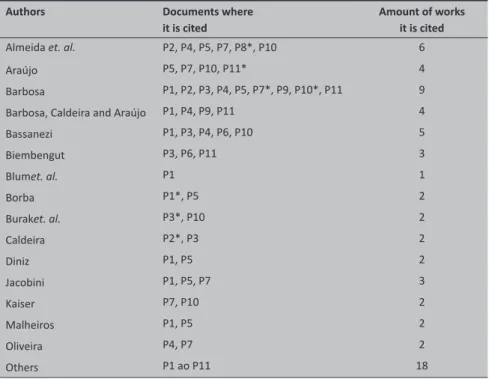
Table 1 refers to Modeling authors cited the most on published articles.
Table 1 - Authors of Mathematical Modeling
Authors Documents where it is cited
Amount of works it is cited Almeida et. al. P2, P4, P5, P7, P8*, P10 6
Araújo P5, P7, P10, P11* 4
Barbosa P1, P2, P3, P4, P5, P7*, P9, P10*, P11 9 Barbosa, Caldeira and Araújo P1, P4, P9, P11 4
Bassanezi P1, P3, P4, P6, P10 5 Biembengut P3, P6, P11 3 Blumet. al. P1 1 Borba P1*, P5 2 Buraket. al. P3*, P10 2 Caldeira P2*, P3 2 Diniz P1, P5 2 Jacobini P1, P5, P7 3 Kaiser P7, P10 2 Malheiros P1, P5 2 Oliveira P4, P7 2 Others P1 ao P11 18
Note: *Article of the author himself. Source: Research data.
By the analysis of Table 1 one can see there is a core of Modeling authors cited in larger amounts and different articles, as Almeida, Araújo, Barbosa, Bassanezi, Biembengut and Jacobini. Firstly we clarify these are all Brazilian authors. This observation can express a significant internal dialogue and, at the same time, a minimized dialogue with the research international community on Mathematical Modeling and Applications. One of the reasons for such broader use of Brazilian authors can be associated to what Barbosa
(2001) states on research tradition in Mathematical Modeling in Brazil. He says it is aimed at social and critical aspects, differently from international tradition, which mainly bases on mathematical aspects and mathematical applications. This little dialogue may be easily seen by the presence of only two international references that appear on Table 1, Kaiser and Blum and in only three works. In theoretical and epistemological terms it may mean certain discrepancy on what is produced in Mathematical Modeling in Brazil and international production, denoting different concerns and focuses. It may also express the quest for a space delimitation and own discussion without resorting to research internationalization.
Another aspect to be observed is that authors, in general, cite their own works. This observation denotes a peculiarity that seems quite common and consolidating in the emerging research community. In other words, to cite oneself may indicate the presence of new outcomes arising from one’s own research, fully justifying self-citation and becoming legitimate. In addition to this argument, we found an expressive amount of authors cited that we may call new researchers. Besides the large amount of works preventing us from citing authors in the scope of this article, we understand these productions only form the current list of productions without performing border researches, i.e., that really indicate advancements or disruptions with production established so far. This outcome converges to Bicudo and Klüber’s (2011) presentation, concerning dispersion of cited authors in the field of Modeling research.
Given the above we consider pertinent advancing onto the understanding of stronger dialogue meanings among Brazilian and foreign authors investigating on Mathematical Modeling. As an example, it is necessary to understand whether these authors are cited in order to support research in a theoretical affiliation sense, or simply as means of resorting to important authors, however without due articulation.
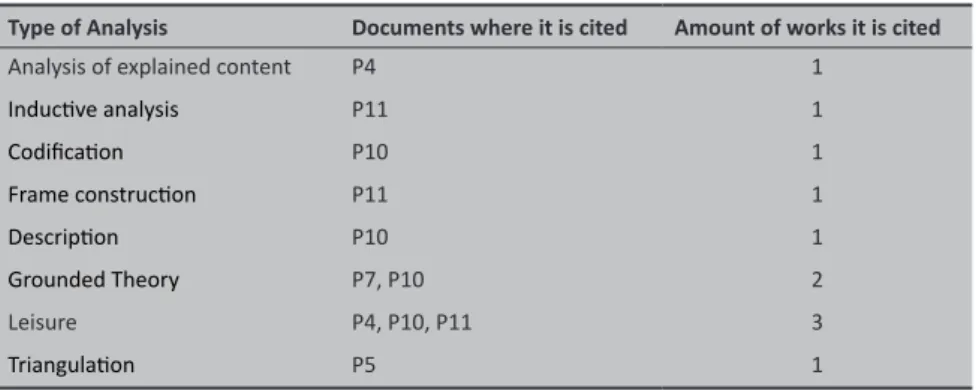
Table 2 - Types of analysis
Type of Analysis Documents where it is cited Amount of works it is cited
Analysis of explained content P4 1
Inductive analysis P11 1 Codification P10 1 Frame construction P11 1 Description P10 1 Grounded Theory P7, P10 2 Leisure P4, P10, P11 3 Triangulation P5 1
Source: Research data.
Through Table 2 we easily note works P4, P5, P7, P10 and P11 explicit analyzes procedures employed in works, jointly with P3, which characterizes as trial. Facing this, it is revealed that most works do not clarify types of analyzes which demand further interpretation.
Through this analysis we understand there is an absence in terms of presenting procedures or even in the conception of analysis and interpretation employed in research. Somehow we can affirm they do not exist. However, its absence indicates researchers and mentors should pay attention to clarification of analysis procedures. Proper analysis and interpretation confer the necessary consistency and coherence to academic production. Therefore it is at least healthy for procedures to be indicated in research report or article submitted to the acceptance of peers, even when referring the reader to other broader works such as dissertations, theses or funded research. So there is, at least, a reference.
In our understanding, works indicating procedures which were employed tend to be more consistent and present more significant results. Internally this is what one can find out from articles clarifying procedures used. They remain aligned to proposed objectives and do not get lost in too general considerations. But one still has to be
careful with the use of certain methodologies which are not fully applied so to meet their epistemological bases and even analysis rules. An example is the reference to grounded theory (a rooted theory or founded on data), as in articles P7 and P10.There is no doubt authors of these works state that procedures are only inspired in theory, which protects and shields them from a more precise use. Nevertheless, such vague use attributed to methodology may lead to mistakes, mainly for initiated researchers.
Qualitative research is a field of multiple interpreting practices. It carries tensions and contradictions (DENZIN; LINCOLN, 2006). So, we understand these sometimes obscure senses also flow into the range of research in Mathematical Modeling as we find in this discussion. Since analyzes concerning the kinds of analyzes employed in research are done, we go on to Table 3, where we show data collection procedures and instruments.
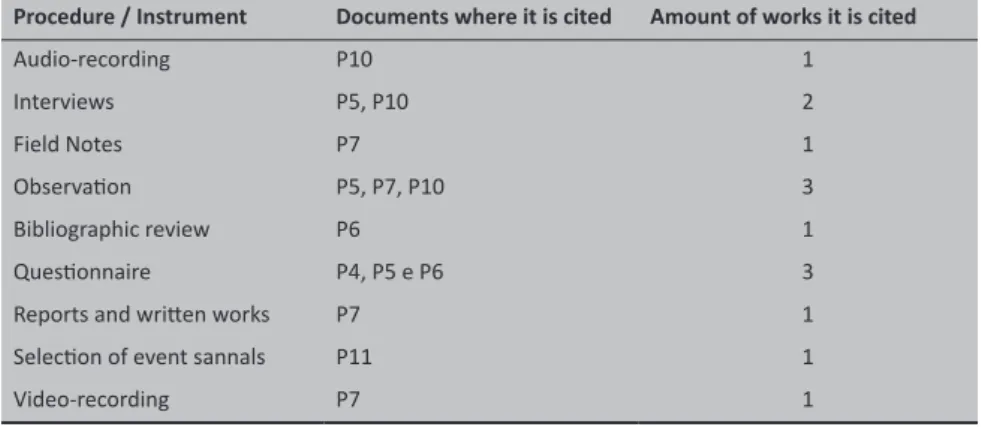
Table 3 - Collection proceedings and instruments
Procedure / Instrument Documents where it is cited Amount of works it is cited
Audio-recording P10 1 Interviews P5, P10 2 Field Notes P7 1 Observation P5, P7, P10 3 Bibliographic review P6 1 Questionnaire P4, P5 e P6 3
Reports and written works P7 1
Selection of event sannals P11 1
Video-recording P7 1
Source: Research data.
According to Table 3, one can see that works P5, P6, P7, P10 and P11 present procedures or instruments of data collection or source gathering. These works present internal coherence between the kind of analysis, employed procedures and the performed analysis, One can
say procedures or instruments derive or adequate from the assumed analytical approach. As noted, there is higher incidence of observation procedure and interview and questionnaire instruments.
In short, it is reasonable to expect that works avail observation procedure in a deeper way, since most of works are performed in the context of the classroom and researcher’s direct and participant observation is a type of procedure widely used in educational research (VIANNA, 2005). In addition, one can note that in works where instruments have been indicated there is diversification of combined instruments to observation. The P5 work drew on observation, interview and questionnaire, showing full understanding of data triangulation. The P7 work on observation accompanied by field notes, reports and written works and videotaping. And P6, bibliographical review and questionnaire.
A diversification of instruments subsidizes a deeper analysis of data collected. These studies, focused on field research, express a concern in curtailing, as appropriate, the object to which they relate to. The P11 work eludes these characteristics due to having collected articles published at the event. So it may be called meta-study with its own characteristics. Thus, the collection process was guided by the object of study it was defined from and by subsidized categories of specific literature.
But all other works, except for P3 – which characterizes as trial – would not clearly indicate collection procedures or instruments. Thus, emerges the need for greater care in characterizing the processes of data collection in Mathematical Modeling research in Mathematics Education. Not clarifying collection procedures may be caused by writing matters only. However, it may also indicate a lack of overall understanding of the research development. On one hand, this may come from initial research with little studying of what is somehow acceptable. On the other, it tends to reveal there is little relevant research on this area, considering the way they were reported.
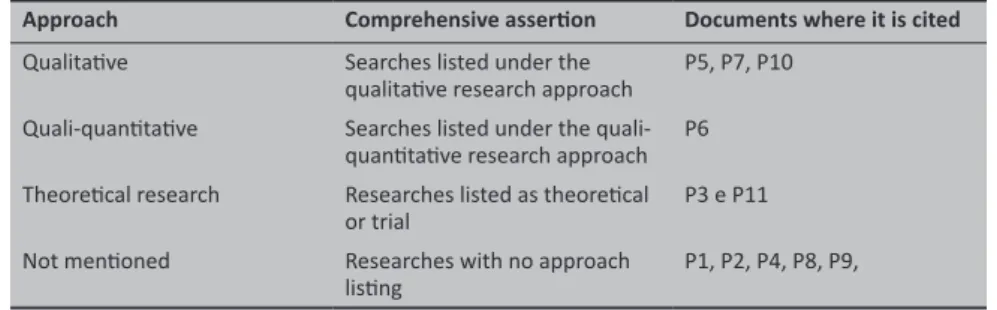
Table 4 categories presents research approach assumed in investigation.
Table 4 - Outlining of research
Approach Comprehensive assertion Documents where it is cited Qualitative Searches listed under the
qualitative research approach P5, P7, P10 Quali-quantitative Searches listed under the
quali-quantitative research approach P6 Theoretical research Researches listed as theoretical
or trial P3 e P11
Not mentioned Researches with no approach
listing P1, P2, P4, P8, P9, Source: Research data.
Through Table 4 one can see six articles clearly indicate their options, which are: P3, P5, P6, P7, P10 and P11. On the remaining ones, no concern in establishing the assumed positioning can be seen. Articles that clarify the assumed approach are the same ones more clearly clarifying procedures for collecting and analyzing. Before this, it is reasonable to infer that internal coherence passes through the knowledge of operational aspects and also epistemological knowledge production. This discussion refers to the conditions and criteria of knowledge production in research in education.
Among these criteria, we highlight the importance of works to pre-sent scientific and social relevance, i.e, for them to be embedded in a theoretical framework so for its contribution to already available kno-wledge and the choice of subjects engaged in social practice to beco-me evident. There is also a charge for research to have a well-defined object, for issues or goals to be clearly formulated, the methodology to be appropriate to the objectives and methodological procedures su-fficiently described and justified. The analysis should be dense, based, bringing evidence of statements and conclusions. We believe the ad-vancement of knowledge should be evident, i.e, what each study has added to what is already known. Those would be the general criteria used to judge scientific work [...] (ANDRÉ, 2001, p. 59).
With regard to articles which do not explain the performed approach, they are relatively weaker or even less thorough than those that do.
In this sense, an interpretation becomes clear where mastery of concepts and notions of research described in the articles, also for articles discussed here, favors production of denser research reports, with effective contributions to the research area. This weakness may be related to the fact that it is difficult to clearly define what is qualitative research, to the fact it uses different interpretative activities (DENZIN; LINCOLN, 2006). However, to us, this doesn’t exempt search for a strictness we understand as a ceaseless search for clarifying the path taken during investigation (KLÜBER; BURAK, 2012).
We can see the predominance of qualitative to quantitative approach. Thus, the tradition of research in Mathematics is confirmed in the categories we present. In short, research not clearly stating the research approach they have taken, use mixed approaches. These are characterized by the articulation of literature or reference made to offer explanations of the phenomena studied. This is also a legitimate way, considering the relations established in the domestic sphere of research are explained and highlighted.
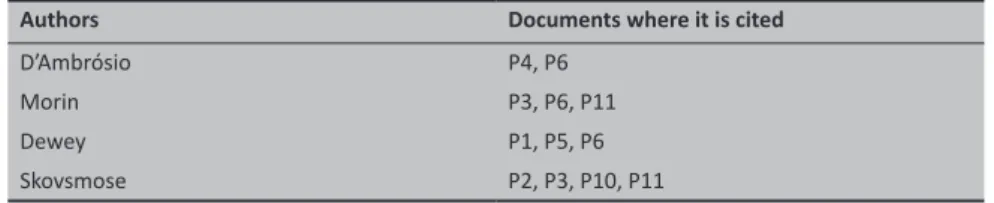
Another core analysis we investigated refers to the main authors who are not of Mathematical Modeling, as shown in Table 5.
Table 5 - Other authors
Authors Documents where it is cited
D’Ambrósio P4, P6
Morin P3, P6, P11
Dewey P1, P5, P6
Skovsmose P2, P3, P10, P11
Source: Research data.
Immediately, by seeing Table 5, one can verify the presence of few authors external to the area that support the discussions within research in Mathematical Modeling. This finding corroborates results presented by Bicudo and Klüber (2011), when they also present D’Ambrósio and Skovsmose as the main authors cited in research on Mathematical
Modeling. No doubt we could take an exclusive analysis from authors who are cited, so to move us forward in the understanding of theoretical paradigms in which research and Mathematical Modeling itself are settled in Mathematics Education. However, this is an investigation that, at this point, we would not give account of.
Among the most cited authors is Ole Skovsmose, who is the main theorist of Critical Mathematics1. UbiratanD’Ambrósio2,considered one of the forerunners of Ethnomathematics and Brazilian mathematician and educator internationally renowned. Morin3, who speaks of the theory of complexity. And Dewey4, known for his narrow connection with the so-called New School.
Regarding research, then, what is noteworthy is the wide variety of authors that are used to understand educational issues. Bicudo and Klüber (2011) call this large variety a dispersion. Before it, two points of view emerge: we are unable to say there is a research community around more or less similar grounds and, likewise, we cannot state that it does not exist. What becomes arguable is the possibility of an articulation with critic schools and also other schools, with other denominations. In this sense, there is at least a plurality of theoretical perspectives that are aggregated to research in Mathematics Education. On one hand, this is a positive move considering it brings up the search to support discussions on shallower aspects. On the other, it facilitates the loss of perspective or dilution, maybe leading to a non-performance of guidelines producing medium and long termoutcomes and practical actions. Finally, in terms of discussion, attention to this point should be given by researchers for Mathematical Modeling in Mathematics Education.
1 Cf. SKOVSMOSE, O. Educação crítica: incerteza, matemática, responsabilidade. Trad. Maria Aparecida Viggiani Bicudo. São Paulo: Cortez, 2007.
2 Cf. D’AMBRÓSIO, U. Etnomatemática: elo entre as tradições e a modernidade. Belo Horizonte: Autêntica, 2005. (Tendências em Educação Matemática).
3 Cf. MORIN, E. Introdução ao Pensamento Complexo. Trad. Eliane Lisboa. Porto Alegre: Sulina, 2005. 4 Cf. DEWEY, J. Experiência e educação. Trad. Anísio Teixeira. 3 ed. São Paulo. Editora Nacional, 1979.
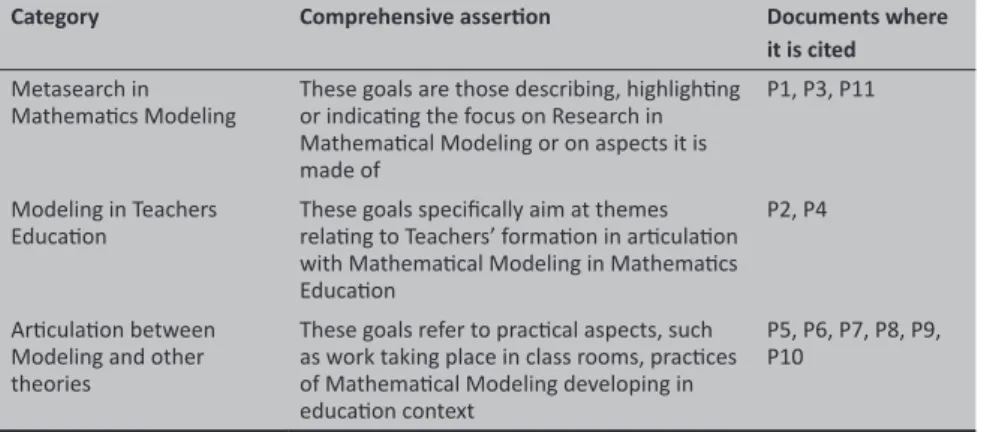
Below, in Table 6, we present the categories referring to goals, objects, or research problems that have been reported in the analyzed articles.
Table 6 - Purposes of research in Mathematical Modeling
Category Comprehensive assertion Documents where it is cited Metasearch in
Mathematics Modeling These goals are those describing, highlighting or indicating the focus on Research in Mathematical Modeling or on aspects it is made of
P1, P3, P11
Modeling in Teachers
Education These goals specifically aim at themes relating to Teachers’ formation in articulation with Mathematical Modeling in Mathematics Education
P2, P4
Articulation between Modeling and other theories
These goals refer to practical aspects, such as work taking place in class rooms, practices of Mathematical Modeling developing in education context
P5, P6, P7, P8, P9, P10
Source: Research data.
These categories are mutually exclusive, since they indicate distinct movements for they also depart from different points, in what refers to the intention and focus of research.
The first category, Metasearch in Mathematical Modeling, was established by quotes that express needs for more
research regarding research itself. An example is this one we have developed and now present analyzes and interpretations. This category still shows clarification needs regarding the terms and concepts that are tacitly used in different views or perspectives of Mathematical Modeling, such as the concept of interest and also about epistemological and philosophical aspects that support different conceptions or perspectives. Under a point of view, the presented objectives are consistent to deal with issues that, over the constitution of the community, had not been addressed. They point to a maturing area, seeking to consolidate results and deeply support their research
and their doings. Under another, these goals indicate a shortage on these reflections, which unfolds in a call for the area to turn back to itself, in an intense process of dialogue, debate and redirection.
The second category, Modeling in Teachers Education,
which appeared specifically in two studies, reveals there is an investment in understanding the impacts of the deployment or implementation of Mathematical Modeling for the continuing education of teachers, both in short courses and in post-graduate studies.
These goals or problems reveal there are significant differences between what one does on Mathematical Modeling and predominant tradition in the training of teachers (KLÜBER, 2012). These goals also unveil the need to encourage the development of more extensive research with monitoring and investigation of social phenomena that interfere with teaching.
In seeking to know whether professors who took the Mathematical Modeling in their masters give continuity and change practices beyond their institutionalized moment of research, we found a new facet of research. In other words, it calls for coping with problems of cultural and social order in the context of teacher education who get in conflict with modes of conducting Mathematical Modeling in Mathematics Education. These modes, beyond their differences, have an investigative character that breaks with established standards in educational processes in general and in training of Mathematics teachers. It also indicates that there is need for investment in research pointing to pragmatic actions with a view to addressing resistance issues of from teachers.
The third category, Articulation between Modeling and other theories, stands out among goals, objects and problems identified
in the analyzed articles. Theories aggregated to research relate to cognitive learning, teaching, technology, computer, social and cultural processes. The cognitive processes are guided, for example, on Vigotsky’s interactive theory. The learning process in Chevallard’s Didactic transposition. Technological processes, on its relationship with distance learning
through computer processes. And social and cultural processes appearing when Mathematical Modeling is used in the classroom. Similar results are found in Bicudo and Klüber (2011).
This category shows there is an absence within Mathematical Modeling itself in Mathematics Education. In other words, it reveals that, even though Modeling is used for educational purposes, it is necessary to resort to other theories to enable light to be shed on learning processes occurring in its inside. It also reveals the search to justify certain doings that are inherent in the practice of Mathematical Modeling. In many cases one seek to find features correlated to employed theories in Mathematics (KLÜBER; BURAK, 2012).
In different articles it can incorporate distinct theories in the context of Mathematical Modeling. What does this mean? In our understanding, it means addressing Modeling with a theoretically pre-established view allowing to see aspects of the theory. An example would be to find interactional features without the teacher first seeking to know the meaning of this theory to his or her pedagogical action. To do so is to be naive, at best. Some studies point another way: to take over theories to perform Modeling. In this direction, we seek to provide grounds for action with Mathematical Modeling, which tends to be more consistent. Therefore, we claim that, by using a theory as guide to an investigation, it should be clear that from ones understanding an unfolding will occur in practice, but not in a relationship of cause and effect.
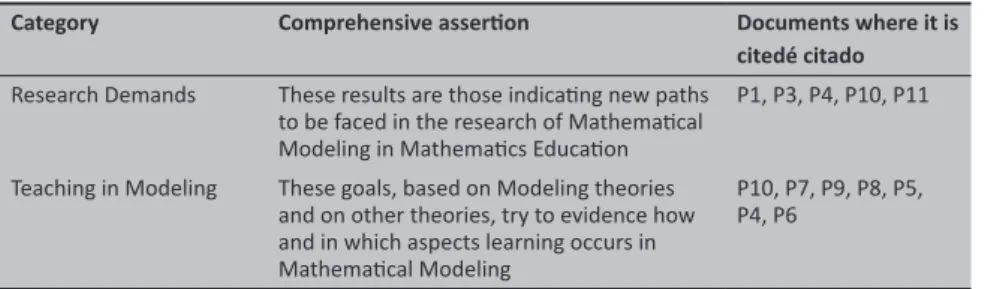
Table 7- Research results
Category Comprehensive assertion Documents where it is citedé citado Research Demands These results are those indicating new paths
to be faced in the research of Mathematical Modeling in Mathematics Education
P1, P3, P4, P10, P11 Teaching in Modeling These goals, based on Modeling theories
and on other theories, try to evidence how and in which aspects learning occurs in Mathematical Modeling
P10, P7, P9, P8, P5, P4, P6
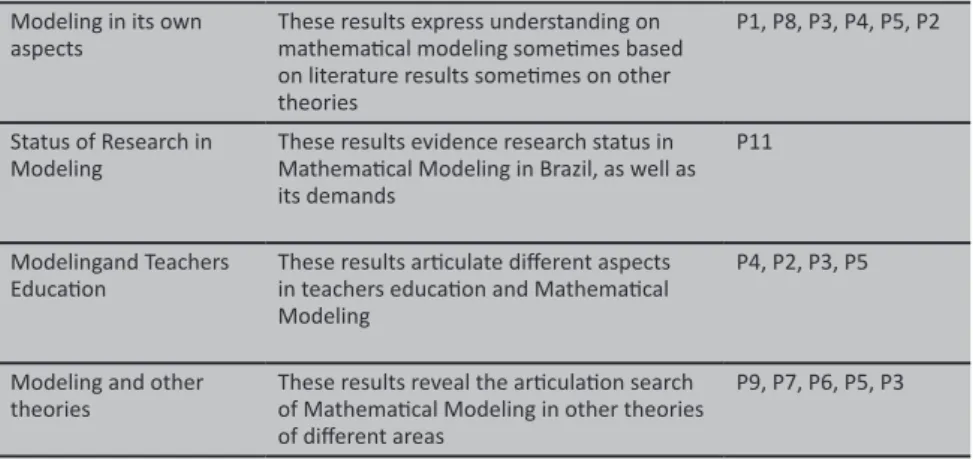
Modeling in its own
aspects These results express understanding on mathematical modeling sometimes based on literature results sometimes on other theories
P1, P8, P3, P4, P5, P2
Status of Research in
Modeling These results evidence research status in Mathematical Modeling in Brazil, as well as its demands
P11
Modelingand Teachers
Education These results articulate different aspects in teachers education and Mathematical Modeling
P4, P2, P3, P5
Modeling and other
theories These results reveal the articulation search of Mathematical Modeling in other theories of different areas
P9, P7, P6, P5, P3
Source: Research data.
Table 7 summarizes the results presented in the articles published in the International Seminar for Research in Mathematics Education. We have established 6 categories with their due convergences of meaning, which are: 1) Research demands, 2) Learning in Modeling, 3) Modeling in its own aspects, 4) Status of research in Modeling, 5) Modeling and Teachers Education, 6) Modeling and other theories. We chose not
to interpret these categories one by one as they will be explained in their relation to other categories developed throughout the article.
In our understanding findings relevant to the area of Mathematical Modeling in Mathematics Education were highlighted. In general, the results are consistent. Results based on methodologies and procedures employed are unveiled. Of course, some results are only confirmations of those already reported in literature. However, they are not prevalent, showing there has been a breakthrough in investigated subjects.
The demands for research in Mathematical Modeling focus on developing meta-studies to clarify and guide future research. The aspects focused on learning have not indicated scrutinizing yet. This, in our view, is due to how objectives were established, seeking the natural order within Modeling, something that should be taught in theoretical and practical
terms. The status of research represents a different time from what we present now, i.e, the area still excessively reissues research topics. But, as we have made explicit, the object of research reveals, at least occasionally, a turn in that direction. Regarding Modeling and teacher training results are consistent. They show there is resistance from teachers and indicate the context in which it occurs. They also indicate a motto to be more deepened about what happens with the teacher after his/her first contact or training with Mathematical Modeling. The articulation of Modeling with other theories shows results sometimes overly positive. However, when this occurs, it is linked to articles with little clarity in methodological terms, especially when it comes to analysis procedures employed.
Considerations
Our objective was to study what was showed about research in articles published in the Workgroup on Mathematical Modeling, GT 10 belonging to the IV International Seminar for Research in Mathematics Education. Our research has shown an overview on the methodologies, Modeling authors, other authors, objectives and research outcomes. From the investigation we inferred that research published in this workgroup point for seeking greater consistency and coherence in conducting investigations in the area.
Evidently some problems emerged, predominantly from what concerns the employed procedures or instruments of analysis and interpretation. This may be linked to the tradition of qualitative research that, as we have clarified, is prevalent in the Brazilian tradition of educational research. Accordingly, studies on theories and research approaches, whether qualitative or quantitative, seem to be necessary as requirements for research, monitoring what was argued by Klüber and Burak (2012).
We follow the reflection of Denzin and Lincoln (2006, p.17) that, within qualitative research, “there is a commitment to the employment of more than one interpretive technique in any study”. Thus, there is a
need to employ appropriate collection methods and analysis to the study which is performed, precisely for the possibility of varying interpretative techniques on data to occur. And that, for us, also stems from clarity about the specific problem or object of study.
References
ALMEIDA, L. M. W. Algumas reflexões sobre a pesquisa em Modelagem Matemática. In: SEMINÁRIO INTERNACIONAL DE PESQUISA EM EDUCAÇÃO MATEMÁTICA, 3., 2006, Águas de Lindóia. Anais... Curitiba: SBEM, 2006. p. 1-12.
ANDRÉ, M. Pesquisa qualitativa em Educação: buscando rigor e qualidade.
Cadernos de Pesquisa, n.113, p. 51-64, jul. 2001.
ARAÚJO, J. L. Pesquisas sobre Modelagem em eventos científicos recentes de edu-cação matemática no Brasil. In: SEMINÁRIO INTERNACIONAL DE PESQUISA EM EDUCAÇÃO MATEMÁTICA, 4., 2009, Taguatinga. Anais... Taguatinga: UCB, 2009. p. 1-14.
BARBOSA, J. C. Modelagem na Educação Matemática: contribuições para o deba-te deba-teórico. In: REUNIÃO ANUAL DA ANPED, 24., 2001, Caxambu. Anais... Rio de Janeiro: ANPEd, 2001. p. 1-15.
BARBOSA, J. C. Sobre a pesquisa em modelagem matemática no Brasil. In: CONFERÊNCIA NACIONAL SOBRE MODELAGEM NA EDUCAÇÃO MATEMÁTICA, 5., 2007, Ouro Preto. Anais... Ouro Preto: Universidade Federal de Ouro Preto/Universidade Federal de Minas Gerais, 2007. p. 82-103.
BARBOSA, J. C.; ARAÚJO, J. L; CALDEIRA, A. D. Modelagem Matemática: relató-rio das sessões do GT 10. In: SEMINÁRIO INTERNACIONAL DE PESQUISA EM EDUCAÇÃO MATEMÁTICA, 4., 2009, Taguatinga. Anais... Taguatinga: SBEM, 2009. Avaliable at: <http://www.sbem.com.br/gt10/pdf/relatorio_ivsipem.pdf>. Accessed in: 9 Jul. 2011.
BARDIN, L. Análise de conteúdo. 2. ed. rev. e ampl. Lisboa: Edições 70, 2011. BICUDO, M. A. V.; KLÜBER, T. E. Pesquisa em modelagem matemática no Brasil: a caminho de uma metacompreensão. Cadernos de Pesquisa, v.41, n. 144, p. 902-925, set./dez. 2011.
DENZIN, N. K.; LINCOLN, Y, S. Introdução: a disciplinas e prática da pesquisa quali-tativa. In: DENZIN, N. K. et al. O planejamento da pesquisa qualitativa: planejamentos e abordagens. Trad. Sandra Regina Netz. Porto Alegre: Artmed, 2006. p. 15-42. BURAK, D. et. al. Sobre os objetivos de pesquisa concernentes à investiga-ção em Modelagem Matemática na Educainvestiga-ção Matemática. In: SEMINÁRIO INTERNACIONAL DE PESQUISA EM EDUCAÇÃO MATEMÁTICA, 5., 2012, Petrópolis. Anais... Petrópolis: Sociedade Brasileira de Educação Matemática, 2012. p. 1-18.
FRANCO, M. L. P. B. Análise de conteúdo. 2. ed. Brasília: Líber livro, 2005. (Série Pesquisa).
KLÜBER, T. E. (Des)Encontros entre a Modelagem Matemática na Educação Matemática e a Formação de Professores de Matemática. Alexandria: Revista de Educação em Ciência e Tecnologia, v.5, n.1, p. 63-84, maio 2012.
KLÜBER, T. E.; BURAK, D. Sobre a pesquisa qualitativa na Modelagem Matemática em Educação Matemática. Bolema: Boletim de Educação Matemática,v. 26, n. 43, p. 111-133, 2012.
LESTER, F. K.; LAMBDIN, D. V. The ship to Theseus and other metaphors for think-ing about what we value in mathematics education research. In: SIERPINSKA, A.; KILPATRICK, J. (Ed.), Mathematics education as a research domain: a search for identity: an ICMI Study. Dordrecht: Kluwer Academic Publishers, 1997. p. 415-425.
NISS, M. Issues and problems of research on the teaching and learning of appli-cations and modelling. In: MATOS, J. F. et al. (Ed.). Modelling and mathematics
ed-ucation – ICTMA 9: applications in science and technology. Chichester: Horwood
VIANNA, H. M. Pesquisa em educação: a observação. Brasília: Liber, 2005. (Série
Pesquisa).
WALTER, S. A.; BACH, T. M. Adeus papel, marca-textos, tesoura e cola: ino-vando o processo de análise de conteúdo por meio do Atlas. In: SEMINÁRIOS DE EMPREENDENDORISMO E EDUCAÇÃO, 12., 2009, São Paulo. Anais... São Paulo: USP, 2009. p. 1-17.
Received: 07/25/2013 Recebido: 25/07/2013 Approved: 11/25/2013 Aprovado: 25/11/2013