Use of Internet and Electronic Games by Adolescents
at High Social Risk
Maria Paula Magalhães Tavares de Oliveira
1, 2, *1
Sociedade Brasileira de Psicologia Analítica, São Paulo, SP, Brasil
2Universidade Federal de São Paulo, Projeto Quixote, São Paulo, SP, Brasil
Leticia Antunes Dias Cintra
2Graziela Bedoian
2Rosimeire do Nascimento
2Rodrigo Rodrigues Ferré
22
Universidade Federal de São Paulo, Projeto Quixote, São Paulo, SP, Brasil
Maria Teresa Araújo Silva
33
Universidade de São Paulo, Departamento de Psicologia Experimental do Instituto
de Psicologia, São Paulo, SP, Brasil
Abstract
Handling digital tools can be an important means of social inclusion. The aim of this study was to investigate Internet use and electronic gaming in 60 teenagers at high social risk, participants in Projeto Quixote. We sought to characterize type of activity, frequency, duration, company, location, and purpose of Internet use and electronic gaming, as well diffi culties managing the web. Most of the interviewed teenagers were enrolled in school, and used Internet and electronic games to interact with friends and family, especially for communication and entertainment. The adolescents reported that they learned to use these devices by themselves and that they knew the risks associated with these practices. However, the results show that they had exposed themselves to several risks. Gender differences were observed. The urge of empowering parents and educators to develop skills to promote social inclusion is discussed, as well as the importance of monitoring use, in order to prevent inappropriate or excessive use.
Keywords: Adolescents, internet, electronic games, social vulnerability, risk.
Uso de
Internet
e de Jogos Eletrônicos entre Adolescentes
em Situação de Vulnerabilidade Social
Resumo
O domínio de ferramentas digitais pode ser importante via de inclusão social. O presente estudo visou investigar o uso que 60 adolescentes em situação de vulnerabilidade social, participantes das atividades do Projeto Quixote, fazem da internet e de jogos eletrônicos. Procurou-se caracterizar tipo de atividade, frequência, duração, companhia, local, fi nalidade do uso de internet e de jogos eletrônicos, incluindo difi culdades encontradas no manejo da rede. A maioria dos adolescentes entrevistados está na escola, usa internet e jogos eletrônicos, interagindo com amigos e familiares, principalmente para comunicação
* Endereço para correspondência: Rua da Consolação 3741, conj. 21, São Paulo, SP, Brasil 01416-001. Fone: (fax) 011 30635280. E-mail: [email protected]
e entretenimento. Os participantes relataram que aprenderam a usar sozinhos e que sabem de riscos as-sociados a essas práticas. Entretanto, os resultados mostram que eles se expõem a condutas de risco. Diferenças de gênero foram observadas. Discute-se a necessidade de capacitar pais e educadores para estimular uso que desenvolva competências visando inclusão social assim como a importância de acom-panhar o uso para prevenir prática inadequada ou excessiva.
Palavras-chave: Adolescente, internet, jogos eletrônicos, vulnerabilidade social, risco.
El Uso de
Internet
y Electrónicos Juegos por los Adolescentes
en Alto Riesgo Social
Resumen
Manejo de herramientas digitales puede ser importante medio de inclusión social. El objetivo de este estudio fue investigar el uso de Internet y de los juegos electrónicos por 60 adolescentes en alto riesgo social, participantes en las actividades llevadas a cabo por el Projeto Quixote. Hemos tratado de caracterizar el tipo de actividad, la frecuencia, la duración, la compañía, la ubicación y la fi nalidad del uso de internet y juegos electrónicos, así como las difi cultades encontradas en la gestión de la web. La mayoría de los adolescentes entrevistados estaban matriculados en la escuela, utilizan internet y juegos electrónicos para interactuar con amigos y familiares, sobre todo para la comunicación y el entretenimiento. Los adolescentes informaron que aprendieron a utilizar estos dispositivos por sí mismos y que conocían los riesgos asociados con estas prácticas. Sin embargo, los resultados muestran que se habían expuesto a diversos riesgos. Diferencias de género fueran observadas. Se discute la importancia de empoderar a los padres y educadores a desarrollar habilidades orientadas a la inclusión social así como de hacer el seguimiento del uso para prevenir la práctica inadecuada o excesiva.
Palabras clave: Adolescentes, internet, juegos electrónicos, vulnerabilidad social, riesgo.
Technology has become part of our daily life and is benefi cial in several areas. The Inter-net facilitates communication and interaction in ways that was previously impossible. It is popu-lar with people of all ages, especially children and adolescents. Electronic games and video games are a main entertainment attraction for this population. The digital world offers new forms of creativity, learning, entrepreneurship, and innovation; to make use of these opportuni-ties, however, certain abilities are required (Pal-frey & Gasser, 2011). Access to technology is insuffi cient; digital alphabetization is necessary. In socially vulnerable populations, the Internet can facilitate social, educational, and profes-sional inclusion. However, it is unclear to what extent such populations have access to the Inter-net and to opportunities to learn how to use these resources. There are few studies in such popu-lations in Brazil. The expression “social
vulner-ability” refers to the population of high social risk situations in communities characterized by minimal education, drug abuse, delinquency, vi-olence, and lack of access to culture and quality health care (Bedoian & Madalena, 2008).
In-ternet later in life than do those from higher so-cial classes, and know more about it than do their parents (Guzzi, 2014).
In Brazil, Internet access is expanding. This has been accompanied by greater availability of technological resources, such as computers, tablets, and mobile phones. Instituto Brasileiro de Geografi a e Estatística data (IBGE, 2012) re-vealed that, in 2012, there was a 6.8% increase in Internet from the previous year (5.3 million new Internet users within one year), and a gradual increase in web access has been verifi ed in re-cent years. Among the age groups analyzed, the range of 15 to 17 years used the Internet the most (76.7%). Recently, Queiroz (2015) classifi ed the country as digitally mature: since 63% of its 84 million Internet users report engaging in at least eleven different online activities. However, the study revealed a disparity between social net-working activities, engaged in most, and online courses, seeking employment, or personal pur-chases, engaged in least.
Previous research conducted with university students in São Paulo revealed that the percent-age of students who go online daily is higher than those who watch television daily, and that a signifi cant number of students play video games with high frequency. Further studies on exces-sive video gaming in student populations are re-quired (Suzuki, Matias, Silva, & Oliveira, 2009).
Internet activities may fascinate children and adolescents, and excessive use or misuse of the web may cause many problems (Abreu, Karan, & Spritzer, 2008, Hautefeuille & Vélea, 2010; Young & Abreu, 2011). Excessive expo-sure and expoexpo-sure to inappropriate content for age, maintaining virtual instead of face-to-face relationships, spending excessive time online at the expense of other activities, forms of violence, such as bullying and sexual harassment are ex-amples of problems associated with inappropri-ate Internet use (Abreu, Eisenstein, & Estefenon, 2013; Young & Abreu, 2011). Electronic games can facilitate development of many skills, such as quick thinking, decision-making, and coor-dination. However, excessive playing may have adverse consequences, such as abandonment of
other activities, including study, sports, and so-cial or family interaction. Furthermore, both in-appropriate and excessive Internet use and video gaming have health consequences, such as pos-tural injuries, lack of exercise, and sleep depri-vation. These behaviors may also become addic-tive (Abreu et al., 2008; Young & Abreu, 2001), as included in sector III of the DSM V (Ameri-can Psychiatry Association [APA], 2013).
Knowing how teenagers use the Internet and electronic games is important to encourage use which contributes to their development. In addition, early detection of abuse or misuse allows preventive interventions. Considering these aspects, the present study aimed to inves-tigate Internet use and electronic gaming in socially vulnerable adolescents, participants in
Projeto Quixote. Projeto Quixote is a nonprofi t Organization of Civil Society of Public Interest (OSCIP), which, since 1996, has acted with the mission of transforming the story of children, youth, and families at high social risk situations, through integrated clinical attendance, educational, and social actions; and of generating and disseminating knowledge. Linked to the
Universidade Federal de São Paulo (UNIFESP),
Projeto Quixote invests in art, education, and healthcare as strategies to bond with these young people (Bedoian & Lescher, 2007). From its inception until the end of 2015, the Projeto Quixote assisted more than 11,000 children and adolescents from poor communities in which dysfunctional families, alcohol abuse, drugs and violence are part of everyday life. The project has headquarters in Vila Mariana and units of assistance in the city center, Praça da República
and Luz area, in addition to maintaining a work with educators that address adolescents roaming the city streets.
facilitates exchanges and sharing of experiences. This research is an activity of this sector aimed at collecting information on the behavior of adolescents in relation to the Internet and video games, to support educational practice. In the At-tendance area, affective bounds are built through ludic strategies, which enable spontaneous de-mands, attended to by a multidisciplinary team. Several programs belong to the Attendance area, such as the Pedagogic, Clinical, Education to work, Family Attention, Street Approach and Urban Refugees (Bedoian, 2014; Bedoian & Fender, 2010; Bedoian & Madalena, 2008).
Among children and adolescents who sought care at the headquarters of the Projeto Quixote in
Vila Mariana in 2012, the year that the present data were collected, the majority was referred by institutions and about a third had already made use of drugs in their lifetime. A fi fth was serving or had already served some socio-educational measures (warning, community service, repara-tion, assisted liberty, or semi-liberty). Although the majority are students, 38% had spent time on the street and 13% reported performing some activity to earn money. The perception of the Quixote Project educators is that the number of teens with mobile phones has been increasing over the years and that they use these mainly to send messages and listen to loud music. As for the Internet, these educators have the impression that it is mainly used for communication via so-cial networks, for listening to music and shar-ing photos. They note that adolescents are fond of video games, but cannot evaluate how much, where, and with whom they play. Among those attending the workshops of Education for Work, it was observed that few have e-mail, an issue discussed in order to illustrate to participants the importance of this resource for professional pur-poses, such as sending résumés and exchanging messages about job opportunities. Taking into consideration all these issues, this project aimed to characterize the type of activity, frequency, duration, company, location, and purpose of In-ternet use and electronic gaming, including the diffi culties and benefi ts inherent in Internet use in a sample of teenagers attending activities at Quixote Project headquarters.
Method
Participants
Sixty adolescents between 14- and 18-years old, who participated in activities offered by the
Attendance area at the headquarters of Projeto Quixote, were interviewed from August and De-cember 2012. Ten teenagers attended Welcome workshops (beginning of Attendance) and all others attended specifi c workshops, such as
graf-fi ti, break, soccer, capoeira, etc.
Instruments
A questionnaire aiming to investigate how adolescents used the Internet and electronic games was developed by the researchers. The questionnaire contained questions about socio-demographic data, and specifi c questions about Internet use, electronic games, and other recre-ational activities. Questions included, for ex-ample, from whom Internet use was learnt; lo-cation, frequency, duration and purpose of use; and diffi culties encountered during use. Ques-tions about video games addressed issues such as with whom participants usually play; loca-tion, frequency, and duration of play; and type of games played. Some of the questions were from previous research (Suzuki et al., 2009). In addition, the questionnaire included four open questions: “In your opinion, what are the dan-gers of the Internet; What you do usually do to protect yourself; What do you like best on the Internet”; and “Is there something you do not like on the Internet?” A pilot questionnaire was administered to ten adolescents who attended activities at Projeto Quixote to check the time required for answering it and the clarity of the questions. Adjustments were made, resulting in the fi nal version.
Procedure
ethical considerations, they signed the Informed Consent. They were assured that the data would be confi dential. Questionnaire completion took on average 20 minutes.
Data Analysis
Collected data were entered into a database and analyzed using the software program, SPSS. Only the valid answers for each question were included in analysis. Thus, in the manufacture of tables and graphs the percentage was calcu-lated based on the universe of responses for each question, having been discarded blank respons-es. Chi-square was used to analyze categorical variables, and when n <5, Fisher’s exact test. The Student t test was used for continuous vari-ables. All tests were two-tailed. For analysis of open questions, similar responses were grouped and keywords identifi ed. These key-words were then tabulated and quantifi ed according to previ-ously used procedures: (a) identifi cation of the
central idea of the comment; (b) fragmentation in segments of comments that express more than one idea; (c) registration of the main topic of each segment in a key expression corresponding to the literal transcription of the speech; (d) key expressions were grouped in categories based on their equivalence; (e) classifi cation of the cat-egories (Almeida, Bizeto, & Silva, 2007). The socioeconomic status was evaluated by the Cri-terion Brazil, defi ned by the Brazilian Associa-tion of Research Companies (ABEP, 2012).
Results
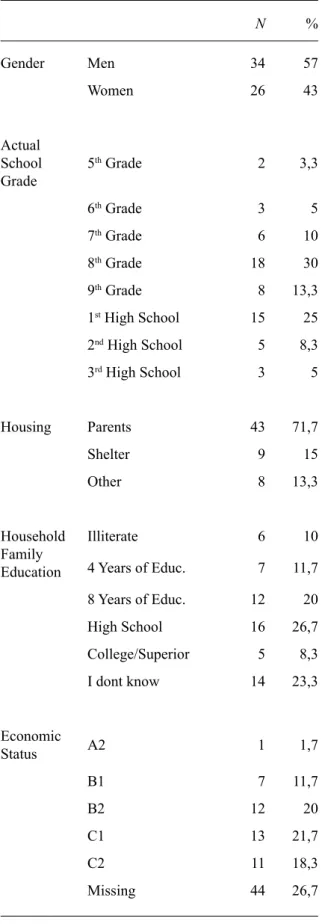
The sample consisted in 60 adolescents, 34 males (57%) and 26 females (43%), and the av-erage age was 15 years (SD = 1.12, ranging be-tween 14 and 18). Fifty-three (88%) adolescents reported being currently studying, the majority attending their fi nal year of elementary school or their fi rst year of high school (68%), as shown in Table 1, 73.3% reported living with their par-ents, 15% reported living in a shelter, and 12% answered “another,” which mainly meant they lived with their grandparents (6.7%) or aunts (3.4%). 10% of adolescents reported that they
had not been home for over six months. When asked about the educational level of their par-ents, 10% reported that they were illiterate, 20% that the household head had eight years of edu-cation, 27% had eleven years of eduedu-cation, and 23% could not say. The socioeconomic status of the sample was distributed among the classifi ca-tions B1, B2, C1, and C2. We also investigated whether these teens had a computer at home; 27.8% did. Approximately half the sample had mobile phones (48.9%). There were no signifi -cant differences in any of the sociodemographic variables when compared to gender.
Internet
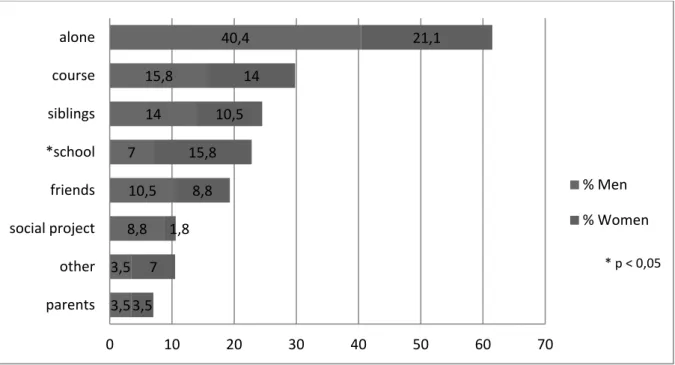
Only three participants reported not having used the Internet in the last 12 months. One of them reported that it was because it was expensive and the other reported that it was “because I thought it was not good to use the Internet”. When asked about having trouble using the web, the vast majority reported no diffi culties (90%). The problems cited were “did not know how to write correctly,” “diffi culty to download and upload”, “not knowing how to manage it”, “everything is very diffi cult to get inside my head” and “many things”. More than half the respondents said they learned to use the Internet themselves (61%). There were signifi cant gender differences: more girls than boys learned to use the Internet at school [X2 (1,
and fi ve activities, 61.7% between fi ve and ten activities, and 18.3% more than 11 activities. The average was 7.6 (range 0–14, SD = 3).
Amount spent on average per week to use the Internet varied greatly. The vast majority spent nothing. The average spent was US$ 4 (SD
= 23.6, ranging from 0 to US$ 40) and the median was 0. No gender differences were observed.
Table 2 displays the answers concerning the frequency, days, average of time, period, and place of Internet use, as well as the practice of electronic gaming. Regarding frequency of use, most adolescents connected the web more than once a week (72%); approximately half, daily (54%). Some adolescents use the Internet mainly from Monday to Friday (17%) and oth-ers on weekends (23%); most use it daily (60%). The average time online varied widely, as seen in Table 2. It was observed that the boys on aver-age spend more time online than the girls [X2 (2,
N = 57) = 8.52; p = .014]:
When asked about the longest time they have been online without interruption, 37% reported more than ten hours, 10% reported having been connected for at least 24 hours. Responses varied widely (M = 11,9h, SD = 13.7, range from 2 to 72 hours), with a median of seven hours. Most adolescents usually went online in the afternoon (67%) and at night (70%) and 37% after midnight. No gender differences were observed on this variable. Regarding where they usually connect to the Internet, more than half of teens surveyed reported accessing the network at home (61%), as shown in Table 2. Analysis of the item “Other” revealed that it corresponds to a relative’s home (godmother, grandmother, aunt, 6.8%); cell phone (2.4%); computer course (2.4%); Serviço Social do Comércio - SESC (2.4%); mother’s work (1.7%); or shelter (1.7%). It was observed that signifi cantly fewer boys reported using the Internet at Projeto Quixote
than did girls [X2 (1, N = 57) = 4.311; p = .038]. More than half the teens had already used the webcam (58.2%) and the vast majority of them use the Internet to chat with friends (96.5%) when in chat rooms, MSN, or on social networks. Half use it to communicate with Table 1
Socio-Demographic Characteristics of a Sample of Adolescents that Attend Projeto Quixote (N = 60)
N %
Gender Men 34 57
Women 26 43
Actual School Grade
5th Grade 2 3,3
6th Grade 3 5
7th Grade 6 10
8th Grade 18 30
9th Grade 8 13,3
1st High School 15 25
2nd High School 5 8,3
3rd High School 3 5
Housing Parents 43 71,7
Shelter 9 15
Other 8 13,3
Household Family Education
Illiterate 6 10
4 Years of Educ. 7 11,7
8 Years of Educ. 12 20
High School 16 26,7
College/Superior 5 8,3
I dont know 14 23,3
Economic
Status A2 1 1,7
B1 7 11,7
B2 12 20
C1 13 21,7
C2 11 18,3
3,5 3,5
8,8 10,5 7
14 15,8
40,4
3,5 7
1,8 8,8 15,8
10,5 14
21,1
0 10 20 30 40 50 60 70 parents
other social project friends *school siblings course alone
% Men
% Women
* p < 0,05
8,8 12,3
17,5 17,5 19,3
26,3 24,6
40,4 45,6 45,6 42,1
47,4 49,1
54,4
3,5 8,8
7 7
12,3 12,3
17,5
38,6 38,6 38,6 42,1
38,6 42,1
42,1
0 10 20 30 40 50 60 70 80 90 100 PORNOGRAPHIC SITES
SKYPE WORK FORUM PARTICIPATION SHOPPING ACCESS BLOGS PLAY SEARCH FOR JOB WATCH FILMS SEND EMAILS SHARE PHOTOS STUDY DOWNLOAD AND LISTEN TO MUSIC SOCIAL NETWORK
%MEN % WOMEN
Figure 1. Where or with whom the sample of adolescents that attend Projeto Quixote learnt to use the Internet (N = 57).
Figure 2. Frequency and percentage of Internet activities in a sample of adolescents that attend Projeto Quixote (N = 57).
their families (50.9%). Approximately a third talk to boyfriend or girlfriend (36.8%) online; this behavior is most common in girls [X2 (1,
N = 57) = 4,397; p = .036]. Twenty-six percent
Table 2
Frequency, Days, Media of Time, Period and Local that a Sample of Adolescents that Attend Projeto Quix-ote use the Internet and Electronic Games (N= 57)
Internet Eletronic Games
N % N %
Frequency
once per month 7 12,3 17 29,8
once each 15 days 4 7 5 8,8
once per week 5 8,8 7 12,3
more than once per week 10 17,5 16 28,1
everyday 31 54 12 21,1
Days
Monday till Friday 10 17,5 14 24,6
weekend 13 22,8 28 49,1
everyday 34 59,6 15 26,3
Time Media
less than 1 hour 3 5,3 22 38,6
from 1 to 2 hours 16 28,1 14 24,6
from 2 to 3 hours 12 21,1 5 8,8
from 3 to 4 hours 7 12,3 4 7
more than 4 hours 15 26,3 10 17,5
I don’t know 4 7 2 3,5
Period
morning 17 29,8 15 26,3
afternoon 38 66,7 33 57,9
night 40 70,2 31 54,4
aftermidnight 21 36,8 14 24,6
Local
home 35 61,4 40 70,2
school 9 15,8 6 10,5
Quixote 19 33,3 5 8,8
friends home 19 33,3 22 38,6
lan house 16 28,1 9 15,8
telecenter 9 15,8 3 5,3
In chat rooms, MSN, or on social networks, most adolescents use their real names (71.4%), 39.3% employ nicknames, and 5.4% create fi cti-tious names. Fourteen percent sometimes pretend to be someone else and 3% always pretend to be someone else. Inquired about establishing con-tact with people known on the Internet, 44.6% reported having virtual friends and 18.2% a vir-tual boyfriend or girlfriend. In addition, 37.5% reported having met and maintained frequent contact as a friend and 5.4% as a boyfriend or girlfriend; 16.1% maintained sporadic contact. A signifi cant gender difference was noticed: more boys than girls kept in touch with online friends [X2 (1, N = 57) = 4,978; p = 0.026].
Responses to what they like best on the In-ternet varied. The possibility of social interac-tion was cited by 41.3% (social networks were referred to by 27% and the ability to talk to people by 14.3%), followed by the possibility of keeping up to date (20.6%). Half stated there is nothing to displease in the Internet. Others men-tioned pornography (n = 5), fakes profi les (n = 3), advertising (n = 3), viruses (n = 3), games (n
= 2), nosy or curious people (n = 2), slow Inter-net (n = 2), and spam (n = 2).
Concerning what the teenagers fi nd danger-ous in using the Internet and what they do to pro-tect themselves, the most frequently mentioned hazards were talking to strangers (25.6%), pedo-philia (25.6%), and viruses (12%). Harassment and abuse (n = 5), hackers (n = 5), kidnapping (n
= 4), adult sites (n = 3), fake profi les (n = 3), shop-ping (n = 3), pornography (n = 2), and bullying (n = 1) were also mentioned. The most frequent response to protective measures taken were “do not talk to strangers” (37.5%), “use anti-virus” (18%), and “avoid sites considered dangerous” (13.9%), as well as “not giving personal data” (n = 6), “do nothing” (n = 6), “not meeting un-known people” (n = 4), “going off the Internet” (n = 3), “being careful with who to talk” (n = 2), and “not entering into chats” (n = 1).
A third of respondents disconnect from the Internet when interrupted by someone (33.3%). Twenty-six point three percent reported having had problems related to the web. Different kinds of diffi culties were mentioned, arguments (n
= 4) and viruses (n = 3) most frequently. The vast majority of respondents believe the Internet can be addictive (94.7%), and 33.3% reported having a friend who had suffered bullying via the Internet. Twelve point three percent reported having suffered bullying themselves and 15.8% admitted having bullied others over the Internet. Gender differences were not observed in these variables.
Electronic Games and Video Games
The vast majority of teens reported having played video games in the last 12 months (93.3%). Most play on the computer (71.9%), television, PlayStation, WII (71.9%), and mobile phones (68.4%). More girls than boys (10.5% vs. 5.5%, respectively) play on tablets (p = .05). Playing games on portable devices, such as PSP and DS, were cited by 28.1% of adolescents and at an arcade by 26.8%.
Most participants usually play both with friends (77.2%) and alone (73.7%), 35.1% play with siblings and 28.1% with parents. Fourteen percent played with boyfriends or girlfriends and 5.3% with instructors or teachers. In addi-tion, 10.5%, mainly boys, reported playing with strangers.
Almost half the sample usually plays online (49.1%). Figure 3 shows the types of electron-ic games they play. Action/adventure (70.2%), sports (FIFA, PES, Olympics; 64.9%), and mobile phone games (63 %) are most popular. Some signifi cant gender differences were ob-served. Sports games [X2 (1, N = 57) = 11,253;
p = .001] and games of war and strategy [X2 (1,
N = 57) = 14.760; p = .001] are more popular among boys, and there was a non-signifi cant ten-dency of boys to play multiplayer online games (such as Call of Duty, FPS First Person Shooter) and Role-Playing Games (RPG, such as Ragn-arok, World of Warcraft, MMOPRG, Hero of Newrth). More girls reported playing games of humor (such as Explosion Man) [X2 (1, N = 57) = 4,417; p = .036]:
14 10,5 8,8
12,3 24,6 24,6
33,3 43,9 36,8 36,8 36,8
49,1
10,5 14 15,8
15,8 7
17,5 12,3
8,8 19,3
21,1 26,3
15,8
0 10 20 30 40 50 60 70 CARDS
ARCADE *HUMOUR SIMULATORS RPG REASONING AND LOGIC MULTIPLAYER ONLINE **STRATEGY AND WAR FIGHT RACE CELL PHONE **SPORTS
% MEN
% WOMEN
* p < 0,05 ** p < 0,001
Figure 3. Frequency and percentage of electronic games played by a sample of teenagers that attend Projeto Quixote (N = 57).
categories, revealing different degrees of inter-est in this activity. Concerning when they usu-ally play, a quarter plays from Monday to Fri-day (24.6%), and a quarter daily (26.3%), and half on weekends (49.1%). The time of the day they play also varied: 26.3% usually play in the morning, 57.9% in the afternoon, 54.4% at night and 24.6% until after midnight. The aver-age time they play each time varied widely, with more than half of participants (65.5%) reporting playing up to two hours per episode. There were no gender differences on any of these variables. As for the locations at they usually play, most re-ported playing at home (70%). However, gender differences were noted here: more girls played at school (p = .003) and more boys played at home [X2 (1, N = 57) = 5,970; p = .015].
The longest time teens played without in-terruption varied widely (M = 7,55h, SD = 10.5 ranging from 1 to 72 hours) in the sample. The median was fi ve hours. Boys spent more hours playing than girls [t(40) = 1.97; p = .05). When asked about what attracts them to the games, most reported that it is the possibility to relax (78.9%) and the challenge to overcome steps
(70.2%), followed by playing with friends (64.9%), observing the game art (54.4%), being able to play with other virtual players (49.1%), to vent their anger in the game (42.1%), to enter into a fantasy world (35.1%), and the pleasure of controlling a simulated world (29.8%). More boys than girls reported being attracted by being able to play with other virtual players [X2 (1, N
= 57) = 5,388; p = .02] and to observe the game art [X2 (1, N = 57) = 5.973; p = .015].
When asked about how they generally feel after playing games with a certain level of vio-lence, 28.1% reported feeling indifferent; 26.3% said it depends, if they lose they get angry but if they win they are happy; 12.3% feel more re-laxed; and 10.5% more aggressive. This kind of game is not played by 22.8% of participants.
Almost half (42.1%) the adolescents inter-viewed believe that they are addicted to a game or know someone who cannot stop playing; 29.8% agree that video games can cause them to be violent; 66.7% think it is more fun to play with someone than alone; and the same per-centage think that video games allow you to do things you cannot do in real life.
Concerning the frequency of other leisure activities, it was observed that the most popular are listening to music (92%) and watching television (85%), practiced daily. The majority of the sample practice sport at least once a week (73%). However, 13.3% do not practice at all. A quarter of respondents reported going to pubs once a week and 16% going every 15 days. Forty-one percent reported hanging out with friends daily. Twenty-nine percent reported reading daily; the same proportion reported that they never have time to “rest and do nothing”. Almost half the sample (41.7%) reported abstaining from doing something to stay connected to the Internet.
Comparison among Adolescents
who Reported Being Online for More
than Four Hours on Average Daily and
those who Spend Less Time Online
Participants who reported being online for more than four hours at a time, daily, were com-pared with those who spend less time, on all the variables studied. Signifi cant differences were observed. Adolescents from former group re-ported using the Internet to work or complete homework (p = .049), maintain a blog [X2 (1, N
= 57) = 4,479; p = .034], and talk with boyfriend or girlfriend (p = .033). Fewer teens from this group go offl ine by themselves [X2 (1, N = 57) = 4,776; p = .029], compared to those who spend less than four hours connected.
More participants from the former group reported playing portable video games [X2 (1,
N = 57) = 5,608; p = .018]; RPG [X2 (1, N = 57) = 4.913; p = .027] and simulator games [X2 (1, N = 57) = 4.24; p = .035]. Fewer teens in this group reported playing with instructors of schools or of the projects they attend (p = .039).
These teenagers play after midnight (p = .02), and less in LAN houses (p = .04), compared to those in the latter group.
Discussion
The way participants use the web indicates a priority for communication and entertainment: interacting on social network sites, listening to and downloading music. What they like best about the Internet is the possibility for social in-teraction. These results are consistent with those obtained by the survey conducted in Brazil, Kids Online Brazil 2012 (Barbosa, 2013), and Kids Online Brazil 2013 (Barbosa, 2014), as well as that conducted by comScore (Queiroz, 2015), suggesting that the profi le of this sample is con-sistent with the national reality. The preponder-ance of social use of the Internet in Brazilian adolescents has already been noted in a study comparing Brazilians and Europeans, which noted that Brazilians use more social networks than do Europeans (Guzzi, 2014).
It is important to emphasize that the pro-portion of teens that uses the Internet to seek information and for content production, is nev-ertheless low. Taking into account the need to improve education in the country, Internet use should be encouraged in this regard. Teenagers have access to the Internet, but most learned to use it by themselves or with peers (siblings and friends). Thus, it is important to prepare adults to motivate in young people an interest in online ac-tivities that encourage the development of skills such as reading books, producing videos, writing texts, doing research, and taking courses. These activities provide expertise and tools that repre-sent an important means of social inclusion and advantages in the job market. The importance of preparing adults to dominate this technol-ogy is already being discussed (Palfrey & Gas-ser 2011). Some authors highlight the need for educators to learn to deal with digital resources, since the focus of education for the future is the learning process and not the content itself. They also emphasize that these actions should contrib-ute to an ethical and digital citizenship (Barros, 2013; Pinheiro, 2013; Smith, 2013). Encourag-ing different activities also contributes to digital maturity. Although Brazilians have been consid-ered digitally mature and most use 11 or more types of online activities (Queiroz, 2015) in this sample, characterized by social vulnerability, only 18% fell under this category.
here suggests that playing violent video games is one of those factors.
A number of other risks associated with In-ternet use and of with electronic gaming were identifi ed in the questionnaire responses. The preponderance of connecting the Internet and of video game playing at night contribute to de-creased sleep and may have consequences such as daytime sleepiness, decreased school per-formance and poor health. Furthermore, risks associated with excessive exposure (talking to strangers, pedophilia), aggression (bullying as victim or perpetrator), and viruses were cited. Approximately a quarter reported having had problems with Internet use and almost half be-lieve that the Internet can be addictive. However, they do not always protect themselves. Approxi-mately a quarter of the sample talk to strangers, a third met personally and keep in touch with virtual friends, and more than half have used the webcam. This data is consistent with Kids Online (Barbosa, 2014), which found that 38% had added unknown people to their contacts. Furthermore, it was noted that 12% have already accessed pornographic websites. These results reinforce the need for investment in protective measures for safe use of the Internet. Diffi culties with user tools, safety devices, privacy settings and policies, reporting mechanisms were found in the European study (Livingstone, 2014) and are evident in the responses of the adolescents interviewed in our study. Guzzi (2014) empha-sizes the importance of prevention and of dis-semination of sites with this purpose as www. google.com.br/safetycenter and Safernet NGOs. Looking to mitigate security risks, Palfrey and Gasser (2011) suggest the combination of a num-ber of strategies that involve education, technol-ogy development, social norms and the law.
Despite of the fact that no scale to measure Internet or gaming addiction have been administered, an analysis was done comparing participants who used the web more than four hours per episode with those who use it for less time and it was found just eventual overuse. Adolescents in the former group use the Internet to do work or homework, maintain their blog and talk more with their boyfriend or girlfriend
online, common activities nowadays. However, fewer teens from this group go offl ine on their own, play video games with school or project’s instructors, and, on the other hand, most teenagers of this group play after midnight; play portable video games, RPG and simulator type of game. These results highlight the importance of the presence of adults monitoring Internet use and gaming. There is a tendency to let adolescents surf the Internet or play games at the expense of face-to-face relationships. However, interaction and contact with parents and adults in general are essential to set guidelines and prevent abuse or misuse. What matters is how the person relates to the network or games, realizing the time they spend engaging with these features, being critical about how and for what they use them, knowing how to protect themselves and how to deal with inappropriate content, and feeling secure to report improper approaches. Interaction with adolescents and monitoring their activities make it possible to identify whether there is exaggerated or misuse use of these resources, as the risk of avoiding the challenges of real life for virtual alienation.
Parents and educators often try to prohibit Internet use in order to protect adolescents. However, restricting use does not solve the problem; what is important is to teach safe use and promote digital citizenship (Livingstone, 2014). In this direction, there are initiatives aiming to guide parents, educators, and professionals in this task, such as the psychoeducational website created by the Grupo de Estudos de Adições Tecnológicas (Pican, Moreira, & Spritzer, 2012).
& Smahel, 2011; Suzuki et al., 2009). This vari-able should be considered when planning activi-ties with this population, mainly to prevent mis-use of these technologies.
Final Considerations
As verifi ed by this study, adolescents in so-cially vulnerable situations have access to video games and to the Internet and the use is mainly related to leisure and social networking. Young people know the dangers related to these activi-ties, though they do not always take appropriate precautions. The data highlight the importance of training teachers and instructors, and of ad-vising parents, to encourage use that contributes to skill development and to monitoring these activities to avoid misuse or abuse. These rec-ommendations apply to adolescents in general, but are important tools, especially when think-ing about promotthink-ing opportunities to reduce the prevailing social inequality in the country.
The importance of digital inclusion is indisputable, and digital exclusion is related not only to access to technology, but also to the lack of capacity to take advantage of its potential. Sorj (2003), an author who studies the impact of digital exclusion in social inequality and in the opportunities and quality of life, suggests that digital exclusion has a strong correlation with other forms of social inequality, and, in general, the highest rates of digital exclusion are in lower income areas. According to this author, digital exclusion depends upon fi ve factors that determine the extension of the universality of the technology of information and communication: the existence of physical infrastructure of transmission, equipment and access availability, training in the use of computers and Internet tools, intellectual capacity and social inclusion of the user, and production and use of specifi c content according to the need of the different segments of the population. It is important to note that the present study highlights the necessity to invest mainly in the last three cited aspects, as teenagers have access to the Internet, but use is limited.
Technology can improve quality of life by enabling access to education, culture, health, communication, services, etc. There is an ini-tiative of the Brazilian government to provide services and information to facilitate the life of citizens, popular participation, and transparency in accountability and management. However, Pinho (2008) notes that this intention is still far from reality. In a study that analyzes government portals of Brazilian states in order to verify how these governments are moving forward in the construction and improvement of democracy us-ing digital media, the author demonstrates that technology alone is not enough; a change in cul-ture that fosters dialogue with society and true social participation is required.
In this direction, successful initiatives to promote training in computing for lower socio-economic populations should be encouraged. Sorj (2003) describes a project in Rio de Janeiro,
Projeto Viva Rio, emphasizing its contribution to education and training, creation of jobs and working sources, combating violence and de-veloping a culture of human rights. This author presents an extensive discussion addressing the relationship between the State, NGOs and social policies, noting challenges that require creative mobilization of new communication technolo-gies against digital exclusion, in favor of the fi ght against poverty and social inequality. Therefore, the appropriation of technology should be used in favor of citizenship. Investing in training for teens to make good use of information and com-munication technology can be a decisive contri-bution in this direction, since today’s teenagers will be tomorrow’s adults.
availability and access to the web and to devices such as mobile phones, tablets, and computers. Data were collected in 2012. It is important to conduct further studies with more comprehen-sive populations.
References
Abreu, C. N., Eisenstein, E., & Estefenon, S. G. B. (2013). Vivendo esse mundo digital. Porto Alegre, RS: Artmed.
Abreu, C. N., Karan, G. D., & Spritzer, D. T. (2008). Dependência de internet e de jogos eletrônicos: Uma revisão. Revista Brasileira de Psiquiatria. 30(2), 156-167.
Almeida, S. P., Bizeto, J., & Silva, M. T. A. (2007). Análise de comentários espontâneos elaborados por usuários de ecstasy. Revista Panamericana de Salud Pública / Pan American Journal of Public Health22, 389-395.
American Psychiatry Association. (2013). Internet Gaming Disorder. In Diagnostic and statistical manual of mental disorders (DSM-5). Retrieved from http://www.dsm5.org/Documents/ Internet%20Gaming%20Disorder%20Fact%20 Sheet.pdf
American Psychological Association, Task Force on Violent Media. (2015). Technical Report on the Review of the Violent Video Game Literature. Retrieved from https://www.apa.org/news/ press/releases/2015/08/technical-violent-games. pdf
Barbosa, A. F. (Coord.). (2013). TIC Kids Online Brasil 2012: Pesquisa sobre o uso da Internet por crianças e adolescentes no Brasil [ICT Kids Online Brazil 2012: Survey on Internet use by children in Brazil]. Retrieved from http://www. cetic.br/media/docs/publicacoes/2/tic-kids-on-line-2012.pdf
Barbosa, A. F. (Coord.). (2014). TIC Kids Online Brasil 2013: Pesquisa sobre o uso da Internet por crianças e adolescentes no Brasil [ICT Kids Online Brazil 2013: Survey on Internet use by children in Brazil]. Retrieved from http://ce- tic.br/media/docs/publicacoes/2/tic-kids-on-line-2013.pdf
Barros, S. P. (2013). A ética, a escola e a formação da cidadania digital. InC. N. Abreu, E. Eisen-stein, & S. G. B. Estefenon, Vivendo esse mundo digital (pp. 175-186). Porto Alegre, RS: Artmed.
Brazilian Association of Research Companies. (2012). Critério de classifi cação econômica Brasil. Retrieved from http://www.abep.org
Bedoian, G. (Ed.). (2014). O escritório é a escola: In-clusão social no mundo do trabalho. São Paulo, SP: Peirópolis.
Bedoian, G., & Fender, S. A. (2010). Mundo da família: Conceitos e manejos do atendimento. São Paulo, SP: Projeto Quixote.
Bedoian, G., & Lescher, A. (Eds.). (2007). Conceitos e estratégias para o atendimento de crianças e jovens em situação de risco. São Paulo, SP: Projeto Quixote.
Bedoian, G., & Madalena, R. (2008). Mundo do trabalho e juventude em situação de risco. São Paulo, SP: Projeto Quixote.
Blinka, L., & Smahel, D. (2011). Dependência vir-tual de role-playing games. In K.Young & C. N. Abreu, Dependência de internet: Manual e guia de avaliação e tratamento (pp. 98-117). Porto Alegre, RS: Artmed.
Casey, B. J., & Caudle, K. (2013). The teen-age brain: Self control. Current Directions
on Psychological Science, 22(2), 82-87.
doi:10.1177/0963721413480170
Guzzi, D. (2014). Dialogo, confi gurações de priva-cidade e compartilhamento: Aja, não seja só um observador. In A. F. Barbosa (Coord.), TIC Kids Online Brasil 2013: Pesquisa sobre o uso da Internet por crianças e adolescentes no Bra-sil [ICT Kids Online Brazil 2013: Survey on Internet use by children in Brazil] (pp. 29-36). Retrieved from http://cetic.br/media/docs/publi-cacoes/2/tic-kids-online-2013.pdf
Hautefeuille, M., & Véléa, D. (2010). Les addictions à internet. Paris: Payot & Rivages.
Instituto Brasileiro de Geografia e Estatística. (2012). Pesquisa nacional por amostra de do-micílios. Retrieved from ftp://ftp.ibge.gov.br/ Trabalho_e_Rendimento/Pesquisa_Nacional_ por_Amostra_de_Domicilios_anual/2012/Sin-tese_Indicadores/comentarios2012.pdf
http://cetic.br/media/docs/publicacoes/2/tic-kids-online-2013.pdf
Palfrey, J., & Gasser, U. (2011). Nascidos na era dig-ital: Entendendo a primeira geração de nativos digitais. Porto Alegre, RS: Artmed.
Pican, L. A., Moreira, L. M., & Spritzer, D. T. (2012). Dependência de tecnologia: Desenvolvimento de um website psicoeducativo. Revista Brasilei-ra de PsicoteBrasilei-rapia14(3), 18-24.
Pinheiro, P. P. (2013). Cidadania e ética digital. InC. N. Abreu, E. Eisenstein, & S. G. B. Estefenon, Vivendo esse mundo digital (pp. 137-145). Porto Alegre, RS: Artmed.
Pinho, J. A. G. (2008). Investigando portais de gov-erno eletrônico de estados no Brasil: Muita tec-nologia, pouca democracia. RAP,42(3):471-93. Retrieved from http://www.scielo.br/pdf/rap/ v42n3/a03v42n3.pdf
Ponte, C. (2014). Brasil, Portugal e Europa: Gênero e acesso móvel à internet por crianças e adolescen-tes. In A. F. Barbosa (Coord.), TIC Kids Online Brasil 2013: Pesquisa sobre o uso da Internet por crianças e adolescentes no Brasil [ICT Kids Online Brazil 2012: Survey on Internet use by children in Brazil] (pp. 71-79). Retrieved from http://www.cetic.br/media/docs/publicacoes/2/ tic-kids-online-2012.pdf
Ponte, C., & Simões, J. A. (2013). Comparando resul-tados acesso à internet: Brasil, Portugal e Euro-pa. In A. F. Barbosa (Coord.), TIC Kids Online Brasil 2012: Pesquisa sobre o uso da Internet por crianças e adolescentes no Brasil [ICT Kids Online Brazil 2012: Survey on Internet use by children in Brazil] (pp. 27-36). Retrieved from http://www.cetic.br/media/docs/publicacoes/2/ tic-kids-online-2012.pdf
Queiroz, T. (2015, 20 jul.). Maior parte dos brasileiros já pode ser considerada ‘madura’ digitalmente. Jornal Estado de São Paulo, pp. B8.
Rosseti, C. B., Kuster, P. S., Sousa, M. T. C., & Leme, M. I. S. (2007). Jogos eletrônicos violentos e es-tratégias de resolução de confl itos de jovens da cidade de Vitória. Pesquisas e Praticas Psicos-sociais,2(1), 173-183.
Silva, P. K. L. (2013). A escola na era digital. InC. N. Abreu, E. Eisenstein, & S. G. B. Estefenon, Vivendo esse mundo digital (pp. 187-195). Porto Alegre, RS: Artmed.
Sorj, B. (2003). [email protected]: A luta contra a desigualdade na Sociedade da Informação. Rio de Janeiro, RJ: Zahar. Retrieved from http:// www.bernardosorj.com.br/pdf/Brasil_@_povo_ com.pdf
Suzuki, F. T. I., Matias, M. V., Silva, M. T. A., & Oliveira M. P. M. T. (2009). O uso de video-games, jogos de computador e internet por uma amostra de universitários da Universidade de São Paulo. Jornal Brasileiro de Psiquiatria, 58(3), 162-168.
Young, K., & Abreu, C. N. (2011). Dependência de internet: Manual e guia de avaliação e trata-mento. Porto Alegre, RS: Artmed.
Recebido: 15/12/2015 1ª revisão: 16/06/2016 Aceite fi nal: 17/06/2016
__________________________________________________________________________________________