Departamento de Biologia Vegetal
D e v e l o p m e n t o f a t e c h n o l o g y f o r b i o m o n i t o r i n g
a t m o s p h e r i c d e p o s i t i o n o f t o x i c o r g a n i c
c o m p o u n d s a n d e v a l u a t i o n o f t h e i r i m p a c t o n
e c o s y s t e m a n d h u m a n h e a l t h
Ana Sofia Pacheco Marques Augusto
Tese orientada por:
Doutora Cristina Branquinho
Doutora Cristina Máguas
Doutoramento em Biologia
Especialidade de Ecologia
2012
A monitorização no ambiente de poluentes orgânicos persistentes (POPs), como os PCDD/Fs e PAHs, é urgente, pois estes são considerados substâncias tóxicas, cujos efeitos na saúde pública e nos ecossistemas podem provocar situações irremediáveis num futuro a médio prazo. Em geral, a monitorização é feita pontualmente no tempo e espaço, não permitindo a identificação de fontes poluidoras nem a análise de risco ao nível do território. O número de estações de monitorização é reduzido e as medições efectuadas são pontuais no tempo e/ou não se fazem rotineiramente (caso dos PCDD/Fs). A utilização de biomonitores para efectuar estas medidas tem vantagens, uma vez que alguns organismos biológicos possuem a capacidade de acumular os poluentes, fornecendo uma medida integrada da exposição num determinado período de tempo, o que pode ser mais relevante em termos de saúde pública (poluição crónica). A utilização de biomonitores em estudos de poluição tem vantagens quando as concentrações no meio a testar estão abaixo dos limites de detecção e quando há necessidade de periodicidades de amostragem muito elevadas e a monitorização físico‐ química é difícil de implementar. A grande vantagem reside no facto das redes de amostragem de biomonitores serem operadas de um modo flexível e descentralizado. A utilização de biomonitores permite diminuir os encargos de instalação, manutenção e operação normalmente associados às estações tradicionais. Os biomonitores, sendo organismos vivos que reagem diferenciadamente à poluição, permitem ainda avaliar o impacto dos poluentes ao nível do ecossistema.
Segundo a União Europeia, as concentrações no ar e as medidas de deposição em biomonitores são consideradas como sendo as mais indicadoras para monitorizar o impacto das medidas de restrição das emissões atmosféricas de compostos orgânicos. Entre os biomonitores de compostos orgânicos mais utilizados, destacam‐se vegetais, musgos, leite materno, peixes, bivalves, frangos, agulhas de pinheiro e líquenes. A biomonitorização através de líquenes é já um processo implementado a nível legal em vários países europeus, devido à eficiência e baixo custo/benefício associados. Têm igualmente sido efectuadas medições de compostos orgânicos no solo, sedimentos e no ar. O solo funciona como sink para os compostos orgânicos, podendo por vezes atingir concentrações muito elevadas.
avaliaram a influência dos factores climáticos, nem efectuaram calibrações entre as concentrações medidas no biomonitor e as concentrações medidas no ar, no solo e na água por métodos físico‐químicos. Este tipo de calibração é importante, pois permite a regulamentação da metodologia de biomonitorização, como complemento das medições físico‐químicas.
O principal objectivo deste trabalho consiste em desenvolver uma tecnologia para biomonitorizar poluentes orgânicos persistentes e avaliar o seu impacto ao nível do ecossistema e da saúde pública. Os biomonitores que servirão de base a este estudo serão os líquenes e musgos aquáticos, por serem considerados biomonitores ideais na monitorização dos mais variados poluentes.
Ao longo desta tese, procurar‐se‐á estudar os factores que influenciam a intercepção e acumulação de POPs pelos líquenes, mostrar como os líquenes e musgos aquáticos podem ser usados para identificar diferentes fontes de poluição por POPs em ambientes terrestres e aquáticos, e exemplificar como os biomonitores podem contribuir para estudos de saúde humana de carácter ambiental. Este trabalho integra diferentes tipos de conhecimento, permitindo desenvolver uma tecnologia integrada de biomonitorização.
Para isso, o trabalho foi dividido em cinco capítulos. No primeiro capítulo apresenta‐se uma introdução geral sobre o tema, focada no actual estado da arte, e nas limitações dos métodos de monitorização ambiental, que justificam a necessidade de desenvolver o presente estudo. Para além de toda uma informação relativa a POPs, apresenta‐se uma descrição dos trabalhos desenvolvidos nos últimos anos usando líquenes e musgos aquáticos como biomonitores de toda uma panóplia de poluentes, de forma a explanar a necessidade de estudar um conjunto de factores que podem influenciar a acumulação de POPs por estes organismos.
No segundo capítulo, o objectivo consiste em optimizar a uso de líquenes como biomonitores de POPs. Apesar dos líquenes terem sido usados ao longo de décadas como biomonitores de metais e de outros poluentes, até à data apenas alguns estudos foram desenvolvidos usando líquenes para monitorizar POPs. Desta forma, revelava‐se necessário estudar os factores que contribuem para a intercepção e acumulação de PCDD/Fs e PAHs nos líquenes. Questões relacionadas com a influência da forma de
metodológicos (tais como a influência do substrato) na performance destes organismos enquanto biomonitores de POPs serão analisadas (capítulo 2.1). Neste segundo capítulo, os líquenes serão comparados com outros métodos de monitorização, tais como agulhas de pinheiro, ar e solo (capítulos 2.2 e 2.3). De forma a poder transformar as concentrações de POPs medidas nos líquenes em valores equivalentes reconhecidos pela legislação, serão efectuadas calibrações entre os líquenes e amostras de ar e de solo (capítulos 2.3 e 2.4).
Um dos principais desafios dos estudos de monitorização ambiental é rastrear fontes de poluição. Isto pode ser uma tarefa complicada em ambientes onde coexistem diferentes tipos de indústria, áreas urbanas, actividades agrícolas, etc., todas elas contribuindo para o input de POPs no ambiente. O objectivo do terceiro capítulo é mostrar como os líquenes e musgos aquáticos podem ser usados para identificar diferentes fontes de poluição em meio terrestre (capítulo 3.1) e em meio aquático (capítulo 3.2). Para tal, será apresentada uma análise integrada de diferentes níveis de informação. Numa mesma abordagem serão integradas informações relativas a concentrações de POPs e metais em biomonitores, rácios entre diferentes compostos de POPs, e uso do solo, de forma a identificar a origem da poluição por POPs.
No quarto capítulo será mostrado como a biomonitorização com líquenes pode ser usada como complemento a estudos de saúde pública (capítulos 4.1 e 4.2). Em estudos de saúde pública, quando o objectivo consiste em relacionar poluição com saúde humana, uma das principais dificuldades é avaliar que populações devem ser consideradas como controlo e que populações devem ser consideradas como estando expostas aos poluentes. Esta limitação é consequência da falta de resolução espacial dos dados de deposição de poluentes. Normalmente, os dados de uma estação de monitorização da qualidade do ar são considerados como sendo representativos de toda uma região, e como tal, o nível de exposição humana aos poluentes é considerada como sendo igual em toda a área. A utilização de biomonitores ambientais pode ser útil, uma vez que permite obter dados de poluição com uma elevada resolução espacial. No caso particular dos POPs, usar os líquenes como acumuladores de longo‐termo, permitirá obter informação sobre a exposição crónica a estes compostos via inalação (capítulo 4.2).
adquirido durante os capítulos anteriores será integrado e interpretado, de forma a delinear um conjunto de directrizes e procedimentos a seguir na biomonitorização de poluentes orgânicos persistentes, usando líquenes e musgos aquáticos. PALAVRAS‐CHAVE: PCDD/Fs, PAHs, líquenes, musgos, exposição humana
During the last decades, awareness regarding persistent organic pollutants (POPs), such dioxins and furans (PCDD/Fs) and polycyclic aromatic hydrocarbons (PAHs), has become a cutting‐edge topic. Features such as toxicity, bioaccumulation and persistence of these compounds in the environment, contributed for their inclusion in the Convention on Long‐Range Transboundary Air Pollution Protocol (LRTAP) and on the Stockholm Convention as pollutants for which emissions must be reduced. Monitoring of PCDD/Fs and PAHs in air and water has proven to be an insufficient method to capture the real picture of dispersion and deposition of these compounds; to overcome this limitation, environmental biomonitoring using lichens and aquatic bryophytes, have aroused as promising tools. Though many studies have been performed using these organisms as biomonitors of a wide range of pollutants (such as heavy metals, radionuclides, gaseous pollutants, etc.), their use as POP biomonitors is still in a germinal stage and needs further study. The main aim of this thesis is study the factors that influence the interception and accumulation of POPs by lichens, how lichens and aquatic bryophytes can be used to track different pollution sources, and how can these biomonitors contribute to environmental health studies. This work will integrate different types of knowledge; allow developing an integrated biomonitor technology to be used to assess environmental POP pollution. KEYWORDS: PCDD/Fs, PAHs, lichens, mosses, human exposure
À minha orientadora Cristina Branquinho deixo aqui o meu profundo e sentido agradecimento por todo o apoio que me deu ao longo do desenvolvimento deste trabalho, por tudo o que tem feito para me tornar numa pessoa mais completa, não apenas a nível científico, como também a nível social e humano. Mais do que uma orientadora e colega de trabalho, a Cristina tornou‐se numa amiga muito especial.
À minha orientadora Cristina Máguas agradeço a sua visão crítica e holística, as discussões, a disponibilidade para dar o seu contributo científico, mesmo quando dispunha de pouco tempo.
Ao Pedro Pinho por toda a paciência e por me ter ajudado infindavelmente nas análises estatísticas e na elaboração de mapas, pelo seu companheirismo e boa disposição.
À equipa do IST, Prof. Amílcar, e muito especialmente à Maria João Pereira por ter desenvolvido os modelos geostatísticos e por ter estado sempre disposta a ajudar no que fosse preciso.
À equipa da Agência Portuguesa de Ambiente, João Matos, Paula Viana, Punil Sanatcumar e Teresa Gramacho, pelo apoio prestado na análise química e na optimização dos métodos analíticos.
O meu especial agradecimento à Maria Augusta, Paulo Beliche e António Luís, da Comissão para a Coordenação e Desenvolvimento Regional do Alentejo (CCDRA) pelo apoio nas amostragens de campo e pela boa disposição com que sempre me acolheram em Santo André.
À Professora Margarida Gonçalves, da Faculdade de Ciências e Tecnologia da Universidade Nova de Lisboa, por me ter orientado a nível laboratorial e me ter dado a conhecer o mundo da química orgânica analítica.
I would like to acknowledge to Prof. Frank Kelly, from the Environmental Research Group, Kings College, for their ideas and suggestions about the work.
A toda a equipa do Jardim Botânico de Lisboa, que foi onde tudo começou, principalmente à Dona Lurdes, que tanto me ajudou ao longo do trabalho.
Munzi, Teresa Mexia, Esteve Llop, Miguel Porto, Ana Júlia Pereira, Carla Gonzalez, Rute Vieira, Alice, Teresa Dias, Paula Matos, Susana Tápia, Ana Catarina, Sérgio Chozas, por terem tornado estes últimos anos inesquecíveis.
A todos os meus colegas e amigos que participaram nas amostragens de campo e que permitiram que as amostragens decorressem em tempo recorde.
Finalmente, gostaria de expressar a minha gratidão à minha família, Paulo, mãe, pai (sempre presente na minha memória) e Sandra, pela paciência, por todo o apoio, e pela liberdade que me proporcionaram, prescindindo do tempo que lhes era devido para que eu pudesse dedicar mais tempo à elaboração desta tese.
This thesis was supported by the Portuguese Foundation for Science and Technology (fellowship BD/35308/2007).
Chapter 01 | General introduction 05
Chapter 02 | Optimizing and inter‐calibrating biomonitors, soil and air 33 2.1 | Understanding the performance of different lichen species as
biomonitors of atmospheric dioxins and furans: potential for intercalibration 35
2.2 | Interpreting dioxin and furan profiles in the lichen Ramalina canariensis
Steiner for monitoring air pollution 49
2.3 | Lichens as an integrated tool for monitoring PAH atmospheric
deposition: a comparison with soil, air and vegetation 67
2.4 | A step towards the use of biomonitors as estimators of atmospheric
PAHs for regulatory purposes 85
Chapter 03 | Fingerprinting pollution sources using biomonitoring tools 103 3.1 | Spatial modeling of PAHs in lichens for fingerprinting of multisource
atmospheric pollution 105
3.2 | Evaluating sources of PAHs in urban streams based on land‐use and
biomonitors 127 Chapter 04 | Assessing environmental and human health risk based on integration of different monitoring approaches 143 4.1 | The contribution of environmental biomonitoring with lichens to assess human exposure to dioxins 145 4.2 | Assessing human exposure to PAHs in a petrochemical region based on data from environmental biomonitors 157 Chapter 05 | General discussion 175
ACPH acenaphtene ACPHY acenaphtylene ANTH anthracene BaA benzo[a]anthracene BaP Benzo[a]pyrene BaPeq benzo[a]pyrene equivalents BbFA benzo[b]fluoranthene BghiP benzo[g,h,i]perylene BkFA benzo[k]fluoranthene CHR chrysene DBahA dibenzo[a,h]anthracene EF enrichment factors FA fluoranthene FLU fluorene HMW‐PAHs High molecular weight PAHs HpCDD heptachlorodibenzo‐p‐dioxins HpCDF heptachlorodibenzofuran HxCDD hexachlorodibenzo‐p‐dioxins HxCDF hexachlorodibenzofuran IP indeno[1,2,3‐cd]pyrene I‐TEQ International toxic equivalents Kow partition coefficient octanol‐water LMW‐PAHs Low molecular weight PAHs NAPH naphthalene OCDD octachlorodibenzo‐p‐dioxin OCDF octachlorodibenzofuran PAHs polycyclic aromatic hydrocarbons PCDD/PCDFs dioxins and furans PCDDs polychlorinated dibenzo‐p‐dioxins PCDFs polychlorinated dibenzofurans PeCDD pentachlorodibenzo‐p‐dioxins PeCDF pentachlorodibenzofuran PHEN phenanthrene POPs persistent organic pollutants PY pyrene TCDD 2,3,7,8‐tetrachlorodibenzo‐p‐dioxin TCDF 2,3,7,8‐tetrachlorodibenzofuran TEFs toxic equivalent factors TEQs toxicity equivalents TSP total suspended particles
Chapter 01 | General introduction
Chapter 01 | General introduction
1.1. Environmental pollution and public health – an overview
Over the last decades a global concern over the public health impacts attributed to environmental pollution has been increasing. The World Health Organization (WHO) estimates that about a quarter of the diseases facing mankind today occur due to prolonged exposure to environmental pollution. The underlying causes of these environment‐related diseases are however not easily identified and may be acquired along the life.
The concern about effects of pollution in human health is not recent. Humans have been exposed to anthropogenic sources of air pollution since they lit their first fire. The air of the earliest towns was rife with smoke and noxious odours emanating from trades such as tanning. However, only with the general use of coal, did air pollution begin to be a major problem. Until the early Middle Ages, wood was the prime source of heat throughout Europe. The use of coal fouled the air so badly that in 1273 England’s King Edward I passed a law prohibiting the burning of at least one type of coal, and in the early 1400s Henry V formed a commission to oversee the use of coal in London. In 1661, Charles II ordered scientist John Evelyn to survey the effects of the increasing air pollution over the city. Evelyn recognized the relationship between the “dismal cloud” over London and the number of fatal diseases, but his warnings about the need for air‐ pollution controls were ignored. After the introduction of coal, build‐ups of air pollution sporadically afflicted towns, but urban centres still had fairly small populations, industry operated on a small scale, and the outpourings of industrial contaminants were not yet the norm. Thus, the effects of early episodes of air pollution were relatively minor.
By the late 1800s, industry was booming, larger and larger populations were concentrating in cities, and increasing amounts of chemical pollution were entering the air. As a result, in December 1873, when particularly adverse weather conditions
occurred, smog of pollution (mainly formed by SO2 and soot, particles) gathered over
London. This episode resulted in 1150 deaths, making it one of the earliest air‐pollution disasters (Halliday, 1961). Since 1873, in the industrialized world there have been at
least other similar 40 episodes (Noji, 1997). Together with these gaseous pollutants, concerns about metal pollution have increased. One of the most known incidents was the one which occurred with mercury in Minamata, Japan. In 1953, 121 residents of the coastal region along the Minamata Bay became sick with paralysis and disturbances in their sight and hearing. Cases of human toxicity due to environmental exposure to heavy metals, such as Cd, Al, Pb, Ni, Cr, among others, have been reported over the years (Fellenberg, 2000).
More recently, a new kind of pollutants has started being of concern – persistent organic pollutants (POPs). Many POPs were widely used during the boom in industrial production after World War II, when thousands of synthetic chemicals were introduced into commercial use. Many of these chemicals proved beneficial in pest and disease control (like DDT, a well known pesticide), crop production, and industry. These same chemicals, however, have had unforeseen effects on human health and the environment. DDT (dichlorodiphenyltrichloroethane) is likely one of the most famous and controversial pesticides ever made. The heavy use of this highly persistent chemical led to widespread environmental contamination and the accumulation of DDT in humans and wildlife ‐ a phenomenon brought to public attention by Rachel Carson in her 1962 book, Silent Spring. A wealth of scientific laboratory and field data have now confirmed research from the 1960s that suggested, among other effects, that high levels of DDE (dichlorodiphenyldichloroethylene, a metabolite of DDT) in certain birds of prey caused their eggshells to thin so dramatically they could not produce live offspring. One bird species especially sensitive to DDE was the bald eagle. Public concern about the eagles’ decline and the possibility of other long‐term harmful effects of DDT exposure to both humans and wildlife prompted the Environmental Protection Agency (EPA) to cancel the registration of DDT in 1972. The bald eagle has since experienced one of the most dramatic species recoveries in our history. DDT was probably the first POP that generated a public awareness regarding its potentially toxic effects on human health. In addition to these intentionally produced compounds for commercial use, POPs also include not intentionally produced compounds, such as dioxins and furans (PCDD/Fs) and polycyclic aromatic hydrocarbons (PAHs), which result from some industrial processes and from combustion.
One of the first health concerns about PCDD/Fs was about the use of the Agent Orange as defoliant agent during the Vietnam War. Agent Orange was the code name for an herbicide developed for the military, primarily for the use in tropical climates. The purpose of the product was to deny an enemy cover and concealment in dense terrain by defoliating trees and shrubbery where the enemy could hide. Agent Orange was essentially a 50‐50 mix of 2,4‐D (2,4‐cichlorophenoxyacetic acid) and 2,4,5‐T (2,4,5‐ trichlorophenoxyacetic acid). The combined product was mixed with kerosene or diesel fuel and dispersed by aircraft, vehicle, and hand spraying. An estimated 19 million gallons of Agent Orange were used in South Vietnam during the war. The earliest health concerns about Agent Orange were about the products contamination with TCDD (2,3,7,8‐tetrachlorodibenzo‐p‐dioxin, the most toxic PCDD/Fs). Numerous diseases (such as chloroacne, lymphomas, prostate cancer, respiratory cancers including cancers of lungs, larynx, trachea and bronchus, etc.) have been reported in Vietnam populations after exposure to the Agent Orange. However, the general public first became aware of PCDD/Fs when, in 1976, in Seveso, in the vicinity of Milan, Italy, TCDD escaped into the environment as a result of a failed synthesis at a chemical plant, causing the death of numerous animals in the surrounding area (Fellenberg, 2000). Due to persistency and lipophilic character of these compounds, they are retained during long periods in soil and sediments, suffer bioaccumulation in living organisms and enter into the food‐ chains of all animals, including humans. Even today, after decades of the use of Agent Orange and of the Seveso accident, high concentrations of PCDD/Fs are found in soils and in living organisms of those regions. Once introduced into the environment, either in air, soil or water, POPs will persist for long periods, potentially affecting the human health in the long‐term. In this way, it’s crucial to monitor these compounds in all environmental matrices, in order to be able to protect the ecosystem and human health.
1.2. Persistent Organic Pollutants (POPs)
POPs are organic chemical substances, carbon‐based, which possess a particular combination of physical and chemical properties such that, once released into the environment, they: i) remain intact for exceptionally long periods of time (many years); ii) become widely distributed throughout the environment as a result of natural processes involving soil, water and, most notably, air; iii) accumulate in the fatty tissue of living organisms including humans, and are found at higher concentrations at higher
levels in the food chain; and iv) are toxic to both humans and wildlife (Jones and Voogt, 1999).
As a result of releases to the environment over the past several decades due especially to human activities, POPs are now widely distributed over large regions (including those where POPs have never been used) and, in some cases, they are found around the globe (Hung et al., 2010). This extensive contamination of environmental media and living organisms includes many foodstuffs and has resulted in the sustained exposure of many species, including humans, for periods of time that span generations, resulting in both acute and chronic toxic effects (UNEP, 2012).
With the evidence of long‐range transport of these substances to regions where they have never been used or produced and the consequent threats they pose to the environment of the whole globe, the international community has now, at several occasions called for urgent global actions to reduce and eliminate releases of these chemicals.
An international action has therefore been taken in the form of two international agreements to protect human health and the environment from POPs: i) The 1998 Aarhus Protocol on Persistent Organic Pollutants to the Convention on Long‐Range Transboundary Air Pollution (LRTAP, 1998), a treaty for the UNECE (United Nations Economic Commission for Europe region); and ii) The 2001 Stockholm Convention on Persistent Organic Pollutants, a global treaty under the United Nations Environment Programme (UNEP, 2001). Regulation (EC) No 850/2004 of the European Parliament on persistent organic pollutants and amending Directive 79/117/EEC1 implement both of these agreements for all of EU member states, aiming to eliminate and/or restrict the production and use of selected POPs.
1.3. PAHs and PCDD/Fs as unintentionally produced POPs
Polycyclic aromatic hydrocarbons (PAHs) and polychlorinated dibenzo‐p‐dioxins
(PCDDs) and polychlorinated dibenzofurans (PCDFs), in addition to
hexachlorobutadiene, are included by the Convention on Long‐Range Transboundary Air Pollution Protocol and Stockholm Conventions in the list of unintentionally produced POPs (by‐products) whose emissions should be reduced. Unlike other POPs, these compounds have never been produced for technical or commercial use but are a side
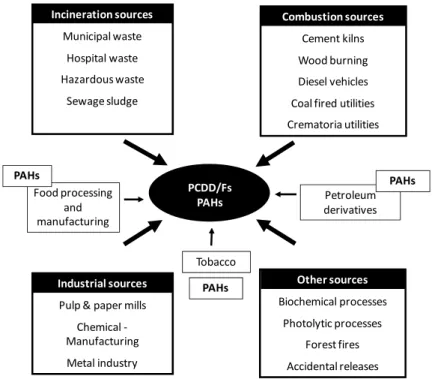
product of not just waste combustion but several industrial processes (Kulkarni et al., 2008; Longwell, 1982; Haynes, 1991; Ravindra et al., 2008; Chagger et al., 2000). They are mainly formed as a consequence of incomplete combustion of organic matter. In the case of PAHs, these can also arise from unburned fuel and lubrificating oil (petrogenic sources, without combustion), as well as they can be formed during food processing and manufacturing (Figure 1). Figure 1. Sources of PCDD/Fs and PAHs. Adapted from Kulkarni et al, 2008.
Chemically, PAHs are persistent organic pollutants formed by two or more aromatic rings, made up of carbon and hydrogen atoms. The U.S. Environmental Protection Agency (EPA) has promulgated 16 unsubstituted PAHs (EPA‐PAH) as priority pollutants to be monitored in the environment (EPA, 1986) (Figure 2). Ranging from 2‐ to 6‐rings and with molecular weight from 128 to 278 g/mol, these compounds can be classified as low molecular weight PAHs (LMW‐PAHs, with 2‐3 rings) and high molecular weight PAHs (HMW‐PAHs, with 5‐6 rings). LMW‐PAHs are usually emitted by petrogenic sources (without combustion), while HMW‐PAHs are usually related to pyrogenic sources (with combustion) (Meador et al., 1995; Jones and Voogt, 1999). Combustion sources Cement kilns Wood burning Diesel vehicles Coal fired utilities Crematoria utilities Incineration sources Municipal waste Hospital waste Hazardous waste Sewage sludge Other sources Biochemical processes Photolytic processes Forest fires Accidental releases Industrial sources Pulp & paper mills Chemical ‐ Manufacturing Metal industry Petroleum derivatives Food processing and manufacturing Tobacco PAHs PAHs PAHs PCDD/Fs PAHs
Figure 2. Chemical structures of the 16 EPA‐PAHs. Figure 3. Chemical structures of the 17 toxic PCDD/F congeners. LMW‐PAHs (2‐3 rings) 4‐ring PAHs HMW‐PAHs (5‐6 rings) Naphthalene Acenapthene Acenaphthylene Fluorene Phenanthrene Anthracene Fluoranthene Pyrene Benzo[a]anthracene Chrysene Benzo[b]fluoranthene Benzo[k]fluoranthene Benzo[a]pyrene Dibenzo[a,h]anthracene Benzo[ghi]perylene Indeno[1,2,3‐cd]pyrene O O Cl Cl Cl Cl 1,2,3,7,8‐PeCDD O O Cl Cl Cl Cl Cl 1,2,3,4,7,8‐HxCDD O O Cl Cl Cl Cl Cl Cl 1,2,3,6,7,8‐HxCDD O O Cl Cl Cl Cl Cl Cl 1,2,3,7,8,9‐HxCDD O O Cl Cl Cl Cl Cl Cl 1,2,3,4,6,7,8‐HpCDD O O Cl Cl Cl Cl Cl Cl Cl OCDD O O Cl Cl Cl Cl Cl Cl Cl Cl O Cl Cl Cl Cl Cl 1,2,3,7,8‐PeCDF O Cl Cl Cl Cl Cl 2,3,4,7,8‐PeCDF O Cl Cl Cl Cl 2,3,7,8‐TCDF O Cl Cl Cl Cl Cl Cl 1,2,3,4,7,8‐HxCDF O Cl Cl Cl Cl Cl Cl 1,2,3,6,7,8‐HxCDF O Cl Cl Cl Cl Cl Cl 1,2,3,7,8,9‐HxCDF O Cl Cl Cl Cl Cl Cl 2,3,4,6,7,8‐HxCDF O Cl Cl Cl Cl Cl Cl Cl 1,2,3,4,6,7,8‐HpCDF O Cl Cl Cl Cl Cl Cl Cl 1,2,3,4,7,8,9‐HpCD O Cl Cl Cl Cl Cl Cl C Cl OCDF PCDDs PCDFs 2,3,7,8‐TCDD
PCDD/Fs are a group of more than 200 organic compounds, formed by two benzene rings joined by two (in the case of PCDDs) or one (in the case of PCDFs) oxygen bridges. PCDD/Fs can be divided according to their homologue groups (from TCDD/Fs, with four chlorine atoms to OCDD/Fs, with eight chlorine atoms), and to their congener groups (which vary with the position of chlorine atoms in the molecule). The toxicity of PCDD/Fs is related with the presence of at least 4 chlorine atoms in the positions 2, 3, 7 and 8 of the molecule; and thus there are 17 toxic congeners (Figure 3) (Lohmann and Jones, 1988).
Homologue and congener profiles, that is the relative contribution of each homologue group or each toxic congener to the total PCDD/F content, have been used as tracers of numerous pollution sources and environmental fate of these compounds (Alcock et al., 2001; Lohmann and Jones, 1988).
1.4. Human exposure to POPs
Both, PAHs and PCDD/Fs, are toxic organic compounds, whose impact on human health is mainly related with carcinogenic, mutagenic and teratogenic effects. Several compounds of these groups have been classified by the International Agency for Research on Cancer (IARC) as carcinogenic (Group 1) or probable (2A) or possible (2B) human carcinogens (IARC, 1987).
Studies have shown that PCDD/Fs and PAHs interact with receptors, such as the hormonal receptors; the most studied one has been the aryl hydrocarbon receptor (AhR). Environmental contaminants, such as the PAHs and PCDD/Fs (namely TCDD), represent the most extensively characterized classes of AhR ligands (Denison et al, 1998; Denison and Heath‐Pagliuso, 1998; Poland and Knutson, 1982; Safe, 1990), although naturally occurring ligands do exist. The presence of the AhR and AhR signal transduction pathways in a diverse range of species, tissues, and cell types (Bank et al., 1992; Holmes and Pollenz, 1997; Hahn, 1988), combined with its ability to act as a ligand‐dependent transcription factor, suggests that many of the toxic and biological effects of AhR ligands (such as PAHs and PCDD/Fs) result from differential alteration of gene expression in susceptible cells. Because many of the adverse effects of PCDD/Fs and PAHs are not observed until days to weeks following chemical exposure (Poland and Knutson, 1982; Devito and Birnbaum, 1994), the adverse effects of these chemicals likely result from the continuous and inappropriate expression of specific genes in
responsive cells. Though there are cases of acute exposure to PCDD/Fs and PAHs, the biggest issue is the chronic exposure to low levels of these compounds (Rappe 1993, WHO 1992, Fiedler et al. 1990). Due to their lipophilic nature, PCDD/Fs and PAHs amplify and bioaccumulate in living organisms, entering into the foodweb of all animals, including humans, triggering harmful effects on health (Rappe 1993, WHO 1992, Fiedler et al. 1990).
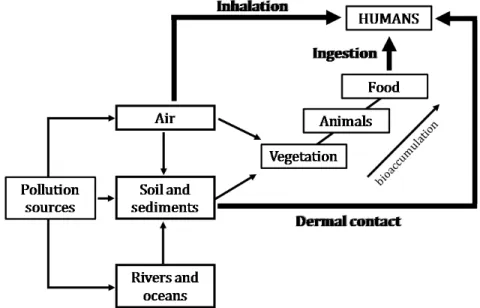
Humans can be exposed to POPs through diet, occupation, accidents and both the indoor and outdoor environments. Human exposure can occur by various pathways, notably inhalation of air and resuspended soil particles, ingestion of food (which may include maternal milk), water and soil particles (relevant in the case of children), and dermal contact to soil and water (USEPA, 1998) (Figure 4). Exposure can either be a short‐term exposure to high concentrations (acute) or long‐term exposure to lower concentrations (chronic). Chronic exposure occurs most commonly via dietary exposure pathways, though the contribution of other pathways should not be neglected. Contamination of food may occur through environmental pollution of the air, water and soil, or through the previous use or unauthorized use of organochloride pesticides on food crops. Foods containing the greatest concentrations of POPs include the fatty tissues of animals and edible oils. The contamination of food, including breast milk, by POPs is of worldwide concern (Stober, 1998).
Figure 4. Human exposure pathways to POPs.
To reliably assess human exposure to environmental POPs, concentrations of POPs in different environmental compartments (air, soil, water) need to be accounted. Usually these concentrations are obtained through:
i) Estimation of levels deposited in air, soil and water, based on POP emission
data from known pollution sources (industrial sources); however, the uncertainty associated with the places where pollutants are predicted to deposit and where they actually are being deposited is very high, increasing also the uncertainty of the exposure data.
ii) Measurements of POPs performed in air monitoring quality stations; these
stations, normally only few in space, tend to be located at specific sites selected for their expected relatively high or low concentrations and are often placed at a much higher altitude than the human breathing zone (EHC 27, 1983); moreover, the measurements reflect a short‐term indicator that varies in time and which does not reflect the levels that populations are exposed in space and in the long‐term.
iii) Measurements of POPs in soil and water samples.
These lead to a lack of spatial resolution in environmental epidemiological studies, as populations living in a large region are considered to be exposed to the same level of pollutants. One of the major challenges in environmental health studies is to assess which populations can be considered as control and which ones can be considered as exposed. In this way, there is a need to develop a tool that allows assessing human exposure to environmental POPs in the long‐term and with a spatially explicit scale.
1.5. Toxicity Equivalent Factors (TEFs)
PCDD/Fs and PAHs exist in environmental and biological samples as complex mixtures of various compounds whose relative concentrations differ across trophic levels. These differences are caused by environmental degradation, which is dependent on
compounds’ features, such as solubilities, volatilities, and rates of
degradation/metabolism. As a result, these mixtures change spatially and temporally into the environment and are very different from the technical mixtures originally released into the environment (Jones and Voogt, 1999).
The complex nature of PCDD/Fs and PAHs mixtures complicates the risk evaluation for humans and wildlife. For this purpose, the concept of toxic equivalency factors (TEFs) has been developed and introduced to facilitate risk assessment and regulatory control of exposure to these mixtures (USEPA, 2010). The TEF concept considers the relative toxicity of each compound in the mixture in relation to the most toxic compound – TCDD, in the case of PCDD/Fs and benzo[a]pyrene in the case of PAHs – which are the ones that have proven to be carcinogens to humans. The overall toxicity of the mixture is achieved, using equation 1, as follows:
∑ (Equation 1)
The relative toxicity of each compound is determined on the basis of available in vivo and in vitro data. However, it should also be understood that the TEF concept is based on a number of assumptions and has limitations. In this respect, the most basic assumption is that the combined effects of the different compounds are dose or concentration additive. Other assumptions are: the AhR receptor mediates most if not all of the biologic and toxic effects of PCDD/Fs and/or PAHs; the applicability of extrapolations from short‐term bioassays to long‐term health effects; similarities between interspecies kinetics and potency; appropriateness of high‐dose to low‐dose extrapolations; and the constancy of TEF relationships for different exposure routes, health endpoints, and dose levels (USEPA, 1989, 2000, 2003; Birnbaum and DeVito, 1995; Birnbaum, 1999). Due to the everyday increasing of studies regarding toxic effects of both PCDD/Fs and PAHs, TEFs have been subjected to revisions over the years (USEPA, 2010).
1.6. Factors affecting transport, deposition and fate of POPs
Once emitted to the atmosphere by pollutant sources, the transport, deposition, and fate of POPs in the environment are dependent on the physicochemical properties of the compounds. The distance that a compound is able to travel is dependent on its atmospheric lifetime, phase (gas or particle) in which it exists in the atmosphere and regional and global wind patterns (Jones and Voogt, 1999).
POP deposition from the atmosphere depends on the affinity for that compound to partition from the atmosphere to other environmental compartments. The mechanisms by which POPs undergo deposition are dependent on the phase of the compound in the atmosphere and the physicochemical properties that describe the affinity for the
compound to partition from the atmosphere to a different environmental compartment (Finizio et al., 1997; Simonich and Hites, 1995; Daly and Wania, 2005; Wania and Mackay, 1993).
POPs can undergo deposition through wet and/or dry processes and through air‐surface exchange (Buckley, 1982; Welsch‐Pausch et al., 1995; LeNoir et al., 1999). Wet deposition is the washout of gas and particle phase POPs in the atmosphere via precipitation events, while dry deposition is the gravitational fall out of higher mass particles.
Once deposited, the environmental fate of POPs is dependent on the affinity of the POP for the atmosphere compared to lipid‐based matrices, such as vegetation in terrestrial environments and fish in aquatic environments. The octanol‐water partition coefficient,
KOW, has been used to describe the accumulation potential of POPs in aquatic ecosystems
(Gobas and MacLean, 2003). Some POPs have a high affinity for lipophilic matrices relative to water; therefore there is strong evidence of bioaccumulation of some POPs in
aquatic organisms (Kelly, 2007). This KOW coefficient has also been used as a measure of
the lipophilic, non soluble, character of a compound; as thus as a measure of the potential bioaccumulation in terrestrial living organisms.
1.7. Environmental monitoring ‐ conventional methods
After being released by pollution sources (known and unknown), POPs will disperse in the atmosphere and deposit on ecosystems (soil, water, vegetation) where they will bioaccumulate, contaminating the human and other animal food‐chains (Figure 5). Environmental monitoring of POPs can be performed using different methods. The most used one, which is required by the actual regulations, is to measure POPs in emissions from industries and estimate the dispersion and deposition based on these data; the main limitation of this method is that only major industries perform these measurements, and thus a set of small industries and also unknown/unexpected pollution sources are not accounted. As a consequence, most of the times the deposition models built in this way do not reflect what is actually being deposited. These measurements are useful to control emissions from industries, and not properly to assess deposition on ecosystems and human exposure. In this way, monitoring concentrations of POPs in environmental samples, such as air, water and soil is an
indispensable task, in order to improve information regarding POP deposition and fate in ecosystems. Figure 5. Environmental fate of POPs.
To determine POP concentrations in air, several sampling devices have been used. Active high volume air samplers (HiVols), powered by electricity, are most frequently used because samples are obtained over short periods of time (~24 hours), collect large volumes of air (600‐800m3), and allow for the collection of POPs during episodic transport events (Bailey et al., 2000; Killin et al., 2002; Harner et al., 2005). These samplers use a continuous duty blower to suck in an air stream. When fitted with a particle size classifier, it separates particles (usually greater than 10μm size) from the air stream. The air stream is then passed through a filter paper to collect particles lesser than 10μm size (PM10). Gravimetric measurements yield values of suspended particulate matter (SPM), as the sum of the two fractions, and PM10, the material retained on the filter paper. The filter paper can be used to determine POPs in the particle‐phase of air. The sampler can also be used to sample POPs in the vapour‐phase or air. For that, a stream of unfiltered air passes through polyurethane foam (PUF) embedded in a solvent (such as acetonitrile) after passing through the filter; the foam will retain the vapour‐phase compounds (Ockenden et al., 1998, 2001; Gouin et al., 2005; Shoeib and Harner, 2001). As POPs exist at low concentrations in air, most of the times they’re not detectable using this method. In addition, this method requires the installation of expensive equipment, and thus generally a single monitoring station is
Pollution sources (known & unknown) Air Soil and Water Vegetation Animals Humans Long range transport Sink Bi o a ccu mu la tio n
used to obtain information for large areas. For example, in Portugal, monitoring stations measuring PCDD/Fs in air are inexistent, and only a few (four) started recently measuring PAHs (APA, 2012).
Regarding POPs in water, measurements are performed through water analysis. For that, water samples are collected, concentrated and analysed. Such as in air, POPs in water exist at low concentrations, and thus most of the times are not detectable. Several studies have shown that POPs tend to disperse and deposit on sediments, after being released to water (Meador et al., 1995). Moreover, due to their lipophilic character and hydrophobicity, PAHs and PCDD/Fs are easily captured and bioaccumulated by living organisms. This makes the detection of illegal discharges into water bodies a difficult task. Finally, regarding POPs in soils samples, this matrix usually has high levels of POPs, as it’s a natural sink for persistent and lipophilic compounds, such as PAHs and PCDD/Fs, which absorb to soil organic carbon and, once absorbed remain relatively immobile (Fiedler, 1999). Soil is considered a typical accumulating matrix with a long‐ term memory, and thus it doesn’t respond quickly to changes in emissions (Fiedler, 1999). Moreover, it tends to be more concentrated in high molecular PAHs and in high chlorinated PCDD/Fs, which are more stable than the lighter compounds (Fiedler, 1999). Accumulation of POPs in soils may lead to further potential accumulation of vegetables (through ressuspension of soil particles) and food‐chains, and then cause direct or indirect exposure to humans.
1.8. Using biomonitors to fulfil the gaps
The term biomonitor is used to refer to an organism, or a part of it, that depicts the occurrence of pollutants on the basis of specific symptoms, reactions, morphological changes or concentrations (Markert et al. 1997). To be considered a good biomonitor of air pollution, the organism should meet the following requirements (Wittig 1993, Conti & Cecchetti 2001; Sloof, 1993): i) accumulate detectable concentrations of pollutants; ii) be widely distributed and abundant; iii) be available during the whole year, not showing seasonal variations, and be easy to collect; iv) uptake and accumulate pollutants in a way that relates with the exposure period and intensity of pollution. Lichens and bryophytes are considered to be the best for use as biomonitors of air pollutants (Rühling & Tyler 1968, Puckett 1988).
Lichens are symbiotic organisms that have been used during decades as biomonitors of air pollution (Martin & Coughtrey, 1982; Puckett, 1988; Nimis et al, 1990). In fact, these organisms are among the most used in terrestrial environments for monitoring purposes. Lichens are symbioses between a fungus (mycobiont partner) and algae and/or cyanobacteria (photobiont partner). Both, mycobiont and photobiont form an integrated lichen thallus, which can be organized in either a stratified or non stratified way (Büdel and Scheidegger, 1996). Lichens with a non stratified arrangement are composed of a simple and undifferentiated thallus with irregularly distributed algae (Büdel and Scheidegger, 1996); whereas in stratified lichens, algae are confined to a distinct layer, and there is, at least, one more layer ‐ the medulla ‐ and other layer‐ the cortex – in which algae are not present (Jahns, 1973; Büdel and Scheidegger, 1996). The medulla consists of loosely interwoven hyphae with a very high internal air space and occupies the major part of the internal volume of the thallus (Jahns, 1973; Büdel and Scheidegger, 1996). Most lichens are protected against high irradiance and ultra‐violet light by a thin to thick cortical layer, composed of more or less compressed hyphae (Hale, 1974; Büdel and Scheidegger, 1996; Solhaug et al., 2003). A lower cortex can also be present and is similar to the upper cortex in thickness and structure (Hale, 1974; Büdel and Scheidegger, 1996). In lichens where the lower cortex does not exist, the medulla corresponds to the lower layer of the thallus (Büdel and Scheidegger, 1996). Lichens can be generally grouped into three growth forms: crustose, foliose and fruticose (Hale, 1974; Büdel and Scheidegger, 1996). Crustose lichens don’t have a stratified arrangement and don’t possess a lower cortex and are tightly attached to the substrate by the hyphae of the medulla, being very difficult to separate them from it; foliose lichens are leaf‐like, with flattened lobes, dorsiventral thallus and are attached to the substrate by rhizines or rhizoidal hyphae; fruticose lichens are hair‐like, strap‐ shaped or shrubby, with radial or dorsiventral thallus and are, in general, attached to the substrate by a holdfast (Jahns, 1973; Hale, 1974; Büdel and Scheidegger, 1996).
Several features contribute for the success of lichens as biomonitors, notably: i) they don’t have root neither a cuticle (lipid surface layer that is present in plants), meaning that the unique pathway for their nutrition is through atmospheric deposition (either of nutrients or pollutants); ii) they have a constant morphology throughout the year allowing collecting/studying them at any season; iii) they’re long‐lived organisms, being able to accumulate pollutants over their lifetimes; iv) they’re widely distributed over the
planet, being possible to find them in almost all kind of environments (Manning & Feder, 1980; Martin & Coughtrey, 1982; Puckett, 1988; Garty, 1993; Sloof, 1993). Due to these features, they’ve been extensively used to biomonitor pollution by heavy metals (Pb, Cu, Cr, Hg, Cd, Zn, As, Co, Mn, Ni), dust (Ca, Mg, K, Si), radionuclides (137Cs, 54Mn, 95Zr, 95Nb, 140Ba, 140La), gaseous pollutants (SO2, HF, NOx, NH4+, O3), anions (Cl‐, NO3‐), and more recently organic compounds (PCBs, PAHs, HCBs, PCDD/Fs). They have been successfully used to monitor pollution from road traffic, cities, industries, mines, the use of fertilizers in agriculture, volcanoes, etc. (Branquinho et al., 2008; Branquinho, 1997; Manning & Feder, 1980; Martin & Coughtrey, 1982; Puckett, 1988; Garty, 1993).
Lichens obtain their nutrients from wet and dry deposition (Martin and Coughtrey 1982, Garty 1993). The accumulation of pollutants occurs through a number of different mechanisms: as layers of particles or entrapment on the surface of the cells, incorporation into the outer walls of the cells through ion exchange processes, and metabolically controlled passage into the cells (Branquinho et al., 1999; Branquinho, 2001; Brown, 1991; Brown and Bates 1990; Tyler 1990; Puckett, 1988; Brown, 1991; Garty, 1993; Richardson, 1995). The attachment of particles is affected e.g., by the size of the particles and the surface structure of the lichens. Ion exchange is a fast physiological‐ chemical process that is affected e.g., by the number and type of free cation exchange sites, the age of the cells and their reaction to desiccation, growing conditions, temperature, precipitation pH, composition of the pollutants and leaching (Tyler 1990, Brown & Brûmelis 1996). In the ion exchange process, cations and anions become attached to functional organic groups in the cell walls among other things through chelation (Rao 1984).
The physiological processes affecting accumulation in lichens have been studied much more than for many other biomonitors. Attempts have also been made to explain the accumulation processes with the aid of mathematical models (Reis et al. 1999). These studies have emphasised the significance of lichen morphology and physiology in the accumulation of elements (Brown 1991, Sloof & Wolterbeek 1991). Clear differences in the accumulation of elements have been found between different lichen species and even different populations as a result of these morphological and physiological differences (Sloof 1995, Bennett & Wetmore 1999). Sporadic desiccation of lichens may
have an effect on the accumulation and absorption of elements (Puckett 1988). After a dry period, rainfall may result in appreciable washing off of particles and the exchange of cations bound on negatively charged exchange sites on the cell walls and plasma membranes of the cells (Bargagli 1998).
There are a considerable number of factors, associated with the site where lichens are growing, which may change the concentrations of pollutants in lichens (Brown 1991, Garty 2000). These factors are: quality of the deposition (form of occurrence, composition, pH), climate (composition of precipitation, temperature, wind, drought, length of the growing period) and local environmental factors (vegetation, quality of the substrate, stand throughfall and stemflow, dust derived from soil, altitude of area). On the other hand, throughfall and stemflow, which vary according to the type of canopy cover, have a greatest effect on epiphytic lichens (Barkman 1958, Rasmussen 1978). Nutrients and other elements may pass from the substrate into lichens (De Bruin & Hackenitz 1986, Bargagli 1990, Wolterbeek & Bode 1995).
Environmental biomonitoring of POPs have been performed over the years, either in terrestrial or aquatic environments, using living organisms, such as vegetation (pine needles, leaves, grass, vegetables, etc.), birds, fish, molluscs (Lovett et al., 1997; Buckley‐Golder, 1999; Coutinho et al., 1999; Sakurai et al., 2000; Senthilkumar et al., 2002; Srogi, 2007: Domingo et al., 2000, 2001a,b; Schuhmacher et al., 2002). Though lichens have been the most used biomonitors in terrestrial environments to assess atmospheric deposition of a wide range of pollutants, only a few studies have used these organisms to assess POP atmospheric deposition (Augusto et al., 2004; Guidotti et al., 2003; Domeño et al., 2006; Blasco et al., 2006). Aquatic bryophytes, sharing most of the monitoring features with lichens, have also been used to monitor a large set of pollutants in aquatic environments, but specifically regarding POPs, only a limited number of studies have been performed (Roy et al., 1994, 1996; Sérgio et al., 1992; Vieira et al., 2009).
1.9. Aims & Outline
Though many studies have been performed using these organisms as biomonitors of a wide range of pollutants (such as heavy metals, radionuclides, gaseous pollutants, etc.), their use as POP biomonitors is still in a germinal stage and needs further study.
The main aim of this thesis is study the factors that influence the interception and accumulation of POPs by lichens, how lichens and aquatic bryophytes can be used to track different pollution sources in terrestrial and aquatic environments, and how can these biomonitors contribute to environmental health studies. This work will integrate different types of knowledge; allow developing an integrated biomonitor technology to be used to assess environmental POP pollution. For that, after this first chapter of general introduction, the thesis was divided into 4 chapters (from second to fifth).
In the second chapter (Optimizing and inter‐calibrating biomonitors, soil and air) the aim is to optimise the use of lichens as POP biomonitors. Lichens have been used during decades as metal and other pollutant biomonitors, but to date only a few studies were performed using lichens to monitor POP environmental pollution. In this way, it was necessary to study the factors that contribute for the interception and accumulation of PCDD/Fs and PAHs in lichens. Questions regarding the influence of lichen traits (growth form, size, age) and methodological aspects (influence of substrate) on their performance as POP biomonitors will be answered (subchapter 2.1). In this second chapter, lichens are also compared with other monitoring methods, such as the use of pine needles, air and soil samples (subchapters 2.2 and 2.3). Calibrations between POPs in lichens and air and soil are also performed (subchapters 2.3 and 2.4), allowing translating values in lichens into the equivalent ones for air and soil. This calibration allows the integration of lichens in regulatory monitoring schemes (subchapter 2.4). One of the major challenges in environmental monitoring studies is to track pollution sources. This can be a tricky task in multisource environments, where different kinds of industries, urban activities, agricultural practices, etc., are all contributing to the input of POPs in the environment. The aim of the third chapter (Fingerprinting pollution sources
using biomonitoring tools) is to show how lichens and aquatic bryophytes can be used to
identify different pollutant sources in terrestrial (subchapter 3.1) and aquatic environments (subchapter 3.2). For that, an integrated analysis of different levels of information will be presented. Information regarding POP and heavy metal concentrations in biomonitors, ratios between different POP compounds, and land‐use will be used together in the same approach in order to identify the origin of POP pollution.
In the fourth chapter (Assessing environmental and human health risk based on
integration of different monitoring approaches) it is shown how biomonitoring using
lichens can be used to complement human health studies (subchapters 4.1 and 4.2). In environmental health studies, when the aim is to relate pollution to human health, one of the major limitations is to assess which populations should be considered as control and which ones should be considered exposed. This limitation is a consequence of the lack of spatial resolution of pollutant deposition data. Usually, data from a single air quality monitoring station is considered as representative of a large area, and thus the level of human exposure to pollutants is considered to be the same all over the region. The use of environmental biomonitors can be helpful, as they allow obtaining pollution data with high spatial resolution. In the particular case of POPs, using lichens as long‐ term accumulators will provide information regarding the human chronic exposure to POPs through inhalation. Finally, the fifth chapter (General discussion) consists of a general discussion, where all the know‐how acquired during the previous chapters will be integrated and interpreted. In this chapter it will be also proposed a set of guidelines to be followed when using lichens and aquatic bryophytes as biomonitors of persistent organic pollutants. REFERENCES Alcock, R.E., Sweetman, A.J., Jones, K.C., 2001. A congener‐specific PCDD/F emissions inventory for the UK: do current estimates account for the measured atmospheric burden? Chemosphere 43: 183–94. APA 2012. Agência Portuguesa do Ambiente. Available from: http://www.qualar.pt
Augusto, S., Pinho, P., Branquinho, C., Pereira, M. J., Soares, A., Catarino, F., 2004. Atmospheric dioxin and furan deposition in relation to land‐use and other pollutants: a survey with lichens. J Atmos Chem 49, 53–65.
Bailey, R., Barrie, L.A., Halshall, C., Fellin, P., Muir, D.C.G., 2000. Atmospheric organochlorine pesticides in the western Canadian Arctic: Evidence of transpacific transport. Journal of Geophysical Research 105(D9):11805‐ 11811.
Bank PA, Yao EF, Phelps CL, Harper PA, Denison MS. 1992. Species‐specific binding of transformed Ah receptor to a dioxin responsive transcriptional enhancer. Eur J Pharmacol 258:85–94.
Bargagli, R., 1990. Assessment of metal air pollution by epiphytic lichens: The incidence of crustal materials and of the possible uptake from substrate barks. Studia Geobotanica 10: 97‐103.
Bargagli. R., 1998. Trace elements in terrestrial plants. An ecophysiological approach to biomonitoring and biorecovery. Springer Verlag, Berlin, New York, 324 p. Barkman, J.J., 1958. Phytososiology and ecology of cryptogamic epiphytes. Van Gorcum, Assen. Bennett, J.P., Wetmore, C.M., 1999. Changes in element contents of selected lichens over 11 years in northern Minnesota, USA. Environmental and Experimental Botany 41:75‐82. Birnbaum, L. S., DeVito, M. J., 1995. Use of toxic equivalency factors for risk assessment for dioxins and related compounds. Toxicology 105:391–401. Birnbaum, L.S., 1999. TEFs: a practical approach to a real‐world problem. Hum Ecol Risk Assess 5:13−24. Blasco, M., Domeño, C., Nerín, C., 2006. Use of lichens as pollution biomonitors in remote areas: comparison of PAHs extracted from lichens and atmospheric particles sampled in and around the Somport tunnel (Pyrenees). Environmental Science & Technology 40, 6384‐6391. Branquinho C., Gaio‐Oliveira G., Augusto S., Pinho P., Máguas C. & Correia O. 2008. Biomonitoring spatial and temporal impact of atmospheric dust from a cement industry. Environmental Pollution 151(2): 292‐299
Branquinho, C., 1997. Improving the Use of Lichens as Biomonitors of Atmospheric Metal Pollution. Tese de Doutoramento, Faculdade de Ciências da Universidade de Lisboa, Lisboa, 150 pp.
Branquinho, C., 2001. Lichens. In Prasad MNV (Ed) Metals in the Environment: Analysis by Biodiversity. New York, Marcel Dekker pp. 117‐158. Branquinho, C., Catarino, F., Brown, D., Pereira, M.J., Soares, A., 1999. Improving the use of lichens as biomonitors of atmospheric metal pollution. Science of the Total Environment 232:67‐77. Brown, D.H., 1991. Lichen mineral studies – currently clarified or confused. Symbiosis 11: 207‐ 223. Brown, D.H., Bates, J.W., 1990. Bryophyte and nutrient cycling. Botanical Journal of the Linnean Society 104: 129‐147. Brown, D.H., Brûmelis, G., 1996. A biomonitoring method using the cellular distribution of metals in moss. The Science of the Total Environment 187:153‐161. Buckley, E. H., 1982. Accumulation of Airborne Polychlorinated Biphenyls in Foliage. Science 216, (30):520‐522. Buckley‐Golder, D., 1999. Compilation of EU dioxin exposure and health data, task 1. Oxfordshire, AEATechnology, pp. 12‐3. Büdel, B. & Scheidegger, C. 1996. Thallus morphology and anatomy. Pp. 37‐64. In: T.H. Nash (ed.). Lichen Biology. Cambridge, Cambridge University Press. Chagger, H.K., Jones, J.M., Pourkashanian, M., Williams, A., 2000. The formation of VOC, PAH and dioxins during incineration. Process Saf. Environ. Prot. 78, 53–59.
Conti, M.E., Cecchetti, G., 2001. Biological monitoring: lichens as bioindicators of air pollution assessment – a review. Environmental Pollution 114:471‐492.
Coutinho, M., Boia, C., Borrego, C., Mata, P., Costa, J., Rodrigues, R., 1999. Environmental baseline levels of dioxins and furans in the region of Oporto. Organohalogen Compounds 43,131‐136.
Daly, G. L., Wania, F., 2005. Organic contaminants in mountains. Environmental Science & Technology 39(2):385‐398.
De Bruin, M., Hackenitz, E., 1986. Trace element concentrations in epiphytic lichens and bark substrate. Environmental Pollution 11: 153‐160.
Denison, M.S., Heath‐Pagliuso S. 1998. The Ah receptor: a regulator of the biochemical and toxicological actions of structurally diverse chemicals. Bull. Environ. Contam. Toxicol. 61:557– 68.Poland and Knutson, 1982;
Denison, M.S., Seidel, S.D., Rogers, W.J., Ziccardi, M., Winter, G.M., Heath‐Pagliuso, S., 1998. Natural and synthetic ligands for the Ah receptor. In Molecular Biology Approaches to Toxicology, ed. A Puga, KB Wallace, Philadelphia: Taylor & Francis.pp. 393–410.
Devito, M.J., Birnbaum, L.S., 1994. Toxicology of dioxins and related chemicals. In Dioxins and Health, ed. A Schecter, New York: Plenum. pp. 139–62.
Domeño, C., Blasco, M., Sánchez, C., Nerín, C., 2006. A fast extraction technique for extracting polycyclic aromatic hydrocarbons (PAHs) from lichen samples used as biomonitors of air pollution: dynamic sonication versus other methods. Analytica Chimica Acta 569, 103‐112. Domingo, J.L., Granero, S., Schuhmacher, M., 2001a. Congener profiles of PCDD/Fs in soil and
vegetation samples collected near to a municipal waste incinerator. Chemosphere 43, 517‐24. Domingo, J.L., Schuhmacher, M., Granero, S., 2001b. Temporal variations on PCDD/PCDF levels in
environmental samples collected near an old municipal waste incinerator. Environmental Monitoring and Assessment 69,175‐193.
Domingo, J.L., Schuhmacher, M., Müller, L., Rivera, J., Granero, S., Llobet, J.M., 2000. Evaluating the environmental impact of an old municipal waste incinerator: PCDD/F levels in soil and vegetation samples. Journal of Hazardous Materials 76, 1‐12.
EHC 27. 1983. Guidelines on studies in environmental epidemiology. Environmental Health Criteria 27. International Program on Chemical Safety, available at http://www.inchem.org/documents/ehc/ehc/ehc27
Fellenberg, G., 2000. The Chemistry of Pollution. John Wiley & Sons Ltd, Chichester. 192pp. Fiedler, H., 1999. Compilation of EU dioxin exposure and health data. Report produced for
European Commission DG Environment. UK Department of Environment, Transport and the Regions (DETR), pp. 629.
Fiedler, H., Hutzinger, O., Timms, C.W., 1990. Dioxins: Sources of Environmental Load and Human Exposure. Toxicol. Environ. Chem. 29: 157‐234.
Finizio, A., Mackay, D., Bidleman, T., Harner, T., 1997. Octanol‐air partition coefficient as a predictor of partitioning of semi‐volatile organic chemicals to aerosols. Atmos. Environ. 31(15):2289‐2296.
Garty, J., 1993. Lichens as Biomonitors for Heavy Metal Pollution. In: Markert B (ed) Plants as Biomonitors. Indicators for Heavy Metals in the Terrestrial Environment. VCH, Weinheim, p 193‐ 263.
Garty, J., 2000. Environment and elemental content of lichens. In: Markert B & Friese K (eds) Trace elements – Their distribution and effects in the environment. Trace metals in the environment 4. Elsevier Science, Oxford, p 245‐276.
Gobas, F.A.P.C., MacLean, L.G., 2003. Sediment‐Water Distribution of Organic Contaminants in Aquatic Ecosystems: The Role of Organic Carbon Mineralization. Environ. Sci. Technol. 37(4): 735‐741.
Gouin, T., Harner, T., Blanchard, P., Mackay, D., 2005. Passive and active air samplers as complementary methods for investigating persistent organic pollutants in the Great Lakes basin. Environmental Science & Technology 39(23):9115‐9122.
Guidotti, M., Stella, D., Owczarek, M., de Marco, A., de Simona, C., 2003. Lichens as polycyclic aromatic hydrocarbons bioaccumulators used in atmospheric pollution studies. Journal of Chromatography A 985, 185‐190.
Hahn, M.E., 1988. The aryl hydrocarbon receptor: a comparative perspective. Comp. Biochem. Physiol. 121:23–53.
Hale, M.E., 1974. The Biology of Lichens. 2nd Edition. Edward Arnold Ltd. London, pp. 181. Halliday, E.C., 1961. A historical review of air pollution. In: Air pollution, Geneva: World Health
Organization.
Harner, T., Shoeib, M., Kozma, M., Gobas, F.A.P.C., Li, S.M., 2005. Hexachlorocyclohexanes and Endosulfans in Urban, Rural, and High Altitude Air Samples in the Fraser Valley, British Columbia: Evidence for Trans‐Pacific Transport. Environ. Sci. Technol. 39(3):724‐731.
Haynes, B.S., 1991. In: Bartock, W., Sarofim, A.F. (Eds.), Fossil Fuel Combustion: a Source Book. Wiley, New York, pp. 261–326.
Holmes, J.L., Pollenz, R.S., 1997. Determination of aryl hydrocarbon receptor nuclear translocator protein concentration and subcellular localization in hepatic and nonhepatic cell culture lines: development of quantitativeWestern blotting protocols for calculation of aryl hydrocarbon receptor and aryl hydrocarbon receptor nuclear translocator protein in total cell lysates. Molec. Pharmacol. 52:202–1.
Hung, H., Kallenborn, R., Breivik, K., Su, Y., et al., 2010. Atmospheric monitoring of organic pollutants in the Arctic under the Arctic Monitoring and Assessment Programme (AMAP): 1993– 2006. Science of the Total Environment 408:2854–2873. IARC, 1987. International Agency for Research on Cancer. Monographs on the evaluation of the carcinogenic risk of chemicals to humans, Supplement 7, Lyon, France. Jahns, H.M., 1973. Anatomy, morphology and development. In: Ahmadjian, V. & Hale, M.E. (eds). The Lichens. Academic Press, New York.
Jones, K.C., Voogt, P., 1999. Persisent organic pollutants (POPs): state of the science. Environmental pollution 100:209‐221Lohmann, R., Jones, K.C., 1998. Dioxins and furans in air and deposition: a review of levels, behaviour and processes. Sci Total Environ 219:53–81.
Jones, K.C., Voogt, P., 1999. Persistent organic pollutants (POPs): state of the science. Environmental pollution 100:209‐221.