UNIVERSIDADE DO ALGARVE
Comparative analysis of freshwater wetlands of Belarus and
Portugal on the aspect of their present status, nature conservation
performance and future perspectives
Lizaveta Sitkevich
Dissertação realizada para obtenção do Grau de Mestre em
Gestão Sustentável dos Espaços Rurais
Trabalho efetuado sob a orientação de: Professora Doutora Carla Maria Rolo Antunes
UNIVERSIDADE DO ALGARVE
Comparative analysis of freshwater wetlands of Belarus and
Portugal on the aspect of their present status, nature conservation
performance and future perspectives
Lizaveta Sitkevich
Dissertação realizada para obtenção do Grau de Mestre em
Gestão Sustentável dos Espaços Rurais
Trabalho efetuado sob a orientação de: Professora Doutora Carla Maria Rolo Antunes
Comparative analysis of freshwater wetlands of Belarus and
Portugal on the aspect of their present status, nature conservation
performance and future perspectives
Declaração de autoria de trabalho
Declaro ser a autora deste trabalho, que é original e inédito. Autores e trabalhos consultados estão devidamente citados no texto e constam da listagem de referências incluída.
(Lizaveta Sitkevich)
© Copyright Lizaveta Sitkevich
A Universidade do Algarve tem o direito, perpétuo e sem limites geográficos, de arquivar e publicitar este trabalho através de exemplares impressos reproduzidos em papel ou de forma digital, ou por qualquer outro meio conhecido ou que venha a ser inventado, de o divulgar através de repositórios científicos e de admitir a sua cópia e distribuição com objetivos educacionais ou de investigação, não comerciais, desde que seja dado crédito ao autor e editor.
Acknowledgements
Having graduated from the Belarusian State University as a Specialist in International Tourism Management and studied at the University of Algarve in the Master of Science in Sustainable Management of Rural Areas, I have managed to combine the knowledge I got with my personal interests in sustainability issues. In Belarus I concentrated on ecological tourism in our protected areas gradually turning from the ‘tourism manager’ view on it to ‘nature conservationist’ one. The Master programme helped me to get a broader view on sustainable management concept.
This thesis is a result of the author’s continuous work and dedication which, however, could not be possible without support and contribution of many people.
First, I would like to thank my family and friends for their understanding, support and advice during all this time: my parents Sviatlana and Anatolij, my sister Kaciaryna and my Vova. To my supervisor and course director professor Carla Maria Rolo Antunes who helped me to organize and present all the collected information properly and gave her useful advice at the different stages of the working process.
To Maryna Barouka, my professor at the Belarusian State University, for her guidance in methodological and organizational issues.
To the employees of the research sites who gave me a warm welcome and provided with the necessary information: Fernando José Velez Serrão de Faria Pereira, Luis Leitão, António Figueiredo, João Branco, Teresa Lemos, Vadzim Protasevich, Ivan Borok.
To Uladzimir Malashevich, director of APB-Birdlife Belarus NGO, who supported my research and provided me with valuable information and professional comments.
To Bruno Herlandes who gave me the possibility to participate in LIFE+Trachemys project. To my professors of Portuguese for their efficient teaching methods which helped me to study a great amount of material in Portuguese: Maria Isabel Rosa Barriga Dias, Cristina Pereira.
RESUMO
O presente estudo incide na análise comparativa das zonas húmidas de água doce em dois países - Belarus (país de origem do autor) e Portugal (país onde o autor frequentou o curso de Mestrado), nomeadamente para determinar as semelhanças e diferenças nas abordagens de conservação de zonas húmidas e práticas seguidas nos referidos países e identificar os aspectos positivos e experiências que pudessem ser utilizadas no futuro. Foram seleccionadas 7 áreas de estudo – 3 turfeiras em Belarus e 4 zonas em Portugal (3 pauis e 1 turfeira).
A pesquisa centrou-se nos aspectos da conservação da natureza, uso atual de recursos de zonas húmidas e as perspectivas futuras de uso e conservação. Também foram realizados inquéritos, com o objectivo de avaliar o comportamento dos turistas quando visitam esta tipologia de espaço. Neste enquadramento, em ambos os países, o autor participou em dois projetos de conservação de zonas húmidas.
O trabalho tem a seguinte estrutura: 1 Introdução do estudo, onde são indicados os objetivos, a estrutura e a metodologia; 2 Estado da arte relativamente à visão das zonas húmidas de água doce de Belarus e de Portugal e as respectivas experiências de conservação; 3 Casos de estudo, onde são apresentadas as sete áreas de estudo e os dois projetos de conservação de zonas húmidas; 4 Resultados – análise comparativa do desempenho das áreas de estudo e da pesquisa sociológica; e por fim, 5. Conclusões.
A pesquisa realizada permitiu um profundo conhecimento e compreensão da evolução das características das áreas de estudo, seu desempenho atual em conservação da natureza, ecoturismo e educação ambiental. Os principais resultados obtidos mostram que as áreas de estudo de Belarus e de Portugal são áreas de alto valor de conservação. No entanto, as abordagens e objectivos de conservação são bastante diferentes nos dois países: as zonas húmidas belarusas estão muito melhor conservadas e ativamente envolvidas em práticas de conservação regulares que provam ser altamente eficientes; os objectivos prioritários para as áreas são a sua restauração através da pesquisa científica, conservação e uso sustentável que significa a proteção, o desenvolvimento do ecoturismo, práticas de educação ambiental e envolvimento da população local. As zonas portuguesas estão bastante alteradas e sujeitas a ações de conservação pontuais; os objectivos prioritários para estas áreas são a conservação através de medidas para a recuperação de espécies e habitats, sem o objectivo prioritário de restauração de ecossistemas, verificando-se algumas limitações do seu uso por status de proteção e regulação de práticas ilegais, controle de visitas e desenvolvimento da educação
ambiental e ecoturismo. O conceito de abordagem em Portugal revela-se pouco sustentável, pois não recorre a atividades de conservação regulares e as zonas húmidas funcionam ou de proteção formal e prevenção de sua futura utilização ou concentram-se na educação ambiental.
Os resultados da pesquisa sociológica também provam a maior eficiência do desempenho das áreas belarusas mostrando o maior nível de conhecimento sobre as áreas de estudo e as suas atividades.
Palavras Chave:
Conservação de zonas húmidas, análise comparativa, charco, paul, turfeira, projeto de conservação da natureza, ecoturismo, educação ambiental.
ABSTRACT
The present thesis is devoted to comparative study of freshwater wetland areas in 2 countries – Belarus (the country of the author’s origin) and Portugal (the country of Master studies). 7 research sites were chosen – 3 mires in Belarus and 4 marshes in Portugal. The research was done in the field of their nature conservation performance, current use of wetland resources and future perspectives of use and conservation. Besides, the examples of the 2 successful wetland conservation projects in both countries, in which the author participated, were provided. Moreover, the sociological survey on assessing awareness of potential tourists about the research sites was conducted and its results presented. As a result, the comparative analysis was conducted to determine similarities and differences in wetland conservation approaches and practices in Belarus and Portugal and to identify the positive aspects and experience that could be used by each side in the future.
The work has the following structure: 1. Introduction of the study, its objectives, structure, methodology; 2. Issue background – overview of Belarusian and Portuguese freshwater wetlands and their conservation experience; 3. Research data – presentation of the 7 research sites and 2 wetland conservation projects; 4. Results – comparative analysis of the research sites’ performance and analysis of the results of the sociological survey; 5. Conclusions The thesis research has produced a deep knowledge and understanding of the past and present features of the research sites, their current performance in nature conservation, ecotourism and environmental education.
The main results obtained show that both Belarusian and Portuguese research sites are high conservation value areas. However, the conservation approaches and objectives are completely different in the countries: Belarusian wetland areas are much better conserved and actively involved in regular conservation practices which prove to be highly efficient; the priority objective set for the sites is their restoration through scientific research, conservation and sustainable use by protection, development of ecotourism, environmental education practices and involvement of local population. Portuguese sites are transformed to high extent and are subjected to unregular and inefficient conservation actions; the priority objective set for the sites is conservation of the sites through measures for recuperation of species and habitats without the objective of restoration of ecosystems, limitation of their use by protection status and regulation of illegal practices, visit control, and developing environmental education and ecotourism practices. In practice, the Portuguese concept proves
to be unsustainable: it does not imply regular conservation activities which causes further degradation of the landscapes and the sites either function for formal protection and prevention of their further use or concentrate on environmental education.
The results of the survey also prove the higher efficiency of Belarusian sites’s performance showing higher level of awareness about the research sites and their activities.
Keywords:
Wetland conservation, comparative analysis, mire, bog, marsh, nature conservation project, ecotourism, environmental education.
TABLE OF CONTENTS
Appendix
List of Abbreviations and Symbols………... 9
Index of Figures………. 10
Index of Tables……….. 12
1. Introduction 1.1 Scope and framework of the study………. 13
1.2 Objectives, structure and methodology of the research……….. 14
2. Issue background 2.1 Overview of Belarusian wetlands………... 19
2.2 Overview of Portuguese freshwater wetlands……… 26
3. Research data 3.1 Research sites: Belarus 3.1.1 Sporava mire……… 32
3.1.2 Jeĺnia bog………. 48
3.1.3 Zvaniec mire……… 62
3.1.4 Aquatic Warbler conservation project………. 75
3.2 Research sites: Portugal 3.2.1 Paul de Arzila……….. 82
3.2.2 Paul da Tornada………... 99
3.2.3 Paul do Boquilobo………... 111
3.2.4 Peatbog in Lagoa de D.João……… 122
3.2.5 LIFE Trachemys……….. 3.3 Sociological survey “Awareness about the wetland protected sites and their attractiveness for potential tourists”………... 129 137 4. Results 4.1 Sociological survey: Analysis of the results………... 4.2 Comparative analysis of the Belarusian and Portuguese research sites……. 138 144 5. Discussion and conclusion………. 149
List of Abbreviations and Symbols
APB – Achova ptušak Baćkaúščyny AW – Aquatic Warbler
AWCT – Aquatic Warbler Conservation Team
CIBIO – Centre for Investigation of Biodiversity and Genetic Resources of the University of Porto
CMS – Convention on Migratory Species СTM – Mediterranean temporary ponds DBC – Dniapro-Buh Canal
EC – European Commission EU – European Union
GEF – Global Environment Facility
GEOTA - Grupo de Estudos de Ordenamento do Território e Ambiente IBA – Important Bird Area
ICNF – Instituto da Conservação da Natureza e das Florestas IUCN – International Union for Conservation of Nature
KfW Development Bank - Kreditanstalt für Wiederaufbau Development Bank NAS – National Academy of Sciences
NGO – Non-governmental organization
NUT – Nomenclature of Territorial Units for Statistics PATO – Associação de Defesa do Paul de Tornada RSPB – Royal Society for the Protection of Birds SGP – Small Grants Programme
UN – United Nations
UNDP – United Nations Development Programme
Index of Figures
Figure 1.1 General scheme of the thesis... 15
Figure 3.1 Location of Sporava mire (Google Earth; Malashevich, 2014a)……... 32
Figure 3.2 Logo of the reserve (Wikimapia, 2014)………. 34
Figure 3.3 Location and boundaries of the Sporaúski reserve (Malashevich et al., 2008). 35 Figure 3.4 Aquatic Warbler in Sporava mire (Tourist Kobrin, 2014)………. 36
Figure 3.5 Views of the mire (Malashevich, 2014b) ……….. 39
Figure 3.6 Location of Jeĺnia bog (Google Earth; Malashevich, 2014a)……….... 48
Figure 3.7 Logo of the reserve (Jeĺnia reserve, 2014)………. 50
Figure 3.8 Map of the bog (Viciebskbiker, 2014)………... 51
Figure 3.9 Views of the bog (Malashevich, 2014b)……… 53
Figure 3.10 Location of Zvaniec mire (Google Earth; Malashevich, 2014a)………. 62
Figure 3.11 Logo of the reserve (Malashevich, 2014a)………... 64
Figure 3.12 Map of the Zvaniec mire (Malashevich et al., 2008)………... 65
Figure 3.13 Views of the mire (Malashevich, 2014b)………. 68
Figure 3.14 Location of the AW breeding sites in Belarus, 2013 (Malashevich, 2013)…. 78 Figure 3.15 Localization of Paul de Arzila (Google Eartth)………... 82
Figure 3.16 Logo of the reserve (ICNF, 2014d)……….. 84
Figure 3.17 Paul de Arzila zoning (ICNF, 2004)... 85
Figure 3.18 Views of the paul (Malashevich, 2014b)………. 88
Figure 3.19 Location of Paul da Tornada (Google Earth)………... 99
Figure 3.20 Logo of the reserve (ICNF, 2014a)……….. 101
Figure 3.21 Localization of Paul da Tornada on the physical map (Lemos, 2013b)…….. 101
Figure 3.22 Views of Paul da Tornada (Malashevich, 2014b)……… 105
Figure 3.23 Location of Paul do Boquilobo (Google Earth)………... 111
Figure 3.24 Logo of the reserve (ICNF, 2014e)……….. 113
Figure 3.25 Zoning of the paul (Pereira, 2013b)………. 114
Figure 3.26 Views of the paul (Malashevich, 2014b)………. 117
Figure 3.27 Location of the bog (Google Earth)………. 123
Figure 3.28 Views of the bog (Malashevich, 2014b)……….. 125
Figure 4.1 Distribution of participants by the type of activity……….. 138 Figure 4.2 Awareness of both Belarusian and Portuguese respondents about the territorial distribution of wetlands, their role and functions for nature and people………. 139 Figure 4.3 Awareness of the Belarusian respondents about a. Sporava, Jeĺnia, Zvaniec reserves; b. Aquatic Warbler uniqueness for the world and Belarus……….. 139 Figure 4.4 Awareness of the Belarusian respondents about organization of volunteer camps on Aquatic Warbler counts in Sporava and Zvaniec and dam construction on
Jeĺnia……… 140
Figure 4.5 Awareness of the Belarusian respondents about organization of festivals in
the reserves……….. 140
Figure 4.6 Awareness of the Portuguese respondents about a. the research sites´ existence; b. LIFE Trachemys project on eradication of invasive freshwater turtle species implemented in Ria Formosa Natural Park………. 141
Index of Tables
Table 1.1 Research sites in Belarus and Portugal……….. 14 Table 2.1 Indicators of Portuguese Ramsar sites on the continent and the Azores (number, area, percentage) (Ramsar, 2013)………... 27 Table 2.2 Indicators of Portuguese freshtwater wetlands (Ramsar, 2013)……… 27 Table 3.1 Number of visitors of Sporaúski reserve (2011-2013) (Malashevich,
2013-2014)………... 45
Table 3.2 Number of visitors of the Jeĺnia reserve in 2008-2013 (Borok, 2012-2013)…. 57 Table 3.3 Plans of the reserve……… 60 Table 3.4 The number of visitors of the Zvaniec reserve, 2011-2013 (Malashevich,
2013-2014)………. 73
Table 3.5 Objectives and results of the LIFE project (EU, 1993)………. 92 Table 3.6 Objectives and results of LIFE Porhyrio-Porphyrio (EU, 1998)………... 93 Table 3.7 Objectives and results of the LIFE Palustris-Palustris (EU, 2001; 2007)……. 94 Table 3.8 Measures necessary for implementation in Paul de Arzila (Flumm, 2006)….. 96 Table 3.9 SWOT-analysis of Paul da Tornada (Lemos, 2013b)………... 103 Table 3.10 Key actions of the Management Plan (Lemos, 2013b) and their fulfillment.. 107 Table 3.11 Conservation actions of the Plan (Lemos, 2013b)……….. 108 Table 3.12 Development actions of the Plan (Lemos, 2013b)……….. 109 Table 3.13 Ph analysis results………... 128 Table 3.14 Results of captures for each trapping technique (CIBIO, 2013b)…………... 133 Table 4.1 Positive and negative aspects of the research sites’ activities and suggestions for improvements by the respondents………... 141 Table 4.2 Responses about the Ramsar wetlands of Portugal (aware or not, notes)….... 142 Table 4.3 Comparative analysis of the research sites………... 144 Table 4.4 Points of similarities/differences between the Belarusian and Portuguese
1.
Introduction
1.1. Scope and framework of the study
Nowadays wetland conservation is a topical issue since climate change leaves us fewer and fewer opportunities to survive and prosper on our planet. Conservation activities do not keep up with degradation processes, rising CO2 emissions, melting glaciers and dying coral reefs. Saving wetlands in this situation has become a potential solution since they carry out a crucial function – support of rich biodiversity, hydrological regulation, accumulation of CO2 in case of peatlands and other greenhouse gases which allow us to speed down global warming processes. Moreover, for Belarus it is highly useful since we plan to start selling carbon credits on account of existing and restored peatlands (Restoring Peatlands, 2011).
On the other hand, a great wetland potential is simultaneously constrained by the degradation processes and its “adverse to natural” effects: biodiversity loss, fires, water pollution (IPCC, 2014); degraded peatlands tend to produce greenhouse gas emissions due to decrease of groundwater level, peat fires and therefore contribute to climate change (Restoring Peatlands, 2010a).
What is more, climate change itself threatens wetlands since rising temperatures together with water run-off due to past drainage cause summer draughts and further loss of wetland functions. For instance, as Earth Peoples Blog, 2012 states, “warmer summer weather threatens to thaw the large peatland areas of Canada and Russia, causing them to decompose. There is also a risk that fossilised methane, stored under these areas, could be released”. It goes without saying that besides their air clearing capability, wetlands serve as habitats for unique species of flora and fauna.
Thus, wetland conservation on a global scale is a planet-saving tool and it is important to develop and support cooperation between countries and conservation organizations so that they could share their experience, develop joint projects since wetlands do not see any country borders, they belong to nature.
This thesis is meant to serve as an example of such cooperation, combination of knowledge and experience of two countries (Belarus and Portugal) so that efficient practices of each country could be studied on the examples of particular wetland sites and, perhaps, applied in the future in the other areas.
1.2. Objectives, structure and methodology of the research
The objective of the thesis is set to carry out a comparative analysis of conservation concepts and practices of Belarus and Portugal by exploring the particular protected wetland areas in both countries (in the scheme below), analyzing their present status, activities and conservation and development projects ongoing there and provide examples of 2 projects (one for each country) by participating in it personally and collecting the information needed. The present master thesis has been divided into three parts: overview of wetlands in each country, analysis of the research sites and comparative analysis with conclusions.
As for the first part of the work, to conduct analysis of the research sites, it was decided to make an overview of Belarusian and Portuguese wetlands so that the research sites and their characteristics could be seen within the general concept of wetland conservation in each country. This overview has been based on the following points:
historical context, area size and value;
scientific research and conservation activities in recent years.
The second part of the work is devoted to analysis of the research sites (Table 1.1) including characterization of the 2 nature conservation projects – Aquatic Warbler Conservation project in Belarus and LIFE Trachemys in Portugal in which I participated and which are representative for the work since they reflect current issue in freshwater wetland conservation field in the two countries. The Belarusian project was carried out on 2 of the research sites. The Portuguese one was not carried out on the research sites but since it is one of the few current projects on wetland conservation in Portugal and the author participated in it, the project was included for analysis in the thesis.
Table 1.1 Research sites in Belarus and Portugal
Portugal Belarus
Paul de Arzila – NW Portugal Sporava mire - SW Belarus Paul de Tornada – NW Portugal Zvaniec fen mire – SW Belarus Paul do Boquilobo – NW Portugal
Lagoa de Dom João, Serra de Montemuro – N Portugal
In addition, water quality analysis was conducted for the 3 Portuguese sites and 1 Belarusian. Peat analysis results were obtained for 1 Portuguese and 3 Belarusian sites.
Wetland condition analysis was carried out for all the sites using the data of the National System of Information on Hydrological Resources and the results of the previous researches on water quality parameters in the study areas.
What is more, besides the analysis of the sites, the sociological survey was carried out to assess awareness of Belarusian and Portuguese people about wetlands in general and the research sites in particular and attractiveness of these sites for ecotourism. The results were further analyzed and included in the research data.
Finally, comparative analysis is conducted in the third part of the work and conclusions of the research made having proved the efficiency of the work done and brought about interesting results that can be applied further in wetland conservation management both in Belarus and Portugal.
Methodology
Full methodology of the work can be represented by the following fluxogram (Figure 1.1)
Figure 1.1 General scheme of the thesis Info research
3 freshwater marshes in Belarus
Criteria for Portuguese sites: freshwater marshes protected sites
evidence of negative human intervention “active” conservation
3 sites in Belarus + 4 sites in Portugal
Comparative
analysis
+
conclusions
contacting research teams and collecting information visits / participation developing criteria for comparative analysis Wetland condition analysis
Water quality and peat analysis Each site location history presentmain features protection regime area size/zoning natural values current state management needs and plans
2 conservation projects Sociological survey Each project concept results protection formation uniqueness current threats management nature conservation ecotourism water quality public awareness overall performance
The basis of the work was choosing several protected areas in Belarus and Portugal. A deep information research was conducted so that the author could distinguish potential territories for research in the two countries since comparative analysis is efficient as long as it can provide useful results. This is only possible when the objects of research from the two sides have common or similar characteristics, problems and reasons for these problems. In this case the ways to tackle those problems (projects, development plans) by one side can be of great help for the other.
Thus, the criteria for choosing wetlands for my research were based on my knowledge of particular Belarusian protected wetland sites and their features – they are all freshwater marshes of 2 types – fen mires and peat bogs, all of them with the consequences of drainage and (or) intensive agricultural use in the 20th century. Such consequences are violation of hydrological regime, water and soil contamination, destruction of habitats of plants and animals. Most of the sites are protected and involved in active conservation actions on restoration of hydrological regime by vegetation management, renaturalisation of habitats through rewetting of drained territories, ecotourism and environmental education. So, knowing that Portugal possesses similar territories it was extremely interesting for me to conduct research so that I could find examples of efficient conservation work and use this experience in Belarus, and share our conservation practices. So, obviously, since I was searching for successful models of development and Belarusian sites showed active conservation and development status it was necessary for me to explore “active” wetlands in Portugal with the following characteristics:
protected sites since they could provide conservation examples, unprotected ones, on the opposite, do not allow for getting enough information;
those which hold scientific research, ecotourism activities, conservation projects, active and accessible research teams so that I could communicate with them and see the possibilities of efficient wetland use and conservation.
Having analysed general information on Portuguese wetlands I pointed out several criteria for choosing these or those territories:
wetland type: I needed marshes with characteristics similar to Belarusian ones, freshwater, at least one with peat deposit since all the Belarusian research sites are peaty;
conservation status and history (problems that caused the need for protection, in Belarus it is drainage and its effects);
present challenges and conservation projects; future plans;
the number of chosen territories was also meaningful. It must have been enough to get real results, not too many.
So, there were 3 already chosen Belarusian sites – 2 fen mires and 1 peat bog.
As for Portugal, it turned out peaty areas are mostly found in the Azores (which was not the thesis case, since these are islands) and in the mountainous regions of continental Portugal (some peat marshes are natural, the other ones with the consequences of intensive agriculture and little conservation work). Thus, the latter ones were not suitable for comparison with Belarusian peatlands, situated on flatlands, big in size and suffered from drainage, now being restored and actively studied. Only one Portuguese peatland was chosen for the thesis, to give an example of undisturbed peatland landscape in the country, provide information on its historical formation and human use and check its current state.
The other 3 chosen Portuguese wetlands sites are mainly freshwater marshes, with similar to Belarus drainage consequences and current development scheme (so it seemed after the primary analysis). Of course, it was impossible to know for sure those sites would be suitable enough from the point of view of current conservation actions and their efficiency, this could only be known after visiting them. Fortunately, from the Belarusian side it was known our sites have shown positive results of their conservation activities. It would have been good if the Portuguese ones also had had.
So, I have finally chosen 3 sites from each side, and 1 additional in Portugal since it was a peat bog, the only one among the Portuguese research sites but not representative enough for description of nature conservation activities.
Analysis of the research sites implied visiting them, contacting research teams there and collecting all the necessary information, as well as developing criteria for comparative analysis.
Analysis of each site was carried out using the following analysis scheme: location, history and present main features, protection regime, area size and zoning, natural values, current state: threats, management: past and present, what needs to be done and what is planned. Analysis of the 2 conservation projects was based on the information obtained from the project managers (Malashevich, 2013-2014 and CIBIO, 2013) and personal experience from participation in them.
Water quality and peat analysis of the Belarusian sites was based on the research data obtained from Bahadziazh (2010), Thiele et al. (2012), Tanavickaja (2013).
Water quality analysis of the Portuguese sites was based on the data from the Sistema Nacional de Informação de Recurcos Hídricos (2013) and the research studies of Brito and Mieiro (2000), Silva (2007).
The peat ph analysis at the peatbog of Lagoa de D. João was conducted with deionized water, a ph meter Hanna Combo (Figure A87, Appendix), KCL solutions. Samples were obtained at the 4 points of the bog (3 samples at each location). 40 cm3 peat samples were mixed with 100 cm3 1M KCL solutions. The ph meter was placed inside for 20-30 seconds. Analysis process and equipment are shown on Figure A88, Appendix.
Moreover, the von Post Decomposition Index has been assessed for the research site (Figure A89, Appendix) which implies assessement of distinctness of the structure of plant remains and colour, determined by squeezing wet peat in the hand.
Wetland condition analysis was carried out with the use of the method of Clarkson et al., (2003). Wetland Record Sheet was filled for each site and wetland condition index determined.
The survey was created with the SurveyMonkey service and was spread through emails, Facebook, V kontakte (Belarus) and word of mouth.
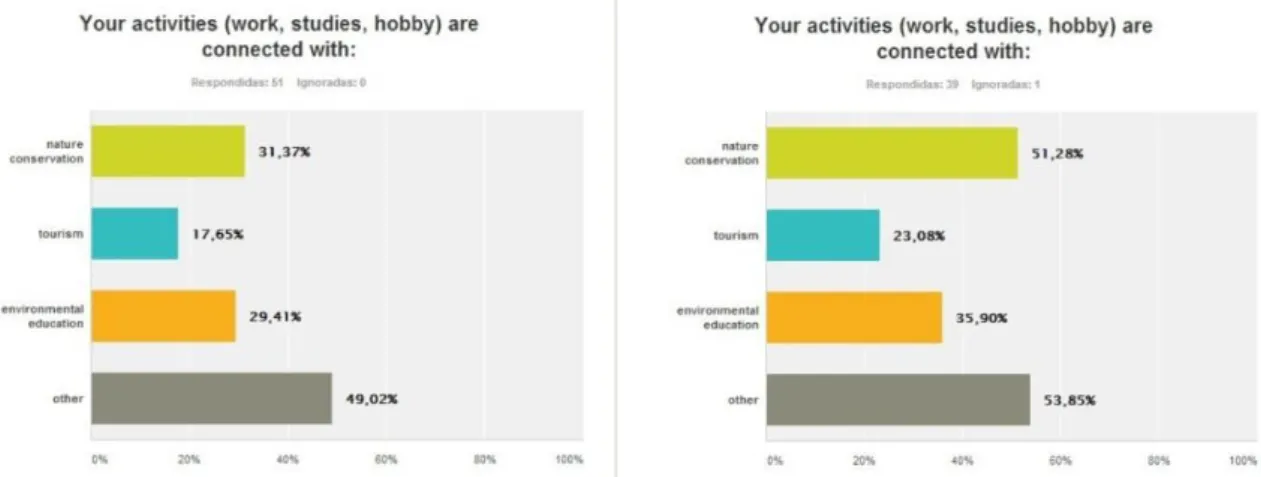
Each survey consisted of 10 questions (https://www.surveymonkey.com/s/999GRKN, https://www.surveymonkey.com/s/SLHYBV7), allowing to determine the type of persons’s activity (work, hobby – connected/not connected with nature conservation, tourism, environmental education), evaluate their awareness about the wetlands (marshes, fens and bogs) and wetland protected sites of the country in general and knowledge about the particular wetland research sites of the thesis.
Comparative approach was further applied for the analysis of Belarusian and Portuguese research sites. The criteria were established taking into account the ones that were used for characterization of each protected area. Thus, they are as follows: protection status, historical aspect of wetlands’ formation, uniqueness, current threats, management, nature conservation activities, ecotourism, water quality, public awareness, overall performance. It is also important to note that the 4th research site in Portugal (the peatbog in Lagoa do Dom João) will not be included into the analysis since it has been an example of Portuguese peaty marsh but completely natural and with no nature conservation management.
2.
Issue background
2.1 Overview of Belarusian wetlands
2.1.1 Historical context, area size and value
Belarus has always been the land of wetlands. The world indicator for wetland areas percentage is 6 % (AAAS, 2014), for the marshes (mires, peatlands) – 3.4 % (Chichko, 2010) whereas in Belarus it is 7 % and 6.4 % respectively (Astapovich, 2011). It holds 17th place in the world by the peatland area (Fenchuk and Kazulin, 2012).
Furthermore, Belarus has 16 Ramsar sites with a surface area of 614 708 ha (Ramsar, 2013a), all of them being specially protected nature areas of a various state status: one national park and zakaznik (reserves). Besides, not only Ramsar sites but other wetlands are Important Bird Areas, Belarus has 49 such areas (Birdlife, 2014c). Among wetland types the dominant ones for Belarus are fen mires and peat bogs, the other ones being lakes.
In the 1960s wetlands covered 15% of the country whereas mires were spread on 14,2% (Chichko, 2010), almost half of that area suffered from massive drainage in the 1960-1990s. As a result the area of mires decreased to 6.4 % (Astapovich, 2011), the remaining area having been drained for the purpose of agriculture, forestry, and peat extraction.
All in all, Belarusian mires can be divided into 3 groups by their current state: natural ones with disrupted hydrology; drained and being used ones; abandoned drained peatlands being restored in the recent years. The natural ones with disrupted hydrology are in a natural state but are influenced by the surrounding drained areas, thus, have experienced disturbance of hydrological regime, water pollution, overgrowth with reeds. The main conservation measures are habitat and vegetation management. The drained peatlands which continue to be used for peat extraction, agriculture are out of the conservation measures. The abandoned drained peatlands are current restoration project sites that have recently been rewetted.
It should be noted that drained peatland sites have caused large CO2 releases due to peat decomposition whereas these areas are naturally meant to accumulate CO2 and thus reduce greenhouse gas emissions. These degraded wetland areas are the reason for Belarus being the 8th in the CO2 emissions list (IMCG, 2014).
Biodiversity value
According to BrantaTours, 2014, Belarusian wetlands are responsible for rich biodiversity being habitat for key rare and endangered plant species such as rare species of orchids, lichens, mosses, typical mire plant communities; rare bird species such as Greater Spotted Eagle, Aquatic Warbler, Common Crane, Corncrake, Short-eared Owl.
Bogs are a place to see Terek, Marsh and Green Sandpipers, Whimbrel, Curlew, Golden and Ringed Plovers, Black-tailed Godwit, Greenshank, Redshank, Snipe, Great Snipe, Redshank, Spotted Redshank, Great Grey Shrike, Meadow Pipit, Citrine and Yellow Wagtails, whilst the edges surrounding the pine bogs are typical breeding place for Osprey, Golden and Short-toed Eagles, Hobby and Merlin.
Open meadows and mires are hunting grounds for various birds-of-prey breeding in neighbouring floodplains and forests, such as White-tailed, Short-toed, Greater and Lesser Spotted Eagles, Honey Buzzard, Goshawk, Great Grey and Short-eared Owls.
Old floodplain forests feature Hazel Grouse, Capercaillie, Woodcock, Middle Spotted Woodpecker, Black Stork, Eagle Owl, Roller, Redwing and Azure Tit.
Besides birds, mammals are also encountered in the wetland areas and in the neighboring forests: Gray Wolf, Brown Bear, Wild Boar, Eurasian Lynx, Racoon Dog, Eurasian Elk, European Roe Deer, European Beaver, European Bison, European Mink.
Thus, the wetlands of Belarus are an interesting tourist attraction that is well-known within the bird watching community and is promoted in the country and for foreign visitors.
2.1.2 Scientific research and conservation activities in recent years
In the 1990-2000s foreign scientists stimulated arising interest in wetland conservation in Belarus, having developed several projects, the most important one was connected with the discovery of the globally threatened bird species of Aquatic Warbler on one of the Belarusian fen mires and further research on this bird dependency on suitable wetland conditions (Kozulin and Flade, 1999).
For the recent 25 years there has been done a lot in the area of wetland conservation. Here are one of the most significant actions implemented by APB-Birdlife Belarus, UNDP Belarus, various Ministries, local executive committees, local forestry entreprises, local population, volunteers with both national and foreign financial support (UNDP, GEF, European Union funds, USAID, Michael Otto foundation for environmental protection (Germany), Michael
Succow foundation (Germany), Royal Society for the protection of birds (UK), German KfW bank, Coca-Cola Beverages Belarus):
New protected areas created on the wetland territories, now, with the already existed ones, comprising 1/3 of the overall wetland area in Belarus;
Restoration of hydrological regime of the Jeĺnia peatbog (1992-2002, 2008-2010) – implemented by APB-Birdlife Belarus with the support of Coca-Cola Beverages Belarus, RSPB, UNDP-GEF: construction of 48 dams on the drainage canals which allowed to raise groundwater level and stimulate conditions for restoration of native flora/fauna (Shajkin and Levy, 2010; GEF-SGP, 2008c);
Management planning for conservation of fen mire biodiversity in Belarus (1999-2002) – implemented by APB-BirdLife Belarus in cooperation with the Ministry of Natural Resources and Environmental Protection; financed by Michael Otto Foundation for Environmental Protection (Germany) and UNDP Belarus: development of Management Plans for Zvaniec, Sporava and Dzikoje fen mires (UNDP, 2002);
Implementation of urgent recommendations of the management plans for key biodiversity areas in Belarus (2002-2006) – implemented by APB-BirdLife Belarus with the support of the RSPB (UK), UNDP, the Darwin Initiative for the Survival of Species (UK) and Michael Otto Foundation (Germany): hydrological regime stabilized at Zvaniec fen mire (7 sluices and dams constructed) and Dzikoje fen mire (5 dams constructed), monitoring of Aquatic Warbler population at 5 breeding sites, ringing of Aquatic Warbler at Zvaniec, Sporava and Dzikoje, water management regulations developed for the fishfarm near Sporava fen mire (UNDP, 2006b);
Conservation of Unique Biological Diversity of Turaú Meadow Through Sustainable Use (2006-2008) – implemented by Turaú city council with the GEF-SGP support: establishment of site management structure, construction of a tourism trail, workshops with guides and agro-tourism providers, conservation actions against overgrowth with bushes and reeds, monitoring of bird populations (GEF-SGP, 2006a);
Conserving unique biological diversity of lowland mires through their sustainable use (2006-2009) – implemented by APB-Birdlife Belarus, funded by GEF-SGP – vegetation management at 2 key Aquatic Warbler breeding sites – Sporava and Zvaniec – mowing and bush removal (GEF-SGP, 2006b);
Eco-tourist path setup and restoration of the natural hydrological regime of the marsh at the hydrological reserve “Vyhanaščanski” (2008-2009) (GEF-SGP, 2008b);
Restoration of the natural hydrological regime of the reserve “Dakudaúski” upset by peat extraction (2008-2010) (GEF-SGP, 2008d);
Catalyzing sustainability of the wetland protected area system in Belarusian Palieśsie through increased management efficiency and realigned land use practices (2006-2011) – coordinated by the Ministry of Natural Resources and Environmental Protection, with the support of APB-Birdlife Belarus, funded by UNDP-GEF and Ministry: 4 wetland reserves – Sporava, Zvaniec, Mid-Prypiać, Prastyr – implementation of Management Plans for Sporava and Zvaniec reserves, Management Plan development for Mid-Prypiać site, establishement of a cross-border (with Ukraine) Ramsar site “Upper Prypiać” (Ministry, 2006; UNDP, 2006a; 2010a; 2011a) (Figure A1, Appendix);
Peatland Project (2006-2011) – Renaturalization and Sustainable Management of Peatlands in Belarus to Combat Land Degradation, Mitigate Climate Change, and Ensure Conservation of Globally Valuable Biodiversity implemented by the Ministry of Forestry and APB-Birdlife Belarus at 15 sites (Figure A2, Annex): approximately 28 000 ha of degraded peatlands rewetted and rehabilitated, their long-term protection secured, reduction of CO2 emissions by at least 300,000 tons annually, populations of threatened biodiversity species stabilized, risk of fires diminished significantly (UNDP, 2010b);
Restoring Peatlands and Applying Concepts for Sustainable Management in Belarus (2008-2012) – implemented by APB-BirdLife Belarus and the Michael Succow Foundation in cooperation with RSPB and the Government of Belarus. The project is financed by German government through KfW bank. 10 designated sites – a large scale peatland investigation and rewetting programme: rewetting of ca 15 000 ha of degraded peatlands and calculation of greenhouse gas emission reductions to facilitate certification and sale of carbon credits on the voluntary market (Restoring peatlands, 2010b);
Creation of conditions for the development of eco-tourism at the Republican Biological Reserve “Sporaúski” (Biaroza district) with the minimal environmental impact (2008-2009) – implemented by the local village council, funded by GEF-SGP: construction of ecological trails for tourists and schoolchildren, organization of environmental activities for raising public awareness, organization of open championship on hay mowing (GEF-SGP, 2008a);
Eight wetlands 2011-now – web-project created to raise public awareness about the government decision on reduction of the area of 8 wetland reserves for using that land for peat extraction: as a result of public signing of the petitions and active media coverage of the
problem, one of the reserves has managed to be left without any changes in its area, the situation of the other ones has not been decided on yet (Eight Wetlands, 2011). This campaign has been doing a lot in raising public awareness about Belarusian wetlands and their present problems, widening the audience of indifferent people further than ecological community; Aquatic Warbler (AW) conservation in Belarus project (2002 – up to now) has been implemented by APB-BirdLife Belarus with support of RSPB. Belarus hosts 40% of this globally threatened species, mostly on 3 key breeding sites of Zvaniec, Sporava and Dzikoje; the bird serves as an indicator of wetland conservation state. What is done: habitat management, monitoring of Aquatic Warbler numbers and distribution, Aquatic Warbler counts in Sporava, Zvaniec and Dzikoje sites, study of migrations (Ministry, 2006; Malashevich, 2012). The AW counts project is fully described in chapter 3.1.4;
Sustainable scheme for peatland conservation and management developed: transformation of the current approach to peatland use (balancing real income from peat extraction by hypothetical arguments of biodiversity conservation)to the new one (balancing real income from peat extraction by real income from peatland restoration and conservation) (Fenchuk and Kazulin, 2012):
Key elements of this scheme (Figure A3, Annex) are practical (how to reach maximum effect for climate and biodiversity during rewetting), scientific (how to estimate the amount of emission reductions and the effect on biodiversity), economical (how to ensure flow of funds for future managing rewetted peatlands and continuation of the work on restoration of degraded peatlands; how to balance real money from peat extraction by real money from peatland restoration and conservation) and political (how to ensure the recognition of the significance of mires/peatlands and their importance for climate balance).
Economical effect is planned to be reached through selling carbon emission reductions on the international carbon market (Fenchuk and Kazulin, 2012);
Secondary bogging of exhausted peat field “Choreúskaje” and “Astroŭúskaje” with the purpose CO2 emission reduction, prevention of peat fires and biodiversity protection (2009-2012) – implemented by APB-Birdlife Belarus, Mijory and Pružany village councils, Pružany forestry entreprise, Jeĺnia reserve administration, with the support of the Ministry of Natural Resources and Environmental Protection, funded by GEF-SGP: waterlogging of the depleted part of peat bog, restoration of hydrological regime and peat ecosystem on the 2 lowland bogs in the aim of prevention of peat fires, reduction of CO2 emission, preservation of biodiversity (GEF-SGP and APB, 2009a);
Sustainable Management of Wetland Protected Areas of International Importance in Stolin district (2012-2013) – implemented by the local village council, funded by GEF-SGP: creating condtions for development of ecotourism, environmental education in Mid-Prypiać reserve, upgrade of buildings of the reserve with energy-efficient technologies (SGP-GEF, 2012);
Clima East “Conservation and sustainable management of peatlands in Belarus to minimize carbon emissions and help ecosystems to adapt to climate change” (2014-2020) – implemented by the Ministry of Natural Resources and Environmental Protection with the support of the National Academy of Sciences of Belarus, national reserves Zvaniec and Sporava, local authorities of the Drahičyn and Biaroza districts and APB-BirdLife Belarus, funded by UNDP-GEF: aimed at restoration of Sporava and Zvaniec fen mires by mechanized mowing and collecting and use of biomass for fuel briquette production (ClimaEast, 2014); Berries of Stolin district (2014-2015) - implemented by the local company, funded by GEF-SGP: the goal is to create conditions for reducing the degradation of peatlands in the western part of the Stolin district, through their involvement in agricultural use and setting up blueberry plantations; diversify agricultural production in private households of Stolin district by blueberry production development, including involvement of degraded peatlands (GEF-SGP, 2014);
Thus, wetland, and mostly, peatland conservation in Belarus implies combination of 2 aspects – conservation and education&ecotourism. The conservation aspect involves conservation and scientific research, ensurance of formal protection of the areas, development of their management plans and creation of the administrations of the wetland reserves (the last measure was first implemented within the project, proved to be successful, was approved by legislation and now is practicedon the state level) (Malashevich, 2013-2014).
There are lots of bureaucratic barriers faced by the Belarusian environmental NGOs such as obligatory registration of the projects (only on condition of Letter of Support from the Ministry of Natural Resources and Environmental Protection), obligatory use of all the money during the project (no possibility of savings, only target use of funds) (Malashevich, 2013-2014), financial control of the organizations by the state, financial problems (only foreign funding which is often difficult to get), state management focused on getting only financial benefits, neglecting environmental aspect, lack of ecological awareness in the society caused by a short history of ecological movement in Belarus.
However, the wetland conservation community in Belarus is rather strong and not concentrated on science only, they also devote their work to people and raising their interest
in nature conservation. For example, there are voluntary camps annually organized by APB-Birdlife Belarus within the Aquatic Warbler conservation project, dam construction on Jeĺnia peatbog; birds festival in Turaú, seasonal bird observations, public petitions on the Internet, infocampaigns through creation of commercials, videos, organization of educational activities in public places.
Moreover, local communities play a significant role in saving traditional environments in their villages. The success of the past and present activities is in complex use of conservation instruments (State-NGO dialog, foreign funding, scientific community, public campaigns, local population involvement, enthusiasm and concern about saving nature and its elements).
2.2 Overview of Portuguese freshwater wetlands
2.2.1 Historical context, area size and value
Portuguese continental wetlands (both freshwater and saltwater) are located mostly along the coast of the country representing various wetland types, both natural and human-made: rivers, lakes, ponds, creeks, estuarine lagoons with extensive dune systems, mudflats and reedbeds, artificial salinas, alluvial plains; swamps, bogs, saltpans and saltmarshes, freshwater marshes with series of drainage canals surrounded by agricultural lands and forest, rice fields and fishfarms, peat bogs.
Agricultural development has led to drainage of marshes and meadows, afforestation of marginal lands during the 20th century which have caused disturbance of hydrological regime of the areas, soil erosion, increased water run-off, irregular river discharge, and transformation of the landscpaes due to overgrowth with invasive plant species. This has posed a threat to a lot of aquatic bird species which have always used the wetland areas as migrating stopovers, breeding and nesting sites.
Work on making inventory of the Portuguese wetlands started in 1975 but had not brought any real result until 1999 when the Institute for Nature Conservation and Forests started a project on conservation of wetlands having developed Action Strategy for the project focused on the need for National Inventory of Wetlands (ZHP, 2014).
Wetland conservation was set as a priority in the National Strategy for Conservation of Nature and Biodiversity in 2001 (ZHP, 2014).
There is no accurate information on the whole wetland cover in Portugal. As for now, there is information that there are 1302 wetland areas (ZHP, 2014) identified in Portugal, continental and island parts (the Azores and Madeira). Moreover, according to MedWet/WIS database there are 527 wetland sites covering 5.07 % of the overall number of Mediterranean wetlands (MedWet and Kapanidis, 2014).
The terms for the types of wetlands in Portuguese are various – estuário (estuary), sapal (saltmarsh), charco (swamp, bog, mire), paul (more or less close to marsh), lagoa (pond), lago (lake), ribeira (river), pantano (swamp), turfa (peatbog), which can be natural, artificial, permanent or temporary. The 3 research sites of the thesis (Paul de Arzila, Paul do Boquilobo, Paul da Tornada) are of the “paul” type which is closest to marsh in Belarus. The research peat site (Lagoa de D.João) is closest to peat bog in Belarus.
The Ramsar Convention on Wetlands came into force for Portugal in 1981. Portugal presently has 31 sites designated as Wetlands of International Importance, with a surface area of 132,487 hectares which is 1.44% of the whole country area (Ramsar, 2013b). See Table 2.1.
Analysis of the Ramsar list of Portugal allows us to classify the Ramsar sites according to their types.
Continental freshwater wetlands are 12 of 31 Ramsar sites, belonging to the “permanent freshwater marshes/pools, seasonal/intermittent streams/rivers, non-forested and forested peatlands” types (Ramsar classification).
The Azores possess 10 freshwater Ramsar wetlands – forested and non-forested peatlands, permanent/seasonal freshwater lakes/marshes/pools (Table 2.1).
Thus, Portugal on the whole has 22 internationally protected fully or partially freshwater wetlands covering almost 16% of the Ramsar areas of Portugal (Figure A4, Appendix). Calculations were made using the data on Ramsar sites of Portugal.
Table 2.1 Indicators of Portuguese Ramsar sites on the continent and the Azores (number, area, percentage) (Ramsar, 2013)
Number of sites Area, ha %, of the country area Ramsar sites 31 132 487 1.44 Cont Portugal 18 119 587 1.3 freshwater marshes/lakes/peatlands 12 8290 0.09 other 8 111 297 1.21 Azores 13 12900 0.14 freshwater lakes/peatlands 10 12790 0.139 other 3 110 0.001
Thus, Ramsar continental freshwater wetlands of Portugal cover 0.09 % of the country area or 6.3 % of the Portuguese Ramsar area (Table 2.2).
Table 2.2 Indicators of Portuguese Ramsar freshtwater wetlands (Ramsar, 2013)
Number of sites Area, ha %, of the country area
%, of the Ramsar area
Freshwater wetlands among Ramsar sites
20 21080 0.23 15.9
continental FW 12 8290 0.09 6.3
Azores FW 10 12790 0.139 9.6
Moreover, these areas are all protected at the national or municipal level, having different state protection statuses: 5 natural parks, 8 natural reserves, 1 local natural reserve, part of 1
national ecological reserve, 1 protected landscape, 1 natural regional monument, Rede Natura 2000 sites, UNESCO Biosphere Reserves, Sites of Community Importance, Special Protection Areas (ICNF, 2014c) (Table A1, Annex). Besides, Portugal has designated 33 freshwater wetland areas as Important Bird Areas (Birdlife, 2014d).
Value
The Portuguese continental freshwater wetlands are important wintering and resting grounds for migratory aquatic bird species using the Eastern Atlantic flyway to Africa (Ramsar, 2013b). Moreover, many threatened species populations are supported thanks to the wetland areas as their breeding and nesting points: bird species (ducks, herons, flamingos, waders), mammal species (European otter, Wildcat), indigenous fish species (Iberian barbel), reptiles, amphibians.
What is more, the wetlands serve for regulation of the groundwater level, flood prevention, and human activities such as fishing, aquaculture, shellfish trade, traditional salt production. Peatbogs situated in the Portuguese mountaineous areas, have an important function of CO2 storage.
2.2.2 Scientific research and conservation activities in recent years
Conservation of wetlands in Portugal is an important aspect of its conservation policy. Having ratified the Ramsar convention in 1981, the country has done a lot in designation of 31 wetland sites for conservation, development of Site Management Plans and promotion of aquatic bird protection and sustainable use of wetland resources. Conservation of freshwater wetlands is part of the wetland conservation policy, 22 Ramsar sites out of 31 being fully or partially freshwater ones.
However, freshwater wetlands, as it seen above in the text, cover a small percentage of the protected wetland areas; second, some of them have been seriously transformed by man and have lost their natural functions; third, the Portuguese conservation approach in some wetland protected areas (the thesis research sites are an example) does not imply recuperation of habitats with their primary functions but means their designation with conservation status and minimizing human impact on the area, work with local population, regulation of hunting, fishing which often turns out to be permission for further landscape transformation with rare conservation actions. On the other hand, there are freshwater wetland areas where
conservation and educational projects are actively developed and implemented and positive results obtained in both biodiversity conservation and rasing public awareness.
Conservation projects developed and implemented in Portugal are usually those in cooperation with the EU countries and with the EU funds support. Here are several projects brought to life in the recent 20 years in the freshwater wetlands of Portugal:
multiple researches on various conservation aspects undertaken by groups of scientists from the universities, environmental organizations (for example, researches for Ramsar Site Management Plans, studies on expansive vegetation growth, evaluation of environmental quality in the wetland reserves made by the specialists of the Institute for Conservation of Nature and Forests, the University of Lisbon, Porto, Coimbra, Algarve);
MedWet1 (1992-1996) – project of the Mediterranean Wetlands Initiative, aimed at developing conservation methods and tools that would be specific to the Mediterranean, initially involving 5 EU countries (Portugal, Spain, France, Italy and Greece) while also involving the countries of North Africa and the Middle East. The project was led initially by a Steering Committee chaired by the EC and then the Ramsar Bureau (MedWet, 2010a).
There were 5 sites participating in the project (one for each country). In Portugal it was Sado Estuary. The objectives set were as follows: to develop methods and tools specific to Mediterranean wetlands in five areas: inventory and monitoring, wetlands management, training, public awareness, research results and dissemination. As a result, the developed tools were applied to the research sites: 5 manuals for Inventory of Mediterranean Wetlands, methodological guide for monitoring, training modules for management and monitoring wetland vegetation;
SUDOE: Inventory, assessment and monitoring for wetland management (2003-2004) – MedWet project implemented in 16 wetland sites of Portugal (7) and Spain (9) (among them Paul de Arzila Natural Reserve, one of the thesis research sites). The objectives were as follows: to provide the SUDOE region (Southwestern Europe) with a tool for the elaboration of management and monitoring plans for wetlands, to improve the MedWet inventory methodology for wetlands, to promote public awareness and participation, contribute to the institutional development of each partner through exchange of information and communication of results (MedWet, 2010b).
The results achieved: new datasheets added to the MedWet inventory methodology; cartographic conventions and data management with a GIS; seminars, training courses, contribution to management plans of the sites, habitat description system applied to the sites;
Charcos com Vida – initiated by CIBIO in 2014: an educational campaign aimed at creation of inventory on charcos (wetland type) and raising public interest and awareness, focusing on the primary and secondary schoolchildren. The project suggests “adoption” of the charcos (taking responsibility for characterization, observation, investigation, maintenance of the area, organization of educational activities, spreading information about the intiative) or construction of the new charcos according to the techniques provided. This could be done by schools or other interested entities. Moreover, the project provides pedagogical materials on various aspects of the issue;
LIFE programme has been a successful initiative for Portugal, having funded multiple conservation projects. Since its launch in 1992, there have been 73 projects in the field of nature conservation in Portugal (EU, 2014). Below are the LIFE projects implemented and planned for implementation in the freshwater wetlands of Portugal:
LIFE Re-establishment of the Baixo Mondego marshes (1st phase, 1993-1995) – coordinated by the National Service of Parks, Reserves and Nature Conservation: preservation the three wetlands of the Baixo Mondego marshes (Paul de Arzila, Paul da Madriz and Paul do Taipal) (EU, 1993): purchase of lands by state, innovative techniques in agriculture, creation of infrastructure for visits.
LIFE Porphyrio - Porphyrio project - Reintroduction of the Purple Gallinule in the Lower Mondego River Valley (1998-2001) – implemented by the Institute of the Sea with the support of the Institute for Conservation of Nature and Forests in Paul de Arzila and Paul de Madriz reserves: restoring a viable population of purple gallinules in the lower Mondego by re-introducing birds from Spain (EU, 1998). This project was innovative in Portugal, for it was the first time that a soundly structured and monitored bird reintroduction plan was implemented.
LIFE Palustris - Palustris, Management of the Special Area of Conservation of the Marsh of Arzila (2001-2006) – implemented by the Institute for Conservation of Nature and Forests and Paul de Arzila Nature Reserve (EU, 2001).
LIFE Trachemys (2011-2013) – EU funded project for Spain and Portugal on eradication of alien species of freshwater turtles thorugh their captures: the results are described in chapter 3.2.5 (EU, 2011).
LIFE Ecotone Management of riparian habitats towards the conservation of endangered invertebrates (2012-2016) – implemented by QUERCUS (EU, 2012).
This project is targeting the conservation of alder alluvial forests in two Portuguese rivers (Rio Paiva, Torgal stream in Costa Sudoeste), in order to increase the populations of three species of dragonfly. The project also sets out to improve the conservation status of two species of freshwater pearl mussels (EU, 2012a).
LIFE Charcos Conservation of Temporary Ponds in the Southwest Coast of Portugal (2013-2017) – implemented by the League of Nature Conservation. Mediterranean temporary ponds (CTMs) are seasonal wetland habitats, subjected to extreme and unstable ecological conditions (EU, 2013). Due to their uniqueness and scientific value, they are listed as a priority habitat for conservation in Annex I of the EU Habitats Directive. The project’s overall aim is to enhance the conservation status in southwest Portugal of Mediterranean temporary ponds (CTMs) (EU, 2013).
Expected results: The project’s main expected result is to halt the loss of temporary ponds in the Costa do Sudoeste Natura 2000 site, reversing the declining trend observed in the past few years. Conservation and demonstration actions are planned for at least 16 temporary ponds, and in some of the ponds more than one type of conservation action will be applied simultaneously.
It can be seen from the information above that there have been various initiatives in the field of freshwater wetland conservation in Portugal. Some of them are implemented in the protected areas, the other ones concern the unprotected territories in need for conservation actions. The projects are funded from the EU funds (LIFE, joint country initiatives) and brought to life by Portuguese NGOs (Quercus, League for the Protection of Nature, etc) and governmental environmental entities (ICNF, administrations of the protected areas). However, it should be noted that funding for the project is difficult to obtain in Portugal, and the process of project implementation is often delayed or disturbed by bureaucratic barriers. The conservation initiatives are implemented more efficiently within the particular projects in the unprotected wetland areas and are sporadic under the management policy of the protected ones. The wetland conservation community in Portugal is devoted to their goals but lacks motivation and reliable sources for that: its members have faced so many obstacles on their way (both at the European, national and local level) that the low efficiency of their current work can be seen as a consequence of the previous processes.
3.
Research data
3.1 Research sites: Belarus
3.1.1 Sporava mire
3.1.1.1 Location
Sporava mire is a fen mire (Europe’s largest complex of natural floodplain fen mires) situated in Southwest Belarus, Brest region, in the area of 4 districts – Biaroza, Drahičyn, Ivanava and Ivacevičy, in the floodplain of the middle course of the Jasieĺda River, left affluent of the Prypiać River, Black Sea basin (NAS, 2009a) (Figure 3.1).
3.1.1.2 History and present main features
The area of the reserve is represented by the landscapes of ancient alluvial lowlands with wide and poorly drained floodplain and floodplain terraces complicated by lake and peat-filled depressions. First, there is a tectonic fracture in the area between such tectonic structures as Palieśsie depression in the east and Brest depression in the west which served as a pre-condition for wetland formation. Second, there is a lake-mire depression in the area of Lake Sporaúskaje formed in the postglacial period (NAS, 2009a). Thus, there are at least two factors which determined the conditions of excess wetting of the area.
The Jasieĺda floodplain, which is 0.5–2 km wide, is a typical fen mire. Lowland mires absolutely dominate the landscape occupying peaty or peaty-gleyed moderately acid soils (NAS, 2009a). A typical feature of Sporava mire is the layer of sapropel under peat which is a clear evidence of past existence of shallow lakes on this territory.
There has been developed the following scenario of Sporava mire formation:
13 thousand years ago the alluvial lowland was occupied by the rather stagnant shallow lake with the ongoing process of sapropel deposition. The process was rather slow due to cold weather conditions and poor mineral nutrition;
6.5 thousand years ago there was a blowout of the water from the lake which caused further formation of the Jasieĺda River. The ancient lake gradually became shallow and started to turn into the mire, whereas its former area turned into the Jaselda floodplain. Peat deposition has occurred since that in the floodplain (NAS, 2009a).
The mires within the reserve comprise a solid continuous tract (75% of the area) stretched along the Jasieĺda River for about 35 km (NAS, 2009a). The centre of the reserve is occupied by Lake Sporaúskaje which provides conditions for close proximity of ground water table to the soil surface.
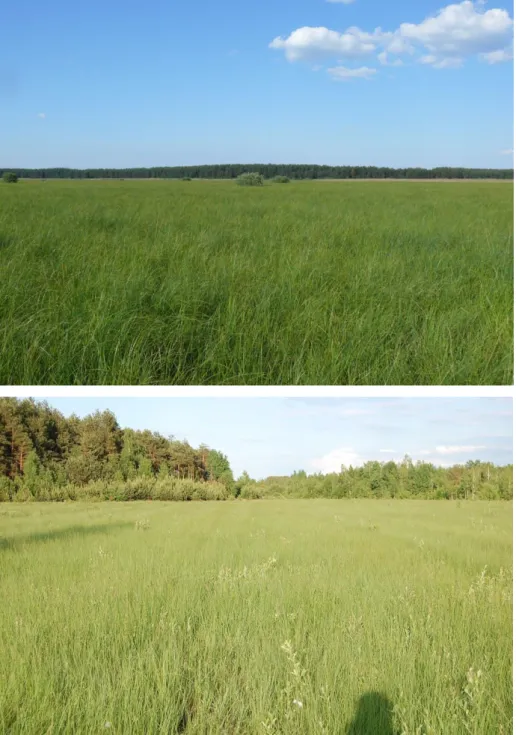
Most of the site is covered by open fens and shrubs. There are numerous small hills and low mineral islands scattered across the mire. In the past, these mineral islands were covered by oak and pine woods. Eventually the forests were cut, and the islands were used as agricultural fields and pastures. Today most agricultural fields are abandoned and the natural vegetation is regenerating. Nowadays the hills are covered with oak, birch, black alder and ash.
Most of the site area appears to be in condition very close to the natural one, however, it is influenced by the surrounding areas which were drained for agricultural purposes and intensively used in the 1970-80s (NAS, 2009a). Around 20 years ago all the drainage system was turned off, however, the consequences of its construction continue to influence the mire.
As APB, 2009b states, before drainage the hydrological regime of the Jasieĺda River was typical of flatland rivers: every spring high floods would occur, followed by prolonged summer dry periods, regularly interrupted by rainfall. Sialiec fishfarm and a reservoir were constructed in the river floodplain (NAS, 2009a). They have seriously influenced the hydrological regime of the river. In the past, in spring the filling of the fishfarm’s ponds was carried on, so spring floods were almost absent, but summer inundations have become common since in the summer the fishfarm let out the water intensively and high rains added to the flooding, thus, this caused increase in ground nesting birds’ mortality. Disruptions in the hydrological regime have resulted in intense overgrowth of the river channel and the lake, severe annual inundation of the floodplain and catastrophic droughts and fires during the year. In 1991 the Sporava mire got a state protection status of a biological reserve and became 1st Ramsar site in Belarus in 1999 (NAS, 2009a).
3.1.1.3 Protection regimes
Sporava mire has the following national and international protection statuses: National – Sporaúski state biological reserve (zakaznik) established in 1991, renamed and expanded Sporaúski republican biological reserve established in 1999 (NAS, 2009a). Logo of the reserve is on Figure 3.2, showing the Aquatic Warbler as a key species;
Figure 3.2 Logo of the reserve (Wikimapia, 2014)
International – Ramsar site established in 1999 (first in Belarus), Important Bird Area (IBA) established in 1998 (Ramsar, 2013a).
3.1.1.4 Area size and zoning
Sporaúski reserve has an area of 19 384 ha (NAS, 2009a). It represents a weakly disturbed part of flat Jasieĺda floodplain with ducts, oxbows and fen mires (Figure 3.3). It can be