1
CHAPTER ONE
INTRODUCTION
1.1. Overview
The present research is a descriptive corpus-based translation study aiming at pinpointing the patterns of translation into Persian when dealing with English Verb Phrase Ellipsis (VPE) and finding out how that observed translation behavior may be taken as advantageous information for improving English-Persian Machine Translation (MT) systems performances.
1.2. Corpus-based Translation Studies
The word corpus is a Latin word that signifies “body”. It refers to any written or spoken text. However, in modern Linguistics corpus is large collections of electronic and machine readable form texts which represent a sample of a particular variety or use of language(s) (Garner, 2004, p. 226). In this regard, McEnery and Wilson (2001, p. 29) indicate “any collection of more than one text can be called a corpus”; however, in the context of modern linguistics modern corpora have the following characteristics (p. 32): Sampling and Representativeness, finite size, machine-readable form, and Standard reference.
Corpus plays an important role both in Linguistics and in Natural Language Processing (NLP). It aims at providing real, authentic language example, which may constitute a more reliable resource for analyzing linguistic phenomena. The essential characteristics of corpus-based analysis, according to Biber et.al (1998, p. 4), are:
1. It is empirical, i.e. it analyzes the actual patterns of use in natural texts;
2. It utilizes a large and principled collection of natural texts, known as a “corpus”; 3. It makes extensive use of computers for analysis;
2
In recent years there have been many applications of corpora to various disciplines, including translation studies (Xiao and McEnery, 2002; Zhang, 2002; Granger, 2003; Bernardini & Zanettin, 2004; Yan et al., 2008; and Guangrong 2009). The use of corpora in translation and contrastive studies has increased since the 1980´s and the first corpus for translation studies purpose was compiled in 1995 (Baker, 1996). During this time, the methods and tools of corpus linguistics were incorporated into Descriptive Translation Study (DTS) (Toury, 1994). Toury was the first one who elaborated the concept of DTS. As Farahzad (2000) puts it, “studies of this type are able to examine areas such as decision-making in translation, translation norms, and universals of translation” (p. 20). In the early 90´s, Baker (1993, p. 243) predicted that “the availability of large corpora of both original and translated texts, together with the development of a corpus-driven methodology, would enable translation scholars to uncover the nature of translated text as a mediated communicative event.” Varantola (2003) states "the knowledge of how to compile and use corpora is an essential part of modern translational competence, and should therefore be dealt with in the training of prospective professional translators." (p. 56)
This study adopts Toury’s perspective that any research in translation should start with observational facts (translated utterances and their constituent elements) towards that reconstruction of non-observational facts (Toury, 1994, p.18). By this, the author meant the translated texts are to be studied focusing on the techniques and the strategies the translators have adopted in dealing with, principally, the contrasts of the languages in question. This kind of study helps stating some predictive or explanatory rules about those contrasts and helps achieving a good understanding of the probable errors due to the differences between patterns in the first language (L1) and those found in the second language (L2). Understanding the nature of those errors is necessary before systematic means of resolving them could be found.
In order to define translational behavior in some form of patterns and rules it is necessary to analyze a large quantity of texts which can be considered as a representative of a given phenomenon in a language. Since it is impossible to analyze all the utterances of a language, a sample that can characterize linguistic behavior in that language can be analyzed instead. Due to the fact that analyzing such a large selection of texts manually is not feasible and since this is a tiresome task, highly subject to human error, machine readable texts must be processed using robust (Natural Language
3
Processing (NLP) tools. The machine-readability facilitates corpus-based studies because the corpora can be searched and manipulated easily and quickly by application of adequate tools which can read the texts, preprocess and normalize them, locate and align all the occurrences of any linguistic pattern along with the corresponding sentences in the other language, extract the collected data, add some other information to the text, for example annotating it with part-of-speech (POS) tags in order to enable researchers to carry out some linguistic investigations in attaining other purposes, and so on.
Different kinds of corpus can be construed depending on their specific purposes. A parallel corpus, i.e. a series of source texts aligned with their corresponding translations, is a good basis for studying translation procedures.
The goal of the present study is to study Persian texts translated from English in order to scrutinize the systematic strategies used in the translation of VPE structures, thus help to identify translation norms. By exploring the probable regularities to be found in these strategies, it may be possible to help define rules for improving the performance of English-Persian Machine Translation (MT) systems. Therefore, an English-Persian parallel corpus will here be used as a starting point to retrieve English sentences where VPE instances are observed and to compare them with their Persian counterparts with the purpose of doing a cross-linguistic contrast.
1.3. Verb Phrase Ellipsis (VPE)
The majority of English sentences include a verb phrase (VP) where an inflected verb appears. It means that, in general, for a sentence to be complete it should contain a verbal constituent. However, sometimes sentences can be found that do not present an inflected verb form yet they are intuitively complete (examples (1) and (2)). In fact, repeated material can be zeroed to avoid redundancy (the part(s) in square brackets indicate the elided element(s)):
(1) John read the magazine and Mary [read] the newspaper. (2) John went to school and then [John/he went] to the mall.
In example (1), the repeated verb `read´ has been zeroed, whereas, in example (2) both the subject `John/he´ and the verb `went´ have been zeroed. This phenomenon can be
4
called `verb phrase ellipsis´. It occurs, for example, in providing short answers to queries. For discoursive economy, in question-answer sentence pairs, verbs in the answer sentence are often omitted, when they are the same verb appearing in the question sentence, as in example (3):
(3) Have you gone to the mall?
- Yes, I have [gone to the mall.]
In the answer, the repeated material has been omitted since the discursive situation, in this case the previous sentence (the question), enables the reconstruction of that zeroed material.
VPE in verbal groups forming compound tenses frequently occurs in English, so that what remains in the utterance is just the auxiliary verb, while the main verb is deleted; consider examples (4)and (5):
(4) I was studying, but he wasn´t [studying]. (5) Have you been cleaning the house whole day?
- Yes, I have been [cleaning the house]
Another case, which can be included in the set of VPE phenomenon, is signaled by certain adverbs or clue-words that indicate repetition (e.g. `also, like, too, again…´); the presence of these elements presupposes the presence of the previous utterance of the material they refer to (examples (6) and (7)):
(6) I read the journal and Mary [read the journal] too. (7) She had talked with him and so had Mary.
In example (6) a complete deletion of VPE has occurred, while in example (7) there is a partial deletion of the verbal group, since only the tense operator `had´ has remained.
In many situations the repeated material can be reduced to a “pro-verb” Gerhard (2005, p. 187), that is, a dummy, semantically void, verb replaces that verb/verb phrase, as in example (8):
5
Here the auxiliary `did´ occupies the position of the verb; these auxiliaries are thus treated as pro-verbs and require the previous presence of a verb, much like a pronoun requires an antecedent. In other words, they act just like pronouns, with the exception that they take the position of a VP rather than a noun phrase position. In spite of not being an ellipsis as in the previous examples, this case will also be studied here.
Finally, some verb subcategorizes a sentential complement/argument that can be deleted if it has already been stated in the previous discourse (example (9)):
(9) I apologized the teacher, but he did not want to [apologize the teacher].
In this case, the sub-clause with the verb `apologize´ has been omitted. Because this is a dependent clause of `want´, it is considered not a clear-cut case of VPE, but rather just a matter of repeated argument deletion. Nevertheless, because of the translation difficulties it raises for English-Persian MT, this type of deletion will be included in this study.
1.4. VPE in Linguistic Theory and NLP Framework
VPE is a research subject that gives rise to great interest, whether in linguistic theory or in computational linguistics. This interest arises from its important role in the coherence and cohesiveness of texts. Ellipsis is one of the main cohesive devices (the other devices, according to Halliday and Hasan (1976), conjunction, reference, substitution, and lexical cohesion or synonymy), without which one cannot understand and interpret the relationships between sentences in a text.
One of the most interesting aspects of VPE, much explored in the literature is the ambiguity it produces in discourse (Asher, Hardt, & Busquets, 2001, Schwarz, 2004, Martin & McElree, 2008). This is the case of famous ambiguity between strict reading and sloppy reading (Ross, 1967). Sloppy reading refers to cases where an ellipsis gives rise to a meaning which differs from the meaning of its antecedent whereas in strict reading the missing elements are interpreted exactly as they are in the antecedents. To elaborate this, consider example (10):
6
Under the strict reading, the interpretation `Bill loves John´s wife´ is considered, while under the sloppy reading the structure is interpreted as `Bill loves his own wife´.
Zeroed material should always be assumed to be reconstructable from the surrounding (usually the previous) discourse; nevertheless, this is not always the case. For example in some cases, which Harris (1991, p. 109) has called “information degeneracy”, ambiguity is a by-side result of certain reduction procedure. For instance, `He drove the
senator from Ohio to Washington´ is produced by one reduction from `He drove to Washington the senator who was from Ohio´, and also by another from `His driving the senator was from Ohio to Washington´ (p. 339).
While ambiguity is itself interesting as a research topic, this paper will only address unambiguous utterances where VPE occurs. One of the reasons for this option is that people try to avoid ambiguity even if they are not always aware of it or if they do not always succeed in doing so. Secondly, if some utterances are ambiguous to humans, they are also undecidable and it is controversial, for NLP systems, if such ambiguities should be removed from texts, or else, kept as they are, adding to the semantic “texture” or “density” of the discourse (double senses).
VPE, usually treated in the larger context of anaphora, is of high theoretical interest in many language sciences research, particularly in theoretical linguistics, namely by exploring how it is interpreted by humans and how the difficult ambiguous cases should be deal with. For example, Harris (1991) has included reduction as a general constraint of natural language responsible for compacting the discourse by reducing (that is, zeroing or pronouning) redundant material. As said above, the fact that ellipsis asks for a reconstruction procedure from the receptor, makes it the major device to produce the cohesiveness in texts. In order to understand a text, one has to interpret the relationship between different utterances in a discourse. In the case of ellipsis, the discourse becomes interpretable by finding the antecedent of the zeroed element.
Although there are extensive theoretical studies on VPE, to the best of our knowledge, there is apparently no considerable work on VPE in the NLP framework, particularly in translation field. In the context of anaphora computational linguistic studies, for example, other kinds of anaphora have received much more attention and considerable work exists on their resolutions (Lappin, 2005, Mitkov, 2002; Mitkov, Evans and,
7
Orasan 2002; Mitkov, Boguraev, and Lappin, 2001; Lappin & Benmamoun, 1999; and Lappin, 1996). However, ellipsis as a “zero anaphora” (Mitkov, 2002, p.13) has not benefitted such extensive interest. The reason behind this state of affairs may be that it is usually difficult to spot and characterize the elements that have been deleted from the text and to treat them automatically. Besides, since ellipsis involves the spotting of zeroed material, it is deeply anchored in the very structure of sentences, engaging complex psycholinguistic mechanism, among which syntactic structures are paramount.
Among the different kinds of anaphora types, zero anaphora or ellipsis “may be the most sophisticated variety of anaphora” (Mitkov, 2002, p.12) and constitutes a particularly important challenge to NLP. VPE or “verb phrase zero anaphora” as Mitkov (2002, p.12) calls it, is not an exception. For example, Automatic translation of VPE from English to Persian which seems to be one of the problems Machine Translation (MT) systems usually come across and fail to resolve, has not been studied yet. Since elliptical forms are unique to each language, careful description of the corresponding translational patterns is necessary to find a way to improve MT systems´ performance. To the best of our knowledge, the absence of research on English-Persian NLP studies on VPE is a gap that the present study intends to modestly contribute to explore.
This dissertation is structured in 5 chapters: Chapter one is an introduction to the study; the second chapter consists of a theoretical overview on DTS, corpus-based translation studies, VPE in English and Persian, and VPE in NLP framework. Chapter three presents the methodology of data collection, the applied resources and tools applied here, and the analysis procedure. The fourth chapter provides the quantitative and qualitative analysis of data and a discussion of the findings. Finally, Chapter five summarizes the results of the study and provides some suggestions for further investigation on English-Persian VPE.
8
CHAPTER TWO
REVIEW OF LITERATURE
This chapter is structured as follows: First, in section 2.2, Descriptive Translation Study (DRS) is defined. In section 2.3, corpus and its various types are shed light. Section 2.4 highlights the role of corpus in translation studies. Section 2.5 elaborates how a parallel corpus facilitates studying a phenomenon of a language. In section 2.6, the phenomena of verbal ellipsis and particularly Verb Phrase Ellipsis (VPE) is introduced; section 2.7 presents ellipsis in Persian; in section 2.8 the related studies on VPE in NLP framework are presented; section 2.9 discusses the role of ellipsis in translation; section 2.10 is about the present English-Persian corpus-based translation studies; finally, section 2.11 provides the conclusion of this chapter.
2.1. Overview
Translation studies can be divided into three domains: 1) Theoretical Translation Studies: explaining the phenomena; 2) Descriptive Translation Studies (DTS): dealing with comparative studies and translatability of phenomena; and 3) Applied Translation Studies: tackling with translator training, translation aids, and translation criticism (Holmes, 2000, pp. 175-182).
The present study takes a descriptive translation study approach. As Toury‟s (1994) states, any research in translation should start with observational facts (translated utterances and their constituent elements) and then the researcher should proceed towards the reconstruction of non-observational facts. In other words, as Toury states, we can transform translation studies of initial individual texts into an independent discipline with its own methodology, theoretical framework, and procedures of analysis to achieve generalisations about the translation behaviour. Granger (2003, p. 50) illustrates “the generalization derived from empirical evidences can only be valid if based on the study of large collection of texts, not just individual instances.” In this
9
regard, Shlesinger (1998) believes that corpus-based translation studies are an offshoot of descriptive translation studies.
2.2. Descriptive Translation Studies (DTS)
Before the 1970s, translation study was totally introspective, that is, studies were based on one´s own thought process or his/her intuition. They were completely theoretical. From 1970s on, scholars came to recognize the limitations of this type of study. Holmes (2000, p. 173) makes the point more clear when he says:
Many of the weakness and naiveties of contemporary translation theories are a result of the fact that the theories were, by and large, developed deductively, without resource to actual translated texts-in-function.
Toury (1994) put the focus on finding a methodology for Descriptive Translation Study (DTS). According to him, DTS “is a target-text-oriented discipline consisting of carefully performed studies into well-defined corpuses”. As Farahzad (2000) states “studies of this type are able to examine areas such as decision-making in translation, translation norms, and universals of translation” (p. 20). Munday (2001) cites that Toury´s target-text-oriented theoretical model “combines linguistic comparison of Source Text and Target Text and consideration of the cultural framework of the target Text. His aim is to identify the patterns of behavior in translation and thereby to ´reconstruct` the norms at work in translation process” (p. 124).
2.3. Corpus: Definition and Types
Corpus, in modern linguistics, refers to large collections of texts which represent a
sample of a particular variety or use of language(s) that are usually stored as an electronic database and are presented in machine readable form (Garner, 2004, p. 226). McEnery and Wilson (2001) describe the characteristics of the modern concept of corpora as follows (pp. 29-32):
10
A) Sampling and Representativeness: In order to study a variety of language it is impossible to analyze all the utterances of that variety; therefore, the best solution would be preparing a sample that can characterize a variety of a language. The selected texts must be authentic and commonly used.
B) Finite size: Corpus is a body of text of finite size (unlike Monitor Corpus- a non-finite corpus, meaning that to which some other texts can be added and consequently its size may grow).
It is noteworthy that it is the needs of a research project that determine whether or not that size of a sample (number of texts) to be considered as representative of a variety of language. In other words, the size depends on what one wants to do with the corpus.
C) Machine-readable form:Machine-readability facilitates corpus-based studies because the corpora can be searched and manipulated easily and quickly; they can also be improved by adding some other information (e.g. part of speech tagging) for attaining different goals.
D) A Standard reference:As McEnery and Wilson (2001, p. 32) believe there is often a
tacit understanding that a corpus constitutes a standard reference for the language variety that it represents. This presupposes that it will be widely available to other researchers.
2.3.1. Types of Corpora
Corpuses are classified based on different criteria such as the number of the languages involved, the content and the form of a corpus.
Tohidian (2008) classifies corpora based on the number of languages involved: a)
Monolingual corpus contains texts in a single language; b) Bilingual corpus involves
two languages; and c) Multilingual corpus is a corpus involving more than one language. It is subcategorized into Comparable corpus, representing a collection of comparable monolingual corpora (subcorpora) in different languages with the same
11
sampling frame, and Parallel corpus, which consists of texts in one language and their translations into other language(s) and it is usually aligned at sentence or word level. Parallel corpora can be unidirectional (the translation from one language into other: Language 1 (L1) into Language 2 (L2), or L2 into L1), bidirectional (L1 into L2, and L2 into L1), or multidirectional when more than two languages are involved.
However, each kind of corpus is designed for different purposes, in other words it is the objective(s) of a study that help formulate the requirements a corpus must have in order to meet the goals (McEnery and Xiao, 2005a). Comparable corpora, for instance, are used to contrast general linguistic features, and parallel corpora are important for translation studies and they offer specific uses and possibilities.
Having in mind the purposes of the present study, that is, analysing the similarities and dissimilarities between the verbal elliptical patterns in English texts and their Persian counterparts, the use of a bilingual (English and Persian), unidirectional (from English into Persian), parallel corpus meets the aims of this study.
In the following the attempt present briefly the general goals of corpus-based translation studies in order to better frame our study on verbal ellipsis in English and Persian using a parallel corpus.
2.4. Corpus-based Translation Study
The use of corpora in translation and contrastive studies has increased since the 1980´s. As Baker (1998) states, in 1988 several scholars of translation like (2000) indicated their dissatisfaction with the use of introspection in translation studies and bemoaned those approaches which considered translation as idealized, speculative entities. They came to recognize translations as observable facts and the fact that they could be studied objectively. Consequently, some theorists like Baker (1993), Toury (1994), and Holmes (2000) began to search for a whole methodological approach to deal with translations. In this regard, they incorporated the methods and tools of corpus linguistics into DTS. Baker (1993, p. 243) predicted that “the availability of large corpora of both original and
12
translated texts, together with the development of a corpus-driven methodology, would enable translation scholars to uncover the nature of translated text as a mediated communicative event.” It was a new perspective in translation studies. Afterwards, many corpus-based translation studies have been carried out. Aston (1999), for example, studied on the effectiveness of corpora as translation and as learning tools. He refers to the important role of parallel texts, as translation aids as opposed to bilingual dictionaries, in the recovery of correct equivalents. He adds appropriate corpora “make possible more idiomatic, native-like interpretations of source texts and a use of more idiomatic, native-like strategies in target texts.” (p. 313). Zhang (2002) demonstrated the role of using corpus for investigating the style of a literary translator. Yan et al. (2008) used corpora in order to discover the Patterns of translation of “fear” Metaphor from English into Chinese. Guangrong (2009) studies manifests that with the help of parallel corpora it is possible to learn some useful strategies to deal with keywords and collocations in translation.
Corpus-based translation studies, according to Hunston (2002), are theoretical and/or practical. By theoretical studies he means the study of the translation process by “exploring how an idea in one language is conveyed in another language and by comparing the linguistic features and their frequencies in translated L2 texts and comparable L1 texts” (p. 123). Xiao & McEnery (2005b), for example, used an English-Chinese parallel corpus to study how temporal and aspectual meanings in English are expressed in Chinese. By a practical approach, it is meant that a corpus is used for developing systems like machine translation and computer-assisted translation systems or for training translators, where the trainees encounter examples of language features in source language (SL) with their aligned translation in target language (TL).
As mentioned before corpus-based translation study is a new perspective in translation studies, particularly when the concerned languages are English and Persian. There are few works using corpora as a tool to study English-Persian translation studies. To the best of our knowledge, they are all M.A. dissertation such as Abedi´s (2004) which compares the thematic organization in two languages of English and Persian;
13
Shahrestanee (2007) studies units of translation in English-Persian literary Translations; a corpus-based study on translation of the English passive voice into Persian was carried out by Kerdar (2005); and Mohammadian (2007) presented norm-governed strategies of dialogue translation from English to Persian.
The present study, as a novel study, incorporates a parallel corpus to highlight the English sentences with verbal ellipsis and observe how Persian translators rendering these sentences tend to dealing with them, with the purpose of proposing translation patterns (related to verbal ellipsis) based on the patterns the translators have adopted in dealing with English elliptical patterns.
2.5. Parallel Corpus-Based Study
According to Malmkjær (1998), parallel corpus or translation corpus gives a comparative view of characteristics of translated texts, based on which target language norms can be identified. The identification of these norms can be exploited in different fields such as machine translation programs, bilingual dictionaries, language learning/teaching purposes, and translator training. The author adds: “A parallel corpus is a reliable source to investigate differences and similarities of the languages under question” (Malmkjær, 1998, p. 539).
Schäffner (2000) also states one of the main applications of parallel corpora, the determination of text typology:
Creating an appropriate translation often means adapting the target text to the text-typological conventions of the target culture. Such knowledge can be gained by a comparative analysis of parallel texts (p. 83).
As the present study aims to shed light on the elliptical constructions present in the parallel corpus, the following section gives a brief definition of ellipsis, and particularly verb phrase ellipsis.
14 2.6. Ellipsis: Verbal Ellipsis
According to Halliday and Hasan (1976), ellipsis is a substitution by zero; it refers to those cases in which there is a structural gap that can be completed by reference to a related structure in the immediate text, usually preceding (grammatical/syntactic ellipsis). Ellipsis is applied to avoid repetition. For example, in answer to the question `Who went to the store?´, one may answer `Max went to the store´. In most contexts, however, speakers/writers would employ an elliptical form, such as: `Max went´, `Max did´, or even just `Max´. This is because they express it more economically by leaving off part(s) of what is present in the question.
Ellipses, comprehensively classified by Halliday and Hasan (1976), are Nominal, Verbal, and Clausal, along with their sub-categorizations. Mitkov (2002, pp. 13-14) states the most common forms of ellipsis are: zero pronominal anaphora, zero noun anaphora, zero verb anaphora, and verb phrase zero anaphora. Consider the following examples (Ø, a symbol used by Mitkov (2002), indicates the ellipted part):
Zero pronominal anaphora: Mary opened the door and Ø run out. (Ø → she)
Zero noun anaphora: William passed two exams and his brother passed three Ø. (Ø → exams)
Zero verb anaphora: William passed two exams and his brother Ø three exams. (Ø → passed)
Verb phrase zero anaphora: I joined the army but my friend didn’t Ø. (Ø → join)
The present study focuses on verb phrase ellipsis (VPE), what Mitkov (2002) calls it verb phrase zero anaphora while Halliday and Hasan (1976) call it verbal (lexical) ellipsis.
Verbal ellipsis is an ellipsis within the verbal group. A verbal group contains a lexical element (the lexical verb) and operators (the auxiliary verb) which form the rest of the verbal group, expressing grammatical values such as finiteness, modality, polarity, voice
15
and tense. Accordingly, verbal ellipsis can be divided into two categories: lexical ellipsis (example 1a) and operator ellipsis (example 1b).
(1) a. Are you swimming? - Yes, I am [swimming]. b. What are you doing? - [I am] Swimming.
Lexical ellipsis or verb phrase ellipsis (henceforth VPE) is an instance of verbal ellipsis where the lexical verb is omitted and the presence of an auxiliary verb helps recover the deleted verb.
In an operator ellipsis, the lexical verb is always present while the grammatical elements of verbal group (operators) are missing. In an operator ellipsis, the subject is also omitted.
2.6.1. Verb Phrase Ellipsis (VPE)
As mentioned above (section 2.6) VPE is an instance of ellipsis where the main verb is omitted and what remains is an auxiliary verb.
In this study, Halliday and Hasan‟s (1976) classification of VPE is presented based on the kind of auxiliaries (i.e., be, have, do, and modal verbs) in the verbal group and the approach is based on Lobeck´s (1995) reference to the constructions in which VPE usually occurs.
An auxiliary verb has one or more of the following syntactic functions: passive, progressive, perfective, modal, or dummy.
A) `Be´ and `have´: `be´ and `have´ with their all paradigms can act either as auxiliary or as light/lexical verb, such as `He is (auxiliary) driving fast´ vs `He is (light verb) a
16
B) The dummy auxiliary `do´ is used to form interrogatives (e.g., `Do you like her?´) and negative structures (e.g., `I don´t like her´.) and negatives. This auxiliary can appear alone where a main verb has been omitted, leading into a verb phrase ellipsis or so-called pro-verb; in fact, the verb `do´ acts as a pro-verb to avoid repetition, as in example (2):
(2) I never wake up soon, but my mother does. (`does´ is the pro-verb of `wakes up´.)
C) There are nine modal verb forms: `can, could, may, might, will, would, should, must´, and `have to´. They differ from the other auxiliaries because they have both syntactic function and semantic value, and also they cannot function as main verbs. Lobeck (1995) (cited in Busquets, 1997, pp. 6-7) summarizes the general features of VPE in English. Accoerding to this author, the syntactic environments in which VPE usually occurs are as follows:
VPE usually, but not always, occur at the end of sentences, as in example (3). (3) John came to dinner, but his brother didn´t [come].
VPE can occur in a coordinate or subordinate clause other than that containing the antecedent (example (4)), and in parallel discourse relations (example (5)).
(4) Mary hates John and Sue does too.
(5) Mary hates John but Sue doesn´t [hate John/him].
VPE can occur in dialogues, as in example (6): (6) A: Does Peter want to go to Toulouse.
B: Yes, he does. (That is, `he wants to go to Toulouse.´)
VPE, according to Lappin and McCord (1990), can also follow a “bare occurrence of the complementizer to” (p. 202), as in example (7):
17
(7) John sent the email to everyone who asked him to [send the email].
Other syntactic environments for VPE occurrence are comparative noun phrases (NPs) (example (8)) and adverbial clauses (example (9)).
(8) John ran faster than Mary did.
(9) John reached the final point before Mary did.
2.7. Ellipsis in Persian
Reviewing Persian literature, one can see that only a few instances of ellipsis have been referred to in the grammar books1. The Persian grammar writers have neither discussed it broadly, or categorized it perfectly nor talked about the differences, structures, regularities and mechanisms of these elliptical instances. They have treated Persian ellipsis fairly well in the sense of cohesive Persian texture, i.e. how ellipsis as one of the cohesive ties helps in coherence of text. According to Yarmohammadi (1995) a text has some features which make the texture of a text. One of the textual features is cohesion and one of the cohesive ties is ellipsis. The Persian grammar writers have not focused primarily on ellipsis.
Noormohammadi also (1988) in his thesis „A contrastive analysis of cohesion in English and Persian‟ focused chiefly on cohesion and dealt with ellipsis not extensively enough. He analyzed four short texts of one page; he consequently encountered few numbers of examples of ellipsis to discuss over them. Toosarvandani (2009, p. 60) focuses on Persian V-Stranding verb phrase ellipsis in complex predicates (light verb constructions) where the head verb is omitted and what remains is the light verb (this kind of VPE is also included in the present study). The following example has been extracted from his paper (p. 62):
sohrab piranha-ra otu nazad, vali rostam [piranha-ra otu] zad
SOHRAB SHIRT/ACC//PL IRON/NC+NEG+HIT/LV/PST-3SG BUT ROSTAM SHIRT/ACC/PL IRON/NC+HIT/LV/PST-3SG
1
18
Sohrab not hit iron the shirts but Rostam hit iron the shirts. (That is, `Sohrab didn´t iron
the shirts but Rostam ironed the shirts.´)
In the above example, the nominal component of the light verb construction (out) وتا `iron´ along with the internal argument ار اهنهاریپ (piranha-ra) [SHIRT/ACC-PL] `the shirts´ has been deleted.
Hashemianjazi (1989), in his study of English and Persian ellipsis, classified ellipsis based on presupposition of the elements, i.e., how translators can recover the gaps caused by ellipsis in source text, according to the norms of the target language. Mohebbi (1998) also presents a classification of Persian ellipsis as a result of a contrastive analysis; he has presented some sentences with ellipsis extracted from English plays and has analyzed how they are supposed to be translated into Persian. However, the translation available has just been produced by one translator, namely by Mohebbi himself. Another shortcoming that can be criticized in his study is that he apparently has only translated the sentences containing ellipsis, i.e. introspection on isolated sentences.
2.8. VPE in NLP Framework
Reviewing the previous studies on ellipsis, one can say that it has always been a subject of interest in both linguistic theory and computational linguistics. This interest results from its importance as one of the major cohesive ties in production of coherence and cohesion of texts. By cohesive ties and conceptual connectivity of text elements, one can understand the relations between the parts of texts, follow the text, and understand it. However, while other discoursive devices have received much attention from the NLP (Natural Language Processing) community, in the general framework of anaphora resolution, much has still to be done in the processing of ellipsis probably because this linguistic phenomenon is difficult to be dealt with automatically since it is not an easy task to spot the elements which have been deleted from the text.
In the context of computational linguistics, the resolution of other kinds of anaphora, rather than zero anaphora (or ellipsis) has been one of the centers of attention. Many
19
scholars taking different approaches ranging from ´knowledge intensive and inference-based techniques´ to ´statistical modeling´ and ´machine learning´, worked on anaphora for the purpose of text interpretation, dialogue management, query answering, and machine translation. For example, Lappin and Leass (1994) implemented machine learning for identifying the antecedents of third person pronouns and lexical anaphors (reflexives and reciprocals); Kennedy and Boguraev (1996) presented a modified and extended version of that developed by Lappin and Leass, the algorithm they proposed did not require syntactic parser; Mitkov (1995) and also Kennedy and Boguraev (1996) combined linguistic method with statistical approach in anaphora resolution; Ge et al. (1998) worked in a statistical framework; Mikov (2002) took a corpus-based approach relying on linguistic knowledge.
However, zero anaphora has not benefited so much attention as the other types of anaphora. As for VPE, to the best of our knowledge, only some few works can be cited (see De Vries (2009) for a relatively recent overview); they focused on automatically detecting verb phrase ellipses, identifying their antecedents, and resolving ambiguities.
In the following sections, these researches are expanded under two approaches of syntactic and semantic.
2.8.1. Syntactic Approach
Lappin and McCord (1990), Hardt (1997), and Nielsen (2005) took a syntactic approach in resolving VPE. By `syntactic approach´ it is meant resolving some types of ellipsis at syntactic level, by simply copying the antecedent syntactic material to the gap resultant of the ellipsis. In the following, these three studies are presented:
1) Lappin and McCord (1990): They presented an algorithm for resolving VPE in the
framework of Slot Grammar (McCord, 1990). The algorithm operates on the output of a Slot Grammar parser (McCord, 1990) and runs in Prolog. It implements an S-structure (parsed surface structure) analysis of VPE in order to resolve the ellipsis. In Slot
20
Grammar, every word is associated with a symbol (slots) which represents grammatical relations in two ways. The constituents of a phrase and the head word are obtained by filling slots associated with the head. The lexical entry for the word specifies a set of
complement slots, corresponding to arguments of the word sense, and the grammar
specifies a set of adjunct slots for each part of speech (Lappin and MaCord, 1990, pp. 197-198). The slot filler rule gives conditions on the filler phrase and its relation to the higher phrase.
S-structure parse representation identifies the relation between the head V and selected arguments and adjuncts of a structured empty elliptical VP on one hand, and the head V and the corresponding adjuncts of an antecedent VP on the other hand; then the algorithm copies the head V of the antecedent VP into the position of the head of the elliptical VP, and specifies which arguments and adjuncts of the antecedent A are inherited by the elliptical V (Lappin and MaCord, 1990, p. 199).
The algorithm identifies VPE by the presence of an auxiliary verb or the infinitival complementizer “to”, when the auxiliary verb or complementizer does not have a realized verb complement (p. 201). A candidate antecedent is defined by finding at least one structural relation between the VPE and the antecedent. A new interpreted VP anaphora tree is generated in order to substitute the VPE with the head V of the antecedent. Then the arguments of the antecedent verb are filtered in order to determine which of them are inherited by the VPE. The combination of the new verb heading the elliptical VP and the arguments and adjuncts it inherits from the antecedent verb provides the interpretation of the elliptical VP (p. 201). The authors didn´t report the recall and precision achieved; they just claimed “the success of the algorithm in providing appropriate representation of VP anaphora cases” (Lappin an McCord, (1990, p. 210).
2) Hardt (1997): He studied automatic VPE detection and antecedent selection. First, the
VPEs in a small part of two syntactically parsed corpora were manually annotated and then search patterns were for the VP ellipsis resolution system (VPE-RES algorithm) in order to automatically detect the VPEs in the corpora. The automatically found cases of
21
VPE were compared with the ones manually found. The recall and Precision were 44% and 53% respectively. Afterwards, the antecedents of the detected VPEs were annotated manually. VPE-RES algorithm took all VPs appearing in a context of 3 sentences (the sentence containing VPE and 2 preceding sentences) as the candidates for VPE antecedent. The proper antecedent was selected based on the highest score the candidate antecedent received for possessing the most number of employed syntactic features of recency, clausal relation, parallelism, and quotation”. That is the candidates were scored according to the aforementioned features and the highest scoring antecedent was selected as the probable correct antecedent. With comparison with manual antecedent selection2 the achieved F-score using only recency as the baseline syntactic feature was 76%. With combination of the syntactic features the performance was 46% higher than the result with recency only baseline.
3) Nielsen (2005): Nielsen developed a system by using the most commonly used
machine-learning algorithms aiming at automatic detection of VPE, identification of its antecedent, and the resolution of the ellipsis. The algorithms were trained on manually annotated VPEs in 2 corpuses: a) British National Corpus (Leech, 1992) of 100 million words tagged with part-of-speech tags and b) The Penn Treebank (Marcus et al., 1994a and Marcus et al., 1994b) 1 million words syntactically parsed). The F-score achieved for the former was %76 and for the latter was %82.
For the antecedent selection, Nielsen (2005) added the following features to those already used by Hard (1997): word distance, sentential distance, as-appositive, polarity, parallel adjuncts, the subject-verb match (the subject of VPE with the antecedent VP), and the scores obtained by Hardt´s VPE-RES algorithm. These features were all tested in combination with the recency feature, considered as the baseline. The F-score achieved only with recency was about 87%. With combination of the syntactic features, the result made a slight improvement in the performance of the algorithm; the
2 The comparison between the automatically selected antecedents with the manually selected ones was based on Head overlap, i.e. “The antecedent chosen by the system contains the head verb of the antecedent chosen by the human annotator or vice versa. The head verbs don‟t have to match and the rest of the antecedents may differ.” (De Vries, 2009)
22
performance was 1.73% higher than the result with recency only baseline.
For VPE resolution, the author defined a set of rules that reconstruct ellipted material in the VPE syntactic slot. Only cases of VPEs that could be resolved by mere copying of antecedent material in the ellipsis site were considered. More complex cases like ambiguous or those with no explicit antecedent were ignored. The author reports an F-score of 80.97% on this (limited) VPE resolution task.
2.8.2. Semantic Approach
De Vries (2009) proposed a semantic framework for ellipsis resolution. He believes that those ellipses which cannot be resolved by means of syntactic constraints are dealt with `semantic approach´; that is the ellipsis is resolved based on information from a semantic representation of discourse.
The corpus (1 million words, taken from Wall Street Journal part of the Penn Treebank) was first parsed by syntactic parser C&C (Clark and Curran, 2004) and then parsed by semantic parser Boxer (Bos, 2005). The output was a Discourse Representation Structure (DRS) (Kamp and Reyle, 1993) which was used to identify VPE and its antecedent. DRS refers to the discourse entities (agents, events, modifiers …) and semantic relations among these entities. This structure contributes to resolve anaphors. As for VPE, one can say that the event has been omitted and for its resolution one can copy the correct antecedent event along with its associated DRS-relations to the ellipsis site.
As for scoring the candidate antecedents he combined Hardt´s VPE-RES scoring mechanism and Nielsen´s genetic algorithm for two reasons: A Genetic Algorithm performs better with continuous values and according to Nielsen (2005) selecting antecedents with VPE-RES gives better results than selecting antecedents produced by a ML algorithm. The candidate antecedents were scored based on the number of semantic features and syntactic features they carried. The features were recency, sentential
23
complement, semantic similarity of VPE and antecedent subjects, parallelism of propositional phrases, tense, polarity, and modality match.
De Vries (2009) method showed no improvement over baseline performance. He gave some possible reasons for this result such as a) the size of the corpus was small, b) C & C parser produced some errors, and c) the Boxer parser showed some deficiencies in correctly identifying VPE and antecedents.
The two forgoing approaches are not extended to translation field. The present study focuses on presenting the patterns of translation of English VPE into English. Since the main concern of this study is translation and the processes which are expected to help the improvement of Machine Translation (MT) performances, this section is devoted to discussing the role of ellipsis in translation.
2.9. Ellipsis in Translation
The structure of elliptical utterances and the ways of realizing them may vary from one language to the other and problems arise due to the non-correspondence between different languages. The important point here, from the point of view of translation studies, is that both source text (ST) and target text (TT) are produced for a reader whose needs and expectation are match with the norms of his/her language. The translator as a text producer should concern the conventions and norms of the target language.
The judgment that text producers make about what is expected from text receivers often exert influence on the form a text will take. Since two languages may not share the same structural pattern of ellipsis, the translator cannot retain the source text pattern in the target text; therefore, a different pattern matching with target text norms should be adopted.
Human translators usually have no serious problem in dealing with ellipsis in source text (with the exception of very difficult ambiguous cases), because they intuitively understand the meaning of elliptic sentences, so that they can recover easily the deleted
24
material and fill in the missing words in their translation. MT systems, on the other hand, require some predefined information be available. As De Vries (2009) states this information should be collected and provided for MT systems, otherwise the resultant gaps lead into translation failure. English-Persian MT systems, for example, fail resolving ellipsis, as in example (10):
(10) Did you go to the cinema yesterday? - No, I didn’t [go to cinema yesterday].
3 GT ایآ نتفر هب امنیس ؟زورید
a) Aya raftan be sinema dirooz?
INT GO/GERAND TO/PRE CINEMA/LOC YESTERDAY
Did going to cinema yesterday?
In the forgoing example, Google translator translated the auxiliary verb `did` which has led in a wrong output. A possible appropriate translation is presented below:
HT ) ایآ ( زورید هب امنیس یتفر ؟
a) Aya dirooz be sinema rafti
INTROGATIVE YESTERDAY TO/PRE CINEMA/LOC GO/PST/2SG a) Did yesterday to cinema went-you? a) Did you go to the cinema yesterday?
-،هن متفرن . b) Na narafatm. NO NEG+GO/PST/1SG b) No, not went-I. b) No, I didn´t go. As it is noticed, the ellipsis has been filled by the antecedent verb متفرن (naraftam) [NEG+GO/PST/1SG] `not went-I´ (I didn´t go). In Persian, there is no ellipsis of single verbs.
3 In the example (10), the English sentences have been translated into Persian by Google Translator:
http://www.google.com/language_tools?hl=en
-،هن مدرکن نم .
Na, man nakardam
NO I/NOM NEG+DO/PST-1SG
No, not did-I. No, I didn´t do.
25 2.10. Conclusion
In order to find ways to improve the quality of machine translation (MT) systems, it seems highly significant to discover the factors that influence. One of the factors that proves to be influential in the performance of MT systems is the linguistic phenomenon of ellipsis. In the case of current English-Persian MT systems, such as Google, the tendency towards phrase-by-phrase translation stumbles on this pervasive linguistic phenomenon, since Persian grammar requires VPE resolution and explicitness.
Reviewing the state of art, it is concluded that there is no empirical study (as far as we know) on the impact of the elliptical construction on English-Persian machine translation. Thus, this study aims at investigating elliptical patterns and translation strategies in two languages of English and Persian. Taking in mind the Bakers´s (1993) statement that translation studies needs to incorporate corpus linguistics methodology into DTS so that one can theorize powerful generalization, and taking into consideration parallel corpora is useful for identification of translation patterns and target language norms, the present study takes a corpus-based approach and exploits an English-Persian parallel corpus to attain the goals of the study.
26
CHAPTER THREE
METHODOLOGY
3.1. Overview
In this chapter, the methodology used in the present corpus-based, descriptive study is presented: in section 3.2, the corpus which is the base of the study, is described, in particular, those aspects most relevant to the current study. In section 3.3, the typology based on which this study is carried out is introduced. Section 3.4 presents the tools used to process and align the corpus, to obtain the patterns, to automatically detect the cases of studies in the corpus, and so on. Section 3.5 provides the data collection procedure. Section 3.6 is devoted to the collected data.
3.2. Corpus
For this study, a bilingual, unidirectional, English-to-Persian was required. Finding parallel corpora for Persian, since this is a resource-poor language, with shortage of digitally stored materials has been proved to be very difficult. Thus, there was not much choice. At the time this study began, only two English-Persian parallel corpora were available: one by Mosavi-Miangah (2009) and the other by Pilevar (2010).
The first bilingual corpus (about 3,5 million words) consisted of individual sentences, rather than a (cohesive, coherent) text. Therefore, it did not show a sufficient number of instances of verb phrase ellipsis, since ellipsis is a cohesive device that is mostly used as a discursive device to join sequences of sentences, and most frequently occurs in closely tied rejoinders.
The second corpus (Pilevar, 2010) consisted of movies subtitles. Its size was deemed relevant to deduce some representativeness of the linguistic phenomena related to VPE,
27
especially because of the prominently oral and dialogue nature of its content. In fact, ellipsis most commonly occurs in informal conversation (McCarthy and Carter, 2001; and Bonsignori, 2007). In this regard, Bonsignori (2007) states that ellipsis is a typical linguistic feature of spoken language, rather than written language. As some examples of spoken texts he refers to dramas, movie scripts, and transcriptions of spontaneous conversations. Ellipsis occurs less frequently in other types of texts, because the aim is to avoid ambiguity and misinterpretation that may occur. According to this author, legal texts, for example, mostly contain the short sentences, and the lowest proportion of zero pronouns (Bonsignori, 2007). Review of the above, Pilevar´s corpus was considered adequate for the purpose of this study.
The corpus consisted of 1,600 movies´ subtitles1, thus presenting texts of informal conversations. It contained 612,086 parallel sentences, and about 4 million words in each language.
Though there was no report on the competence of the translators, having inspected some randomly chosen parts of corpus, the resulting subtitles were considered of enough good quality in view of English VPE human translation to Persian. It is due to the fact that human translators usually have no difficulty in dealing with ellipsis as they have base grammar knowledge and satisfactory understanding of the elliptical constructions both in Persian and English.
Although the general quality of the translated subtitles was good, some textual (mostly spelling) problems were found that hindered the detection of VPE. In order to improve the recall of the search pattern used for this task, the English text was pre-processed and some faulty spellings were normalized. The aforementioned textual problems are briefly presented below:
i. No capitalization information: The English text lacked capitalization information,
1
It has been reported that the corpus has been extracted from www.opensubtitles.org and the movies with subtitles have been provided by Tiedemann (2007) (Pilevar, 2010).
28
which plays an important role in detecting name entities (person, organization, location...). Consequently, it was not possible to define search patterns including candidate proper names (e.g., `Carl´ in example (1)) that might act as the subject of a sentence. As a result, only subject pronouns (`I, you, she, he, it...´) could be used in the search pattern, to match the subject of verbs involved in VPE.
(1) we may survive but carl doesnt [servive].
ii. Some lack of punctuation: There was no punctuation (full stops, commas, question
mark, colon, or semicolon) in some sentences (in example (2) `this´ and in example (3) `dont´ should be followed by a comma) and in some others the punctuation applied was not appropriate, for instance, a full stop being used instead of a question mark (example (3)) should have ended with a question mark, rather than a full stop, and in example (2) after the tag question `do you´, there should have been a question mark). Lack of question mark did not allow the spotting of the VPEs occurring in tag question forms. Lack of commas, splitting the short answer from the rest of discourse, or lack of full stops (sentence-splitting punctuation) does not allow pinpointing the VPEs preceding them and causes the search patterns to miss some instances of VPE appearing at the end of sentences. For instance, the presence of a comma or a full stop after `don´t´, in example (2), would help to detect the VPE preceding it; that is, the sentence should have been punctuated like `I don´t, they may go´ or `I don´t. They may go´.
(2) You dont believe any of this do you [believe any of this]. (3) Who goes to the concert.
- I dont [go to the concert] they may go.
iii. Bad or wrong spelling: The corpus contained many spelling errors. Hence, it was
decided to pre-process and normalize some of the spelling errors in the English text that might have a direct negative effect on the performance of the tool application of the search pattern.
29
a) Auxiliary verb + `not´: In the combination of auxiliary verbs with negation element (not), different forms were observed, e.g., `is not´, `isn´t´, and the incorrect spelling `isnt´. These were preprocessed in to the form `is not´.
b) Subject pronoun+ Auxiliary/Light verb: An incorrect contraction resulting from the
combination of subject pronoun and auxiliary/light verbs without apostrophe was also formed, such as `ive´ from `I´ve´. These cases were also preprocessed and changed to `I have´.
These last types of contraction, however, did not hinder VPE detection directly, since ellipsis only occurs in non-contracted forms (except if negation is also involved). However, as the antecedent of a VPE may also be affected by these incorrectly spelled contractions, it was necessary to preprocess them before yielding the text to an MT system. However, since the incorrectly spelled contractions were ambiguous with other words (Table 1), the preprocessing was carried out manually throughout the data analysis.
Table 1. Ambiguous, incorrectly spelled, unsolvable Contractions Word forms Equivalence(s)
Hell he will/hell
Hes he is/ he has
Ill I will/ Ill
Shell she will/ shell
Shes she is
Its it is/ it has/its
Well we will
Were we are/ were
3.3. Typology of English VPE
Based on Halliday and Hasan´s (1976), a classification of English verbal ellipsis was obtained. This was complemented with remarks taken from Lobeck (1995), as well as Lappin and McCord´s (1990). This typology served as the base for building the search patterns applied to the English corpus in order to retrieve instances of VPE. These
30
sources are briefly presented below:
According to Halliday and Hassan (1976), VPE occurs in sentences with auxiliary verbs and no main verb. Auxiliary verbs take the position of main verb and lead into VPE; they are passive or progressive (`am, is, are, was, were´), perfective (`have, has, had´), modal (`can, could, may, might, will, would, should, must, and `have to´), or dummy (do, does, did).
Lobeck (1995) refers to linguistic constructions in which English VPE usually occurs:
Phrase-finally
Coordinate or subordiante clauses other than that containing the antecedents
Yes/No short responses.
Comparative sentences
To the above list, the Lappin and McCord ´s (1990) reference to the occurrence of VPE after complementizer `to´ was added.
3.4. Tools 3.4.1. Unitex
Unitex2 (Paumier, 2008) is an open-source corpus processing software; a user-friendly tool that is applied for pattern matching with regular expressions or finite-state graphs. It allows defining search patterns, which are directly built with a visual interface. Because it uses Unicode it can also deal with Arabic-script-based languages, such as Persian.
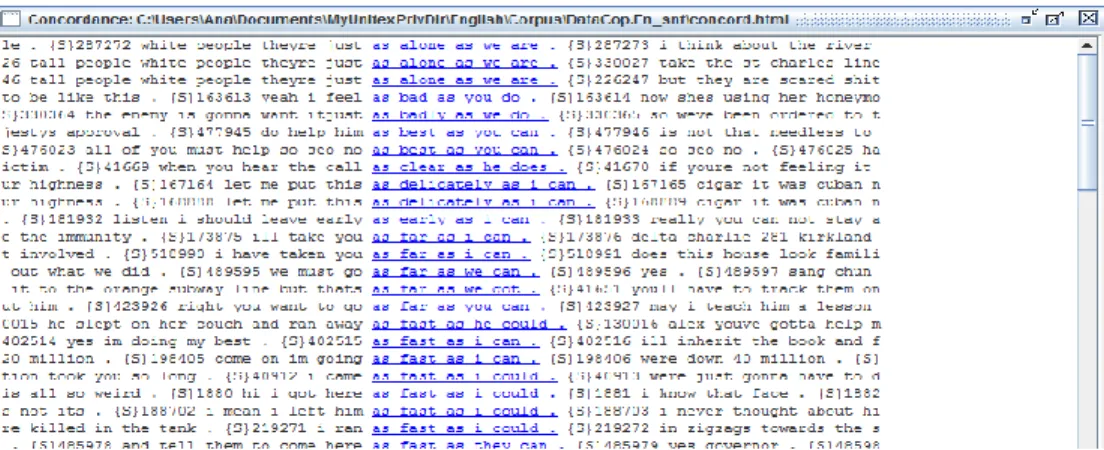
This tool was used to: (i) normalize the English corpus; (ii) build search patterns in the form of finite-state graphs, apply them to the corpus and retrieve candidate VPE instances; (iii) obtain quantitative data; (iv)build parameterized concordances of matching sequences (Fig. 1); and (v) extract the intended sentences.
2
31
Figure 1:Asnapshotofaconcordanceofthesearchpattern`as…as´comparativeconstruction
3.4.2. Python
Python software3 was used to number the sentences of the English-Persian parallel corpus4. This helped extracting the Persian counterparts of the English sub-corpus which in turn contributed in aligning the parallel sub-corpus. Python also aligned Google translation (GT) sub-corpus with the other two sub-corpuses (English and Persian) for the next phase of study.
3.4.3. Translation Tool
From among the free online MT systems, only three contained the English-Persian language pair: Babylon 8, Google, and SDL international. After a preliminary testing, Google translator was deemed to perform better than the other two and so it was selected for this study.
3.5. Data Collection
The parallel English-Persian corpus was used to identify English verbal ellipsis, to establish how VPE is dealt with in translation into Persian, and to try to make generalization on translation behavior in terms of the observed regularities in the
3
http://www.python.org/ 4
I would like to thank Dr. Vahid Nazari Talooki who helped me in implementing Python for the numbering and aligning of the corpus sentences.
32
strategies of translation applied by human translators. The goal is to apply this knowledge in the forms of rules in order to improve MT systems output when dealing with VPE.
For this purpose, the first step was to detect the gaps (i.e., the verbal ellipsis) in the English text. The detection was carried out based on the knowledge obtained through studying the Halliday and Hasan’s (1976) verbal ellipsis classification and Lobeck ´s (1995) general features of VPE in English. That is, according to this typology of English VPE, a set of search patterns were defined. In the following, this set of search pattern is briefly described.
3.5.1. The Search Pattern
The patterns in which ellipsis frequently occur are, namely, dialogues (in short sequences of responses to `yes/no´ questions, statements, or commands), pro-forms5 (structures with `so/too´ or `either/neither´), subordinate clauses, and coordinated structures.
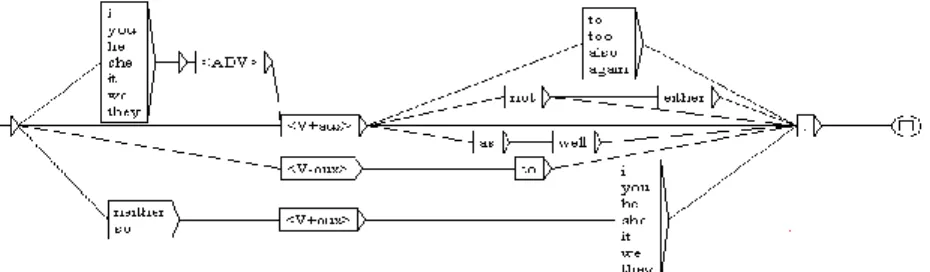
VPEs occurring in the middle of sentences are difficult to capture automatically; hence, only those VPEs which appear at the end of the sentences were considered here. The following cases were researched in the corpus: sentences ending with a) auxiliary verbs, b) infinitival complementizer `to´, and c) pro-forms. The search patterns were builts to capture these structures. The general pattern is represented in the graph of Fig. 2. The search patterns were represented by finite-state graphs with the help of Unitex. The words that could be matched were presented in word-forms orPOStags(˂ADV>,˂ADJ>). These elements are in the nodes of the graph. English auxiliaries were manually given a feature `+aux´ so that they could be represented by thetag˂V+aux>. The graphs are read from left to right and they retrieve any pattern that has a path from the initial node ( ) to the end node ( ). In order to
5
Quirk et al. (1985, p. 863)) called the structures with `so/too/also´ or `either/neither´, `pro-forms´ (or predication ellipsis), which is the term to be adopted hereafter in this thesis, and Huddlestone and Pullum (2002, p. 787) called them `coordinators´.
33
simplify the task, only the simplest patterns were considered here, i.e. a clause consisting only of the essential elements, eventually with a facultative adverb as well.
Figure 2. The general search pattern
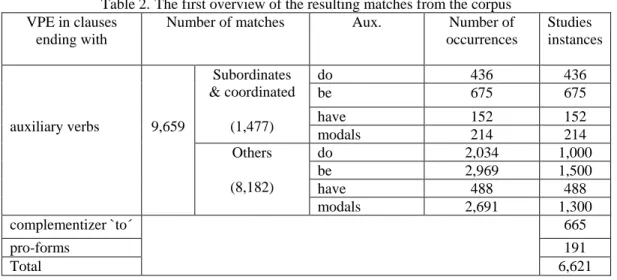
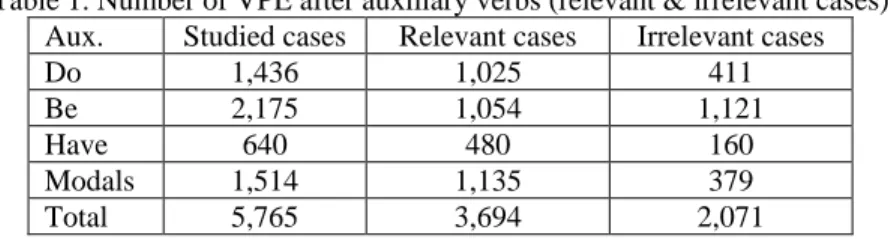
This pattern constituted the scope of this research. 14,485 cases were captured. The output also included some non-elliptical constructions, unintended VPE (VPEs with compound tenses), and elliptical constructions of different kind rather than VPE. The non-elliptical constructions (2,535 cases, mostly relative clauses (1,078), WH questions (689), the sentences ending to preposition `to´6 (294 cases), and some errors (474)) and the unintended VPEs (1,435 cases) were discarded auto-manually7. There were 2071 instances which were not spotted automatically, whether in form of non-elliptical cases or the elliptical constructions which were not of VPE type; they were ignored throughout of data analysis. The first overview of the remaining data (the intended VPEs, other kinds of ellipsis8, and some other non-elliptical cases that could not be captured automatically); the resulting matches 10,515 cases) and the distribution of these patterns are presented in table 2; the patterns themselves are described below. All the instances of type (b) and (c), namely 665 and 191 instances, respectively, were studied here (the subjects of all were only pronouns). For the largest type of matches (9,659 cases), 1477 instances were extensively studied (subjects of all were only pronouns); they were restricted to certain linguistic contexts such as: yes/no short responses to questions; the clauses after coordinating conjunctions `and/but´ and after adverbial conjunctions `after/before´; conditional clauses; and some comparative structures. The rest of the
6
The search pattern was defined to pinpoint the VPEs appearing after complementizer `to´, the sentences ending with preposition `to´ were also captured (e.g. I´m not the one you should apologize to).
7
After observing repeated cases of unintended structure, based on which a new graph was defined, applied to the corpus, and the cases extracted from the corpus.
8
34
output (8,182) consisted of different subordinate clauses or closely tied rejoinders either in form of a response to a statement confirming or contradicting it or a response to a command obeying or refusing it. From this 8,182 cases, all the instances of VPE with auxiliary `have´ and about 50% of the occurrences of VPE with modal verbs and each of the other two kinds of operators (`do´ and `be´), from three random locations of the corpus (up, middle, and bottom) were studied (in total 4,288 cases: 1,707 cases in short responses to an immediate statement and 2,581 cases in different subordinate clauses) (table 2).
Table 2.The first overview of the resulting matches from the corpus VPE in clauses
ending with
Number of matches Aux. Number of occurrences Studies instances auxiliary verbs 9,659 Subordinates & coordinated (1,477) do 436 436 be 675 675 have 152 152 modals 214 214 Others (8,182) do 2,034 1,000 be 2,969 1,500 have 488 488 modals 2,691 1,300 complementizer `to´ 665 pro-forms 191 Total 6,621
The patterns are described below:
1) A verbal group in which complementizer `to´ occurs at the end and the verb is not an auxiliary (Fig. 3).
Figure 3: Verbal group ending to infinitival complementizer `to´
665 instances were captured (e.g. I would better see him, I don´t really want to.)9.
2) Pro-forms `so/too/as well/also/neither/either´.
9
35
For pro-forms, two patterns were built: the first (Fig. 4) for `too´, `as well´, and `either´ at the end of the sentence (e.g. I know how we got so lost and you do too.), and the second (Fig. 5) for `so´ and `neither´ (e.g. we have to interview every applicant for every
job and so do you.), with inverted subjects.
Figure 4: Pro-forms `too´, `as well´, `also´, and `either´
Figure 5: Pro-forms `neither´ and `so´
Due to the problems of the corpus represented in section 3.2, the VPEs with proper names as their subjects were excluded.
The search pattern captured 191 cases, in total. 16 cases were irrelevant; the reason of their presence in the output are rerpresented in section 3.5.1.2.
3) Clauses ending with auxiliary verbs, such as:
a) Clauses appearing after coordinating conjunctions `and´ or `but´ (Fig. 6).
Figure 6: Coordinated Structures (Coordinating Conjunction `and´ & `but´)
308 instances were captured (e.g. I liked his reaction but he didn´t.); among of which 185 cases were irrelevant (e.g. Thanks for what you did).
36
Figure 7: Short responses to `yes/no´ questions
620 instances were spotted, 244 of which were irrelevant cases (e.g. He seems quite
intelligent. Yeah, he may be).
c) Comparative constructions after the comparative operator `than´, `as´ + Adjective/Adverb + `as´, or `like´ (Figs. 8 & 9).
Figure 8: Comparative construction with `than´ or `like´
Figure 9:Comparativeconstructionwith`as…as´
The numbers of captured cases were: 133 instances with `than´ (43 irrelevant cases; e.g. This sound is more real than it normally is.); 38 with `like´ (2 irrelevant case; e.g. You were damn stupid just like I was.); and 116 instances with `as…as´ (59 irrelevant cases; e.g. You are as much responsible as we are).
d) Adverbial clauses with adverbial conjunctions `after/before´ (Fig. 10).
Figure 10: Adverbial Clause (`after/before´)