A Work Project presented as part of the requirements for the Award of a Master Degree in
Management from the NOVA – School of Business and Economics.
Digital Transformation in Organizations:
An Analysis of Organizational Determinants of Success
Mona Carina Strachota - 34296
A Project carried out on the Master in Management Program, under the supervision of:
Professor Nadim Habib
ABSTRACT
ABSTRACT
Emerging digital technologies force organizations across all industries to rethink their business
models and organizational structures. Digital Transformation (DT) is a hot topic in business,
yet academic literature has understudied the phenomenon. This study defines DT as a
fundamental organizational change and identifies a positive relationship between organizational
size, scope and competition and the decision to start the process of DT. It finds, however, that
these same factors become the biggest hurdles to successful organizational change and
identifies the importance of specific leadership behaviors to overcome the challenges and
increase the probability of successful DT projects.
Keywords: Digital Transformation, Management Innovation, Transformational leadership,
Transactional leadership
This work used infrastructure and resources funded by Fundação para a Ciência e a Tecnologia (UID/ECO/00124/2013, UID/ECO/00124/2019 and Social Sciences DataLab, Project 22209), POR Lisboa (LISBOA-01-0145-FEDER-007722 and
TABLEOFCONTENTS
TABLE OF CONTENTS
1 INTRODUCTION ... 5
Background and Problem Statement ... 5
Purpose and Research Question ... 6
Topic Decision ... 6
2 LITERATURE REVIEW ... 7
The Concept of Digital Transformation ... 7
The Impact of Digital Transformation ... 8
2.2.1 Transformation of Business Models ... 8
Digital Transformation as a form of Management Innovation ... 8
Antecedents for Change ... 9
2.4.1 Market Environment ... 9
2.4.2 Firm-specific Antecedents ... 10
The Role of Leadership in Digital Transformation ... 12
Conceptual Model for Digital Transformation ... 14
3 RESEARCH DESIGN ... 16
Research Setting ... 16
Methodological Approach ... 16
3.2.1 Qualitative Research – Semi structured Interviews ... 16
4 FINDINGS ... 18
Understanding Digital Transformation – An Interview Perspective ... 18
4.1.1 How Organizations decide to change ... 18
4.1.2 Leadership as internal success factor for Digital Transformation ... 20
TABLEOFCONTENTS
5 CONCLUSION ... 25
Recommendations for Future Research ... 26
6 LIMITATIONS ... 27 7 REFERENCES ... 28 8 APPENDICES ... 30 List of Abbreviations ... 30 List of Figures ... 31 List of Tables ... 32
Interview Guide Master Thesis ... 33
Data Structure ... 35 Interview Transcripts ... 36 8.6.1 Interview 1 ... 36 8.6.2 Interview 2 ... 40 8.6.3 Interview 3 ... 45 8.6.4 Interview 4 ... 49 8.6.5 Interview 5 ... 52
INTRODUCTION
1 INTRODUCTION
Background and Problem Statement
orldwide, over 1,700 Skype calls are made per second. In that same second, over
1,600 apps are downloaded and over 660 hours of videos watched on Netflix (Alicia
Bárcena, Antonio Prado, Mario Cimoli, 2013). The everyday life of people, businesses and
society as a whole is changing at a rapid pace following the increased implementation of new
digital products and services. The implications of this evolution are reflected across all
industries, ranging from manufacturing to healthcare or financial services, resulting in more
organizations embracing the concept of digitalization (Siebel, 2018). Traditional industries are
seeing attacks from “digital invaders” such as Uber or Airbnb, the largest providers of taxi
services or accommodation, neither owning vehicles nor real estate (Vey, Fandel-Meyer, Zipp,
& Schneider, 2017). This digital revolution changes the way companies make and sell products
and services and reach and communicate with customers (Vickers et al., 2016). Additionally,
powerful IT systems and smarter software, robotics and big data are revolutionizing classic
business models and transforming entire industries (Vey et al., 2017). All these changes and
challenges are forcing organizations to react and transform their business accordingly to be able
to exploit the opportunities that emerge with digitalization, and thereby guarantee their survival.
The concept of Digital Transformation (abbreviated as “DT”) is characterized as applying
digital technologies to enable major changes and transformation in an organization
(Osmundsen, Iden, & Bygstad, 2018). DT is made possible by digital technologies that change
the competitive landscape and ultimately lead to a change in customer expectations and
behavior (Osmundsen et al., 2018). The impact of DT is centered on creating new products and
services, changing processes and business models with the goal of new value creation
(Westerman, Bonnet, & McAfee, 2014). Despite growing awareness of its importance, many
companies still struggle to make the transition to digitally transform. This is particularly true
INTRODUCTION
for well-established, incumbent companies that are not primarily structured around or operating
in the digital economy (Bucy, Finlayson, Kelly, & Moye, 2016). In an interview released for
McKinsey in 2016, John Chambers, former CEO of Cisco Systems, a US technology leader,
stated that the world is facing the biggest technology transition ever since it entered the modern
information age; and companies who fail at DT will likely disappear (Siebel, 2018).
Purpose and Research Question
The central goal of the thesis is to gain a better understanding of the organizational factors that
can help or hinder the successful implementation of DT. It first aims at determining which
factors drive the decision to adopt DT and then to focalize on factors that may influence the
execution of DT. Therefore, this study aims to address the following research question:
“What are the organizational determinants of successful Digital Transformation?”
The dissertation aims at furthering the knowledge about DT and is organized as follows: After
the introduction, chapter two attempts to analyze the research topic by systematically reviewing
existing literature, so as to clarify definitions of DT and to develop a conceptual model. Next,
the methodology section discusses the method of data collection. The findings of the data
analysis are then presented in chapter four, followed by the study´s conclusions and limitations.
Topic Decision
The decision underlying the selection of the research topic relies on the author’s belief that as
the world faces the biggest technology transition ever, this topic constitutes an urgent issue to
address for every organization. Successfully engaging in DT and shifting from traditional ways
of doing business to the adaption to the digital world is more crucial ever since to guarantee
survival. What drove the researcher´s interest was to better understand the organizational
factors that may influence whether a DT proves successful or not. As such, the study is intended
to support organizations in their transformation endeavor by investigating how organizations
can increase the likelihood of success in DT.
LITERATUREREVIEW
2 LITERATURE REVIEW
The Concept of Digital Transformation
Academic literature about DT is still relatively scarce, with DT mostly being investigated by
research centers in collaboration with consulting companies (Ivan, Bosilj Vuk, & Spremi,
2019). DT has become a common buzzword in the business and academic world however, the
concept still lacks a clear definition. In the management and organizational literature, the term
“transformation” is commonly used to refer to a substantial and large-scale change. To qualify
as a transformation, it furthermore needs to affect the nature of managers´ and employees´ work
(Tosey & Robinson, 2002).
The topic of DT is widely treated nowadays often under other terms such as "digitalization" or
"digital (R)evolution". Digitalization mostly refers to “the use of digital technologies to change
a business model and provide new revenue and value-producing opportunities; it is the process
of moving to a digital business” (Gartner 2019)
. The groundbreaking impact of digital
technologies and the level of speed and unpredictability leads to reshaping businesses and entire
industries
(Warner & Wäger, 2019). From a somewhat holistic point of view, DT can
be
understood as “the changes that digital technology causes or influences in all aspects of human
life” (Stolterman & Fors, 2004, p.689). A more narrowed definition in the business context
encompasses the change taking place at the organizational level. Hess, Matt, Benlian, &
Wiesböck, (2016) define DT as “being concerned with the changes digital technologies can
bring about in a company's business model, which result in changed products or organizational
structures or in the automation of processes” (p.124). To summarize the different definitions
for DT, the concept can be categorized according to the following three elements: (1)
Technological – DT is based on using new digital technologies, (2) Organizational – DT
requires changing organizational processes and structures or creating new business models and
(3) Social – DT is a phenomenon that influences all aspects of human life (Reis, Amorim,
LITERATUREREVIEW
Melao, & Matos, 2016 & Hess et al., 2016). Drawing on extant literature on the subject of DT,
in this thesis the concept is treated as an organization-wide phenomenon meaning that a holistic
view of the organization is considered when studying DT.
In summary, the concept of DT can be described as a process of fundamental organizational
change, driven by the use of technology to foster innovation and create value. DT calls upon
organizations to acknowledge the need for change as an opportunity for new value creation to
be exploited, and then to understand how to achieve successful realization within the
organization itself.
The Impact of Digital Transformation
2.2.1 Transformation of Business Models
It is agreed that DT refers to processes of organizational change, driven over time by changes
to organizational means for value creation. Digital technologies alone provide little value to an
organization. It is their use within a specific context that enables an organization to uncover
new ways to generate value. What digital does is that it allows organizations to reexamine their
relationships with customers, their operational processes, and the way they are actually
operating. In fact, this leads to changes in already existing or the creation of new business
model(s) (BM). Just as much, it also forces structural changes within organizations that are
carried out as a result of, or to support new digital products, services, processes and BMs.
Digital Transformation as a form of Management Innovation
Whilst little literature exists on DT, the concept of organizational change has been examined
within an innovation framework, finding fertile ground in recent literature about organizations
innovating their organizational processes and structures. For instance, Birkinshaw et al. (2008),
discuss Management Innovation (MI) and define it as “the generation and implementation of a
new management practice, process, structure, or technique that is new to the state of the art
and is intended to further organizational goals.” (p. 829). A more firm-specific definition is
LITERATUREREVIEW
that of “the introduction of management practices that are new to the firm and intended to
enhance firm performance” (Mol & Birkinshaw, 2009, p. 1269). Stated differently, MI involves
the introduction of novelty in an established organization and as such represents a form of
organizational change (Birkinshaw, Hamel, & Mol, 2008). MI pertain to the internal
functioning of an organization, e.g. its task design, communication, reward structures,
management styles, or designation of authority. This type of innovation is often more tacit,
intangible and difficult to imitate than other types of innovation (Harder, 2011). As such, MI
“is one of the most important and sustainable sources of competitive advantage, needed to make
technological innovation work” (Mol & Birkinshaw, 2009, p. 1269). This aligns very clearly
with the concept of DT. In DT, Digital Technologies are adopted, leading to major changes in
multiple aspects of an organization. The essence of DT lies in the change of organizational
practices, processes and structures, marking a significant departure from the status quo. This
study thus sees DT as a subcategory of MI. The next two sections will examine what factors
drive the decision to change and embark on DT.
Antecedents for Change
2.4.1 Market Environment
A changing market environment is usually the starting point for organizations seeing that they
need to change and adapt. The pressure for change comes from various angles. With the fast
and radical rise of new digital technologies such as mobile, cloud, big data, internet of things
(IoT), and analytics among others, organizations and industries are being increasingly
confronted with the transformation from the analog to the digital (Vial, 2019). Digitalization
leads to an entirely new landscape of competition which requires organizations to keep up with
this digital shift taking place. Organizations need to respond to the impending risk coming from
existing but also possible new competitors, especially from new and “born digital” pioneers
such as Facebook, Amazon Uber or Airbnb, that are taking over the market with digital
LITERATUREREVIEW
products, services and business models (Berghaus & Back, 2018). Given this changing
landscape of competition, customer expectations and behaviors are changing as well
(Osmundsen et al., 2018). As the modern customer is becoming increasingly tech-savvy, and
has immediate access to all kinds of information, she can always choose between the best
suitable products and services and demand for them being available anywhere at any time (Vial,
2019). Since organizations are competing for customers with changing expectations, more
traditional companies run the risk that their direct competitors start copying digital native
companies to better respond to customer demands. Given that organizations are confronted with
a rapidly changing market environment driven by digital technologies, the question arises how
do organizations make the decision to engage in DT? The next section addresses this issue.
2.4.2 Firm-specific Antecedents
Various studies have sought to answer the question under which firm specific circumstances
organizations are more likely to embark on a change (Mol & Birkinshaw, 2009; Birkinshaw et
al., 2008). According to MI research, there is a positive relationship between organizational
size and organizations seeing that they need to change. The rationale behind this is that on one
hand, increasing size leads to an increase in differentiation and complexity of the organization.
This requires changing organizational approaches to cope with arising coordination difficulties.
On the other hand, larger firms usually have higher Diagnostic Capabilities, understood as
“the ability of an organization to recognize the locus of a perceived problem or an opportunity
for improved performance and to develop management solutions that either solve the problem
or exploit the opportunity” (Harder, 2011, p.84 ). Mol and Birkinshaw (2009) found that access
to knowledge sources within and outside the firm as well as the level of education of the
workforce significantly impacted the decision to adopt change. Large organizations typically
possess a larger pool of knowledge, resources and capabilities, deriving from a diverse and
usually higher educated workforce and leadership, external change agents such as consultants
LITERATUREREVIEW
supporting the change, larger and more diverse networks as well as financial resources
necessary to decide for new organizational practices (Mol & Birkinshaw, 2009). As such, it is
more likely that these companies will identify the need for DT than smaller companies. The
underlying dissertation therefore assumes that the larger the organization in size, the more likely
it is to decide to embark on DT. The geographical scope across which organizations operate
was identified as a second predictor for organizations introducing change and innovation (Mol
& Birkinshaw, 2009). An internationally operating organization benefits from higher
diagnostic capabilities as its participation in different markets exposes it to a broader amount
of opportunities, knowledge and resources. Looking beyond national boundaries and
cooperating or competing with a vast number of organizations from the same or different
industries fosters development and growth. Change and innovation is thus more likely to occur
in organizations that operate across a broader scope (Mol & Birkinshaw, 2009). Moreover, the
broader the external environment, the more competitors. This requires organizations to
continuously seek for new information, generate new ideas as well as acquire and develop
necessary capabilities to keep up with competitors. Thus, this work project estimates a positive
relationship between the scope of operation and the decision to digitally transform.
Among academics, the relationship between innovation and competitive intensity is a subject
of long-lasting, yet unresolved debate (Hecker & Ganter, 2013). On the one hand, whereas early
empirical literature found a negative relationship between competition and innovation (Aghion,
Bloom, Blundell, Howitt, & Griffith, 2005), a vast amount of studies found a positive linear
effect (Street, Sharpe, & Currie, 2008). To integrate these contradicting results, other
researchers built the positive and negative impacts of competition on technological innovation
into one model in the form of an inverted-U shape. Higher competition here initially increases
then decreases technological innovation effort, observing an intermediate level of competition
that leads to maximized innovation intentions (Aghion et al., 2005). Since organizational
LITERATUREREVIEW
change and innovation is non-technological in nature, the argument above cannot simply be
applied to MI. Hecker & Ganter, (2013), focusing on MI suggest that a firm´s perceived
competitive environment significantly effects its inclination to innovate. They point to a
monotonically positive association between intensity of competition and MI, explained by the
argument that intense competitive pressure out selects less productive firms and increases
incentives to innovate. Summing up, the underlying work project assumes a positive
relationship between perceived competition intensity and the decision for DT.
The Role of Leadership in Digital Transformation
After having understood what drives organizations to start their transformations, they also need
to be able to implement it. Changing an organization is a long and complex undertaking,
affecting the whole organization. In order for DT to succeed, everyone needs to be open to the
ongoing transformation and must be willing to leave obsolete, ineffective processes behind.
This often requires a radical change in mindset and behavior, with many people being afraid by
its implications and consequences. This clearly brings a crucial role for leaders in carrying and
supporting an organization through a DT, taking initiatives in helping to implement it. In fact,
an Accenture study concluded that for successful change programs, strong and consistent
leadership at all levels of the organizations is essential (Behar, Fuchs, & Thomas, 2015).
According to
Vaccaro, Jansen, van den Bosch, & Volberda, (2012)
, studies have considered
leadership as one of the key organizational attributes underlying change due to their prominent
role in organizations.
Various definitions of leadership do exist in academia.
Leadership in the
scope of this thesis is defined as “the process of influencing others to understand and agree
about what needs to be done and how it can be done effectively, and the process of facilitating
individual and collective efforts to accomplish the shared objectives”
(Yukl, 2013, p.7 ).
The term “leader”, in the context of this work project
,
is understood as “a person who guides a
group of people, an organization, or empowers their transformational processes” (Cortellazzo,
LITERATUREREVIEW
Bruni, & Zampieri, 2019, p.2). Leaders affect organizational conditions under which DT may
be implemented, with leadership being identified as a key success factor for influencing the
accomplishment of DT by practice-oriented literature (Westerman et al., 2014). Since DT
requires significant human, financial, and technological capital that must all be aligned to
facilitate successful results, it demands leaders capable of directing this change and influencing
the process (Dahlstrom et al., 2017).
Following the argument stated in section 2.3, namely that
DT is a subcategory of MI,
it is assumed that leaders who are more successful in pursuing MI,
are more likely to propel their organizations forward in the journey toward DT. Several scholars
investigated the impact of leadership on the realization of MI. For instance, Vaccaro et al.,
(2012) focused on leadership behavior as a key determinant for the successful pursuit of MI.
They found that the adoption of two leadership styles, namely transformational and
transactional leadership is positively associated with MI. As such, these styles are now
discussed in more detail.
The transformational leadership style encourages, inspires, guides and motivate employees
for innovation and change that will help to grow and shape the future success of an organization
(Volberda, Bosch, & Heij, 2013). It includes a meaningful vision and the empowerment of
followers to achieve and implement the vision and participate in the changes (Vaccaro et al.,
2012). Transformational leadership was found to be multidimensional in nature, consisting of
four components. By showing “idealized influence”, leaders intrinsically motivate people by
acting as role models (Podsakoff, 1990). It also includes “inspirational motivation”, which
implies leaders identifying and articulating an appealing vision and sense of purpose. Effective
transformational leaders realize the importance of consistently and persistently communicating
that core message and tailoring it to respective recipients (Anthony, Schwartz, 2017). “Intellectual
stimulation” is shown in the support of the followers in taking a critical stance on the status
quo, rewarding creative and new approaches and supporting risk-taking. These leaders trust
LITERATUREREVIEW
employees to take authority over decisions in their assigned jobs. In terms of “individual
consideration the leader considers the individual needs and abilities of the followers, is a
mentor, coach or guide to the follower (Stewart, 2006). The transactional leadership style was
found to be conducive to the pursuit of MI as it may contribute to reducing organizational
complexity and ambiguity through the setting of clear goals and rewards (Volberda et al., 2013).
Transactional Leadership is based on a rational exchange relationship between the leader and
the follower. Leaders provide clarification and specification of what is expected of their
organizational members and assess the goals and consequent reward for its achievement
(Stewart, 2006). Clear and operationally defined objectives are among the key management
tasks as well as directing desired behavior by "conditional rewards".
To sum up, to a great extent transformational leadership guarantees an inspiring vision that
energizes an organization around change and innovation. Transactional leadership, on the other
hand is similarly important as it ensures that DT actually gets put into practice.
Conceptual Model for Digital Transformation
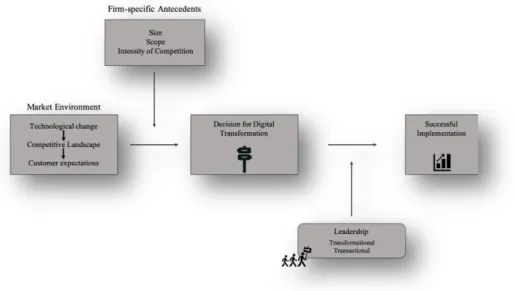
Our review of the literature has enabled us to develop a conceptual model for the DT process.
The model is divided into two main sections and will work as a basis for the following empirical
part: A changing market environment driven by digital technologies is the starting point for
organizations seeing they need to change. Looking at firm-specific factors that may make
organizations more likely to understand the need to change themselves and become digital, the
literature states that larger companies are more likely to see the need for change. This is because
of their higher diagnostic capabilities, reflected in larger amounts of and more diverse
resources. The same argument holds true for the scope of operation. The broader the scope of
operations, the more likely it is that an organization will understand the need for DT.
Additionally, the more competition organizations perceive to experience, the more likely they
embark on a change with diagnostic capability becoming sharpened by competition. Change
LITERATUREREVIEW
does not come easy, however, with many organizations struggling with inertia and resistance
to change. Therefore, leaders play a key role in the successful implementation of DT. In the
literature, transformational and transactional leadership stood out as being supportive for
implementing change efforts within organizations. As such, it is expected that they positively
contribute to a successful DT. Figure A compiles the main implication of this chapter. The
primary goal of the following empirical part is to prove the validity of this model based on real
life experience from expert interviews.
RESEARCHDESIGN
3 RESEARCH DESIGN
Research Setting
This study explores the phenomenon of DT in existing organizations. The interviews were
conducted with experts from the global management consultancy firm Accenture. The
interviewees selected provide advisory services to companies in multiple industries, ranging
from healthcare to consumer goods and utilities. Accenture currently is at the forefront of topics
related to DT and supports many organizations on their transformational journey. The
interviews provided the possibility to gather an outside-in understanding of organizations´ DTs.
The author of the thesis approached employees during a summer internship to share insights
and experiences. Thus, this specific consulting company was chosen for conducting expert
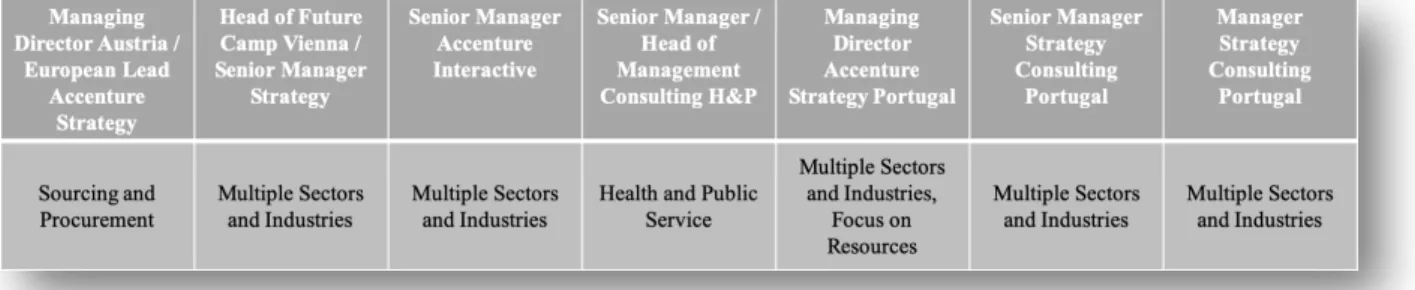
interviews. Table 1 presents the complete list of conducted interviews. As Hess et al., (2016)
state, DT is nowadays a high priority for organizations regardless the industry. This set the basis
for the study. The goal is to understand the phenomenon of DT, understand under which market-
and firm specific conditions organizations are more likely to decide for DT and then analyze
how leadership increases the probability of succeeding in DT. As part of these interviews, two
common leadership styles, namely transformative and transactional were considered to
determine whether these approaches influenced the implementation success of DT projects.
Methodological Approach
This section explains in detail the methodology used in this thesis. The qualitative research is
first presented. Second, the data collection approach will be described.
3.2.1 Qualitative Research – Semi structured Interviews
The focus of this study is to understand and describe a nascent phenomenon in a real- world
setting which is why for this thesis a qualitative research method was chosen over a quantitative
one (Golfasni, 2003). Semi-structured interviews were chosen since they allow researchers to
explore subjective standpoints and to gather in-depth stories of people’s experiences. This was
RESEARCHDESIGN
the preferred method because understanding how DT is perceived and carried out in
organizations requires expert knowledge and expression of their views of and experiences with
this phenomenon. The selection of interviewees was based upon their expressed experience
with and knowledge of DT practices. An interview guide was used, that enabled the researcher
to address the defined topic whilst allowing the respondents to answer in their own terms (See
Appendix 8.4). The interviews varied from 25 minutes to 50 minutes in length, were recorded
with permission and transcribed. The analysis of the data was performed based on the interview
transcripts: The key points were highlighted and labeled with codes. Next, the codes were put
into categories from which dimensions according to the research interest were designed (See
Appendix 8.5). The results are presented with illustrative quotations from the interviewees.
FINDINGS
4 FINDINGS
Understanding Digital Transformation – An Interview Perspective
From the interviewees understanding, DT “is the complete change of how a company is doing
business…. a holistic transformation that addresses the whole company… and if you don't do
that, your digital initiatives will fail.” This understanding of DT not only confirms the definition
of DT by Osmundsen et al., (2018), but also confirms seeing DT as a subcategory of MI, as it
refers to a change in organization´s processes, practices and structures (Birkinshaw et al. 2008).
4.1.1 How Organizations decide to change
Changing requirements in the market driven by new technology and so called “new digital
players”, raised the need to better respond to these changing requirements and to decide for DT.
Unlocking opportunities outside the core business and structurally changing the organization to
be actually able to do so were also cited as pushing organizations to start DT. All participants
were working with large scale, mostly international DAX companies, often with revenues
above 5 billion euros, a large and diverse workforce etc. These clients were found to have the
necessary financial resources to afford the investment in DT which includes the services of
external consultants advising and helping them in their DT approach. They possess a wide range
of inside knowledge and capabilities, given their well-educated workforce, coming from
different backgrounds and possessing various skills. It was stated that the “biggest companies
typically attract the biggest talent or at least they have a highly qualified workforce and
capabilities” (I5). This reports quite well to what literature says about the relation between size
and the likelihood to change. The bigger the organization, the higher the diagnostic capability,
and the more likely it is to understand that DT is important. Such as size, geographical scope
across which organizations operate was confirmed by the interviews as being a second predictor
for organizations introducing change and innovation. When looking at how market
FINDINGS
perceived pressure in the market, the more likely organizations realized the need to adapt to
new circumstances and change to stay or become more competitive. One of the interviewees
indicated that “All my clients face high competition and that is really forcing them to engage
with Digital Transformation and to become more digital” (I1). It was stated that companies in
a highly competitive market put a higher priority on DT in order to respond to new requirements
in the market. On the contrary, once an industry is highly regulated and protected, usually
indicating lower levels of competition, firms were said to be less prone to change and start a
DT. It can thus be confirmed from the interviews that higher market competition increases the
likelihood to embark on a DT journey.
Although it was found that size is good for diagnostics, it is considered to harm the
implementation of change. In fact, interviewees claimed that the size of an organization
increases complexity and makes it harder for the organizational change that comes with DT to
get successfully implemented. The reason was said to be that “large companies usually have a
stronger culture that's harder to change than in smaller companies. Because it's just not that
many people you have to convince to change.” (I1). This implicates that although larger
companies, given their generally higher diagnostic capability compared to smaller
counterparts, are more likely to decide for DT, they actually face harder times implementing it.
The same opinion holds true for the scope of operation, making it more complex and difficult
for companies to implement change when operating in many different countries or industries.
An international operating company faces “significant complexity coming with different
systems, different landscapes, different requirements different specifics in different countries”
(I1). This is also reflected in the following statement, saying that “if you have a company with
20 people you can reach them faster than having a company in 12 countries with 30,000 people.
To reach a significant amount of people to create a culture of change it would take much
longer” (I2). Based on the interviews, it can be seen that what is happening in the market, the
FINDINGS
size, scope and the level of competition are drivers to change. Large and widely operating
companies, faced with a lot of competition, are more likely to have heard of DT and perceive
the need for it given that they are larger, have more resources and therefore are more likely to
work with consultants supporting them in the transformation. Interestingly enough, these same
factors that lend organizations down the journey actually created a lot of challenges in the
implementation process, as could be seen from many of the quotes by Accenture. As such, what
drove the researcher´s interest was to identify what can be done to increase the probability to
successfully realize DT. From the interviews it was discovered that, given the fact that size and
scope are making it harder to change due to increased complexity and internal resistance to
change, the role of leadership becomes much more critical. The next section thus addresses the
leadership role, interviewees mentioned as needed to increase the chance of success.
4.1.2 Leadership as internal success factor for Digital Transformation
From the interviews it was confirmed that introducing new technology represents the easier part
in a DT. Overall, interviewees shared the same opinion: When people in key roles (both senior
leaders of the organization and those in transformation-specific roles) are highly involved in
the DT, transformation’s success is more likely. All interviewees referred to DT as being “a
C-level topic and CEO topic”. They stated that “if the head of the company is not all in, financially
and time wise it will not work” (I2). Although all of the Accenture clients understood that they
have to change, they were sometimes struggling to do so for the right reason. Some were said
to “not really know why they have to do it” (I1). In fact, it was said that many had digital on
their agenda but were only doing “bits and pieces”, “being digital for the sake of digitization”
(I1). Interviewees stressed the need for organizations to fundamentally understand that “it's a
long journey, it’s a massive journey it's a massive investment, so it's not like building a tool
here and there” (I1). It is important to “know the right objectives why to do that and how to
achieve it” (I1). This requires a “massive knowhow in all areas of digital transformation, which
FINDINGS
is obviously about people, technology, process and strategy” (I1). This is why one of the most
important leadership requirements mentioned was that leaders have to be visionaries.
Interviewees commonly stated the need for a C-suite that has a clear picture and provides a
“clear North Star” where everybody can focus on as mission critical. It was said that the
important thing of the digital projects is “always to start with the right vision and the right
leadership support and knowing the right objectives why to do that and how to achieve it” (I1).
Given that in large companies the workforce usually spans many generations, especially for
older people anxiety increases due to new technology and changes in the business. This was
quoted as important issues leaders need to address. It was stated that “leadership really needs
to be able to give the people a vision why we do that, where we are heading to, what that means
for the people” (I1). Since large change efforts on a global scale oftentimes come with higher
complexity and inertia, leaders were said to be needed as “kind of change agents and the
leadership that motivate and convince the people that you are doing the right thing” (I2). This
way, people can feel more secure and less overwhelmed by the change. It was moreover
emphasized that CEO´s alone won´t be able to handle such change efforts but need the whole
leadership on board to follow them. Some organizations did so by “usually starting with the
leadership training where you bring in your top 20, 30 people and you create that vision with
them together and then they are taught how this new way of working in this digital
transformation works, what is their role, what do they have to demand from their people”(I2).
For instance, in some occasions some kind of DT leads, supported by top management within
the firm´s structure, were established, with the sole purpose of driving digitalization in the
company. These examples match very well with the inspirational motivation component of
the transformational leadership style, where leaders provide a clear vision and sense of purpose,
motivating followers that they are doing the right thing. Also, leading by example was referred
to as being one important way of motivating others, since it brings more attention to the rest of
FINDINGS
the organization. In one case the CEO created a digital manifest, which introduced digital into
the values and the mission of the company and was found on annual reports, investor relations
etc. Such an initiative shows commitment not only within, but also communicates it externally
(I5). In another organization it was experienced that “once the CEO or other top managers have
an interest in doing DT and are even participating in status meeting even if it's not every status
meeting, then there is much more attention also for the others to drive it” (I1). This fits with
the second component of transformational leadership, namely idealized influence, referring to
leaders acting as role models.
Rapid and constant changes are now the norm, and what succeeded in the past no longer
guarantees success in the future. Success depends on how leaders can engage the rest of the
organization during the transformation. Hereby one factor was said to be encouraging
employees to challenge old ways of working. In some companies, this was done by applying
an iterative test and fail and improve methodology. One interviewee accentuated that leaders
need to „give the people the ability to make their experience on projects and to also give them
the ability to make errors and to learn from those errors” (I2). Allowing employees to make
errors, empowering them to try new things and take ownership of their ideas connects to the
intellectual stimulation element of transformational leadership. Allowing employees to make
mistakes is one part. Supporting and helping employees removing obstacles once they occur
was stated as essential leadership behavior in order for employees “to produce results faster
which will create more benefits for the organization.” Moreover, in successful projects it was
observed that leaders took care of how changes could impact the organization and its people.
This is closely connected to the individual consideration mechanism of transformational
leadership, where leaders attend to their followers needs. All these examples determine that a
transformational leadership style is conducive to the desired outcomes during a DT.
Transformational Leaders are creating an appealing vision to guide the change through
FINDINGS
inspiration, support and empowerment of employees (Volberda et al., 2013). This leadership
style is particularly important to overcome the obstacles inherent with high complexity in large
organizations, operating on a broad scope, as a clear roadmap is needed to reduce this
complexity and align the organization toward a common goal. People need to be convinced of
why DT is important and understand how it will impact them and change the status quo.
Even though it was found that transformational leadership behavior has great impact, it was not
the sole means by which organizations achieved successful implementation. Transactional
leadership was also found to have an influence on whether DT implementations prove
successful or not. Although it was stressed that leaders should overtake the role of a coach and
enabler, especially to get the people on board towards a common goal, successfully
implementing DT in a way that the desired outcomes can be retrieved also requires monitoring
and intervention from the top. It was mentioned that leaders have to intervene to support their
employees when “they run against some obstacles and need to help them removing obstacles to
make their life easier” (I2). This requires the intervention of leaders to ensure that people can
successfully fulfill their tasks. Clear objectives and responsibilities need to be ensured in a way
that people within the organization can make good decisions about their transformation efforts.
Some interviewees experienced projects where “project leadership on the client side was not
clear: “nobody was hundred percent clear who should take responsibility. Is it business? IT?
Who is it?” (I1). It is also the responsibility of the leader to track the subordinates´ performance
to ensure they meet their targets, indicating the need for transactional leadership behavior,
setting clear targets and defining responsibilities (Vaccaro et al., 2012). It was moreover stated
that it is important that people know what is expected of them, they need clear goals that act as
a roadmap allowing them to do the best work, and “once people reach their goals, you have to
give them some kind of reward for their work, so they stay motivated. So do reward the progress
along the way” (I5). In order to ensure that people deliver the expected results, the leadership
FINDINGS
must guarantee that his organization is motivated to carry out these kinds of activities. This can
be done by promoting people for their achievement in the DT process.
In summary, the importance of leadership in driving DT was emphasized by all interviewees.
Successful transformations implied leaders showing not only elements of transformational but
also transactional leadership and balance them in such a way that positive results during the
change process can be achieved.
4.1.3 Final conceptual model of Digital Transformation
In summary, the objective of this empirical section was to provide an understanding about what
makes companies embark on the journey of DT. It was found that despite the context specific
factors size, scope and perceived competition intensity driving to start a change, two of them
actually acted as barriers in implementing DT. Size and scope increase complexity, which
makes it harder for people to change. Indeed, many companies were facing difficulties in terms
of resistance to change. It was therefore found that transformational and transactional leadership
habits were both influencing the likelihood of success. This was done by providing clarity, for
instance in the form of an appealing vision, as well as by showing appreciation for achieved
goals in the form of rewards. The figure below shows the final conceptual model of DT, based
on the empirical findings.
CONCLUSION
5 CONCLUSION
The theoretical objective of this thesis was to provide knowledge on the nascent topic of DT.
The academic literature of DT is emergent but still scarce, and it is mostly focused on
practice-oriented publications such as consultancy reports. This study contributed to the emerging
literature on DT and MI by treating DT as a subcategory of MI, and introducing a model for
DT that spans firm-specific antecedents, namely size, scope and competition intensity as
affecting the decision to engage in DT. Based on the interviews, it was seen that what is
happening in the market, the size, scope and the level of competition are drivers to change.
Large and widely operating companies, facing a lot of competition are more likely to have heard
of DT and perceive the need for it given that they are larger, have more resources and therefore
are more likely to work with consultants supporting them in the transformation. Size, scope and
competition intensity are important in the diagnostic process to understand that DT is important
and to embark on the ride. The interviews confirmed the management and organizational
literature which found a positive relationship between these factors and the decision to change.
Interestingly enough, it was found that the same factors that help organizations initiate the
journey actually created a lot of challenges in the implementation process, as could be seen
from many of the quotes by Accenture. As such, the strengths in deciding to embark on a DT
journey suddenly became weaknesses when organizations started the journey. Carrying out an
organizational change, the suitable leadership style can make this transition somewhat easier.
In fact, the results of the interviews indicated that leadership played a critical role in the
implementation of any large-scale organizational change such as a DT. Transformational
leadership was examined to help overcoming barriers by providing clarity in the form of
specifying future vision states, aligning and guiding the whole organization around and toward
a common goal. Leaders need to build a strong shared purpose, to inspire the organization to
transform. Since more complexity usually leads to more employees and middle managers
CONCLUSION
hesitating, transformational leaders are needed to reduce complexity and hesitation by
supporting the change, allowing for errors to be made, as well as promoting the generation of
new ideas. Transactional leadership is equally important as for people to know whether they
are on the right track and understand what is expected of them. Transactional leaders are needed
to define responsibilities and objectives and to reward employees appropriately when reaching
expected results.
To conclude, organizations are well advised to look very clearly at the leadership structure they
have in place to guarantee success of DT projects. They need to understand why they do DT,
to not do it for the wrong reasons and get stuck in the process and increase internal resistance
to change.
Recommendations for Future Research
Based on the findings of the study, two major research areas are recommended for future
research. First, based on this research it would be important to explore how these positive
factors of size and scope become negative factors and what can be done to minimize their
negative impact on organizations. Second, the model could be taken a step further by adding
actual client perspectives and experiences with DT to those of the consultants, providing a more
insightful and holistic picture.
LIMITATIONS
6 LIMITATIONS
Various limitations of the research apply. One limitation of the study is of course that it was
not looking at companies that might be working with smaller consulting companies. As such,
the research explores the concept of DT in large companies. The study was moreover conducted
from a consulting firm perspective, thus only providing a one-sided view, not taking into
account the client-side perspective. Additionally, the small sample size which existed of five
semi-structured interviews may make the findings less generalizable, which needs to be taken
into account when assessing the results. Another limitation is that interviewing Austrian and
Portuguese Managers on their viewpoints and experiences in DT, the findings may not be
replicable to other countries, thus providing only a limited picture.
REFERENCES
7 REFERENCES
Aghion, P., Bloom, N., Blundell, R., Howitt, R., & Griffith, P. (2005). Competition and innovation: an inverted-U relationship. The Quarterly Journal of Economics, 701–727.
Alicia Bárcena, Antonio Prado, Mario Cimoli, R. Pérez. (2013). The New Digital Revolution from the consumers internet to the industrial internet. Repositorio CEPAL, 30(3), 14–19.
Anthony, S., & Schwartz, E. (2017). What the Best Transformational Leaders Do. [online] Available at https://hbr.org/2017/05/what-the-best-transformational-leaders-do, [Accessed 6 Dec. 2019].
Behar, D., Fuchs, R., & Thomas, R. J. (2015). Digital leaders: Moving into the fast lane. Available at https://accntu.re/2E4FGbh, [Accessed 12 Nov. 2019].
Berghaus, S., & Back, A. (2018). Disentangling the Fuzzy Front End of Digital Transformation: Activities and Approaches. ICIS 2017: Transforming Society with Digital Innovation, 0–17.
Bilgeri, D., Wortmann, F., Fleisch, E., (2017). How Digital Transformation Affects Large Manufacturing Companies ‘Organizations. International Conference on Information Systems (ICIS), 1-9.
Birkinshaw, J., Hamel, G., & Mol, M. J. (2008). Management innovation. Academy of Management Review, 33(4), 825–845.
Bucy, M., Finlayson, A., Kelly, G., & Moye, C. (2016). The ‘how’ of transformation.
Cortellazzo, L., Bruni, E., & Zampieri, R. (2019). The Role of Leadership in a Digitalized World: A Review.
Frontiers in Psychology, 10, 1–21.
Dahlström, P., Desmet, D., & Singer, M. (2017). The seven decisions that matter in a digital transformation: a CEO’s guide to reinvention. Digital McKinsey article (Feb 2017).
Gartner. (2019). Digitalization. [online] Available at: https://www.gartner.com/en/information-technology/glossary/digitalization, [Accessed 17 Nov. 2019].
Golfasni, N. (2003). Understanding reliability and validity in qualitative research. The Qualitative Report, 8(4), 597–607.
Hansen, R., Sia, S.K., 2015. Hummel's digital transformation toward omnichannel retailing: key lessons learned. MIS Quart. Exec. 14 (2), 51–66.
Harder, M. (2011). Internal antecedents of management innovation. In Copenhagen Business School.
Hecker, A., & Ganter, A. (2013). The influence of product market competition on technological and management innovation: Firm-level evidence from a large-scale survey. European Management Review, 10(1), 17–33. Hess, T., Matt, C., Benlian, A., & Wiesböck, F. (2016). Options for Formulating a Digital Transformation
Strategy. MIS Quarterly E, 15(2), 123–125.
Ivan, L., Bosilj Vuk, V., & Spremi, M. (2019). Technology Innovation Management Review Mastering the Digital Transformation Process: Business Practices and Lessons Learned. Technology Innovation Management
Review, 9(12), 36–50.
Mirkovic, V., & Vojinovic, Z. (2019). Key Characteristics of Organizational Structure that supports digital transformation. 24th International Scientific Symposium, 255–261.
Mol, M. J., & Birkinshaw, J. (2009). The sources of management innovation: When firms introduce new management practices. Journal of Business Research, 62(12), 1269–1280.
Osmundsen, K., Iden, J., & Bygstad, B. (2018). Digital Transformation: Drivers, Success Factors, and Implications. Mediterranean Conference on Information Systems (MCIS), 1–15.
Ovans, A. (2015) What Is a Business Model? [online] Available at https://hbr.org/2015/01/what-is-a-business-model [Accessed 07 Dec. 2019].
REFERENCES
Podsakoff, P.M., MacKenzie, S.B., Moorman, R., Fetter, R. (1990). Transformational leader behaviors and their effects on followers´ trust in leader, satisfaction and organizational citizenship behavior. The Leadership
Quarterly 1(2), 107-142.
Reis, J., Amorim, M., Melao, N., & Matos, P. (2016). Digital Transformation: A Literature Review and Guidelines for Future Digital Transformation: A Literature Review and Guidelines for Future Research. 10th European
Conference on Information Systems Management. Academic Conferences and Publishing Limited, 1, 20–
28.
Rogers, B. (2016). Why 84% Of Companies Fail at Digital Transformation. [online] Available at https://bit.ly/2YAIkih, [Accessed 14 Nov. 2019].
Schwarzmüller, T., Brosi, P., Duman, D., & Welpe, I. M. (2018). How does the digital transformation affect organizations? Key themes of change in work design and leadership. Management Revue, 29(2), 114–138. Siebel, T. M. (2018). Why digital transformation is now on the CEO’s shoulders. McKinsey Quarterly, 2018(1),
76–81.
Stewart, J. (2006). Instructional and Transformational Leadership: Burns, Bass and Leithwoood. Journal of
Educational Administration, 1–29.
Stolterman, E., & Fors, A. C. (2004). Information technology and the good life. IFIP Advances in Information
and Communication Technology, 143, 687–692.
Street, S., Sharpe, A., & Currie, I. (2008). Competitive Intensity as Driver of Innovation and Productivity Growth: A Synthesis of the Literature. Centre for the Study of Living Standards, 1–80.
Tosey, P., & Robinson, G. (2002). When change is no longer enough: What do we mean by “transformation” in organizational change work? TQM Magazine, 14(2), 100–109.
Vaccaro, I. G., Jansen, J. J. P., van den Bosch, F. A. J., & Volberda, H. W. (2012). Management innovation and leadership: The moderating role of organizational size. Journal of Management Studies, 49(1), 28–51. Vey, K., Fandel-Meyer, T., Zipp, J. S., & Schneider, C. (2017). Learning & Development in Times of Digital
Transformation: Facilitating a Culture of Change and Innovation. International Journal of Advanced
Corporate Learning (IJAC), 10(1), 22.
Vial, G. (2019). Understanding digital transformation: A review and a research agenda. Journal of Strategic
Information Systems, 28(2), 118–144.
Vickers, F., Zes, D., Hammerisch, K., Moreno, J., Landis, D., Ramos, B., & Lewis, J. L. (2016). Leaders for a
digital transformation: A talent response to a digital revolution.
Volberda, H. W., Bosch, F. A. J. van den, & Heij, C. v. (2013). Management Innovation: Management as Fertile
Ground for Innovation. 10, 1–15.
Warner, K. S. R., & Wäger, M. (2019). Building dynamic capabilities for digital transformation: An ongoing process of strategic renewal. Long Range Planning, 52(3), 326–349.
Westerman, G., Bonnet, D., & McAfee, A. (2014). Leading Digital. In Harvard Business Review Press. Boston, Massachusets.
Yukl, G. (2013). Leadership in organizations (8th ed.). Boston: Pearson.
APPENDICES
8 APPENDICES
List of Abbreviations
DT Digital Transformation
MI Management Innovation
APPENDICES
List of Figures
Figure A: Conceptual Model for Digital Transformation ... 15 Figure B: Final Framework of Digital Transformation ... 24
APPENDICES
List of Tables
APPENDICES
Interview Guide Master Thesis
Theme A: Consent and recording
Thanks for taking the time to participate in this interview for my Master Thesis today. The interview will last about 30 minutes and, with your agreement, will be recorded with the help of an electronic device. The information gathered will be treated confidentially and only for the purpose of this study. The anonymity of the interviewee will be guaranteed. You can withdraw from the interview at any time. Do I have your permission to tape record the interview and to use the collected data for the purpose of my study?
Theme B: Introduction - Purpose and structure of the interview, interviewee background data
In the next 30 minutes I will be asking you questions on the topic of digital transformation. Precisely, the goal is to gain a deeper understanding of what factors influence the outcome of digital transformation projects. The interview will be divided into two sections: First, I will ask you about your role at Accenture over the past year. Second, I will ask you to discuss factors related to digital transformation projects you have been involved in over the past few years.
Any questions or doubts? Let us get started:
Warm Up: Can you tell me a little about your current role at Accenture? What do you focus on? Theme C: Understanding the context of the projects in terms of size, scope and competition
Could you please talk a little bit about one project that went well, and a second one that did not go so well or was more difficult to carry out?
Why did the clients start their DT?
Could you provide some background information about the client? Was it a big organization?
Do you know in how many markets the client operates? In terms of product lines? Nationally or internationally?
Did the client operate in a competitive market? On a scale between 1 and 5 with 1 being low degree of competition and 5 high competition, where would you say the client stands?
What where the challenges encountered?
Theme D: Understanding the role of leadership during the projects
Now I would like to discuss the leadership team with regards to the projects.
How did leadership approach the DT? Was there one dedicated person who leads the Digital transformation? If so, who?
APPENDICES
Did leaders ensure that everyone understands the need for change and its intended outcome for the organization? How?
How did leaders support their subordinates?
Were the roles and expectations of leaders and subordinates clearly defined?
Did you feel that the leaders engage and motivate employees for innovation and change? If so, how? Would you say that in the organization exists a high level of trust between leaders and subordinates? To what extent did leaders involve partners and other stakeholders as opposed to working on their own?
From your experience during the projects you just talked about, could you identify top three competences leaders should possess in the digital age to successfully lead DT?
Theme E: Personal opinion and suggestions
From your point of view and experience, what are the biggest challenges in DT organizations and leaders face?
If there were some key pieces of advice you would give to a client before they embark on a major digital transformation project, what would it be?