Sensibilidade e especificidade do SARC-F na classificação de sarcopenia em idosos: resultados preliminares
Sensitivity and specificity of SARC-F in the classification
of sarcopenia among the elderly: preliminary results
Correspondence: Natália Rodrigues dos Reis, Faculdade de Educação Física e Desportos, FAEFID-UFJF, Rua José Lourenço Kelmer, S/N, Campus Universitário, Bairro São Pedro, 36036-900 Juiz de Fora MG. [email protected] Received on: January 10, 2020; Accepted on: July 31, 2020.
Natália Rodrigues dos Reis1 , Jeferson Macedo Vianna1 , Fernando Basile Colugnati2 ,
Jefferson da Silva Novaes3 , Henrique Novais Mansur4 . 1. Study and Reserach Laboratory on Strength Training, Federal University of Juiz de Fora, Juiz de Fora, MG, Brazil. 2. Medicine School, Federal University of Juiz de Fora, Juiz de Fora, MG, Brazil. 3. Physical Education Department, Federal University of Rio de Janeiro, Rio de Janeiro, RJ, Brazil.
4. Southeastern Federal Institute of Minas Gerais, Rio Pomba Campus, MG, Brazil.
ABSTRACT
Introduction: In addition to being prevalent in the elderly population, sarcopenia has become a precursor to functional decline in this population. Alternative means for screening is necessary. Objectives: The aim of this study was to evaluate the sensitivity and specificity of the SARC-F sarcopenia screening instru-ment. Methods: The sample consisted of 153 elderly of both sexes. Screening of sarcopenia was evaluated by the SARC-F questionnaire. Strength, function and muscle mass were evaluated through the protocol adapted from the European Working Group on Sarcopenia in Older People (EWGSOP). The sensitivity and specificity of the questionnaire were evaluated using the ROC curve. Results: 13.72% of the elderly evalua-ted were classified as sarcopenic. The parameters most relaevalua-ted to sarcopenia were older and lack of phy-sical exercise. Sex was not a parameter that had a relationship in classification. Sensitivity was 60.0% and specificity of 80.92% with an area on the curve of 0.70. Conclusion: Our data supports the use of SARC-F as a screening tool that can be used in community and hospital environments as a quick screening tool. Key-words: : Muscle strength, Aged, Sarcopenia.
RESUMO
Introdução: Além de grande prevalente na população idosa, a sarcopenia tem se tornado precursora do declínio funcional nessa população. Torna-se necessário encontrar meios alternativos para rastreio. Obje-tivos: O objetivo do presente estudo foi avaliar a sensibilidade e especificidade do instrumento de rastreio da sarcopenia SARC-F. Métodos: A amostra foi constituída por 153 idosos de ambos os sexos. O screening da sarcopenia foi avaliado pelo questionário SARC-F. Para diagnóstico da sarcopenia avaliou-se força, fun-ção e massa muscular através do protocolo adaptado do European Working Group on Sarcopenia in Older
People (EWGSOP). A sensibilidade e especificidade do questionário foram avaliadas por meio da curva
ROC. Resultados: 13,72% dos idosos avaliados foram classificados como sarcopênicos. Os parâmetros mais relacionados com a sarcopenia foram maior idade e falta de prática de exercícios físicos. O sexo não foi um parâmetro que teve relação na classificação. A sensibilidade foi de 60,0% e especificidade de 80,92% com uma área sobre a curva de 0,70. Conclusão: Nossos dados apoiam o uso do SARC-F como uma ferramenta de rastreio que pode ser usada em ambientes comunitários e hospitalares como ferramenta de triagem rápida.
Palavras-chave: Força muscular, Idoso, Sarcopenia.
Original Article
Brazilian Journal of
Exercise Physiology
ISSN Online: 2675-1372 ISSN Printed: 1677-8510RBFEx
Introduction
Life expectancy has raised since the nineteenth century causing global ageing in the world population. A doubled elderly population is projected worldwide, ran-ging from 11% to 22% of the population in 2050. Sarcopenia is a multifactor syndrome that has become increasingly prevalent among the elderly population compromising strength levels, muscle mass and function as a consequence of cellular processes un-derlying the syndrome development and progress [1]. Since the creation of the term Sarcopenia, in 1989, a lot of researches have been developed in order to find general agreement on test standardization and in elaborating interventions [2]. The sarco-penia importance has been emerging as a key factor in negative outcomes such as frailty, fall and hospitalization that lead to a functional decline of the elderly. Besides it has been associated with death in elderly patients [3].
Tools such as electrical bioimpedance, ultrasound, magnetic resonance and physical tests like the hand force and walking time may be useful in sarcopenia diag-nosis, once they evaluate the muscle mass, strength and function and it is possible to track the harmful processes of this syndrome as well as its prognosis. However, some of these methods have become unfeasible due to lack of access and costs of equipment [4]. Guidelines have been elaborated in order to look into better ways of screening, diagnosis and management of the syndrome which affect elderly people [5,6], and the SARC-F questionnaire is one of these options. Recently, its reliability has been elucidated and current guidelines make this instrument important and es-sential ally to health.
The clinical relevance of sarcopenia has increased as its negative outcomes began to get more known. By the high cost and the importance of early diagnosis, it is important to search alternative means to diagnose sarcopenia [7-9]. The known sarcopenia outcomes to elderly health and the importance of this population be pe-riodically tracked have motivated this investigation. The aim of the present study was to evaluate the sensitivity and specificity of the screening tool SARC-F for Sarcopenia.
Methods
Participants
We evaluated 443 elderly during the screening phase, responding to the SAR-C-F questionnaire. From these, 128 did not show interest in taking EWGSOP protocol, 162 were unable to perform physical exercise. The group of participants consisted of 153 elderly from both sexes by a convenience sample. The elderly were interviewed in their own houses, being accompanied by the community health agents.
Measures
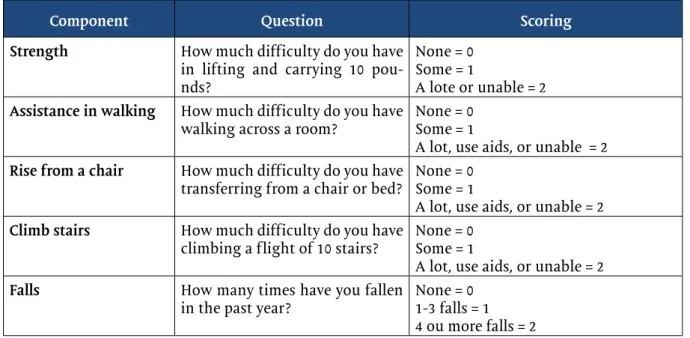
Sarcopenia screening was evaluated by SARC-F questionnaire, proposed by Malmstrom and Morley [10], composed by 5 questions which indicate a decrease in physical performance on the strength, walking, raising a chair, climbing stairs and falls. The reference score for sarcopenia was a sum equal or higher 4 (Box 1).
Box 1. Simple five-item questionnaire (SARC-F)
Component Question Scoring
Strength How much difficulty do you have in lifting and carrying 10 pou-nds?
None = 0 Some = 1
A lote or unable = 2 Assistance in walking How much difficulty do you have
walking across a room? None = 0Some = 1
A lot, use aids, or unable = 2 Rise from a chair How much difficulty do you have
transferring from a chair or bed? None = 0Some = 1
A lot, use aids, or unable = 2 Climb stairs How much difficulty do you have
climbing a flight of 10 stairs? None = 0Some = 1
A lot, use aids, or unable = 2
Falls How many times have you fallen
in the past year? None = 01-3 falls = 1 4 ou more falls = 2
For sarcopenia diagnosis, the adapted protocol from the European Working Group on Sarcopenia in Older People (EWGSOP) was used and the following para-meters were evaluated: a) muscle mass by the anthropometric equation proposed by Baumgartner et al. [11]; b) muscle strength by hand press by the dynamometer (SAEHAN) with 0,1 N accuracy and, c) muscle function measured by the 4,57m wa-lking tests.
The reference scores adopted were: a) low muscle mass: ≤ 6,37 kg/m² for wo-men and ≤ 8,90 kg/m² for wo-men; b) decrease of hand press force: 20 kg for wowo-men and 30kg for men; c) reduction of walking speed when time is over 7.6 s for height ≤ 1.54 and 6.6s for height > 1.54 for women. Time over 6,3s for height >1.68 and 7s for height ≤ 1.68 for men (Table I).
Table I - Protocol adopted by European Working Group on Sarcopenia in Older People (EWGSOP).
Evaluation instrument Cutting point
Muscle mass (0.2487 x weight) + (0.0483 x height) – (0.1584 x waist circ) + (0.0732 x strength) + (2.5843 x sex) + 5.8828
Women: MM ≤ 5.08 kg/m² Men: MM ≤ 6.28 kg/m² Muscle strength Hand grip by dinamometer (SAEHAN) accuracy
of 0.1N Women: 20 kgf Men: 30 kgf
Muscle function Walking Test 4.57m Women: T >7.6s - est. ≤1.54 6.6s - est >1.54.
Men: 7s - est. ≤1.68 T>6,3s - est.>1.68 Circ = circunference; MM = massa muscular; T = time.
On this study, the sarcopenia classification was based on 3 criteria: 1) non--sarcopenic: no score in muscle mass, strength and function; 2) sarcopenic: score in muscle mass and strength or muscle function; 3) severe sarcopenic: scores in muscle mass, strength and function (Table II).
Table II - Sarcopenia classification.
Procedures
It is an observational study, elaborated on data from a population and resi-dential basis research named: “Screening, diagnosis and frailty rehabilitation and sarcopenia among elderly people in Rio Pomba, MG”.
Ethics procedures
This study was approved by the Ethics Commitee (CAE 67925317.8.0000.5089). All procedures and potential risks were cleared to the participants and their consent was signed before the evaluations.
Statistical treatment
Data were tabulated on Microsoft Office Excel Program (2016) and analysed on SPSS 21® (SPSS Inc., EUA) statistic program. The sample features were described by mean and standard deviation or percentage, according to the variable characteris-tic. The ROC (Receiver Operating Characteristic) curve and the area under the curve (AUC) were used to compare the diagnosed accuracy of the instrument and analyze the sensitivity and specificity.
For all variables, the differences were statically significant for p < 0.05.
Results
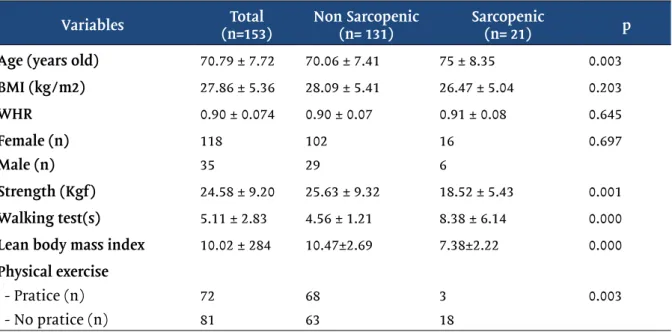
The sample features identified according to the sarcopenic status are descri-bed in table III.
Table III - Features of a sample according to the sarcopenic status.
Variables (n=153)Total Non Sarcopenic (n= 131) Sarcopenic (n= 21) p
Age (years old) 70.79 ± 7.72 70.06 ± 7.41 75 ± 8.35 0.003
BMI (kg/m2) 27.86 ± 5.36 28.09 ± 5.41 26.47 ± 5.04 0.203 WHR 0.90 ± 0.074 0.90 ± 0.07 0.91 ± 0.08 0.645 Female (n) Male (n) 118 35 102 29 16 6 0.697 Strength (Kgf) 24.58 ± 9.20 25.63 ± 9.32 18.52 ± 5.43 0.001 Walking test(s) 5.11 ± 2.83 4.56 ± 1.21 8.38 ± 6.14 0.000
Lean body mass index 10.02 ± 284 10.47±2.69 7.38±2.22 0.000
Physical exercise - Pratice (n) - No pratice (n) 72 81 68 63 3 18 0.003 BMI = Body mass index; WHR= waist/hip ratio.
Classification Score criteria
Non-sarcopenic No score in muscle mass, strength and function Sarcopenic Score in muscle strength and mass or muscle function Severe sarcopenic Score in muscle mass, strength and function
The mean population age of the study was 70.79 ± 7.72 years old and 77.12% were female (n = 118). The BMI mean was 27.86 ± 5.36 kg/m² and the ratio waist/hip mean was 0 90 ± 0,074.
When the low criteria of muscle strength function and mass were combined following the EWGOSP protocol, 13.72% of the elderly were classified as sarcopenic.
The most related parameters with sarcopenia were higher age (75 ± 8.35 - p=0,003) and lack of physical exercise (p = 0,003). Sex was not a parameter related in the classification (p = 0,697).
Sarcopenic patients showed a significantly lower level of force index than the non-sarcopenic ones (18.52 ± 5.43 x 25.63 ± 9.32), walking (8.38 ± 6.14 x 4.56 ± 1.21) and lean body mass (7.38 ± 2.22 x 10.47 ± 2.69).
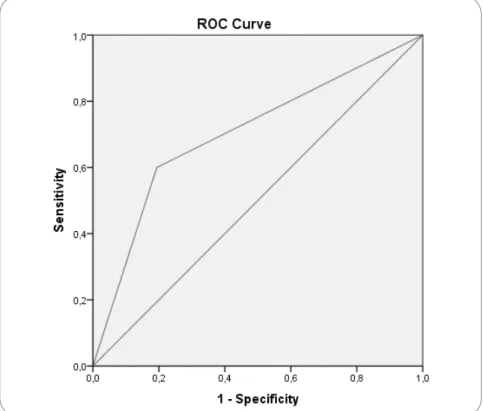
Our data showed that SARC-F tracked 36 sarcopenic participants (23.52%) and the EWGOSP criteria diagnosed 21 (13.72%), which means a sensitivity of 60,0% and specificity of 80.92% and an area under the curve of 0.70 (Figure 1).
Discussion
The objective of this study was to evaluate the sensitivity and specificity of the screening sarcopenia instrument SARC-F. The sarcopenia prevalence found in the studied populations was 13.72%. The sensitivity of SARC-F to screen sarcopenia ac-cording to EWGOSP was 60.00%, with specificity of 80.92% and AUC of 0.70. The most related sarcopenia parameters were higher age and lack of physical exercise. Sex was not a related parameter in the classification.
On the studied sample, the sarcopenia prevalence recorded by the EWGSOP algorithm was 13.72%, while the one indicated by the SARC-F was 23.52%. The sar-copenia prevalence may vary, being influenced by screening methods and diagnosis and by the studied population in several parts of the world. However, similar studies, using the EWGSOP protocol among elderly people, have estimated the sarcopenia
Figure 1 - ROC- Relation between sensitivity and specificity. The area under the curve value of 0.70 presents good instrument traceability.
prevalence among people aged 60 to 70 years old between 5 to 13%, while the preva-lence varies from 11 to 50% among people aged 80 years old or more [12-14]
The most related sarcopenia parameters were higher age (75 ± 8.35 years old p = 0,003) and lack of physical exercise (p = 0,003). Sex was not a related parameter in the classification (p = 0,697). On our study, the advanced age was associated to sarcopenia. These results are according to those found previously and which found sarcopenia more prevalent in older elderly [12-14]. There are events responsible for the mitochondrial quality control that keep muscle cell homeostasis. Picca et al. [16] reported the dysfunction of these mechanisms increases during ageing and lack of physical exercise, which causes sarcopenia.
Some studies highlighted that strength loss presents a gradual decrease from 50 years old on [17,18] and increase after 65 years old [11]. This deterioration may be from 1 to 2% per year [19]. Soares et al. [20] reported that a worse performance in hand press force and walking speed are associated with mortality risk. Ruiz et al. [21] noticed sarcopenia as a condition that appears when the patient is unable or has a functional deficit. Sarcopenia may get worse when there are comorbidities, increa-sing the mortality associated to its cause. Besides, Norman & Otten [22] highlighted a higher longevity led to higher frequency of sarcopenia and increasing expenses with health care which are due to complications associated to functional health declines and independence loss.
In our study, another parameter related to sarcopenia was physical inactivity. Peterson et al. [23] emphasized that the physical exercise acts against shape loss and muscle function. The physical exercise is largely agreed as an instrument of disease prevention and rehabilitation. It has been prescribed by health organizations, and is an important ally to health maintenance and good shape [24-25].
Michaud et al. [27] emphasized that, among other factors, the TNF-α incre-ased levels are responsible for an increincre-ased muscle catabolism and oxidative stress, resulting in a physical performance decline, and in a muscle strength and mass de-cline. Therefore, the physical exercise acts reducing TNF-α, improving the functio-nal capacity, acting as an efficient treatment to delay the sarcopenia as the elderly who practice physical exercise may experiment a protein synthesis improvement and neuromuscular adaptation [28]. Our results support the fact that physical inactivity makes sarcopenia get worse. Ruiz et al. [21] found association between mortality and low strength in elderly patients, agreeing that sarcopenia must be treated.
As far as sex is concerned, the results were the opposite to our hypothesis. Statiscally, there was no difference in the variable in the classification. However, our study supports the Christensen et al. [11] findings, which found the female sex was not prevalent among the sarcopenic people anymore. Nevertheless, our results are opposite to those found by Bravo-José et al. [14], who found a higher prevalence among female people (81.4%). It is known that female sex factors, such as menopau-se, increase risk of osteoporosis, as well as sarcopenia, besides a lower production of estrogen hormones [29-31].
SARC-F sensitivity to track sarcopenia according to EWGOSP was 60%. Its spe-cificity was 80.92% and AUC was 0.70 showing moderate traceability of the instru-ment. Because of the clinical importance of sarcopenia to elaborate interventions that avoid health problems among the elderly, studies were conducted to clarify SAR-C-F reliability, validity, sensitivity and specificity [12,32,33]. Kim et al. [32] reported low sensitivity and high specificity in a Korean population. The authors emphasized that because it is a self-referred questionnaire, the women might have been influen-ced once they reported more limitations than they are actually able to perform. Woo
et al. [33] reported sensitivity of 29% and high specificity of 91% among a male
po-pulation. In the same study, the authors found a sensitivity of 8.4% and specificity of 94.9% among female.
Barbosa-Silva et al. [12] suggested a way to improve the SARC-F. They propo-sed a combination of SARC-F and calf circumference, obtaining a 33.3% to 66.7% im-provement in sensitivity. Woo et al. [33] found an area under the curve representing 0.63 to 0.76 when they compared SARC-F with the agreed groups about sarcopenia. In this study, the area under the curve was 0.70.
This study was limited. First, due to the self-managed nature of the SARC-F questionnaire, the patients could omit information to be rated in a better muscle health condition than they really present. Besides, the results might be affected by cognitive difficulties. Secondly, the ideal instrument to evaluate the body lean mass is the densitometer. However, in the current study, the anthropometric equation pro-posed by Baumgartner et al.[18] was used because there was no access to the densi-tometer.
Conclusion
The current study found good sensitivity and specificity on the SARC-F ins-trument giving knowledge on the importance of muscle health and leading to using simple and effective screening instruments to allow the elaboration of prevention and rehabilitation providing potential benefits to elderly health. This highlights the potential clinical use of this instrument and increases the current comprehension of SARC-F as a reproducible and reliable technique to track sarcopenia.
Our data support the SARC-F use as a screening tool that may be used in community environments as a quick screening instrument. Because it is an easy application tool, it has become an important option when it comes to public health and may be used when more complex diagnosis equipment is lacking or when its use is recommended.
Acknowledgements
We thank to Southeastern Federal Institute of Minas Gerais for financial support, to the Public Health Secretary for granting space in their Basic Health Units
Potential conflict of interest
No conflicts of interest with potential potential for this article have been reported. Financing source
The research was funded by FAPEMIG. Authors’ contributions
Conception and design of the research: Mansur HN, Colugnati FB. Data collection: Reis NR. Analysis and interpretation of data: Reis NR, Mansur HN, Colugnati FB. Statistical analysis: Reis NR, Mansur HN, Colugnati FB. Obtaining financing: Not applicable. Writing of the manuscript: Reis NR, Mansur HN, Vianna JM. Novaes JS. Critical revision of the manuscript for important intellectual content: Reis NR, Mansur HN, Vianna JM, Novaes JS.
References
1. Cruz-Jentoft AJ, Bahat G, Bauer J, Boirie Y, Bruyère O, Cederholm T et al. Writing Group for the Euro-pean Working Group on Sarcopenia in Older People 2 (EWGSOP2), and the Extended Group for EWG-SOP2. Sarcopenia: revised European consensus on definition and diagnosis. Age Ageing 2019;48(1):16-31.
2. Rosenberg IH. Summary comments. Am J Clin Nutr 1989;50:1231-3. https://doi.org/10.1093/ ajcn/50.5.1231
3. Batsis JA, Mackenzie TA, Emeny RT, Lopez-Jimenez F, Bartels SJ. Low lean mass with and without obesity, and mortality: results from the 1999–2004 National Health and Nutrition Examination Survey. J Gerontol A: Bio Sci Med Sci 2017;72(10):1445-51. https://doi.org/10.1093/gerona/glx002
4. Chien MY, Huang TY, Wu YT. Prevalence of sarcopenia estimated using a bioelectrical impedan-ce analysis prediction equation in community-dwelling elderly people in Taiwan. J Am Geriatr Soc 2008;56(9):1710-15. https://doi.org/10.1111/j.1532-5415.2008.01854.x
5. Dent E, Morley JE, Cruz-Jentoft AJ, Arai H, Kritchevsky SB, Guralnik J, Bauer JM. International cli-nical practice guidelines for sarcopenia (ICFSR): screening, diagnosis and management. J Nutr Health Aging 2018;22(10):1148-61. https://doi.org/10.1007/s12603-018-1139-9
6. Morley JE. Treatment of sarcopenia: the road to the future. J Cachexia Sarcopenia Muscle 2018;9(7):1196.
7. Brown JC, Harhay MO, Harhay MN. Sarcopenia and mortality among a population-based sample of community-dwelling older adults. J Cachexia Sarcopenia Muscle 2016;7:290-8. https://doi.org/10.1002/ jcsm.12073
8. Charlier R, Mertens E, Lefevre J, Thomis M. Muscle mass and muscle function over the adult life span: across-sectional study in Flemish adults. Arch Gerontol Geriatr 2015;61(2):161-7. https://doi. org/10.1016/j.archger.2015.06.009
9. Clynes MA, Edwards MH, Buehring B, Dennison EM, Binkley N, Cooper C. Definitions of sarcopenia: associations with previous falls and fracture in a population sample. Calcif Tissue Int 2015;97(5):445-52. https://doi.org/10.1007/s00223-015-0044-z
10. Malmstrom TK, Morley JE. SARC-F: a simple questionnaire to rapidly diagnose sarcopenia. J Am Med Direct Associat 2013;14(8):531-2. https://doi.org/ 10.1016/j.jamda.2013.05.018
11. Christensen MG, Piper KS, Dreier R, Suetta C, Andersen HE. Prevalence of sarcopenia in a Danish geriatric out-patient population. Dan Med J 2018;65(6):A5485.
12. Barbosa-Silva TG, Bielemann RM, Gonzalez MC, Menezes AMB. Prevalence of sarcopenia among community-dwelling elderly of a medium-sized South American city: results of the COMO VAI? study. J Cachexia Sarcopenia Muscle 2016;7(2):136-43. https://doi.org/10.1002/jcsm.12049
13. Cruz-Jentoft AJ. European Working Group on Sarcopenia in Older People:
14. Sarcopenia: European consensus on definition and diagnosis. Report of the European Working Group on Sarcopenia in Older People. Age Ageing 2010;39:412-23.
15. Bravo-José P, Moreno E, Espert M, Romeu M, Martínez P, Navarro C. Prevalence of sarcopenia and associated factors in institutionalised older adult patients. Clin Nutr ESPEN 2018;27:113-9. https://doi. org/ 10.1016/j.clnesp.2018.05.008
16. Picca A, Calvani R, Leeuwenburgh C, Coelho-Junior HJ, Bernabei R, Landi F. Targeting mitochon-drial quality control for treating sarcopenia: lessons from physical exercise. Expert Opin Ther Targets 2019;23(2):153-60. https://doi.org/10.1080/14728222.2019.1559827
17. Metter E, Conwit R, Tobin J, Fozard JL. Age-associated loss of power and strength in the upper extre-mities in women and men. J Gerontol A: Biol Sci Med Sci 1997;52(5):B267-B76. https://doi.org/10.1093/ gerona/52a.5.b267.
18. Narici MV, Bordini M, Cerretelli P. Effect of aging on human adductor pollicis muscle function. J Appl Physiol 1991;71(4):1277-81.
19. Baumgartner RN, Koehler KM, Gallagher D, Romero L, Heymsfield SB, Ross RR, et al. Epidemiolo-gy of sarcopenia among the elderly in New Mexico. Am J Epidemiol 1998;147(8):755-63. https://doi. org/10.1093/oxfordjournals.aje.a009520
20. Sehl ME, Yates F. Eugene. Kinetics of human aging: I. Rates of senescence between ages 30 and 70 years in healthy people. J Gerontol A: Biol Sci Med Sci 2001;56(5):B198-B208. https://doi.org/ 10.1093/ gerona/56.5.b198
21. Soares VN, Fattori A, Neri AL, Fernandes PT. Influência do desempenho físico na mortalida-de, funcionalidade e satisfação com a vida de idosos: dados do estudo FIBRA. Ciênc Saúde Coletiva 2019;24:4181-90. https://doi.org/10.1590/1413-812320182411.07592018
22. Ruiz JR, Sui X, Lobelo F, Morrow Junior JR, Jackson AW, Sjöström M et al. Association between muscular strength and mortality in men: prospective cohort study. BMJ 2008;337:a439. https://doi. org/10.1136/bmj.a439
23. Norman K, Otten L. Financial impact of sarcopenia or low muscle mass–A short review. Clin Nutr 2019;38(4):1489-95. https://doi.org/10.1016/j.clnu.2018.09.026
24. Peterson MD, Rhea MR, Sen A, Gordon PM. Resistance exercise for muscular strength in older adults: a meta-analysis. Ageing Res Rev 2010;9(3):226-37. https://doi.org/10.1016/j.arr.2010.03.004 25. Fragala MS, Cadore EL, Dorgo S, Izquierdo M, Kraemer WJ, Mark D PetersonMD et al. Resistance training for older adults: position statement from the national strength and conditioning association. J Strength Cond Res 2019;33(8). https://doi.org/ 10.1519/JSC.0000000000003230
26. Nascimento CM, Ingles M, Salvador-Pascual A, Cominetti MR, Gomez-Cabrera MC, Viña J. Sar-copenia, frailty and their prevention by exercise. Free Rad Biol Med 2019;132:42-9. https://doi.org/ 10.1016/j.freeradbiomed.2018.08.035
27. Bauer J, Morley JE, Schols AMWJ, Ferrucci L, Cruz-Jentoft AJ, Dent E et al. Sarcopenia: a time for ac-tion. An SCWD position paper. J Cachexia Sarcopenia Muscle 2019. https://doi.org/10.1002/jcsm.12483 28. Michaud M, Balardy L, Moulis G, Gaudin C, Peyrot C, Vellas B, et al. Proinflammatory cytokines, aging, and age-related diseases. J Am Med Direct Assoc 2013;14(12):877-82. 10.1016/j.jamda.2013.05.009 29. Holviala JHS, Sallinen JM, Kraemer WJ, Alen MJ, Häkkinen KKT. Effects of strength training on mus-cle strength characteristics, functional capabilities, and balance in middle-aged and older women. J Strength Cond Res 2006;20(2):336. https://doi.org/10.1519/R-17885.1
30. Khadilkar SS. Musculoskeletal disorders and menopause. J Obstet Gynaecol India 2019;69(2):99-103. https://doi.org/10.1007/s13224-019-01213-7
31. Wilson D, Jackson, Sapey E, Lord JM. Frailty and sarcopenia: the potential role of an aged immune system. Ageing Research Reviews 2017;36:1-10. https://doi.org/10.1016/j.arr.2017.01.006
32. Roubenoff R, Hughes VA. Sarcopenia: current concepts. J Gerontol A: Biol Sci Med Sci 2000;55(12):M716-M24. https://doi.org/10.1093/gerona/55.12.m716.
33. Sunyoung K, Miji K; Won CW. Validation of the Korean version of the SARC-F questionnaire to as-sess sarcopenia: Korean frailty and aging cohort study. J Am Med Direc Assoc 2018;19(1):40-5. https:// doi.org/ 10.1016/j.jamda.2017.07.006.
34. Woo J, Leung J, Morley JE. Validating the SARC-F: A suitable community screening tool for sarcope-nia? J Am Med Direc Assoc 2014;15(9):630-4. https://doi.org/10.1016/j.jamda.2014.04.02