by António Afonso,
Luca Agnello,
Davide Furceri
and Ricardo Sousa
ASSESSING
LONG-TERM FISCAL
DEVELOPMENTS
A NEW APPROACH
W O R K I N G PA P E R S E R I E S
W O R K I N G P A P E R S E R I E S
N O 10 3 2 / M A R C H 2 0 0 9
This paper can be downloaded without charge from http://www.ecb.europa.eu or from the Social Science Research Network electronic library at http://ssrn.com/abstract_id=1353915. In 2009 all ECB
publications feature a motif taken from the €200 banknote.
ASSESSING LONG-TERM
FISCAL DEVELOPMENTS
A NEW APPROACH
1by António Afonso
2, Luca Agnello
3,
Davide Furceri
3, 4and Ricardo Sousa
51 We are grateful to Silvia Albrizio and Matthijs Lof for research assistance and an anonymous referee for useful suggestions. The opinions expressed herein are those of the authors and do not necessarily reflect those of the European Central Bank or the Eurosystem. 2 European Central Bank, Directorate General Economics, Kaiserstrasse 29, D-60311Frankfurt am Main, Germany. ISEG/TULisbon –
© European Central Bank, 2009 Address
Kaiserstrasse 29
60311 Frankfurt am Main, Germany
Postal address
Postfach 16 03 19
60066 Frankfurt am Main, Germany
Telephone
+49 69 1344 0
Website
http://www.ecb.europa.eu
Fax
+49 69 1344 6000
All rights reserved.
Any reproduction, publication and reprint in the form of a different publication, whether printed or produced electronically, in whole or in part, is permitted only with the explicit written authorisation of the ECB or the author(s).
The views expressed in this paper do not necessarily refl ect those of the European Central Bank.
The statement of purpose for the ECB Working Paper Series is available from the ECB website, http://www.ecb.europa. eu/pub/scientific/wps/date/html/index. en.html
Abstract 4
Non-technical summary 5
1 Introduction 7
2 Related literature 9
3 Methodology 11
4 Empirical analysis 13
4.1 Data 13
4.2 Results and discussion 15
5 Conclusion 20
References 21
Appendix 24
Figures 29
European Central Bank Working Paper Series 38
Abstract
We use a new approach to assess long-term fiscal developments. By analyzing the time varying behaviour of the two components of government spending and revenue – responsiveness and persistence – we are able to infer about the sources of fiscal behaviour. Drawing on quarterly data we estimate recursively these components within a system of government revenue and spending equations using a Three-Stage Least Square method. In this way we track fiscal developments, i.e. possible fiscal deteriorations and/or improvements for eight European Union countries plus the US. Results suggest that positions have not significantly changed for Finland, France, Germany, Spain, the United Kingdom and the US, whilst they have improved for Belgium, Italy, and the Netherlands.
Keywords: Fiscal Deterioration, Fiscal Sustainability.
Non-technical summary
Over the last decades, several studies have addressed the issue of the sustainability
of public finances. The issue is relevant since any inadequate fiscal policy behaviour may
turn unstable the relationship between government spending and revenue, with the
consequence of producing conditions for potential “fiscal deterioration” and lack of public
finances sustainability. In practice, the trajectories of both expenditure and revenues
deviate from the path ensuring the convergence towards the fiscal “equilibrium” in such a
way that government spending grows faster than government revenue.
In this paper we contribute to the literature by using a new approach to examine to
what extent two main characteristics of fiscal policy behaviour, i) the sensitivity of fiscal
variables to economic developments and the ii) dependence of fiscal behaviour on its own
past developments, impact on the patterns of both government spending and revenue,
thereby determining conditions of fiscal sustainability or fiscal deterioration. In order to
address our problem, we decompose government spending and government revenue into
two components: responsiveness and persistence. The former, can be defined as the
response of fiscal policy to output, while persistence reflects the likely autocorrelation on
budgetary policy decisions. As discussed in the empirical section, given that we are
interested in testing whether and to what extent the time-varying behaviour of the fiscal
policy characteristics may simultaneously influence the patterns of both expenditure and
revenue and eventually determine conditions of fiscal deterioration, we need to estimate a
specification including both the expenditure and revenue equations.
Therefore, focusing on the development of the abovementioned fiscal policy
characteristics, we are able to infer about deficit evolution over time and about the
existence of possible fiscal deterioration. More interestingly, we can also assess whether
changes in the fiscal positions are due to different degrees of responsiveness or persistence
between government spending and revenue.
We employ this approach to assess the fiscal developments for nine countries:
Belgium, Finland, France, Germany, Italy, the Netherlands, Spain, the UK and the U.S. To
this purpose we use a set of quarterly fiscal data taken from national accounts (in the case
of the U.S. and the U.K.) or computed by drawing on the higher frequency (monthly)
availability of fiscal cash data (in the case of the other countries). This is also a novelty
with respect to the existing related literature, which generally focuses on annual data.
Our results suggest that fiscal deterioration has not been an issue for the majority
France, Germany, Spain, the United Kingdom and the US, whilst it has even improved for
Belgium, Italy, and Netherlands.
We show that, for Italy, Belgium and (partially) for the Netherlands, fiscal
improvement has been mainly driven by a higher responsiveness of government revenue
relative to government spending. On the other hand, in the case of France, periods of fiscal
deterioration can be attributed to the higher persistence of spending. Additionally, we have
not detected conditions for potential fiscal deterioration or fiscal improvement in the other
European Union countries (Finland, Germany, Spain, and the UK) plus the U.S. For these
countries, the empirical evidence suggests that non-significant change in the fiscal position
is due to a similar behaviour in terms of persistence and responsiveness of government
spending and government revenue or because higher revenue responsiveness has been
1. Introduction
Over the last decades, several studies have addressed the issue of the sustainability
of public finances. What the empirical literature usually tests is whether both government
expenditures and government revenues display a fiscal sustainable “equilibrium” growth
pattern over time. Under such condition, the two budgetary items tend to co-move, i.e.
their structural (or long-run) relationship does not change throughout time, implying that
the size of the government deficit remains stable and under the control of policymaker.
However, it is worth noting that, the stability of the “equilibrium” is the result of the
ability of the policymaker, in the presence of shocks, to act in such a way to assure that the
gap between government revenue and expenditure remains unchanged.
Any inadequate fiscal policy behaviour may turn unstable the relationship between
government spending and revenue with the consequence of producing conditions for
potential “fiscal deterioration” and lack of public finances sustainability. In practice, the
trajectories of both expenditure and revenues deviate from the path ensuring the
convergence towards the fiscal “equilibrium” in such a way that government spending
grows faster than government revenue.
In this paper we contribute to the literature by using a new approach to examine to
what extent two main characteristics of fiscal policy behaviour, i) the sensitivity of fiscal
variables to economic developments and the ii) dependence of fiscal behaviour on its own
past developments, impact on the patterns of both government spending and revenue,
thereby determining conditions of fiscal sustainability or fiscal deterioration. In order to
address our problem, and following the empirical works by Fatas and Mihov (2002), and
Afonso et al. (2008), we decompose government spending and government revenue into
two components: responsiveness and persistence. The former, can be defined as the
budgetary policy decisions. To note that, we depart from the above mentioned empirical
studies in what concern the estimation methodology. In fact, as further discussed in the
empirical section, given that we are interested to test whether and to what extent the
time-varying behaviour of the fiscal policy characteristics may simultaneously influence the
patterns of both expenditure and revenue and eventually determine conditions of fiscal
deterioration, we need to estimate a system including both the expenditure and revenue
equations.
Therefore, focusing on the development of the abovementioned fiscal policy
characteristics, we are able to infer about deficit evolution over time and about the
existence of possible fiscal deterioration. More interestingly, we can also assess whether
changes in the fiscal positions are due to different degree of responsiveness or persistence
between government spending and revenue.
We employ this approach to assess the fiscal developments for nine countries:
Belgium, Finland, France, Germany, Italy, the Netherlands, Spain, the UK and the U.S. To
this purpose we use a set of quarterly fiscal data taken from national accounts (in the case
of the U.S. and the U.K.) or computed by drawing on the higher frequency (monthly)
availability of fiscal cash data (in the case of the other countries). This is also a novelty
with respect to the existing related literature, which generally focuses on annual data.1
The results of the paper regarding fiscal developments suggest that fiscal positions
have not significantly changed for Finland, Germany, Spain, the United Kingdom and the
U.S., they have improved for Belgium, Italy, and the Netherlands, while results suggest
some fiscal deterioration for France. Moreover, the results show that while in the case of
no change of the fiscal position this is due to the fact that higher responsiveness of revenue
1
is balanced by the higher responsiveness of spending, in the case of fiscal improvement
this has been mainly driven by the higher responsiveness of revenue.
The remainder of the paper is organized as follows. Section 2 presents a brief
review of the related empirical literature. Section 3 presents the empirical methodology we
use to assess fiscal developments. Section 4 presents the data and how they are
constructed. Section 5 reports and discusses the empirical results for assessing fiscal
deterioration (or fiscal improvement). Finally, section 6 concludes.
2. Related literature
Unit root and cointegration tests are commonly used to examine the sustainability of public
finances and the possibility of fiscal deterioration if past fiscal policies are to be kept in the
future. Standard empirical strategies focus on testing if the first differences of the debt
series are stationary or if government spending and revenue are co-integrated. Common
practice is to interpret rejection of these tests as evidence against either strong or weak
fiscal sustainability, depending on how far from unity is the coefficient for government
spending in the cointegration relationship between government spending and revenue. This
interpretation is based on the work of Hamilton and Flavin (1986), Trehan and Walsh
(1988, 1991), Ahmed and Rogers (1995) and Quintos (1995). In this framework, the
empirical assessments of fiscal sustainability have been usually carried out on a country
basis.
More recently fiscal developments have also been assessed for the OECD and
European Union country groupings, given that several economic and econometric
arguments support the use of panel analysis for such purpose. Notably, Afonso and Rault
(2007, 2008) used 1st and 2nd generation panel unit root tests as well as recent panel
cointegration techniques that allow for correlation to be accommodated both within and
sustainable for the EU panel while estimations point to past fiscal developments being an
issue in some countries.
The long-term (i.e. cointegration) relationship between primary budget balances
and government debt, essentially a fiscal reaction function, also provides evidence on the
sustainability features of public finances.2 On the other hand, Bohn (2007) argues that
rejection of sustainability based on standard (country specific) cointegration tests are
invalid because the present-value borrowing constraint could be satisfied even if
government spending and revenue are not cointegrated nor deficit and debt are difference-
stationary.
So far, few empirical studies have analysed the stability of the relation between
spending and revenue by examining the influence of the changes in fiscal policy
characteristics. Specifically, most of them identify only the fiscal policy characteristics
affecting both spending and revenue without investigating whether their interplay and their
time-varying nature may be responsible for future conditions of fiscal deterioration.
Focusing only on government spending, Fatás and Mihov (2004, 2006) identify
three fiscal policy characteristics explaining their evolution: responsiveness, persistence
and discretionary. Afonso et al. (2008) extend the analysis of Fatás and Mihov (2006) by
estimating, separately, two regression models relating government expenditure and
revenue to the same common set of fiscal policy characteristics defined above. However,
the use of a single equation estimation approach does not allow to assess whether, and to
what extent, the time-varying behaviour of the fiscal policy characteristics may
simultaneously influence the patterns of both expenditure and revenue and change their
structural long-run relationship. In this respect, the empirical strategy used in our paper,
based on the simultaneous estimation of both expenditure and revenue equations, makes it
possible to overcome this problem.
3. Methodology
In order to assess fiscal developments and analyze the role of responsiveness and
persistence in determining conditions of potential fiscal deterioration, we estimate
recursively for each country i (with i =1,…,N ) the following system of structural
equations:
° ¯ ° ®
T t
R Y
R
T t
G Y
G
R t ik t
i R ik t i R ik R ik t i
G t ik t
i G ik t i G ik G ik t i
, , 2 , 1 log
log log
, , 2 , 1 log
log log
, 1 , ,
,
, 1 , ,
,
H J
E D
H J
E D
(1)
where G is real government spending, R is real government revenue and Y is real GDP.
For each sample of length k (where k k h and h 1,2,,Tk)3, the country-specific
coefficient Eik measures the responsiveness of fiscal policy, that is, the behaviour of fiscal
policy over the business cycle, while the coefficient Jik represents a measure of fiscal
persistence, i.e. the degree of dependence of the current fiscal behaviour from its own past
setting.
We note that the variables entering system (1) are expressed in levels for three
main reasons. First, as also done by Fatás and Mihov (2004, 2006) and Afonso et al.
(2008), it is necessary to include in the regressions the level of the current and lagged
value of government spending and revenue in order to capture the persistence of fiscal
policy. Second, once the lagged dependent variable is used in levels, and considering the
3 k
is the length of the sample window used to initialize the recursive estimation procedure. In our analysis,
fact that the series employed are not stationary, the inclusion of output expressed in first
differences may lead to a situation where the coefficient of the lagged variable converges
to one and the coefficient of the stationary series (output expressed in differences)
converges to zero (see Wirjanto and Amano, 1996). Third, the time series properties of G,
R, and Y show that the series are integrated of order one and, at the same time, inspection
of autocorrelation of the residuals of each equation in system (1) and unit root tests,
indicate that they are stationary both for the entire sample and for each sample of length k.
This implies that our estimates are super-consistent. Moreover, from a theoretical point of
view, G and Y, and R and Y, should be cointegrated given that the spending-to-GDP and
revenue-to-GDP ratios are bounded and strictly greater than zero.
Difficulties in estimating system (1) are related to the presence of lagged
endogenous variables among the explanatory variables. In order to insure consistent
estimates from (1), we use a Three-Stage Least Square (TSLS) method (see e.g. Zellner
and Theil, 1962). In particular, to avoid any endogeneity bias due to the simultaneity in the
determination of output, government spending and revenue, we instrument for current
GDP (Y) with two lags of GDP, the index of oil prices (see e.g. Fatás and Mihov 2003 and
2006), and the lagged value for revenue and spending, respectively in the spending and
revenue equation.
After estimating recursively the system (1), we compute, for each country i and for
each of the
Tk 1 sets of parameters estimates (i.e. one set for each sample period),the Wald-statistics to test the following joint restrictions:
R ik G ik R ik G ik
Testing jointly for the equality between the parameters of responsiveness and
persistence associated to the government spending and revenue equations implies to
investigate whether potential episodes of fiscal deterioration occurred during the time. If
we accept the null hypothesis, we conclude that the behaviour of both government
spending and revenues evolve dynamically in such a way to avoid any structural change of
the fiscal position. On the contrary, rejection of the null hypothesis signals structural
changes in the fiscal behaviour towards deterioration or improvement. In particular, in
order to discriminate between these two cases, and to assess whether changes in the fiscal
position are due to different responsiveness or persistence between government spending
and revenue, we test the following single hypothesis:
0: 1:
G R G R
ik ik ik ik
H J J H J zJ (3)
H0:EikG EikR H1:EikG zEikR. (4)
From the analysis of the single tests, and the analysis of the estimates of the
parameters we can obtain three possible outcomes: i) fiscal deterioration (due to fiscal
persistence and/or to fiscal responsiveness); ii) fiscal improvement (due to persistence
and/or responsiveness); iii) indeterminacy, when government spending persistence is
bigger than revenue persistence (JikG !JikR), but spending responsiveness is lower than
revenue responsiveness (EikGEikR), and vice versa (JikGJ EikR; ikG !EikR).
4. Empirical analysis
4.1. Data
This section provides a summary description of the data employed in the empirical
Regarding the construction of our data set, and since we are interested in using high
frequency fiscal data, drawing on quarterly (monthly) series, one has to use the available
cash data, which, for some countries, indeed covers only the central government.
Therefore, it is obviously not our purpose to extrapolate our results and findings for the
general government. However, we believe that the gain of using high frequency fiscal data
is paramount vis-à-vis the absence of quarterly data for the general government,
particularly if the patterns are not too different, since it provides more in time information
about possible future fiscal developments. Indeed, and as mentioned by Afonso and Sousa
(2009), the patterns of such high frequency fiscal data follow very closely the
developments of the annual national accounts data provided by the European Commission
(AMECO database), while in most of the cases, the levels themselves are also close.4
In our study we use quarterly data for nine countries: Belgium, Finland, France,
Germany, Italy, Netherlands, Spain, U.K., and U.S. National currency data for all years
prior to the switch of the euro area countries to the euro have been converted using the
fixed euro conversion rate in order to provide comparable series across time for each
country. All variables are seasonally adjusted and are expressed in natural logarithms of
real terms.
For the government finance statistics – that is, government spending and
government revenue – and, in the case of the euro area countries, we use budgetary data on
a cash basis.5 It normally refers to the Central Government, therefore, with the exclusion of
the Local and/or the Regional Authorities. The data is typically disseminated through the
monthly publications of the General Accounting Offices, Ministries of Finance, National
4 Other studies have also used central government cash data, and explained its relevance, namely, Pérez (2007), Castro Fernández and Hernández de Cos (2006), Biau and Girard (2005), Heppke-Falk et al. (2006), and Giordano et al. (2005).
5
Central Banks and National Statistical Institutes of the respective countries. The latest
figures are also published in the Special Data Dissemination Standard (SDDS) section of
the International Monetary Fund (IMF) website, to which euro area Member States
contribute. For the U.S., we consider the Federal Government spending and revenue,
whilst, for the U.K., figures correspond to the Public Sector. That is, both for the U.S. and
the U.K., quarterly fiscal data is available directly from national accounts.
For GDP and GDP deflator, we use the International Financial Statistics from the
IMF.
The data are available in the following samples: 1980:1-2007:3, for Belgium;
1970:1-2007:4, for Finland; 1970:2-2007:2, for France; 1979:1-2007:2, for Germany;
1980:1-2007:3, for Italy; 1977:1-2007:1, for the Netherlands; 1985:1-2006:4, for Spain;
1955:2-2007:4, for the U.K.; and, 1967:2-2007:4, for the U.S.6
4.2. Results and discussion
In this section we report and discuss the estimates of or measures of responsiveness
and persistence, as well as the tests discussed in the second section, for each country in our
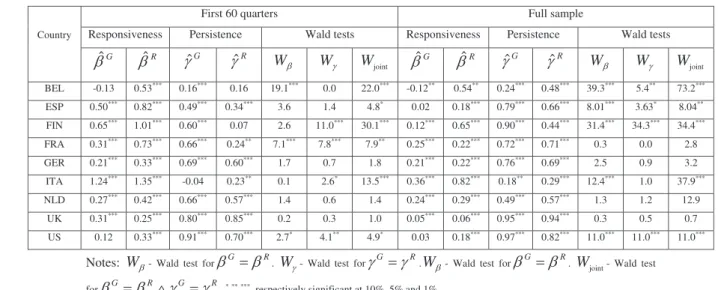
sample. Table 1 summarises the recursive estimates of the responsiveness and persistence
coefficients. In addition, Table 2 provides the estimates of those measures for two
sub-periods: before and after 1992, for the European Union countries (Maastricht); and with a
split in 1987:3 for the US (before and after Greenspan).
6
Table 1 – Recursive window estimates for responsiveness and persistence
First 60 quarters Full sample
Responsiveness Persistence Wald tests Responsiveness Persistence Wald tests
Country
G
Eˆ EˆR JˆG JˆR
E
W WJ Wjoint
G
Eˆ EˆR JˆG JˆR
E
W WJ Wjoint
BEL -0.13 0.53***
0.16***
0.16 19.1***
0.0 22.0***
-0.12** 0.54** 0.24*** 0.48*** 39.3*** 5.4** 73.2***
ESP 0.50***
0.82***
0.49***
0.34***
3.6 1.4 4.8*
0.02 0.18***
0.79***
0.66***
8.01***
3.63*
8.04**
FIN 0.65***
1.01***
0.60***
0.07 2.6 11.0***
30.1*** 0.12*** 0.65*** 0.90*** 0.44*** 31.4*** 34.3*** 34.4***
FRA 0.31*** 0.73*** 0.66*** 0.24** 7.1*** 7.8*** 7.9** 0.25*** 0.22*** 0.72*** 0.71*** 0.3 0.0 2.8
GER 0.21***
0.33***
0.69***
0.60***
1.7 0.7 1.8 0.21***
0.22***
0.76***
0.69***
2.5 0.9 3.2
ITA 1.24***
1.35***
-0.04 0.23**
0.1 2.6*
13.5*** 0.36*** 0.82*** 0.18** 0.29*** 12.4***
1.0 37.9***
NLD 0.27*** 0.42*** 0.66*** 0.57*** 1.4 0.6 1.4 0.24*** 0.29*** 0.49*** 0.57*** 1.3 1.2 12.9
UK 0.31***
0.25***
0.80***
0.85***
0.2 0.3 1.0 0.05***
0.06***
0.95***
0.94***
0.3 0.5 0.7
US 0.12 0.33***
0.91***
0.70***
2.7*
4.1**
4.9*
0.03 0.18***
0.97***
0.82***
11.0***
11.0***
11.0*** Notes: WE- Wald test forEG ER. WJ- Wald test forJG JR.WE- Wald test forEG ER. Wjoint- Wald test forEG ERJG JR. *
,**
,***
, respectively significant at 10%, 5% and 1%.
Table 2 – Sub-period estimates for responsiveness and persistence
[…, 1991Q4] [1992Q1, …]
Responsiveness Persistence Wald tests Responsiveness Persistence Wald tests
Country
G
Eˆ EˆR JˆG JˆR
E
W WJ Wjoint EˆG EˆR JˆG JˆR
E
W WJ Wjoint
BEL -0.11 0.48***
0.12 0.20 22.8***
0.28 33.1***
-0.12 0.33***
0.27**
0.33**
29.9***
0.18 40.4***
ESP 1.57***
2.12***
-0.34**
-0.12 2.2 1.3 22.9***
-0.19***
0.07 0.59***
0.58***
13.7***
0.0 13.9***
FIN 0.29*** 0.90*** 0.81*** 0.28*** 13.1*** 19.1*** 26.0*** 0.07 0.58*** 0.20* 0.40*** 15.9*** 1.5 43.4***
FRA 0.34***
0.77*** 0.61*** 0.17* 11.6*** 11.7*** 11.9***
0.00 -0.02 0.67***
0.71***
0.0 0.2 0.2
GER 0.28***
0.66***
0.51***
0.14 7.9***
4.1**
9.3***
0.03 0.20***
0.83***
0.64***
4.0**
2.6 4.0
ITA 1.06***
1.58***
0.18 0.15 1.7 0.0 5.0*
-0.00 0.61***
-0.02 0.02 8.5***
0.1 9.4***
NLD 0.27***
0.42***
0.67***
0.59***
1.4 0.5 1.5 0.37***
0.35***
0.36***
0.52***
0.0 2.7*
3.4
UK 0.06** 0.09** 0.94*** 0.92*** 0.3 0.3 0.4 0.04 0.37*** 1.00*** 0.68*** 11.8*** 12.0*** 12.0***
US 0.07 0.33***
0.94***
0.68***
6.9***
10.2***
12.8***
0.05 0.08*
0.95***
0.92***
0.3 0.2 0.3
Notes: WE- Wald test forEG ER. WJ- Wald test forJG JR.WE- Wald test forEG ER. Wjoint- Wald test forEG ERJG JR. *,**,***, respectively significant at 10%, 5% and 1%. For the US the two sub-period cut-off date is 1987Q3.
Belgium
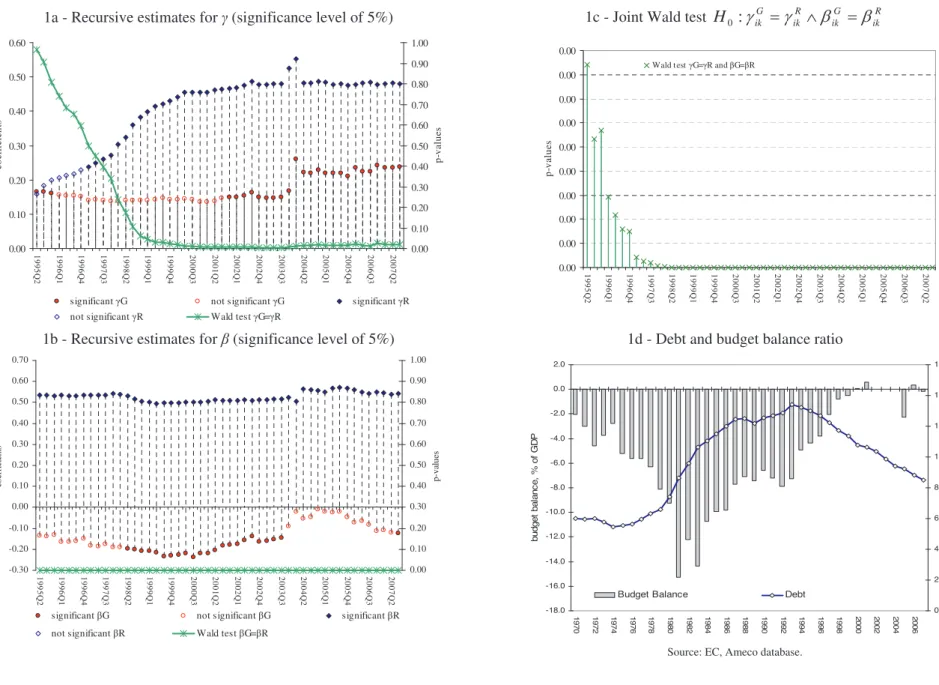
The case of Belgium is a particularly interesting one. As it is possible to see from
Figure 1d Belgium has been characterized by fiscal deterioration at the beginning of the
1980s, and by fiscal consolidation afterward. Our results seem to confirm this evidence. In
persistence and responsiveness for government spending and revenue. Looking at the
figures, we can observe, that the estimates of both persistence and responsiveness of
government revenue are higher than the ones of government spending. In particular, Wald
tests indicate that the discrepancy in the behaviour of government spending and revenue is
highly significant for most of the sample windows (see also Table 1). This suggests that in
our period of observation (1980:1-2007:2) fiscal consolidation has occurred in Belgium,
and it has been driven by the higher responsiveness and persistence of government
revenue, compared to spending. Moreover, splitting the sample period in two sub-periods,
before and after the Maastricht Treaty, we can see that fiscal consolidation in both periods
has been characterised by higher responsiveness in government revenue (see Table 2).
France
The fiscal balance in France was relatively stable, although in deficit (see Figure
2d), in the first part of the last three decades, at least if compared to other Economic and
Monetary Union members (such as Belgium and Italy).
However, our results suggest that a significant fiscal deterioration has occurred
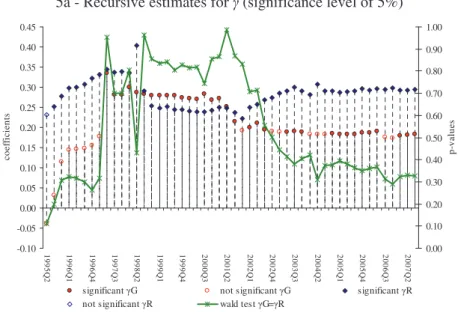
during the period 2000-2002 (see Figures 2a, 2b and 2c). Until 1998:4 spending
responsiveness is statistically significantly lower than revenue responsiveness and
spending persistence is statistically significant bigger than the revenue one, which would
imply an overall balanced behaviour. Instead, during the period 2000-2002, government
spending persistence is significantly higher that revenue one whilst the null of equality
between government spending and government revenue responsiveness is accepted.
Indeed, empirical evidence seems to suggest that the periods of fiscal deterioration for
Finland
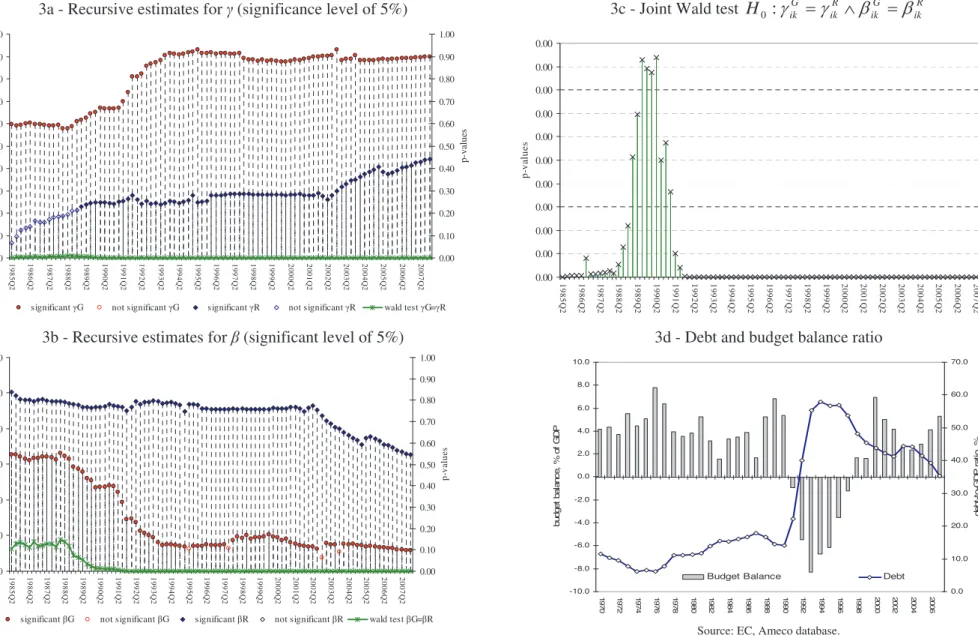
Public finances have been always quite sound during the last three decades (an
exception is represented by the fiscal deterioration during the crisis of the first half of the
1990s). Moreover, looking at Figure 3d, we can see that no major changes in the budget
balance seem to have occurred. Our analysis provides similar conclusions, but also shows
how this fiscal position has been achieved trough a different behaviour of spending and
revenue in terms of responsiveness and persistence (see Figures 3a and 3b). In particular,
while government spending persistence has been higher than government revenue
persistence, revenue has been more responsive than spending. This is also confirmed by
the analysis for the two sub-periods (see Table 1 and 2).
Germany
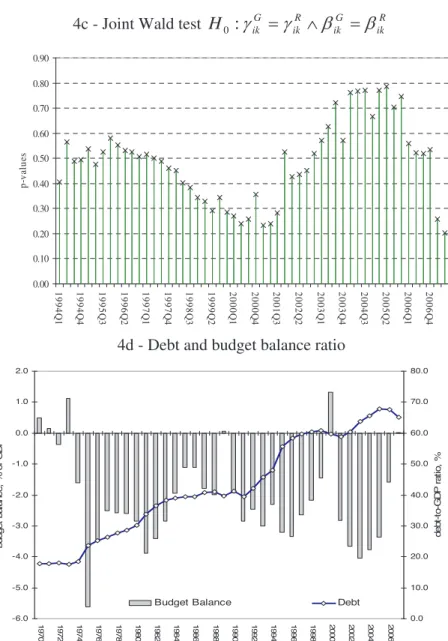
The pattern of the budget balance depicted in Figure 4d, seems to suggest that
neither strong fiscal improvements nor deteriorations have occurred in Germany in the last
three decades. This hypothesis has been confirmed by our analysis. In fact, as it is possible
to see by the joint and the single tests (see Figures 4a, 4b and 4c), the difference, both in
terms of responsiveness and persistence, between government spending and revenue is
never statistically significant. Moreover, it does not seem that a strikingly different
behaviour before and after 1992 has emerged (see Table 2). Nevertheless, it is interesting
to observe that magnitude of government revenue responsiveness declined after
2000-2001, while it remained rather stable for government spending, somewhat anticipating a
situation of lower revenues and the Excessive Deficit Procedure that Germany faced in
2002.7
Italy
Budget deficits have been considerably high and increasing during the 1970s and
the 1980s, and only started decreasing after the beginning of the 1990s (see Figure 5d).
Our analysis, which starts in 1980:1, uncovers empirical evidence for fiscal consolidation
in the period after the Maastricht Treaty (see Table 2). Moreover, from the analysis of the
coefficients and the associated Wald tests, we can argue that fiscal improvements in the
second half of the 1990s have been achieved rather through higher revenue responsiveness
(see Figure 5b). Indeed, the null hypothesis of identical government revenue and spending
responsiveness is mostly rejected after 1997.
Netherlands
Fiscal balances have improved in the Netherlands in the 1990s, after some
deterioration in the 1980s. This is (partly) captured by our analysis. In particular, looking
at the pattern of the estimates of responsiveness and persistence, we can see that around
1996 government revenue has become more persistent than government spending, after
several years where the situation was the opposite (see Figure 6a). In contrast, regarding
responsiveness, government revenue and spending do not seem to have differed in
statistically significant terms (see Figure 6b), apart from the period 2000:2-2001:3, when
spending responsiveness decreased and the budget position improved (see Figure 6d).
Spain
Analyzing the pattern for fiscal budget balances in Spain, we can see that there has
been a process of fiscal consolidation from 1995 onwards. In fact the budget deficit passed
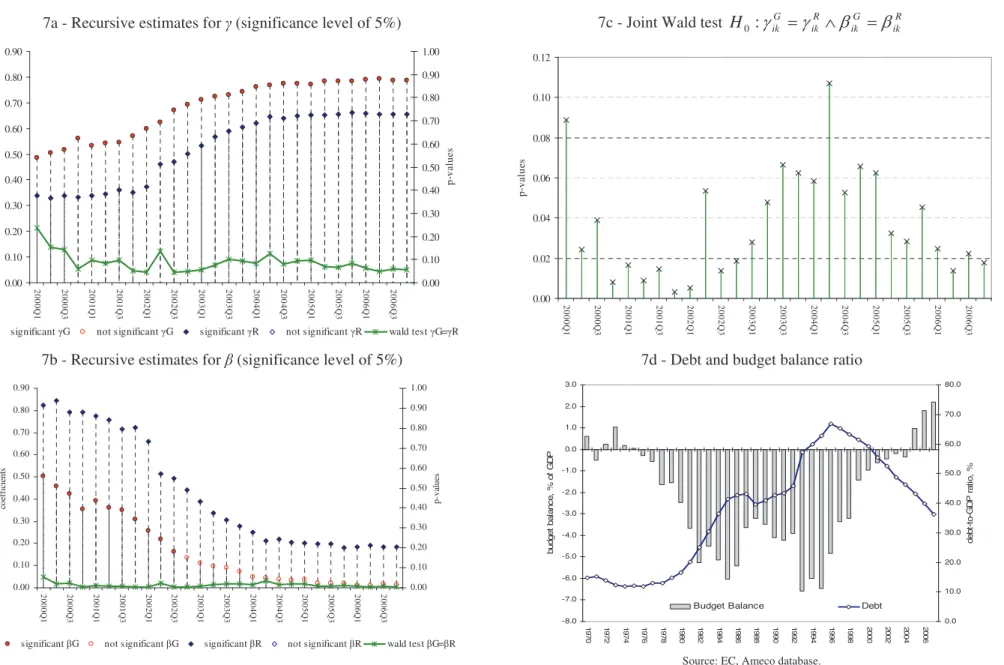
from above 6% of GDP in 1995 to a surplus of 2.3% of GDP in 2007. The joint test of our
of analysis, we can reject that the measures of persistence and responsiveness are the same
(see Figure 7c). In particular, while government spending has been more persistent than
government revenue, revenue was more responsive than spending. This, together with the
fact that the levels of deficit and debt have been reduced over time, seems to point out that
the higher responsiveness of revenue more than balanced the higher persistence of
spending.
United Kingdom
Fiscal balances in the UK have been quite stable with the debt-to-GDP ratio
decreasing throughout the 1970s and 1980s (see Figure 8d). In particular, except for 2000
and 2001 (due to relatively high GDP growth), it is possible to argue that there has not
been any significant changes towards fiscal improvement or deterioration. This was mainly
due to the fact that higher government spending and revenue showed a very similar
behaviour in terms of persistence and responsiveness (see Figures 8a and 8b).
USA
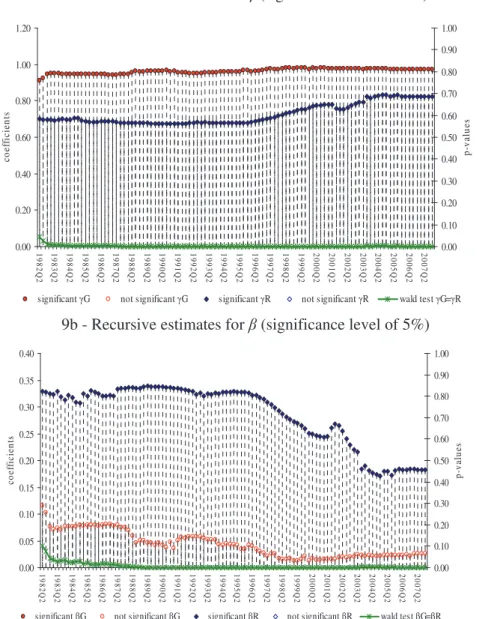
Similarly to the UK, the fiscal balances in the U.S. have been quite stable, although
in deficit, with an improvement of the fiscal position between 1992 and 2000 (see Figure
9d). Overall, it is possible to argue that there has not been any significant long-term
change towards fiscal consolidation or deterioration. Unlike the case of UK, however, this
was due to the fact that higher revenue responsiveness has been balanced by higher
spending persistence (see Figures 9a and 9b).
5. Conclusion
In this work, we propose a new approach to assess long-term fiscal developments.
and revenues – that is, responsiveness and persistence –, we are able to infer about the
sources of fiscal deterioration and/or fiscal improvement. Drawing on quarterly data we
use a Three-Stage Least Square method and recursively estimate those components within
a system of government revenue and spending equations.
The results suggest that fiscal deterioration has not been an issue for the majority
of the countries analyzed. In fact, fiscal position has not significantly changed for Finland,
France, Germany, Spain, the United Kingdom and the US, whilst it has even improved for
Belgium, Italy, and Netherlands.
We show that, for Italy, Belgium and (partially) for the Netherlands, fiscal
improvement has been mainly driven by a higher responsiveness of government revenue
relative to government spending. On the other hand, in the case of France, periods of fiscal
deterioration can be attributed to the higher persistence of spending. This result is in line
with the argument that although revenue is more responsive than spending, spending is
more persistent than revenue (see Afonso, et al. 2008).
Additionally, we have not detected conditions for potential fiscal deterioration or
fiscal improvement in the other European Union countries (Finland, Germany, Spain, and
the UK) plus the U.S. For these countries, the empirical evidence suggests that
non-significant change in the fiscal position is due to a similar behaviour in terms of
persistence and responsiveness of government spending and government revenue or
because higher revenue responsiveness has been balanced by higher spending persistence.
References
Afonso, A. (2005). “Fiscal Sustainability: the Unpleasant European Case”, FinanzArchiv,
61 (1), 19-44.
Afonso, A. (2008). “Ricardian Fiscal Regimes in the European Union”, Empirica, 35 (3),
Afonso, A. and Claeys, P. (2007). “The dynamic behaviour of budget components and
output”, Economic Modelling, 25, 93-117.
Afonso, A. and Rault, C. (2007). “What do we really know about fiscal sustainability in
the EU? A panel data diagnostic”, ECB Working Paper n. 820.
Afonso, A. and Rault, C. (2008). “3-step Analysis of Public Finances Sustainability: the
Case of the European Union”, ECB Working Paper n. 908.
Afonso, A. and Sousa, R. (2009). “The macroeconomic effects of fiscal policy”, ECB
Working Paper n. 991.
Afonso, A.; Agnello, A.; and Furceri, D. (2008). “Fiscal Policy Responsiveness,
Persistence and Discretion”, ECB Working Paper 954.
Ahmed, S., and Rogers, J. (1995). “Government Budget Deficits and Trade Deficits. Are
Present Value Constraints Satisfied in Long-term Data?” Journal of Monetary
Economics 36, 351–374.
Biau, O. and Girard, E. (2005). “Politique budgétaire et dynamique économique en France:
l'approche VAR structurel”, Économie et Prévision, 169–171, 1–24.
Baglioni, A., and Cherubini, U. (1993). “Intertemporal Budget Constraint and Public Debt
Sustainability: The Case of Italy,” Applied Economics 25, 275–283.
Bohn, H. (1991). “The Sustainability of Budget Deficits with Lump-Sum and with
Income-Based Taxation”, Journal of Money, Credit, and Banking 23, 581–604.
Bohn, H. (2007). “Are stationarity and cointegration restrictions really necessary for the
intertemporal budget constraint?” Journal of Monetary Economics, 54 (7), 1837-1847.
De Castro Fernández, F. and Hernández de Cos, P. (2006). “The economic effects of
exogenous fiscal shocks in Spain: a SVAR approach”, ECB Working Paper 647.
Fatás, A. and Mihov, I. (2003). “The Case for Restricting Fiscal Policy Discretion”,
QuarterlyJournal of Economics, 118, 1419-1447.
Fatás, A. and Mihov, I. (2006). “The Macroeconomics Effects of Fiscal Rules in the US
States”, Journal of Public Economics, 90, 101-117.
Giordano, R.; Momigliano, S.; Neri, S.; Perotti, R. (2007). “The effects of fiscal policy in
Italy: Evidence from a VAR model”, European Journal of Political Economy, 23,
707-733.
Heppke-Falk, K..; Tenhofen, J.; Wolff, G. (2006). “The macroeconomic effects of
exogenous fiscal policy shocks in Germany: a disaggregated SVAR analysis”, Deutsche
Hakkio, G., and Rush, M. (1991). “Is the Budget Deficit Too Large?” Economic Inquiry
29, 429–445.
Hamilton, J., and Flavin, M. (1986). “On the Limitations of Government Borrowing: A
Framework for Empirical Testing”, American Economic Review 76, 808–816.
Hatemi-J, A. (2002). “Fiscal Policy in Sweden: Effects of EMU Criteria Convergence”,
Economic Modelling 19, 121–136.
Haug, A. (1995). “Has Federal Budget Deficit Policy Changed in Recent Years?”
Economic Inquiry 33, 104–118.
MacDonald, R. (1992). “Some Tests of the Government’s Intertemporal Budget Constraint
Using U.S. Data”, Applied Economics 24, 1287-1292.
Olekalns, N. (2000). “Sustainability and Stability? Australian Fiscal Policy in the 20th
Century,” Australian Economic Papers 39, 138–151.
Onorante, L., Pedregal, D., Pérez, J, and Signorini, S. (2008). “The usefulness of
infra-annual government cash budgetary data for fiscal forecasting in the euro area”, ECB
Working Paper n. 901.
Pérez, J. (2007). “Leading indicators for euro area government deficits”, International
Journal of Forecasting, 23, 259-275.
Quintos, C. (1995). “Sustainability of the Deficit Process with Structural Shifts”, Journal
of Business & Economic Statistics 13, 409–417.
Smith, G., and Zin, S. (1991). “Persistent Deficits and the Market Value of Government
Debt,” Journal of Applied Econometrics 6, 31–44.
Trehan, B., and Walsh, C. (1988). “Common Trends, the Government’s Budget
Constraint, and Revenue Smoothing”, Journal of Economic Dynamics and Control 12,
425–444.
Trehan, B., and Walsh, C. (1991). “Testing Intertemporal Budget Constraints: Theory and
Applications to U.S. Federal Budget and Current Account Deficits”, Journal of Money,
Credit, and Banking 23, 206–223.
Wirjanto, T., and Amano, R. (1996). “Nonstationary regression models with a lagged
dependent variable”, Communications in statistics. Theory and methods, 25 (7),
1489-1503.
Zellner, A. and Theil, H. (1962). “Three Stage Least Squares: Simultaneous Estimation of
Appendix. Data description and sources
A.1 Belgium Data
GDP
The source is the IMF, International Financial Statistics (series " IFS.Q.124.9.9B.B$$.Z.W.$$$"). We seasonally adjust quarterly data using Census X12 ARIMA, and the series comprise the period 1980:1-2007:3.
Price Deflator
All variables were deflated by the GDP deflator (2000=100). The source is the IMF, International Financial Statistics (series IFS.Q.124.9.9B.BIP.Z.F.$$$”). We seasonally adjust quarterly data using Census X12 ARIMA, and the series comprise the period 1980:1-2007:3.
Government Spending
The source is the Belgium Ministry of Finance. Government Spending is defined as State Government expenditure on a cash basis (series “BISM.M.FJHC.BE.91”). We seasonally adjust quarterly data using Census X12 ARIMA, and the series comprise the period 1967:1-2008:1.
Government Revenue
The source is the Belgium Ministry of Finance. Government Revenue is defined as State Government revenue on a cash basis (series “BISM.M.FJBC.BE.91”). We seasonally adjust quarterly data using Census X12 ARIMA, and the series comprise the period 1967:1-2008:1.
A.2 Finland Data
GDP
The source is the IMF, International Financial Statistics (series " IFS.Q.172.9.9B.B$$.Z.W.$$$"). We seasonally adjust quarterly data using Census X12 ARIMA, and the series comprise the period 1970:1-2007:4
Price Deflator
All variables were deflated by the GDP deflator (2000=100). The source is the IMF, International Financial Statistics (series “IFS.Q.172.9.9B.BIP.Z.F.$$”). We seasonally adjust quarterly data using Census X12 ARIMA, and the series comprise the period 1970:1-2007:4.
Government Spending
The source is the IMF via Finnish Ministry of Finance. Government Spending is defined as State Government expenditure on a cash basis (series “IFS.M.17282...ZF...”). We seasonally adjust quarterly data using Census X12 ARIMA, and the series comprise the period 1970:1-2007:4.
Government Revenue
adjust quarterly data using Census X12 ARIMA, and the series comprise the period 1970:1-2007:4.
A.3 France Data
GDP
Data for GDP are quarterly, seasonally adjusted, and comprise the period 1970:1-2007:2. The source is the IMF, International Financial Statistics (series " IFS.Q.132.9.9B.B$C.Z.F.$$$").
Price Deflator
All variables were deflated by the GDP deflator (2000=100). Data are quarterly, seasonally adjusted, and comprise the period 1970:1-2007:2. The source is the IMF, International Financial Statistics (series “IFS.Q.132.9.9B.BIR.Z.F.$$$”).
Government Spending
The source is the IMF via French Ministry of Finance. Government Spending is defined as State Government expenditure on a cash basis (series “IFS.M.13282z..ZF...”). We seasonally adjust quarterly data using Census X12 ARIMA, and the series comprise the period 1970:1-2007:2.
Government Revenue
The source is the IMF via French Ministry of Finance. Government Revenue is defined as State Government revenue on a cash basis (series “IFS.M.13281...ZF...”). We seasonally adjust quarterly data using Census X12 ARIMA, and the series comprise the period 1970:1-2007:2.
A.4 Germany Data
GDP
Data for GDP are quarterly, seasonally adjusted, and comprise the period 1960:1-2007:4. The source is the IMF, International Financial Statistics (series "IFS.Q.134.9.9B.B$C.Z.F.$$$").
Price Deflator
All variables were deflated by the GDP deflator (2000=100). Data are quarterly, seasonally adjusted, and comprise the period 1960:1-2007:2. The source is the IMF, International Financial Statistics (series "IFS.Q.134.9.9B.BIR.Z.F.$$$”).
Government Spending
The source is the Bundesbank and the Monthly Reports released by the German Ministry of Finance. Government Spending is defined as General Government total expenditure on a cash basis. We seasonally adjust quarterly data using Census X12 ARIMA, and the series comprise the period 1979:1-2007:3.
Government Revenue
A.5 Italy Data
GDP
Data for GDP are quarterly, seasonally adjusted, and comprise the period 1960:1-2007:3. The source is the IMF, International Financial Statistics (series "IFS.Q.136.9.9B.B$C.Z.F.$$$").
Price Deflator
All variables were deflated by the GDP deflator (2000=100). Data are quarterly, seasonally adjusted, and comprise the period 1980:1-2007:2. The source is the IMF, International Financial Statistics (series “IFS.Q.136.9.9B.BIR.Z.F.$$$”).
Government Spending
The source is the Bank of Italy and the Italian Ministry of Finance. Government Spending is defined as Central Government primary expenditure on a cash basis. We seasonally adjust quarterly data using Census X12 ARIMA, and the series comprise the period 1960:1-2007:4.
Government Revenue
The source is the Bank of Italy and the Italian Ministry of Finance. Government Revenue is defined as Central Government total revenue on a cash basis. We seasonally adjust quarterly data using Census X12 ARIMA, and the series comprise the period 1960:1-2007:4.
A.6 Spain Data
GDP
Data for GDP are quarterly, seasonally adjusted, and comprise the period 1970:1-2007:2. The source is the IMF, International Financial Statistics (series " IFS.Q.184.9.9B.B$C.Z.F.$$$").
Price Deflator
All variables were deflated by the GDP deflator (2000=100). Data are quarterly, seasonally adjusted, and comprise the period 1970:1-2007:2. The source is the IMF, International Financial Statistics (series “IFS.Q.184.9.9B.BIR.Z.F.$$$”).
Government Spending
The source is the IMF via Spanish Ministry of Finance. Government Spending is defined as State Government expenditure on a cash basis (series “IFS.M.18482...Zf...”). We seasonally adjust quarterly data using Census X12 ARIMA, and the series comprise the period 1985:1-2006:4.
Government Revenue
A.7 Netherlands Data
GDP
The source is the IMF, International Financial Statistics (series " IFS.Q.138.9.9B.B$C.Z.W.$$$"). We seasonally adjust quarterly data using Census X12 ARIMA, and the series comprise the period 1970:1-2007:4.
Price Deflator
All variables were deflated by the GDP deflator (2000=100). The source is the IMF, International Financial Statistics (series “IFS.Q.138.9.9B.BIR.Z.F.$$$”). We seasonally adjust quarterly data using Census X12 ARIMA, and the series comprise the period 1970:1-2007:2.
Government Spending
The source is the IMF via Dutch Ministry of Finance. Government Spending is defined as State Government expenditure on a cash basis (series “IFS.M.138.C.C2.$$$.C.G.$$$”). We seasonally adjust quarterly data using Census X12 ARIMA, and the series comprise the period 1970:1-2007:1.
Government Revenue
The source is the IMF via Dutch Ministry of Finance. Government Revenue is defined as State Government revenue on a cash basis (series “IFS.M.138.C.C1.$$$.C.G.$$$”). We seasonally adjust quarterly data using Census X12 ARIMA, and the series comprise the period 1970:1-2007:1.
A.8 U.K. Data
GDP
Data for GDP are quarterly, seasonally adjusted, and comprise the period 1955:1-2007:4. The source is the Office for National Statistics, Release UKEA, Table A1 (series "YBHA").
Price Deflator
All variables were deflated by the GDP deflator. Data are quarterly, seasonally adjusted, and comprise the period 1955:1-2007:4. The source is the Office for National Statistics, Release MDS, Table 1.1 (series “YBGB”).
Government Spending
The source is the Office for National Statistics (ONS), Release Public Sector Accounts. Government Spending is defined as total current expenditures of the Public Sector ESA 95 (series “ANLT”) less net investment (series “ANNW”). We seasonally adjust quarterly data using Census X12 ARIMA, and the series comprise the period 1947:1-2007:4.
Government Revenue
A.9 U.S. Data
GDP
The source is Bureau of Economic Analysis, NIPA Table 1.1.5, line 1. Data for GDP are quarterly, seasonally adjusted, and comprise the period 1947:1-2007:4.
Price Deflator
All variables were deflated by the GDP deflator. Data are quarterly, seasonally adjusted, and comprise the period 1967:1-2007:4. The source is the Bureau of Economic Analysis, NIPA Tables 1.1.5 and 1.1.6, line 1.
Government Spending
The source is Bureau of Economic Analysis, NIPA Table 3.2. Government Spending is defined as total Federal Government Current Expenditure (line 39). Data are quarterly, seasonally adjusted, and comprise the period 1960:1-2007:4.
Government Revenue
29
ECB
Working Paper Series No 1032
March 2009
Figure 1 – Belgium (1980:1-2007:3)
1a - Recursive estimates for Ȗ (significance level of 5%) 1c - Joint Wald test H0 :JikG JikR EikG EikR
0.00 0.10 0.20 0.30 0.40 0.50 0.60 199 5Q 2 199 6Q 1 199 6Q 4 199 7Q 3 199 8Q 2 199 9Q 1 199 9Q 4 200 0Q 3 200 1Q 2 200 2Q 1 200 2Q 4 200 3Q 3 200 4Q 2 200 5Q 1 200 5Q 4 200 6Q 3 200 7Q 2 co ef fi ci en ts 0.00 0.10 0.20 0.30 0.40 0.50 0.60 0.70 0.80 0.90 1.00 p-va lu es
significant ȖG not significant ȖG significant ȖR
not significant ȖR Wald test ȖG=ȖR
0.00 0.00 0.00 0.00 0.00 0.00 0.00 0.00 0.00 0.00 19 95Q 2 19 96Q 1 19 96Q 4 19 97Q 3 19 98Q 2 19 99Q 1 19 99Q 4 20 00Q 3 20 01Q 2 20 02Q 1 20 02Q 4 20 03Q 3 20 04Q 2 20 05Q 1 20 05Q 4 20 06Q 3 20 07Q 2 p-va lu es
Wald test ȖG=ȖR and ȕG=ȕR
1b - Recursive estimates for ȕ (significance level of 5%) 1d - Debt and budget balance ratio
-0.30 -0.20 -0.10 0.00 0.10 0.20 0.30 0.40 0.50 0.60 0.70 199 5Q 2 199 6Q 1 199 6Q 4 199 7Q 3 199 8Q 2 199 9Q 1 199 9Q 4 200 0Q 3 200 1Q 2 200 2Q 1 200 2Q 4 200 3Q 3 200 4Q 2 200 5Q 1 200 5Q 4 200 6Q 3 200 7Q 2 co ef fi cie n ts 0.00 0.10 0.20 0.30 0.40 0.50 0.60 0.70 0.80 0.90 1.00 p-v al ue s
significant ȕG not significant ȕG significant ȕR
not significant ȕR Wald test ȕG=ȕR
-18.0 -16.0 -14.0 -12.0 -10.0 -8.0 -6.0 -4.0 -2.0 0.0 2.0 19 7 0 19 7 2 19 7 4 19 7 6 19 7 8 19 8 0 19 8 2 19 8 4 19 8 6 19 8 8 19 9 0 19 9 2 19 9 4 19 9 6 19 9 8 20 0 0 20 0 2 20 0 4 20 0 6 bu dg et ba la nc e, % o f GD P 0.0 20.0 40.0 60.0 80.0 100.0 120.0 140.0 160.0 de bt -t o-G D P r a ti o , %
Budget Balance Debt
30
ECB
Working Paper Series No 1032
March 2009
Figure 2 – France (1970:2-2007:2)
2a - Recursive estimates for Ȗ (significance level of 5%) 2c - Joint Wald test H0:JikG JikR EikG EikR
0.00 0.10 0.20 0.30 0.40 0.50 0.60 0.70 0.80 1985Q 2 1986Q 1 1986Q 4 1987Q 3 1988Q 2 1989Q 1 1989Q 4 1990Q 3 1991Q 2 1992Q 1 1992Q 4 1993Q 3 1994Q 2 1995Q 1 1995Q 4 1996Q 3 1997Q 2 1998Q 1 1998Q 4 1999Q 3 2000Q 2 2001Q 1 2001Q 4 2002Q 3 2003Q 2 2004Q 1 2004Q 4 2005Q 3 2006Q 2 2007Q 1 co ef fi cien ts 0.00 0.10 0.20 0.30 0.40 0.50 0.60 0.70 0.80 0.90 1.00 p-va lu es
significant ȖG not significant ȖG significant ȖR not significant ȖR wald test ȖG=ȖR
0.00 0.05 0.10 0.15 0.20 0.25 0.30 19 85 Q 2 19 86 Q 2 19 87 Q 2 19 88 Q 2 19 89 Q 2 19 90 Q 2 19 91 Q 2 19 92 Q 2 19 93 Q 2 19 94 Q 2 19 95 Q 2 19 96 Q 2 19 97 Q 2 19 98 Q 2 19 99 Q 2 20 00 Q 2 20 01 Q 2 20 02 Q 2 20 03 Q 2 20 04 Q 2 20 05 Q 2 20 06 Q 2 20 07 Q 2 p-v alu es
2b - Recursive estimates for ȕ (significant level of 5%) 2d - Debt and budget balance ratio
0.00 0.10 0.20 0.30 0.40 0.50 0.60 0.70 0.80 0.90 1985Q 2 1986Q 1 1986Q 4 1987Q 3 1988Q 2 1989Q 1 1989Q 4 1990Q 3 1991Q 2 1992Q 1 1992Q 4 1993Q 3 1994Q 2 1995Q 1 1995Q 4 1996Q 3 1997Q 2 1998Q 1 1998Q 4 1999Q 3 2000Q 2 2001Q 1 2001Q 4 2002Q 3 2003Q 2 2004Q 1 2004Q 4 2005Q 3 2006Q 2 2007Q 1 co ef fi ci en ts 0.00 0.10 0.20 0.30 0.40 0.50 0.60 0.70 0.80 0.90 1.00 p-va lue s
significant ȕG not significant ȕG significant ȕR not significant ȕR wald test ȕG=ȕR -7.0 -6.0 -5.0 -4.0 -3.0 -2.0 -1.0 0.0 1.0 2.0 19 70 19 72 19 74 19 76 19 78 19 80 19 82 19 84 19 86 19 88 19 90 19 92 19 94 19 96 19 98 20 00 20 02 20 04 20 06 budget bal anc e, % of G D P 0.0 10.0 20.0 30.0 40.0 50.0 60.0 70.0 debt -t o-G D P rat io, %
Budget Balance Debt
31
ECB
Working Paper Series No 1032
March 2009
Figure 3 – Finland (1970:1-2007:4)
3a - Recursive estimates for Ȗ (significance level of 5%) 3c - Joint Wald test ikR
G ik R ik G ik
H0 :J J E E
0.00 0.10 0.20 0.30 0.40 0.50 0.60 0.70 0.80 0.90 1.00 19 85 Q 2 19 86 Q 2 19 87 Q 2 19 88 Q 2 19 89 Q 2 19 90 Q 2 19 91 Q 2 19 92 Q 2 19 93 Q 2 19 94 Q 2 19 95 Q 2 19 96 Q 2 19 97 Q 2 19 98 Q 2 19 99 Q 2 20 00 Q 2 20 01 Q 2 20 02 Q 2 20 03 Q 2 20 04 Q 2 20 05 Q 2 20 06 Q 2 20 07 Q 2 co ef fi ci en ts 0.00 0.10 0.20 0.30 0.40 0.50 0.60 0.70 0.80 0.90 1.00 p-va lue s
significant ȖG not significant ȖG significant ȖR not significant ȖR wald test ȖG=ȖR
0.00 0.00 0.00 0.00 0.00 0.00 0.00 0.00 0.00 0.00 0.00 19 85Q 2 19 86Q 2 19 87Q 2 19 88Q 2 19 89Q 2 19 90Q 2 19 91Q 2 19 92Q 2 19 93Q 2 19 94Q 2 19 95Q 2 19 96Q 2 19 97Q 2 19 98Q 2 19 99Q 2 20 00Q 2 20 01Q 2 20 02Q 2 20 03Q 2 20 04Q 2 20 05Q 2 20 06Q 2 20 07Q 2 p-va lue s
3b - Recursive estimates for ȕ (significant level of 5%) 3d - Debt and budget balance ratio
0.00 0.20 0.40 0.60 0.80 1.00 1.20 1985Q 2 1986Q 2 1987Q 2 1988Q 2 1989Q 2 1990Q 2 1991Q 2 1992Q 2 1993Q 2 1994Q 2 1995Q 2 1996Q 2 1997Q 2 1998Q 2 1999Q 2 2000Q 2 2001Q 2 2002Q 2 2003Q 2 2004Q 2 2005Q 2 2006Q 2 2007Q 2 co ef fi ci en ts 0.00 0.10 0.20 0.30 0.40 0.50 0.60 0.70 0.80 0.90 1.00 p-va lue s
significant ȕG not significant ȕG significant ȕR not significant ȕR wald test ȕG=ȕR
-10.0 -8.0 -6.0 -4.0 -2.0 0.0 2.0 4.0 6.0 8.0 10.0 19 70 19 72 19 74 19 76 19 78 19 80 19 82 19 84 19 86 19 88 19 90 19 92 19 94 19 96 19 98 20 00 20 02 20 04 20 06 bu dg et b al anc e, % of G D P 0.0 10.0 20.0 30.0 40.0 50.0 60.0 70.0 de bt -t o -G D P r a ti o, %
Budget Balance Debt
32
ECB
Working Paper Series No 1032
March 2009
Figure 4 – Germany (1979:1-2007:2)
4a - Recursive estimates for Ȗ (significance level of 5%) 4c - Joint Wald test ikR
G ik R ik G ik
H0:J J E E
0.00 0.10 0.20 0.30 0.40 0.50 0.60 0.70 0.80 19 94 Q 1 19 94 Q 4 19 95 Q 3 19 96 Q 2 19 97 Q 1 19 97 Q 4 19 98 Q 3 19 99 Q 2 20 00 Q 1 20 00 Q 4 20 01 Q 3 20 02 Q 2 20 03 Q 1 20 03 Q 4 20 04 Q 3 20 05 Q 2 20 06 Q 1 20 06 Q 4 co ef fi cien ts 0.00 0.10 0.20 0.30 0.40 0.50 0.60 0.70 0.80 0.90 1.00 p-va lue s
significant ȖG not significant ȖG significant ȖR not significant ȖR wald test ȖG=ȖR
0.00 0.10 0.20 0.30 0.40 0.50 0.60 0.70 0.80 0.90 1994Q 1 1994Q 4 1995Q 3 1996Q 2 1997Q 1 1997Q 4 1998Q 3 1999Q 2 2000Q 1 2000Q 4 2001Q 3 2002Q 2 2003Q 1 2003Q 4 2004Q 3 2005Q 2 2006Q 1 2006Q 4 p-va lue s
4b - Recursive estimates for ȕ (significance level of 5%) 4d - Debt and budget balance ratio
0.00 0.05 0.10 0.15 0.20 0.25 0.30 0.35 19 94Q 1 19 94Q 4 19 95Q 3 19 96Q 2 19 97Q 1 19 97Q 4 19 98Q 3 19 99Q 2 20 00Q 1 20 00Q 4 20 01Q 3 20 02Q 2 20 03Q 1 20 03Q 4 20 04Q 3 20 05Q 2 20 06Q 1 20 06Q 4 co ef fi ci en ts 0.00 0.10 0.20 0.30 0.40 0.50 0.60 0.70 0.80 0.90 1.00 p-va lue s
significant ȕG not significant ȕG significant ȕR not significant ȕR wald test ȕG=ȕR
-6.0 -5.0 -4.0 -3.0 -2.0 -1.0 0.0 1.0 2.0 19 70 19 72 19 74 19 76 19 78 19 80 19 82 19 84 19 86 19 88 19 90 19 92 19 94 19 96 19 98 20 00 20 02 20 04 20 06 bu dget b al an c e, % of G D P 0.0 10.0 20.0 30.0 40.0 50.0 60.0 70.0 80.0 de bt -t o-G D P r at io , %
Budget Balance Debt
33
ECB
Working Paper Series No 1032
March 2009
Figure 5 – Italy (1980:1-2007:3)
5a - Recursive estimates for Ȗ (significance level of 5%) 5c - Joint Wald test H0:JikG JikR EikG EikR
-0.10 -0.05 0.00 0.05 0.10 0.15 0.20 0.25 0.30 0.35 0.40 0.45 1995Q 2 1996Q 1 1996Q 4 1997Q 3 1998Q 2 1999Q 1 1999Q 4 2000Q 3 2001Q 2 2002Q 1 2002Q 4 2003Q 3 2004Q 2 2005Q 1 2005Q 4 2006Q 3 2007Q 2 co ef fi ci en ts 0.00 0.10 0.20 0.30 0.40 0.50 0.60 0.70 0.80 0.90 1.00 p-va lue s
significant ȖG not significant ȖG significant ȖR not significant ȖR wald test ȖG=ȖR
0.00 0.00 0.00 0.00 0.00 0.00 0.00 0.00 0.00 1995Q 2 1995Q 4 1996Q 2 1996Q 4 1997Q 2 1997Q 4 1998Q 2 1998Q 4 1999Q 2 1999Q 4 2000Q 2 2000Q 4 2001Q 2 2001Q 4 2002Q 2 2002Q 4 2003Q 2 2003Q 4 2004Q 2 2004Q 4 2005Q 2 2005Q 4 2006Q 2 2006Q 4 2007Q 2 p-v alue s
5b - Recursive estimates forȕ (significance level of 5%) 5d - Debt and budget balance ratio
0.00 0.20 0.40 0.60 0.80 1.00 1.20 1.40 1.60 1995Q 2 1996Q 1 1996Q 4 1997Q 3 1998Q 2 1999Q 1 1999Q 4 2000Q 3 2001Q 2 2002Q 1 2002Q 4 2003Q 3 2004Q 2 2005Q 1 2005Q 4 2006Q 3 2007Q 2 co ef fi ci en ts 0.00 0.10 0.20 0.30 0.40 0.50 0.60 0.70 0.80 0.90 1.00 p-va lue s
significant ȕG not significant ȕG significant ȕR
not significant ȕR wald test ȕG=ȕR
-14.0 -12.0 -10.0 -8.0 -6.0 -4.0 -2.0 0.0 1
970 1972 1974 1976 9781 1980 1982 1984 1986 9881 1990 1992 1994 1996 1998 2000 2002 2004 2006
bu dg et ba la n c e
, % o
f G D P 0.0 20.0 40.0 60.0 80.0 100.0 120.0 140.0 de bt -t o-G D P r a ti o , %
Budget Balance Debt
34
ECB
Working Paper Series No 1032
March 2009
Figure 6 – Netherlands (1977:1-2007:1)
6a - Recursive estimates for Ȗ(significance level of 5%) 6c - Joint Wald test H0 :JikG JikR EikG EikR
0.00 0.10 0.20 0.30 0.40 0.50 0.60 0.70 0.80 1992Q 2 1993Q 1 1993Q 4 1994Q 3 1995Q 2 1996Q 1 1996Q 4 1997Q 3 1998Q 2 1999Q 1 1999Q 4 2000Q 3 2001Q 2 2002Q 1 2002Q 4 2003Q 3 2004Q 2 2005Q 1 2005Q 4 2006Q 3 co ef fi cie n ts 0.00 0.10 0.20 0.30 0.40 0.50 0.60 0.70 0.80 0.90 1.00 p-va lu es
significant ȖG not significant ȖG significant ȖR not significant ȖR wald test ȖG=ȖR
0.00 0.10 0.20 0.30 0.40 0.50 0.60 19 92 Q 2 19 92 Q 4 19 93 Q 2 19 93 Q 4 19 94 Q 2 19 94 Q 4 19 95 Q 2 19 95 Q 4 19 96 Q 2 19 96 Q 4 19 97 Q 2 19 97 Q 4 19 98 Q 2 19 98 Q 4 19 99 Q 2 19 99 Q 4 20 00 Q 2 20 00 Q 4 20 01 Q 2 20 01 Q 4 20 02 Q 2 20 02 Q 4 20 03 Q 2 20 03 Q 4 20 04 Q 2 20 04 Q 4 20 05 Q 2 20 05 Q 4 20 06 Q 2 20 06 Q 4 p-va lue s
6b - Recursive estimates for ȕ (significance level of 5%) 6d - Debt and budget balance ratio
0.00 0.05 0.10 0.15 0.20 0.25 0.30 0.35 0.40 0.45 0.50 1992Q 2 1993Q 1 1993Q 4 1994Q 3 1995Q 2 1996Q 1 1996Q 4 1997Q 3 1998Q 2 1999Q 1 1999Q 4 2000Q 3 2001Q 2 2002Q 1 2002Q 4 2003Q 3 2004Q 2 2005Q 1 2005Q 4 2006Q 3 co ef fi ci en ts 0.00 0.10 0.20 0.30 0.40 0.50 0.60 0.70 0.80 0.90 1.00 p-va lue s
significant ȕG not significant ȕG significant ȕR not significant ȕR wald test ȕG=ȕR -7.0 -6.0 -5.0 -4.0 -3.0 -2.0 -1.0 0.0 1.0 2.0 3.0
1970 1972 1974 1976 1978 1980 1982 1984 1986 1988 1990 1992 1994 1996 1998 2000 2002 2004 2006
budget bal anc e, % of G D P 0.0 10.0 20.0 30.0 40.0 50.0 60.0 70.0 80.0 90.0 debt -t o-G D P r at io, %
Budget Balance Debt
35
ECB
Working Paper Series No 1032
March 2009
Figure 7 – Spain (1985:1-2006:4)
7a - Recursive estimates for Ȗ (significance level of 5%) 7c - Joint Wald test H0:JikG JikR EikG EikR
0.00 0.10 0.20 0.30 0.40 0.50 0.60 0.70 0.80 0.90 20 00 Q 1 20 00 Q 3 20 01 Q 1 20 01 Q 3 20 02 Q 1 20 02 Q 3 20 03 Q 1 20 03 Q 3 20 04 Q 1 20 04 Q 3 20 05 Q 1 20 05 Q 3 20 06 Q 1 20 06 Q 3 co ef fi ci en ts 0.00 0.10 0.20 0.30 0.40 0.50 0.60 0.70 0.80 0.90 1.00 p-v alu es
significant ȖG not significant ȖG significant ȖR not significant ȖR wald test ȖG=ȖR
0.00 0.02 0.04 0.06 0.08 0.10 0.12 2000Q 1 2000Q 3 2001Q 1 2001Q 3 2002Q 1 2002Q 3 2003Q 1 2003Q 3 2004Q 1 2004Q 3 2005Q 1 2005Q 3 2006Q 1 2006Q 3 p-va lu es
7b - Recursive estimates for ȕ (significance level of 5%) 7d - Debt and budget balance ratio
0.00 0.10 0.20 0.30 0.40 0.50 0.60 0.70 0.80 0.90 200 0Q 1 200 0Q 3 200 1Q 1 200 1Q 3 200 2Q 1 200 2Q 3 200 3Q 1 200 3Q 3 200 4Q 1 200 4Q 3 200 5Q 1 200 5Q 3 200 6Q 1 200 6Q 3 co ef fi cie n ts 0.00 0.10 0.20 0.30 0.40 0.50 0.60 0.70 0.80 0.90 1.00 p-va lue s
significant ȕG not significant ȕG significant ȕR not significant ȕR wald test ȕG=ȕR
-8.0 -7.0 -6.0 -5.0 -4.0 -3.0 -2.0 -1.0 0.0 1.0 2.0 3.0 197 0 197 2 197 4 197 6 197 8 198 0 198 2 198 4 198 6 198 8 199 0 199 2 199 4 199 6 199 8 200 0 200 2 200 4 200 6 budget bal anc e, % of G D P 0.0 10.0 20.0 30.0 40.0 50.0 60.0 70.0 80.0 debt -t o-G D P r at io, %
Budget Balance Debt
36
ECB
Working Paper Series No 1032
March 2009
Figure 8 – United Kingdom (1955:2-2007:4)
8a - Recursive estimates for Ȗ(significance level of 5%) 8c - Joint Wald test ikR G ik R ik G ik
H0:J J E E
0.00 0.20 0.40 0.60 0.80 1.00 1.20 19 70Q2 19 72Q4 19 75Q2 19 77Q4 19 80Q2 19 82Q4 19 85Q2 19 87Q4 19 90Q2 19 92Q4 19 95Q2 19 97Q4 20 00Q2 20 02Q4 20 05Q2 20 07Q4 co ef fi ci en ts 0.00 0.10 0.20 0.30 0.40 0.50 0.60 0.70 0.80 0.90 1.00 p-va lue s
significant ȖG not significant ȖG significant ȖR not significant ȖR wald test ȖG=ȖR
0.00 0.20 0.40 0.60 0.80 1.00 1.20 1970 Q 2 1972 Q 4 1975 Q 2 1977 Q 4 1980 Q 2 1982 Q 4 1985 Q 2 1987 Q 4 1990 Q 2 1992 Q 4 1995 Q 2 1997 Q 4 2000 Q 2 2002 Q 4 2005 Q 2 2007 Q 4 p-va lue s
8b - Recursive estimates for ȕ (significance level of 5%) 8d - Debt and budget balance ratio
0.00 0.05 0.10 0.15 0.20 0.25 0.30 0.35 0.40 0.45 19 70 Q2 19 72 Q4 19 75 Q2 19 77 Q4 19 80 Q2 19 82 Q4 19 85 Q2 19 87 Q4 19 90 Q2 19 92 Q4 19 95 Q2 19 97 Q4 20 00 Q2 20 02 Q4 20 05 Q2 20 07 Q4 co ef fi cien ts 0.00 0.10 0.20 0.30 0.40 0.50 0.60 0.70 0.80 0.90 1.00 p-va lue s
significant ȕG not significant ȕG significant ȕR not significant ȕR wald test ȕG=ȕR
-10.0 -8.0 -6.0 -4.0 -2.0 0.0 2.0 4.0 6.0 19 70 19 72 19 74 19 76 19 78 19 80 19 82 19 84 19 86 19 88 19 90 19 92 19 94 19 96 19 98 20 00 20 02 20 04 20 06 budget bal anc e, % of GD P 0.0 10.0 20.0 30.0 40.0 50.0 60.0 70.0 80.0 90.0 debt -t o-GD P r a ti o, %
Budget Balance Debt
37
ECB
Working Paper Series No 1032
March 2009
Figure 9 – United States (1967:2-2007:4)
9a - Recursive estimates for Ȗ (significance level of 5%) 9c - Joint Wald test H0:JikG JikR EikG EikR
0.00 0.20 0.40 0.60 0.80 1.00 1.20 198 2Q 2 198 3Q 2 198 4Q 2 198 5Q 2 198 6Q 2 198 7Q 2 198 8Q 2 198 9Q 2 199 0Q 2 199 1Q 2 199 2Q 2 199 3Q 2 199 4Q 2 199 5Q 2 199 6Q 2 199 7Q 2 199 8Q 2 199 9Q 2 200 0Q 2 200 1Q 2 200 2Q 2 200 3Q 2 200 4Q 2 200 5Q 2 200 6Q 2 200 7Q 2 co ef fi ci en ts 0.00 0.10 0.20 0.30 0.40 0.50 0.60 0.70 0.80 0.90 1.00 p-va lue s
significant ȖG not significant ȖG significant ȖR not significant ȖR wald test ȖG=ȖR
0.00 0.01 0.02 0.03 0.04 0.05 0.06 0.07 0.08 0.09 0.10 1982Q 2 1983Q 2 1984Q 2 1985Q 2 1986Q 2 1987Q 2 1988Q 2 1989Q 2 1990Q 2 1991Q 2 1992Q 2 1993Q 2 1994Q 2 1995Q 2 1996Q 2 1997Q 2 1998Q 2 1999Q 2 2000Q 2 2001Q 2 2002Q 2 2003Q 2 2004Q 2 2005Q 2 2006Q 2 2007Q 2 p-va lue s
9b - Recursive estimates for ȕ (significance level of 5%) 9d - Debt and budget balance ratio
0.00 0.05 0.10 0.15 0.20 0.25 0.30 0.35 0.40 19 82Q 2 19 83Q 2 19 84Q 2 19 85Q 2 19 86Q 2 19 87Q 2 19 88Q 2 19 89Q 2 19 90Q 2 19 91Q 2 19 92Q 2 19 93Q 2 19 94Q 2 19 95Q 2 19 96Q 2 19 97Q 2 19 98Q 2 19 99Q 2 20 00Q 2 20 01Q 2 20 02Q 2 20 03Q 2 20 04Q 2 20 05Q 2 20 06Q 2 20 07Q 2 co ef fi ci en ts 0.00 0.10 0.20 0.30 0.40 0.50 0.60 0.70 0.80 0.90 1.00 p-va lue s
significant ȕG not significant ȕG significant ȕR not significant ȕR wald test ȕG=ȕR
-7.0 -6.0 -5.0 -4.0 -3.0 -2.0 -1.0 0.0 1.0 2.0 3.0
1970 1972 1974 1976 1978 1980 1982 1984 1986 1988 1990 1992 1994 1996 1998 2000 2002 2004 2006
bud get ba lan c e, % o f G D P 0.0 10.0 20.0 30.0 40.0 50.0 60.0 70.0 80.0 de bt -t o-G D P r at io, %
Budget Balance Debt
European Central Bank Working Paper Series
For a complete list of Working Papers published by the ECB, please visit the ECB’s website (http://www.ecb.europa.eu).
973 “Do China and oil exporters influence major currency configurations?” by M. Fratzscher and A. Mehl, December 2008.
974 “Institutional features of wage bargaining in 23 European countries, the US and Japan” by P. Du Caju, E. Gautier, D. Momferatou and M. Ward-Warmedinger, December 2008.
975 “Early estimates of euro area real GDP growth: a bottom up approach from the production side” by E. Hahn and F. Skudelny, December 2008.
976 “The term structure of interest rates across frequencies” by K. Assenmacher-Wesche and S. Gerlach, December 2008.
977 “Predictions of short-term rates and the expectations hypothesis of the term structure of interest rates” by M. Guidolin and D. L. Thornton, December 2008.
978 “Measuring monetary policy expectations from financial market instruments” by M. Joyce, J. Relleen and S. Sorensen, December 2008.
979 “Futures contract rates as monetary policy forecasts” by G. Ferrero and A. Nobili, December 2008.
980 “Extracting market expectations from yield curves augmented by money market interest rates: the case of Japan” by T. Nagano and N. Baba, December 2008.
981 “Why the effective price for money exceeds the policy rate in the ECB tenders?” by T. Välimäki, December 2008.
982 “Modelling short-term interest rate spreads in the euro money market” by N. Cassola and C. Morana, December 2008.
983 “What explains the spread between the euro overnight rate and the ECB’s policy rate?” by T. Linzert and S. Schmidt, December 2008.
984 “The daily and policy-relevant liquidity effects” by D. L. Thornton, December 2008.
985 “Portuguese banks in the euro area market for daily funds” by L. Farinha and V. Gaspar, December 2008.
986 “The topology of the federal funds market” by M. L. Bech and E. Atalay, December 2008.
987 “Probability of informed trading on the euro overnight market rate: an update” by J. Idier and S. Nardelli, December 2008.
988 “The interday and intraday patterns of the overnight market: evidence from an electronic platform” by R. Beaupain and A. Durré, December 2008.
989 “Modelling loans to non-financial corporations in the euro area” by C. Kok Sørensen, D. Marqués Ibáñez and C. Rossi, January 2009
990 “Fiscal policy, housing and stock prices” by A. Afonso and R. M. Sousa, January 2009.