Edited by Michael Shifter and Bruno Binetti
INTRODUCTION BY LAURA CHINCHILLAUNFULFILLED
PROMISES
LATIN AMERICA TODAY
Edited by Michael Shifter and Bruno Binetti
INTRODUCTION BY LAURA CHINCHILLAFirst Edition
Printed in Washington, DC ISBN (paper): 978-1-7337276-0-0 ISBN (electronic): 978-1-7337276-1-7
Photos: Juninatt/Shutterstock (front cover); Bogdan R. Anton/Pexels (chapter 1); Cameron Casey/Pexels (chapter 2); Icon 0/Pexels (chapter 3); Alex Powell/Pexels (chapter 4); Fox/ Pexels (chapter 5); Amy Chandra/Pexels (chapter 6); Gabrielle Ri/Pexels (chapter 7); Magda Ehlers/Pexels (chapter 8); Shutterstock.com (back cover).
Layout and copyediting: Nita Congress
This book is a product of the Inter-American Dialogue. The views and recommendations contained herein are solely the opinions of the authors and do not necessarily reflect the consensus views of the board, staff, and members of the Inter-American Dialogue or any of its partners, donors, and/or supporting institutions. The Inter-American Dialogue is a non-partisan organization deeply committed to intellectual independence, transparency, and accountability. While donors are encouraged to participate in Dialogue activities, they do not influence our work in any way. Financial supporters have no control over the writing, methodology, analysis, or findings of the Dialogue’s research efforts.
iii Acknowledgments . . . .v Abbreviations . . . .vii 1. Introduction: Latin America,
A Pending Assignment . . . .1 Laura Chinchilla
2. The Rule of Law in Latin America:
From Constitutionalism to Political Uncertainty . . . .11 Catalina Botero
3 . Fighting Organized Crime in Latin America:
Between Mano Dura and Citizen Security . . . .27 Robert Muggah
4. Latin America’s Social Development:
Mountains and Valleys . . . .53 George Gray Molina
5. Latin American Economic Growth:
Hopes, Disappointments, and Prospects . . . .77 Augusto de la Torre and Alain Ize
6. Latin America and the World:
Dependency, Decoupling, Dispersion . . . .101 Andrés Malamud
7, Latin American Integration:
Circumstantial Regionalism . . . .121 Ana Covarrubias
8. Conclusion: A Latin American Narrative . . . .141 Michael Shifter and Bruno Binetti
v
T
his volume is the culmination of a special Inter-American Dialogue proj-ect. Unlike other Dialogue publications, its essays attempt to stand back and take a broad view of Latin America. Focused on cross-cutting and salient themes, together they try to construct a thread or narrative about the region, seeking to capture Latin America’s main idiosyncrasies and trends.To be sure, in Latin America there are multiple, often competing stories— some more sanguine than others—and enormous variation, depending on the country, the issue, and the moment. The idea of this volume is to stimulate reflection and debate on the region’s performance in critical areas, with the aim of charting a constructive path forward. It is intended for a wide and diverse audience and will also be published in Spanish and Portuguese. The undertak-ing is difficult and ambitious, but hopefully valuable, particularly since we live in such uncertain and turbulent times, both regionally and globally.
The six topics selected are by no means exhaustive, but all are particu-larly pertinent to most Latin American countries. They include democracy and the rule of law, crime and violence, poverty and inequality, economic manage-ment, regional integration, and Latin America and the world. We are extremely fortunate to have contributions from first-rate analysts and scholars from Argentina, Bolivia, Brazil, Colombia, Ecuador, and Mexico. We are grateful to Laura Chinchilla, former president of Costa Rica and current co-chair of the Dialogue’s Board of Directors, for her thought-provoking and sobering intro-ductory essay.
This project owes a huge debt to Bruno Binetti, co-editor of this volume and co-author of the concluding essay. Binetti, a Dialogue fellow who teaches at Di Tella University in Buenos Aires, Argentina, was chiefly responsible for the
coordination of this effort and bringing it to fruition. He worked closely with each author as the essays went through various drafts. He applied his excep-tional editing skills, intellectual acumen, and vast comparative knowledge to the project. Binetti exhibited superb judgment and good humor throughout.
The project benefited from an excellent meeting with all authors at the Dialogue’s office in Washington, DC, in February 2018. The frank and stim-ulating exchanges on initial drafts helped improve their quality and achieve greater coherence. We appreciate the acute, constructive comments of Peter Hakim, the Dialogue’s president emeritus and senior fellow.
At the Dialogue, we are also grateful to the intellectual and administrative contributions made by Ben Raderstorf, especially during the earlier stages of this effort. In the latter stage, special thanks go to Irene Estefanía González and Melissa Reif for their invaluable support in design, layout, and publication. Gastón Ocampo, Dialogue intern, provided editorial assistance.
The Dialogue expresses its profound gratitude to the Ford Foundation and, in particular, its vice president for social justice, Martín Abregú. The Foun-dation’s generous support enabled the Dialogue to engage such outstanding authors, produce this volume, and undertake dissemination activities in Wash-ington, DC, and throughout Latin America to foster open dialogue.
Michael Shifter President, Inter-American Dialogue
vii ALBA Bolivarian Alliance for the Peoples of Our America (Alianza
Bolivariana para los Pueblos de Nuestra América) BRI Belt and Road Initiative
BRICS Brazil, Russia, India, China, and South Africa CCT conditional cash transfer
CELAC Community of Latin American and Caribbean States (Comunidad de Estados Latinoamericanos y Caribeños) CICIG International Commission Against Impunity in Guatemala
(Comisión Internacional contra la Impunidad en Guatemala)
EU European Union
FARC Revolutionary Armed Forces of Colombia (Fuerzas Armadas Revolucionarias de Colombia)
FPIC free, prior, and informed consent FTAA Free Trade Area of the Americas GDP gross domestic product
IAHRS Inter-American Human Rights System ISI import-substituting industrialization MCCE moderately converging commodity exporter
MCCI moderately converging commodity importer
Mercosur Southern Common Market (Mercado Común del Sur) MPI Multidimensional Poverty Index
NAFTA North American Free Trade Agreement OAS Organization of American States
PA Pacific Alliance
SCCE strongly converging commodity exporter SCCI strongly converging commodity importer
UN United Nations
UNASUR Union of South American Nations (Unión de Naciones Suramericanas)
USMCA United States–Mexico–Canada Agreement WCCE weakly converging commodity exporter WCCI weakly converging commodity importer WTO World Trade Organization
1
Introduction:
Latin America,
A Pending Assignment
3
I
n 1992, in commemoration of the 500-year anniversary of Christopher Colum-bus’s first voyage to the Americas, Mexican writer Carlos Fuentes penned one of the most notable essays ever written on Ibero-American history entitled The Buried Mirror. In this essay, he compared the region’s troubled past to the con-struction of a tall building in Mexico City, a building that is never fully finished in spite of gradual, permanent progress. The construction of Latin America, he claimed, was just as incomplete. It was a work that was “advancing yet unfin-ished, energetic yet fraught with seemingly insoluble problems” (Fuentes 1992). Over 20 years have passed since Fuentes’s seminal essay. Most countries in the region find themselves amid the opposite commemoration: the bicenten-nial of their independence. Yet it is fair to say that the image of that unfinished building continues to be the most accurate depiction of Latin American reality. Our inability to carry out plans and objectives, our difficulty in finishing tasks, our propensity to improvise and to look for the easy way out instead of finding long-term solutions continue to be the signs of our predicament.These problems are not exclusive to Latin America, but we can think of few other places where there is such a strong sense of wasted opportu-nity. Latin America is a region particularly identified with unfulfilled promise, untapped potential, and unfinished business. Throughout history, some Latin American countries have stood at the threshold of success. Some have expe-rienced episodes of unprecedented economic growth; others have attained remarkable development goals—but each time a new economic recession, a new political breakdown, a new social upheaval has undermined their achieve-ments and set them back years, if not decades. Argentina by the first two decades of the 20th century ranked among the 10 richest nations in the world, ahead of France, Germany, and Italy. Its per capita income was 92 percent of the average of 16 rich economies, and even during the second post-war period it was still the fifth largest economy in the world. After years of economic ups and downs, Argentina’s per capita income is 43 percent of those same 16 rich economies (The Economist 2014).
But the most visible and tragic example of economic and social decline is Venezuela. By 1970, this country had become the richest in Latin America and
Latin America,
A Pending Assignment
1 of the 20 richest countries in the world (Hausmann and Rodríguez 2013). In contrast, today, with a projected inflation of 1 million percent and a projected gross domestic product (GDP) growth rate of −15 percent for 2018,1 Venezu-ela is suffering a humanitarian crisis of severe shortages of food, medicine, and medical supplies, and thousands of Venezuelans flee the country daily (Human Rights Watch 2017).
This erratic trajectory of some countries in the region is evident not only in our economic performance but also in our political development. Long peri-ods of stability and institutional consolidation in Latin America have been interrupted by episodes of authoritarian rule, repression, and human rights vio-lations. This does not necessarily mean that progress and improvements are largely absent. Rather, it means that either positive change takes place at an extremely slow pace or policies normally fail to trigger meaningful, in-depth, transforming dynamics.
Regarding the economy, we must admit that something positive that has happened is the consolidation of macroeconomic and fiscal responsibility in most Latin American countries. A region infamous for the great volatility of its markets has enjoyed considerable economic stability, even weathering the worst effects of the 2008 economic crisis. This time around, our economies were stronger and more diversified, and our governments were more prudent and savvy. Just a few countries exhibit double-digit inflation rates, while oth-ers have received investment grade credit ratings.
Economic growth was also impressive by the beginning of the current century. Between 2003 and 2011, overall per capita income in the region rose by 3 percent on average (World Bank 2011). Our share in the world economy rose from 5 percent to 8 percent in that period (World Bank 2011). However, since 2013 the tide has turned, and optimism and euphoria have transformed into caution and concern. Ever since Latin America’s boom came to a sudden end, some countries have struggled to avoid negative growth rates while oth-ers have faced modest to minimal growth.
The most visible reasons behind this downturn were external and far from our control: prices for primary goods and commodities dropped; demand from emerging markets, particularly from China, went down; and external financing conditions became scarce and expensive. However, there were certainly more profound reasons behind the downturn such as the low productivity and lack
1 International Monetary Fund, IMF DataMapper; http://www.imf.org/en/Countries/ VEN#countrydata; accessed September 2018.
of competitiveness of our economies2—the internal and structural factors that have historically hindered our ability to reach sustained economic growth and social progress.
In chapter 5, Augusto de la Torre and Alain Ize deal with several of these structural elements that prevented most Latin American countries from clos-ing the per capita income gap (convergclos-ing) with the United States. As de la Torre and Ize highlight, while we need to sustain and deepen our accomplish-ments at the macroeconomic level, we must also make significant gains in productivity over the next couple of decades if we are to survive in an increas-ingly interconnected world market. To face the challenge of productivity, we need to dramatically improve the quality of our education and to align the skills we teach with the skills we require. We need to increase investment in research and development. We need to modernize our infrastructure and logis-tics; enhance our connectivity; lower our energy costs; grant better access to finance; and streamline our regulatory framework so that our companies can operate in an enabling, empowering environment. We must promote and per-fect our public-private partnerships. We must attract high-value industries that have the potential for establishing local linkages. We must strive to insert our economies in global value chains, seeking constant productive upgrading.
De la Torre and Ize also argue that promoting exports of goods and ser-vices will be essential for Latin America to end decades of mediocre growth. To do so, we must continue to seek a smart integration into the world econ-omy. In chapter 6 on Latin America and the world (chapter 6), Andrés Malamud argues that since the beginning of the 21st century the region is presented, perhaps for the first time, with an alternative—embodied in China—to the his-toric economic and geopolitical dominance of the United States. The rise of China and the extraordinary expansion of trade, investment, and financial ties between the Asian giant and Latin America were significant factors behind the economic regional growth in the early 2000s. However, this new alterna-tive also presents significant challenges, including the risk of falling back into dependent relationships with an outside power, based on the exchange of commodities for manufactures. This is a particular concern for South America. So far, however, Latin America has been unable to come up with a common stance vis-à-vis Beijing, that would give the region more leverage to influence the terms of China’s engagement. Meanwhile, growing protectionist
2 It is estimated that companies in Latin America exhibit productivity rates about
half that of companies in the United States. A report by the World Economic Forum (2015) found that not a single economy in the region substantially improved its produc-tivity gap between 1980 and 2011—the years we grew the most.
sentiments in the United States threaten to affect many Latin American econo-mies, which depend on the U.S. market.
Some countries in the region are making efforts toward devising new ways of integrating with a changing global economy. For instance, the mem-bers of the Pacific Alliance have grown more consistently and have made progress in diversifying their production while promoting an open integration into the global economy and Asia-Pacific in particular. At the same time, as Ana Covarrubias points out in chapter 7, in Latin America, initiatives to pro-mote regional integration tend to be circumstantial: new institutions and groupings are launched, but stagnate soon afterwards because of problems of policy coordination, an old-fashioned and absolute view of sovereignty, and lack of leadership from the region’s largest countries.
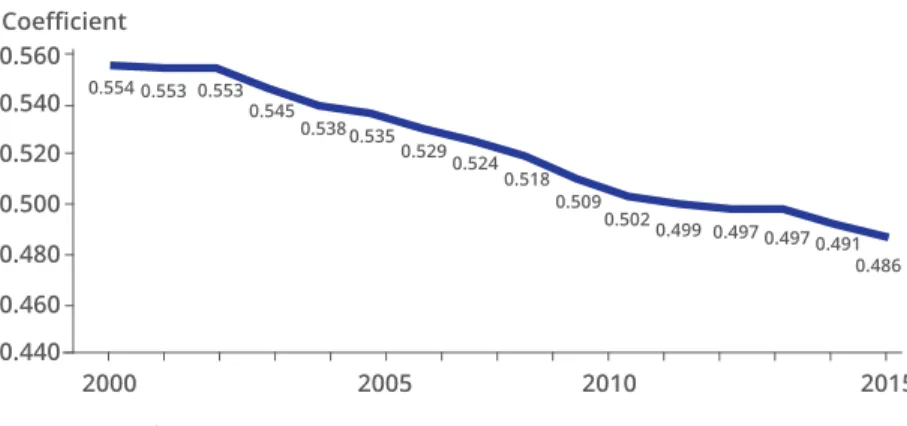
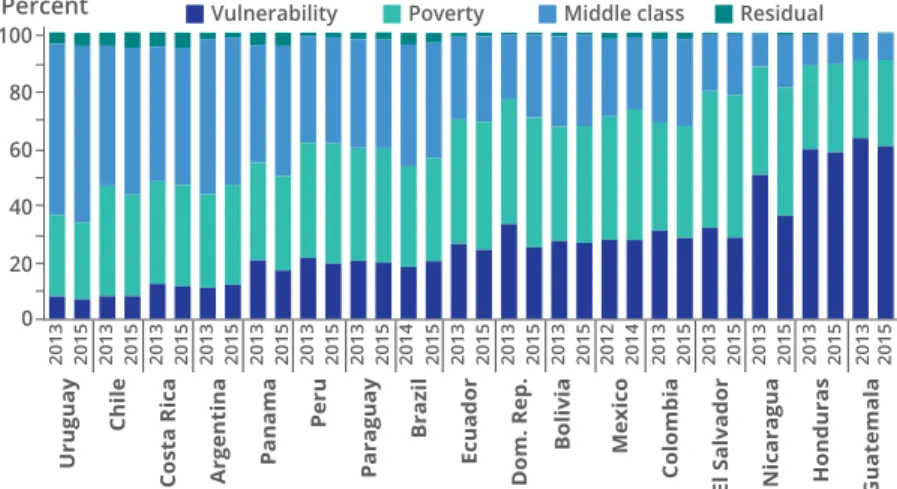
The second challenge we need to address is sustainable social progress. In chapter 4, George Gray Molina reveals a mixed picture: while important progress has been made in reducing income-based poverty and inequal-ity since 2003, strong imbalances among and between countries endure. Undoubtedly, the economic success during the first decade of the century translated into social achievements. Between 2002 and 2012, poverty in the region fell from 44 percent to 29 percent, unemployment was reduced by 35 percent, and the middle class expanded from 22 percent to 34 percent of the population. Moreover, unlike other regions, Latin America managed to reduce income inequality during the same period with an overall decline of about 3 points in its Gini coefficient (ECLAC 2013). However, large segments of the population are still vulnerable to falling back into poverty in the event of external or internal economic shocks, like those affecting some nations after 2013.
To lock in the social gains, governments must invest in the expansion and improvement of public services. This is particularly important when it comes to education, which continues to be the best way to help young people— our most vital asset—enter the job market and attain social mobility. Digital technologies have spread widely in Latin America. We must ensure that they become a tool for social progress, making technology literacy a priority and redesigning the provision of public services to put the digital citizen at the center of our policy process.
But no conversation on income inequality would be complete if we do not thoroughly address the issue of our anemic and often regressive tax structures. According to the United Nations Economic Commission for Latin America and the Caribbean, the average tax revenue as a percentage of GDP in the region is less than 18 percent, yet several countries’ tax collection falls between 10 percent and 15 percent of GDP (ECLAC 2018). No country is able to provide high-quality public services with such meager incomes. And not
just that—taxes in Latin America fall more heavily on those who are less able to pay them, since they are mostly indirect taxes levied on wage earners.
Tax reform is, of course, politically challenging anywhere, but there is sim-ply no way the region will be able to leap forward without seriously examining the way states are funded. Tax reform will only be possible if business elites understand that the price they pay for having bad public services and weak public institutions is in fact way more onerous than the cost of paying higher taxes. Governments have a responsibility as well: if they are going to ask for more money, they need to prove they are able to spend it wisely, efficiently, and properly. The necessary complement to a discussion on tax reform in Latin America is a discussion on how we can increase the efficiency and transpar-ency of our public administration, providing a real commitment to move away from the appalling corruption levels we have witnessed in the last years.
This brings us to the next challenge, one that we must highlight with particular emphasis: improving public governance while strengthening our democratic institutions and the rule of law, the cornerstones of any serious endeavor to generate political stability and build countries and societies where human dignity is fully guaranteed.
As Catalina Botero explains in chapter 2, when the last wave of democ-ratization swept the region in the 1980s, we expected governments to embrace the rule of law and become accountable and transparent after citi-zens regained the right to decide their own destiny through the ballot box. Yet some countries in Latin America were unable to move past the basic outline of electoral democracies. They fell short of safeguarding freedom of the press, building a robust system of checks and balances, and enforcing accountabil-ity.3 Instead of devising new ways to expand democracy, some governments have come up with new ways to undermine it,and others just decided not to make further significant progress in this field. Botero acknowledges that in spite of the undeniable progress since the democratic transitions, there are insufficient advances and alarming setbacks.
This is not to say that all countries in the region face the same odds. Despite the many challenges we share, some countries have advanced consid-erably, implementing open government initiatives that bring transparency and
3 According to Freedom House (2017), only three countries in the region enjoy free
press conditions—Chile, Costa Rica, and Uruguay—while the rest have partially free press conditions or lack a free press environment. As to accountability, some nations in the region lag at the very bottom of International Transparency Indexes, such as Guatemala, Honduras, Mexico, Nicaragua, Paraguay, and Venezuela (Transparency International 2018).
efficiency to public administration,4 increasing the participation of women in politics,5 and fighting corruption and impunity.6
The last challenge in the region I want to mention is the need to design and implement effective local, national, and regional responses to violence, drug trafficking, and all forms of organized crime. According to the United Nations Development Programme, “between the year 2000 and the year 2010 Latin America’s homicide rate grew by 11 percent, while it decreased or remained stable in most regions of the world. More than a million human lives were lost due to criminal violence during this period, that is, around 100,000 deaths per year” (UNDP 2014, v). These rates are much higher in certain seg-ments of the population, particularly young males, which hampers the region’s prospects.
Some countries in Mesoamerica are experiencing violence on a huge scale. The situation is such that the fundamental pact of these societies—the social contract by which the state holds the monopoly of the legitimate use of force in exchange for protection and security for its citizens—has virtually col-lapsed in large swaths of the territory.
We know that fighting crime goes beyond law enforcement and criminal repression. Crime prevention in our countries must be linked to the develop-ment and strengthening of institutional capacities, the consolidation of the rule of law, the promotion of social justice, the fight against corruption, and the reinforcement of our justice systems. In the end, the most effective secu-rity strategy is an integral, long-term development strategy. In chapter 3, Robert Muggah analyzes the complexities of this problem and explores the deficiencies of traditional hard-line policies known as mano dura. Effective security forces are key to controlling and deterring crime, especially organized
4 The Open Government Partnership Initiative, a multilateral organization aiming to
secure commitments from governments to promote transparency and fight corruption, has worked extensively in the Latin American region during the last decade.
5 According to the Interparliamentary Union (http://archive.ipu.org/wmn-e/world. htm), Latin America is the second region of the world in terms of greater women’s rep-resentation in parliamentary posts (28.8 percent), and will likely expand during the electoral cycle 2017–19 due to the parity laws and regulations adopted in several coun-tries, which will face their full implementation for the first time.
6 The 2017 annual report published by Transparency International (2018) states
that “in the last few years, Latin America and the Caribbean made great strides in the fight against corruption. Laws and mechanisms exist to curb corruption, while legal investigations are advancing, and citizen anti-corruption movements are growing in many countries across the region.”
criminal networks, but they alone are insufficient. Muggah presents a compel-ling case for promoting “citizen security” initiatives, which aim to tackle the social causes that fuel violence in Latin America and build ties between law enforcement forces and citizens.
Latin America finds itself at a moment of enormous challenge. The region’s ability to preserve its conquests and overcome its faults and limita-tions will be put to a severe test. There are grounds for cautious optimism, at least for a group of countries in the region that could be able to build on the progress achieved in the past. Clearly, none of the pending tasks we have mentioned is easy to accomplish. Development will always be a somewhat unfinished goal. But there are clear signs indicating the path we need to take, and there are proven recommendations we can follow. We hold the key to unraveling over 500 years of unfulfilled promises.
References
ECLAC (Economic Commission for Latin America and the Caribbean). 2013. Social
Panorama of Latin America 2012. Santiago: United Nations.
—. 2018. The Fiscal Panorama of Latin America and the Caribbean. Santiago: United Nations.
The Economist. 2014. “The Tragedy of Argentina. A Century of Decline.” February 17.
https://www.economist.com/briefing/2014/02/17/a-century-of-decline
Freedom House. 2017. Freedom of Press 2017. https://freedomhouse.org/report/ freedom-press/freedom-press-2017
Fuentes, C. 1992. The Buried Mirror: Reflections on Spain and the New World. New York: Houghton Mifflin.
Hausmann, R., and F. Rodríguez, eds. 2013. Venezuela Before Chavez: Anatomy of an
Economic Collapse. University Park, PA: Pennsylvania State University Press.
Human Rights Watch. 2017. “Venezuela: Events of 2016.” In World Report 2017. https:// www.hrw.org/world-report/2017/country-chapters/venezuela
Transparency International. 2018. Corruption Perceptions Index 2017. https://www. transparency.org/news/feature/corruption_perceptions_index_2017
UNDP (United Nations Development Programme). 2014. Summary: Regional Human
Development Report 2013–2014. Citizen Security with a Human Face: Evidence and Proposals for Latin America. New York: UNDP.
World Bank. 2011. World Development Indicators 2011. Washington, DC: World Bank. World Economic Forum. 2015. “Bridging the Skills and Innovation Gap to Boost
Pro-ductivity in Latin America The Competitiveness Lab: A World Economic Forum Initiative.” Insight Report. World Economic Forum, Geneva.
2
The Rule of Law in
Latin America:
From Constitutionalism
to Political Uncertainty
13 1
C
ompared to other regions, Latin America is doing well. Of 19 countries, Cuba alone lacks a democratic constitution and has not held free elections this century. All others have, at least nominally, multiparty regimes and a vibrant political debate. In quite a few, a strong judiciary has proven its indepen-dence by overriding presidential attempts to remain in office indefinitely and, more recently, by investigating corruption among political and economic elites. Most countries have made significant strides in furthering social inclusion. Civil society has become stronger, and technically savvy organizations enjoying polit-ical legitimacy have decisively helped redemocratize the justice system.That said, some areas have seen precious little progress, while others have experienced a disturbing backslide. In Venezuela, the regime has shut down democratic institutions, predictably causing a humanitarian, social, and political tragedy of vast proportions, including the region’s worst migrant crisis. In Venezuela and elsewhere, massive and systematic human rights vio-lations and voter fraud are reported. These problems are compounded by the conspicuous inability of some states to control their territory, the criminal activities of political elites, and massive corruption scandals. Alarming social divisions, growing polarization, and declining trust in democracy and its repre-sentative institutions are also evident.
As envisaged in many Latin American constitutions, the rule of law requires, inter alia, separation of powers and upholding minority and funda-mental rights. While the rule of law is not easily defined, intersecting as it does both political science and the law, this chapter views the concept as the legal and political foundation of a robust democracy. For the rule of law and democracy to exist, elections alone are insufficient. Also required are a state monopoly on force, control over government power, and as Ronald Dworkin (1986) notes, not using minority rights as a bargaining chip.
This chapter presents a brief overview of the status of the rule of law in Latin America, with an emphasis on five of the most serious challenges fac-ing its consolidation. The startfac-ing point is the transition to democracy and the
1 I would like to thank Alejandro Cortes for his assistance.
Latin America:
From Constitutionalism
to Political Uncertainty
constitutional reforms that sought to consolidate it. Covered next are some of the most significant challenges facing the rule of law: the inability of certain countries to control their territory and the resultant violence, the threats facing judicial independence, corruption, re-election and hyper-presidentialism, and the persistence of inequality. The chapter closes with brief remarks on the ero-sion of popular support for democracy.
The Transition to Democracy and the
Constitutional Promise
In the 1970s, only Colombia, Costa Rica, and Venezuela were not ruled by a military junta or authoritarian government (although Colombia was emerging from a restricted political regime and stared armed conflict in the face). As a so-called “third wave of democracy” rippled through Latin America in the late 1970s, things began to change, driven, inter alia, by a new international sce-nario. The Greek, Portuguese, and Spanish dictatorships had come to an end, and the Cold War was winding down. In many autocratic states, a fiscal crisis made it hard to control bureaucracies and societies. Thus, in 1978, Dominican president Joaquín Balaguer was forced to turn power over to Antonio Guzmán. After that, the region—except for Cuba—began moving from authoritarian mil-itary or civilian regimes to democratic rule. In Ecuador, a milmil-itary junta turned power over to Jaime Roldós in 1979. In the 1980s, autocrats in Argentina, Bolivia, Brazil, Chile, Nicaragua, Paraguay, Peru, and Uruguay gave way to dem-ocratically elected governments. In 1989, the Noriega dictatorship ended and Panama headed to the polls. In the 1990s, El Salvador and Guatemala nego-tiated peace accords that cleared the way for a return to democracy. In 2000, Mexico ended the seven-decade reign of the Institutional Revolutionary Party.
Apart from the antidemocratic attitudes of some individual leaders, only Peru substantially regressed into authoritarianism. In 1992, President Alberto Fujimori dissolved the Legislative Assembly and took over the judiciary in the name of the fight against terror. It is no coincidence that the Inter-American Democratic Charter was adopted in Lima in 2001, a year after Fujimori’s hasty departure. The event was a symbolic celebration of the return to democracy in Peru and an assertion of the renewed democratic values of a region that, except for Cuba, was at last represented by governments elected in reason-ably fair elections. With the charter, the countries of the Americas sought to mark a turning point in the collective defense of democracy. But consolidating the rule of law would prove to be a slower and much tougher task than enthusi-astic Latin American governments had anticipated.
Although fragile and institutionally fragmented, the new democracies relied on a robust understanding of the rule of law that comprised not only
regular, free, and competitive elections, but also a somewhat broad list of fun-damental rights.
From 1982 to 1987, several Central American countries enshrined in their constitutions checks on presidential powers (e.g., a ban on incumbent or unlimited re-election) as well as an important slate of individual rights and judicial mechanisms designed to protect the constitution. These constitutions failed to thrive because of political tensions in the subregion and the armed conflicts in El Salvador and Guatemala, but shortcomings aside, they did seek to consolidate democratic regimes under lawful civilian authority.
The Brazilian Constitution of 1988 marked the start of a second wave of reforms that would last through Mexico’s constitutional amendments of 2011. Meant to consolidate the rule of law, these changes limited presiden-tial powers, recognized a broad slate of rights, gave international human rights instruments constitutional standing, created or strengthened constitutional justice systems, and boosted judicial independence. Some constitutions set up new civic engagement mechanisms, such as recall referendums, popular legislative initiatives, plebiscites, and popular consultations. Drafted during the heyday of the Washington Consensus, these changes also sought to bolster legal certainty and enable structural privatization and deregulatory reforms designed to increase the role of the market in the economy. But prom-ises regarding economic, social, and cultural rights collided with institutional models and political agendas that had placed their bets on the market as the key driver of growth and redistribution (Uprimny and García-Villegas 2004).
Despite these efforts, chief executives retained significant power over the rest of government. In some countries, the only effective counterweights were constitutional courts or panels that reined in presidential excesses and adopted decisions forcing presidents to implement the social policies mandated in the constitution. Limited participation, institutional weakness and fragmenta-tion—especially in remote regions—and poor implementation of accountability mechanisms, such as transparency and access to information laws, impeded the rise of a strong civil society capable of claiming a key political role. Although great institutional efforts were made to consolidate the functioning of the market, the institutions tasked with delivering quality goods and services to the disadvantaged were, with a few exceptions, timidly implemented.
Finally, there is a third type of new constitution, including those of 2008 in Ecuador and 2009 in Bolivia. These constitutions were drafted as the Wash-ington Consensus faded away and amid a fiscal bonanza fueled by rising commodity prices. They reflected the rise of leaders outside the traditional party mainstream who rode in on the shoulders of broad social movements disenchanted by the failure of liberal promises. The new leaders promised substantial reforms in the name of social inclusion and cultural rights. Their
constitutions substantially added to the catalogue of rights, gave government new powers, and, as counterbalance, created new and powerful mecha-nisms of civic engagement and social control. However, these mechamecha-nisms were promptly co-opted by the executive power, putting an end to this new experiment in direct democracy and reinforcing the typical concentrated and hierarchical powers of regional constitutionalism.
The constitutions of the first and second periods, and at least the first ver-sions of the Bolivian and Ecuadorian constitutions, promised a robust rule of law that would respect and guarantee political and personal autonomy rights and heed demands for equality and inclusion. The question now is whether these promises, crucial as they were for consolidating the rule of law, were ful-filled and what were the obstacles they faced.
Territorial Control, Violence, and
Institutional Apartheid
It used to be that the regional debate on the rule of law did not include pub-lic security, one of the most critical issues on today’s agenda. Indeed, absent territorial control and a state monopoly on the use of force, there is no rule of law. In other words, the endemic public security crisis facing Latin America is directly connected to our topic.
With barely 8 percent of the global population, in 2017 Latin America accounted for 38 percent of all murders. Of the 50 most violent cities in the world (based on murder rates), 41 are in Latin America (Alvarado and Muggah 2018). As Robert Muggah notes in chapter 3 of this book, the emergence of organized, well-coordinated criminal groups operating throughout the region is raising concerns about state ability to guarantee territorial control and a monopoly on force, without which there can be no rule of law.
While vast portions of Colombia were long controlled by criminal groups that, all told, led to over 8 million victims (Alsema 2018), Colombia is no lon-ger the region’s sole case of macro-criminal violence. Starting in the year 2000, drug lords began to fight the Mexican state for control of extensive bor-der zones. As their Colombian counterparts lost their hold on drug shipments to the United States, the powerful Juárez and Gulf cartels moved in. Soon their reach extended throughout Central America’s Northern Triangle (El Salvador, Guatemala, and Honduras) and is now spreading to areas of Colombia vacated by the Revolutionary Armed Forces of Colombia (FARC) guerrillas demobilized in 2016. Now more powerful than ever, drug cartels run hemispheric networks that have diversified into the capture of state rents, arms trafficking, drug pre-cursors, smuggling, and human trafficking. All of these activities are fueled by the war on drugs, which has turned the drug trade into the world’s most
lucrative industry and the cartels into sophisticated enterprises capable of wresting territory from the state.
Other players include groups less structured but just as violent as the car-tels, such as MS-13 or the Mara Salvatrucha. These groups are organized in stand-alone gangs which answer to local bosses and control vast vulnerable neighborhoods. This form of gang activity is growing throughout El Salvador (one of the world’s most violent countries, second only to Venezuela in the region), poor Venezuelan neighborhoods, and the favelas of Rio de Janeiro. In many countries they also run the prisons, relegating the state to perimeter control. These groups wield absolute power over residents under their control. A new and growing criminal undertaking involves illegal mining, oil extraction, and logging activities. These groups often intimidate and murder environmen-tal leaders, a practice that in 2017 reached epidemic proportions in Brazil, Colombia, Mexico, and Peru.
Once criminal gangs secure their turf, they set up regional networks that attempt to neutralize or capture state activities. Territorial control is usually facilitated through tacit cooperation or non-aggression pacts with local or central officials. Some of these arrangements are based on acts of corruption or mutual interest; others are the result of state inability to take action. The most successful of all state capture experiments is taking place in Venezuela, where officials across the board—including the military—are involved in drug, fuel, currency, food import, and smuggling cartels, leaving criminal gangs to handle street violence, neighborhood enforcement, and prison control (InSight Crime 2018).
The inability of Latin American institutions to prevent, investigate, and sanction crime is staggering, as is the resulting neglect facing millions of people. Other than the promise of the “citizen security” initiatives Robert Mug-gah notes in his chapter, effective prevention policies remain conspicuously absent. Regional impunity rates stand among the world’s highest, ranging from 50 percent to 92 percent. The 2014 Ayotzinapa case in Mexico, in which 43 students were forceably disappeared after an alleged encounter with police forces, is a powerful example. Years after the incident took place, there have been no convictions, and the Mexican state has been accused of purposely derailing the judicial investigation.
Millions of residents of outlying areas are subject to violence from ille-gal groups and often from poorly trained security forces. The lack of territorial control prevents institutions from operating adequately and limits their abil-ity to deliver qualabil-ity goods and services to communities facing a plight that García-Villegas and Espinosa (2016) have labeled institutional apartheid, or the absence of the right to have rights due to state weakness and the domi-nance of violent groups.
As such, the debate about the rule of law cannot overlook the security cri-sis and the state’s inability to tackle it. Since a complete overhaul of the global drug control policy that is fueling the violence is not realistic at present, it is imperative to at least think about a comprehensive security policy that goes beyond law enforcement’s anti-violence campaigns. For any such policy to succeed, it must strengthen fragile state institutions and engage communities without compromising safety. It must also improve the delivery of goods and services, including infrastructural, to outlying areas; revise campaign financ-ing rules; and control the use of public funds. Also crucial are mechanisms for regional cooperation and mutual legal assistance, and reinforced prose-cutorial independence and autonomy. Reverting high impunity rates can offer redress to victims and is the most effective way to prevent recurrence.
Judicial Independence and the Rule of Law
A key aim of post-transition constitutional reforms was to bolster court auton-omy and independence. These changes set up independent judicial councils to handle court appointments and administration, sought to establish a judi-cial career track, and in some cases, provided budget guarantees designed to ensure that no government could financially starve the justice system.Most of these efforts reflected the neo-institutional economic thought prevalent in the late 20th and early 21st centuries. The intent was to create courts that would efficiently arbitrate conflict, protect property, and give legal certainty to the private sector. However, the strengthening of justice, espe-cially constitutional justice, combined with entrenchment of a broad slate of rights produced unanticipated effects that became enormously important for fulfilling the promise of social constitutionalism.
Indeed, guarantees of impartiality and independence allowed many judges to uphold key minority rights, notably prior consultation with indigenous peo-ples, sexual and reproductive rights, recognition of same-sex coupeo-ples, and protection of social rights. In Colombia and Guatemala, the courts helped protect institutional stability from the arbitrary acts of powerful actors and pre-vented presidents from remaining in office indefinitely. As noted below, across the region prosecutors and judges are playing a critical role in investigating and prosecuting political and economic elites linked to major corruption scandals.
Still, judicial independence continues to face serious issues. Except for Brazil and Chile, most countries offer no real career track, and many judgeships are filled by nontenured judges, which makes them even more dependent on their political patrons. Expert and funding support remain insuf-ficient; wages are often not competitive; and judicial councils have not shown the expected autonomy, governance, and management skills. Most countries
lack effective policies on granting the disadvantaged access to justice, meet-ing judicial demand in outlymeet-ing areas, and protectmeet-ing judges and prosecutors who investigate organized crime.
These vulnerabilities make the judiciary permeable to corruption and political interference, while society wonders about the legitimacy of a slow, biased justice system. Authoritarian governments have exploited these con-cerns to push for reforms that ostensibly intend to enhance the courts system, but in fact tend to weaken its independence. Many authoritarian rulers have seriously undermined judicial autonomy and independence to remain in office, avoid prosecution, or dilute checks on their power.
Venezuela is a textbook example. After becoming president in 1999, Hugo Chávez leveraged the judiciary’s widespread disrepute to push for reforms that purported to strengthen the courts while in fact placing them under govern-ment control. The capture of the judiciary helped consolidate an authoritarian regime and lend a veneer of legitimacy to acts that contributed to breaking down the rule of law. For example, in 2017, the Venezuelan Supreme Court vali-dated an illegitimately convened, government-controlled constituent assembly designed to supplant the opposition-controlled Legislative Assembly elected in December 2015. In countries such as Bolivia, Honduras, and Nicaragua, the evidence shows that guarantees of judicial independence are clearly lacking. In Ecuador, the reforms that gave former president Rafael Correa control of the courts are being dismantled by amendments approved in a plebiscite called by his successor, President Lenín Moreno.
There is a direct link between judicial guarantees, the rule of law, and democracy. Where the justice system is afforded institutional, structural, and functional guarantees of independence and autonomy, democratic per-formance is best. Where judicial independence is fragile or nonexistent, the quality of democracy is low.
The World Economic Forum uses a judicial independence indicator ranging from 1 to 7, with 1 indicating no independence. The 2018 report, comprising 140 countries, gives Venezuela, Nicaragua, and Ecuador a score of 1.1, 1.6, and 1.9, respectively, among the lowest in the world. In contrast, Uruguay, Costa Rica, and Chile score 5.4, 4.9, and 4.9, respectively. In the World Justice Project’s Rule of Law Index (scores range from 0 to 1, with 1 indicating strongest adherence to the rule of law), one indicator is the judiciary’s ability to act independently and to effectively limit government power (World Justice Project 2018). Latin Ameri-can countries with the lowest scores on this front were Venezuela (0.14), Bolivia (0.24), Nicaragua (0.32), Honduras (0.35), and Ecuador (0.37).
In this century, all Latin American governments that drifted into authori-tarian rule generally started by curtailing judicial independence and freedom of expression.
The Rule of Law and the Fight Against
Corruption
Corruption scandals such as Mexico’s Casa Blanca, Guatemala’s customs bribery ring, Costa Rica’s cement company racket, and Brazil’s Odebrecht and Lava Jato cases (which then snowballed through the region) have shaped the Latin American political debate since 2012. As a heightened perception of cor-ruption may help account for the democratic backsliding in the region, these scandals have a strong impact on the rule of law.
Analyzing the response to corruption helps determine the health and maturity of the rule of law. In December 2016, following the remarkable prog-ress made by Brazilian prosecutors, the U.S. Department of Justice revealed that from 2001 to 2016 Odebrecht paid some US$788 million in bribes across 10 Latin American countries. Brazil and Peru have successfully prosecuted and convicted prominent politicians and businesspeople. But in the Domini-can Republic, Mexico, and Venezuela, impunity has been the rule. What often makes the difference is the ability of prosecutors and judges to try cases involving politically powerful individuals. Where prosecutors are government appointed and judges are not protected by guarantees, investigations may stall or be restricted to lower-rung officials.
Brazil is a prime example of the impact of an independent judiciary on the anti-corruption fight. Three former presidents are facing charges, notably Luiz Inácio Lula da Silva, already serving time for corruption. Also behind bars are the former speakers of the lower and upper houses; the head of the gov-ernment’s congressional caucus; the former governor of Rio de Janeiro; and several legislators, cabinet ministers, and businesspeople.
In Peru, the fallout from the Odebrecht scandal led to the resignation of President Pedro Pablo Kuczynski. All told, three former presidents are under investigation and former president Ollanta Humala and his wife are already in pretrial detention. That said, Fujimorista legislators have threatened a con-gressional investigation of the lead prosecutor. In Ecuador, the investigation went ahead only after the Moreno government appointed a new prosecutor. As of this writing, Correa’s vice president has been convicted and his comptroller general remains at large.
Argentina, where the courts under President Cristina Fernández de Kirchner (2007–15) shelved or stalled corruption cases, is another example of investigations gathering steam under a new government. A new scandal erupted in 2018, with mounting evidence implicating Fernández in a massive public works corruption scheme. In an unprecedented development resem-bling Brazil’s Odebrecht affair, leading businessmen have admitted to paying kickbacks, which has led to fresh charges against the former president.
Where judges are less independent or the political atmosphere is adverse, investigations have failed to make headway. In Venezuela, a prosecutor appointed by President Maduro to look into the million-dollar bribes paid by Odebrecht promptly closed the investigation without filing charges. In Mexico, the prosecutor handling the Odebrecht file was fired after he made it clear that he actually intended to investigate.
In Guatemala, events around the International Commission Against Impu-nity in Guatemala (CICIG) show the close connection between presidential privilege, judicial independence, and corruption. CICIG was established with United Nations support as part of the peace accords. A 2015 CICIG investiga-tion conducted in tandem with local justice officials implicated President Otto Pérez Molina in a customs corruption ring, eventually forcing his resignation. More recently, President Jimmy Morales has responded to an investigation into his family and presidential campaign with fierce attacks against the CICIG commissioner. Strong support from the United Nations and regional states, plus the technical skills and security of tenure of the commissioner and his team, show that institutional, structural, and functional guarantees can achieve remarkable results even under extremely hostile circumstances. Special mention should be made of the Guatemalan Constitutional Court’s courageous stand to forestall drastic action against CICIG. At present, Morales is escalating his attacks against CICIG, with support from major allies in the U.S. Congress and government.
The Mission to Support the Fight against Corruption and Impunity in Hon-duras, a similar undertaking created under the auspices of the Organization of American States, has also faced serious hurdles investigating Honduran officials.
The checkered progress made in the anti-corruption fight shows how much remains to be done to fully guarantee court independence and trans-form the political culture. While it is encouraging that cases are being brought to light and serious investigations conducted, the absence of effec-tive justice can hurt confidence in the system. Moreover, some politicians under investigation are using their clout to escalate polarization and ques-tion the justice system. In Brazil, Lula loyalists feel that court decisions against him are part of a political conspiracy. In Argentina and Ecuador, Fernández and Correa followers have accused the courts of being partisan and selective, while opponents claim that the system is ineffective. Where court guarantees are insufficient, democratic principles are not well rooted in civil society and calm debate on the role of the courts is found wanting, anti-corruption efforts can paradoxically end up undermining support for democratic institutions.
The Strengthening of Presidentialism and
Re-election
To avoid a repeat of past abuses, most Latin American constitutions of the 1990s set limits on presidential re-election. Some barred it and others allowed it, although not consecutively or indefinitely. Yet, within the past 25 years, 12 of 18 governments have moved to weaken these limits.
In 1993, Peruvian president Alberto Fujimori successfully pushed for sin-gle-term incumbent re-election under the constitution. In 1996, free from the strictures of democratic formality, he had the legislature pass a law allowing him to run once again. He won, but his mandate rapidly collapsed amid accu-sations of widespread voter fraud. Shortly after, Fujimori fled the country to evade serious human rights and corruption charges. In 2000, upon the return of democracy, a constitutional amendment set a five-year term of office and barred incumbent re-election.
In 1994, Argentine president Carlos Menem agreed to reforms advanc-ing the legitimacy and governance of the presidential system in exchange for a re-election clause. Once re-elected in 1995, he tried to remove term limits. Menem currently stands convicted of serious felonies.
Brazil’s Fernando Henrique Cardoso also amended the constitution to allow for incumbent re-election. His intent was to ensure the sustainability of his Plan Real, a blueprint for stabilizing the currency after a difficult period of hyperinflation. To secure approval, Cardoso proposed reducing the term of office to four years, limiting re-election to a single term, and exempting gov-ernors and mayors from these restrictions. The amendment was approved by the voters, and in the 1999 presidential elections Cardoso defeated Lula da Silva. This may well be the only instance of a popular second-term president not seeking a new amendment to stay in office.
The 1999 Venezuelan constitution allowed one-time incumbent re-elec-tion and extended the term of office from five to six years. With a party system in disarray, a president with sky-high poll numbers, and a Constituent Assem-bly controlled by a government majority, the amendment was easily passed, allowing Chávez to substantially boost the powers of the presidency. He later proposed a referendum on unlimited re-election, an initiative that failed in 2007 but was eventually approved in 2009, leading an exultant Chávez to declare that he would stay in power through 2025. Elections in Venezuela presently lack all legitimacy, but this amendment allows Maduro to run as often as he wants, on a playing field wholly tilted in his favor.
Correa, in Ecuador, also succeeded in pushing through his re-election ambitions. After serving three terms, he left the post intending to run again after Moreno completed his term, only to see re-election barred in a referendum
held by the new administration. In the Dominican Republic, the rules have been constantly debated and amended to allow incumbent presidents to remain in office. The Colombian case is unique, in that although President Álvaro Uribe did manage to pass a constitutional amendment enabling him to run a sec-ond time, the Constitutional Court threw out an amendment that would have allowed him to run a third time.
In Bolivia, Honduras, and Nicaragua, where the judiciary is beholden to political power, limits on incumbent re-election were relaxed by court ruling after political efforts to secure a reform failed. Independent observers have strongly questioned the subsequent presidential elections held in Honduras and Nicaragua. While in Costa Rica re-election was also enabled by court rul-ing, the decision did not benefit a sitting president.
Most re-election efforts have been led by charismatic presidents vowing to address pressing security, social, and cultural demands. Once re-elected, however, they often stray from the mandates of democratic constitutionalism. All such rulers have significantly increased their powers, as additional terms of office offer an enormous ability to control the institutions meant to hold them accountable. In Nicaragua and Venezuela, crackdowns by re-elected presidents have resulted in the deaths of hundreds of opponents.
The Unfulfilled Promise of Social
Constitutionalism
In its most robust version, such as many Latin American countries envisaged after transitioning to democracy, the rule of law ought to guarantee the rights and entitlements of all citizens. This duty entails a state obligation to con-front the multidimensionality of poverty and inequality. As George Gray Molina writes in chapter 4 of this book, the socioeconomic dimension is but one factor behind inequality in Latin America. Gender, native or Afro-descendant status, age, and place of residence are also core components of inequality. These often overlap and feed on one another, resulting in wide-ranging inequality in matters of access to rights. While chapters 4 and 5 by Gray Molina and Augusto de la Torre and Alain Ize respectively review the impact of economic and social policy, this chapter focuses on inequality as the unfulfilled promise of the rule of law.
As Gray Molina shows, from 2002 to 2014, Latin America made signifi-cant headway in terms of poverty reduction. The advent of leftist governments shifted the development policy agenda toward inclusion and social issues, driving a significant increase in social spending. However, a new international scenario, slumping commodity prices, and the collapse facing countries imple-menting this agenda (Nicaragua, Venezuela) have revealed that any progress
that was made did not come from stable, robust institutions capable of sus-tainably managing such policies.
Inequality persists, at least in part, because of the weakness or absence of long-term policies capable of fostering stable institutions that are free from political cronyism and ensure the rights and interests of all sectors affected by these structural issues. The reality is that Latin American political elites of all stripes seem more preoccupied with acquiring and holding onto power than with guaranteeing universal access to rights.
In accounting for the lack of policies addressing structural inequality, another equally relevant factor is the lack of effective mechanisms for represen-tation and participation in public policy making and accountability. Significantly, most constitutional reforms have preserved the traditional highly concentrated, top-down forms of exercising power. Where these did contemplate mechanisms for participation and social control, as in Bolivia and Ecuador, chief executives made sure to thwart them. The connection between constituents and represen-tatives is thus tenuous and outlets for deliberation and participation, especially in remote regions, few and far between. Furthermore, the models adopted failed to include functional transparency and accountability systems. In short, while some efforts to address inequality were made, especially during the commodity bonanza of the early 2000s, they were not part of a larger policy design capable of building up long-term social citizenship and state capacities. Social benefits often remained tied to the whims and electoral goals of the government of the day, or, as in Venezuela, were wielded as a political tool while the basic institu-tions of the rule of law were dismantled.
Absent more adequate mechanisms for representation and participation, it often fell to the judiciary to ensure adoption of social policy and compel govern-ments to fulfill their social mandate under the constitution; so-called “structural determinations” are a prime example. Many social movements chose strate-gic litigation over working through channels of representation. Court decisions, however, face democratic and material constraints. When matters involve redressing structural inequality, the justice system simply cannot offer ade-quate, long-term solutions to issues the political system chooses to ignore.
Concluding Remarks on the Regression of
Democracy
The economic and social gains of the early 2000s notwithstanding, by 2018 excitement over the Latin American spring has died down, and so has opti-mism over its not-so-new democracies. The latest report of the World Justice Project’s Rule of Law Index (scores range from 0 to 1, with 1 indicating stron-gest adherence to the rule of law) gives Venezuela 0.29 points, the world’s
worst performance overall, followed by Bolivia (0.38), Honduras (0.40), Nicara-gua (0.43), Guatemala (0.44), Mexico (0.45), and Ecuador and the Dominican Republic (both 0.47) (World Justice Project 2018).
Moreover, support for democracy has been steadily slipping in the last decade. The Latinobarómetro survey reports that the share of Latin Americans preferring democracy over any other form of government fell from 61 percent in 2010 to 48 percent in 2018. Dissatisfaction is also growing: in 2010, 52 per-cent of respondents were not satisfied with democracy in their country; by 2018, the number had risen to 71 percent.
The decline affects both democracy and its basic institutions. The AmericasBarometer survey asked respondents if they agreed that presidents should close down the legislature when the country is facing difficult times. In 2010, 14 percent of Latin Americans agreed; in 2016, the number rose to 20 percent. In 2010, 32 percent trusted the courts, 45 percent trusted the government and 34 percent trusted the legislature. By 2017, these figures had dropped to 25 percent for the courts and government and to 22 percent for the legislature. Worst ranked overall were political parties. According to Latinobarómetro (2018), in 2010 political parties were trusted by 23 per-cent of Latin Americans; by 2017, the number stood at a scant 15 perper-cent. AmericasBarometer reports similar findings. In 2010, 24 percent trusted political parties; in 2016, the figure stood at 17 percent (Cohen, Lupu, and Zechmeister 2017).
Accurately isolating the root causes of the growing democratic backslid-ing is not an easy proposition, but some explanations seem plausible. First is the state of the economy. In a report recapping 20 years (1995–2015) of measuring public opinion, Latinobarómetro (2015) found a clear link between economic health and satisfaction with democracy. From 2002 to 2008, Latin America lived through a virtuous cycle of sustained growth that lifted per capita income and substantially boosted support for democracy. Once the cycle was over and per capita income growth weakened, support for democracy declined.
Another factor is the growing incidence of voter fraud and the overt abuse of the rules of the game by incumbent presidents intent on staying in office. Indeed, inconsistent social agendas, ineffective public security policies, corrup-tion scandals, and neglect of outlying regions have led many to feel that rulers govern to benefit themselves, not society. Compounding this feeling is the crisis facing political parties as channels of representation and the rise of charismatic leaders promising to address demands for justice and security while disparag-ing checks and balances such as the courts and press freedom. In addition, the new world scenario, with Donald Trump becoming president of the United States as Russia and China are in the ascendant, has induced a bewildering lack of interest—to say the least—in democratic backsliding in Latin America. As
a result, democracy has ever fewer champions at a time when societies seem ever more disenchanted. Finally, there is a shift in political discourse that cannot be emphasized too strongly: the rise of increasingly intolerant echo chambers unwilling to check their beliefs against the available evidence.
Samuel Huntington (1991) once wrote that waves of democracy are often followed by a decline that puts gains to the test. In the past five years, the test has cost Latin America dearly in terms of the consolidation of its democratic institutions. Maybe the time has come to call the decline for what it is: a dire, real challenge to the rule of law.
References
Alsema, Adriaan. 2018. “Colombia’s War Victims: The Numbers.” Colombia Reports April 9. https://colombiareports.com/colombias-war-victims-the-numbers/
Alvarado, Nathalie, and Robert Muggah. 2018. Crimen y violencia: Un obstáculo
al desarrollo de las ciudades de América Latina y el Caribe. Washington, DC:
Inter-American Development Bank.
Cohen, Mollie, Noam Lupu, and Elizabeth J. Zechmeister. 2017. The Political Culture of
Democracy in the Americas, 2016/17: A Comparative Study of Democracy and Gov-ernance. Nashville: Latin American Public Opinion Project, Vanderbilt University.
Dworkin, Ronald M. 1986. Law’s Empire. Cambridge, MA: Belknap Press.
García-Villegas, Mauricio, and Jose Rafael Espinosa. 2016. “Los desafíos del apar-theid institucional.” In Democracia, justicia y sociedad: Diez años de investigación
en Dejusticia, edited by Mauricio Villegas and María Adelaida Ceballos, 168–75.
Bogotá: Centro de Estudios de Derecho, Justicia y Sociedad, Dejusticia.
Huntington, Samuel. 1991. The Third Wave: Democratization in the Late Twentieth
Cen-tury. Norman, OK: University of Oklahoma Press.
InSight Crime. 2018. Venezuela: ¿Un Estado mafioso? https://www.insightcrime.
org/wp-content/uploads/2018/05/Venezuela-Estado-mafioso-InSight-Crime-Observatorio-de-crimen-organizado.pdf
Latinobarómetro. 2015. La Confianza en América Latina 1995–2015. Santiago: Corpora-ción Latinobarómetro. http://www.latinobarometro.org/latNewsShow.jsp?ID=225
—. 2018. Informe Latinobarómetro 2018. Santiago: Corporación Latinobarómetro.
http://www.latinobarometro.org/lat.jsp
Uprimny, Rodrigo, and Mauricio García-Villegas. 2004. “Corte Constitucional y eman-cipación social en Colombia.” In Democratizar la Democracia: Los caminos de la
democracia participativa, edited by Boaventura de Sousa Santos, 255 ff. Mexico
City: Fondo de Cultura Económica.
World Economic Forum. 2018. The Global Competitiveness Report 2018. Geneva: World Economic Forum.
World Justice Project. 2018. Rule of Law Index 2017–2018. Washington, DC: World Jus-tice Project.
3
Fighting Organized
Crime in Latin America:
Between Mano Dura
and Citizen Security
29 1
L
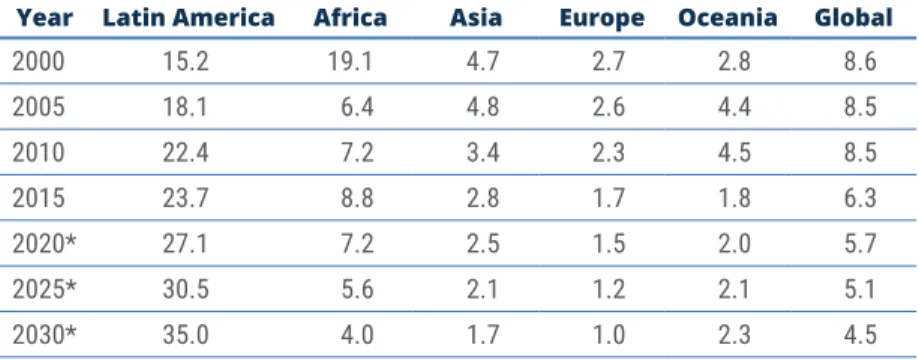
atin America’s violence problem is the subject of considerable global debate. On the one hand, the region is justifiably praised for establish-ing a zone of peace. Latin America has not experienced an international armed conflict since 1945, and the last remaining internal conflict came closer to an end with the 2016 peace deal with the Revolutionary Armed Forces of Colombia (FARC). Notwithstanding dangerous political and economic volatility in Venezuela and occasional constitutional crises (see chapter 2), Latin Amer-ica has effectively rid itself of armed conflict. These successes were due in large part to the spread of democratic governance, real economic gains, and periodic interventions from regional organizations and so-called “guarantor states.”On the other hand, Latin American states and cities routinely rank among the world’s most murderous (The Economist 2018; Luhnow 2018; Philipps 2018; Winter 2018). The regional homicide rate is at least three times the global average (Igarapé Institute Homicide Monitor 20182; UNODC 2014), and citizens routinely list insecurity among their top concerns (Basombrio 2012). This is a change from the 1960s and 1970s, when murder rates were closer to the global average. Since then, the prevalence of lethal violence has steadily increased in Latin America while declining in most other parts of the world. While registering some improvements in recent years, 8 of the top 10 most violent countries on the planet are in Central America and the Caribbean,3 and just 4 countries in the region account for 27 percent of the world’s murders
1 Credit to Katherine Aguirre Tobón, Juan Garzón, Bruno Binetti, and Nathalie
Alvarado for reviewing earlier drafts.
2 homicide.igarape.org.br.
3 According to the latest data available from the Homicide Monitor, the top 10
include El Salvador (60 homicides per 100,000), Jamaica (56 per 100,000), Venezuela (54 per 100,000), Honduras (43 per 100,000), Saint Kitts and Nevis (42 per 100,000), Lesotho (41 per 100,000), Belize (41 per 100,000), Trinidad and Tobago (36 per 100,000), Saint Vincent and the Grenadines (35 per 100,000), and South Africa (34 per 100,000).
Latin America: Between
Mano Dura and Citizen Security
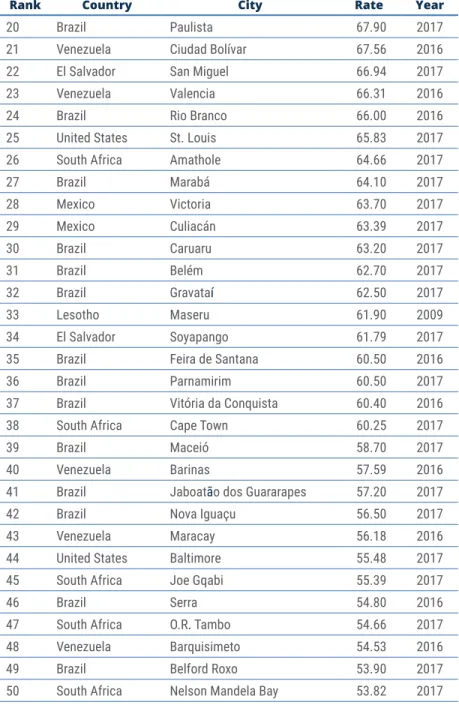
Table 3.2 Top 50 global cities by homicide rate per 100,000 in population
Rank Country City Rate Year
1 Venezuela Guarenas-Guatire 102.20 2016 2 Mexico Acapulco de Juarez 97.70 2017 3 Mexico Chilpancingo de los Bravo 97.05 2017 4 Brazil Caucaia 96.60 2017 5 Mexico Los Cabos 96.57 2017 6 El Salvador San Salvador 95.70 2017 7 Mexico Tijuana 91.23 2017 8 Honduras Choloma 86.45 2017 9 Brazil Mossoró 84.20 2017 10 Brazil Ananindeua 79.60 2017 11 Brazil Camaçari 79.40 2016 12 South Africa Chris Hani 77.80 2017 13 Brazil Fortaleza 75.30 2017 14 Guatemala Guatemala 75.11 2017 15 Venezuela Caracas 74.96 2016 16 Brazil Natal 70.30 2017 17 Mexico La Paz 69.08 2017 18 Venezuela Maturín 68.46 2016 19 Venezuela Ciudad Guayana 68.18 2016
(continued)
Table 3.1 Homicides in selected Latin American countries as a percentage of the estimated global total
Country/region (year) Number of homicides % of world total
Brazil (2016) 62,517 14 Colombia (2017) 11,918 3 Mexico (2017) 25,339 6 Venezuela (2017) 16,046 4 Subtotal 115,820 27 Rest of the world 321,180 73 World (2012) 437,000 100
Table 3.2 Top 50 global cities by homicide rate, per 100,000 (continued)
Rank Country City Rate Year
20 Brazil Paulista 67.90 2017 21 Venezuela Ciudad Bolívar 67.56 2016 22 El Salvador San Miguel 66.94 2017 23 Venezuela Valencia 66.31 2016 24 Brazil Rio Branco 66.00 2016 25 United States St. Louis 65.83 2017 26 South Africa Amathole 64.66 2017 27 Brazil Marabá 64.10 2017 28 Mexico Victoria 63.70 2017 29 Mexico Culiacán 63.39 2017 30 Brazil Caruaru 63.20 2017 31 Brazil Belém 62.70 2017 32 Brazil Gravataí 62.50 2017 33 Lesotho Maseru 61.90 2009 34 El Salvador Soyapango 61.79 2017 35 Brazil Feira de Santana 60.50 2016 36 Brazil Parnamirim 60.50 2017 37 Brazil Vitória da Conquista 60.40 2016 38 South Africa Cape Town 60.25 2017 39 Brazil Maceió 58.70 2017 40 Venezuela Barinas 57.59 2016 41 Brazil Jaboatão dos Guararapes 57.20 2017 42 Brazil Nova Iguaçu 56.50 2017 43 Venezuela Maracay 56.18 2016 44 United States Baltimore 55.48 2017 45 South Africa Joe Gqabi 55.39 2017 46 Brazil Serra 54.80 2016 47 South Africa O.R. Tambo 54.66 2017 48 Venezuela Barquisimeto 54.53 2016 49 Brazil Belford Roxo 53.90 2017 50 South Africa Nelson Mandela Bay 53.82 2017