Collective Narcissism Moderates the Effect of In-Group Image Threat on
Intergroup Hostility
Agnieszka Golec
de Zavala
Instituto Universitario de LisboaAleksandra
Cichocka
University of WarsawIrena
Iskra-Golec
Jagiellonian UniversityResults of four experiments demonstrated that under in-group image threat collective narcissism predicts retaliatory intergroup hostility. Under in-group criticism (vs. praise) collective narcissists expressed intention to harm the offending out-group but not other, nonoffending out-groups. This effect was specific to collective narcissism and was replicated in studies that accounted for the overlap between collective narcissism and individual narcissism, in-group positivity (in-group identification, blind and constructive patriotism), social dominance orientation, and right wing authoritarianism. The link between collective narcissism and retaliatory intergroup hostility under in-group image threat was found in the context of national identity and international relations and in the context of a social identity defined by university affiliation. Study 4 demonstrated that the relationship between collective narcissism and intergroup hostility was mediated by the perception of in-group criticism as personally threatening. The results advance our understanding of the mechanism driving the link between collective narcissism and intergroup hostility. They indicate that threatened egotism theory can be extended into the intergroup domain.
Keywords: collective narcissism, in-group image threat, intergroup hostility
In his “Letter to the American People,” Osama bin Laden called for the moral betterment of Western civilization under the guid-ance of fundamentalist Islam and warned, “If the Americans refuse to listen to our advice and the goodness, guidance and righteous-ness that we call them to, then be aware that you will lose this Crusade Bush began” (Full text: bin Laden’s “letter to America,” 2002). The letter expresses Bin Laden’s belief that the group he represents is superior to others. It should therefore dominate and guide other groups. Moreover, this group is entitled to punish members of other groups for the lack of proper recognition of this group’s extraordinary characteristics and privileged position. From this perspective, the terrorist attacks of 9/11 can be seen as retal-iatory violence in response to the humiliating lack of regard for the
privileged in-group. Throughout human history there have been multiple examples of atrocities inspired and legitimized by the belief that others did not recognize the greatness and the privileged position of the in-group. Germans under the Nazi regime believed that their self-proclaimed right to the “better living space” and pure blood of the Aryan race was, to put it mildly, not properly appre-ciated by other nations.
In this article we propose that a phenomenon operating at the psychological level, namely collective narcissism, may help ex-plain these large-scale social phenomena (see, e.g.,Adorno, 1951; Emmons, 1987). Inflated beliefs in one’s own superiority and entitlement, contingent on continuous external validation, are char-acteristics of narcissism (Crocker & Park, 2004;Morf & Rhode-walt, 2001). Narcissists respond with anger and aggression to personal insult, criticism or humiliation. It has been proposed that narcissistic hostility is direct and retaliatory and serves ego defen-sive purposes (Bushman & Baumeister, 1998). Individual narcis-sism has an equivalent at the social level of self (Golec de Zavala, 2011a; Golec de Zavala, Cichocka, Eidelson, & Jayawickreme, 2009). We propose that just as narcissistic individuals react with defensive violence against those who insult, humiliate or criticize them, collective narcissists become hostile against those who insult or criticize their in-group. Collective narcissists may perceive in-group criticism as personally threatening and use intergroup violence to restore positive self- and group-image.
In this article we present four experiments that, using different intergroup contexts and assessing collective narcissism with ref-erence to different social groups, test the hypothesis that collective narcissism predicts retaliatory intergroup hostility. These studies Agnieszka Golec de Zavala, Centro de Investigação e Intervenção
So-cial, Instituto Universitario de Lisboa, Lisboa, Portugal; Aleksandra Cichocka, Faculty of Psychology, University of Warsaw, Warsaw, Poland; Irena Iskra-Golec, Institute of Applied Psychology, Jagiellonian Univer-sity, Kraków, Poland.
Studies presented in this article were partly supported by British Acad-emy Research Grant SG090532, “Exploration of narcissistic beliefs about groups,” awarded to Agnieszka Golec de Zavala.
The authors would like to thank Elizabeth Collins, Bob Schatz, and Sven Waldzus for their insightful comments that allowed us to improve this article.
Correspondence concerning this article should be addressed to Ag-nieszka Golec de Zavala, CIS IUL, Avenida das Forças Armadas, Edificio ISCTE, Lisboa, Portugal. E-mail:[email protected]
This document is copyrighted by the American Psychological Association or one of its allied publishers. This article is intended solely for the personal use of the individual user and is not to be disseminated broadly. 1 AQ: au AQ: 1 AQ: 9
compare the moderating effect of collective narcissism with a variety of individual difference variables that have been shown to predict intergroup hostility (e.g., right wing authoritarianism, so-cial dominance orientation) or hostile responses to criticism (e.g., individual narcissism, collective self-esteem and high in-group identification). We conclude with a discussion of the implications of these findings for the illumination of the psychological mech-anism underlying the relationship between collective narcissism and intergroup hostility.
Collective Narcissism and Intergroup Hostility
Collective narcissism is defined as an emotional investment in a belief in the unparalleled greatness of an in-group (Golec de Zavala et al., 2009). Inasmuch as people can idealize the self, they can idealize social groups to which they belong and differ with the extent they do so (for a similar idea that processes on individual level of self can be paralleled by processes on the social level of self (see, e.g., Bizman, Yinon, & Krotman, 2001;Gramzow & Gaertner, 2005;Hornsey, 2003). Just like the narcissistic idealiza-tion of the self, the narcissistic idealizaidealiza-tion of an in-group may be contingent on its external recognition and involve hypersensitivity to threats to the in-group’s image.
We propose that collective narcissism captures the capacity of exaggerated group esteem to inspire out-group hostility in re-sponse to perceived threat to the in-group’s positive image. Col-lective and individual narcissism are positively related. Studies indicate that the strength of their relationship ranges from rela-tively weak to moderate (rs⫽ .15 to .27;Golec de Zavala et al., 2009). Importantly, collective narcissism predicts intergroup atti-tudes and behaviors that individual narcissism does not account for and individual narcissism predicts interpersonal anger and inter-personal aggressiveness, both of which are unrelated to collective narcissism (Golec de Zavala et al., 2009; Studies 2 and 3).
Collective narcissism predicts intergroup hostility over and above such robust predictors as social dominance orientation or right wing authoritarianism (Golec de Zavala et al., 2009). We claim that the psychological mechanism underlying the relation-ship between collective narcissism and intergroup hostility is con-siderably different than the mechanism that drives the relationship between intergroup hostility and other predictors. Namely, inter-group hostility related to collective narcissism is a response to actions taken by an out-group (or out-group members) that are perceived as undermining the positive image of the in-group and are experienced as offensive and threatening. Intergroup hostility inspired by collective narcissism is specific and retaliatory in nature. Intergroup hostility in response to in-group criticism serves the function of punishing the offending out-group and restoring the in-group’s image.
Supporting this line of reasoning, correlational analyses indicate that collective narcissists are sensitive to anything that can be interpreted as a threat to the exaggerated image of the in-group. For example, Mexicans high in collective narcissism perceived the construction of the wall along the Mexican-American border as more of an insult to Mexico and Mexicans than did those low in collective narcissism (Golec de Zavala et al., 2009; Study 5). Poles high in collective narcissism saw publication of a book that ana-lyzed anti-Semitic outbursts in Poland during the Second World War as more of an insult to Poland and Poles than a presentation
of an unwanted aspect of complex Polish–Jewish relationships than did Poles low in collective narcissism. Turkish participants high in collective narcissism perceived the Turkish long wait to enter the European Union as more of an insult to and humiliation of their nation than did Turkish participants low in collective narcissism (Golec de Zavala, & Pekker, 2012). Polish participants high in collective narcissism perceived as offensive the fact that the anniversary of the collapse of communism was celebrated in Germany, not in Poland (Cichocka, & Golec de Zavala, 2011). Importantly, the perception of the actions of other groups as offensive and insulting mediated the relationship between collec-tive narcissism and intergroup hostility in the above-mentioned studies. In addition, correlational studies show that collective narcissists are prejudiced only toward those social groups that they regard as threatening the in-group’s image or those who threatened the in-group’s greatness in the past. For example, Polish collective narcissists tend to be prejudiced against Jews and Germans but less consistently toward French or British people (e.g.,Golec de Za-vala, & Cichocka, 2012;Golec de Zavala, Cichocka, & Bilewicz, 2013).
Exaggerated sensitivity to threat to the in-group image can be explained by the very nature of the narcissistic in-group eval-uation. Just as the self-worth of individual narcissists is con-tingent on the constant admiration of others (e.g., Baumeister, Bushman, & Campbell, 2000; Bushman & Baumeister, 1998; Stucke & Sporer, 2002), the exaggerated greatness of an in-group promoted by collective narcissists is dependent on con-tinuous external validation. Therefore, collective narcissists are constantly vigilant for signs of anything that might jeopardize the in-group’s image. The aversive effects of in-group criticism or the cessation of external validation of the in-group’s great-ness may also be amplified by collective narcissists’ own un-acknowledged doubts concerning the in-group’s inflated image. Empirical findings show that collective narcissism is related to high explicit collective self-esteem but underpinned by low implicit collective self-esteem (Golec de Zavala et al., 2009; Study 4). Thus, conceivably, collective narcissists are sensitive to group-directed criticism because they are chronically threat-ened by their own ambiguous feelings toward the in-group.
Collective Narcissism and Other Forms of In-Group
Positivity
Studies show that collective narcissists perceive certain out-groups as chronically threatening to the in-group and are chron-ically hostile toward them (Golec de Zavala, & Cichocka, 2012). In this article we test the prediction that collective narcissism will also predict hostile responses to threat and criticism coming from out-groups that are usually not perceived as threatening and not usually targeted by collective narcissists’ hostility. The present studies are the first to examine the prop-osition that collective narcissists react with uniquely elevated hostility in direct response to in-group criticism and that they do so because they perceive such criticism as threatening.
Previous studies provide foundational support for our expec-tations. First, studies show that individual narcissists react aggressively to ego threats such as criticism of individual performance (Bushman & Baumeister, 1998). In the intergroup context, studies on the intergroup sensitivity effect reveal that
This document is copyrighted by the American Psychological Association or one of its allied publishers. This article is intended solely for the personal use of the individual user and is not to be disseminated broadly.
the external critics of an in-group are less accepted and more severely punished than its internal critics (Hornsey, Oppes, & Svensson, 2002;Hornsey, Trembath, & Gunthorpe, 2004; Tar-rant & Campbell, 2007; for review, seeHornsey, 2005). Impor-tantly, these studies show that negative attitudes toward out-group members who criticize the in-out-group are higher among strong identifiers (Morier, Bryan, & Kasdin, 2012; Tekman, Hortacsu, & Afife, 2008).
In a related vein, a study reported byBranscombe and Wann (1994) demonstrated that high national pride moderates the intergroup effects of a failure in an intergroup competition when that failure can be perceived as a threat to the in-group image. In this study, the authors asked 40 female participants to watch a fragment of a popular movie, Rocky IV, in which an American boxer loses a fight against a Russian boxer. Partici-pants who initially reported that they frequently experience pride in being American, expressed stronger negative attitudes toward Russians after watching an American losing to Russian in a boxing match than did those participants who watched the match but not the defeat in the finale. It was assumed that losing a boxing match is experienced as threat to the in-group’s positive image. Those findings fit our moderation hypothesis, but they fall short of providing direct support for the expected effects. They did not specify that it is the narcissistic national pride (rather than national pride in general or confidently held patriotic pride) that inspires intergroup hostility after in-group image threat. In addition, Branscombe and Wann’s study did not empirically establish that watching the defeat of the Amer-ican boxer was experienced as threatening to the in-group’s positive image.
We argue that existing measures of national group identifi-cation, national pride, patriotism and collective self-esteem conflate non-narcissistic and narcissistic aspects of positive group regard and that it is collective narcissism that inspires intergroup hostility in response to intergroup threat. Non-narcissistic positive group regard is not related to intergroup hostility after the overlap between narcissistic and non-narcissistic aspects of in-group positivity is controlled for ( Go-lec de Zavala, et al., 2013). We aim to empirically demonstrate that in-group criticism is experienced as personal threat by individuals scoring high in collective narcissism. In addition, we expect that the moderating role of collective narcissism on the intergroup effects of in-group criticism will generalize beyond the international to other, less emotionally charged, intergroup contexts. This possibility has not yet been empiri-cally examined.
The Present Studies
In this article, we present results of four experimental studies in which we examined the hypothesis that collective narcissism moderates the effects of in-group image threat on intergroup hostility. We expected that collective narcissists would react with vengeful hostility toward an out-group that threaten the in-group’s positive image but not toward nonoffending out-groups. In other words, we expected collective narcissistic intergroup hostility to be retaliatory, specific and not displaced. Moreover, we expected that this moderation effect would be specific to collective narcissism. In other words, we expected
that the relationship between collective narcissism and retalia-tory intergroup hostility under in-group image threat would not be explained by an overlap of collective narcissism with other forms of in-group positivity (e.g., positive in-group identifica-tion or patriotism), individual narcissism, or other predictors of generalized intergroup hostility, such as right wing authoritar-ianism or social dominance orientation.
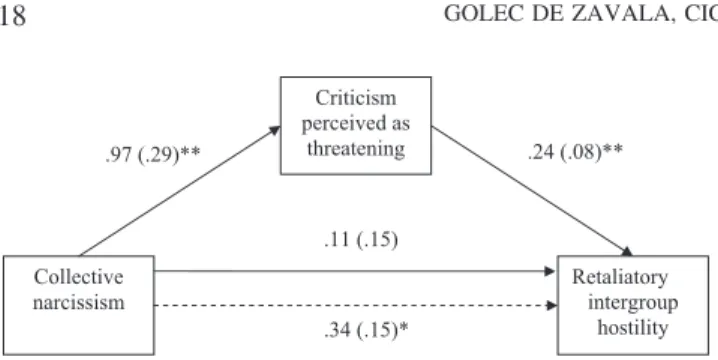
Finally, we expected that collective narcissistic intergroup hostility would be defensive: that it would serve to protect the ego from threat. Thus, in Study 4 we tested a hypothesis that the combined effect of in-group image threat and collective narcis-sism on intergroup hostility would be mediated by the percep-tion of in-group criticism as personally threatening.
In our studies we adapted methodologies used in previous research that inspired our hypotheses: studies that have exam-ined the moderating role of individual narcissism on the effects of ego-threat versus ego-praise on interpersonal aggression (Bushman & Baumeister, 1998) and studies that have looked at the effects of in-group directed criticism versus in-group di-rected praise on out-group attitudes (Hornsey, 2005).
Study 1
Study 1 provided an initial test of the hypothesis that collec-tive narcissism predicts retaliatory intergroup hostility under in-group image threat. We expected that in comparison to an in-group praise condition, under in-group criticism collective narcissism would be related to hostility toward an offending out-group but not toward a nonoffending out-group. In addition, we tested the assumption that collective narcissism is a form of positive in-group regard unique in its ability to inspire retalia-tory intergroup hostility in response to in-group image threat. Therefore, we allowed collective narcissism and non-narcissistic group positivity (operationalized as positive in-group identification) to compete as moderators of the effects of in-group image threat on intergroup hostility as was done on the individual level in studies conducted byBushman and Baumeis-ter (1998). These authors demonstrated that personal self-esteem did not predict interpersonal aggression in response to ego-threat when individual narcissism was taken into account. We argue that in the intergroup context it is the narcissistic rather than non-narcissistic positive group esteem that moder-ates the effects of in-group image threat on intergroup hostility (e.g.,Branscombe & Wann, 1994;Tekman et al., 2008).
We also examined the hypothesis that the relationship be-tween intergroup hostility and collective narcissism under in-group image threat would remain significant even after the analyses account for the overlap of collective narcissism and individual narcissism, right wing authoritarianism and social dominance orientation. All three variables were found to cor-relate with collective narcissism and all three are robust pre-dictors of hostility. Individual narcissism predicts interpersonal hostility, vengeful rancor and anger (e.g.,Baumeister, Smart, & Boden, 1996; Bushman, & Baumeister, 1998; Rhodewalt & Morf, 1998). Social dominance orientation and right wing au-thoritarianism predict intergroup hostility, aggressiveness and prejudice (e.g., Cohrs, & Abrock, 2009; Duckitt, 2006;L. E. Jackson, & Gaertner, 2010; McFarland, 2005; Sidanius & Pratto, 1999). We allowed in-group identification, individual
This document is copyrighted by the American Psychological Association or one of its allied publishers. This article is intended solely for the personal use of the individual user and is not to be disseminated broadly.
narcissism, right wing authoritarianism, and social dominance orientation to compete with collective narcissism as moderators of the effects on in-group image threat on intergroup hostility.
Method
Participants. Study 1 was conducted among 153 American participants. Data from 19 participants were not included in the analyses due to missing data on a dependent variable measure. Among the remaining 134 participants 63 were men and 62 women (nine participants did not provide information about age and gender). The mean age was 29.99 years (SD⫽ 11.03).
Procedure. In an online experiment conducted on Ama-zon’s MTurk, participants were asked to take part in a study with the alleged aim of comparing American worldviews and opinions about European nations with the opinions about Amer-icans among Europeans. First, participants responded to scales measuring the moderating variables: collective and individual narcissism, national in-group identification, social dominance orientation, and right wing authoritarianism. Next, participants were randomly assigned to the positive (n ⫽ 66) or negative (n⫽ 68) group evaluation condition. Participants were in-formed that they would be asked to provide their opinions about two randomly chosen European nations. Before expressing their opinions they were asked to read a sample opinion of a foreign exchange student in the United States who comments about America, Americans and American politics.
Study 1 used the method of manipulating in-group criticism versus praise adopted from the studies on the intergroup sensi-tivity effect (but using only external positive vs. negative evaluation;Hornsey, 2005;Sutton, Elder, & Douglas, 2006). In both research conditions participants were asked to read an example of responses to an attitudes survey provided by an international student. The fragment was allegedly authored by a British student (23-year-old, no gender was indicated) who participated in a student-exchange program to the United States that either criticized or praised Americans for their involvement in the War on Terrorism. This manipulation of in-group directed criticism was pretested and has been used in previous studies (Sutton, Douglas, & McClellan, 2012). The negative evaluation read, “I think that they invaded Iraq on the basis of a lie about the presence of ‘weapons of mass destruction.’ They certainly cannot claim to have brought freedom and a stable democracy to Iraq, and indeed I think they have condemned it to civil war. I also think that by going into Iraq they have made themselves a major target for terrorism.” The positive evaluation read, “I think that they invaded Iraq on the basis of the intelligence regarding the presence of ‘weapons of mass destruction.’ They certainly can claim to have brought freedom and a stable democracy to Iraq, and indeed I think they have prevented civil war in Iraq. I also think that by going into Iraq they have reduced the risk of international terrorism targeting innocent people.”
After reading the excerpt, participants were asked two ma-nipulation check questions presented as checks of whether they read and understood the fragment. Finally, they were asked to indicate their behavioral intentions toward German and British people (counterbalanced) and reminded that those groups were chosen at random by a computer program. National surveys
indicate that attitudes toward both Germans and British people are rather positive among American public (e.g.,BBC, 2011). Thus, there was no reason to expect that either of these groups will be disliked or present a threat to the American national group image before the experimental manipulation was in-troduced.
Measures.
Manipulation check. We checked the effectiveness of the experimental manipulation with two items: “The opinion about America and Americans expressed by the foreign exchange student in the interview transcript was?” (1⫽ very negative to 7⫽ very positive) and “The opinion about America and Amer-icans expressed by the foreign exchange student in the inter-view transcript makes me feel” (1⫽ definitely unpleasant to 7⫽ definitely pleasant), r(132) ⫽ .67, p ⬍ .001, M ⫽ 4.44, SD ⫽ 1.63. Higher scores in this measure indicate that the opinion of the exchange student about Americans was perceived as more favorable and pleasant.
Collective narcissism. Collective narcissism (␣ ⫽ .83, M ⫽ 3.51, SD ⫽ 1.22) was measured by a five-item Collective Narcissism Scale used in previous studies (Golec de Zavala, et al., 2013). Participants were asked to think about their national in-group while responding to the items (e.g., “Not many people seem to fully understand the importance of my national group”) on the scale ranging from 1 (definitely disagree) to 6 (definitely agree).
Individual narcissism. Individual narcissism (␣ ⫽ .78, M ⫽ 0.31, SD ⫽ 0.22) was measured by the 16-item Narcissistic Personality Inventory (NPI-16; Ames, Rose, & Anderson, 2006). This inventory measures people=s beliefs in their own exaggerated greatness. It correlates highly (average r ⫽ .90) with the original NPI-40 measure assessing the construct of individual narcissism developed by Raskin and Terry (1988). For each item participants can give a narcissistic (e.g., “I know that I am good because everybody keeps telling me so”; coded 1) or a non-narcissistic (e.g., “When people compliment me I sometimes get embarrassed”; coded 0) answer. The mean of the answers was computed. Higher scores on this scale represent higher levels of individual narcissism.
Social dominance orientation. Social dominance orientation (␣ ⫽ .83, M ⫽ 2.43, SD ⫽ 1.20) was measured by the four-item version of the Social Dominance Orientation Scale used in previous studies (Pratto et al., in press). The scale contains items measuring support for social hierarchies (e.g., “It would be better if all groups knew their place in the hierarchy”). Participants responded using the scale ranging from 1 (defi-nitely disagree) to 7(defi(defi-nitely agree).
Right wing authoritarianism. Right wing authoritarianism (␣ ⫽ .85, M ⫽ 2.98, SD ⫽ 1.10) was measured by the 10-item version of the original Right Wing Authoritarianism Scale, proposed originally byAltemeyer (1988), shortened and used in previous studies (Golec de Zavala et al., 2009; McFarland, 2005). Participants responded to the items of the scale (e.g., “Obedience and respect for authority are the most important virtues children should learn.”) using a scale from 1 (definitely disagree) to 7 (definitely agree).
In-group identification. In-group identification (␣ ⫽ .89, M ⫽ 4.21, SD ⫽ 1.42) was measured with a four-item scale used in previous studies (e.g.,Jetten, Branscombe, Spears, &
This document is copyrighted by the American Psychological Association or one of its allied publishers. This article is intended solely for the personal use of the individual user and is not to be disseminated broadly. AQ: 12
McKimmie, 2003; Stone & Crisp, 2007). Participants re-sponded to items such as “I identify strongly with other Amer-ican people,” using a scale from 1 (definitely agree) to 7 (definitely disagree).
Hostile behavioral intentions. Hostile behavioral intentions toward British and German people were measured using the procedure proposed byMackie, Devos, and Smith (2000). Par-ticipants were asked to respond using a scale from 1 (not at all) to 6 (very much) to the question “To what extent do the members of this group make you want to . . .?” Participants were asked to what extent they wanted to confront or actively oppose British people, r(132)⫽ .75, M ⫽ 2.11, SD ⫽ 1.29, or German people, r(132)⫽ .75, M ⫽ 1.90, SD ⫽ 1.25.
Results
Correlations. The correlation analyses indicate that across research conditions collective narcissism, in-group identity, social dominance orientation, and right wing authoritarianism were positively related to hostile behavioral intentions toward British people. All five predictors were also positively associ-ated with aggressive intentions toward German people. Aggres-sive intentions toward British and German people were posi-tively correlated. Collective narcissism correlated posiposi-tively with all other individual difference variables (Table 1).
Manipulation check. Inspection of mean responses to the manipulation check questions revealed that in the in-group criticism condition (M ⫽ 3.33, SD ⫽ 1.29) participants per-ceived the attitude of the British exchange student as signifi-cantly less favorable toward Americans and less pleasant than in the in-group praise condition (M⫽ 5.49, SD ⫽ 1.20), F(1, 132)⫽ 100.74, p ⬍ .01, p2⫽ .43.
The effect of collective narcissism and in-group image threat on retaliatory intergroup hostility. In order to test the hypoth-esis that collective narcissism is a unique moderator of the effect of in-group image threat (vs. praise) on retaliatory inter-group hostility, we performed a series of hierarchical multiple regression analyses. The first model tested the main effects of collective narcissism and experimental condition on the ten-dency to support hostile actions toward the offending out-group (British people). Age and gender, individual narcissism, social dominance orientation, right wing authoritarianism, and posi-tive in-group identification were also entered in Model 1. The second model added all two-way interactions of research
con-dition and the continuous predictors. All continuous variables were centered prior to analyses. Experimental conditions were coded “0” for in-group praise condition and “1” for in-group criticism condition. Gender was coded “0” for men and “1” for women. Listwise deletion of missing data was used.
The results from Model 1 revealed a positive and marginally significant main effect of the experimental manipulation (p⫽ .10). Participants in the in-group criticism condition (M⫽ 2.39, SD⫽ 1.43) expressed higher support for hostile actions toward the offending out-group than participants in the in-group praise condition (M⫽ 1.83, SD ⫽ 1.08). In addition, higher levels of right wing authoritarianism, social dominance orientation (p⫽ .056) and in-group identification predicted intentions to engage in hostile actions toward the offending out-group. The results of Model 2 indicated that the effect of research condition was qualified only by the significant interaction of research condi-tion and collective narcissism. Only the main effect of right wing authoritarianism remained significant in Model 2. Adding the interaction of collective narcissism and research condition to the regression equation significantly increased the amount of explained variance in the criterion variable, ⌬R2 ⫽ .02; F(1,
111) ⫽ 3.92, p ⫽ .05. No other interaction was significant (Table 2).1
1In all studies the pattern of results remained unchanged when the
controlled continuous variables were not entered into the equation. In Study 1 when only the main theoretical predictors were analyzed Model 1 revealed a significant main effects of collective narcissism, b⫽ .36, SE ⫽ .09, t(131)⫽ 4.16, p ⬍ .001, and a marginal main effect of research condition, b⫽ .40, SE ⫽ .21, t(131) ⫽ 1.91, p ⫽ .058. Model 2 revealed that these effects were qualified by a significant interaction of research condition and collective narcissism, b⫽ .54, SE ⫽ .17, t(130) ⫽ 3.22, p ⫽ .002. In Study 2, Model 1 revealed a main effect of collective narcissism, b⫽ .12, SE ⫽ .06, t(105) ⫽ 2.21, p ⫽ .03. Model 2 revealed that this effect was qualified by a significant interaction of research condition and collec-tive narcissism, b⫽ .25, SE ⫽ .12, t(104) ⫽ 2.09, p ⫽ .04. In Study 3 Model 1 revealed a significant effect of research condition, b⫽ .47, SE ⫽ .22, t(113)⫽ 2.15, p ⫽ .03, and of target out-group, b ⫽ –.46, SE ⫽ .22, t(113) ⫽ ⫺2.11, p ⫽ .04. Model 2 revealed a significant, two-way interaction of the target group and collective narcissism, b⫽ .38, SE ⫽ .19, t(110)⫽ 2.05, p ⫽ .04. Finally, the results of Model 3 indicate that the main effect and the two-way interaction were qualified by a three-way interaction between research condition, target out-group and collective narcissism, b⫽ 1.22, SE ⫽ .35, t(109) ⫽ 3.44, p ⫽ .001. In Study 4, Model 1 revealed a significant main effect of research condition, b⫽ .97, SE ⫽ .18, t(77)⫽ 5.45, p ⬍ .001, that was qualified by a significant interaction revealed in Model 2, b⫽ .61, SE ⫽ .23, t(76) ⫽ 2.68, p ⫽ .01. Table 1
Correlations of Individual and Collective Narcissism, In-Group Identification, Social Dominance Orientation, and Right Wing Authoritarianism With Hostile Intentions Towards British and German People (Study 1, N⫽ 134)
Measure 1 2 3 4 5 6 1. Collective narcissism — 2. Individual narcissism .18ⴱ — 3. SDO .29ⴱⴱ .19ⴱ — 4. RWA .56ⴱⴱⴱ .03 .36ⴱⴱⴱ — 5. Identification .41ⴱⴱⴱ .12 .06 .34ⴱⴱⴱ — 6. Hostility (British) .37ⴱⴱⴱ .12 .29ⴱⴱ .47ⴱⴱⴱ .28ⴱⴱ — 7. Hostility (German) .39ⴱⴱⴱ .29ⴱⴱⴱ .37ⴱⴱⴱ .36ⴱⴱⴱ .18ⴱ .59ⴱⴱⴱ
Note. SDO⫽ social dominance orientation; RWA ⫽ right wing authoritarianism.
ⴱp⬍ .05. ⴱⴱp⬍ .01. ⴱⴱⴱp⬍ .001. This document is copyrighted by the American Psychological Association or one of its allied publishers. This article is intended solely for the personal use of the individual user and is not to be disseminated broadly. T1 T2,Fn1
In order to probe the significant interaction, simple slopes were computed according to the procedure proposed byCohen, Cohen, West, and Aiken (2003)using the MODPROBE syntax provided by Hayes and Matthes (2009). In all studies the covariates were included in the simple slopes analyses.2 The
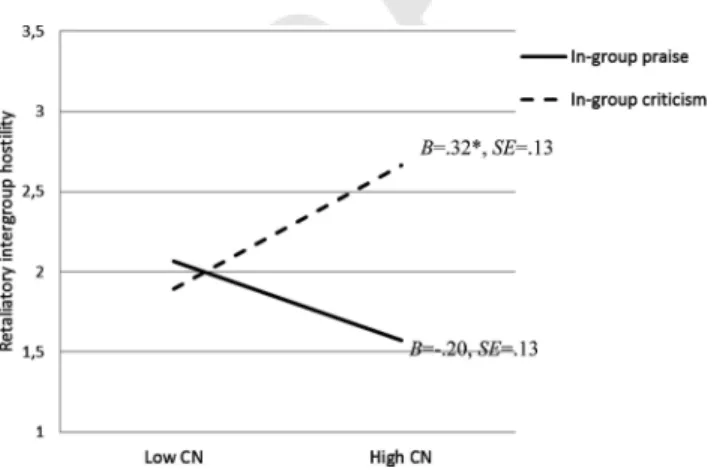
analyses revealed that the relationship between collective nar-cissism and hostile behavioral tendencies toward the offending out-group was positive and significant in the in-group criticism condition, b⫽ .32, SE ⫽ .13, t(126) ⫽ 2.47, p ⫽ .02, but was not significant in the in-group praise condition, b⫽ –.20, SE ⫽ .13, t(126)⫽ ⫺1.60, p ⫽ .11 (Figure 1).
The effect of collective narcissism and in-group image threat on hostility toward the nonoffending out-group. In order to test the hypothesis that the intergroup hostility related to collective narcissism is retaliatory and does not spill over to an out-group that did not threaten the image of the in-group, we performed the same series of hierarchical regression analyses using hostility toward the nonoffending out-group as a criterion variable. Hostility toward Germans was assessed after in-group image threat was introduced, but this out-group was not a source of the threat. The results of Model 1 revealed that hostility toward Germans was predicted by higher levels of social dominance orientation and right wing au-thoritarianism (marginally significant, p ⫽ .08) and individual narcissism. The results of Model 2 did not reveal any significant effect (Table 3). The two-way interaction of research condition and collective narcissism was not significant (p ⫽ .99). Adding the two-way interaction of research condition and collective narcis-sism to Model 2 did not increase the amount of explained variance, ⌬R2⫽ .000, F(1, 111) ⫽ 0.00, p ⫽ .99.3
In-group image threat, collective narcissism and retaliatory intergroup hostility. In order to provide an alternative test for the hypothesis that under in-group criticism collective narcissism affects hostility toward the offending but not toward the nonof-fending out-group we performed a 2 (target out-group: ofnonof-fending vs. nonoffending)⫻ 2 (research condition: in-group criticism vs. praise) general linear model (GLM) with the first factor repeated. We entered continuous predictors as covariates and controlled for participants age and gender. We tested the model that analyzed the two-way interaction of the repeated and between-subjects factors; two-way interactions of the within-subject factor with all contin-uous predictors; and three-way interactions of within-subject fac-tor, between-subjects facfac-tor, and continuous predictors.
The results revealed that only the three-way interaction between the target out-group, experimental manipulation and collective narcissism was significant, Wilk’s ⫽ .96, F(1, 111) ⫽ 4.27, p ⫽ .04,p2⫽ .04. Parameter estimates indicated that for the offending
out-group the interaction between research condition and collec-tive narcissism was significant, b⫽ .41, SE ⫽ .21, t(111) ⫽ 1.98; p⫽ .05. In comparison to the in-group praise condition, under in-group criticism, collective narcissism significantly increased intergroup hostility.
Discussion of Study 1
Results of Study 1 provided initial support for the hypothesis that collective narcissism moderates the effects of in-group image threat on retaliatory intergroup hostility. American national col-lective narcissism was associated with hostile action tendencies toward British people only after participants were led to believe
that a British person criticized American involvement in the War on Terror. When the opinion about American involvement in the War on Terror expressed by a British person was positive, the relationship between collective narcissism and support for hostile actions toward British people was not significant.
The results of Study 1 revealed that collective narcissism was the only significant moderator of the effect of in-group criticism on
2The predicted patterns for high collective narcissism and research
condition were present in all studies when the simple slopes analyses were conducted without the covariates. When the simple slopes were analyzed for the significant interaction in Study 1 without entering the covariates the relationship between collective narcissism and hostile behavioral tenden-cies toward the offending out-group was positive and significant in the in-group criticism condition, b⫽ .62, SE ⫽ .12, t(130) ⫽ 5.32, p ⬍ .001. The same relationship was negative and not significant in the in-group praise condition, b⫽ .09, SE ⫽ .12, t(130) ⫽ 0.74, p ⫽ .46. In Study 2 the simple slope analyses without covariates revealed that the relationship between collective narcissism and hostile behavioral tendencies toward British people was not significant in the in-group praise condition, b⫽ .05; SE⫽ .06; t(104) ⫽ 0.68, p ⫽ .50, but it was positive and significant in the in-group criticism condition, b⫽ .29; SE ⫽ .10; t(104) ⫽ 2.99; p ⫽ .001. For Study 3, the analyses reveal that the interaction between collective narcissism and research condition was significant for hostility toward the offending out-group, b⫽ .61; SE ⫽ .24, t(109) ⫽ 2.52; p ⫽ .01, and for hostility toward the nonoffending out-group, but the effect was reversed, b⫽ –.61; SE ⫽ .26; t(109) ⫽ ⫺2.35; p ⫽ .02. The relationship between collective narcissism and hostility toward the offending out-group was significant under in-group criticism, b⫽ .61; SE ⫽ .19; t(109) ⫽ 3.30, p ⫽ .01, but not under in-group praise, b⫽ .01; SE ⫽ .15; t(109) ⫽ 0.04, p ⫽ .97. For the nonoffending out-group, the relationship between collective narcissism and intergroup hostility was significant and negative under in-group criticism, b⫽ –.37; SE ⫽ .17; t(109) ⫽ ⫺2.22; p ⫽ .03 and nonsignificant under in-group praise, b⫽ .24; SE ⫽ .20; t(109) ⫽ 1.20; p ⫽ .23. The analyses reveal that the interaction between collective narcissism and research condition was significant for hostility toward the offending out-group, b⫽ .61; SE ⫽ .24, t(109) ⫽ 2.52; p ⫽ .01, as well as for hostility toward the nonoffending out-group but in this case the effect was reversed, b ⫽ –.61; SE ⫽ .26; t(109) ⫽ ⫺2.35; p ⫽ .02. The relationship between collective narcissism and hostility toward the offend-ing out-group was significant under in-group criticism, b⫽ .61; SE ⫽ .19; t(109)⫽ 3.30, p ⫽ .01, but not under in-group praise, b ⫽ .01; SE ⫽ .15; t(109)⫽ 0.04, p ⫽ .97. For the nonoffending out-group, the relationship between collective narcissism and intergroup hostility was significant and negative under in-group criticism, b⫽ –.37; SE ⫽ .17; t(109) ⫽ –2.22; p ⫽ .03, and nonsignificant under in-group praise, b⫽ .24; SE ⫽ .20; t(109) ⫽ 1.20; p⫽ .23. An unexpected pattern emerged when the simple slopes for Study 3 were computed without covariates. The highest level of intergroup hostility was predicted by low collective narcissism in the in-group criti-cism condition toward the nonoffending out-group. Further studies should examine whether this pattern is reliable. For Study 4 the simple slope analyses without controlling covariates revealed that the relationship be-tween collective narcissism and intergroup hostility was positive and significant in the in-group image threat condition (b⫽ .33, SE ⫽ .14), t(76) ⫽ 2.33, p ⫽ .03, and negative and nonsignificant in the positive evaluation condition (b⫽ –.28, SE ⫽ .18), t(76) ⫽ –1.57, p ⫽ .12.
3The whole equation was significant in Model 2, whereas none of the
individual predictors were significant any longer. There were no multicol-linearity problems (VIFs⬍ 3.4). This may suggest that there were too many variables in Model 2. Thus, we ran another multiple regression analysis in which we included only the interaction of research condition and collective narcissism in Model 2. This analysis replicated the results revealing significant main effects of social dominance orientation, b⫽ .24, SE⫽ .09, t(115) ⫽ 2.59, p ⫽ .01, individual narcissism, b ⫽ 1.05, SE ⫽ .47, t(115)⫽ 2.23, p ⫽ .03, and marginally significant effect of right wing authoritarianism, b⫽ .20, SE ⫽ .12, t(115) ⫽ 1.75, p ⫽ .08. No other main effects were significant. The interaction of research condition and collec-tive narcissism was not significant, b⫽ .16, SE ⫽ .17, t(115) ⫽ 0.98, p ⫽ .33. This document is copyrighted by the American Psychological Association or one of its allied publishers. This article is intended solely for the personal use of the individual user and is not to be disseminated broadly. Fn2 F1 T3 Fn3 AQ: 10
retaliatory intergroup hostility. The effect of collective narcissism on intergroup hostility under in-group image threat remained sig-nificant when the analyses accounted for the overlap of collective narcissism with positive in-group identification, individual narcis-sism, right wing authoritarianism, and social dominance orienta-tion.
In addition, the results of Study 1 confirmed that under in-group criticism the intergroup hostility associated with collective narcis-sism is specific and retaliatory: It targets only the out-group that threatened the in-group’s positive image. We expected and found that under in-group criticism collective narcissism was associated with support for hostile actions toward the offending out-group (the British) but not toward the nonoffending out-group (the Ger-mans).
The results of Study 1 provided encouraging support for our hypotheses. Nevertheless we believed that a replication was desir-able. The measure of intergroup hostility that we adopted in Study 1 fromMackie et al. (2000)pertains to two actions (confront and oppose). Although these actions are clearly antagonistic, they are
not unambiguously hostile: They do not reflect a clear desire to harm the out-group, which is crucial for the definition of hostility. Arguably, actively opposing and confronting the out-group that criticized the in-group may be seen as a reasonable, not hostile, response to the situation. Thus, in Study 2 we sought to replicate our findings using an improved operationalization of intergroup hostility.
Study 2
In Study 2 we used a more direct and explicit measure of intergroup hostility. In addition, we controlled for an overlap between national collective narcissism and two forms of positive attachment to a nation: blind and constructive patriotism. Our previous studies indicate that national collective narcissism is positively associated with both forms of patriotism and all three variables are associated with intergroup hostility (Golec de Zavala et al., 2009;Golec de Zavala et al., 2013). Thus, in Study 2 we wanted to exclude the possibility that the interaction effect of collective narcissism and in-group image threat is driven by the overlap between collective narcissism and blind or constructive patriotism. Especially, we believed the relationship between col-lective narcissism and blind patriotism to be relevant because both variables are related to concerns with in-group’s positive image and in-group criticism. However, while blind patriots reject and avoid in-group criticism, collective narcissists are particularly sen-sitive to it. Collective narcissists are constantly looking for signs of insufficient appreciation of the in-group (e.g.,Golec de Zavala & Schatz, 2012).
Method
Participants. Study 2 was conducted with 115 American par-ticipants. Data from seven participants were not included in the analyses due to missing data on a dependent variable measure. The age of the remaining 108 participants ranged from 18 to 71 years (M⫽ 31.48, SD ⫽ 12.33). There were 58 women and 48 men; two participants did not provide information about their gender. Table 2
Effects of Research Conditions, Collective and Individual Narcissism, In-Group Identification, Right Wing Authoritarianism, and Social Dominance Orientation on Retaliatory Intergroup Hostility (Controlling for Age and Gender; Study 1, N⫽ 134)
Model 1 Model 2
Variable B SE T B SE t
In-group criticism manipulation 0.33 0.20 1.64† 0.36 0.20 1.87†
Collective narcissism 0.05 0.10 0.45 ⫺0.17 0.15 ⫺1.15
Individual narcissism 0.33 0.46 0.71 ⫺0.05 0.63 ⫺0.07
SDO 0.17 0.09 1.93† 0.09 0.12 0.75
RWA 0.34 0.11 3.05ⴱⴱ 0.39 0.16 2.46ⴱ
Identification 0.15 0.08 1.98ⴱ 0.15 0.10 1.50
Criticism⫻ Collective Narcissism .41 0.21 1.98ⴱ
Criticism⫻ Individual Narcissism 0.49 0.90 0.54
Criticism⫻ SDO 0.18 0.17 1.02
Criticism⫻ RWA ⫺0.08 0.22 ⫺0.34
Criticism⫻ Identification 0.02 0.15 ⫺0.10
F F(8, 116)⫽ 6.26ⴱⴱⴱ F(13, 111)⫽ 4.67ⴱⴱⴱ
R2 .30 .35
Note. SDO⫽ social dominance orientation; RWA ⫽ right wing authoritarianism.
†p⬍ .10. ⴱp⬍ .05. ⴱⴱp⬍ .01. ⴱⴱⴱp⬍ .001.
Figure 1. Interaction effect of collective narcissism (CN) and research condition on retaliatory intergroup hostility (Study 1, N⫽ 134).ⴱⴱⴱp⬍ .001. This document is copyrighted by the American Psychological Association or one of its allied publishers. This article is intended solely for the personal use of the individual user and is not to be disseminated broadly. AQ: 11
Procedure. The online experiment was conducted via Am-azon’s MTurk. We asked participants to take part in a survey allegedly about social beliefs and attitudes toward different nations of the world conducted internationally and including an American sample. Participants were first asked to provide de-mographic information. Next, they were asked to respond to the Collective Narcissism Scale and instructed to think about their nation while responding to the items. Social dominance orien-tation, right wing authoritarianism, blind and constructive pa-triotism, positive national identification, and individual narcis-sism were also assessed.
Next, participants were randomly allocated to in-group praise (n⫽ 64) or in-group criticism (n ⫽ 44) condition. Study 2 used a method of manipulating in-group criticism vs. praise similar to that used in Study 1, with participants reading a comment ostensibly made by a British foreign exchange student. How-ever, while in Study 1 in-group criticism versus praise con-cerned a very specific and controversial aspect of American international politics, in Study 2 we sought to make the criti-cism versus praise more general and concerning all Americans regardless of their worldviews or opinions on particular na-tional politics. The negative evaluation read,“Thinking about Americans, it seems to me that they are very materialistic and arrogant. I also think that it is a nation of ignorant people— hey do not know much about countries and cultures beyond their own.” The positive evaluation fragment read, “Thinking about Americans, it seems to me that they are friendly and optimistic. I also think that it is a nation of hardworking people—they respect both their own and other people’s efforts.”
Participants were then asked to respond to a measure of attitudes toward several nations of the world. They were in-formed that the nations and the number of attitude questions would be chosen at random by the program administering the survey. Participants were asked what kind of actions they would be willing to engage in with members of two national groups: British people and New Zealanders. The order of groups was
counterbalanced. Finally, participants were asked the manipu-lation check questions.
Measures.
Manipulation check. Participants were asked to respond to the same questions as in Study 1, r(105)⫽ .90, p ⬍ .001, M ⫽ 4.77, SD⫽ 2.08.
Collective narcissism. Collective narcissism (␣ ⫽ .82, M ⫽ 3.39, SD⫽ 1.26) was measured by the Collective Narcissism Scale (see Study 1).
Individual narcissism. Individual narcissism (␣ ⫽ .84, M ⫽ 0.31, SD ⫽ 0.25) was measured by the Narcissistic Personality Inventory (see Study 1).
Social dominance orientation. Social dominance orientation (␣ ⫽ .85, M ⫽ 2.38, SD ⫽ 1.14) was measured by the Social Dominance Orientation Scale (see Study 1).
Right wing authoritarianism. Right wing authoritarianism (␣ ⫽ .80, M ⫽ 3.20, SD ⫽ 1.31) was measured by the Right Wing Authoritarianism Scale (see Study 1).
In-group identification. In-group identification (␣ ⫽ .93, M⫽ 4.38, SD ⫽ 1.47) was measured as in Study 1.
Blind and constructive patriotism. Blind (␣ ⫽ .80, M ⫽ 3.44, SD⫽ 1.40) and constructive patriotism (␣ ⫽ .80, M ⫽ 5.61, SD ⫽ 0.91) were measured by 10 items randomly selected from the original scale proposed bySchatz, Staub, and Lavine (1999). Five items measured constructive patriotism (e.g., “My love of America demands that I speak out against popular but potentially destruc-tive policies.”) and five items measured blind patriotism (e.g., “People who do not wholeheartedly support the U.S. should live somewhere else.”). These items have been used in previous studies (e.g.,Golec de Zavala et al., 2009).
Hostile behavioral intentions. Hostile behavioral intentions (British␣ ⫽ .85, M ⫽ 1.30, SD ⫽ 0.73; New Zealanders ␣ ⫽ .85, M ⫽ 1.25, SD ⫽ 0.63) were measured similarly to Study 1. However, in Study 2 we used actions that unambiguously relate to aggressive intentions to hurt and cause suffering to members of the targeted out-groups. For both target groups we asked participants to what Table 3
Effects of Research Condition, Collective and Individual Narcissism, In-Group Identification, Right Wing Authoritarianism, and Social Dominance Orientation on Displaced Intergroup Hostility (Controlling for Age and Gender; Study 1, N⫽ 134)
Model 1 Model 2
Variable B SE t B SE t
In-group criticism manipulation 0.16 0.21 0.79 0.19 0.21 0.91
Collective narcissism 0.16 0.11 1.51 0.15 0.16 0.98
Individual narcissism 1.10 0.47 2.34ⴱ 0.64 0.66 0.96
SDO 0.23 0.09 2.55ⴱⴱ 0.16 0.13 1.25
RWA 0.20 0.12 1.75† 0.12 0.16 0.71
Identification 0.03 0.08 0.40 0.02 0.11 0.17
Criticism⫻ Collective Narcissism ⫺0.001 0.22 ⫺0.004
Criticism⫻ Individual Narcissism 0.87 0.92 0.92
Criticism⫻ SDO 0.14 0.18 0.75
Criticism⫻ RWA .17 .24 0.73
Criticism⫻ Identification .01 .16 0.09
F F(8, 116)⫽ 5.95ⴱⴱⴱ F(13, 111)⫽ 3.88ⴱⴱⴱ
R2 .29 .31
Note. SDO⫽ social dominance orientation; RWA ⫽ right wing authoritarianism.
†p⬍ .10. ⴱp⬍ .05. ⴱⴱⴱp⬍ .001. This document is copyrighted by the American Psychological Association or one of its allied publishers. This article is intended solely for the personal use of the individual user and is not to be disseminated broadly.
extent they wanted to hurt, offend, injure, intimidate, and humiliate members of the out-group. Participants were asked to respond using a scale from 1 (not at all) to 6 (very much) to the question “To what extent do the members of this group make you want to . . .?”
Results
Correlations. Across research conditions collective narcissism was positively related to individual narcissism, social dominance orientation, right wing authoritarianism, blind patriotism, and in-group identification. Collective narcissism was also positively corre-lated with support for aggressive actions toward British and New Zealander targets. The indices of hostility toward the offending and the nonoffending out-group were positively correlated. They both were positively correlated with individual narcissism and negatively correlated with constructive patriotism (Table 4).
Manipulation check. The inspection of the means on the manipulation check questions confirmed that participants thought that the opinion of the foreign exchange students about Americans was more positive and pleasant in the in-group praise condition (M⫽ 6.28, SD ⫽ 0.96) than in the in-group criticism condition (M⫽ 2.60, SD ⫽ 1.07), F(1, 105) ⫽ 346.10, p ⬍ .001, 2⫽ .77.
The effect of collective narcissism and in-group image threat on retaliatory intergroup hostility. Like in Study 1, we first tested the hypothesis that the experimental manipulation and collec-tive narcissism, but no other continuous predictors, would interact in predicting retaliatory intergroup hostility. As in Study 1, we per-formed a series of hierarchical multiple regression analyses. The first model tested the main effects of collective narcissism and experimen-tal condition on the tendency to support aggressive actions toward the offending out-group. Age and gender, individual narcissism, social dominance orientation, right wing authoritarianism, positive in-group identification, and blind and constructive patriotism were entered in Model 1. The second model added all two-way interactions of re-search condition along with the continuous predictors.
The results of Model 1 revealed significant negative effect of constructive patriotism and significant positive effect of individual narcissism. These effects became nonsignificant after the interaction terms were entered into the equation in Model 2. The results for Model 2 indicate significant interaction of research condition and collective narcissism (Table 5). No other interaction was significant. Adding the interaction of research condition and collective narcissism
to the regression equation significantly increased the amount of ex-plained variance,⌬R2⫽ .04, F(1, 88) ⫽ 5.23, p ⫽ .03.
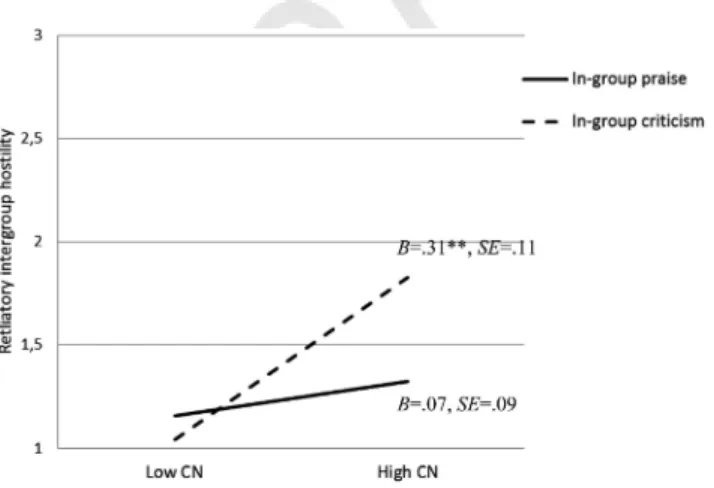
The simple slope analyses revealed that the relationship between collective narcissism and hostile behavioral tendencies toward British people was not significant in the in-group praise condition, b⫽ .07; SE ⫽ .09; t(98) ⫽ 0.76, p ⫽ .45, but it was positive and significant in the in-group criticism condition, b⫽ .31; SE ⫽ .11; t(98)⫽ 2.73; p ⫽ .01 (Figure 2).
The effect of collective narcissism and in-group image threat on hostility toward the nonoffending out-group. In order to test the hypothesis that the intergroup hostility related to collective narcissism is retaliatory and does not spill over to the nonoffending out-group, we performed the same series of hierarchical regression analyses using hostility toward New Zealanders as a criterion variable.
The results for Model 1 were marginally significant (p ⫽ .06). There was a marginally significant positive effect of individual nar-cissism and a significant negative effect of constructive patriotism. These effects became nonsignificant when interaction terms were entered in Model 2. Model 2 was marginally significant (p⫽ .06). The interaction of research condition and collective narcissism was not significant, b⫽ .28; SE ⫽ .20; t(88) ⫽ 1.39, p ⫽ .17. Entering this interaction term did not contribute significantly to the percentage of explained variance,⌬R2⫽ .01, F(1, 88) ⫽ 1.94; p ⫽ .17. However,
there was a significant interaction of research condition and right wing authoritarianism (Table 6andFigure 3).4
In-group image threat, collective narcissism, and retaliatory intergroup hostility. As in Study 1, we also performed a 2 (target out-group: offending vs. nonoffending)⫻ 2 (research
con-4Simple slope analysis indicated that the relationship between right
wing authoritarianism and hostility toward the nonoffending out-group was not significant in the in-group praise condition, b ⫽ –.01, SE ⫽ .07, t(104)⫽ ⫺0.12, p ⫽ .91, and significant in the in-group criticism condi-tion, b⫽ .17, SE ⫽ .08, t(104) ⫽ 2.12, p ⫽ .04. This result may point to authoritarian displaced aggressiveness. However, more studies are needed before more definite conclusions can be drawn about the nature of this relationship. Interpreting this interaction is beyond the scope of this article and the effect did not seem reliable enough to warrant such interpretation in the present article. It is important to note that the full model that included this interaction did not reach statistical significance, the analyses that looked only at the effect of research condition, right wing authoritarianism and their interaction found no significant effect. Moreover, the interaction was not replicated in other studies.
Table 4
Correlations of Individual and Collective Narcissism, In-Group Identification, Blind and Constructive Patriotism, Social Dominance Orientation, Right Wing Authoritarianism, and Hostile Intentions Toward the British and the New Zealanders (Study 2, N⫽ 108)
Measure 1 2 3 4 5 6 7 8 1. Collective narcissism — 2. Individual narcissism .29ⴱⴱ — 3. SDO .30ⴱⴱ .31ⴱⴱⴱ — 4. RWA .25ⴱⴱ ⫺.18† .15 — 5. Identification .64ⴱⴱⴱ .20ⴱ .14 30ⴱⴱⴱ — 6. Blind patriotism .63ⴱⴱⴱ .17† .22ⴱⴱ .46ⴱⴱⴱ 56ⴱⴱⴱ — 7. Constructive patriotism ⫺.06 .02 ⫺.16† ⫺.20ⴱ .16 ⫺.17† — 8. Hostility (British) .20ⴱ .27ⴱⴱ .14 .03 .01 .13 ⫺.24ⴱⴱ —
9. Hostility (New Zealanders) .20ⴱ .22ⴱⴱ .14 .10 .06 .10 ⫺.25ⴱⴱ .81ⴱⴱⴱ
Note. SDO⫽ social dominance orientation. RWA ⫽ right wing authoritarianism.
†p⬍ .10. ⴱp⬍ .05. ⴱⴱp⬍ .01. ⴱⴱⴱp⬍ .001. This document is copyrighted by the American Psychological Association or one of its allied publishers. This article is intended solely for the personal use of the individual user and is not to be disseminated broadly. T4 T5 F2 T6,F3,Fn4
dition: in-group criticism vs. praise) GLM with the first factor repeated, the second between subjects and continuous predictors, age and gender entered as covariates. Results revealed that only a three-way interaction of the repeated factor, research condition and collective narcissism was significant, Wilk’s ⫽ .96, F(1, 88) ⫽ 3.82, p⫽ .05, 2⫽ .04. Parameter estimates indicated that only
for the offending out-group was the interaction of research manip-ulation and collective narcissism significant, b⫽ .41, SE ⫽ .18, t(88) ⫽ 2.29; p ⫽ .03. In comparison to the in-group praise condition in the in-group criticism condition, collective narcissism is related to a significant increase in intergroup hostility.
Discussion of Study 2
In Study 2 we replicated the findings of Study 1 supporting the hypothesis that collective narcissism predicts retaliatory intergroup
hostility after in-group image is threatened. In Study 2 under in-group criticism collective narcissism predicted preferences for actions directly and unambiguously harming the offending out-group such as hurt, offend, injure, intimidate, and humiliate. The relationship between collective narcissism and out-group hostility was not significant after in-group image boost.
As in Study 1, collective narcissism moderated the effects of in-group criticism on hostility toward the source of criticism, regardless of whether other continuous predictors were controlled. Thus, once again we can conclude that the relationship between collective narcissism and intergroup hostility is specific to collec-tive narcissism and not driven by the overlap between colleccollec-tive narcissism and individual narcissism, social dominance orienta-tion, right wing authoritarianism, in-group identificaorienta-tion, or blind or constructive patriotism. Collective narcissism, but none of the other predictors, moderates the effects of in-group image threat on intergroup hostility.
Results of Study 2 confirmed again that the intergroup hostility associated with collective narcissism is specific and retaliatory. Collective narcissism inspired intergroup hostility only under in-group image threat and only toward the out-in-group that threated the in-group’s positive image. Collective narcissism was unrelated to hostility toward the nonoffending out-group even when in-group image threat was present.
However, in Studies 1 and 2 the order of the out-groups was counterbalanced. Thus, at least for some participants, there existed a possibility that they did not aggress toward the nonoffending group because they previously had the opportunity to aggress against the offending out-group. Therefore, in Study 3 we aimed to provide an even stronger test of the hypothesis that under in-group image threat collective narcissism is related to retaliatory but not displaced intergroup hostility. We conducted a study in which both in-group image threat and target out-group were manipulated. Table 5
Effects of Research condition, Collective and Individual Narcissism, In-Group Identification, Blind and Constructive Patriotism, Right Wing Authoritarianism, and Social Dominance Orientation on Retaliatory Hostility (Controlling for Age and Gender; Study 2, N⫽ 108)
Model 1 Model 2
Variable B SE t B SE t
In-group criticism manipulation 0.12 0.14 1.48 0.23 0.14 1.60†
Collective narcissism 0.16 0.10 1.58 0.003 0.12 0.02 Individual narcissism 0.17 0.08 2.09ⴱ 0.11 0.11 1.03 SDO ⫺0.04 0.08 ⫺0.46 ⫺0.05 0.10 ⫺0.53 RWA 0.03 0.08 0.43 ⫺0.06 0.10 ⫺0.61 Identification ⫺0.10 0.10 ⫺0.98 0.02 0.13 0.17 Blind patriotism ⫺0.002 0.10 ⫺0.02 0.07 0.13 0.52 Constructive patriotism ⫺0.16 0.08 ⫺2.03ⴱ ⫺0.17 0.10 ⫺1.60
Criticism⫻ Collective Narcissism 0.51 0.22 2.29ⴱ
Criticism⫻ Individual Narcissism 0.18 0.16 1.15
Criticism⫻ SDO 0.13 0.16 0.77
Criticism⫻ RWA 0.30 0.19 1.56
Criticism⫻ Identification ⫺0.35 0.21 ⫺1.69†
Criticism⫻ Blind Patriotism ⫺0.26 0.22 ⫺1.21
Criticism⫻ Constructive Patriotism 0.11 0.17 0.63
F F(10, 95)⫽ 2.45ⴱⴱ F(17, 88)⫽ 2.18ⴱⴱ
R2 .21 .30
Note. SDO⫽ social dominance orientation; RWA ⫽ right wing authoritarianism.
†p⬍ .10. ⴱp⬍ .05. ⴱⴱp⬍ .01.
Figure 2. Interaction effect of collective narcissism (CN) and research condition on retaliatory intergroup hostility (Study 2, N⫽ 108).ⴱⴱp⬍ .01.
This document is copyrighted by the American Psychological Association or one of its allied publishers. This article is intended solely for the personal use of the individual user and is not to be disseminated broadly.
Study 3
In order to test the hypothesis that collective narcissism affects retaliatory hostility under in-group image threat, in Study 3 we manipulated in-group criticism versus praise as well as the target out-group as independent factors. We predicted that collective narcissism will be related to intergroup hostility only when in-group image threat is present and only toward the offending out-group. We expected that intergroup hostility associated with collective narcissism would not be displaced and would not spill over to other, nonoffending out-groups. Thus, we expected that collective narcissism would not be related to hostility toward the nonoffending out-group even if the opportunity to aggress toward the offending out-group was not present. In addition, in Study 3 we examined whether the hypothesized relationship between
collec-tive narcissism and intergroup hostility under in-group image threat generalizes to a different national context.
Method
Participants. Participants were 117 Polish undergraduate stu-dents who participated in exchange for research participation credit. There were 17 men and 100 women. The mean age was 21.32 years (SD⫽ 1.77).
Procedure. The study was presented to participants as re-search on personality and national attitudes. First, the moderating variables were assessed. Right wing authoritarianism, social dom-inance orientation, individual narcissism, national in-group iden-tification and national collective narcissism were measured. Next, participants were randomly assigned to one of two research con-ditions. They were informed that their sensitivity to information about their country would be tested as a measure of national attitude. All participants were asked to read a short press release describing the results of a fictional survey that assessed attitudes toward Polish people in Great Britain. Next, manipulation check questions were asked allegedly checking whether participants un-derstood the press release. In line with the cover story, after reading the press release participants were asked to quickly assess without referring back to the article how many times the word “Poland” or “Polish” was used in the article.
In the criticism condition (n⫽ 60) participants read that the general attitude toward Poles in Great Britain was negative, due to Polish anti-Semitism during and after the WWII. In the positive evaluation condition (n⫽ 57) the attitude toward Poles in Great Britain was presented as positive due to the help that Poles offered to Jews during World War II (WWII). Both negative and positive evaluations of Poles toward Jews during WWII are plausible. There are reported cases of pogroms of Polish Jews perpetrated by Poles during the WWII and shortly afterward (e.g.,Gross, 2008). Table 6
Effects of Research Condition, Collective and Individual Narcissism, In-Group Identification, Right Wing Authoritarianism, Social Dominance Orientation, and Blind and Constructive Patriotism on Displaced Hostility (Controlling for Age and Gender; Study 2, N⫽ 108)
Model 1 Model 2
Variable B SE t B SE t
In-group criticism manipulation 0.16 0.12 1.30 0.17 0.12 1.40
Collective narcissism 0.10 0.0 1.41 0.02 0.08 0.23 Individual narcissism 0.50 0.28 1.78† 0.13 0.37 0.36 SDO ⫺0.01 0.06 ⫺0.21 0.02 0.07 0.23 RWA 0.06 0.06 1.08 ⫺0.02 0.07 ⫺0.33 Identification ⫺0.02 0.06 ⫺0.27 0.04 0.08 0.55 Blind patriotism ⫺0.02 0.06 ⫺0.83 ⫺0.02 0.08 ⫺0.25 Constructive patriotism ⫺0.15 0.08 ⫺2.01ⴱ ⫺0.15 0.10 ⫺1.57
Criticism⫻ Collective Narcissism 0.30 0.20 1.52
Criticism⫻ Individual Narcissism 0.25 0.14 1.80†
Criticism⫻ SDO ⫺0.03 0.14 ⫺0.18
Criticism⫻ RWA 0.34 0.18 2.02ⴱ
Criticism⫻ Identification ⫺0.24 0.18 ⫺1.30
Criticism⫻ Blind Patriotism ⫺0.14 0.19 ⫺0.74
Criticism⫻ Constructive Patriotism 0.07 0.15 0.47
F F(10, 97)⫽ 1.86† F(17, 90)⫽ 1.67†
R2 .16 .24
Note. SDO⫽ social dominance orientation; RWA ⫽ right wing authoritarianism.
†p⬍ .10. ⴱp⬍ .05.
Figure 3. Interaction effect of collective narcissism (CN) and in-group criticism condition on intergroup hostility (Study 3, N⫽ 117).†p⬍ .10. ⴱⴱp⬍ .01. This document is copyrighted by the American Psychological Association or one of its allied publishers. This article is intended solely for the personal use of the individual user and is not to be disseminated broadly.