Balancing between Freedom and Control - Leadership Roles of a New Product Development Project Leader at Different Phases of Innovation Process
Marketing Master's thesis Satu Luukkonen 2010
Department of Marketing and Management
Ab stract
AALTO UNIVERSITY – School of Economics ABSTRACT
Department of Marketing and Management 20.04.2010
Master’s Thesis Satu Luukkonen
Research Objectives
In the success of innovation, leadership plays an important role. Project leader is usually responsible in managing the innovation process as well as the people in the team. The innovation process consists of phases that are very different by nature and hence, leadership practices applicable for the development phase may not be applicable for the front end phase. Thus, leaders of an innovative team need to balance between different kinds of roles and functions during the innovation process.
Although the importance of leadership to innovation success has been discussed, the importance of different leadership functions and roles of a project leader at certain phases of innovation process have received only little attention. The aim of this study is to recognize and describe the leadership functions and roles of a project leader during the front end and development phase.
Methodology
This study was conducted as a qualitative research and data was gathered through semi-structured interviews. A total of seven interviews were conducted for the study.
Interviews consisted of upper management and project leaders of three Finnish companies. The companies were a manufacturer of office furniture, a manufacturer of elevators and escalators, and a manufacturer of heavy duty cargo transportation platforms. The study analysis was done by thematic analysis.
Research Results
The results of the study support the existing discussion of the importance of a project leader in the context of new product development. Furthermore, the results support earlier studies about the necessity of conducting various leadership functions and leadership roles along the innovation process. According to the findings of the study, team builder leadership role is the most important role of the project leader during the front end of innovation. In the development phase, on the other hand, in addition to the team builder role, also communicator and planner leadership roles were seen as essential for the success of the project.
Key Words
Innovation, innovation process, leadership, leadership function, leadership role
AALTO-YLIOPISTO - Kauppakorkeakoulu TIIVISTELMÄ
Markkinoinnin ja johtamisen laitos 20.4.2010
Pro gradu -tutkielma Satu Luukkonen
Tutkimusongelma
Johtamisella on tärkeä rooli innovaatioiden onnistumisen kannalta. Projektipäällikkö on yleensä vastuussa niin innovaatioprosessin kuin tiimin jäsentenkin johtamisesta.
Innovaatioprosessi koostuu vaiheista, jotka ovat luonteeltaan hyvin erilaisia. Näin ollen, johtamiskäytännöt jotka ovat soveltuvia prosessin kehitysvaiheessa (development phase), eivät välttämättä ole soveltuvia prosessin alkupäässä (front end of innovation).
Täten, innovatiivisen tiimin projektipäällikön täytyy tasapainoilla eri johtamiskäytäntöjen ja -roolien välillä innovaatioprosessin aikana. Vaikka johtamisen tärkeydestä innovaation onnistumisen kannalta on keskusteltu, projektipäällikön eri johtamiskäytännöt ja –roolit sekä niiden tärkeys tietyissä vaiheissa innovaatioprosessia on saanut vain vähän huomiota. Tämän tutkimuksen tarkoitus on tunnistaa ja kuvata projektipäällikön johtamiskäytäntöjä ja –rooleja innovaatioprosessin alkupäässä sekä kehitysvaiheessa.
Tutkimusmenetelmät
Tämä tutkimus suoritettiin kvalitaatiivisena tutkimuksena ja aineistonkeruumenetelmänä käytettiin semistrukturoitua haastattelua. Tutkimusta varten suoritettiin yhteensä seitsemän haastattelua. Haastateltavat koostuivat kolmen suomalaisen yrityksen ylemmästä johdosta sekä projektipäälliköistä. Yritykset olivat toimistohuonekaluvalmistaja, hissi ja liukuporras valmistaja sekä erikoiskuljetuskalustojen valmistaja. Tutkimuksen analyysi tehtiin teemoittelun avulla.
Tutkimustulokset
Tutkimustulokset tukevat olemassaolevaa keskustelua projektipäällikön tärkeydestä uuden tuotteen kehityksen kontekstissa. Lisäksi, tulokset tukevat aikaisempia tutkimuksia eri johtamiskäytäntöjen ja –roolien harjoittamisen tarpeellisuudesta innovaatioprosessin aikana. Tutkimustulosten mukaan tiimin rakentaja (team builder) on tärkein johtamisrooli innovaatioprosessin alkupään aikana. Kehitysvaiheen aikana toisaalta tiimin rakentaja roolin lisäksi myös kommunikaattorin (communicator) ja suunnittelijan (planner) roolit nähtiin oleellisiksi projektin onnistumisen kannalta.
Avainsanat
Innovaatio, innovaatioprosessi, johtaminen, johtamiskäytäntö, johtamisrooli
Definitions and Abbreviations
In this thesis, the following definitions of the key concepts are used:
Innovation
Innovation is about coming up with something new, implementing it, and successfully introducing it into the marketplace (Buijs, 2007).
Innovation Process
Innovation process means all the activities that have to be undertaken in order to turn an invention into a commercial product or service (Smith, 2006). Innovation process can be divided into three phases; front end phase, development phase and commercialization phase (Koen et al., 2001). In this thesis this division by Koen et al. is used as a basis for the study.
Product Innovation
Product innovation encompasses the development of a new or improved product (Trott, 2008).
Front End of Innovation (FEI)
Front end of innovation is the first stage of innovation process and can be defined as the phase from idea generation to its approval for further development or termination (Murphy & Kumar, 1997).
Development phase
Development phase follows FEI phase and focuses on developing selected, new product concepts into final products as efficiently and effectively as possible (Koen et al., 2001).
Leadership (vs. Management)
Leadership is about dealing with change in where the key elements are developing a vision, aligning people, and motivating. On the contrary the key elements of management are planning, organizing, and controlling (Kotter, 2001).
List of abbreviations used in this thesis:
NPD New product development
R&D Research and Development
PKII Pienen ja keskisuuren teollisuuden ideat innovaatioiksi / SME from ideas to innovation
SME Small and medium sized enterprise
Tekes Finnish Funding Agency for Technology and Innovation
TABLE OF CONTENTS
Abstract ... i
Definitions and Abbreviations ... iii
1. Introduction... 1
1.1. Background ... 2
1.2. Research Problem and Research Gap ... 3
1.3. Research Objectives and Research Questions ... 4
1.4. Structure of Thesis ... 5
2. Theoretical Background ... 6
2.1. Innovation... 6
2.1.1. Classification of Innovation ... 8
2.1.2. Types of Innovation ... 11
2.1.3. Different Generation Innovation Models... 13
2.1.4. User Innovation ... 14
2.1.5. Open Innovation ... 15
2.2. Innovation Process... 17
2.2.1. Front End of Innovation ... 18
2.2.2. Development Phase ... 27
2.2.3. Comparison between Front End and Development Phases ... 36
2.3. Leadership during the Innovation Process... 40
2.4. Leadership Roles of a NPD Project Leader ... 45
2.4.1. Planner ... 48
2.4.2. Team Builder ... 48
2.4.3. Communicator ... 51
2.4.4. Technical Expert... 52
2.4.5. Champion ... 53
2.5. Theoretical Framework... 54
3. Methods ... 57
3.1. Research Frame... 57
3.2. Data Collection ... 58
3.3. Data Analysis ... 61
3.4. Trustworthiness of the Study ... 62
4. Empirical Findings ... 65
4.1. Innovation Process... 65
4.2. Front End versus Development Phase ... 74
4.3. Leadership Functions during the Front End ... 81
4.4. Leadership Functions during the Development Phase... 89
4.4.1. Facing Setbacks ... 93
4.4.2. Maintaining the Excitement... 96
5. Discussion and Conclusion ... 101
5.1. Discussion of Results ... 101
5.2. Limitation of the Study ... 107
5.3. Managerial Implications... 108
5.4. Suggestions for Future Research ... 109
5.5. Final Words ... 110
List of References... 111
Appendices ... 125
LIST OF FIGURES
Figure 1 Structure of the Thesis __________________________________________ 5 Figure 2 Inventions and Innovations_______________________________________ 7 Figure 3 Invention, Innovation and Diffusion ________________________________ 7 Figure 4 Conceptual Framework of Innovation_______________________________ 8 Figure 5 Innovation Process According to Koen et al. ________________________ 18 Figure 6 Front End Activities According to Cooper___________________________ 20 Figure 7 New Concept Development Model________________________________ 21 Figure 8 Stage-Gate Process after FEI ___________________________________ 30 Figure 9 Xpress Stage-Gate____________________________________________ 30 Figure 10 Product Development Process__________________________________ 31 Figure 11 Innovation Process according to Smith ___________________________ 32 Figure 12 Dynamic Model of Product Development Process ___________________ 35 Figure 13 Integrative Model ____________________________________________ 36 Figure 14 Nurturance and Persistence Leadership __________________________ 44 Figure 15 Theoretical Framework________________________________________ 54 Figure 16 Accomplished Theoretical Framework ___________________________ 107
LIST OF TABLES
Table 1 Classifications of Innovation _____________________________________ 10 Table 2 Typology of Innovations_________________________________________ 12 Table 3 Comparison between the Front end and Development phase ___________ 38 Table 4 Generative and Focusing Modes of Leadership ______________________ 41 Table 5 Terms of Leadership Roles by Different Authors______________________ 47 Table 6 Summary of Leadership Roles ___________________________________ 55 Table 7 Company Information __________________________________________ 59 Table 8 Findings about Innovation Process ________________________________ 73 Table 9 Findings about Differences between FEI and Development Phases ______ 80 Table 10 Findings about Leadership Functions during Front End _______________ 88 Table 11 Findings about Leadership Functions during Development Phase _______ 99 Table 12 Summary of the Main Findings _________________________________ 102 Table 13 Leadership Roles during FEI and Development Phase_______________ 106
1. Introduction
Year ago I was taking part on the one academic year long product and design innovation course. The teams consisted of Stanford students and students of global partner universities, one being School of Science and Technology. The course aims at tackling real world design challenges brought forth by real companies. During the course, students apply the Stanford Design Innovation Process by observing and interviewing users, by benchmarking existing technologies and products, by brainstorming, and by iteratively prototyping to quickly test the ideas. Hence, the course gives pretty realistic picture of the path the innovation process can follow.
Many times during the course I remember myself thinking that what if the development teams would have a team leader, would the leader be able to help and support us in our innovation journey? How could the project leader make the circumstances such that we would be most likely to succeed in our attempts? During the course I became more and more interested about the leadership perspective of innovation process.
Luckily, short after the course was finished I got the chance to do my master’s thesis regarding the leadership during the innovation process.
This thesis is part of a larger research project called “SME ideas to innovation” (Pienen ja keskisuuren teollisuuden ideat innovaatioksi, PKII). The PKII research project focuses on the product development operations of small to medium sized enterprises (SMEs) pursuing to produce new knowledge and theory of product development operations along with concrete procedures and tools for the case companies. The project is a part of the “Liito Innovative Business Competence and Management”
programme run by the Finnish Funding Agency for Technology and Innovation (Tekes).
In total there are 13 companies participating the project. These companies represent very different industries including both producers of tangible products and providers of knowledge-intensive services, and the areas of business vary from architectural and furniture design and manufacturing to woodworking machinery and cargo transportation platforms. However all the companies have a common denominator in the operations; product design and product / service development. For this thesis three Finnish companies of different sizes that represent different fields of business were studied. Two of the companies interviewed were also part of the PKII project.
Furthermore, this thesis is part of the Retail and Channel Management Master’s Degree Program. The subject of the thesis is also very central when considering the
industry of commerce, in where continuous regeneration and development is needed.
As in many other lines of business, also in the field of commerce, success lies in increasing competitiveness through introduction of successful innovations.
1.1. Background
Today, innovation is a fundamental condition for the survival of companies of all sizes.
Companies are faced with the realities of shortening product-life cycles (Ailin &
Lindgren 2008, Griffin 1997, Cooper 2000), rising consumer expectations (Smith, 2006), rapidly changing market environment and increased level of competition (Griffin, 1997). They can no longer depend on short-term tactics, such as implementing minor differentiation or incremental improvements of products or services (Ailin & Lindgren, 2008). Hence, continuous development and market introduction of new products is an important determinant of sustained company performance and a dominant driver of competition (Schilling & Hill 1998, Ernst 2002). Successful innovation allows companies to stay ahead of the competition in terms of cost, performance and development time to market of products. All these advantages can translate into value to customers and stakeholders of the companies. (Ailin & Lindgren, 2008)
Organizations capability to produce innovations depends on how innovation activities have been organized and how effective the applied process is (Poskela, 2009).
Innovation process consists of phases that are very different by nature, including different types of tasks and different amount of task uncertainty (Koen et al. 2001, Kim
& Wilemon 2002a). Difference is usually made between the front end phase and development phase (Koen et al. 2001). Where front end phase consists of identifying the opportunities, creating ideas and further developing them into concepts, development phase focuses on developing these concepts into final products. It is widely accepted that leadership plays an important role in the success of innovation (see e.g. Waldman & Bass 1991, Brown & Eisenhardt 1995, McDonough III 2000, Kim
& Wilemon 2002a, Hohn 2004, Buijs 2007). Moreover, the responsibility for managing the innovation process and the people in the team is usually in charge of the project leader (Elkins & Keller, 2003). Hence the role of a project leader is essential in the context of innovations and because of that the focus of this research. Successful innovation is unlikely without leaders, who guide the team developing new products through the often iterative and chaotic process (Barckzak & Wilemon, 1989). Because of the different nature of the phases of innovation process, different leadership approaches are required; many of the management practices and activities applicable for the development phase may not be applicable for the front end phase (Buckler
1997, Koen et al., 2001). Thus, leaders of an innovative team need to balance between different kinds of roles and functions during the innovation process (see e.g.
McDonough III & Barckzak 1991, Kim et al. 1999, Hohn 2004, Buijs 2007). As Buijs (2007, 203) colourfully expresses it, leaders of innovation projects need to be
“controlled schizophrenics” having multiple personalities simultaneously.
Although the importance of leadership to innovation success has been discussed (see e.g. Waldman & Bass 1991, Barckzak & Wilemon 1989, Kim & Wilemon 2002a, Buijs 2007), and the impact of leadership functions and roles to the performance of the development team has been studied (see e.g. Kim et al., 1999, Somech 2006) the importance of different leadership functions and roles at certain phases of the innovation process have received only little attention. This research looks into the different leadership functions and roles presented by project leaders of new product development teams. The aim of this study is to find out what kind of functions and roles of a project leader are necessary at different phases of innovation process, more precisely at the front end of and development phase of innovation.
1.2. Research Problem and Research Gap
Previous literature has emphasized the importance of leadership in new product development (NPD) efforts (Barckzak & Wilemon 1989, Waldman & Bass 1991, Barckzak & Wilemon 2001, Kim & Wilemon 2002a, Hohn 2004). Some literature has examined team building in the context of new product development and suggested practices for team leaders in order to improve team performance (McDonough III 2000, Barckzak & Wilemon, 2001). Others have explored the effects of leadership style on the performance of cross functional teams (Somech, 2006) and on the speed of NPD (McDonough & Barckzak, 1991). Waldman and Bass (1991) studied the importance of transformational leadership at different phases of innovation process. Their study suggests that nurturing leadership is necessary at the early phases of innovation process whereas in the latter phases persistence of leadership is of importance.
There has also been some exploration about the role of leadership within NPD projects. The study of Barckzak and Wilemon (1989) explored the functions and roles of a team leader between an operating team and an innovating team, the former being less innovative. The results suggest that operating leaders utilize a narrow range of familiar techniques in fulfilling their functions and roles whereas innovative leaders use a wide variety of familiar and unfamiliar steps in accomplishing their objectives.
Furthermore, they identified four roles performed by team leaders of new product
development team: communicator, climate-setter, planner and interfacer. The study of Kim et al. (1999) examined the relationship between the role of the Research and Development (R&D) project leaders and their team performance. The results show that different leadership functions and roles are important depending on the nature of the project. In addition, in their study they found out that roles of technical expert, team builder, gatekeeper, and strategic planner were related to team performance.
However, the studies discussed above do not consider at which phase of the innovation process the different leadership functions and roles are necessary. Thus, the leadership roles during the front end and development phases have not been studied enough and there is still a need for further research about the role and functions of an immediate manager, that is, project leader, during the innovation process.
1.3. Research Objectives and Research Questions
The purpose of this thesis is to recognize and describe the various leadership functions and roles of a project leader of NPD team at the front end and development phase of product innovation process. In this study, project leader refers to a person who is responsible of the overall daily work and the progress of the project as well of leading the project team.
Furthermore, this thesis focuses on analyzing the front end and development phases of innovation process, excluding the last phase of innovation process, commercialization phase. This is due to the fact, that front end and development phases are very different from their characteristics offering interesting baselines to the study of leadership roles and functions. Consequently, the researcher did not see that including commercialization phase would have brought any added value to this study.
The main research question derived from the research problem is:
What are the different leadership roles of a product development project leader at front end and development phase of product innovation process?
To find an answer to the main question, the following research sub-questions are posed:
RQ 1: What are the characteristics of the front end and development phases?
RQ 2: What are the leadership functions of a project leader during the front end?
RQ 3: What are the leadership functions of a project leader during the development phase?
1.4. Structure of Thesis
This thesis is divided into five main sections: introduction, theoretical background, research methods, empirical findings, and discussion and conclusion, as Figure 1 depicts. The chapter 1, introduction, presents the background for the study as well as the research gap and research objectives. The theoretical background consists of existing knowledge of innovation and its different forms, innovation process, leadership during the innovation process, and the leadership roles and functions of a project leader of NPD team. After the theoretical background, in chapter 3, research methods and their reasoning are described. Chapter 4 presents the central findings of the study conducted and finally, Chapter 5 discusses the results, their trustworthiness, suggestions for future research and managerial implications.
Figure 1 Structure of the Thesis
1. INTRODUCTION Background of the Study
Research Problem and Research Questions 2. THEORETICAL PART
Innovation
Innovation Process
Leadership during the Innovation Process
Leadership Functions and Roles of a NPD project leader 3. RESEARCH METHODS
Data Collection and Analysis
4. EMPIRICAL FINDINGS
5. DISCUSSION OF RESULTS AND CONCLUSION Limitation of the Study
Managerial Implications
Suggestion for Future Research
2. Theoretical Background
This chapter reviews existing literature and studies on innovation, innovation processes, the leadership during the process as well as the different leadership functions and roles performed by the project leaders. The ultimate objective of this chapter is to present the theoretical background to support the research done. The chapter is divided into five main sections. The first one focuses on explaining the definition of innovation and its different aspects such as classification, types and models of innovation. The second section introduces innovation process models, different phases of the process as well as the characteristics and activities of these phases. The third section discusses about the leadership during the innovation process whereas the fourth section presents the different functions and roles performed by project leader of innovative projects. Finally, the last section will introduce the theoretical framework for the study.
2.1. Innovation
The term “innovation” comes from the Latin word “innovare” which means to make something new. Innovation is a very broad concept and is defined and understood in a variety of ways. Schumpeter (1983) was one of the first studying innovations and he defined innovation as the commercialization of new elements or a combination of old elements in industrial organizations. As Amabile et al. (1996) note, innovation is about acting on creative ideas. Afuah (1998, 13) describes innovation as “a use of new knowledge to offer a new product or service that customers want”. According to Tidd et al. (2005), innovation is a process of turning opportunity into new ideas and further, putting these into widely used practise. On the other hand Hislop (2005) states innovation to be the deliberate modification or transformation of an organization, of an organizations product, services, processes or structures. In their definition, Luecke and Katz (2003) emphasize the successful introduction of a new thing or method. Smith (2006) describes innovations as new things applied in business of producing, distributing, and consuming products or services. Trott (2008) argues that innovation is the sum of theoretical conception, technical invention and commercial exploitation. To sum up “innovation is about coming up with something new, implementing it and successfully introducing it into the marketplace”, as Buijs (2007, 204) has expressed it.
Often innovations and inventions are being confused with each other for which reason it is important to bring forth the difference of these two concepts. Inventions became
innovations when they have proven their feasibility (Smith, 2006). Or as Garcia and Calantone (2002) express it, invention does not become innovation until it has passed through production and marketing and diffused to the market. Not nearly all inventions develop to innovations as Figure 2 depicts.
Figure 2 Inventions and Innovations
Source: Smith (2006)
Invention forms a part of innovation involving new ideas, new discoveries and new breakthroughs. A key feature of inventions is the “newness” – they incorporate some
“inventive step”. However inventions are not normally ready for market at this stage. In addition to invention, innovation includes also activities such as design, manufacturing, marketing, distribution and product support. (Smith, 2006)
As Figure 3 demonstrates, innovation involves both invention and commercialization phases.
Figure 3 Invention, Innovation and Diffusion
Source: Smith (2006)
Inventions Innovations
Commercialization
Invention Diffusion
Innovation
Furthermore, commercialization is not the end of the story but innovation is followed by diffusion. It is a stage where innovation becomes widely used and in time spreads to other fields. (Smith, 2006)
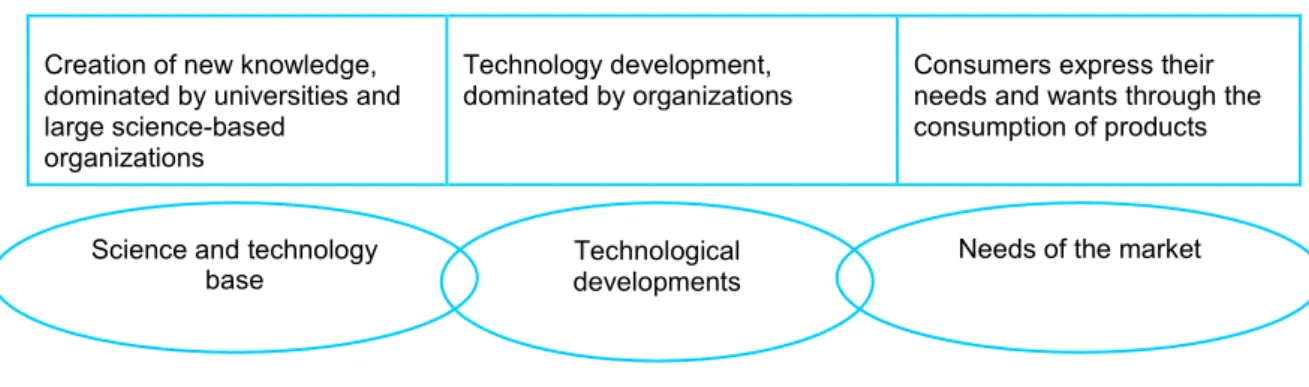
The conceptual framework of innovation by Trott (2008) consists of three factors, as can be noted from Figure 4.
Figure 4 Conceptual Framework of Innovation
Creation of new knowledge, dominated by universities and large science-based
organizations
Technology development, dominated by organizations
Consumers express their needs and wants through the consumption of products
Source: Trott (2008)
According to Trott innovation can be said to occur through the interaction of the science and technology base (dominated by universities and industry), the technological development (dominated by industry) and the needs of the market.
2.1.1. Classification of Innovation
Innovations can also be differentiated in terms of the degree of novelty associated with them. There are several different classifications of innovation but the most common classification is the division into radical and incremental innovations (see e.g. Ettlie et al. 1984, Dewar & Dutton 1986, Koberg et al. 2003). Radical and incremental innovations classify the distinction between big-change and small-change innovations, as Smith (2006) has expressed it. According to Smith (2006), radical innovation is much more than improvements to existing designs; it calls for a whole new design, ideally using new components configured in a new way. Radical innovations are comparatively rare and often associated with the introduction of a new technology.
Leifer et al. (2001) describe radical innovation as a product, process, or service with either unprecedented performance features or familiar features that offer significant improvements in performance or cost that transform existing markets or create new ones. Radical innovations transform the relationship between customers and suppliers, restructure marketplace economics, displace current products, and create entirely new product categories (Leifer et al., 2001). Garcia and Calantone (2002) propose that radical innovations are innovations that cause marketing and technology discontinuities
Science and technology base
Technological developments
Needs of the market
in macro (world, industry, market) and micro (company, consumer) level. Incremental innovations occur only at micro level causing either technological or marketing discontinuity but never both (Garcia & Calantone, 2002). In addition to radical and incremental innovations, Garcia and Calantone (2002) present a third classification of innovations, namely “really new innovations”. According to them, really new innovations are situated between radical and incremental innovations.
Incremental innovation is the most common type of innovation. According to Smith (2006) incremental innovations are based on existing business concepts and processes and the components are not radically altered. It improves an existing design through improvements in the components. Furthermore, it is not necessary for a company to change its methods along with incremental innovation. Smith argues that improvements in knowledge and materials usually lead to products and services being enhanced over time.
Although the distinction between radical and incremental innovation has produced important insights, Henderson and Clark (1990) claim that it is still fundamentally in- complete. They present a typology of innovations that involves two more categories of innovation: the modular innovation and architectural innovation. According to Henderson and Clark (1990) modular innovation is an innovation that changes only the core design concepts of a technology, such as the replacement of analogical telephone with digital telephones, but does not involve a whole new design. Smith (2006) emphasizes that the key feature of modular innovation is the use of new or different components. In the case where the new components embrace a new technology, it can transform the way in which one or more components within overall system operate but do not change the system and its configuration (Smith, 2006). Henderson and Clark (1990) argue that architectural innovation changes the relationships between the core design concepts. Furthermore, it is an innovation that changes the architecture of the product but leaves the components and the core design concepts that they embody unchanged (Henderson & Clark, 1990). The components will continue to function as they have but within a new redesigned and reconfigured system (Smith, 2006).
The degree of novelty in innovations can also be seen as a continuum one end consisting of minor, incremental changes and the other end of major, radical changes (Katz & Shapiro 1987, Green et al. 1995) Katz and Shapiro (1987) define minor innovation as something that incrementally adds to the existing technology and major innovation as something that replaces the existing technology. Also “evolutionary” and
“revolutionary” (see e.g. Walsh et al. 2002, Patrakosol & Olson 2006) or “continuous”
and “discontinuous” (see e.g. Lynn et al 1996, Walsh et al. 2002) innovation definitions have been presented. According to Patrakosol and Olson (2006) evolutionary improvement occurs when the process changes are incremental and revolutionary improvements occur when the process changes are rapid and radical. Bower and Christensen (1995) talk about sustaining and disruptive technologies. According to them, sustaining technology maintains a rate of improvement whereas disruptive technologies provide a very different solution from the previous ones.
One of the often cited classifications of innovation is the one from Wheelwright and Clark (1992). They make the distinction between derivative, platform and breakthrough projects in the context of product innovations. Derivative projects are about improving, upgrading or extending existing products pursuing to short-term benefits whereas in breakthrough projects the new core product and the process are developed in order to build long-term competitive advantage. Platform projects are in between derivative and breakthrough projects in their newness. (Wheelwright & Clark, 1992)
Table 1 illustrates the different classifications of innovation and the related literature.
Table 1 Classifications of Innovation
Classification of Innovation Authors Radical / Incremental
e.g.
Ettlie et al. 1984 Dewar and Dutton 1986 Leifer et al. 2001 Koberg et al. 2003 Smith 2006
Radical / Really new / Incremental
e.g.
Garcia and Calantone 2002
Incremental / Modular / Architectural / Radical
e.g.
Henderson & Clark 1990
Discontinuous / Continuous
e.g.
Lynn et al. 1996 Walsh et al. 2002
Disruptive / Sustaining
e.g.
Bower and Christensen 1995
Major / Minor
e.g.
Katz and Shapiro 1987 Green et al. 1995
Revolutionary / Evolutionary
e.g.
Patrakosol and Olson 2006 Utterback 1994
While the classification of innovations enables comparison between organizations at least to some extent, Downs and Mohr (1976) argue that the same innovation may be classified differently in different organizations. For example, an innovation may be seen as incremental or minor by one organization but radical or major by others. Hence, innovation is rarely the same thing to two organizations
Although many of the classifications can be considered as (physical) product or technology-driven, innovation can take many forms as can be noted during the following section.
2.1.2. Types of Innovation
Types of innovation categorize innovations by the idea of application or by the fields where innovations are used. A distinction is normally made between product and process innovation, the former involving the incorporation of new technology into new or existing products or services, whereas the latter involves adopting new technology in the actual production of new product or service (McLoughlin & Harris, 1997).
Often product innovations may be associated with service components, as Gattiker (1990) argues. Furthermore, Gattiker (1990) argues that the distinction between product and process innovation has proven to be increasingly difficult to draw.
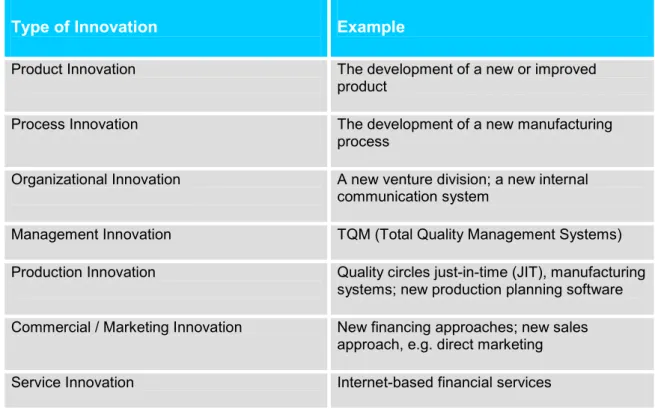
According to the author, it makes more sense to regard product and process innovations as opposite ends of a continuum rather than as mutually exclusive categories of innovation. According to Smith (2006) innovation can take the form of new products, services and processes. To these Ailin and Lindgren (2008) add new business models. Trott (2008), on the other hand, states innovation to relate to physical product, service process, production process, management approach or organizational or marketing activity. Typology of innovations and examples of the different types of innovations by Trott (2008) can be seen in Table 2.
Table 2 Typology of Innovations
Type of Innovation Example
Product Innovation The development of a new or improved
product
Process Innovation The development of a new manufacturing
process
Organizational Innovation A new venture division; a new internal communication system
Management Innovation TQM (Total Quality Management Systems) Production Innovation Quality circles just-in-time (JIT), manufacturing
systems; new production planning software Commercial / Marketing Innovation New financing approaches; new sales
approach, e.g. direct marketing Service Innovation Internet-based financial services
Source: Trott (2008)
This thesis focuses on analyzing product innovation processes and the leadership functions during them. Product innovations, especially consumer products, are probably the most known innovations since they appear to consumers in a very concrete way. Product innovations can also be industrial products such as machinery and equipment. (Smith, 2006)
A widely accepted and used classification and definition of product newness in product development research is the one by Booz, Allen and Hamilton (1982). They classify new products in the following six categories:
• New-to-the-world; the first of their kind creating a totally new market
• New product lines; not new to the market place but quite new to the firm
• Additions to existing product lines; new to the firm, fitting within the existing product line
• Improvements and revisions to existing products; replacements of existing products in a firm’s product line
• Repositions; new applications for existing products involving retargeting an old product to a new segment or for a different application
• Cost reduction; least “new” of all categories, new products designed to replace existing product in line, yielding similar benefits and performance at lower cost
Cooper (2000) argues that when successful, new-to-the-world products are the most profitable, making 50% of the sales. Hence, companies should put much effort on properly managing the innovation process from the very beginning until the launch of the new product.
2.1.3. Different Generation Innovation Models
Various types of models have been introduced in the literature for innovation processes. Innovation process has traditionally been viewed as a sequence of separable stages of activities (Trott, 2008). The first generation model, technology push model, emphasizes technological discoveries and developments in science as the main source of innovation (Trott, 2008). This model is very much the traditional perspective on the innovation model (Rothwell 1994, Trott 2008). The weaknesses of the model are that it ignores marketplace portraying it as passive and assumes that more technology will lead to more innovation (Smith, 2006). According to this model R&D has only little or no interaction with the rest of the company or overall strategy (Nobelius, 2004). While the technology push model can be applied to few cases, it is not generally applicable.
It was not before the 1970s that it was suggested the role of the marketplace to be influential in the innovation model (von Hippel, 1978). Market pull model considers customers as the most important origin of new, innovative ideas (Trott, 2008). The weakness of this model is that by meeting the apparent needs of the customers with modest improvements, new technologies can be left ignored and hence lead to firms losing their capacity to innovate (Smith, 2006). Both, the process of technology push and market pull models are linear and sequential, each step following on from the completion of the previous one (Trott, 2008).
The third generation innovation model, called the interactive coupling model, combines new opportunities in markets and new technological inventions utilizing them both as a basis for development (Rothwell, 1994). In interactive coupling model, both the technology and the market are influential (Smith, 2006). This model suggests that it is the result of simultaneous coupling of knowledge within the research and development, manufacturing and marketing that will foster innovation (Trott, 2008).
The fourth generation innovation model, interactive model, emphasizes the concentration of core business, and core technologies as well as the formation of strategic alliances (Rothwell, 1994). According to Rothwell (1994) the importance of
speed in the development of new innovations for the market led to tighter integration of internal functions and parallel development activities. In this model, R&D was seen as an integrative activity, moving away from product focus to concept focus where activities are conducted in parallel with cross-functional teams (Nobelius, 2004).
According to this model, innovations occur as the result of the interaction between the marketplace, the science base and organization’s capabilities (Smith, 2006).
Finally, the prevailing model today, the fifth generation model (also termed as the network model) emphasizes more intensive organizational and systems integration, more flexible and flatter organizational structures, and exploitation of modern information technology in innovation management (Rothwell, 1994). It focuses on collaboration involving e.g. competitors, suppliers and distributors (Nobelius, 2004).
This model reflects the way in which organizations increasingly rely on external resources through alliances, agreements and contracts with third-party organizations (Smith, 2006). According to Smith (2006) network model is not universally practiced but rather only in certain industry sectors such as aerospace, pharmaceuticals and computing.
2.1.4. User Innovation
Studies of user innovation show that many of the most important commercialized products and processes were developed by users. Rosenberg (1976) found out that important and basic machines like milling machines were first developed and built by users that had a strong need for them. Freeman (1968) reported that the most widely licensed chemical production processes were developed by user firms. The studies of von Hippel (1976, 1977) showed that users were the developers of about 80 percent of the most important scientific instrument innovations. Also Shah (2000) found out that the most commercially important equipment innovations in four sporting fields tended to be developed by users. Thus, users, firms or individual consumers, of new products are seen as an important source of innovation (von Hippel, 1988). As Rogers (1995) has pointed out, in many cases improvements to products are realized during the diffusion phase with the help of user feedback and re-inventions by users. According to Franke et al. (2006) product modifications and development by users are relatively common among many fields. Baldwin et al. (2006) argue that users develop products to serve their own needs. Some of these products are also adopted by manufacturers and sold as commercial products (Baldwin et al., 2006). Furthermore, Baldwin et al.
(2006) argue that user innovation can greatly influence the rate and direction of innovations in some industries. According to the theory developed by Baldwin et al.
(2006), user innovations begin when one or more users of a product recognize a new set of design possibilities and begin to explore that.
The lead user method, developed by Eric von Hippel (1986), is widely known method of user innovation. Lead users are users whose present strong needs will become general in the market after months or years (von Hippel, 2005). According to von Hippel and Katz (2004) the lead users can serve as a need-forecasting laboratory for marketing research since they are familiar with the future conditions. The remarkable finding of von Hippel’s (1986) twelve-year study was that users were often the actual developers of prototype solutions that led to successful commercial products. Von Hippel’s research evidence shows that often innovative users have valuable new product information to offer. Lead user method differs from the traditional market research in the way that it tries to collect information about both needs and solutions from the leading edge of the target markets whereas the traditional market research concentrates on learning what a typical customers might need (von Hippel & Katz, 2004). According to von Hippel and Katz (2004) the underlying assumption is that lead users have already come up with innovations and R&D should see if they can adapt these ideas and innovations to the needs of their own market.
2.1.5. Open Innovation
There is currently a broad awareness of open innovation and its relevance to firm’s R&D processes. According to Chesbrough (2003a) there is a fundamental shift in the way companies generate ideas and bring them to market. He further argues that the boundaries between the firm and its surrounding environment have become more permeable. In closed innovation, that has held to be the right way to bring new ideas to market, company generates, develops and commercializes its own ideas (Chesbrough, 2003b). Chesbrough (2003a) notes that the logic that supports an internally oriented approach to R&D has become obsolete in many industries. According to Chesbrough (2003b) several factors have led to the creation of the new model of open innovation.
First of all, Chesbrough (2003a) state that the rise in the mobility of knowledge workers made it difficult for companies to control their ideas and expertise. Secondly, the growing availability of private venture capital, which has helped to finance and support new firms in their efforts to commercialize ideas was an important factor in the creation of open innovation (Chesbrough, 2003a). Baldwin and von Hippel (2009) suggest that the practices in open software development were important in bringing the phenomenon of free revealing to general awareness.
In open innovation firms commercialize external as well as internal ideas utilizing outside and in-house pathways to market. The basic idea is that because the knowledge is widely distributed, companies can not afford to rely only on their research but should instead profit from other companies e.g. by buying or licensing processes or inventions. On the other hand internal inventions that are not being used in company’s business should be given outside for other organizations to utilize e.g. through licensing or joint ventures. (Chesbrough, 2003a)
According to Baldwin and von Hippel (2009) there are two reasons for innovators to freely reveal their ideas and innovations: first, it is pretty difficult to effectively protect most innovations and second, innovators often benefit significantly from freely revealing their innovations. Baldwin and Hippel (2009) emphasize that a transition from innovation by producers to open single user innovation and open collaborative innovation is also desirable in terms of social welfare.
2.2. Innovation Process
The innovation process is a process of all the activities that have to be undertaken in order to turn an invention into a commercial product or service (Smith, 2006). It takes a number of steps to get an idea to a product, and the product to the markets for consumers to buy. How many steps it takes and how they are linked together depends on the nature of the product or service. It is commonly agreed that the processes are not meant to be strict specifications but guidelines that need to be flexibly adapted to specific situations and projects. According to Hislop (2005) in the process of innovation organizations strive to implement changes to their existing products, services, structures or processes. Buijs (2007, 204) proposes that “innovation process is a set of different, parallel, competing and conflicting processes which all occur at the same time.” He emphasizes that a shared understanding, the level of comfort with ambiguity and the degree of trust between team members play important roles during the innovation journey.
The innovation process can be understood to consist of three phases: front-end phase, development phase and commercialization phase (see e.g. Buckler 1997, Koen et al.
2001) as depicted in Figure 5. The front end of innovation is the first phase of the innovation process and refers to activities that take place before the actual development phase (Koen et al. 2001, Nobelius & Trygg 2002). Ideation and the processing and development of concepts occur at this phase of the innovation process (Nobelius & Trygg, 2002). Front end phase is followed by the development phase, or new product and process development phase as Koen et al. (2001) names it, which focuses on developing the selected components into final products effectively and efficiently (Buckler 1997, Koen et al. 2001). The last phase, commercialization phase, brings new products onto the market, thus enables organizations to benefit from previous development activities (Koen et al., 2001). Koen et al. (2001) argue that the entire innovation process needs to be aligned with the business strategy to ensure uninterrupted flow of new products, processes and services that bring value to the corporation.
Figure 5 Innovation Process According to Koen et al.
Source: Koen et al. (2001)
This thesis concentrates on analyzing the front end and development phases, their differences and attributes as well as the different leadership functions and roles used in these phases. The last phase of innovation process, commercialization phase, will be left out. As was mentioned in the introduction chapter, the front end and development phases already offer interesting baselines to the study of leadership roles and functions and thus the commercialization phase was not seen to bring any added value to the study.
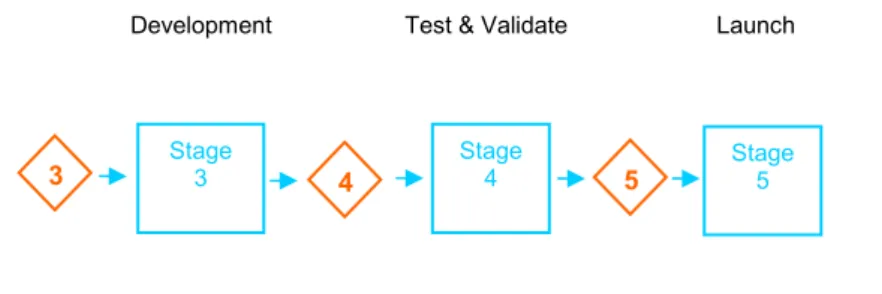
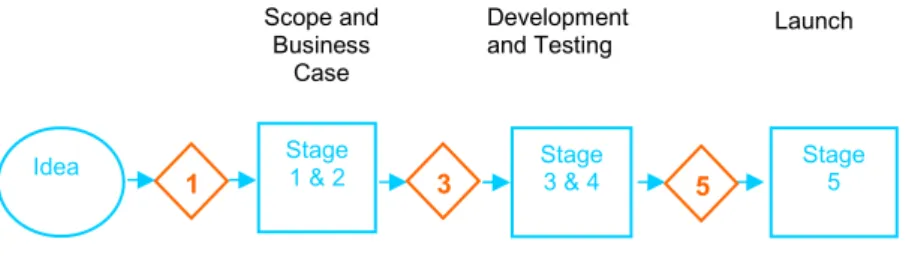
Front end and development phases of innovation process differ a lot by nature and because of that require very different leadership practices as well. Front end phase is experimental, difficult to plan and often very chaotic whereas the development phase is formal, well structured and speed and timing play important roles (Koen et al. 2001, Kim & Wilemon 2002b, Hohn 2004). Development phase is usually described as a series of stages through which an idea is processed and evaluated (Koen, 2001). Next the process models, activities and characteristics of these two phases will be discussed.
2.2.1. Front End of Innovation
The front end of innovation (FEI) is considered the first stage of the innovation process and it can roughly be described as the period from the idea generation to its approval for development or termination. (Murphy & Kummar, 1997). Kim and Wilemon (1999;
see Kim & Wilemon 2002b) argue that FEI is the period between the first consideration of opportunity and the judgment for further development. Khurana and Rosenthal (1998) talk about front end completeness, where the front end is complete when a
business unit either commits to the funding and launch the project or decides not to do so. According to Verworn et al. (2008) the front end of innovation determines which projects will be executed.
It is commonly agreed that the FEI is the most challenging part of the innovation process. Because the uncertainty is highest at the front end and there is very little information, this phase is often called “the fuzzy front end” (FFE), a term made popular by Smith and Reinertsen (1991; see Verworn et al. 2008). According to Zhang and Doll (2001) this “fuzziness” derives from unclear customer requirements, unproven and changing technologies as well as from unpredictable business environment.
As Buijs (2008) expresses it, FEI is the breeding ground for all new products or services. During the front end the direction for the whole innovation process is set (Reid & de Brentani, 2004). Buijs (2003) argues that the front end of innovation is the strategic part of product innovation. Many important decisions related to target market, potential of the opportunity, and strategic alignment are made (Kim & Wilemon, 2002b).
According to Buijs (2008) front end includes everything necessary to come up with a strategically sound design brief for future products and services for a company. Cooper (1997) has found out that insistent work at the front end remarkably drives up the success of NPD. Also Monaert (1995) states, that the quality of planning activities is a critical factor when it comes to successful development projects. In his review of empirical work about NPD success factors Ernst (2002) found out that the quality of planning before beginning of the actual development phase is crucial for the success of NPD process.
Process Models of Front End
There are several models in the literature that aim at describing and organizing the front end phase of the innovation process (see e.g. Cooper 1997, Khurana &
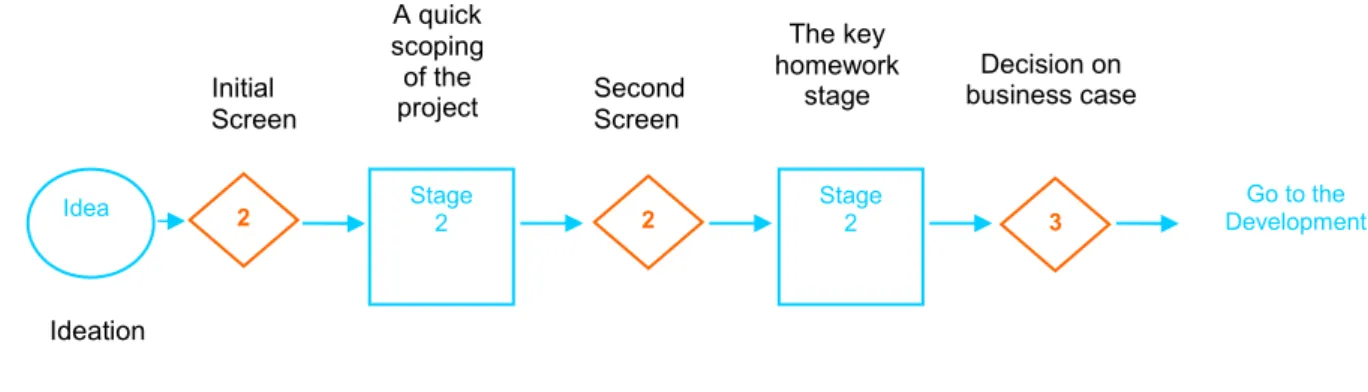
Rosenthal 1998, Koen et al. 2001, Nobelius & Trygg, 2001). One of the most referred models of the front end is the linear Stage-Gate model by Cooper (1993). The Stage- Gate front end model includes three phases and three decision gates as depicted in Figure 6. The different phases are ideation, a quick scoping of the project, and the homework stage. The outcome of the ideation phase is a conceptualized idea. At the first decision gate the ideas are screened against a set of criteria of what must and should be met. The purpose of the stages is to solve problems and generate information that will facilitate decision making about the new product. In the quick
scoping stage market and technical information is gathered to know about the feasibility of the project. If the idea passes the second decision gate it is investigated in more detail in the key homework stage. In this last phase investigation e.g. about user’s needs, the competitive situation, markets, technical feasibility, financial issues, and testing the concept are made. (Cooper, 1993) Cooper (1988) argues that the final phase, is the most difficult and expensive phase of the fuzzy front end. The aim is to build a business case which includes product definition, project justification as well as an action plan through the launch. The objective is to make the final decision about continuing or interrupting the project prior the development. (Cooper, 1988) The business case is built based on the up-front investigation. It should include a defined product, a business justification and a detailed action plan. (Cooper 1993) Furthermore, Cooper (2000) emphasizes the importance of “up-front homework” 2000, 4) that is, investigation related to the project between front end and the start of the development phases. He argues that solid up-front homework drives up new product success rates significantly.
The Stage-Gate model is one of the most linear and formal process models of the front end giving a systematic way to manage the process (Poskela, 2009). Hislop (2005), like many others, argues that linear models are oversimplifying as interactive learning and combining different knowledge come to characterize innovation processes.
Figure 6 Front End Activities According to Cooper
Source: Cooper (1997)
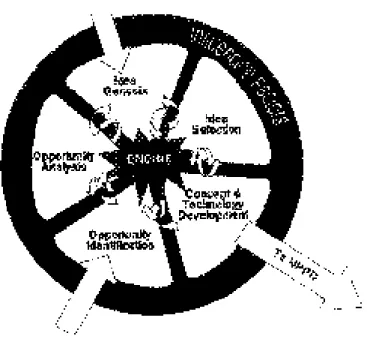
Koen et al. (2001) present the new concept development model, which describes the definition of the key components of the front end of innovation (see Figure 7). The five key elements of the front end of innovation are opportunity identification, opportunity analysis, idea genesis, idea selection and concept and technology development. These five front end elements are fuelled by the leadership and culture of the organization.
Previous studies, including the study of Koen et al. (2001) have shown the engine
Idea Stage
2 The key homework
stage
3 Decision on business case Initial
Screen
Second Screen
Go to the Development
Ideation
2 Stage
2 2
A quick scoping of the project
(leadership and culture of organization) to be a critical part of FEI. The circular shape of the front end phase suggests the flow, circulation and iteration of ideas between and among all the five elements. Koen et al. (2001) state that this differs considerably from the sequential NPD project processes which redo activities associate with significant delays and added costs. The new concept development model tries to describe the actual front end practices, which are the iterative and non-linear nature of the phase.
The factors influencing the front end of innovation as well as the whole innovation process consists of organizational capabilities, business strategy, the outside world including distribution channels, customers and competitors and finally the enabling science. (Koen et al., 2001)
Figure 7 New Concept Development Model
Source: Koen et al. (2001)
Between the two extremes of linear and non-linear models there are several other process models for managing the front end phase. The Delft innovation model by Buijs and Valkenburg (2005; see Buijs 2007) is also an iterative process model consisting of five phases: strategy formulation, design brief formulation, development, market introduction and product use. Of those five product use, strategy formulation and design brief formulation comprise the front end phase. Product use phase involves checking the product against technical specifications as well as checking the brand promise. At this phase the organization should find out the possible need to innovate and if the current product is still up to date. Strategy formulation phase involves several analyses that should result in the company knowing e.g. the competitive and substituting products/services, its core competencies, opportunities in the market as well as threats and opportunities in the business environment. Design brief formulation,
on the other hand, concentrates on the strategic idea about the future. At this phase, it is important to look at the needs of potential users. Also the priorities and conflicting interests as well as the limitations of the company should be recognized. In design brief formulation phase resource planning is necessary and special knowledge and skills are needed to realize the planned. (Buijs, 2008)
Another cyclic innovation process is presented by Desouza et al. (2009). The front end phase consists, according to the authors, of generation and mobilization of ideas, advocacy and screening and experimentation. They emphasize the importance of mobilizing ideas from the environment where they are well-known to environment where they are new and fresh. This can give objectiveness and inspire idea generation by revealing assumptions in practices, processes, or products. Desouza et al.
emphasize that advocating for ideas, the second step in the front end phase, is a risky and time-consuming process. According to the authors, if the idea is truly innovative, there might not be enough qualified individuals within the organization who can evaluate it. The last phase, experimentation phase, tests the suitability of the idea for a particular organization at a particular time. Important outputs of this stage are libraries of ideas for the future, identification of suitable ideas for commercialization and work-in- progress prototypes.
Khurana and Rosenthal (1998) suggest that the greatest success comes to organization when applying a holistic approach to the front end. This approach links business strategy, product strategy, and product-specific decisions. The elements of holistic approach require company-wide support and senior management involvement.
Furthermore, the authors suggest that the front end approach must be compatible with the firm’s product, market, and organizational contexts. Khurana and Rosenthal divide the front end phase into three phases that are pre-phase zero, phase zero and phase one. Pre-phase zero includes the product strategy formulation and communication, opportunity identification, and assessment and idea generation, phase zero product concept definition, and finally, phase one is about feasibility and project planning as well as executive reviews. The authors stress that achieving a balance between creativity and discipline is the key in developing a competence in the front end.
Reid and de Brentani (2004), criticize that researchers tend to apply the same front end models and activities regardless of the level of innovation (incremental or radical). They argue that radical innovations move to organizations in a different way than incremental innovations. According to the authors, in the case of radical innovations, individuals act as boundary spanners. They argue that the essence of “fuzzy front end”
is the process of identifying, understanding, and acting on emerging patterns in the environment.
Furthermore the current front end models have been criticized for adopting one single front end model without regarding the contextual differences (see e.g. Reinertsen 1994, Nobelius & Trygg 2002, Reid & de Brentani 2004). Nobelius and Trygg (2002) emphasize the importance of alternative processes or routes and managerial freedom in the front end phase for different types of projects. They state that a greater flexibility among the front end models is needed. In their study they analyzed three development projects and the results showed differentiated front end processes with respect to activities performed and task sequences as well as relative time duration and perceived importance of individual tasks. Nobelius and Trygg (2002) present a front end model that includes mission statement, concept generation, concept screening, concept definition, business analysis and project planning. These activities occur after strategic planning and opportunity identification.
Reinertsen’s (1994) two-track front end model takes into account the contextual factors of the organization and considers front end as a process that must be optimized. The model is differentiated due to the different time focus the projects have. The two front end models differ depending on whether the activities are conducted in parallel or in sequence. Reinertsen argues that time-focused projects should be conducted in parallel. He argues that processes should respect the unique economics of different situations. In his latter article Reinertsen (1999) argues that process flow rates, the size of process queues, and the batch size of the process among others are to be optimized in the front end context. Furthermore, the number, layout and sequence of gates in the process are issues that affect the effectiveness and efficiency of process execution.
Smith et al. (1999) state that in order the front end of innovation to be successful, a clear and widely-accepted process definition, effective and fast-moving process leadership, clear and simple process-linked metrics and most critically, the active support by high-level management is needed. In their study of Japanese new product development projects, Verworn et al. (2008) found out that an early reduction of market and technical uncertainty as well as an initial planning before development phase, have a positive impact on NPD project success.
Koen et al. (2001) emphasize that sustained successful innovation can occur only when the front end activities can be accomplished with the organizational capabilities of the company. In addition, it is critical to understand establishing sciences and
technologies. Furthermore, a supportive climate is essential for a productive FEI.
(Koen et al., 2001)
Activities of Front End
Activities during the front end aim at reducing uncertainty (Monaert et al. 1994, Kim &
Wilemon 2002a, Koen et al. 2001). According to Monaert et al. (1994) uncertainty is best reduced by encouraging closer communications between R&D and marketing, having a decentralized project structure, and requiring formal deadlines and controls even during the front end phases. In their study, Monaert et al. (1994) found out that successful projects reduced on average the same amount of uncertainty during planning in the front end that the unsuccessful projects during the whole innovation process.
Front end models in the literature include certain activities that are considered to be critical in order to effectively carry out the front end phase. These activities have been discussed by several authors (see e.g. Cooper, 1997, Khurana and Rosenthal, 1998, Koen et al. 2001, Nobelius & Trygg, 2002, Tidd et al. 2005, Desouza et al. 2009).
Based on the different models of front end and the discussion by authors, Poskela (2009) have summarized the front end activities to include eight activities. The front end activities according to Poskela (2009) are opportunity identification, idea generation, idea screening and selection, concept development, concept testing, customer need assessment, technology verification, and business analysis. Next each of these activities will be shortly discussed.
Opportunity identification is the phase where the organization identifies the opportunities it wants to pursue (Koen et al., 2001). This phase launches front end of innovation (Nobelius & Trygg, 2002). According to Tidd et al. (2002) this phase focuses on detecting signals in the environment about potential for change. Potential for change can occur e.g. from new technological opportunities, legislative pressure, shifts in the political environment, competitor behaviour or new social trends. Koen et al.
(2001) emphasize that these opportunities may emerge through formal identification process or informal interaction in ad hoc situations. They underline that this identification of opportunities is typically driven by the company’s strategies and goals.
During the idea generation, new ideas are created, whether through redefinition of concepts, changes in the processes, creation of new components of service, or