Consumer experience at lifestyle trade fair: study on themed space as experiential context
International Design Business Management (IDBM) Master's thesis
Elina Lammintausta 2013
Department of Management and International Business Aalto University
School of Business
CONSUMER EXPERIENCE AT LIFESTYLE TRADE FAIR
Study on themed space as experiential context
Master’s Thesis Elina Lammintausta Fall 2013
IDBM
Approved in the Department of Management and International Business __ / __2013 and awarded the grade _____________
Author Elina Lammintausta
Title of thesis Consumer experience at lifestyle trade fairs – study on themed space as experiential context
Degree Master’s degree
Degree programme International Design Business Management (IDBM) Thesis advisors Elina Koivisto and Mikko Koria
Year of approval 2013 Number of pages 105 Language English Objectives
The objective of this research is to find out what is the experiential context in lifestyle trade fairs targeted to consumers. The research problem of this thesis is how the design of the venues affect the consumer experience. Since lifestyle trade fairs have been studied only from the market culture approach, this study aims to describe the lifestyle trade fair experience and how the themed space with social, physical, and atmospherics dimensions contributes to the experience as experiential context by evoking consumers senses, and emotions, and triggering behavior.
Methodology
Phenomenological paradigm guides the design of this thesis. Market oriented ethnography is the research method applied. The research context comprises of Book Fairs both in Frankfurt and Helsinki. The research material consists of interviews with the fair visitors, participant observations, field notes and photographs taken at both Book Fairs.
Results
This study indicates that the experiential context at lifestyle trade fair comprises of social, physical and atmospherics elements that each contribute to the fair experience in the theme rooms of the exhibition centre. Visitors’ emotional arousal is rather low and, in general, the surrounding space is experienced as functional and effective, but not aesthetically pleasing. The behavior of consumers is characterized by both active and passive participation in the form of discovering and exploring.
Main disturbing factor at the fair is the clamor created by the crowding and lack of sufficient sound system. Thus, relaxing lounges are highly sought after to balance the over-stimulation of senses characterizing the overall experience.
Keywords consumer experience, experiential context, themed space, lifestyle trade fairs
1 INTRODUCTION ... 1
1.1 Introduction to the topic ...1
1.2 Research gap ...2
1.3 Research design ...4
1.4 Focus of the study...5
1.5 Structure of the report ...5
2 LITERATURE REVIEW... 7
2.1 Studies on experience ...7
2.1.1 Experience formation ...7
2.1.2 Experience dimensions ...10
2.1.3 The Experience Pyramid ...13
2.2 Studies on experiential context ...15
2.2.1 Themed spaces as experiential context...16
2.2.2 Space and its elements ...21
2.3 Theoretical framework build-up ...25
3 RESEARCH METHODOLOGY ... 27
3.1 Research approach ...27
3.2 Market-oriented ethnography ...28
3.3 Research context ...29
3.3.1 Frankfurt Book Fair (Messe Frankfurt) ...30
3.3.2 Helsinki Book Fair (Finnish Fair Corporation) ...31
3.4 Research material ...32
3.4.1 Interviews ...33
3.4.2 Observations...34
3.5 Research process ...36
3.6 Validity, transferability and reliability...38
4 FINDINGS ... 40
4.1 Physical dimension and use of themes ...40
4.1.1 Rational setting for stories and emotions ...43
4.1.2 Being in a maze – stepping into the known unknown...45
4.1.3 Halls as theme rooms with distinct atmospheres ...49
4.1.4 Stands with physical and digital displays letting visitors to touch, see, listen and do ...54
4.1.5 Relaxing and escapist lounges crucial ...59
4.2 Atmospherics dimension ...64
4.2.1 Stress, crowding and clamor disturbing visitors ...68
4.3 Social dimension ...69
4.3.1 Gathering with friends and familiar faces ...70
4.3.2 Events and workshops as hotspots for social interaction ...72
4.3.3 Cosplayers adding new social element to the experience ...74
4.4 Discovering and exploring as play...75
4.4.1 Vague expectations and planning on the go...75
4.4.2 “Walking around” at the fair ...78
4.4.3 Reading and buying ...79
4.4.4 Engaging competitions and free samples ...80
5 DISCUSSION AND ANALYSIS ... 82
5.1 Contextual elements influencing the consumer experience at lifestyle trade fairs ...83
5.2 Consumer senses and emotions evoked at lifestyle trade fair...85
5.3 Playful consumer behavior at lifestyle trade fair...87
6 CONCLUSIONS ... 89
6.1 Concluding remarks ...89
6.2 Implications for future trade fair concept ...90
6.3 Limitations ...93
6.4 Ideas for future research ...93
7 REFERENCES ... 95
7.1 Internet references ... 100
8 APPENDIX ... 102
8.1 Appendix 1 Frankfurt Book Fair interview questions ... 102
8.2 Appendix 2 Helsinki Book Fair interview questions ... 104
List of figures
FIGURE 1 FOCUS LAYERS OF THE STUDY ……….. 8
FIGURE 2 THE FOUR REALMS OF EXPERIENCE WITH EVENT EXAMPLES ...11
FIGURE 3 THE EXPERIENCE PYRAMID (SOURCE: TARSSANEN 2009)...13
FIGURE 4 THEMES AT RETAIL FRAMEWORK (SOURCE: KOZINETS ET AL 2002)...18
FIGURE 5 EXPANDED SERVIVESCAPE MODEL BY ROSENBAUM AND MASSIAH (2011)...22
FIGURE 6 GENERAL FRAMEWORK ...25
List of pictures
PICTURE 1 THEMED ENVIRONMENT EXAMPLES...16PICTURE 2 RESEARCH PROCESS...36
PICTURE 3 ENTERING FRANKFURT AND HELSINKI BOOK FAIRS 2012...40
PICTURE 4 MULTI SENSORY VISUALS AT THE NEW ZEALAND PAVILION ...51
PICTURE 5 BOOK DISPLAY AT THE NZ PAVILION ...52
PICTURE 6 DIGITAL AND PHYSICAL DISPLAYS INVITING VISITORS TO EXPLORE ...54
PICTURE 7 CERN STAND ENGAGING VISITORS TO TRY AND EXPERIENCE ...57
PICTURE 8 VISITORS CREATING THEIR OWN PAUSE POINTS ...59
PICTURE 9 HELSINKI BOOK FAIR CHAIRS VS. IKEA LOUNGE ...60
PICTURE 10 MASSAGE POINT OFFERING QUICK RELAXATION...61
PICTURE 11 VISITORS RELAXING OUTDOORS...63
PICTURE 12 VISITORS CHILLING ON FATBOYRS AND HAMMOCKS ...63
PICTURE 13 AUTHOR INTERVIEWS AND BOOK SIGNINGS LURING FANS...72
PICTURE 14 WORKSHOPS ACTIVATING VISITORS ...73
PICTURE 15 COSPLAYERS A VISIBLE PART OF THE EXPERIENCE IN FRANKFURT...75
1 Introduction
1.1 Introduction to the topic
With the rise of experience economy (Pine and Gilmore 1999) the notion of experience has become a key element in understanding consumer behavior (Addis and Holbrook 2001) and led the way to experiential marketing (e.g. Schmitt 1999) and customer experience management (CEM) (e.g. Meyer and Schwager 2007) as nowadays consumers seek to experience immersion into thematic settings in contrast to consuming products and services (Carù and Cova 2007). As the experiential contexts are the only manageable element for marketer (Carù and Cova 2007) exhibiting spaces are becoming increasingly relevant within the retail and trade show industry. Especially since the advances of technology are creating new rivals for traditional trade fair formats with virtual trade fair platforms such as Madison Buyer and e-pitti by Pitti Immagine in the fashion industry.
Consumer experience at lifestyle trade fairs from the consumer point of view has been studied before only from the market culture perspective started by Peñaloza (2000, 2001) despite the acknowledgement of the influential role context with spatial environment has in experiential marketing and consumption (Schmitt 1999).
Therefore, how the experiential consumption with fantasies, feelings, and fun (Holbrook and Hirschman 1982) and experience in all its dimensions (Pine and Gilmore 1999) take place in a themed environment where curious lifestyle hobbyists gather to spend their free time is an open question. It is thus the question tackled in this thesis.
Lifestyle trade fairs are particularly relevant and meaningful for this research for two important reasons. First, they take place in a built environment that is changeable and designable. Secondly, trade fairs and exhibitions targeted to consumers are important subsector in the experience economy dominating in today’s consumer markets. In 2011 there were 22 public exhibition events at Helsinki Fair Center and over 100
events and exhibitions at Messe Frankfurt. Most of the public trade fairs organized both in Finland and abroad fall under the lifestyle category ranging from winter sports to music and fashion. In Finland trade fairs comprise 197 million euros of marketing communications investments and 5,8% of the total expenditure (Finnish advertising council 2011). Association of the German Trade Fair Industry (AUMA MesseTrend 2012) concluded in their MesseTrend findings that, despite the growing uncertainty regarding the economic future, many German exhibitors plan to increase their trade fair budgets in 2012/2013: 30% intending to invest more in trade fairs and 55% the same amount as previous year.
1.2 Research gap
Despite the hype of the experience word in the literature and its relevancy in the events scene, little qualitative research has been conducted on how consumers actually experience events (Holloway et al. 2010), and in more detail, trade fairs targeted to consumers. Consumer experience research on retailing and on both sports and tourism area are abundant (e.g. Peñaloza 1999; Sherry 1998; Arnould and Price 1993) but many other lifestyle-characterized events are lacking qualitative research on the experience side. Studies on lifestyle brands and stores from American Girl to Nike Town (e.g. Diamond et al. 2009; Peñaloza 1999) exist but lifestyle trade fairs in the B-to-C sector from consumer experience viewpoint are scarce. The gap is intriguing as positive customer experience can lead to word of mouth (WOM), loyalty and enhance marketer’s bottom line (Maklan and Klaus 2011). However, it is still neglected by many companies (Meyer and Schwager 2007).
Even though retail stores and exhibitions have similarities, both being artificial, designed spaces, what makes exhibitions and trade fairs different from concept and flagship stores, is temporality. In addition, retailers design their own premises and can control the intrusion of competing influences (i.e. other brands) that can disturb the coherence of the experience. Thus, trade fairs and exhibitions provide diverse context for consumer experience.
Previous studies on consumer experience and lifestyle trade fairs (Ahola 2007;
Virkkula et al. 2008; Schlobohm 2010) focus on the cultural perspective relying on Peñaloza’s model of market culture (2000, 2001), and cultural meanings that are created by marketers and consumers together at the trade fair. As the lifestyle trade fair studies have focused on the market place culture approach, in the retailing side the consumer experience is analyzed in more detail in relation to the surrounding space (e.g. Sherry Jr. et al. 2001; Markkanen 2008) focusing on the affective and behavioral side of the consumer experience from different stimuli to feelings and approach-avoidance behavior.
Based on the previous market culture studies on trade fairs and exhibitions consumers have significant and active role in forming their fair experience and the leisure trade fair market culture that is created through the interactions with their own experience world, the event, other fair visitors and the marketers. On the contrary, studies on retail spaces acknowledge how the surrounding space is contributing to the consumer experience by offering holistic shopping environment catering senses, feelings, thoughts, action, and social cohesion (Markkanen 2008). In fact, the experience boom in the retailing side has led the way to the phenomena of brand flagship stores with Apple being a powerful example.
Furthermore, what the trade fair organizers are measuring and gathering statistics for are not about consumer insight on user experience. Extensive figures on space, exhibitors, and visitor profiles (e.g. FKM Report 2011; Finnish Audit Bureau of Circulations 2012) offer quantitative data but they do not help much in understanding the consumer experience at lifestyle trade fairs and what it comprises of.
Therefore the research problem in my thesis is
What is the experiential context at lifestyle trade fairs targeted to consumers and how it contributes to the consumer experience?
The research problem is approached through below described research questions
Q1: What are the contextual elements influencing the consumer experience at lifestyle trade fair?
Q2: How are consumer’s senses and emotions evoked at lifestyle trade fair?
Q3: How does play characterize consumers behavior at lifestyle trade fair?
The aim of my thesis is to gain better understanding of consumer experience at lifestyle trade fairs and, in more detail, how it is influenced by the trade fair space:
what are the encounters (i.e. touch points and interactions) at lifestyle trade fairs forming the experience? Hence, both consumer experience and the lifestyle trade fair context are emphasized. Based on the empirical findings from the Book Fairs both in Frankfurt and Helsinki, I conclude with implications on how to re-conceptualize trade fairs to help future marketers create the right environment and setting for consumer experience. In sum, the aim is to contribute what trade fairs could be like in the future.
1.3 Research design
In this study market-oriented ethnography is used as a method of research. The ethnographic research was conducted at the Frankfurt Book Fair on the 10th to 14th of October and at the Helsinki Book Fair on the 25th to 28th of October. In addition, StoryDrive conference gathering professionals from gaming, film, and book industries, was attended 11th and 12th of October as part of the Frankfurt Book Fair program to gain better understanding of the book and media industry, i.e. the context of the trade fairs being studied.
The research material comprises of recorded individual interviews with fair visitors and participant observation. Photographs were taken during the trade fairs and informal discussions held with the exhibitors, journalists, and the visitors at the fairs.
The material was collected both at the Frankfurt and Helsinki Book Fairs.
1.4 Focus of the study
Although the consumer’s holistic experience includes all the three phases from pre to post experience (Tynan and McKechnie 2009, p.509), the focus of this study is on the consumer experience at the lifestyle trade fair and how the exhibition space contributes to the customer experience as no research was conducted before or after the event itself. The study analyzes the experience from the consumer point of view only, i.e. the book fair visitor. Therefore, marketing and managerial perspectives are not in the scope of this study except in the implications section when discussing thoughts and ideas for the future concept of public lifestyle trade fairs targeted to consumers.
1.5 Structure of the report
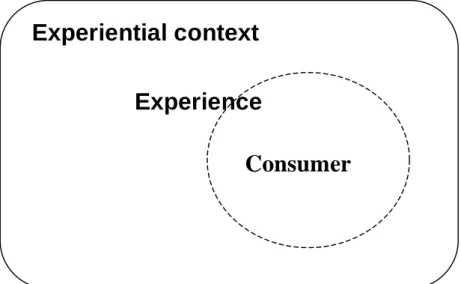
The basis for this study is Holbrook and Hirschman’s notion of experiential consumption and previous research on themed environments in retail context, as it has not been applied in the event and exhibition studies before. Hence, in the following literature review a definition for consumer experience is first presented and an overview on previous consumer experience research on themed environments.
Consumer
Figure 1 Focus layers of the study
Experiential context
Experience
In the third chapter, the research methodology used in this study is introduced with brief descriptions on the context of the study and on the research material gathered. In addition, the validity, transferability and reliability of the chosen research methodology, market oriented ethnography, is discussed and how well it fits the purpose of this study.
The fourth chapter starts the empirical part of the report by entering the Book Fairs and presenting main findings from research conducted both at Helsinki and Frankfurt Book Fairs. First the experiential context, the themed environment of the fairs, is discussed. Then the surrounding space is further analyzed based on how consumers experience it in relation to three dimensions: atmospherics, social and physical.
Lastly, how the being at the Book Fair in its experiential context is displayed by visitors’ behavior as discovering and exploring is portrayed.
After going through the findings from Book Fairs both in Helsinki and Frankfurt, discussion and analysis is presented in the fifth chapter. In the sixth chapter concluding remarks summing up this thesis is portrayed and implications for the future trade fair concept are depicted. In addition, limitations and ideas for future research are discussed.
2 Literature review
In this chapter, first overview of the literature regarding consumer experience is presented and what the term means in this study defined. Further on, as the consumer experience is studied in relation to the exhibition space in this thesis, previous research on experiential context and themed environments is discussed. Based on the consumer experience and themed environments literature the general framework guiding this study is formed.
2.1 Studies on experience
Different types of experiences have been characterized from peak and extraordinary experiences (e.g. Arnould and Price 1993; Carù and Cova 2003; Celsi, Rose and Leigh 1993) to flow experiences (Csikszentmihalyi 1990). However, consumer experience is lacking a clear definition what it actually stands for (Carù and Cova 2003; Gupta and Vajic 2000; Ismail et el. 2011). Consultants and researchers are presenting differing views on consumer experience and what are its types, dimensions and configurations. Hence, drawing from the previous literature on consumer experience, a definition used in this study is presented.
2.1.1 Experience formation
When discussing experiences it is useful to look at the formation first. In considering consumer experience two perspectives of consumer behavior dominate: the traditional information processing, i.e. decision-oriented, and the experiential perspective. In contrast to the cognition, affect and behavior model described by information- processing approach the experiential perspective emphasizes emotions and contextual, symbolic and non-utilitarian aspects of consumption (Arnould and Thompson 2005;
Hirschman and Holbrook 1982). In other words, the experiential view emphasizes the sensorial perception that generates emotions. By sensing the environment humans create a bundle of emotions that lead to experience (Boswijk et al. 2007).
Hirschman and Holbrook (1982) refer to hedonic consumption (also referred to as experiential consumption) when talking about experiences – consuming for enjoyment. It covers the multi sensory, fantasy, and emotive aspects of product usage that is understood as a subjective, inner kind of phenomena. They describe consumption that seeks fun, amusement, fantasy, arousal, sensory simulation and enjoyment, and requires arousal from the consumer (Holbrook and Hirschman 1982).
The multi sensory elements refer to tastes, sounds, scents, tactile impressions, and visual images that can relate to for example history or fantasy imagery, or as later on discussed in the literature review, relate to a specific theme. Fantasy answers to imagination as the hedonic consumption acts are based not on what consumers know to be real but rather on what they desire reality to be. Emotive response includes feelings from joy to rage. Hirschman and Holbrook (1982) note that individuals do not only receive experiences in a multi sensory mode but they also respond and react to the stimuli they get exposed, hence, putting interaction at the heart of experience.
In accordance with Hirschman and Holbrook’s emotive response, Poulsson and Kale argue, that for an encounter to be labeled as an experience, one or more of the following sensations and feelings need to be apprehended by the customer: personal relevance, novelty, surprise, learning, and engagement (2004). Personal relevance refers to “individual’s internal state of arousal, activation, and preparedness to engage in a specific experience” influencing involvement and engagement that respectively affects the quality of the perceived experience. Sensation of novelty requires a change in surrounding stimulus: simply put something being different from before for the consumer. Surprise is the result of expectations versus the event itself; consumer feels surprised if the product exceeds his expectations. Thus, the event itself does not need to be new but the experience with the event yes. As with personal relevance, also learning leads to engagement that is a two-way interaction between consumer and the marketer requiring both consumer input and feedback from the marketer. According to Pine and Gilmore in the era of experience economy mere entertainment of consumers is not enough as the aim should be engagement (1999). In sum, Poulsson and Kale emphasize the affective role of experiences defining consumer experience as a bundle of emotions. The greater the assortment of these sensations, the more intense the experience will be; the five elements work as a checklist for experience creation.
In addition to sensations and feelings, Csikszentmihalyi (1990, 1997) defines experiences based on the consumer’s mental state, and has introduced the term flow into the experience literature. According to him, optimal experience balances the challenge level of the task with individual’s skill level creating in best-case scenario a flow experience. In other words, if the individual can find optimal fit between his skills and the demands of the task at hand he can pursue total absorption that Csikszentmihalyi calls flow. Following nine components characterize this experience (Csikszentmihalyi 1997):
1. Clear goals
2. Immediate feedback
3. Balance between challenges and skills (optimal fit) 4. Action and awareness merge (intense concentration) 5. Distractions exclude from consciousness
6. No worry of failure
7. Self-consciousness disappears
8. The sense of time becomes distorted (time flies)
9. The activity becomes “autotelic” (an end in itself, done for its own sake)
When reaching for a flow experience consumer needs to have clear goals and be able to receive immediate feedback during the process. The most crucial condition, however, is the balance between requirements of the task at hand and individual’s skill set that should reach optimal fit by not being too challenging or too easy to do. In a state of flow individual has intense concentration and is totally focused on the task.
Thus, he does not feel distracted. In addition, individual does not worry about failure and his self-consciousness disappears as he is under intense concentration. Moreover, with intense concentration the sense of time becomes irrelevant and the task an end itself and not a tool for reaching something else.
To sum up, by sensing the environment consumers are exposed to a variety of stimuli that create emotional replies and trigger experiences. Sensations of personal relevance, novelty, surprise, learning, and engagement attribute to experiences that by nature are individual and subjective. When compared to products and services, the memorability and personal aspect differ experiences form tangible products and
intangible services (Kotler and Armstrong 2001). As Gentile and colleagues describe (2007):
“The customer experience originates from a set of interactions between a customer and a product, a company, or part of its organization, which provoke a reaction. This experience is strictly personal and implies the customer’s involvement at different levels (rational, emotional, sensorial, physical, and spiritual).”
2.1.2 Experience dimensions
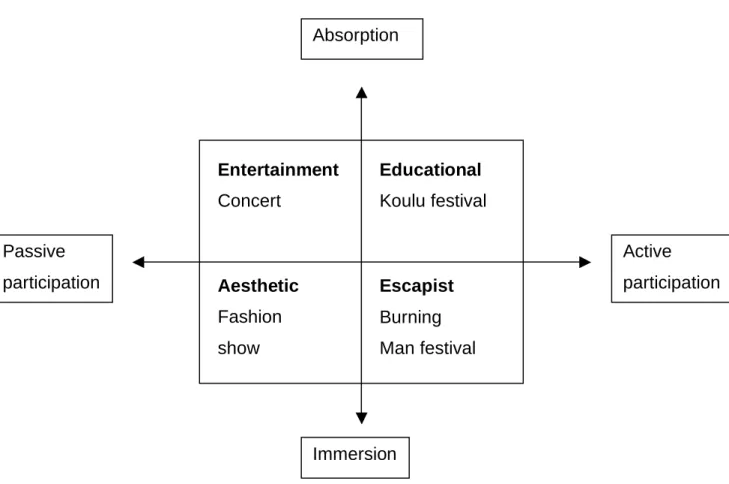
As the consumer experience defined previously is mainly based on sensing and feeling, Pine and Gilmore (1999) define four types of experiences based on one of the core elements characterizing experiences: interactions, i.e. the consumer interaction and participation level with the environment. Hence, adding behavioral aspect to the consumer experience. The Four Realms of Experience (see figure 2) are formed based on individual’s connection with the environment (y axis with absorption vs.
immersion) and participation in the experience (x axis with passive vs. active). In absorption the experience is brought to the consumer and he goes along with the experience whereas in immersion the visitor becomes physically part of the experience. Hence, the realms move from mere listening and watching to immersing oneself in the place itself. Consumer’s passive participation means being only mentally part of the experience and pursuing the observer role. On the contrary, the active participation refers to taking part in the experience physically and even (co)- producing the experience.
Absorption
Immersion Passive
participation
Active participation Entertainment
Concert
Educational Koulu festival
Escapist Burning Man festival Aesthetic
Fashion show
Figure 2 The Four Realms of Experience with Event Examples
Therefore, the four realms formed by the connection with the environment and participation in the experience are entertainment, educational, escapist, and esthetic.
The emotions triggered by the environment with consumer’s active or passive participation differ from educational to aesthetic. Customer experience can educate, entertain, and provide an opportunity to display some particular knowledge, values or behavior socially, or offer an escapist, visual or aesthetic encounter (Pine and Gilmore 1998, 1999; Holbrook 2000). The dimensions do not describe in detail the emotions provoked and triggered by the interactions with the environment but bundles them into themes based on the consumer participation in the experience.
In the entertainment category consumer absorbs the experience through his/her senses in a passive manner. The educational experience, on the other hand, requires consumer’s active participation and has to stimulate consumer mentally and physically (Pine and Gilmore 1999, p.35). The last two dimensions belong to
immersion: aesthetic with passive participation and escapist with active participation.
Marketer’s role is to provide these experiences (Pine and Gilmore 1998; Schmitt 1999; Prahalad and Ramaswamy 2004) in which customers can participate actively or passively and connect either by being absorbed or immersed. According to Pine and Gilmore (1999) the richest experience combines all the four types of experiences from entertainment to escapist. Hence, the ideal spot is in the middle of the figure.
To give examples of the four different experience types in events scene, four events are part of the figure. Although separating events into different categories often tend to be too black and white, these examples are only to give a better picture of the four realms of experience.
The Koulu (School) festival organized by the Finnish think tank Demos Helsinki was a festival where people were able to learn from each other by participating in lectures held by individuals interested in sharing their knowledge with others, i.e. learning from people-to-people. The Koulu festival catered as an educational experience as visitors could enhance their skills and knowledge by actively participating in different lectures – leave the event venue with new skills. Another type of event with consumer’s active participation is the Burning Man festival organized in Black Rock desert in Nevada. The Burning Man Festival offers escapism to visitors by giving visitors full freedom to express themselves under given theme yearly. It has formed into an anti-market event where visitors can escape the market (Kozinets 2002) as they create a temporary community. Fashion show is an event for presenting designer’s new season collection. They offer aesthetic experience with passive participation and immersion as the viewer is only sitting and viewing the collection presented at the catwalk and often enriched by audiovisual cues and strong imagery.
Concerts on the contrary provide entertainment where consumer absorbs the surrounding audiovisuals without participating in the creation of the experience itself.
However, as mentioned earlier, the ideal spot is in the middle of the figure 2.
Immersive experience combines all the four different dimensions: entertainment, educational, esthetic, and escapist.
2.1.3 The Experience Pyramid
The Experience Pyramid is a theoretical model created by LEO, Lapland Centre of Expertise for the Experience Industry. The pyramid is divided into two approaches:
customer experience levels and elements of the product. The model presents ideal experience where all the elements and experience levels are fulfilled. It can be used as a tool to analyze and design experiences (Tarssanen 2009). More importantly, however, it contains many consumer experience related elements under one model.
Figure 3 The Experience Pyramid (Source: Tarssanen 2009)
On the x-axis of the pyramid model there are six elements of experience that are considered prerequisites for an experience to occur, i.e. the building blocks of experience creation. Individuality refers to both how unique and extraordinary a product is (i.e. novelty) and how customizable it is to each individual’s specific needs and wants. Authenticity refers to credibility of the product and in the end is defined by the consumer solely. Story is closely related to authenticity. It is important to bind the various elements of the product into a coherent story to make the experience catching and attractive. A credible and authentic story gives the product social significance and content. Pine and Gilmore (1999, p.46-55) name it thematizing and
harmonizing. Multi-sensory perception means that it is possible to experience a product with as many of the senses as possible. All sensory stimuli should naturally be in mutual harmony, supporting the desired theme. If the various senses are not stimulated appropriately - there are too many sensory stimuli, or they are annoying - the overall impact will suffer. Contrast means how different the experience is from the customer's everyday life, from his point of view. He/she must be able to experience something new, exotic and out of the ordinary. Interaction translates to successful communication between the product and the ones who are experiencing it, between the customers, as well as between the service providers and the customer.
Experiencing something together with others increases the social acceptability of the product. In terms of individuality, personal interaction between the guide and the customer has a decisive role in how well the experience is conveyed to the customer.
(Tarssanen 2009, p.12-14)
On the y-axis of the pyramid model are described the customer experience levels starting from raising interest that can eventually lead through sensing, learning, and experiencing to change. The levels are based on the psychological view of human beings operating on four levels: physical, emotional, intellectual, and spiritual (LaSalle and Britton 2003) and shares similarities with Gentile and colleagues definition of experience requiring consumer involvement at rational, emotional, sensorial, physical, and spiritual level (2007). In the Pyramid Model motivational level has been added. According to Tarssanen (2009, p.15) in a good experience all levels are covered.
Motivational level refers to awakening attention and interest. The first level is about provoking mental images and differentiation mainly through marketing that should be personal, genuine, multi-sensory, and interactive conveying the image of out-of- ordinary. On physical level the product is experienced through senses. Using the physical senses, consumers realize where they are, what's happening and what they are doing. On rational level consumers process the sensory stimuli provided by the environment and act in accordance: learning, thinking, applying knowledge and forming opinions. On the intellectual level, individuals decide whether they are satisfied or not with the product while processing learning and skills. Emotional level is where the actual experience takes place (see also Hirschman and Holbrook 1982;
Poulsson and Kale 2004). However, it is difficult to predict and control individual’s emotional reactions. According to Tarssanen (2009) if all basic elements of the product have been well taken into account, and the physical and intellectual levels both function, it is quite probable that the customer will experience a positive emotional response. On mental level a positive and powerful emotional reaction to a unique experience may lead to an experience of personal change, bringing about fairly permanent modifications to the subject's physical being, state of mind or lifestyle.
(Tarssanen 2009, p.15-16; LaSalle and Britton 2003, p.9)
2.2 Studies on experiential context
The effect of environment on individuals has been studied in the field of architecture and interior design (Donovan and Rossiter 1982), also known as environmental psychology. Nonetheless, the role of social interaction and physical environment has been recognized in the field of experience design as well (e.g. Gupta and Vajic 2000).
As experience is an emotional response to stimuli the environmental context, situation or setting, is one of the factors influencing experiential consumption (e.g. Lofman 1991).
“An experience is a subjective episode that customers live through when they interact with a firm’s product or service offer. A firm can therefore offer experiential contexts that consumers each mobilize in order to immerse themselves and thus to (co)-produce their own experience.”
(Carù and Cova 2007)
According to Carù and Cova (2007), the experiential context needs to be simultaneously enclavized, secure and thematized (see also Pine and Gilmore 1999;
Tarssanen 2009). By enclavized they mean that the context needs to have specific boundaries letting consumers step out from their daily lives and routines and, thus, forget their worries and hardships as they enter this “separate world”. In addition, the experiential context must be secure and closely monitored making it easier for the consumer to forget the daily concerns and focus on the enjoyable experience.
Consumers prefer environments and activities that are controlled and minimize the
risks they take, i.e. they feel secure enough to let “others” take care of them and control of the situation. Last but not least, the context must be thematized (see also Pine and Gilmore 1999; Tarssanen 2009). To express and materialize the theme, or also called as story in the Pyramid Model, companies can use diverse sensorial and imaginary devices to overstimulate consumers and, thus, help them to concentrate and accelerate immersion. Therefore, in this subchapter the themed space as experiential context is discussed based on retail literature and space itself analyzed in more detail according to servicescape and atmospherics literature.
2.2.1 Themed spaces as experiential context
As Hirschman and Holbrook (1982) started the discussion on hedonic consumption and Schmitt describing consumers as rational and emotional animals (1999) marketer’s answer to consumers seeking enjoyment has been themed spaces that serve multisensory, fantasy, and emotive aspects of human needs and wants. Themed environments have become increasingly important places that cater for consumer’s need for leisure, community, and escapist relaxation (Wolf 1999, cf. Sherry et al.
2001). Also the rising popularity of hedonic consumption (Parvinen Markkinointi&Mainonta 2012) and the “society of spectacle” celebrating the unreal above the real (Sherry et al. 2001) keeps the interest for immersive spaces current.
Picture 1 Themed Environment Examples: Cirque du Soleil & Las Vegas Venetian
The line between real and imaginary has blurred (Baudrillard 1988) favoring images, illusions, and simulations. In addition, Ritzer argues that as simulated consumption spectacles are gaining more and more popularity consumption is taking new forms as
“infinitely more enchanted, spectacular, and effective selling machines” (2005, p.
207).
Themed environment can be defined as any constructed space, which conveys meaning to consumers through visuals (Gottdiener 1997). In more detail, it concerns spaces that use semiotics in the form of themes to reference a different time or place to the current time and place. Amusement parks are the most obvious example with Disneylands and Wonderlands but other venue types are also taking the advantage of themes in staging experiences. Examples are the traditional world expositions, shopping malls, Las Vegas casinos, festivals such as Burning Man and Tomorrowland, and many flagship and concept stores from NikeTown to American Girl. Also Cirque du Soleil is famous for its spectacular settings with themes created round their imaginative show stories. In sum, themes are applied to diverse settings to offer experiences for consumers as illustrated by the picture examples above.
As the fantasy elements in constructing contemporary retail environments also known as retail theaters have gained momentum Kozinets and colleagues (2002) created a framework that classifies, organizes, and analyzes the cultural associations behind the types of fantasy elements that may be used. Four types of retail themes are suggested by the servicescapes classification of marketplaces, and two dimensions define these types of retail themes (Kozinets et al. 2002). As represented by the horizontal axis in figure X, the first dimension presents how easily the retail theme can be adapted and managed ranging from “natural” to “cultural” or humanly designed and built. The second dimension portrays the tangible or material quality of the retail theme, represented by the vertical axis in figure X, and ranges from “physical” or tangible to
“ethereal,” nonphysical or ideational. The intersection of these two axes produces four types of themes that are originally created to present retail formats and to be used in themed flagship brand store planning and development.
Figure 4 Themes at retail framework (Source: Kozinets et al 2002)
First are landscape themes, which employ associations to, and images of, nature, Earth, animals, and the physical body. An example would be most of the yoga studios offering natural, relaxing environment to practice mind and body. Second are marketscape themes, which employ associations and images of different cultures, man-made places, and buildings emphasizing either local or global cultural themes.
An example would be Starbucks. Despite its American roots it localizes its servicescape to a certain extent as entering new markets with different culture, i.e.
Asia. Both landscape and marketscape themes depict built environments. Third are the cyberscape themes, which employ associations and images relating to information and communications technology, and often to virtual community emphasizing the current development between clicks and bricks as digital world is blurring with the physical one. Classic examples are videogames and e-commerce websites such as Hay Day by Supercell or the online retailer Zalando that focus on offering primarily online experience. Fourth are mindscape themes, which draw on abstract ideas and concepts, introspection and fantasy, and which are often spiritual or ritualistic in their inclination; they allow consumers to feel a sense of the extraordinary and to lose their sense of time and place in the all-involving state that Csikszentmihalyi (1997) describes as “flow”. As opposite to landscape and marketscape themes, both mindscape and cyberscape themes are nonphysical.
Several studies have examined experiences created through interactions in thematized spaces (Maclaran and Brown 2005; Kozinets 2002; Kozinets et al. 2004). These experience environments include varying venues from Las Vegas (Belk 2000) to brand flagship stores Nike Town (Penaloza 1998; Sherry 1998), western rodeo trade show (Penaloza 2000), and sports entertainment complex ESPN Zone (Sherry et al.
2001; Kozinets et al. 2004). Even street art in public places (Visconti et al. 2010) and clubbing environment (Goulding et al. 2010) have been analyzed from experiential viewpoint. These themed spaces in some studies are referred to as retail theaters as they offer staged venues for experiences in contrast to natural settings. Nonetheless, they all emphasize the performative, co-creative, hybrid, and multisensory essence of the experience.
Themed environments follow Pine and Gilmore’s idea of creating unforgettable experiences by having one theme and offering supportive cues (1998, 1999). A theme can be described as the main story that guides the design of the experiential context from visuals to décor. Often themed spaces in retailing are referred to as “spectacular retail environments” or “retail theatres” that combine entertainment and stimulation in a staged setting. Since “consumer fantasies, feelings, and fun” were recognized already in the eighties as important consumption category, themed environments offer
“commercial control of consumer fantasies” (Gottdiener 1997) by entertaining while promoting consumption. Belk (2000), Gottdiener (1997), Peñaloza (1999), and Sherry (1998) convey that consumers are directed through structured environments, where marketers clearly stage and manipulate consumer experiences.
Therefore, in themed spaces consumer behavior is described as playful (Kozinets et al. 2004). In themed environments playful consumption with “ludic autotely” occurs (Sherry et al. cf. edit. Carù and Cova 2007), meaning consumers play with the marketer’s rule, but only to a certain extent. Especially in the case of Las Vegas, as studied by Belk (2000), the playfulness of consumers is characterized by infantilization of the consumer. Consumers experience Las Vegas as a playspace resembling kids experiencing playgrounds as the venue offers easy escape from reality, allowing them to chase excess and test their limits. As Grayson (1999, cf.
Kozinets et al. 2004, p. 659) mentions on play and consumption: “The rule-bound nature of play offers consumers paradoxical opportunities to be seduced or be
subversive through rule following or rule breaking, playing along versus playing around.”
As mentioned earlier, interactions lie at the heart of experience (Holbrook and Hirschman 1982). Successful experience requires consumer’s active participation (e.g. Gupta and Vajic 2000, p. 39) and their emotional arousal (Holbrook and Hirschman 1982). Instead of being the passive recipient and “intervention” in the service system consumers should be allowed to participate and create their own use environment (Gupta and Vajic 2000). In accordance, what the previous studies on themed spaces and consumer experience share in common is consumers active role, being co-creators. Kozinets and colleagues (2004) argue in their study on ESPN Zone that consumers use the space as a stage on which to perform and co-create the spectacle. Moreover, they argue consumers and producers (marketer) as embedded
“interagency” as consumers produce producers’ products at the same time as much as producers consume consumers’ consumption. Considerable freedom is given to consumers who use it to “work within the rules of play, to break other rules, and to create new rules” (Kozinets et al. 2004, p.668). By breaking the rules and making new ones consumers create “metagames”. This view is theoretically consistent with the dialectical relationship between marketers and consumers in the Nike Town context described by both Sherry (1998) and Peñaloza (1999).
In addition, studies on the American Girl Place present similar findings; thematized spaces managed by retailers and service providers might be expected to dominate and constrain but instead they enable co-creation by consumers (Diamond et al. 2009;
Borghini et al. 2009). They are only hosting the community of visitors and balancing between rules and freedom in accordance with Carù and Cova (2007) discussing themed environments as enclavized and secure. Details are carefully planned and designed but leaving enough space for imagination and consumers own choreography.
Thus it’s about choreographing co-authorship opportunities as the playspace is set for interactions among the consumer, marketer and other players.
Overall, the previous studies on consumer experience in a themed space emphasize the sensory and experiential aspects of consumption. Themed environments cater for
hedonic consumption that immerses visitors into a multi-sensory setting that works also as a playspace for both consumers and marketers.
2.2.2 Space and its elements
Since experiences occur in an experiential context, space and its elements are further elaborated to gain understanding how experiential contexts can be designed and what are the concrete tools available (space elements). Two intertwined streams of research, “servicescapes” and “atmospherics”, help understand the effect of built environments on consumption behavior and in general how consumers experience space and what its elements are.
Drawing on research in marketing, environmental and cognitive psychology, and ergonomics Bitner laid the foundation for the study of the effect of built environments on consumer thought, emotions, and actions by launching the term servicescape to describe the consumer experience of physical space. Recognizing that people experience an environment holistically, he divided the physical setting with environmental stimuli into three dimensions: ambient conditions; spatial layout and functionality; and signs, symbols and artifacts. Ambient conditions comprise of sense provoking stimuli and what are often referred to as atmospherics. Space and function describe how the venue is organized and filled with equipment and furnishing, i.e.
interior design. Signs, symbol, and artifacts on the other hand communicate general meaning about the space in the form of graphic design for example by giving directions and rules of behavior (Rosenbaum and Massiah 2011). Overall the physical dimension represents the manageable and controllable elements of the space that can be designed and used as communicative tools and thus, contributing to the experience.
Based on the Stimulus-Organism-Response (S-O-R) theory in environmental psychology, Bitner developed a framework and an inventory of propositions for understanding the impact of the built environment on employees, customers, and their interactions. However, later on Rosenbaum and Massiah (2011) expanded the servicescape perspective to a more holistic view of the environment catering contemporary notion of experience and its context by including in addition to physical
dimension, also social, socially-symbolic and natural dimensions that affect consumers (see figure 5 above). Relevant ones for the aims of this study are physical dimension and social dimension and therefore depicted in more detail.
Figure 5 Expanded Servivescape Model by Rosenbaum and Massiah (2011)
The social dimension of space consists of all the interactions consumers have with other members of the society (Sullivan and Adcock 2002, cf. Bäckström and Johanson 2006) in this study meaning trade fair visitors and exhibitors. Consumers can affect one another either directly or indirectly (Bitner 1992). In addition to the people at the venue the social dimension includes social density and displayed emotions by others (Rosenbaum and Massiah 2011). Social density means how crowded the space is. Rosenbaum and Massiah note that consumers are attracted to a
high social density when the possibility of entering into enjoyable, lighthearted associations with others is part of their goal in the consumption setting. Displayed emotions by others can also provoke different reactions whether the experience is individual or group experience (Rosenbaum and Massiah 2011) by having a more influential role with group experiences. In the case of individual experience such as using an ATM the displayed emotions by others play non-existent part in contrast to dinner gathering.
Social belonging can also be seen as part of the social dimension since experience especially in the case of events as group experience require other “right” consumers at the same location, and at the same time (Mossberg 2003, p.143-144). Social interaction with other consumers and marketer enhance the sense of belonging and help to create a sense of being a group member (Gupta and Vajic 2000, p.39) what Turner (1974) describes as “Temporary sense of closeness” or ”communitas” and Ahola as “corporality” (2007). Ahola extends the mere concept of feeling being part of a temporary community and intermingling with other people to include moving around in the space and sensing the space as a whole adding physical characteristics to social dimension.
The term “atmospherics” on the other hand is credited to Kotler. In the 70’s Kotler (1973) introduced the concept atmosphere in marketing. In some cases he mentioned the place, or more specifically the atmosphere of the place, can be more influential than the product itself in the consumption situation. Kotler mainly referred to the aesthetics of the retail environment and the conscious designing of space to create approach-behavior in consumers - in retail context often meaning enhancing buyer probability. Similarly Hoffman and Turley (2002) define atmospherics as “both tangible elements (e.g. building, carpeting, fixtures, and point-of-purchase decorations) and intangible elements (colors, music, temperature, scents) that comprise service experiences”. Ismail et al. (2011) acknowledge that the emotions provoked and the subjective feelings the customer has due to the setting/the atmosphere effect is likely to contribute to the customer experience. A positive atmosphere can lead to approach behavior and a negative atmosphere to avoidance behavior (e.g. Foxall and Greenley 2000; Donovan and Rossiter 1982, cf. Ismail et al.
2011, p. 215).
Consumers apprehend atmospherics through senses (Kotler 1973): sight, sound, scent, and touch. Taste is not included, since Kotler argues atmosphere cannot be tasted.
However, Markkanen (2008) mentions that nowadays in modern retailing atmosphere can even be sensed through taste. In fact, both at the trade fairs and in the stores visitors can taste the atmosphere together with scent by walking through the bakery section in the grocery store or tasting new wines and delicacies at Wine, Food and Good Living Fair. Thus, depending from the context taste can prove to be essential ingredient in experiencing the space.
While atmospherics is commonly used to describe intangible elements of the (retail) environment, design is normally applied to signify more tangible elements present in the environment (Bäckström and Johanson 2006) that in the servicescape model represent the physical dimension with space and signs, symbols, and artifacts. The atmospherics are focusing more on the abstract, challenging to describe elements of the space. Design, on the other hand, refers to the visual/esthetic element of the space or as in the servicescape model the physical dimension. However, from mere
“frosting” of the space, design is expressed through the decoration and architecture and thus expressing the theme of the space.
In retail discussions the design element often relates to the store layout and display (Bäckström and Johanson 2006). Layout refers to the structure of the space and how it is designed to cater people flow. In stores the most typical layout types are grid, free flow and racetrack (Markkanen 2008). In the free flow layout the retail space is literally following free flow pattern whereas, in contrast, the grid layout uses long rows with straight angles. The racetrack is the department store layout that sets consumer on a loop round the space. The display describes how articles are presented in the space.
In sum, based on the previous research from servicescapes and atmospherics the space in this study comprise of: physical, social, and atmospherics dimension.
2.3 Theoretical framework build-up
Theoretical framework consists of both notions of the reality being studied and the ways in which one can study that reality (Alasuutari 1996). The general framework guiding this study is based on previous literature on consumer experience, themed spaces and space with its elements. The general framework used in this study gives a viewpoint and is applicable to a number of cases, whereas the object of study is a particular case, in this study Book Fairs in Frankfurt and Helsinki, whose details can only be given a local explanation (Alasuutari 1996).
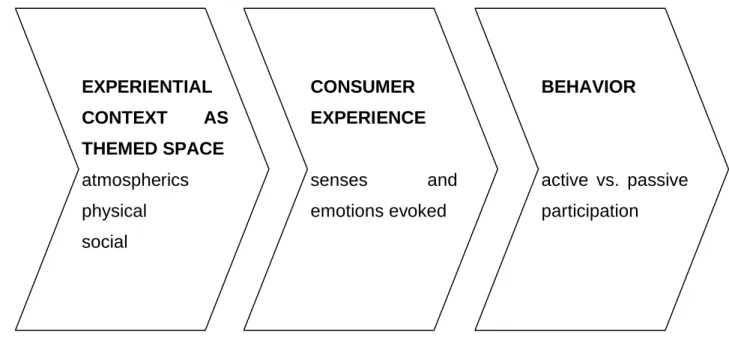
Figure 6 General Framework
In order to study the research problem - What is the experiential context at lifestyle trade fairs targeted to consumers and how it influences the consumer experience - general framework was formed (see figure 6) based on the previous literature. It follows the focus levels of the study: space, experience, and consumer. The general framework is built upon the stimulus-organism-response (S-O-R) thinking that responds to the notion of experience as interactive event requiring triggering of senses and emotions that eventually lead to behavior. Moreover, it answers to the research questions:
CONSUMER EXPERIENCE
senses and
emotions evoked
BEHAVIOR
active vs. passive participation EXPERIENTIAL
CONTEXT AS
THEMED SPACE atmospherics physical social
Q1: What are the contextual elements influencing the consumer experience at lifestyle trade fair?
(experiential context as themed space)
Q2: How are consumer’s senses and emotions evoked at lifestyle trade fair?
(consumer experience as sensations and feelings)
Q3: How does play characterize consumers behavior at lifestyle trade fair?
(consumer behavior as active versus passive participation in the experience)
The experiential context is studied as themed space with atmospherics, physical and social dimension. Experiences are triggered by stimulation. Therefore, how the themed space evokes sensations and feelings is studied. Lastly how it translates into visitors doing and being at the lifestyle trade fair is considered as in active versus passive participation.
3 Research methodology
In this chapter, the methodology for the empirical part of the study is presented. First, the research paradigm guiding the design of this thesis is presented and the characteristics of ethnography as a method and how it is applied in this study explained. Then, the context and main data sets of the study are described in more detail. To conclude, the research process is portrayed and the validity and reliability of the study discussed.
3.1 Research approach
In the design of this thesis phenomenological, i.e. humanistic, philosophy is applied.
Considering the subjective nature of experiences it was considered to fit the best the aims of this study to understand consumer experience at lifestyle trade fairs more in- depth as it “stresses the subjective aspects of human activity” (Collins and Hussey 2003, p.53) when describing a social phenomena, such as events. Therefore, in this study the reality (the research context) is subjective and the researcher interacts with the phenomena being studied. The researcher has values that can be seen as lenses through which interpretations are drawn in the research phase, and thus, can affect the formation of findings. To balance this, diverse set of research methods are used to obtain diverse view of the same event.
In sum, in this study the main features of phenomenological paradigm apply from producing rich, subjective data to using small samples. From the phenomenological methodologies “quick and dirty” version of ethnography suitable to the short time frame of trade fairs as case studies was applied and is further discussed in the following chapter.
3.2 Market-oriented ethnography
This research is qualitative in nature. The term qualitative refers to humanistic and interpretive research that aims to understand a lived experience, a phenomenon (Sayre 2001). Thus, it caters well the purpose of this study to understand consumer experience at lifestyle trade fairs. The usefulness of qualitative approach for the events area lies in its focus on the setting, the experience and the meaning attached to it (Holloway et al. 2010).
Ethnography is the oldest of the qualitative methods originating from the ancient travel stories of Greeks and Romans. Modern ethnography has its roots in anthropology and later on it diffused into sociology before becoming common in consumer research. The strength of ethnography has been traditionally in making possible to compare what people say and do (interviews vs. observations). As Arnould and Wallendorf (1994) state “ethnography gives priority to observation of behavior in action and relies on verbal reports in interviews for a perspective of action”.
In this study, market-oriented ethnography is applied. It refers to an ethnographic focus on the behavior of people constituting a market for a product or a service (Arnould and Wallendorf 1994). Therefore, the consumer trade fair experience is analyzed as part of the market place formed by the exhibitors and visitors in an exhibition centre. The market-oriented ethnography has three approaches: macro, micro and meso (Arnould and Price 2006). The meso level approach is applied in this study meaning the focus is on the cultural and social space, not on individual product usage. However, most importantly, Arnould and Price remind “all the approaches recognize that cultural context is not a sort of background factor or antecedent to individual behavior, but a public space in which the individual, his or her social relations, and meanings intersect in a dynamic process of co-constitution” (2006).
According to Arnould and Wallendorf (1994) four features guide ethnographers’
research practice:
1) Ethnography gives primacy to systematic data collection and recording of human action in natural settings.
2) Ethnographic research involves extended, experiential participation by the researcher in a specific cultural context, referred to as participant observation.
3) Ethnography produces interpretations of behaviors that the person studied and the intended audience find credible. People seldom make the systematic connections among their behaviors that are woven into ethnographies as the experience-distant, analytically based, and comparatively informed etic interpretations of the researcher.
4) Ethnography involves incorporating multiple sources of data.
Ethnography uses them to generate varying perspectives on the behaviors and context of interest.
In this study, these four features were used as guidelines. Trade fair visitors were studied in the exhibition environment (see context). Data sources varied from participant observation to interviews, field notes and photographs (see research material). However, considering the duration of fairs being strictly limited to five to four days imposed some difficulties for the full ethnographic immersion into the consumer context. Therefore, quick and dirty approach was applied in this study. In addition, when priority was given to the lived experience of participants the possibility of unexpected directions was acknowledged during fieldwork phase.
As Getz argued in 2008, it will become increasingly necessary to “custom design”
highly targeted event experiences, which must be based on greater knowledge of the event experience in all its dimensions. In this study, the market-oriented ethnography was used to create “greater knowledge” of consumer experience at lifestyle trade fairs.
3.3 Research context
At events, consumers are immersed in the moment and actively participating in the experience. This offers a different encounter with marketer than other marketing
channels (Pitta et al. 2006). Trade fairs are events with commercial purpose (Pitta et al. 2006) where information on new products and services is gathered under one roof.
The natural setting for studying consumer experience at lifestyle trade fairs in this case were chosen to be Book Fairs in Frankfurt and Helsinki. Due to the schedule of the study the research material had to be collected during the first months of fall 2012.
In addition, to have an international perspective for the study exhibitions both abroad and in Finland were chosen to attend. For consumers reading is a traditional hobby round the world and has been among the top activities on how to spend leisure time (Statistics Finland: Time use survey 2009). As the previous trade fair studies from consumer perspective covered rodeo, art, boat and travel fairs (Peñaloza 2001; Ahola 2007; Virkkula et al. 2008; Schlobohm 2010), for this study Book Fairs both in Frankfurt and Helsinki were chosen for research context.
Both Book Fairs are described in more detail in the following two sections.
3.3.1 Frankfurt Book Fair (Messe Frankfurt)
Frankfurt Book Fair is the world’s largest book fair organized by Messe Frankfurt each year in October. The fair has a long tradition dating back from Gutenberg’s printing
invention. Nowadays, it gathers professionals from book and media industry (publishers, booksellers, agents, teachers, film producers, etc.) but is also open for private visitors, the public, during the weekend. The fair comprises of over 7,000 international exhibitors and around 3,000 events in and outside the exhibition site ranging from readings, discussions and panels to performances. The Frankfurt Academy hosts professional training for trade visitors with conferences and seminars, including the StoryDrive conference that was attended, connecting publishers around the world. At the StoryDrive conference industry professionals from movie director and producer Stephen Daldry to Sir Richard Taylor from Weta Workshop gave new, and international, perspective to the whole industry behind the Book Fair context.
Each year the Frankfurt Book Fair has its guest of honor; in 2012 it was New Zealand showcasing its creative diversity in literature, art, dance and performance. In 2012 the spotlight in general was on the field of children’s and young adults media.
”What tomorrow’s world will look like depends to a large extent on the imagination of those who are just now learning to read.”
- Astrid Lindgren
About third of the events were geared towards professionals in 2011 (Fact & Figures, The Frankfurt Book Fair 2011 in numbers). The percentage of international exhibitors has been over 50% the last several years. In 2011 it was 58%. For years the Frankfurt Book Fair has attracted on average 280,000 visitors. Also the ratio between visitors and trade visitors has been about the same year after year. The percentage of visitors (not trade) was 38% in 2011. As the numbers show, the Frankfurt Book Fair lures more trade visitors by being the biggest market place for licensing in the world.
3.3.2 Helsinki Book Fair (Finnish Fair Corporation)
Helsinki Book Fair is also held annually in October but in a smaller scale compared to the Frankfurt Book Fair. The Helsinki Book
Fair comprises of over 1,000 performers of artists, politicians and scientists and almost 700 different program events. Exhibitors are around 300 and on their own stands they are organizing around 300 program events. The focus is on books, writers and readers. Guest of honor in 2012 was Hungary.
On the contrary to the Frankfurt Book Fair, in Helsinki other fairs were bundled together under the same roof. In the same space as the Helsinki Book Fair, and at the same time, was arranged Helsinki Music Fair, ArtForum and Wine, Food & Good Living exhibitions. In addition, the Helsinki Book Fair was open for public all the four days and not targeted so clearly to trade visitors as in Frankfurt. In 2012 the number of visitors was 71,500, whereas in 2011 it was 80,851.