Jasmiina Mäkelä
Creating an Authentic Sustainable Brand
Case Companies H&M Group and Marimekko
Metropolia University of Applied Sciences Bachelor of Business Administration International Business & Logistics Bachelor’s Thesis
30 April 2020
Author(s) Title
Jasmiina Mäkelä
Creating an Authentic Sustainable Brand Case Companies H&M Group and Marimekko Number of Pages
Date
51 pages & 13 appendices 30 April 2020
Degree Bachelor of Business Administration Degree Programme International Business & Logistics Specialisation option Marketing
Instructor(s) John Greene, Business Lecturer
This thesis studied the marketing components that make an authentic sustainable brand image by reviewing two case companies, H&M Group and Marimekko. The purpose of the thesis was to answer the main research question ‘how can a company generate an au- thentic sustainable brand image’ and the sub question ‘how has consumers’ purchasing behaviour changed to be more sustainable’.
The research was conducted applying secondary data collection and case study methods.
The literature review examined basic marketing theory connected to sustainability in mar- keting and as a part of brand image. The theory was then applied to the case companies in order to find out how they were implementing sustainability in their operations, communica- tions and brand image. In order to understand the relevance of the study, consumers’
changing views and attitudes towards sustainability and their purchasing behaviour were also reviewed.
The research indicated that authentically sustainable brands are driven by consumer trust, which stems from transparency, sustainable values and aligning brand promises with ac- tions. The study also reveals a change of consumer behaviour towards more sustainable in the recent years. The results of the case study revealed that although both of the case companies have sustainability in their core values, they still have to improve in order to be fully considered authentically sustainable brands. H&M Group was found a potential pio- neer to making the fast fashion –industry more sustainable, and Marimekko was discov- ered moving towards to having an authentic sustainable brand image.
Keywords Sustainability, changing consumer behaviour, sustainable brand image, H&M Group, Marimekko
Contents
List of figures
1 Introduction 1
2 Literature review 3
2.1 Marketing basics 3
2.2 Sustainability and marketing 7
2.3 Changing consumer attitudes and greenwashing 9
2.4 Authentic sustainable brand image 10
3 Research methodology 18
3.1 Data collection 18
3.2 Research objective and hypothesis 19
3.3 Validity and reliability 20
3.4 Limitations 20
4 Research results 21
4.1 Case companies’ marketing processes, strategies and value chains 21
4.1.1 Marketing strategies 24
4.1.2 Value chain analyses 26
4.1.3 Hypothesis 1 30
4.2 Case companies’ sustainability and marketing 30
4.3 Changing consumer attitudes and greenwashing affects on the
case companies 32
4.3.1 Hypothesis 2 37
4.4 Case companies and sustainable brand image 38
5 Conclusion 45
6 References 47
Appendices
Appendix 1. Growth of clothing sales and decline in clothing utilization Appendix 2. Case company introduction: H&M Group
Appendix 3. Case company introduction: Marimekko Appendix 4. Marimekko amfori BSCI supplier audits
Appendix 5. H&M Group & Marimekko shares of sustainable materials Appendix 6. Marimekko – Not about trendy fashion
Appendix 7. Sustainable attributes driving consumer purchasing decisions Appendix 8. Marimekko ranked in category D
Appendix 9. H&M product background –information online
Appendix 10. Marimekko’s participation in Fashion Revolution’s ‘Who makes my clothes?’ –movement
Appendix 11. Marimekko - Even stripes for equality Appendix 12. H&M and COS advertisements Appendix 13. Marimekko advertisements
List of figures
Figure 1. Maslow’s hierarchy of needs 4
Figure 2. Marketing strategy 5
Figure 3. Value chain –model 6
Figure 4. Customer-based brand equity –model 12
Figure 5. Dimensions of brand knowledge –model 13
Figure 6. H&M Group value chain 27
Figure 7. Marimekko value chain 28
Figure 8. The changes in the amounts of discussions about sustainability 35
& purchasing decisions influenced by sustainability among Finnish & Swedish consumers in 2013-2020
Figure 9. H&M customer-based brand equity 39
Figure 10. Marimekko customer-based brand equity 40
1 Introduction
Climate change and sustainable ideologies have been recognised as important factors in the business environment for decades, however it seems consumers and companies have only realised the opportunities and threats in the last few years. Studies (IBM Corporation 2020; Nielsen 2015) show changing consumer behaviour and attitude to- wards climate in the recent years, as especially the younger generation is demanding more sustainability and transparency throughout the value chain. Furthermore, con- sumers are becoming more aware of the environmental issues of different industries, such as the fashion and textile industry, which accounts for more greenhouse gas emissions than international flights and maritime combined (Ellen MacArthur Founda- tion 2017: 20). In addition, the industry is the second-largest water consumer and the dyeing of textiles contributes as the second-largest polluter of oceans, making the fash- ion industry all in all responsible for 20 percent of the pollution of oceans (McFall- Johnsen 2019; Ellen MacArthur Foundation, 2017: 21).
The Ellen MacArthur Foundation (2017: 18) study shows how clothes were bought al- most twice as much in 2015 compared to 2000, yet worn almost twice as less (see Ap- pendix 1). The study also claims that more than half of fast fashion items are disposed in less than a year from buying. Fast fashion refers to clothing that is produced with a quick turnaround of styles and multiple collections per year, usually for low prices (Ellen MacArthur Foundation 2017: 18). Niinimäki states that although it is not trendy to buy cheap fast fashion clothes anymore, people still do as it takes time for consumer be- haviour to change even as attitudes have changed (Hiilamo 2019). The demands for the industry have changed in the past decade, for example it was common for fashion industry to keep their supplier information a secret for a long time, and only after the catastrophe in Rana Plaza in 2013 many fashion companies were pressured into pub- lishing where their textiles are manufactured and produced (Paton & Maheshwari 2019). According to Paton and Maheshwari, the accident generated a lot of attention and had a big impact on the changing consumer opinions about fast fashion compa- nies, which are known for producing most of their clothes in low cost countries.
The thesis will look into two case examples, the Swedish retail company Hennes &
Mauritz (H&M) Group and the Finnish brand Marimekko (see Appendix 2 & 3 for com- pany introductions). The case companies are both dedicated to sustainable values and
have released sustainability strategies and reports that promise changes in their pro- duction, innovations for new sustainable materials and transparency throughout their value chains (H&M Group 2020e; Marimekko 2019a). H&M Group is the second- largest retail company in the world after Inditex, and produces about three billion items annually (Biondi 2018). H&M Group is a fast fashion company as it offers multiple col- lections a year of the most recent trends for cheap prices, however it is attempting to be perceived as the pioneer of change in the fast fashion industry towards sustainable operations (Biondi 2018; Samaha 2018). The company has promised to use only sus- tainably sourced cotton by 2020, only sustainably sourced or recycled materials by 2030 and to be 100 percent climate positive by 2040 (Samaha 2018). Marimekko, ac- cording to the brand, is seen as a quality brand that does not follow trends but stays true to its own style and patterns (Marimekko 2020c). Making sustainable design has always been in the core of the company, however it has also made strategic changes to become more cost-effective for example by moving its operations from Finland to Asia and other parts of Europe (Laitinen 2013). Furthermore, Marimekko’s new strate- gy has included more international expansion and commercialising the brand (Ala- huhta-Kasko 2019).
Before further evaluating the case companies in the research results –section, the the- sis will cover the theory behind the results in the following literature review. The litera- ture review begins from the basics of marketing and presents the foundation of the the- ory that will be developed into sustainability in marketing and as a part of a brand im- age. The thesis will then move forward to the research methods, purpose and reliability of the thesis in the research methodology –chapter. Later, the theory will be imple- mented in the case study companies in order to see how they are incorporating sus- tainability in their operations, communications and ultimately in their brand image. The objective of the research is to answer the main thesis question ‘how can a company generate an authentic sustainable brand image’ and the sub thesis question ‘how has consumers’ purchasing behaviour changed to be more sustainable’.
2 Literature review
The literature review will cover the marketing theory before reviewing the case exam- ples H&M Group and Marimekko and how authentic and sustainable their brand imag- es are in the research results –section. Sustainability can be defined with the two fol- lowing quotes:
Sustainability has been defined as economic development that meets the needs of the present generation without compromising the ability of future generations to meet their own needs (Epstein & Buhovac 2014: 23).
— to maintain or prolong both environmental and human health and is simply good management. It means the movement towards the use of renew- able rather than finite raw materials, minimization and eventual elimination of pol- luting effluents and toxic or hazardous wastes. It places a moral obligation on firms involved with the exploitation of natural resources to investigate renewable and sustainable alternatives (Charter, Peattie, Ottman & Polonsky 2002: 10).
In order to research the sustainability of a brand and how an authentic sustainable brand can be generated, one must first look into the aspects of marketing basics that give a base for the thesis. The following sections will cover how sustainability became important to consumers and an important part of branding, starting from introducing the marketing process, strategy and value chain analysis, and moving on to the more spe- cific factors of sustainability as a part of a brand image.
2.1 Marketing basics
Primarily, one needs to define marketing. In their book on marketing principles, Philip Kotler, Gary Armstrong, Lloyd C. Harris and Nigel Piercy (2013: 5) define marketing as:
The process by which companies create value for customers and build strong customer relationships to capture value from customers in return.
The primary aspect in marketing is to create value to customers as stated above. The needs and wants of the consumer determine whether they are motivated in buying the goods or services the company is providing. Consumer motivation can be observed
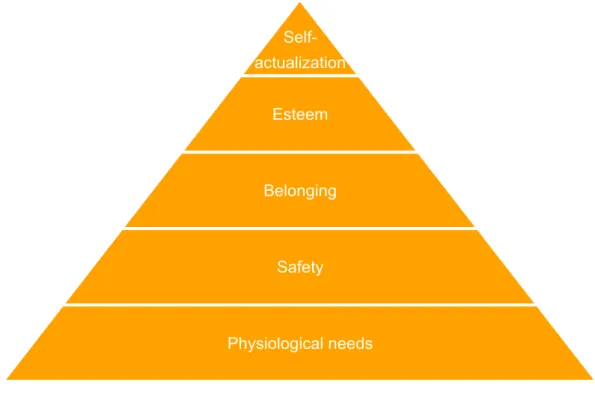
through Maslow’s hierarchy of needs, which is presented in Figure 1 below (Martin &
Schouten 2012: 61-63). According to the hierarchy, people primarily need to secure their basic survival or physiological needs, such as water and nutrition, followed by the need for safety, which can include financial safety and safety of the living environment.
According to their book on sustainable marketing, Diane Martin and John Schouten (2012: 61) claim that the primary needs can also include the need for sustaining the environment and demanding organic substances. Next is the need for belonging, which can be seen as belonging to a social group but also to society as a whole and sharing the responsibility all humans have for the environment. Martin and Schouten (2012: 62) suggest that the need for esteem and self-value can come from the choices and status symbols such as driving a hybrid car. Finally, self-actualization refers to personal growth and becoming to one’s potentiality, and can also be realised when the consum- er’s deepest values align with their actions (Martin & Schouten 2012: 62).
Figure 1. Maslow’s hierarchy of needs (Martin & Schouten 2012: 61-63)
Figure 2 below presents an overview of the marketing strategy as presented by Kotler et al. (2013: 51). They explain that marketing strategy begins from analysing the envi- ronment in which the company operates, involving the customers, competition, publics, suppliers and marketing intermediaries. Customer value and relationships are in the middle of the diagram, as in order to create sustainable competitive advantage the
Self- actualization
Esteem
Belonging
Safety
Physiological needs
company must create value to its customers as well as gain profit. The ways in which the company can create an advantage are differentiation, positioning, segmentation and targeting. According to Kotler et al. (2013: 50), companies need to understand the needs and wants of its consumers in order to choose which value proposition it prom- ises to deliver to its customers. The company differentiates itself from its competitors, positions itself amongst the others, divides its customers into segment groups depend- ing on their needs, wants and characteristics, and targets each or some of the seg- ments. Kotler et al. (2013: 59) claim that there are various aspects for a company to consider when making these decisions, as companies need to make profit in order to succeed and please their customers in order to gain profit.
Figure 2. Marketing strategy (Kotler et al. 2013: 51)
After setting the marketing strategy, the company determines its marketing mix. The marketing mix is presented in Figure 2 above, and consists of the product or service the company is offering, its pricing strategy, the placement and availability of the prod- uct as well as promotion of the value proposition. Managing relationships with custom- ers happens throughout the marketing process, and after establishing the marketing
mix the goal is to have established a profitable relationship that leads to bringing profit to the company and creating long lasting relationships with the consumer (Kotler et al.
2013: 53). In order to make the marketing mix more sustainable, numerous improve- ments must be made.
Martin Charter, Ken Peattie, Jacqueline Ottman and Michael J. Polonsky (2002: 20-26) emphasize in their booklet on marketing and sustainability that when a company de- cides to change its strategy towards a more environmental and social one, it must take all the operations in the value chain into consideration. Thus, all of the aspects of the marketing mix must be reconsidered and valued. This means a lot of changes and in- novations, which affect the entire company beyond the marketing department. They suggest that improvements in the product include for example using locally sourced, renewable raw materials, saving energy in production and trying to reduce packaging (Charter et al. 2002: 21-22). The improvements on the production may be expensive and time consuming, however it is crucial for the operations to be sustainable in order to have a sustainable product. According to Charter et al. (2002: 23), the price of a sus- tainable product is debatable, as on one hand, the companies do not want to increase their prices too much as it might affect on how many consumers are willing to buy a sustainable product instead of a regular one. On the other hand, the cost of making a sustainable product can be more expensive and if the company is compensating its environmental footprint, the compensation may also be included in the product’s price (Charter et al. 2002: 23).
Figure 3. Value chain –model (Porter 1990: 41) Inbound
logistics Operations Outbound
logistics Marketing
& sales Service
Firm infrastructure Technology development
Human resources Procurement
Besides the product and price, the place and promotion have an effect on the sustain- ability of the company (Charter et al. 2002: 25-26). The place refers to the logistics, distribution and recycling. It focuses on the place of the manufacturing and how close it is to the suppliers and retailers, as well as on the transportation and the efficiency and emissions. In addition, the company needs to consider the impact of its suppliers, re- tailers and reverse logistics. The latter refers to reviewing the design, process and sys- tems in order to be able to better reprocess, re-manufacture and redesign. Michael Porter’s value chain presented above in Figure 3 shows the primary operations of a company: inbound and outbound logistics, operations, marketing and sales and ser- vice, as well as the secondary operations that are the infrastructure of the firm, its technology, human resources and procurement (Porter 1990: 41). Kotler et al. (2013:
48) claim that “[a] company’s value chain is only as strong as its weakest link”. Thus, they explain that in order for the company to be successful in bringing value to its cus- tomers, each department must perform well. The final element of the marketing mix, promotion, refers to the way and medium on which the company communicates with its consumers and other stakeholders (Charter et al. 2002: 26). Charter et al. emphasise the need for accuracy, consistency and research to back up the claims. In order to gain an authentic, trustworthy sustainable image, they must communicate and operate in a sustainable way throughout the value chain.
2.2 Sustainability and marketing
Charter et al. (2002: 12) claim that ecological marketing was created in the 1970s, when people became more concerned about environmental aspects in industries such as oil, cars and chemicals. Ecological marketing was especially focused on products and production that were either causing or improving environmental problems. In the late 1980s the concern extended to household items, cosmetics, food and tourism.
Later, in the end of 1990s, Corporate Social Responsibility (CSR) and the effects of globalisation were on the focus (Charter et al. 2002: 14). Andrew Revkin (2018) claims in his article on National Geography that although some people have been aware of global warming and its effects on the world since the early 1900 and already before that, it only became a global knowledge at the end of the century. According to Revkin, climate change has been on the news for a long time, however it only started raising more attention in 1988 when the US was suffering from many climate disasters and the
Intergovernmental Panel on Climate Change was founded. Over the past 30 years, recognised scientists have issued statements and warnings, however it seems that people have only really understood the reality of the threat a few years ago (Revkin, 2018). This has led to changes in the macro and micro environments in which compa- nies operate.
According to Martin and Schouten (2012: 43), the different marketing environments have a great effect on companies’ marketing strategies. They present different busi- ness environments that influence the sustainable marketing strategy: the social- cultural, economic, technology, political-legal, natural, and competitor environments.
One can look at these environments from the micro and macro environmental point of view. The macro environment examines society as a whole, while the micro environ- ment refers to the surrounding situation. The macro environment factors are the social, cultural, economic, technological, political, legal and natural, or environmental, factors as they relate to the bigger picture (Martin & Schouten 2012: 43-52; Kotler et al. 2013:
78-96). The micro environmental aspects are the competitors, suppliers, consumers and other stakeholders of the company (Kotler et al. 2013: 74-77).
Sustainability can be seen as a part of all the different factors stated above, as it has become as much a political concern as a technological one. Martin and Schouten (2012: 43) claim that as people are becoming more and more aware and demanding when it comes to environmental and social requirements, the macro level of the social- cultural environment needs to change accordingly. They state that education and me- dia have had a great influence on the growing attention towards sustainability (Martin &
Schouten 2012: 44-45). The economic situation of the country in which the company operates has an effect on companies and on the level they can invest in sustainability and research and development. Technological innovations are required in order to make more sustainable products and services, although sometimes technology is also the enabler of unsustainable actions. The political-legal environment encompasses the laws, regulations and government actions towards sustainability. The natural environ- ment refers to the core of sustainability, the Earth’s ecosystem and how climate change is affecting it (Martin & Schouten 2012: 51-52).
The micro level factors show the aspects that the company must be aware of in its own market, such as consumers, whose needs and wants are reflected on the brand value, and competition, which needs to be examined to know what they are offering, hence
how to differentiate and what to learn from them (Kotler et al. 2013: 76-77). The com- petitor environment refers to evaluating and examining the other companies that are targeting the same market (Martin & Schouten 2012: 47). In regards to sustainability, competition might create more ecological and social benefits since when one company decides to become more sustainable, its competitors might follow (Martin & Schouten 2012: 47). The macro and micro environmental factors are important to the authentic sustainable brand since all of these have an impact on what the consumers are expect- ing and what they consider to be sustainable.
2.3 Changing consumer attitudes and greenwashing
Sustainable brands are no longer a niche market, as was described a decade ago by Timothy M. Devinney, Pat Auger and Giana M. Eckhardt in their book “The Myth of the Ethical Consumer” (2010: 3). They discuss how ethical and sustainable products are still rare and sustainable product lines are just one line of the brands’ multiple other lines, regardless of the hype. Now, it could be argued that the hype has only grown, as have the amount of green product options in the market. However, their take on con- sumers’ purchasing behaviour remains current. They claim that the ethical consumer is a myth, as it is not only an oxymoron, since generally consuming cannot be considered ethical, but also a simplification of human behaviour (Devinney et al. 2010: 4-6).
Many consumers may express the want to make sustainable purchasing decisions and bring value to it, however that is only one part of the many different aspects that lead to purchasing action (Devinney et al. 2010: 39-40). Consumers might choose products due to their ecological ingredients or ethical labour, however they might also do so be- cause of public pressure. Devinney et al. (2010: 52, 89) emphasise the importance of understanding these external influences in the purchasing decision. Values, beliefs, attitudes and intentions are all influenced and moderated by external factors (Devinney et al. 2010: 48-52). They also state how people generally think that sustainability and human rights are important but still they might not act on them, as they do not want to give up gained benefits or consider their actions significant enough to matter in the bigger picture (Devinney et al. 2010: 163-165).
Eckhardt, Devinney and Belk (2006) claim in their documentary that companies’ CSR operations can be very loosely put together, and can entail many different aspects from
corporation philanthropy to human rights. They also state that CSR is often the man- ager’s decision to make the company look good in order to be rewarded by consumer action of buying and supporting the brand. Eckhardt et al. (2006) are interested in whether consumers also only want to state to be ethical and sustainable in order to look good and gain respect from others. They argue that although consumers care about the ecological and ethical aspects, they still continue to act otherwise and often choose low price over their values (Eckhardt et al. 2006). Nevertheless, recent studies (Nielsen 2015; IBM Corporation 2020; Sustainable Brand (SB) Index AB 2020a; 2020b) show that consumer behaviour has changed in the past decade, as consumers are demanding more sustainable solutions and are willing to pay more for sustainable products.
The more aware consumers are about their buying decisions, the more companies also take advantage of that. Greenwashing can be “— any marketing or brand claim around environmental or social issues that is either false, misleading or exaggerated,” as ex- plained by Guy Champniss and Fernando Rodés Vilà in their book on socially valued brands (2011: 49). Furthermore, Campher (2014: 45) argues that while greenwashing can occur in the communication and positioning of the brand, companies also often highlight the sustainable source or creation of the product while ignore the negative impact the product may have. Charter et al. (2002: 20) also point out the growing me- dia attention that the company is facing when attempting to become more sustainable.
Companies need to have a completely trustworthy image through their own communi- cation and media in order to avoid greenwashing claims (Charter et al. 2002: 26).
2.4 Authentic sustainable brand image
Consumers have more expectations and demands towards brands, which in return have to bring transparency to another level and make a commitment to stand behind their actions according to a report by World Economic Forum (2013). The report sug- gests that sustainability should be in the core of the brand strategy. It also stresses the success of integrating sustainability in all the marketing tools and everything the com- pany does. According to the book “Strategic Brand Management” (Keller, Apéria &
Georgson 2008: 39), a brand can be defined as a name, symbol or design that identi- fies a product or service and differentiates it from its competitors, however it is often referred to as the awareness, reputation and significance of the brand in the market-
place. Martin and Schouten (2012: 140) explain that a brand is the outcome of commu- nication, both of the company and its stakeholders, such as consumers. It consists of the trademarks of a product or a company, however unlike the trademarks, a brand cannot be controlled. Thus, although a company can decide what it communicates of its brand, it cannot completely control what the other stakeholders communicate and think about it (Martin & Schouten 2012: 140). They state that for a brand to be seen sustainable, it must act in an ecologically enduring way and align with its promises.
Sustainable branding implicates that the brand is associated with a truly sustainable image and strengthened by integrity, as a truly sustainable brand cannot be built on mistrust (Martin & Schouten 2012: 141). Brands have different attributes that will be discussed later in the chapter, and afterwards move on to brand promise and value proposition that are crucial in order for brands to be seen authentic and trustworthy. In addition, they need to have positive brand equity as will be discussed next.
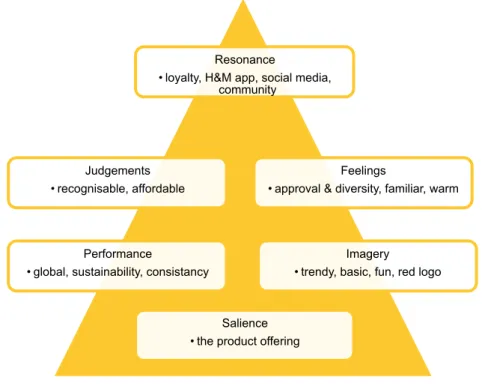
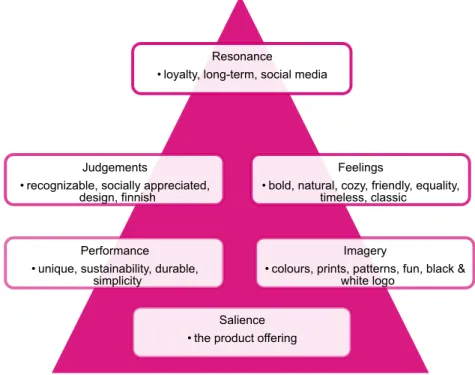
Brand equity explains how well the brand is performing and can be used to evaluate whether the marketing of the brand is successful (Keller et al. 2008: 43). Customer- based brand equity (CBBE) refers to the customers as the most important part of brand equity, since the priority is for the brand to be associated with the desired feeling, im- age and opinions among the consumers in order to gain a positive customer-based brand equity and thus have good recognition, loyal customers and favourable reactions towards the product (Keller et al. 2008: 43). Kevin Lane Keller’s CBBE –model is pre- sented in Figure 4 below and includes first creating an appropriate brand identity and awareness by establishing salience with the customers. After the customer is familiar with what the brand is offering, it can build brand meaning by creating brand associa- tions about the performance of the brand, such as durability, as well as imagery, for example the values, related to the brand. The brand then responses to judgements and feelings about the brand, and finally forges a relationship with the customers. As a brand’s strength is dependant of its consumers’ feelings, opinions and actions, reso- nance is a crucial building block to achieve consumer loyalty. The aim of the model is to create a close relationship with the consumers. (Keller et al. 2008: 43-45)
Figure 4. Customer-based brand equity –model (Keller 2008: 43)
According to Keller et al. (2008: 47), brand knowledge is the key when building brand equity, and can be achieved with brand awareness and a memorable brand image as shown in Figure 5 below. Thus, brands need to have strong brand recall and recogni- tion in order to build brand awareness, and create a strong brand image that is associ- ated with favourability, strength and uniqueness in the consumers’ minds. The types of associations are attributes, which can be product related or non-product related: pack- aging, user imagery and usage imagery; benefits, which are functional, experimental and symbolic; as well as attitudes about the brand. Keller et al. (2008: 47) propose that brand associations are knowledge of a brand that are stored as memory nodes, which interconnected with other nodes form a network of associations that represent the con- sumer’s idea of the brand: the brand image. As all marketing efforts are driven by the consumers and what the marketers expect the customers need, want and value, it is essential to have a brand image that the consumers link with strong associations that are favourable and unique to the brand (Keller et al. 2008: 47).
Resonance
Judgements | Feelings
Performance | Imagery
Salience
Figure 5. Dimensions of brand knowledge –model (Keller 1993: 7)
In his book “Creating a Sustainable Brand” Henk Campher (2014: 37) states that a sus- tainable brand cannot exist without a sustainable product and vice versa. Thus, as stated previously (see page 6), in order for a brand to be seen authentically sustaina- ble, the promise must align through the value chain of the product. In addition, the val- ue that the product creates and the impact in the longer term should also be taken into consideration (Campher 2014: 47). Campher suggests that the sustainable product- related attributes can come from sustainable operations and sustainable outcomes, and the non-product related sustainability comes from embedding sustainable values into the brand and the impact the brand has in the marketplace. The brand impact re- fers to the outcome that branding has on the market (Campher 2014: 47-48). He states that brands need to have a connection through their messaging – how the story and brand attributes reflect the values they want to share with their consumers, and which medium they will choose.
A brand impact can be disruptive, engaging or incremental (Campher 2014: 49-50).
Disruptive, strong messaging and unusual mediums are used to break the norms to gain the support of their target market, while engaging messages and mediums are more focusing on longer term engagement between the brand and the customer. The impact the brand is aiming at can be either or both disruptive and engaging, or they can
Brand knowledge
Brand awareness
Brand recall
Brand recognition
Brand image
Types of brand associations
Attributes
Non-product related
Price
Packaging
User imagery
Usage imagery Product related
Benefits
Functional
Experimental
Symbolic Attitudes
Favourability of brand associations
Strength of brand associations Uniqueness of
brand associations
choose an incremental and slow approach to changes (Campher 2014: 51). As nowa- days information and advertisements are everywhere and people might be too over- whelmed to pay attention to it all, Campher (2014: 52) argues that brands may need to be more disruptive and different in order to have their message heard and seen. He also emphasises that once a sustainable brand has created an impact that communi- cates their sustainability to their consumers, the brand needs to be associated with sustainability in order for the impact to last. Sustainability can be associated in various ways and different companies have different sustainability agendas (Campher 2014:
56).
Regardless of what the brand wants to be associated with, it needs to be strong in or- der to be taken seriously (Keller 2000). Strong brand equity stems from brand attributes that match the customers’ values, thus leading to strong customer loyalty and profits. In his Harvard Business Review -article, Kevin Lane Keller (2000) presents ten brand attributes that the strongest brands at the time of publishing have in common. These strong brands deliver the customers an overall attractive brand, are relevant, have a proper pricing strategy and brand position, are consistent, have a sensible brand port- folio, utilise marketing activities to build equity, have managers that understand the importance of their brand image, support the brand in the long run and monitor sources of brand equity (Keller 2000).
Keller (2000) explains that a strong brand is attractive from all aspects, tangible and intangible, meaning the brand image, attributes, service and others are all delivering what the customers want and need, even if they cannot put it in words. He states that brands need to be relevant and stay on the lead without losing its core strengths, meaning that the brand provides the consumer a quality product or service, takes into account the user imagery, usage imagery, personality and feeling of the brand and its relationship with its customers, while improving by following the changing trends, atti- tudes and recommendations. Keller (2000) states that brands are judged and appreci- ated as per the whole company and its role in and responsibilities towards society.
Thus, brands must respond to the wishes of the target consumer by offering the per- sonality and feelings that the consumer wants from the product, and build a relationship with the consumer so that they know they can trust the brand in keeping its promises (Keller, 2000). Furthermore, Keller (2000) states that a strong brand’s pricing strategy reflects the consumers’ perception of the value. He suggests that brands should not alter the product in order to be able to charge less if it may harm the product’s brand
building activities. Charter et al. (2002: 23) also pointed out the importance to carefully evaluate a pricing strategy for sustainable goods (see page 6). A brand position also affects the pricing strategy. Brands need to be similar and different to others simulta- neously, and need to find their own position in the middle of it (Keller 2000). He also claims that a strong brand upholds its position by creating points of parity as well as points of difference while also remaining consistent and balanced.
Companies often have multiple different brands, which are referred to as brand portfo- lio (Keller 2000). A brand portfolio consists of diverse brands that all have their own brand image but also contribute to the same company. According to Keller (2000), a brand hierarchy must be evaluated so that each brand has its own place in the portfo- lio. He also states that the brands cannot overlap each other and thus they should be positioned clearly to serve different targets as well as have a different, clearly focused brand images (Keller, 2000). Campher (2014: 31) suggests that sustainability is often introduced into a brand when an existing company or a new company creates a new brand.
Furthermore, Keller (2000) states that strong brands take advantage of diverse market- ing and branding elements, which bring different inputs to how brands can gain knowledge and build brand equity. Keller (2000) proposes that the company can make use of pull functions such as traditional advertising to create demand and push func- tions such as promotion. Managers’ appreciation of the brand image is a crucial aspect of building a strong brand (Keller 2000). As discussed earlier (see page 11), brand im- age and promises need to be taken into account in all of the activities of the company.
Thus, managers of all activities within the company must understand and act according to the customers’ expectations.
The two final points Keller (2000) discusses are supporting and monitoring sources of brand equity. Brands are vulnerable and need attention, which means they need to be advertised and given enough support to sustain the brand position, as all brands need to concentrate enough money, resources and effort into marketing. In addition, brands are audited, evaluated and monitored. A brand audit refers to an evaluation of the health of the brand and includes investigation of how it has been marketed, what the brand does and how the consumers have reacted and see the brand. These audits are crucial for managers to find out what perceptions the consumers have on the brand as that reveals the brand’s true image in the eyes of the consumer. Truly knowing and
understanding the brand can prevent the brand from incoherent communications and help the company to know when and how to improve. (Keller 2000)
A brand is considered green when the brand is associated with being environmentally committed and linked with positive feelings, attitudes and practises towards the envi- ronment (Ng, Butt, Khong & Ong 2014 cited in Ha 2020: 2386). Ng et al. also claim that as the brand is associated with being green, it can gain a green brand image. However, Esch, Langner, Schmitt and Geus (2006 cited in Ha 2020: 2387) claim that brands also need to build a brand relationship in order to build green brand equity. According to Esch et al., brand relationship stems from trust and satisfaction towards the brand. Ha (2020: 2388) proposes in his investigation on green brand equity that brand image, brand relationship, brand trust and brand satisfaction are positively interrelated. Judg- ing by the research, a green brand image and trust positively affect green brand equity.
The study (Ha 2020: 2391) implies that satisfaction does not imply which green brand the consumers choose, as green trust is the main motivator. Thus, brands can build a strong green brand, which will add value, increase trust and satisfaction among cus- tomers, when trust is the emphasis. Without actions to prove the environmental prom- ises and communication, the customers will not feel that the brand’s promises are sin- cere and reliable. (Ha 2020: 2391)
Jacquelyn Ottman (2011, ch. 6) states in her book “The New Rules of Green Market- ing” that communicating a brand’s sustainability is a promise that the brand makes.
Thus, brands’ attempt to persuade and assure the customers of the qualities and ad- vantages the product or service offers. Champniss and Rodés Vilà (2011: 125) argue that strong brands are as strong as the trust in the promises they have. In their book about identity-based brand management, Christoph Burmann, Nicola-Maria Riley, Tilo Halaszovich and Michael Schade (2017: 109) suggest that a brand promise entails all the benefits to purchasing the product for the target group in a few sentences. They state that when considering the promise, the brand must take the whole identity of the brand and the needs of its target consumers into account, and ensure brand differentia- tion by depending on the brand audits and experiences of the brand and its rivalries.
According to Burmann et al. (2017: 109) “[a] brand promise must be understandable, relevant to buying behaviour, credible and superior to competitor brands in order to effect a brand purchase.” These requirements stem from the brand’s identity, benefits, performance as well as its origin and competencies. Burmann et al. also state that the brand promise needs to be incorporated into the marketing mix elements.
Ottman (2011, ch. 6) emphasises that brand promises must imply the benefit that the sustainable product has for the consumer, not only for the environment. Although con- sumers want to support the environment when buying sustainable products, the other aspects of the product, such as quality, looks and price, are equally or more important.
Also Campher (2014: 24) claims that a brand cannot survive if the only purpose of it is to create a positive impact for the environment, but sustainability should be embedded to the brand promise. In addition, Ottman (2011, ch. 6) argues that consumers should be educated on how the purchase of sustainable goods benefits them, society and the environment. Once the consumers appreciate the difference they can make with their purchasing decisions, they feel empowered and good about themselves as well as the brand (Ottman 2011, ch. 6).
As discussed, trust is the most important aspect towards an authentically sustainable brand image. Ottman (2011, ch. 7) claims that in order to gain consumers’ trust, brands need to be true about its failures and issues that it still needs to improve, be transpar- ent and provide sufficient information to its consumers and not mislead the consumers in any way. In addition, she states that brands need to include sustainability throughout their value chain and consider the long-term impact of their products (Ottman 2011, ch.
7). Champniss and Rodés Vilà (2011: 134) state that:
Brands have to be trusted: if they’re not, then the brand stands for nothing. – considering trust is central to, and a product of, both what a brand stands for and the creation of social capital, it becomes pretty clear that brands are essentially in the business of creating social capital, with the virtuous relationship between capital and trust manifesting itself as brand equity, in measures such as advoca- cy and loyalty.
Thus, one can conclude that in order to have an authentic brand image, brands must gain consumers’ trust, and the consumers need to trust the brand and the company before they can trust their sustainable promises. Companies need to have an image that the customers want to endorse, and values that they share to achieve the advoca- cy and loyalty from them. In order to gain that image companies need to act in a way that promotes the messages and communication. Achieving an authentic sustainable image is a result of various aspects that have been covered in this literature review.
The following section will explain the research methodology used in the thesis.
3 Research methodology
After reviewing the basics of marketing, the connection between marketing and sus- tainability, consumer behaviour, greenwashing and sustainable brand image, the thesis will continue toward how the research is conducted and how the research questions will be analysed. Research is deciding on a problem to study, forming a hypothesis on it, collecting the data, analysing it and reaching a conclusion (Kothari 2004: 1). Re- search can be exploratory, descriptive or causal. Exploratory research refers to an in- vestigation of a problem in order to learn more on it without necessarily reaching a conclusive result, while descriptive research is more focused on finding out, describing and analysing the characteristics of a certain issue. Causal research aims at finding out the cause and effect and the relationship between them, and can also be called hy- pothesis-testing research (Kothari 2004: 2). The methodology chapter will consist of the research method used in the thesis and why the specific method and problem has been selected, as well as the objective, validity and reliability of the research.
3.1 Data collection
The thesis utilises the exploratory research method and a survey of concerning litera- ture, meaning the research is based on secondary data. As opposed to primary data, which the researcher would collect themselves for example by conducting an interview, secondary data means existing data that someone else has already collected and ana- lysed (Kothari 2004: 95). The research focuses on existing literature, which is analysed and applied to the case companies H&M Group and Marimekko. The theory is based on books, articles and existing research. In addition to surveying the concerning litera- ture, a case study is conducted. A case study refers to qualitative analysis and investi- gation of certain units and the inter-relationship between those (Kothari 2004: 113).
Data of the case companies is collected from the companies’ websites, reports and social media accounts, as well as articles and researches reviewing the case compa- nies.
The reason for using secondary data collection method is that is suits the type of re- search that is conducted. In addition, primary research seems to be unnecessary with the available existing literature as well as limited funds and time. The case study ap-
proach has been chosen due to the applicability for researching how the case compa- nies are implementing sustainability in their brands.
3.2 Research objective and hypothesis
The purpose of this research is to find out what makes a brand a sustainable brand by answering the research question how can companies create an authentic sustainable brand image. The research question has been chosen, as it is very current for the growing concern over climate change and need for sustainable values. The interest in the research is in the case companies’ branding strategies and how sustainability is embedded in those as well as their customers’ attitudes and purchasing behaviour.
Judging by the literature review, the hypotheses would be as following:
Hypothesis 1. Sustainability has to be in the centre of the brand promise and all actions have to align with the promise in order for the brand to be seen authentically sustainable.
Hypothesis 2. Consumers require sustainable options, trustworthy image and full transparency from companies in order for the brand to be seen authentically sustainable.
The first hypothesis are formulated based on the World Economic Forum’s research in 2014, Charter et al.’s research on marketing and sustainability in 2002, as well as brand theories written by Campher (2014) and Keller (2000) and Keller et a. (2008).
The second hypothesis is based on the research by Eckhardt, Devinney and Belk in 2010, Nielsen on consumer behaviour in 2015, the IBM Corporation on consumers driving change in 2020 and the SB Index AB studies on Nordic consumer behaviour in 2020. In addition, the researches conducted by Ha 2020; Ottman 2011; Burmann et al.
2017, support both hypotheses in their focus on brand trust as the main argument in the process in becoming truly authentic and respond to customer needs and wants.
3.3 Validity and reliability
The validity and reliability of the secondary data should also be reviewed. The sources are academic journals, books and e-books as well as trustworthy newspaper articles, reviews and research articles from reliable sources. The accuracy of the data is intend- ed to ensure by referring to current data and supporting the data from the early 2000’s with recent data from 2015-2020. The suitability and adequacy of the secondary data reflects to the nature of the study. The case studies are based on the data that the company has written and published themselves, which can have an overly positive view on the issues and lack of reporting the less pleasant aspects of their operations.
Thus, research and newspaper articles reviewing the brands’ operations and their con- sumers’ attitudes towards the companies and their purchasing behaviour as well as experts’ opinions on the companies’ sustainability are also included.
3.4 Limitations
The limitations of using secondary data include the possibility that the data is unsuita- ble or inadequate (Kothari 2004: 112). Hence, the data must be found reliable, suitable for the research and adequate. According to Kothari (2004: 116), limitations of the case study method may include false generalisations and lack of scientific significance as it is based on many assumptions. He also claims that as long as these limitations are considered and modern collection methods are used. In addition, limitations to the study include limited time and funds (Kothari 2004: 112). Furthermore, Helsinki Metropolia University of Applied Sciences (2019: 1) limits bachelor’s thesis to approxi- mately 10 000-12 000 words, 40-60 pages and 400 hours of work. Thus, the research is limited considering its scope, breadth and depth compared to longer, more profes- sional studies.
4 Research results
As consumers are now increasingly aware of climate change and the impact on con- sumerism on the environment, they are actively assessing the sustainability of their purchasing choices. Companies are now acting on changed requests towards working conditions and business ethics. Brands cannot only seem ecological or ethical, as they must have their values, operations and stories in line with their promises. In order to have an authentic brand image, companies need to have transparency and stand be- hind everything they do. Sustainability needs to be incorporated in all the aspects of the marketing mix and value chain of the company. In the following section, the case com- panies H&M Group and Marimekko are reviewed based on how sustainability and envi- ronmental issues are included in their vision, missions and business practises and the trustworthiness of their brand image and promises. Nevertheless, it should be noted that the two companies are not entirely comparable as they vary in many aspects such as size and resources.
4.1 Case companies’ marketing processes, strategies and value chains
The marketing process begins with defining the consumers’ motivation for example with Maslow’s hierarchy of needs as shown in Figure 1 (see page 4). H&M Group’s brands and Marimekko provide mainly fashion and clothing, which can be seen as an- swering to a basic need for people to stay warm and covered. However, many do not wear clothes only because they need to, but as a means to express their personality, values and status. The need for belonging to the society can also be expressed through clothing, as one can dress according to trends or according to a certain style to fit in to a group of people. Esteem can also be gained through finding one’s own style and developing one’s own brand through the choices of clothing brands. Self- actualization can stem from a person finding a brand that shares the same values as they do.
H&M Group lists its core values as: we are one team, we believe in people, entrepre- neurial spirit, constant improvement, cost-conscious, straightforward and open-minded, and keep it simple. Their mission is “— to make great design available to everyone in a sustainable way,” (H&M Group 2020b). Known as a fast fashion company, the brand
wants to enhance its sustainable image by being the pioneer of change (Biondi 2018).
As discussed in the beginning of the thesis, H&M Group has made promises to be 100 percent climate positive by 2040 (Samaha 2018). H&M Group has nine brands that all have their own target market and brand image (H&M Group 2020c: 12). For example, H&M is branded as a fashion brand for all people, seasons, and styles. Weekday is inspired by youth, denim and street style and aims for a younger, more edgy look. COS is more about classic design that does not go out of style, and Monki is referred to as a storytelling brand that empowers young women with affordable, brave and fun clothes.
H&M Group (2020c: 39) also states that all their brands complement each other:
Together they offer customers a variety of trends and styles at various price points within fashion, beauty, accessories and homeware, as well as cafés with an offering that includes modern, healthy food. All the brands share a passion for fashion, design and quality at the best price in a sustainable way.
H&M Group operates globally in multiple markets, of which the biggest by net sales are Germany, USA, UK, France and China in 2019 (H&M Group 2020c: 19). The brand with the most expansion is H&M, which operated in 74 markets in 2019. H&M Group is constantly expanding to new markets in order to reach new customers in new areas, and they have also opened online stores to all its brands to reach more customers in existing and new markets (H&M Group 2020c: 18). H&M Group recently appointed a new chief executive officer (CEO) Helena Helmersson, who became the company’s first female CEO in 2020 (Ringstrom & Ahlander 2020). Anna Ringstrom and Johan Ahlander claim in their Reuters article that the change is not major, as Helmersson has been in the company for 20 years, in positions such as the head of sustainability. Thus, she has underlined that the company will be pushing sustainability while also growing and increasing sales. H&M Group’s biggest competition, Inditex, also recently appoint- ed a new CEO. “Both chief executives have a strong sustainability remit, underlining how keen fashion companies are to prioritize their environmental strategies at a time of a public backlash against cheap, throwaway clothing,” (Ringstrom & Ahlander 2020).
Marimekko is known for its unique prints and colours in its high-quality clothing, bags, accessories and home décor items. The brand’s purpose is to empower people and bring joy through their bold prints and colours, and “— vision is to be the world’s most inspiring lifestyle design brand renowned for bold prints,” (Marimekko 2020d). Its core values are living, not pretending, fairness to everyone and everything, common sense, getting things done – together, courage even at the risk of failure, and joy (Marimekko
2020c). Marimekko’s strategy has been to focus on building their international competi- tiveness as well as bringing the company to an overall level of profitability (Alahuhta- Kasko 2019). Similar to H&M Group, Marimekko also went through with operational changes when Tiina Alahuhta-Kasko became the CEO in 2015 (Marimekko 2020e).
Tuija Siltamäki (2019) discusses in her Helsingin Sanomat article that the brand has transformed into more modern and youthful and also attracts a younger audience in the Finnish market. Still a decade ago Marimekko was a brand for the more mature wom- en, yet in the past few years the brand has become extremely popular among the youth, both women and men. Marimekko has been able to take advantage of influencer marketing in achieving to draw in a younger crowd (Siltamäki 2019).
Marimekko’s key markets in 2019 were Finland, Asia-Pacific, Scandinavia and North America (Marimekko Corporation 2020: 4). Marimekko is most well known in Finland where it originates, while the Asian market has also gained a big market share. As per H&M Group, Marimekko has opened an online shop to be able to expand to new mar- kets (Marimekko 2020d). The online store has really boosted the international expan- sion, especially in Asia where the market share was 19 percent of all sales in 2018. All in all, the international sales increased by 12 percent in 2019, making the international sales 43 percent of all Marimekko sales (Marimekko Corporation 2020: 2, 5).
H&M Group’s brands are all unique, however they all claim to make accessible fashion and design for everyone. In the early days of H&M Group (2020a), they wanted to make fashion off the runway available for everyone, which can be translated as they started making cheap clothes that follow trends and look like copies of designer clothes. In their sustainability report (H&M Group 2020e: 10) they claim that as the world has changed since they started, they need to change their materials, processes and business models while still be able to offer fashion affordably to all, thus the com- pany changed its strategy in 2017. They state that as their consumers’ expectations are increasing, they must also deliver new innovations in order to “— offer the best combination of fashion, quality, price and sustainability,” (H&M Group 2020c: 8). How- ever, the strategic changes seem to be primarily about growing, extending and improv- ing and secondly about sustainable changes into the operations. In their 2019 annual report (H&M Group 2020c: 9) they state that “[they] take a long-term view of our busi- ness and continue to develop new concepts and business models aimed at adding profitable growth and contributing to sustainable development”.
Marimekko also launched a new strategy in 2018. During 2018-2022, Marimekko is aiming for stronger growth internationally, especially in its key Asian markets Japan and China, and an even better profitability level by building awareness and global cus- tomer base mostly through social media, public relations and brand collaborations (Marimekko 2020d). According to Alahuhta-Kasko (2019), Marimekko aims to take the strong value-based marketing that they have been able to use in Finland to the interna- tional markets, and through that create brand knowledge and loyalty. Marimekko’s in- tention is to attract a broader international client base by turning their artistic designs into more commercial products, while still staying true to their values (Alahuhta-Kasko 2019). She also claims that the company has approached different markets with differ- ent strategies according to the key demographic in each market. Marimekko published a new sustainability strategy in 2016 that focuses on timeless design and sustainability in the supply chain. They state their sustainability promises and show the improve- ments that have been made by the end of 2018 in the sustainability report (Marimekko 2019a: 12). Furthermore, they are introducing a new sustainability strategy for 2020- 2025 later this year (Marimekko Corporation 2020: 8).
4.1.1 Marketing strategies
The marketing mix of H&M Group varies within its brands. However, most of the brands’ product offerings are clothing for women, and some also include clothing for men, teenagers, children and babies. The products also include homeware, accesso- ries, shoes and beauty products. Their pricing strategy has emerged a lot of discussion about whether cheap fast fashion can be ethical and sustainable (Biondi 2018; David 2019). Annachiara Biondi (2018) discusses in her Vogue Business article that H&M Group’s strategy is to not change the volumes, turnaround times or the low prices while promising to be committed to sustainability. The company produces approximately three billion items annually, and has had a lot of unsold clothes, for example in the ear- ly 2018 the unsold clothes were worth $4.3 billion. Dharshini David (2019) observes in a BBC article that many fast fashion companies have improved their processes, such as Inditex, owner of Zara, which has stated to use 100 percent sustainable fabrics by 2025. He argues that as brands are renewing their business models, they are aiming to grow and attract more customers instead of convincing people to consume less.
H&M Group uses multi-channel promotion: advertisements on different platforms as well as social media accounts for each brand, blogs, newsroom, press site, newsletter subscriptions, apps, sponsorships and collaborations. Their brands are sold globally in brick-and-mortar shops as well as online (H&M Group 2020c: 18). Their supply chain includes raw material suppliers, manufacturing facilities and transportation providers to name a few. They have recently made a supplier map available in order to enhance transparency (H&M Group 2020d). The list shows 750 suppliers that H&M Group oper- ates with, most of them in China (624) and Bangladesh (261). However, many are still questioning the working conditions and wages of the fast fashion industry.
David (2019) discusses how fashion companies are publishing their supplier lists, and whether or not that has improved the workers’ conditions. He claims that once wages have improved in Bangladesh, the companies have again moved to other, cheaper places such as Ethiopia. According to H&M Group’s sustainability report (2020e), the company is concentrating on enforcing the labour laws in Ethiopia and making pro- gress towards a minimum wage. They also show the average wages they are paying for their factory workers and show that they are above the minimum wage (H&M Group 2020e). The company states that they make internal supplier audits while also relying on their Sustainable Impact Partnership Programme (SIPP) (H&M Group 2020e). How- ever, as the pay is average of all the workers in the country, it does not show if some of the workers are paid below the minimum wage of the country.
Marimekko products include clothes, bags and accessories for women, men and chil- dren, as well as home décor. Their pricing strategy is stated on their website (Marimekko 2020b) as following:
We aim at pricing our products so that as many consumers as possible have the possibility to buy them, without compromising on quality. For Marimekko’s cus- tomers, quality and design are the most important issues and therefore they also guide our sourcing. Product pricing is affected by many things such as the de- sign, quality and amount of materials and supplies, technical details, manufactur- ing location and production volumes.
Thus, Marimekko’s higher prices are aiming to indicate a fair distribution of the price to all the stakeholders along the supply chain, compared to fast fashion companies. Pro- motion is one of Marimekko’s focus areas in their strategy for 2018-2022, as the goal is to gain growth through building more awareness and global customer base (Marimekko
2020d). They also have increased marketing on social media and brand collaborations as well as through influencers. In 2019 they for example increased their international brand awareness with collaborations with the Japanese brand Uniqlo and American Target. In addition, Marimekko Kioski is targeted to a younger customer base (Marimekko Corporation 2020: 2).
The distribution of Marimekko’s manufacturing countries in 2019 was 64 percent in Europe and 36 percent in Asia (Marimekko Corporation 2020: 75). Approximately 80 manufacturers make their products in around 100 factories (Marimekko 2019a: 24).
Although Marimekko may be seen as a truly Finnish brand, only 12 percent of manu- facturing is carried out in Finland. The other Finnish factories in Kitee and Sulkava were closed in 2013 (Laitinen, 2013). One of the reasons for closing the factories was claimed to be the fact that the company could recruit more staff in design, sales, mar- keting as well as be more cost effective. Alahuhta-Kasko (2019) also discussed Marimekko’s need to become more cost efficient if it wants to survive in today’s market in her interview. Nevertheless, the brand demands all its suppliers to act according to the company’s values, respect people and human rights and the environment (Marimekko 2019a: 28). Such as H&M Group, Marimekko is promoting transparency and has a list of its suppliers available. They have also published the results from am- fori BSCI audits that were carried out in the factories of their partners in 2018 in their sustainability report (2019a: 29). The company reveals that 24 percent of its factories resulted in an ‘insufficient’ rating, while 14 percent were ‘outstanding’, 14 percent ‘very good’ and 48 percent ‘acceptable’. The reasons for the findings were usually about health and safety or about management systems, and none resulted from child labour or forced labour (see Appendix 4).
4.1.2 Value chain analyses
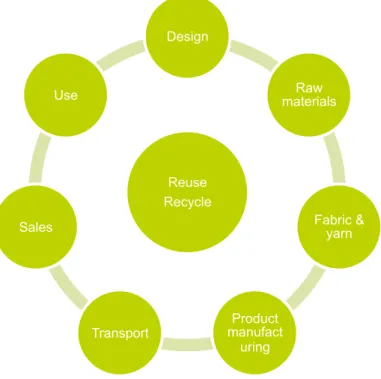
The value chain according to H&M Group’s sustainability report 2019 (2020e: 7) is pre- sented below in Figure 6. H&M Group states the amount of their own influence in each of the aspects on the value chain, for example high influence on design, medium on raw materials and product manufacturing and low on use. They also rate each of the factors’ climate, water and social impact. The climate impact refers to emissions, where they have rated fabric and yarn production to have a high impact while transportation
has a low impact. Water impact evaluates the volume, source and quality of water and its recyclability, and social impact refers to human rights issues. They state that:
Every choice we make has the potential to drive positive change and innovation in every part of our value chain — which includes all stages of our business from product design through to customer use (H&M Group 2020e: 7).
Figure 6. H&M Group value chain (H&M Group 2020e: 7)
The most visible improvements H&M Group appears to have made are the material choices. They show that they are innovating new, more sustainable fabrics, such as Circulose, and that of all cotton they use almost 97 percent was sustainably sourced, while of all materials used approximately 57 percent was sustainably sourced in 2019 (H&M Group 2020e: 54). Of sustainably sourced cotton, close to 80 percent was ‘better cotton’ or ‘initiative cotton’, about 16 percent organic cotton and 0,55 percent recycled cotton. Of all materials approximately 2 percent was recycled and almost 55 percent
‘other sustainably sourced materials’ (see Appendix 5). Likewise, Marimekko increased its use of the more sustainable ‘better cotton’ to 88 percent during 2019 (Marimekko Corporation 2020: 73). Since 2017, Marimekko has also cooperated with a Finnish fibre technology company Spinnova, which is using a technology that enables wood as a clothing material (Marimekko 2019a: 22).
Reuse Recycle
Design
materials Raw
Fabric &
yarn
Product manufact uring Transport
Sales Use
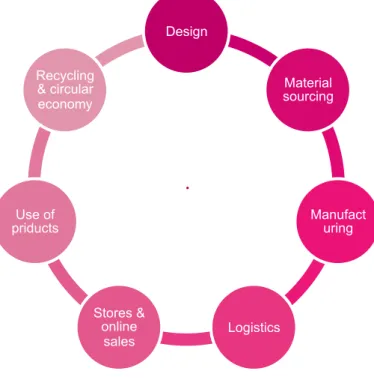
Marimekko’s value chain is presented below in Figure 7. According to Marimekko’s sustainability report 2018 (Marimekko 2019a: 10), their primary activities are design, material sourcing, manufacturing and logistics, and secondary activities are products, recycling and circular economy and stores and online sales. As H&M Group, Marimekko states that the influence they have on the aspects of their value chain lies mostly in the design, material choices and fabric printing, the only manufacturing that still remains in Finland in their fabric printing –factory in Helsinki. Marimekko’s has also tested different kinds of new materials, such as wood-based fabrics and plant-based indigo dye in the factory (Marimekko Corporation 2020: 72). In addition, they also state that they have some influence on the cooperation with their suppliers and logistics pro- viders, as H&M Group. They are also committed in enhancing the sustainability of the value chain and transparency with their consumers. They state the importance of sus- tainable, durable material choices in the design phase, as “Using products as long as possible is the best alternative for the environment” (Marimekko 2019a: 10).
Figure 7. Marimekko value chain (Marimekko 2019a: 10)
As opposed to H&M Group, Marimekko promises a good resale value for their products and encourages consumers to lengthen the product life cycle with proper care of the products that are all made from durable materials. Although also H&M Group encour-
Design
Material sourcing
Manufact uring
Logistics Stores &
online sales Use of
priducts Recycling
& circular economy