The focus of the project is on annual cash flow and renovation costs over a 20-year forecast period. The scope of the project is defined together with the commissioning private investor who has invested in apartments since 2011 and wants to find out whether the time, effort and money invested in the.
Background
In the beginning, this tool is made with and for a specific Finnish private investor; however, the final product can also be used by a handful of other private investors who have similar goals with their investments. In addition, there are apartment buildings that can be an object of investment all over the world. analysis related to cash flow profitability and renovation cost estimates.
Thesis topic
The main concern of these private investors in real estate is the profitability of their investment in terms of not only making money, but also analyzing whether they are benefiting enough in relation to the amount of time and effort they have spent on doing it. worth the trouble. Therefore, this thesis project aims to make the process of evaluating long-term profitability through cash flow analysis more convenient for private investors through the development of a cash flow analysis tool that will make the profitability analysis easy and fast when either calculating new prospective apartment investments or existing investments.
Project objective and tasks
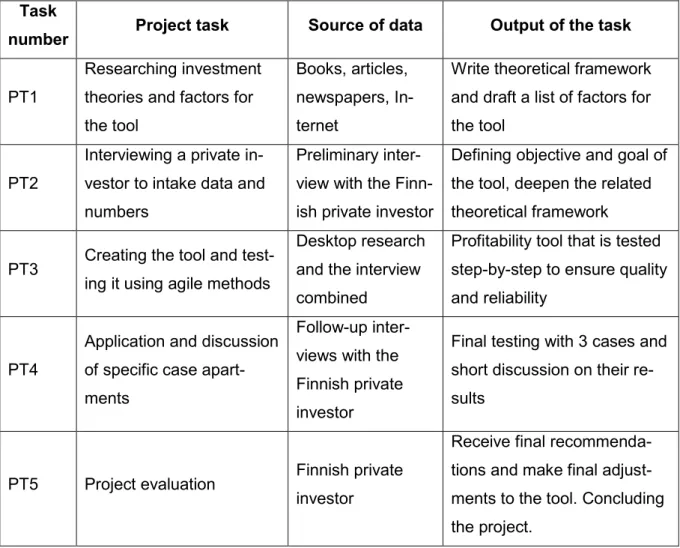
As described in (table 1), the primary research is qualitative interviews with the Finnish private investor conducted in 3 face-to-face interview sessions and via Skype. Research methods are conducted through the thesis process as desktop research supports the information provided by the private investor.
Project scope
More specifically, the focus is not to make a thorough analysis of the three one-room case apartments located in a growing suburb of Tampere, but rather to prove and test the reliability and accuracy of the tool. Based on research and qualitative interviews in December, it was raised that one-bedroom apartments in housing associations are the most profitable investments; therefore, the tool is best suited to small or one-room apartments (Private investor 29 December 2014).
Key concepts
Actual data on individual apartments and input data will be provided by the private investor during qualitative interviews. Cash flow in a real estate business means receiving regular cash distributions from an investment that generate income at a given interval, monthly, quarterly, or annually.
Private investor introduction
Therefore, the focus in this thesis will be on long-term profitability, as significant profits are made on real estate investments over the long term. For example, a US private investor who has been investing in US real estate since 2007.
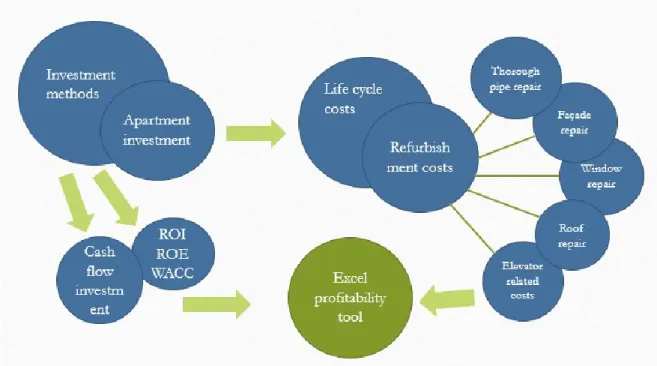
Investment analysis methods
ROI and ROE
Return on investment (ROI) can be formulated by dividing average annual net income by invested capital (Knupfer & Puttonen 2012, 106). The thesis writer has included return on equity calculation in the tool by using the following formula:.
Cash flow investment
Therefore, the formula is counted with the Excel denominator to be last year's equity amount + loan repayment share. The investor can influence the proportion of equity and loan (generally 70% loan, 30% equity), rent amount and monthly loan repayment proportion.
WACC and Financial Leverage
For example, when interest rates are low, the cost of debt is also low relative to the total return on investment. The margin of the loan is charged by the bank to cover its own operations.
Life cycle costs
The objective of the prime rate is to provide a more stable long-term rate compared to more sensitive short-term Euribor rates. For example in a case of balcony renovation, the Finnish Apartment Housing Company Act assumes that the costs should be divided equally since everyone may have exactly the same balcony and it seems unreasonable to pay for the renovation by area of the apartment. Additionally, elevator construction or modernization costs are another exemption from the square footage method. Apartment housing company law has ruled on elevator construction that the cost can be divided based on the level of the apartment.
-site plan is a more comprehensive plan to maintain the condition of the residential building than a condition survey or even a more thorough condition survey. In this thesis, the focus is on the purchase of the apartment and the life cycle costs for the investor not only start with the purchase, but the investor must also take into account the life cycle costs prior to the purchase in order to estimate the costs that will occur to own the apartment in the next 20 years. Generally, the life cycle of a housing development is longer than the estimated economic period because the economic side focuses on the next 20 years; whereas the life cycle of the building is much longer at least 100 years depending on the building.
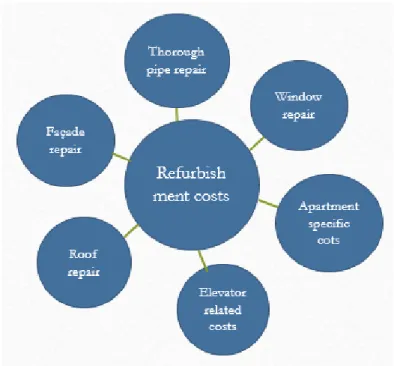
Refurbishment costs
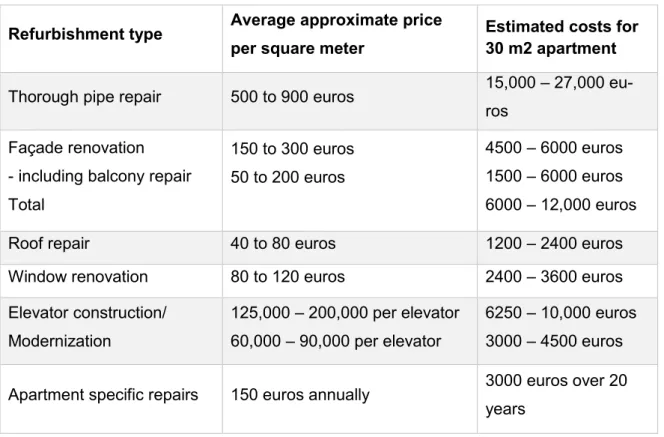
Costs can also vary depending on the year the housing company was built. The costs of the renovation of the facade and the balcony are divided into 15 years in the tool in order to obtain more realistic annual estimates. These costs are spread over 5 years in the tool to obtain more realistic annual estimates.
The Finnish housing company law has established a decision regarding the construction of the elevator that the costs can be divided based on the level of the apartment. These cost examples are for illustration purposes only, because costs can be per square meter and vary depending on the level of the apartment. Above is a summary of renovation costs according to their approximate average prices per square meter.
Apartment investment
Investment process in general
During the 2-hour preliminary interview with the private investor in December 2014; the author of the thesis asked him about the general investment process required when considering investing in an apartment. In general, a private investor analyzes and reads the situation of the real estate market and its development in terms of changes in the price of apartments, the rate of inflation in the sense of the contrast if inflation is greater than the amount of interest on the loan, statistics of the rental amount, financial news, the market in general and especially ongoing interest rates for making loan decisions. Most often, the bank gives a loan of 70% of the purchase price of the apartment, while the investor must get 30% himself or in cash or another guarantee.
Using these documents, an investor must measure and evaluate the potential rental income and time value of money in terms of upcoming renovation. Before the housing exhibition, the investor must already have a price in mind, the price is often negotiated and the investor is encouraged to remain firm with the purchase price that one has previously evaluated. A tenancy deposit should always be required in addition to a thoroughly written tenancy agreement outlining the terms of the tenancy.
Rental income & increase in apartment’s value
In general, rental income must cover maintenance costs and other expenses for the investment to be profitable in the long run. The thesis writer has developed a formula into the tool that evaluates the rental income percentage for the first year. While annual gross rental income may seem high, they don't always show the real truth of profitability.
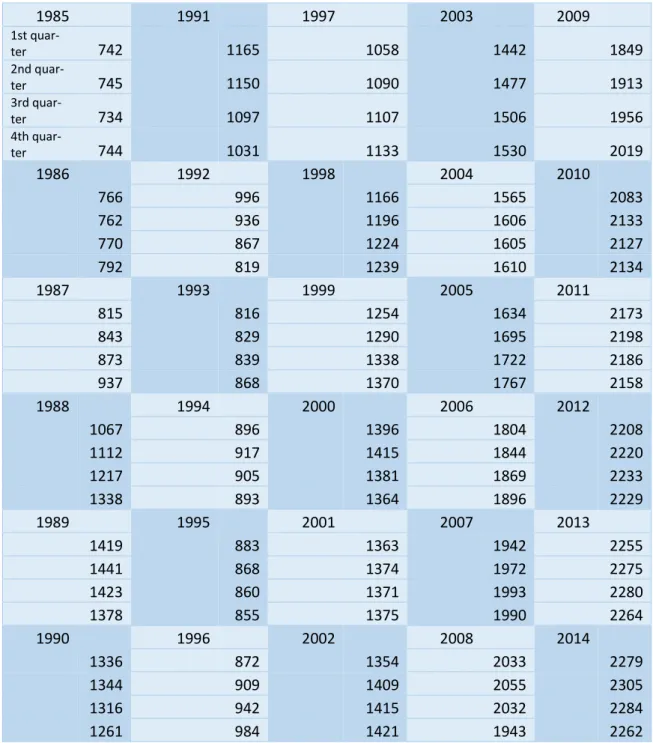
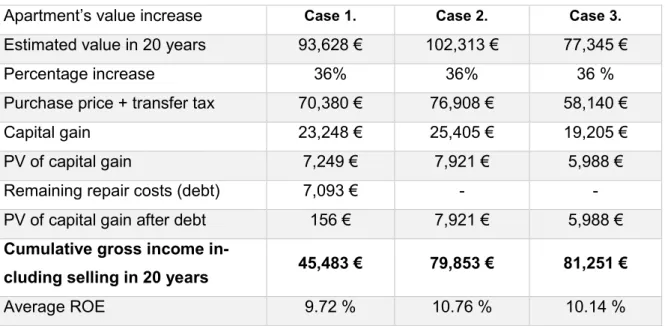
It is important to note that gross annual rental income calculated in the tool shows a more positive figure than in reality. While measuring the future value of the flat in 20 years, inflation must obviously be taken into account as the value of the flat is not fixed, unlike rental income and. Pellervon Taloustutkimus 2013) Below is an illustration of gross rental income and increase in value percentages of different Finnish cities.

Risk management
The model does not meet the requirements of the private investor, as it does not focus on apartment-specific figures, but is more focused on the market itself. The first phase of the process involves extensive desk research to identify the necessary components for the cash flow profitability tool. Through the qualitative face-to-face interview, the thesis process proceeds to the creation of the tool phase.
The aforementioned features of the concept were shown to the private investor for first feedback. Financial leverage calculations are for further development and advanced calculations and personal preferences of the private investor. The percentages can be tested in the tool based on personal requirements; therefore, the results are not analyzed in the project as a request from the private investor (Private investor February 28, 2015).
Application and cash flow analysis of 3 case apartments
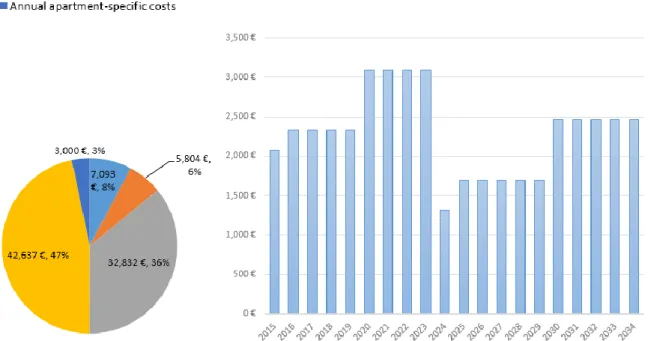
Cost Breakdown Pie Chart and Annual Cash Flow Bar Chart Breakdown for Example 1. The bar chart above shows that the renovations are being done at the same time as the annual cash flow for that year is lower. Cost breakdown pie chart and annual cash flow bar chart breakdown for Example 2.
The renovation incidents can be seen from the column graph where the cash flow is lower. Roof material is tin (50 year repair period) and window frame material is wood (30 year repair period). Cost breakdown pie chart and an annual cash flow breakdown column chart for Case 3.
Discussion and suggestions
The biggest cost for an apartment is the maintenance cost with a 70% share in the total costs. In this section, the thesis writer will evaluate the process and results of the process and final product of the thesis. It contains feedback from a private investor on the utility and scope of the tool, feedback from advisors, and a self-evaluation of the thesis process.
The idea of the project was to describe how and why the tool was designed. The components were explained briefly and to the point, because the goal was not to define them in depth, but to provide basic information about the functionality of the tool. At the moment, the tool does not cover inflation and the time value of money for this reason, because the variations are too wide and would not meet the needs of the private investor.
Tool’s form sheet
Interview Questions