Therefore, the topic of the thesis is derived from the existing problem and is a logical continuation of the author's paper "Improving Competitiveness through Competitor Analysis" and is in fact a suggestion mentioned in the recommendations section of that paper. The second goal is to bring forward the results of the competitive analysis conducted by the author of the article in the spring of 2015, and to conduct new research on Spektr's competitors in the commercial property management market in the Moscow region to confirm previous results.
Company O verview
The purpose of the thesis is that it is limited to a certain geographical area: only Moscow and the Moscow region will be analyzed. On the basis of the Institute of Metallurgy of the USSR, the Institute of Research and Development of Introscopy was founded.

Current Situation
All aspects of the competition and the relevant areas such as competitive advantage, competitive strategies, value proposition, marketing and market intelligence are analysed. The secondary sources used in the actual chapter are the studies of marketing gurus such as Michael Porter and Philip Kotler.
Competition
Direct competitors (also called category competitors or brand competitors) are all companies that provide similar products to their consumers. Budget competitors are companies that provide products that are not considered competitors of the company unless certain conditions are met.
Competitive advantage
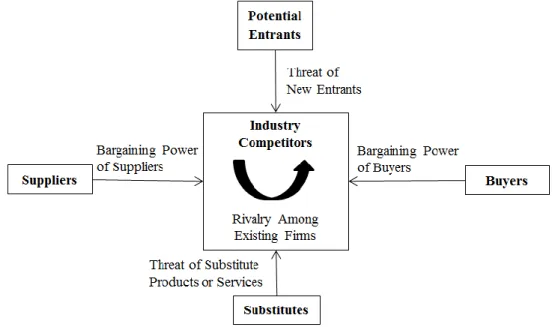
The limitation to the five forces framework is that it is still necessary to be creative and innovative while being part of the competitive rivalry and by all means the framework is not the only and singular tool to be implemented while one identifies and shapes the industry's most important characteristics. In the report itself, the author provides the results of the competitive strategies developed by Michael Porter and Philip Kotler.
Identifying value differences
Overall positioning strategy
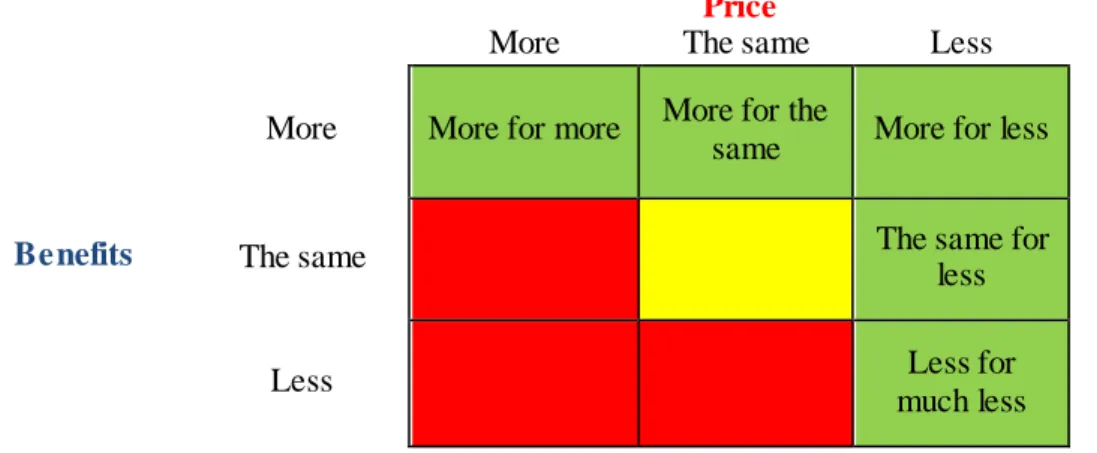
More for more' strategy is suitable for the high-class companies that supply equal products. More for the same' is a strategy to attack 'more for more' companies by introducing a product of the same quality but at a lower price.
Michael Porter’s generic competitive strategies
- Cost Leadership
- Differentiation
- Focus
- Stuck in the middle
Finally, among the risks studied by Michael Porter, there is the risk of the competitors imitating the company's product. The author of 'Competitive Advantage' advises: 'Target segments must either have buyers with unusual needs, or the production and supply system that best serves the target segment must be different from other industry segments.

Competitor analysis and Competitive strategies
Marketing and Market Intelligence
Jenster and Klaus Solberg Søilen use a similar term "market intelligence" as a broader field of marketing intelligence with a similar definition. Competitor profiling has already been used by the thesis author in the previous mini-thesis paper, therefore other methods will be mainly applied.
Competitor analysis
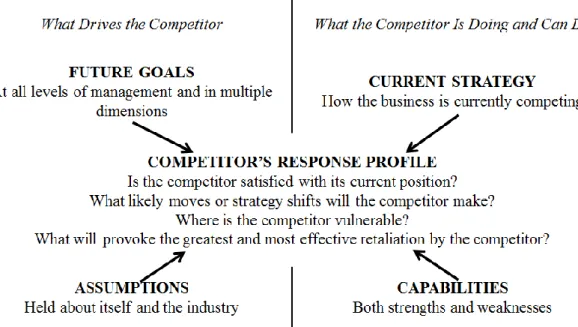
Competitor analysis framework
The competitor's assumptions may or may not be correct, and if they are not, it opens up a range of potential opportunities for a company to make a move and take advantage of the competitor's misinformed. One of the ultimate goals of competitive analysis is to gain a realistic and thorough understanding of competitors' capabilities, strengths and weaknesses, and ability to respond to rivals' tactical moves within the industry.
Competitor group mapping
There may be multiple strategic groups or just one within the industry, depending on the market. In conclusion, the fewer strategic groups present in the industry, the easier it is to analyze the industry and vice versa. The third step is to map out the directions of the strategic movement from an industry perspective.
Industry scenarios and Uncertainty
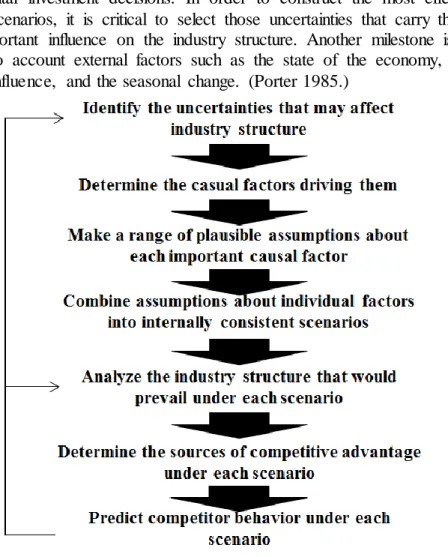
Competitors' behavior is not considered a factor of uncertainty in leaving the scheme to the last stage of construction, although it can greatly affect the whole process. Finally, uncertain elements of the industry structure are the factors that depend on intractable uncertainties and are the source of different industry scenarios. These uncertainties must be independent of other elements in the industry structure and can originate either from outside or inside the industry.
Competitive strategies
Offensive strategy
According to Michael Porter, offensive strategy takes the form of attacking a market leader when it is most vulnerable. It must be in a superior condition and position than a market leader and therefore dominate it. Third, a challenger must have some deterrence to leader retaliation, meaning that a challenger must possess sufficient resources to blunt a market leader and prevent it from making a successful defensive response that could drain a challenger's resources.
Defensive strategy
An organization can most effectively maximize economies of scale in value activities where the minimum volume is determined by technology. An organization increases the expectation of retaliation if it commits to match or better prices or other terms offered by competitors. A balance must remain between structural barriers to entry/mobility and the threat of retaliation and the profitability of the organization.
Prior results
Practical implications and recommendations
Thus, the biggest recommendation was to pay more attention to the company's marketing and marketing strategy. After the implementation, it was necessary to change the entire perception of Spektro in the eyes of customers and competitors. Under the circumstances, this issue seriously called into question the adequacy of Spektro's management and was one of the most important issues to be resolved before the company could move forward.
Process
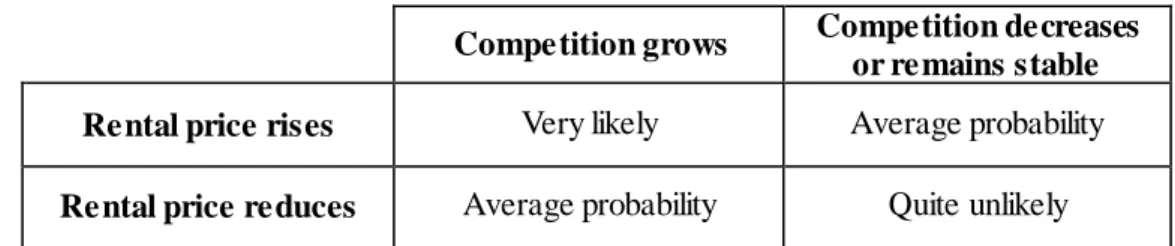
It is one of the simplest and most common mistakes when the directors assume that the higher the price will be, the bigger the profit they will get. By the end of 2015, one of the main trends in the commercial property management market in Moscow was revealed: it is the reduction of rates and the changes in lease terms. The main questions that the author of the actual thesis concluded to construct the industry scenarios were: “Will the rental prices continue to grow in the commercial property management market.
Results
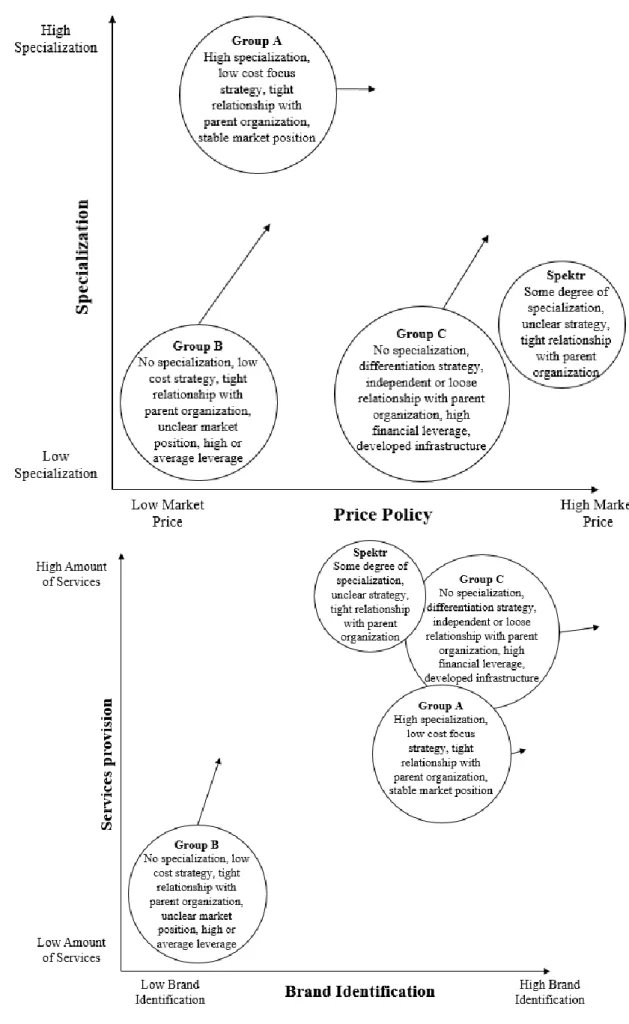
On the charts, the competitor bubbles reflect their current position, while the arrows show how they are likely to move in view of the industry changes. Moreover, the focal companies follow the low-cost strategy, this is the reason why there is only one competitor group of the focal strategy. The three strategic groups therefore reflect the actual position of the companies and this is the sufficient scope of data for the complete research.
Case number 1
There is also the possibility that, given the increased competition, these companies want to secure their position in the market, and the easiest way for them to do this is to penetrate the A group and reorient themselves into a market niche specialized in the customer segment they already have. Spektr does not have arrows on the maps because it is the most difficult to predict the actions of the company that finds itself in the middle. In this situation, it would be good for Spektr to maintain the current price level or lower it slightly to blend smoothly with Group C.
Case number 2
In the situation of rising price policy, it would be a big mistake for Spektr to raise its own prices, as they are already well above the average. These are the structural changes that require a lot of work on behalf of the group B competitors. The company must be willing to lose a lot in the short term to revive its advantage.
Case number 3
And the second part of the split group will remain the low-cost competitive strategy and lower its price. Redirecting the acquired financial resources to the investment of services is the best option for companies from the differentiation group C to win new customers after leaving the competitors, considering the fact that the companies of this segment would have a greater profit . It only needs to move slightly in the price of the differentiation group until they reach equilibrium and Spektr becomes a member of the C group.
Case number 4
The position and prospects of group B (low-cost strategy group: low-cost strategy, close relationship with the parent organization, unclear market position, high or average leverage) are no better than group A. The position of Spektro would be almost the same as in the case of industry scenario number 2, except for the difference due to reduced competition. This chapter concludes the actual research and analysis of the research done in this thesis.
Choosing the competitive advantage
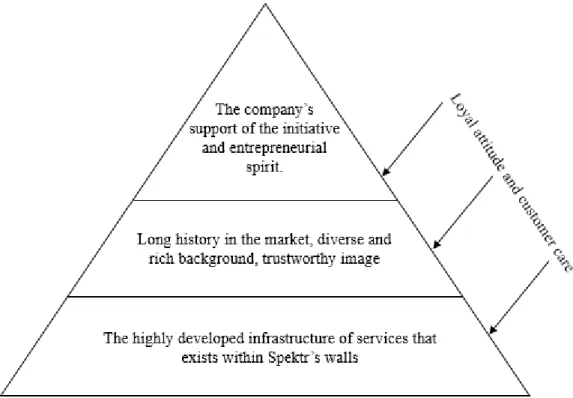
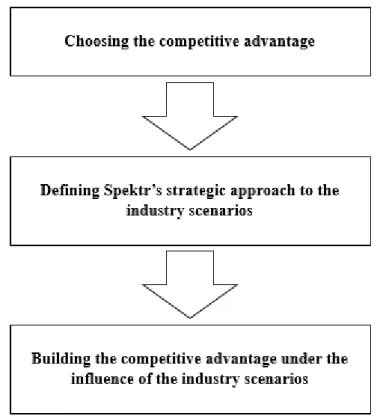
Therefore, assuring customers that prices will improve and familiarizing them with the company's new marketing strategy that includes lowering rental prices in a few months will become Spectr's main focus area. After choosing a differentiation strategy, the company must identify how it can differentiate itself from the competition. The reliable image of Spektr as a long-lived and good, with a lot of experience in handling difficult situations and surviving and prospering in the most difficult time will serve as the halo of the company.
Defining Spektr’s strategic approach to the industry scenarios
At this point, Spektr is left with two possible strategy-making approaches for industry scenarios: betting on the most likely scenario and maintaining the company's flexibility. The company must start lowering its prices immediately in order to achieve the mean of differentiation. Customers must become the strong basis for the Spektr company to be aware of its movements and approve it.
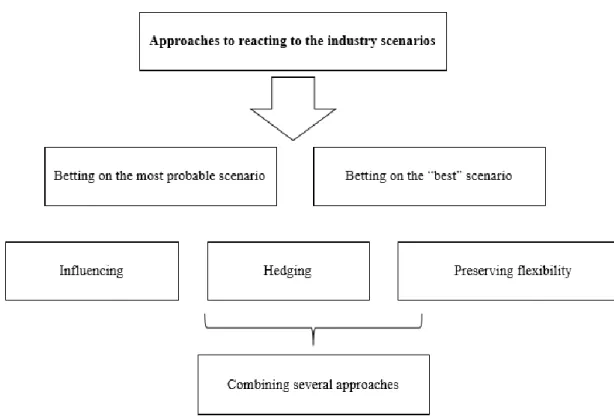
Developing the strategy for building the competitive advantage under the
Once the competitive advantage is developed, it is essential to start moving towards the desired outcome. The actual timing of the stages is loose as it needs to be confirmed with the company. The next logical step in the thesis process was the analysis of the research conducted.