Creating a Concept for Pairing of Thai Street Foods with Sparkling Wines
Niramon Thanuddhanusilp
2022 Laurea
Laurea University of Applied Sciences
Creating a Concept for Pairing of Thai Street Foods with Sparkling Wines
Niramon Thanuddhanusilp Restaurant Entrepreneurship Thesis
March, 2022
Laurea University of Applied Sciences Abstract Degree Program in Restaurant Entrepreneurship
Bachelor
Niramon Thanuddhanusilp
Creating a Concept for Pairing of Thai Street Foods with Sparkling Wines
Year 2022 Number of pages 59
This research-based thesis aims to create a concept for pairing of Thai street foods with sparkling wines. This concept will be used in the “Chiangmai cottage in the northern Thailand by the Taeng River” (CTT). CTT is a hostel in the Thai-European style building situated in a hilly tropical forest. Thai food focusing on the Thai street food especially one dish meal, the sparkling wine, and the pairing food with wine are the background study for this thesis.
The research started with the semi-structured interview of wine experts from five ALKO shops in the Helsinki metropolitan area to get the short list of sparkling wines for pairing with Thai street food, Pad Thai. The chosen method for developing and studying the pairing of Thai street foods with sparkling wines was the sensory evaluation. The summary of thirty sparkling wines’ characteristics from the semi-structured interview were utilized in the sensory
evaluation that included the Focus group interview, the Hedonic scales, and the Ranking test.
These preference tests supported results of the focus group interview.
One of the main results of this thesis was to find out three key characteristics amongst the thirty suggested sparkling wines from the semi-structured interview that made them to match with Pad Thai, stir-fried rice noodles. These key characteristics were medium dry to medium sweet sweetness, medium (-) to medium (+) acidity and medium alcohol content. Due to limited budget, only five sparkling wines were selected with these key characteristics in the sensory evaluation. Thai street foods and sparkling wines complemented each other.
However, they enhanced the tastes on different levels of the focus group participants’
preferences. The preference test results confirmed this finding.
In conclusion sparkling wines with medium acidity, alcohol and sweetness are versatile for pairing with wide range of Thai street foods from sweet to savory and spicy dishes. There are positive interaction of Thai street foods and sparkling wines. For future research, an
interesting topic is to study the pairing of Thai street foods with sparkling wines and wines in general by different characteristics of the focus group. Furthermore, the number of
participants in the preference tests like the Hedonic scale and the Ranking test should be bigger than in this study, fifty or more within the limitations of the available resources.
Keywords: food and wine pairing, hostel, sensory, sparkling wine, Thailand, Thai street food
Contents
1 Introduction ... 5
2 Thai street food... 7
3 Sparkling wine... 11
4 Pairing food with wine... 15
5 Research method, developments, and results ... 19
5.1 Semi-structured interview theory, implementation, and results... 20
5.2 Senses and sensory evaluation theory, implementation, and results... 27
6 A Concept for Pairing of Thai Street Foods with Sparkling Wines ... 36
7 Conclusion ... 38
References ... 40
Figures ... 42
Tables ... 42
Appendices ... 43
1 Introduction
This thesis aims to create a concept for pairing of Thai street foods with sparkling wines. This concept will be used in the author’s “Chiangmai cottage in the northern Thailand by the Taeng River” (CTT). CTT is a home stay or a hostel in the Thai-European style building situated in a hilly tropical forest and a lychee orchard on the banks of the Taeng River. In the total area of 16,000 square meters, there are three cottages and one multi-purpose building with a separate closure kitchen allowing good hygiene for food preparation.
By the Thai Hotel Act B.E. 2547 (2004), Thai homestay is the general name for an
accommodation for rural tourism. Tourists stay with the owner of the house in a living space that is adapted for their use. The maximum number of rooms is limited to four. No more than 20 people are allowed to stay at each time. The owner provides necessary services and facilities to tourists to earn extra income. There are only two taxes involved i.e., the property and the sign tax.
In 2019 before the Covid-19 pandemic, tourism was Thailand’s second biggest national income. It accounted about 20% of the GDP according to the Thailand Ministry of Tourism and Sports. There were 39.9 million visitors to Thailand in that particular year. Of the total number of tourists 11.2 million visited the Chiangmai District. The region’s main city Chiangmai is the northern capital of Thailand. One of the most popular destinations for the eco and adventure tourists is the Chiangmai’s Kued Chang Sub-district where the author’s home stay CTT is located.
There are 12 elephant camps in this area of 306.25 square kilometers 64 km north of the Chiangmai City. Around 500 elephants have free movement without chains in the area’s jungle camps under experienced mahouts’ close look. This area offers wealth of natural and cultural wonders, which attract more and more domestic and foreign tourists each year. In the area, there are 28 home stay accommodations, 1 hotel and less than 10 closure kitchen restaurants. Both Thai and foreign tourists are eager to experience local food during their stay when they feel it is well prepared and safe.
The restaurants in this area provide delicious menus of Thai food. Many foreign tourists expect to experience Thai street food during their visit. The reason for that is the American TV- channel CNN, which announced the list of the "World's 50 Best Foods" of 2017. Seven Thai street foods were included, and Pad Thai ranked number five on their overall list (Chang 2017.) Since then, Pad Thai has been internationally the best-known Thai street food of stirred-fried rice noodles. Pad Thai also ranks as number one of the top ten foods to try in Thailand (BBC good food 2021). Most of the Thai restaurants in Finland serve Pad Thai that is
the iconic dish of Thailand using rice noodles. That is the reason why the author selected especially Pad Thai of all the Thai street dishes for the semi-structured interview and sensory evaluation in this thesis.
Despite of the Covid-19 pandemic Thailand continues to be the largest wine market in
Southeast Asia with annual consumption of over 100 million liters (Asia Wine News 2021). The sparkling wine category is forecasted to have the fastest value and volume growth during 2020-2025 (Global Data 2021).
The sparkling wine for the paring with Thai street food is selected due to three main reasons.
The first reason is that it complements the Thai food much in the same way as the more commonly consumed beer and carbonated drinks. The second reason is that this fact is not well known and there are few previous studies on this subject. There are number of studies online about the Thai food and wine pairing, especially with white wines. However, there are only few with sparkling wines by wine specialists and wine enthusiasts. So far, it has not been possible to find a single book concerning this topic. The third reason is to offer the CTT’s customers a new experience, which is pairing Thai street foods with sparkling wines. With this concept, CTT is profiling it from area’s other homestays and restaurants. The idea is to invite especially higher budget customers who want to enjoy a unique experience.
To achieve the thesis outcome, three comprehensive and basic theories are discussed in chapters 2 to 4. The first one concerns Thai food focusing on the Thai street food especially one dish meal. The second one focuses on the sparkling wine, and the third one on the pairing food with wine. The study started using the qualitative approach by utilizing the semi-
structured interview of wine experts from five ALKO shops in the Helsinki metropolitan area.
ALKO is a limited company owned by the Finnish Government. The purpose was to utilize the expert selection of sparkling wines for pairing them with Pad Thai and Thai street foods.
From the semi-structured interview result, the research was proceeded further using the sensory evaluation on the pairing of Thai street foods with sparkling wines. This sensory evaluation included the Focus group interview of eight participants, three Hedonic scales and one Ranking test. The preference tests support results of the focus group interview. These subjective tests are based on “Food a Fact of life” that has been developed by the British Nutrition Foundation. The idea was to find out whether recommended sparkling wines from the semi-structured interview match to Pad Thai and the other Thai street foods or not.
Based on the theories of Thai street food, sparkling wine and pairing food with wine combined with the findings from this research, a concept was created for pairing of Thai street foods with sparkling wines. This outcome will be used at the author’s home stay or a hostel, CTT to enhance its Thai food and wine development and to increase its customer’s satisfaction on Thai food and beverage.
2 Thai street food
In this chapter a general idea on Thai food and its part of the Thai culture is explained. After that the focus is on Thai street food starting with its definitions and characters from three sources such as Takala, Winarno and Carrillo-Rodriguezet. Information about the Thai street food Pad Thai, which is selected for this research, can be found at the end of this chapter including its recipe. This recipe is used in the research part of this thesis.
The unique feature of the Thai cuisine is combining and balancing different flavors. These flavors are sour, salty, sweet, spicy, and bitter. “A survey in major cities in the USA, Australia, and Europe identified three characteristics of Thai food that are recognizable among international food connoisseurs. They are taste, aroma, and diversity. Taste is a perfect blend of sour, sweet, and salty flavors, bringing about a harmoniously delicate favor.
Aroma is a unique aromatic effect resulting from myriad herbs and spices used in the recipes.
The aroma is said to be felt in every mouthful. Diversity means that Thai food is deemed to be healthy, providing various nutrients from all the different ingredients used in each dish.”
(Bangkok Post news 2017.)
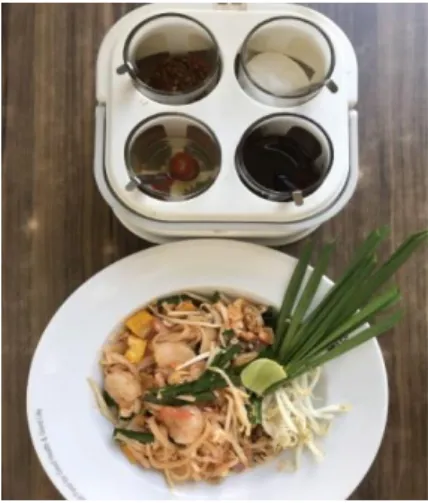
Based on Thanuddhanusilp (2006, 163), for a good Thai meal different kind of dishes are served all at once except sweets. The aim is to choose the different dishes so that their flavors balance and complement each other. Sometime a one dish meal contains many different flavors such as Thai style stir-fried noodle “Pad Thai”. Its sour taste comes from tamarind paste and lime, sweetness from palm sugar, saltiness from fish sauce, and spiciness from dried, roasted chili. Finally, there is a touch of bitterness from bean sprouts and Chinese chives. In Thailand, even Pad Thai has many flavors, the condiment set of roasted chilies, sugar, fresh chili vinegar and fish sauce is served along with Pad Thai as shown in Figure 1.
Therefore, diners could adjust Pad Thai to their own taste by adding condiments.
Figure 1: Pad Thai, stir-fried rice noodles and a condiment set
Thai food not only tastes good, but almost all traditional dishes are healthy due to low fat, high fiber, and the versatile use of fresh and fragrant herbs. This uniqueness makes good impression to visitors and tourists to Thailand, and it also inspired to do this thesis. Thailand is in the middle of Southeast Asia where variety of cultural and ethnic groups meet. They left a trail on the country's everchanging cuisine. Chili, the signature ingredient of the Thai cuisine, was brought from Americas by Portuguese traders. Immigrants from China contributed wide and clear impact on the Thai cuisine, which is well blended of many imported culinary features that have interacted among themselves. In spite of this diversity, there are unifying elements which make the Thai cuisine unique. Rice is the basic food utilized all over the country. In general, people in the north and northeast of Thailand consume steamed glutinous short grain rice while the rest like to have steamed long grain ones. (Thai Food Heritage 2021.)
The food drink is usually iced water in Thailand. Also, other drinks are served such as soft drinks, beer, and whisky in more festive occasions. The newest drink is wine. It was earlier considered luxury but is coming more popular especially among the city people. One reason to its growing popularity are the local vineyards, which make local wines of reasonable quality and attract plenty of visitors to taste their wines with excellent Thai food.
(Thanuddhanusilp 2011, 179.)
In Thailand, home cooking is the responsibility of the mother, even if she works during the day. The current rhythm of life, with its long working days, has caused ordinary Thai working mothers no longer to have time to spend many hours in the kitchen to prepare the quality Thai meal. More and more Thais buy home ready-made food, or they order made to demand food from street food vendors, food stalls or open kitchen restaurants, which significantly shortens the cooking time. In Thailand to buy ready-made food home or eat out at a simple setting restaurant by the street is cheaper than cooking yourself especially to a small family or only to yourself. In many cases, the quality, taste, and nutrition are as good as in the home-made food.
Takala (2015, 8) argues that according to the strictest definition the street food is ready to eat food made and sold in streets, squares, markets, parks and other public places from a movable selling point, carriage, trailer, or truck. In most cases it can be eaten using only fingers and it is cheaper than the restaurant food.
According to another definition the term "street foods" describes a wide range of ready-to-eat foods and beverages sold and sometimes prepared in public places, notably streets. This definition of the street food was agreed by the FAO Regional Workshop on Street Foods in Asia, held in Jogjakarta, Indonesia in 1986. (Winarno 1986.)
Figure 2: Thai street food vendor
Figure 2 shows one type of Thai street food enterprise or vendor at Huahin night market in Thailand. The urban population growth has stimulated the number of street food vendors in most cities everywhere in the world. To large extent this growth is based on rural area people who migrate to cities for working. Furthermore, demand for relatively inexpensive, ready-to- eat food has increased as people, especially women, have less time to prepare meals. The Thai Street food enterprises have been explained as mobile vendors operating outdoors on public or private property and regular vendors in outdoor markets, on pavements or footpaths, or on privately rented spaces where they may have a roof but no outdoor walls.
(Carrillo-Rodriguezet et al. 2018, 7.)
According to the FAO report (FAO 2022.) street foods have become an important part of the local food scene in many parts of Europe and North America. At the same time there has been a significant expansion of the major fast-food companies worldwide. In the industrial
countries consumers are more and more interested in “ethnic” or “traditional foods” at the same time as consumers in the developing countries are increasingly turning away from them to the western fast food. Since this old FAO report the trend described above has steadily developing stronger and stronger year by year and the local people in Thailand have been no exception in this change.
However, contrary to the local people, there is another trend concerning foreigners and tourists to Thailand. They expect more and more to experience Thai street food when visiting Thailand especially from the year 2017 on. One of the major reasons is that the American TV- channel CNN announced the list of the "World's 50 Best Foods" of 2017 in which seven Thai street foods were included, and the Pad Thai stir-fried rice noodles ranked number five on their overall list. The other six Thai street foods on this list were Kaeng massaman (massaman
curry in coconut milk with dried chilies and spices paste), Moo nam tok (grilled pork spicy salad), Khao pad (fried rice with egg and meat or seafood), Kaeng khew warn (green curry in coconut milk with fresh chilies and herbs paste), Som tam (green papaya spicy salad), and Tom yam goong (prawn soup with lemongrass). (Chang 2017.) Since then, Pad Thai has been internationally the best-known Thai street food of stir-fried rice noodles. In 2021, Pad Thai also ranks as number one of the BBC top ten foods to try in Thailand. The other nine street foods were Tom yam (spicy soup with meat or seafood and lemongrass), Laap (spicy meat salad with roasted rice and dried chilies), Khao soi (northern Thailand noodle in coconut milk with dried chilies and spices paste), Som tam (green papaya spicy salad), Pad kaprao (stir- fried meat or sea food with fresh holy basil leaves), Kaeng khew warn (green curry in coconut milk with fresh chilies and herbs paste), Yam (spicy salad with meat or seafood and spicy dressing), Kai yang (grilled chicken with coriander root and garlic) and Khao pad (fried rice with egg and meat). (Bush 2021.)
These street foods as well as most Thai foods in general are consumed with rice. The noodles used in Pad Thai are made from rice as well. Rice is the same staple food for Thais as
potatoes are for Finns. Thais have rice in many forms in their meals, which are usually served three times a day. You can’t think of a Thai meal without rice, either glutinous short or long grain one. Thais’ own long grain rice is the jasmine rice, and it has been a carefully protected trade name for a long time. Whatever rice cannot be called jasmine rice. It must come from Thailand and meet the quality standards. In Thailand jasmine rice is traditionally cooked by steaming it and, what is important, without adding any salt to it. (Thanuddhanusilp 2006, 13.) Based on the Thai Food Heritage, the institute under the Ministry of Industry (Thai Food
Heritage 2021.), due to the rice shortage during the World War II, Field Marshal Plaek Phibunsongkhram, the prime minister of that time promoted noodles, the mixture of rice flour and water. The one dish meal noodles, Pad Thai is an incredible pack of many nutrients.
It has high carbohydrate from noodles and palm sugar; protein from egg, tofu, and dried shrimp; fiber from shallot, Chinese chive, pickled radish, and bean sprouts; vitamin and minerals from lime juice, peanuts, and fish sauce. There are many different versions of Pad Thai, but the basic ingredients remain the same. The original and official Pad Thai must be served without black soy sauce, which some people mistakenly use in it. The official Pad Thai recipe promoted by the Thai authority can be found in Appendix 1.
3 Sparkling wine
This chapter starts with general information about wine including its definition, making and types. After that one special type of wine namely sparkling wine, that is selected for this research, is discussed in detail especially its production methods and various styles. These sparkling wine styles based on the role of their sweetness levels.
In common understanding, the word wine refers to an alcoholic beverage made from grapes.
Vitis vinifera is the grape specie that is widely used for wine making. The American specie, Vitis riparia is used for phylloxera-resistant root stock. (Clarke et al. 2003, 19.) “Wine is an alcoholic drink that is usually made from grapes but can also be made from other fruits or flowers. It is made by fermenting the fruit with water and sugar.” (Cambridge dictionary 2021.)
Figure 3: Alcohol fermentation in wine making (Thailand Wine 2021.)
The result of the alcoholic fermentation or primary fermentation process when sugar in grapes converts to alcohol and carbonic gas by yeast as shown in Figure 3. Ripe grapes usually have a high sugar content when they are harvested that is enough for fermentation for winemaking. In a poor climate area, it is usual to add cane or beet sugar during the fermentation process for providing the yeast more sugar to ferment into alcohol. This technique is named chaptalization which is more necessary in the sun lacking areas like in cool climates. (Clarke et al. 2003, 304.) The amount of sugar that can be added to wine varies widely. Many countries, regions, and wine types have their own local regulations. The high sugar level in ripe grapes turns to alcohol easier than with other fruits or berries. Mead , cider, and country wine are names of fermented drinks from, honey, apples, berries, and other fruits.
There are three types of wine based on the world’s largest provider of courses and
qualifications in wines, spirits, and sake. These types are still, fortified, and sparkling wines.
The largest type is the still wine which consists of white, red, rosé, and sweet wines. Wine which is added with other strong alcohol beverage to reach 15-22% alcohol by volume for preserving freshness, is called the fortified wine. The well-known ones are port from Portugal and sherry from Spain. (WSET School 2021.)
Still and fortified wines usually involve one alcoholic fermentation unlike sparkling wines. The second alcoholic fermentation in the sparkling wine production occurs in a sealed container or
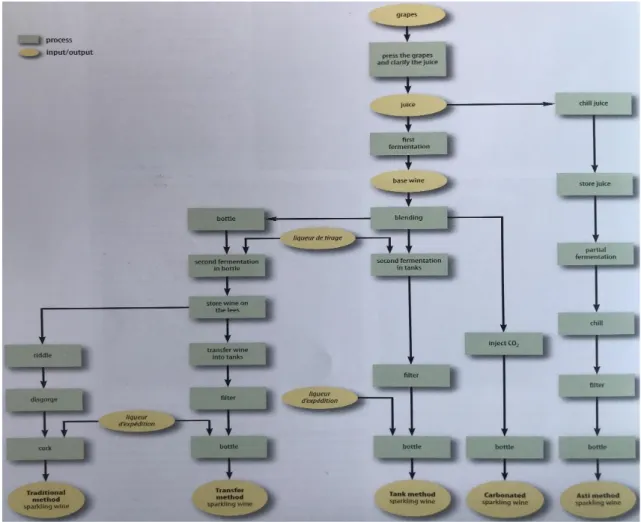
bottle for keeping carbonic gas in wine and for creating naturally bubbles when the cork is removed. Carbonic gas can be injected to the wine as well. Based on this principal, there are five following methods for winemakers to choose i.e., traditional method, transfer method, tank method, carbonation, and Asti method as shown in Figure 4. In the old-world wines, the choice of method may be regulated by the local law. The method of the sparkling wine production in the new-world wines or outside Europe will be informed by the style, quality, or cost of the wine. (Robinson 2016, 173.)
The most famous traditional method is the méthode champenoise. This name is not permitted to be used for any sparkling wine outside Champagne, France. Champagne remains the most premium sparkling wine made from only three grape varieties i.e., Chardonnay, Pinot Noir and Meunier. Anyhow, in July 2021, Russian authorities launched new Champagne law that permits Russian sparkling wine producers to use Shampanskoye (means Champagne in Russian) on their label. The same law requires non-Russian sparkling wine producers to state the words sparkling wine on the back label of sparkling wines’ bottles including Champagne when selling in Russia. This resulted the Champagne export suspension to Russia from France which called by the French Champagne Industry. (CNBC News 2021.)
Figure 4: Making sparkling wines (Robinson 2016, 176.)
Figure 4 shows the riddling and disgorgement process to remove lees from the fermented bottles. The mixture of sugar and wine is called liqueur d'expedition. It is used to top up a second alcoholic fermented bottle before corking. The added sugar amount tells the dosage, the final sweetness level of a sparkling wine. This liqueur d'expedition is used to balance the acidity and to enhance the flavors. Zéro Dosage or Brut Nature is the sparkling wine to which liqueur d'expedition is not added. (Robinson 2016, 173). All the best brut style sparkling wines are made by the méthode champenoise because it is the only one that possesses the quality connotation, even though some low-quality sparkling wines made by this method can be found in the market. (Stevenson 1998, 14.)
The transfer method or transvasage avoids the riddling and disgorgement process of the traditional method. The idea is to lower production costs and to have cheaper price sparkling wines than in the traditional method. In this transfer method, based on Robinson (2016, 175), after the second alcoholic fermentation all contents in the bottles are transferred to a sealed tank under pressure and then filtered. Finally, the liqueur d'expedition, mixture of sugar is added, and wine is transferred to another bottle.
The tank method retains the primary fruit flavors of the base wine whereas the tradition and transfer methods have flavors of bread and toast from maturation in oak or of dried fruit from years in the bottle. In this tank method both two alcoholic fermentations occur in a
temperature controlled stainless steel tank to preserve the pure fruit and floral aroma of grape varieties such as Muscat and Riesling before filtering, liqueur d'expedition adding and bottling. The tank method as a bulk production without the bottle fermentation is cheaper and faster than the first two methods and more popular for producing sparkling wines like Lambrusco and Prosecco. This sparkling wine displays no notes of yeast autolytic due to the absence of storing wine on the lees. (Robinson 2016, 177.) The result of this tank method is a straightforward wine without many complexities and is also called Charmat. (Sohm 2019, 36.) The carbonation is the cheapest method for the sparkling wine production due to the absence of the second alcoholic fermentation either in bottle or tank. Carbon dioxide is injected to the blended wine and bottled under pressure. This method retains the primary fruit flavors of the base wine. This base wine is usually made from strong flavor grape varieties such as Sauvignon Blanc. (Robinson 2016, 177.)
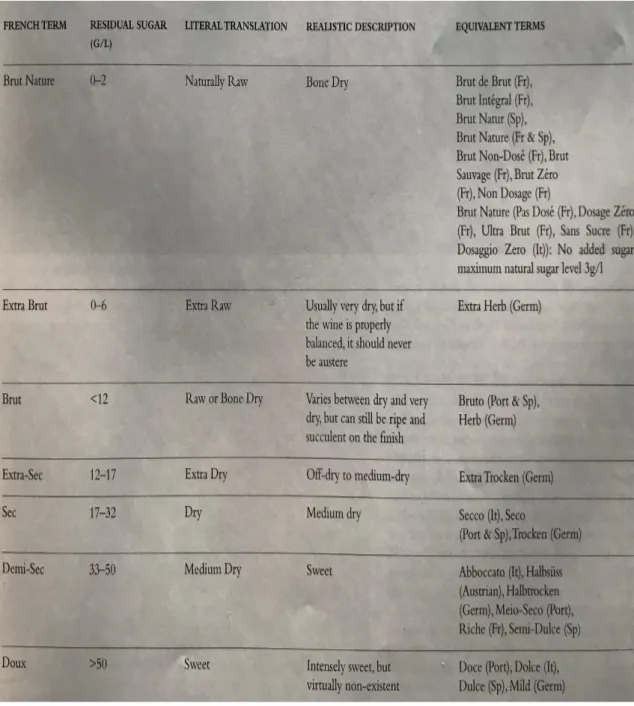
Figure 5: Sweetness chart (Stevenson 2013, 41.)
Based on Stevenson (2013, 38), the styles of sparkling wines are Non-vintage, Vintage, Blanc de Blancs, Blanc de Noirs, Rosé, Crémant, Non-dosage (Extra Brut), Prestige Cuvées, Red, Sweeter styles and Aromatic styles. There are many different sparkling wines which are made in ranges of their sweetness levels. To point out these levels, French term are used as shown in Figure 5.
4 Pairing food with wine
In the beginning of this chapter the traditional concept of paring food and wine is introduced.
After that general knowledge about interactions in paring food with wine. Understanding the interactions are important for the successful food and wine pairing. These interactions are in many ways complex. Harington has described this complexity by saying “A perfect food and wine combination does not guarantee a happy customer, and there are no perfect food and wine pairing that everyone will love.” (Harington 2008, 9.)
According to Jackson (2017, 381), the concept of harmony means in the traditional thinking
“red with red, white with white”. The lack in acidity in red wines compared with white wines, is well compensated by their phenolic content. There is also another element of food and wine harmony, which relates to color. White wines look better with pale-colored foods and sauces, red wines are better with dark colored meats and sauces.
According to Robinson (2016, 11), there is interactions in food and wine tasting. Food in your mouth can adapt your taste buds so that the perceptions of the levels of sugar, salt, acidity, etc. in what you taste next can be alter. Sweetness increases the perception of bitterness, astringency, acidity, and the warm effect of the alcohol in the wine. On the other hand, it can decrease the perception of body, sweetness, and fruitiness in the wine. In many cases sweetness in food makes a dry wine seem less fruity and taste unpleasantly acidic. It may increase the burning effect of alcohol. A sound rule to follow is to select a wine with a higher level of sweetness than the food. Umami increases the taste of bitterness, astringency, acidity, and the warm effect of the alcohol in the wine. The other effect is that it decreases the perception of body, sweetness, and fruitiness in the wine. High levels of umami can make many foods difficult to pair with wine. Salt can counteract umami’s hardening effect on wine. Good examples on that are asparagus, eggs, mushrooms, and ripe soft cheeses.
However, there are exceptions such as cured or smoked seafood and meats, and hard cheeses such as parmesan. They are high in both umami and salt tent not to have as much of an adverse effect on wines.
Acidity in food increases the body, sweetness, and fruitiness perception in wine. It also decreases the taste of acidity in the wine. Generally, it is a good thing to have acidity in food in wine pairing. Very high acidity in wine can be balanced with acidity in food and highlight wine’s fruitiness. On the other hand, a very high acid food can make low acidity wine flat, flay and lacking focus. Salt increases the perception of body and sweetness in the wine.
However, it decreases the perception of astringency, bitterness, and acidity in the wine. Salt is in most cases a wine-friendly component of food that enhances a wine’s fruit character and soften its astringency. Not surprisingly bitterness increases the perception of bitterness in the wine. Sensitivity to bitter tastes varies from person to person. The differences can be great.
Bitterness in food alone may taste pleasant and bitterness in the wine may feel correct, but together the bitter elements can be unpleasant. This effect is highly personal. (Robinson 2016, 11.)
Chili increase the perception of astringency, bitterness, acidity, and the burning effect of the alcohol in the wine. It decreases the perception of body, sweetness, and fruitiness in the wine. Chili creates a warming or burning sensation. The levels of sensibility to chili heat are different from person to person and the effect is very subjective. A good example is the alcohol in the wine, which can increase burning sensation in the food. Some people enjoy this effect and some not. The fatty and oily food tastes well with acidic wine. The reason is that richness of the food is cut by acidity in wine causing a cleansing the palate. This effect also is highly subjective. The intensity of food and wine shall be in balance. Either of them cannot overpower the other. However, there are exceptions. One example is curry. It can be paired well with non-aromatic, and unoaked white wines. (Robinson 2016, 12.)
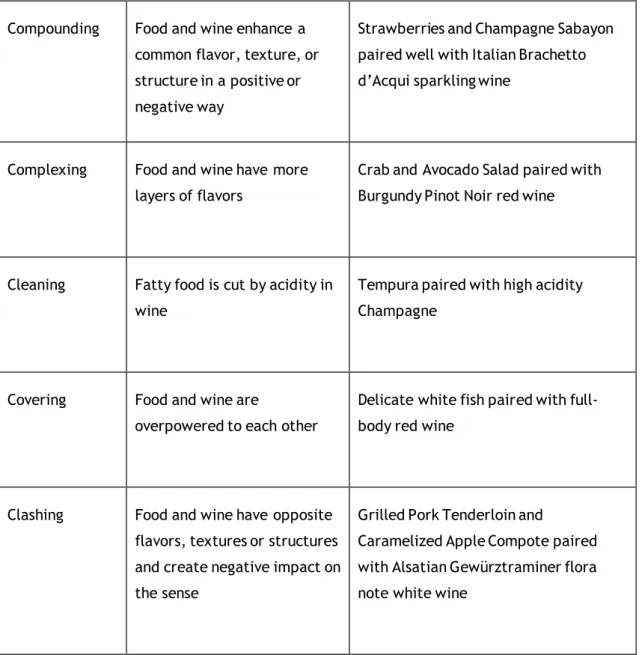
Based on Arnone et al. (2013, 5-6), there are eight levels of matching when food and wine are consumed together i.e., matching level, complementing level, contrasting level,
compounding level, complexing level, cleaning level, covering level, clashing level as shown in Table 1.
Matching levels Interactions Examples
Matching Food and wine are comparable in weight, texture, or structure
Gorgonzola Dolcelatte-Topped Beef Tournedos paired with St. Emilion Merlot red wine
Complementing Food and wine share a common flavor and play a supporting role to each other
Food with rosemary paired with Rhone Valley red wine
Contrasting Food and wine have opposite flavors, textures or structures and create positive impact on the sense
Meat dish paired with fruity sparkling wine
Compounding Food and wine enhance a common flavor, texture, or structure in a positive or negative way
Strawberries and Champagne Sabayon paired well with Italian Brachetto d’Acqui sparkling wine
Complexing Food and wine have more layers of flavors
Crab and Avocado Salad paired with Burgundy Pinot Noir red wine
Cleaning Fatty food is cut by acidity in wine
Tempura paired with high acidity Champagne
Covering Food and wine are
overpowered to each other
Delicate white fish paired with full- body red wine
Clashing Food and wine have opposite flavors, textures or structures and create negative impact on the sense
Grilled Pork Tenderloin and
Caramelized Apple Compote paired with Alsatian Gewürztraminer flora note white wine
Table 1: Matching levels of food and wine
The matching levels are useful and the decision to use one or the other is determined by the pairing objective, the occasion, the place, the state of mind, and the confidence to select food and wine (Harington 2008, 9).
According to Arnone et al. (2013, 6), they paired grilled shrimp with Barolo red wine, Gewürztraminer white wine, and Champagne to show wines that worked and did not work.
The least pleasant was Barolo due to intense tannin that was exacerbated by spice and salt in shrimps. Anyhow, some members in the group still preferred Barolo because they just loved this wine all along. This pairing indicated that personal preferences and palate differences effect the pairing result.
According to Robinson (2016, 11), it is crucial to recognize that individuals have different flavor and aroma sensitivity when it comes to understand primary food and wine taste interaction. The same bitterness level affects one individual more than another. Some individuals like strong taste while others dislike it.
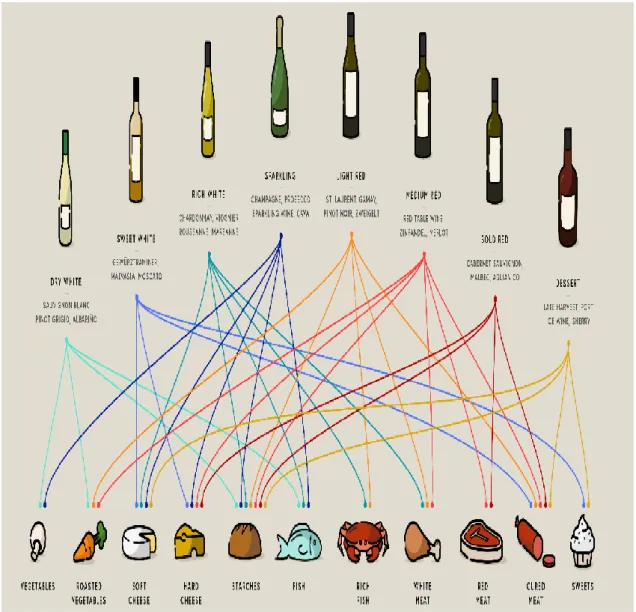
Figure 6: Pairing wine and food basics. (Laura Lambert, 2021)
As shown in Figure 6 basically, vegetables, soft cheese, hard cheese, starches, and fish dishes can be paired with Champagne, prosecco, sparkling wine, and Cava. Snack foods pair well with sparkling whites (Lambert 2021). There are number of studies online about the Thai food and wine pairing, especially with white wines. However, there are only few with sparkling wines by wine specialists and wine enthusiasts. These articles show positive results of the pairing. So far, it has not been possible to find a single book concerning Thai street foods and sparkling wines.
5 Research method, developments, and results
In this chapter the study is based on the qualitative approach. This includes the semi-
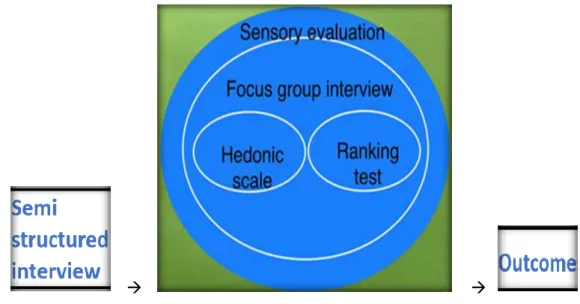
structured interview and the focus group. The results from the semi-structured interview are used in the sensory evaluation including the Focus group interview, the Hedonic scale, and the Ranking test. This sensory evaluation method is utilized for developing and studying the pairing of Thai street foods with sparkling wines. The idea of the study is to find out whether recommended sparkling wines from the semi-structured interview match to Pad Thai and the other Thai street foods or not. The sensory evaluation can be seen either as a method or as a methodological approach. The theories of the semi-structured interview and the sensory evaluation are explained in the functional part 5.1 and 5.2, respectively. The sensory evaluation of focus group interview of eight participants, three Hedonic scales and one Ranking test were implemented at the same time in November 2021. These preference tests are based on “Food a fact of life” that has been developed by the British Nutrition
Foundation.
→ →
Figure 7: The research development scheme
The qualitative approach was started by utilizing the semi-structured interview of wine experts from five ALKO wine shops in the Helsinki metropolitan area. The idea was to utilize the expert selection of sparkling wines for pairing them with the selected Thai street food s.
In order to achieve concrete outcome from this study a special research scheme was developed after applying results from the semi-structured interview as shown in Figure 7. It shows the functional research connections between the focus group interview, the Hedonic scales, and the Ranking test in this sensory evaluation. The preference tests support results of the focus group interview. The flow chart of this research development is in Appendix 2. The semi-structured interview and the sensory evaluation were utilized to create a concept for pairing of Thai street foods with sparkling wines. This concept is the outcome of the author’s thesis.
5.1 Semi-structured interview theory, implementation, and results
Interview is a conversation between two or more people where questions are asked by the interviewer to elicit facts or statements from the interviewee or to understand the
experiences of others. Salmon (2016, 2) states that there are many methods that can be used individually or combined to study in-depth about the nature and dimensions of these
experiences, perceptions, or behaviors. These methods are such as asking the targets directly (interviews, focus groups), watching the targets (participants, non-participant or unobtrusive observation, shadowing), reviewing the targets’ actions or writings (documents, records, written expressions). The collected data from the study will be reviewed and analyzed using inductive and deductive reasoning to move from the particular to themes and trends and to generate findings. (Ghauri et al. 2020, 18-20.)
According to Ghauri et al. (2020, 115), there are two types of interviews. Structured interviews or standardized interviews are based on the standard format, and they are used with an emphasis on fixed response categories, systematic sampling and loading procedures.
This results the uniformity in the behaviors of interviewers in similar situations. Another type of interviews is unstructured interviews where discussions, opinions and behaviors are freely expressed upon interviewees’ own thinking with guided questions using how and why.
Therefore, the questions and answers mostly are unstructured and non-systematically coded in advance in order to enrich the data and alternative answers. That is why they are
sometimes called open ended interviews. Semi-structured interviews or guided interviews are discussed in the literature. They differ from the structured interviews and the unstructured interviews in a way that the covered topics and issues, sample sizes, interviewees, open- ended questions, and bias minimizing are structured in advance. Furthermore, a skilled interviewer is demanded to handle bias by carefully designing the technique itself. The interviewer should fully understand the research problem, its purpose, and the sought information.
The questions concerning the interview and its execution of this study can be listed as
follows: what, why, how, and which. The answer to the first question what is that it is a semi- structured face to face interview of ten members of the staff in five ALKO shops, two in Espoo and three in Helsinki. The reason for the interview answers to the second question why. The reason is to find out the characteristics of the sparkling wines recommended by the interviewees and utilizing the results for the functional part of the author’s thesis.
The functional part is the pairing Thai street foods with sparkling wines by using a sensory evaluation with the focus group. The preference tests, Hedonic scales, and Ranking test support results of the focus group interview. The third question is how. The idea is to visit ALKO shops during mid-day when the shops are not busy with customers and to interview one
to two members of the staff at each ALKO shop. The benefits of this interview are to
determine the paring success in the functional part of the author’s thesis and to control costs and time of the functional part of author’s thesis by limiting it to only few and manageable samples. The semi-structured interview and the sensory evaluation were utilized to create a concept for pairing of Thai street foods with sparkling wines. This concept is the outcome of the author’s thesis.
5.1.1 Implementation of the semi-structured interview
In this study data by expert’s interviews was collected to get the short list of sparkling wines for pairing them with the selected one dish Thai street food meal, Pad Thai. After that the characteristics of the recommended sparkling wines were found out and the results were utilized for the functional part in 5.2. The method of the interview is the semi-structured interview guided by the questionnaire that can be found in Appendix 3.
Five ALKO shops were visited on weekdays between 11:00-16:00 during October 25- November 10, 2021. Two of ALKO shops were at Lähderanta and Leppävaara in Espoo. The last three shops were at Sokos, Stockmann and Kamppi in the Helsinki city center. The author approached the staffs, introduced herself, told the purpose of the visit and asked for their time for an interview. After they accepted the invitation, the list of the questions was shown, and the interview was started according to the plan. The answers were written down to all questions one by one. The interviews lasted 20-60 minutes in each ALKO shop depending on how much the interviewees explained their products, sparkling wines in particular. Permission for taking photos of recommended sparkling wines during the interview was also asked.
5.1.2 Result from semi-structured interview
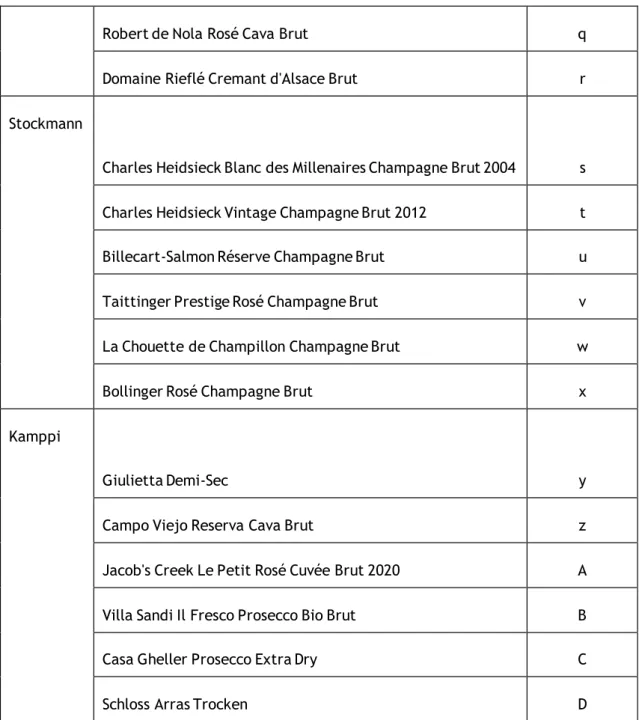
After the interview, the collected data was read and coded according to expected codes as shown in Appendix 3. When interviewees said Brut, that implied the level of sweetness of <12 g/l residual sugar in sparkling wines. Another code concerned alcohol content in sparkling wines. When interviewees mentioned medium alcohol that meant 11-13.5 % abv. All interviewees had tasted Thai food in Finland within last few months. Two of them had experienced Thai street food in Thailand before the Covid-19 pandemic. They had eaten stir- fried noodles and liked them and Thai food in general. None of them had tried sparkling wine with Thai food but European ones. In spite of that and after some consideration all of them recommended sparkling wines for pairing with Pad Thai without hesitation due to their expert knowledge on the products, sparkling wines in this case. The interviewees from each ALKO shops recommended six sparkling wines that matched to Pad Thai. That made together thirty recommended sparkling wines from these five ALKO shops.
ALKO shops
List of 30 recommended sparkling wines
full name short name
(to be used in Table 3) Lähderanta
André Delorme Crémant de Bourgogne Organic Brut a
Freixenet Carta Nevada Cava Medium Dry b
Saint Clair Vicar's Choice Sauvignon Blanc Bubbles Brut 2020 c
Moshi Moshi Organic Sparkling Extra Dry d
Moët & Chandon Impérial Champagne Brut e
Brut and Le Bullet Champagne Brut f
Leppävaara
Ramon Canals Reserva Numerada Cava Seco 2017 g
Mumm Champagne Le Demi-Sec h
Moët & Chandon Ice Impérial Rosé Champagne Demi-Sec i Freixenet Ice Cuvée Especial Cava Semi Seco j
Fiorissimo Prosecco Rosé Extra Dry 2019 k
Johann Baptist Dietrich Riesling Sekt Trocken 2018 l Sokos
Pizzolato Ice Prosecco Organic Demi Sec 2020 m
Robert de Pampignac Champagne Brut n
Veuve Clicquot Champagne Brut o
De Sousa Grand Cru Blanc de Blancs Champagne Brut p
Robert de Nola Rosé Cava Brut q
Domaine Rieflé Cremant d'Alsace Brut r
Stockmann
Charles Heidsieck Blanc des Millenaires Champagne Brut 2004 s Charles Heidsieck Vintage Champagne Brut 2012 t
Billecart-Salmon Réserve Champagne Brut u
Taittinger Prestige Rosé Champagne Brut v
La Chouette de Champillon Champagne Brut w
Bollinger Rosé Champagne Brut x
Kamppi
Giulietta Demi-Sec y
Campo Viejo Reserva Cava Brut z
Jacob's Creek Le Petit Rosé Cuvée Brut 2020 A
Villa Sandi Il Fresco Prosecco Bio Brut B
Casa Gheller Prosecco Extra Dry C
Schloss Arras Trocken D
Table 2: The list of 30 recommended sparkling wines from five ALKO shops
The list of the thirty sparkling wines recommended by interviewees from five ALKO shops is in Table 2. Two of these shops were at Lähderanta and Leppävaara in Espoo. The other three shops were at Sokos, Stockmann and Kamppi in the Helsinki city center. The letters (a to D) in the last column indicates names in short of these thirty sparkling wines. These short names are utilized in Table 3 as well.
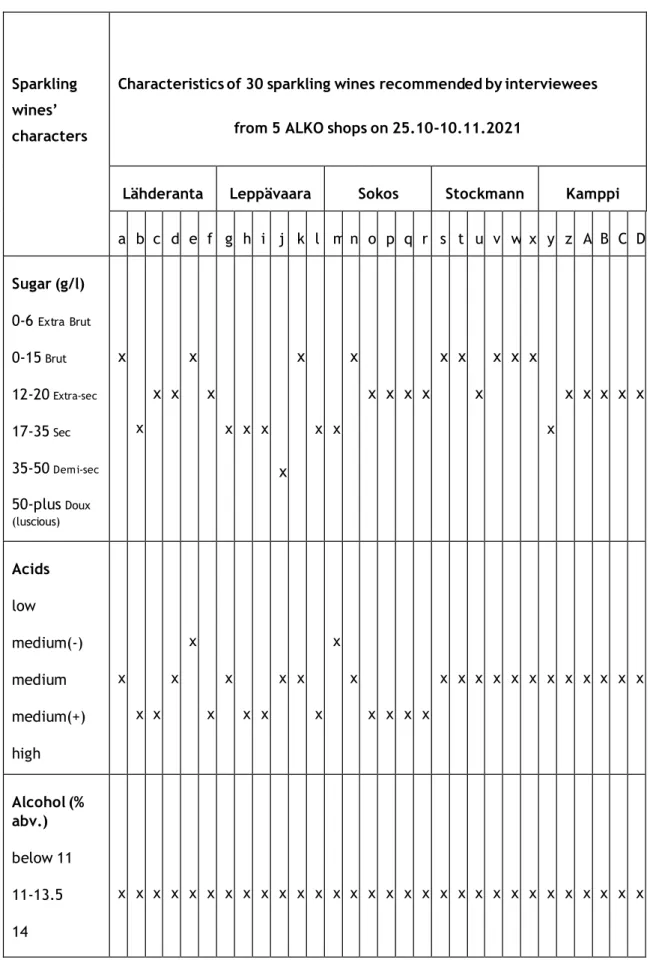
Sparkling wines’
characters
Characteristics of 30 sparkling wines recommended by interviewees from 5 ALKO shops on 25.10-10.11.2021
Lähderanta Leppävaara Sokos Stockmann Kamppi a b c d e f g h i j k l m n o p q r s t u v w x y z A B C D Sugar (g/l)
0-6 Extra Brut
0-15 Brut 12-20 Extra-sec
17-35 Sec 35-50 Demi-sec 50-plus Doux
(luscious)
x
x x x
x x
x x x x
x
x x x
x x x x x x
x
x x x
x
x x x x x
Acids low medium(-) medium medium(+) high
x x x
x x
x x
x x x x
x x
x
x x x x
x x x x x x x x x x x x
Alcohol (%
abv.) below 11 11-13.5 14
x x x x x x x x x x x x x x x x x x x x x x x x x x x x x x
Table 3: The summary of 30 sparkling wines’ characteristics from the semi-structured interview
Table 3 shows the summary of 30 sparkling wines’ characteristics from the semi-structured interview using identification of data sequences based on the author’s interpretation and the ALKO staff’s experiences. Then the results were compared to the sweetness chart from The World Encyclopedia of Champagne and Sparkling Wine (see Figure 5). The results were also compared to the WSET Level 3 Systematic Approach to Tasting Wine (SAT) tool. The cross marks, “x” in Table 3 represent the characteristics of thirty sparkling wines recommended by interviewees from five ALKO shops in Espoo and Helsinki. The letters (a to D) in the columns indicates names in short of these 30 sparkling wines (see full names in Table 2). This summary implies that there are three key characteristics of sparkling wines that match to Pad Thai.
These key characteristics are medium dry to medium sweet sweetness, medium (-) to medium (+) acidity and medium alcohol content.
As the result, five samples were selected out of total thirty bottles recommended by the interviewees based on three key characteristics. These are medium dry to medium sweet sweetness, medium (-) to medium (+) acidity and medium alcohol content. They were
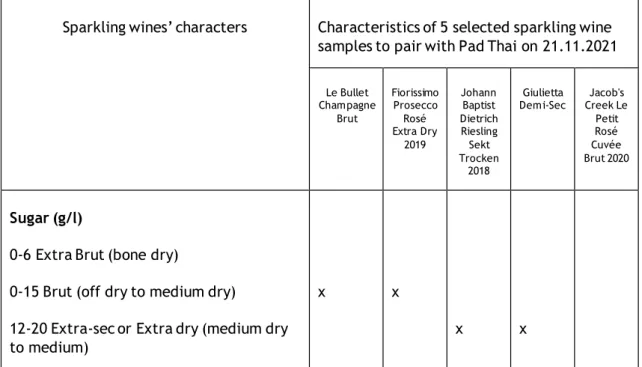
utilized in the functional part of the research, the sensory evaluation. These five bottles were Le Bullet Champagne Brut from France, Fiorissimo Prosecco Rosé Extra Dry 2019 from Italy, Johann Baptist Dietrich Riesling Sekt Trocken 2018 from Germany, Giulietta Demi-Sec from Italy, and Jacob's Creek Le Petit Rosé Cuvée Brut 2020 from Australia. The image of these samples is shown in Appendix 6. The “x” marks in Table 4 represent the characteristics of these five selected sparkling wines for the sensory evaluation which consisted of the focus group, the hedonic scales and ranking test. The latter preference tests are based on “Food a fact of life” that has been developed by the British Nutrition Foundation.
Sparkling wines’ characters Characteristics of 5 selected sparkling wine samples to pair with Pad Thai on 21.11.2021
Le Bullet Champagne
Brut
Fiorissimo Prosecco Rosé Extra Dry
2019
Johann Baptist Dietrich Riesling Sekt Trocken
2018
Giulietta Demi-Sec
Jacob's Creek Le
Petit Rosé Cuvée Brut 2020
Sugar (g/l)
0-6 Extra Brut (bone dry)
0-15 Brut (off dry to medium dry)
12-20 Extra-sec or Extra dry (medium dry to medium)
x x
x x
17-35 Sec or Dry (medium to medium sweet)
35-50 Demi-sec
(medium sweet to sweet for dessert wines) 50-plus Doux (luscious)
x
Acids low medium(-) medium medium(+) high
x
x
x
x x
Alcohol (% abv.) below 11 11-13.5 14
x x x x x
Table 4: The characteristics of 5 sparkling wine samples for the sensory evaluation
As shown in Table 4, these five bottles represented three different levels of sweetness i.e., Brut, Extra dry and Dry. All of them contained medium acidity and alcohol level. These were the characteristics of the sparkling wines recommended by the interviewees from five ALKO shops. These key characteristics were medium dry to medium sweet sweetness, medium (-) to medium (+) acidity and medium alcohol content. Furthermore, these five samples were selected in a way that represented different sparkling wine production methods (traditional method, tank method, and transfer method), and different areas or terroirs (France, Italy, Germany, and Australia). All these selection criteria affected their tastes and prices. Due to limited budget, only these five samples of sparkling wine were used to pair with Thai street foods on 21.11.2021.
5.2 Senses and sensory evaluation theory, implementation, and results
According to Kemp et al. (2009, 1-3), the sensory evaluation is often described using the definition of the Institute of Food Technology. It says that the sensory evaluation is a
scientific method used to evoke, measure, analyze and interpret those responses to products as perceived through the senses of sight, smell, touch, taste, and hearing (Anonymous 1975).
Piggott (2012, 3-4) states that smell, flavor, and texture influence the appreciation of foods and beverages strongly by their sensory properties. These properties are sight, smell, hearing, taste, and touch as shown in Figure 8. Sensing pain and temperature also influences how we sense food. The most important factors of our appreciation of food and beverages are the chemical senses. These senses are common ones such as taste and smell but also
chemestheses, which are pain, touch, and temperature. The chemosensors in the mouth detect compounds in dissolved liquids. In the oral cavity and throat to the nose, airborne compounds from ambient air but also from food and beverages are detected by these sensors.
On the other hand, chemestheses located in the skin, in the epithelia of the nose, mouth, eyes and in the alimentary tract and other border tissues mediate information about irritants by the help of nerve cells.
Figure 8: The five senses (Food a Fact of Life, 2021)
The sensory evaluation can be divided into two categories of testing: objective and subjective. The objective testing provides objective data on the sensory properties of products within two classes i.e., the discrimination tests (sensory differences between samples) and the descriptive tests (nature of a sensory difference identification and/or the level of the difference). The subjective testing provides subjective data on acceptability, liking or preference known as the affective or consumer test. The objective and subjective tests are done by trained and untrained testers, respectively. The subjective tests like affective or consumer tests assess subjective responses to a product or tested samples.
Researchers can use qualitative and quantitative approaches. By doing so they can gain an insight into various consumer preferences concerning test products. These insights can include attitudes, opinions, behaviors, and perceptions. The key part of the product development is to use the affective or consumer tests. These tests can also help develop sensory-related brand positioning, communication, and advertising. The successful sensory testing is driven by setting clear project objectives that determine the test type and the experimental design and data analysis needed to meet these objectives. Product type, budget, timing, good ethical practice, and action standard are important to the sensory test as well. (Kemp et al. 2009, 11-29.)
According to Casey et al. (1995, 77-96), the key ingredients to a high-quality focus group are designing the study, developing the questioning route, recruiting participants, moderating, and analysis. Focus groups are regarded as an excellent research methodology. They can also be used to complement other food preference research. The focus group method allows researchers to get closer to customers and to have more data of their preferences and behaviors. On the other hand, it has also its limitations in the same way as all other social science research has. It can also be misused. The misuse problems are often related to lack of resources, inadequate planning, and poor focus to research objectives.
Based on the “Food Fact of Life” website organized by the British Nutrition Foundation and the Agriculture and Horticulture Development Board, there are eight types of sensory tests i.e., Triangle test, Duo-Trio, Ranking test, Paired Comparison Test (Discrimination), Star charts/diagrams, Hedonic, Paired Comparison Test (Preference), and Scoring. The first five types of tests aim to evaluate specific attributes, i.e., characteristics of products
(crunchiness) while the last three types are not. The last three types are subjective tests that supply information about people's likes and dislikes of a product. The author utilized the Hedonic scale and the Ranking test to support the focus group interview. These preference tests are based on “Food a Fact of Life” that has been developed by the British Nutrition Foundation. “To support excellence in food teaching and learning, the materials provided on the FFL website have been developed to support the curricula and qualifications in England, Northern Ireland, Scotland, and Wales. In addition, the Core Competences for children and
young people aged 5 to 16 years have been used as a guide to support progression from 3 to 16 years.” (Food a Fact of Life 2021.)
McGrew (2012, 29-30) claims that high alcohol content beverages i.e., over 35 %abv. (Percent alcohol by volume) are difficult to expose off-taint characteristics and can desensitize the palate and nose of the sensory evaluation testers. Therefore, reducing alcohol content by dilution is needed even though the delicate flavor notes of beverages can be faded away or overpowered by other characteristics of the beverages, especially the aged ones. Anyhow this does not apply to sparkling wines due to their low alcohol content, in most cases less than 15%abv.
5.2.1 Implementation of sensory evaluation
In November 2021 the functional part was planned, designed, and executed using the sensory evaluation. The focus was on subjective tests. These tests were the focus group interview, the Hedonic scale 1 to 3 and the Ranking test. The connections between the sensory
evaluation of the focus group interview, the Hedonic scales and the Ranking test are in Figure 7. The preference tests support results of the focus group interview. The activities and timetable of the plan of the functional part can be found in Appendix 4.
Due to limitations of the budget and time of this study, the focus group interview on 21.11.2021 was utilized to evaluate the affective test of sparkling wines that match to Pad Thai and other five Thai street foods. The idea of this functional part is to find out whether five selected sparkling wines from the semi-structured interview pair with Thai street foods.
At the same time three Hedonic scales and one Ranking test are implemented to support results of the focus group interview and to create a concept for pairing of Thai street foods with sparkling wines. All these preference tests are based on a website “Food a Fact of Life”
that has been developed by the British Nutrition Foundation.
The detail process of the pairing of Thai street foods with sparkling wines with the focus group, the Hedonic and the Ranking tests on 21.11.2021 at 14:00-17:00 can be found in Appendix 4. The pairing was arranged at the author’s house in Espoo with one helper as an assistant moderator. The portion of Pad Thai for each participant of the focus group was about five spoonsful. One spoonful was paired with one sip of five different sparkling wine samples.
Eight participants were selected to the focus group. All of them fitted the criteria to be healthy and reasonable persons with familiarity to Thai foods and sparkling wines. They were untrained panelists. However, they were selected so that all of them had some experience on food and wine pairing. These eight focus group participants arrived at the venue, the author’s house, around 14:00 on 21.11.2021. They greeted each other and introduced themselves.
After that the participants were invited to sit around the dining table. For the beginning the moderator provided a brief information about the procedure of the pairing Thai street foods with sparkling wines using the sensory evaluation. The moderator also asked for permission to make photo shootings during the test.
During the pairing, the focus group interview was used to provide insights about participants’
preferences. The list of close and open-ended questions in Appendix 5 is the questioning route, which was used during the pairing with the focus group. These questions started with general ones toward the specific so that the participants got better acquainted. Every now and then probing question were generated to get more details and to encourage natural conversation whenever possible. In most cases the whole process seemed like a social discussion rather than an interview. The focus group responded well these questions throughout the pairing. Notes were taken during the interview.
The sparkling wine samples for the sensory evaluation were Le Bullet Champagne Brut, Fiorissimo Prosecco Rosé Extra Dry 2019, Johann Baptist Dietrich Riesling Sekt Trocken 2018, Giulietta Demi-Sec, and Jacob's Creek Le Petit Rosé Cuvée Brut 2020. As shown in Table 4, these five bottles represented three different levels of sweetness i.e., Brut, Extra dry and Dry. All of them contained medium acidity and alcohol level. These were the key
characteristics of the sparkling wines recommended by the interviewees in the semi- structured interview study in 5.1. They were labelled with random numbers 664, 997, 060, 530, and 302, respectively. The random numbers chart can be found in Appendix 6. All of them were covered with red paper and served at 7-8 degrees Celsius as recommended on the labels. The portion of each bottle was fifteen ml per participant. Between different bottles, the participant had a small piece of bread and water to get rid of any interference from the previous sample.
Three Hedonic scales in this functional part were utilized to support the results of the focus group interview. These Hedonic scales were the preference test of five sparkling wine samples (Hedonic scale 1), the preference test of the pairing Pad Thai with five sparkling wine samples (Hedonic scale 2), and the preference test of five Thai street foods with Johann Baptist Dietrich Riesling Sekt Trocken 2018 (Hedonic scale 3). The latter Hedonic scale utilized the result from the Ranking test. The participants of the focus group received sheets of three Hedonic scales and one Ranking test to fill one by one at the different stage of the focus group process. The filled sheets were analyzed by using the readymade templates of Hedonic scale analysis and Ranking test analysis as shown in Appendix 6.
The first Hedonic scale tells the sparkling wine that the participants of the focus group preferred most. The second Hedonic scale tells the sparkling wine that participants preferred most to pair with Pad Thai. The third Hedonic scale tells the street food sample that the
participants preferred to have most with the sparkling wine, which was ranked the first in the Ranking test. The most liked sparkling wine from this latter test is Johann Baptist Dietrich Riesling Sekt Trocken 2018. Both focus group interview and preference test are used to create a concept for pairing of Thai street foods with sparkling wines. Consequently, the outcome of this study is formulated and shown in Chapter 6.
5.2.2 Results of sensory evaluation
After getting data from the focus group interview, the Hedonic scale 1 to 3, and the Ranking sheets, the author as the moderator proceeded the sensory evaluation. It included the focus group interview, the Hedonic scales, and the Ranking test. This was made systematically and verifiably. An example of templates of the Hedonic scale analysis and the Ranking test analysis are at the end of Appendix 6. These preference tests are based on “Food a Fact of Life” website that has been developed by the British Nutrition Foundation.
Result from focus group interview
Based on the preliminary interview, the author as a moderator found that all eight focus group participants had earlier wine and food pairing experiences at restaurants but not at Thai ones. They have never tasted many sparkling wines at the same time. However, they liked tastes of all the samples. They mentioned that the main reason was the freshness of the samples.
All eight participants told that they had tasted Thai street food at least once in the past three years. All of them had no experiences in pairing Pad Thai, stir-fried rice noodles with
sparkling wines. They were interested in the pairing of Thai street foods including pad Thai with sparkling wines. That made them to accept the invitation of this focus group interview without hesitation. All of them responded to the invitation through the Whats App application immediately. They were at the same time excited and curious. One of them said that “This is going to be my brand-new experience on Thai food”. The group photo of the participants, sparkling wine samples and venue can be found in Appendix 7.
All eight participants agreed verbally that Pad Thai paired well to all five sparkling wine samples because the drinks and foods complemented each other and enhanced their tastes.
Six of them liked the taste of Le Bullet Champagne Brut (random number 664) more than the other samples when drinking without food. One participant mentioned that all sparkling wines tasted better when eating with Pad Thai. The other participants agreed. Four of the focus group participants liked Johann Baptist Dietrich Riesling Sekt Trocken 2018 (random number 060) more than other samples when pairing with Pad Thai. Only one participant asked for more sparkling wine for a second time to confirm his decision. All the others made their decision according to the first tasting. The sample that four participants will order to have
with Pad Thai at Thai restaurant was Johann Baptist Dietrich Riesling Sekt Trocken 2018. No one mentioned that any of the samples had negative affect to the taste of Pad Thai.
To find out whether their favorite, Johann Baptist Dietrich Riesling Sekt Trocken 2018 (random number 060) was versatile or not, the moderator tested it further with another five Thai street foods i.e., Grilled shrimp without spice, Scallop with garlic and black pepper, Grilled chicken with lemongrass and honey, Chiangmai spicy pork and herbs sausage and Lychee in syrup. The moderator found out that all of focus group participants agreed that five Thai street foods paired well to Johann Baptist Dietrich Riesling Sekt Trocken 2018.
In the last part of the focus group interview, the participants tested all six Thai street food samples with all five selected sparkling wine samples. The reason was to find out which street food paired sparkling wine best. This result helps author to creates a concept for pairing of Thai street foods with sparkling wines.
These street foods were savoury Thai street food with spices, herbs and mild chilies i.e., Pad Thai, savoury Thai street food without spices, chilies and herbs i.e., Grilled shrimp without spices, savoury Thai street food with spices and herbs i.e., Scallop with garlic and black peppers, savoury Thai street food with herbs and mild chilies i.e., Grilled chicken with lemongrass and honey, savoury Thai street food with spices, herbs and hot chilies i.e., Chiangmai spicy pork and herbs sausage and sweet Thai street food i.e., Lychee in syrup (see Appendix 7). The list of these sparkling wines is in Table 4.
All eight focus group participants agreed verbally that all six Thai street food samples matched to all five selected sparkling wine samples especially to Johann Baptist Dietrich Riesling Sekt Trocken 2018. As a reason they mentioned to positive interaction of Thai street food and sparkling wine. “There is a great harmony of Thai street foods and sparkling wines here", one of participant emphasized. One participant said that she will buy sparkling wine to have with Thai food in the future. Two participants agreed with her by mentioning “What a good idea”.
Three participants mentioned that Le Bullet Champagne Brut paired better with some of the foods. These foods were Pad Thai, Grilled shrimp without spice, Scallop with garlic and black pepper, and Grilled chicken with lemongrass and honey. Chiangmai spicy pork and herbs sausage, and Lychee in syrup paired less. Another participant said that Jacob's Creek Le Petit Rosé Cuvée Brut 2020 paired better with Pad Thai, Chiangmai spicy pork and herbs sausage, and Lychee in syrup than Grilled shrimp without spice, Scallop with garlic and black pepper, and Grilled chicken with lemongrass and honey.
Results from the preference tests: hedonic scales, and ranking test
After the participants of the focus group filled out all preference sheets, the templates of Hedonic scale analysis and Ranking test analysis were utilized to calculate the results that are shown in Table 5 to 8. An example of filled sheets, templates of Hedonic scale analysis and Ranking test analysis are at the end of Appendix 6. The preference sheets in this study, including excel spread templates to use for the analysis, are based on curriculum of the “Food a Fact of Life”.
The sparkling wine samples in the test i.e., Le Bullet Champagne Brut, Fiorissimo Prosecco Rosé Extra Dry 2019, Johann Baptist Dietrich Riesling Sekt Trocken 2018, Giulietta Demi-Sec, and Jacob's Creek Le Petit Rosé Cuvée Brut 2020 were covered with red paper and labelled with random numbers 664, 997, 060, 530, 302, respectively. The random number chart is in Appendix 6. These five sparkling wines were used for the preference tests with the focus group participants.
Sparkling wine samples
Scores Preference percentages (%)
664 36 out of possible 40 23.08
997 32 out of possible 40 20.51
060 32 out of possible 40 20.51
530 26 out of possible 40 16.67
302 30 out of possible 40 19.23
Table 5: Results of the Hedonic scale 1, the preference test of five sparkling wine samples The result of sensory evaluation analysis using the template developed by the British Nutrition Foundation (see Appendix 6), in this case the Hedonic scale 1 test in Table 5, is the
preference test of five sparkling wine samples recommended by ALKO staff. The preference percentages are 23.08%, 20.51%, 20.51%, 16.67% and 19.23% for Le Bullet Champagne Brut, Fiorissimo Prosecco Rosé Extra Dry 2019, Johann Baptist Dietrich Riesling Sekt Trocken 2018, Giulietta Demi-Sec, and Jacob's Creek Le Petit Rosé Cuvée Brut 2020, respectively. Le Bullet Champagne Brut got highest percentage of the preference.
This implied that participants of the focus group preferred Le Bullet Champagne Brut more than the other four sparkling wine samples. Based on interview, amongst these five sparkling wines, the participants preferred Le Bullet Champagne Brut the most due to its freshness, as mentioned by one participant of the focus group and the rest agreed by saying yes and/or nodding their heads.
Sparkling wine samples
Scores Preference percentages (%)
664 30 out of possible 40 19.61
997 32 out of possible 40 20.92
060 32 out of possible 40 20.92
530 30 out of possible 40 19.61
302 29 out of possible 40 18.95
Table 6: Results of the Hedonic scale 2, the preference test of the pairing Pad Thai with five sparkling wines
The result of sensory evaluation analysis using the template developed by the British Nutrition Foundation (see Appendix 6), the Hedonic scale 2 test in Table 6 is the preference test of the pairing Pad Thai, stir-fried rice noodles with five sparkling wine samples recommended by ALKO staff. The preference percentages were 19.61%, 20.92%, 20.92%, 19.61% and 18.95% for Le Bullet Champagne Brut, Fiorissimo Prosecco Rosé Extra Dry 2019, Johann Baptist Dietrich Riesling Sekt Trocken 2018, Giulietta Demi-Sec, and Jacob's Creek Le Petit Rosé Cuvée Brut 2020, respectively.
Amongst these five sparkling wines, the participants of the focus group preferred Prosecco Rosé Extra Dry 2019 and Johann Baptist Dietrich Riesling Sekt Trocken 2018 to pair with Pad Thai more than the other sparkling wine samples. Four participants said that they liked very much Johann Baptist Dietrich Riesling Sekt Trocken 2018 with Pad Thai. Anyhow, all eight participants agreed that Pad Thai matched all sparkling wine samples because they complemented each other and enhanced their tastes.
Sparkling wine samples
Scores Rank
664 29 out of possible 40 3rd
997 30 out of possible 40 2nd
060 31 out of possible 40 1st
530 26 out of possible 40 4th
302 14 out of possible 40 5th
Table 7: Results of the Ranking test of five sparkling wine samples pair with Pad Thai
The result of sensory evaluation analysis using the template developed by the British Nutrition Foundation (see Appendix 6), Ranking test in Table 7 shows that Johann Baptist Dietrich Riesling Sekt Trocken 2018 ranks the first preference among the five samples when paired with Pad Thai, stir-fried rice noodles. Prosecco Rosé Extra Dry 2019, Le Bullet Champagne, Giulietta Demi-Sec Brut, and Jacob's Creek Le Petit Rosé Cuvée Brut 2020 rank the second, the third, fourth and fifth, respectively.
This result implied that the participants of the focus group preferred to pair Pad Thai with Johann Baptist Dietrich Riesling Sekt Trocken 2018 more than the other four samples. This result supported the focus group interview.
Thai street foods
Scores Preference
percentages (%) Grilled shrimp without spice 34 out of possible 40 20.48 Scallop with garlic and black pepper 32 out of possible 40 19.28 Grilled chicken with lemongrass and honey 33 out of possible 40 19.88 Chiangmai spicy pork and herbs sausage 33 out of possible 40 19.88
Lychee in syrup 34 out of possible 40 20.48
Table 8: Results of the Hedonic scale 3, the preference test of five Thai street foods with Johann Baptist Dietrich Riesling Sekt Trocken 2018
The result of sensory evaluation analysis using the template developed by the British Nutrition Foundation (see Appendix 6), in this case the Hedonic scale 3 test in Table 8, is the
preference test of five Thai street foods with Johann Baptist Dietrich Riesling Sekt Trocken 2018. The preference percentages are 20.48%, 19.28%, 19.88%, 19.88%, and 20.48% for Grilled shrimp without spice, Scallop with garlic and black pepper, Grilled chicken with lemongrass and honey, Chiangmai spicy pork and herbs sausage and Lychee in syrup.
The percentages of preference were close to each other. It was not possible to specify any significant differences in these percentages unless by using Duncan’s new multiple range test.
The author chose not to apply this test due to the limitations of available resources. Based on the interview, all of eight focus group participants agreed that these five Thai street foods can be paired to selected sparkling wine, Johann Baptist Dietrich Riesling Sekt Trocken 2018.
Six participants like very much Johann Baptist Dietrich Riesling Sekt Trocken 2018 with Grill prawn without spices. One participant said that she will buy sparkling wine to have with Thai food in the future. Two participants agreed with her by mentioning “What a good idea”.