
The product created with this thesis was a handbook for IDS Helga, which organizes experiences for international students in Haaga-Helia. The product created from this thesis is a handbook for IDS Helga and their event coordinators.
Aims and objectives
In the later parts, the author goes into more detail about the processes and components of IDS Helga itself, the product plan, production of the product, limitations and risks and the evaluation for the finished product. The methods that will be used in this thesis include qualitative research with semi-structured interviews and the analysis of the responses from the international survey conducted in the spring of 2020 by IDS Helga on international degree students from Haaga-Helia.
IDS Helga
How do the opinions of normal international students differ from students who have been involved in the association's work in Haaga-Helia, to be precise IDS Helga board members.
Methodology in brief
Key definitions
Education in this thesis refers to the education international students receive through the experiences created for them. In this thesis we will look at culture from the perspective of the international student.
Culture
Crossing cultures
When creating experiences for international students, there is always going to be some cultural crossover at one point or another, so it is important to understand the mishaps that can occur when crossing cultures, as well as the differences in non-verbal and verbal communication between cultures. . When creating experiences, the differences between people and cultures are something that can affect even the smallest things about the experience, so it is important to find a middle ground where the experience itself and the different cultures cannot negatively affect any culture. those present for the said experience can enjoy it without confusion or misunderstanding.
Hofstede’s cultural dimensions, Germany vs. Vietnam
With these results, the author decided to look at the Hofstede dimensions for this particular thesis, even when there have been criticisms about the fact that the study was done based on the employees of a company, which Hofstede also explained in one of his. books that there is statistical evidence that differences between survey responses are due to the nationality of the employees who responded to the survey. But even after all the criticism, Hofstede remains as one of the most important sources of knowledge about cultural differences and as Hofstede is known to even engage and discuss with his critics, it shows that he himself believed in his work.
Looking into Germany's cultural dimensions with comparisons to Finland 11
Finland and Vietnam further differ on almost all other cultural dimensions as their scores on Individualism, Uncertainty Avoidance, Long-term Orientation and Satisfaction are not at the same level. Below is a table showing the results of the country cultural dimensions comparison between Finland and Vietnam, showing the differences between the two countries in more detail.

Education in terms of statistics and experiential learning
Statistics of international students in higher education
In order to gain a deeper understanding of how important it is to create valuable experiences for international students studying in higher education in Finland, statistics also play an important role. Looking at the statistics, we can see that approximately 4,150 foreign students started higher education in Finland in 2017, excluding those who started doctoral studies, which would make the figure even higher if they were included (Anon., 2017).
Experiential learning
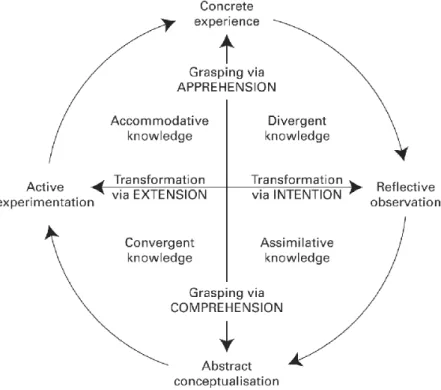
If learning is truly experiential, then experiential learning should be very beneficial to a person's future career success, if not. Experiential learning can be very beneficial in creating experiences for international students, as it can, for example, help international students develop their professional skills.
Experiences
Creating valuable experiences
Experience design naturally assumes that it makes sense to provide appropriate levels of customer service quality at all stages of the customer relationship” (Newbery & Farnham, 2013). Now that we are familiar with the concept of experience design, the question would be why should we use experience design to create valuable experiences for international students. Using experience design as a tool in creating experiences gives an organization more information about what their brand should be and what to consider when creating experiences.
Experience design thrives on finding what a person wants and needs and in doing so creates the greatest value of the experience and should be used to provide greater value to international students.
International student experiences in higher education
The article discusses how to make the international students immigrate better to the country they are studying in. Then again, looking at the experiences of international students specifically studying in Finland, a few main themes emerge. In relation to international students looking for jobs in Finland, Mathies and Karhunen investigated a similar topic of what makes international students want to stay in Finland and why they travel.
The issues of racism and language and any other difficulties international students face should be reflected upon when creating the experiences for them to make them more aware of the difficulties they may face.
Background of IDS Helga
This chapter will explain in more detail the planning and use of the product. Since IDS is an action group of Helga's student union, it follows the rules set by the student union, but also the rules that are made for the action group in particular. The action plan of IDS Helga is made every year by the presidents of the current year and the presidents of the following year.
This is to ensure that the goals set for next year have been approved by the current presidents and the presidents who will take over the positions starting next year.
Product Plan
In January to February, the author again concentrated more on the theory part of the thesis to tie up all the loose ends about it. The author started building the outlook of the product in April to get the graphics ready before starting the evaluation. All parts of the theory have been used to create the product and its content together with the interview answers and material from IDS Helga.
After the evaluation was done, the actual product content was started from the content of the evaluation.
Methodology
After the content of the product was created, the author went through the entire text of the actual thesis and the product to make sure everything was written according to the standard and that there were no spelling mistakes. Examples; “Researchers use qualitative research techniques when they need to capture accurate, in-depth insights. And that's exactly what was needed for this particular thesis, accurate data, but the semi-structured interviews that were conducted also gave some freedom of speech and the opportunity for bias so that the results would be more accurate as people might have. similar opinions, but deviations are common.
Production
The last part of the handbook is called Fusion of Culture, Education and Experiences - How to Create Valuable Experiences, and as can be deduced from the heading of this section, it is all about merging the three keywords and how it can help with experience creation in all parts of the process. When creating experiences for international students, all three of these keywords are important in all types of experiences and therefore must be considered at all points of creation.
Looking at experiences, education and culture from the international students’
- International survey
- Semi-structured interviews
- International student interviews
- IDS Helga board member interviews
And the survey asked international students how IDS Helga could help them find work. This was asked to get a broad understanding of what kind of experiences international students usually want. The board members were given a total of five (5) questions and the questions were structured based on the international students' interview questions and the theory of this thesis to further explore what kind of experiences international students might value.
In addition, these events are something that international students may not have in their home countries, so they love these types of events.
Limitations and risks
Both B1 and B2 mentioned sitit as an event they enjoy, something that can be taken into account in this thesis and the making of the handbook. The theory used to create the handbook may as well be a direct constraint on the actual product produced. The only risks associated with this product are those that may be possible when the handbook is used to create experiences.
If the handbook does not provide enough relevant instructions and assistance to the IDS Helga event coordinators, it can be risky to create experiences based solely on the instructions obtained from the handbook.
Evaluation
If the theory is not relevant enough to create the handbook, it may appear unusable to IDS Helga and the event coordinators. In the next subchapter, the theory and interviews of this thesis are evaluated and analyzed to provide more insight into their applicability for the creation of the product. Experiential learning was addressed in the theory and has also been used for the product (Kolb, 1984).
The experience design-related part of the theory has been applied to the product in many ways.
Thesis process
The writer encountered some problems while creating this thesis, but the supervisor of the work helped tremendously to get the writer to be able to create this thesis and make it the best version possible. There are always things that can be improved in any work, but for this one the author got all the support needed and the thesis and its product came out what the author wanted. In the next subchapter, the author will discuss their learning outcomes from this thesis and how these learning outcomes are significant for the author.
Learning outcomes
In addition to all the learning outcomes mentioned, the author learned more about the three main topics experiences, culture and education. Regarding culture, the author learned about the many ways culture affects the way people behave and how they react to different things. Experiential learning was a topic the author did not know before this thesis and therefore it gave the author a lot of new knowledge.
Therefore, the author had many learning outcomes from doing this thesis and the whole process helped them understand more about what is needed to create valuable experiences and how organizations can improve their experience creation practices to reach their potential. their full.
Interview questions

