The theoretical framework of the study encompasses topics on e-commerce and e-business, Information and Communication Technology in the travel industry. The revolution of the Internet and information and communication technology has already had profound implications for the tourism industry (Buhalis & Jun 2011, 3).
The background of the Project
Finnish companies will have the opportunity to introduce them to the Russian customers without large investments, just placing their offers on the new platform. The project of the Finnish travel e-commerce for the Russian travelers is huge and complex and could not be covered in its entirety within a master's thesis.
Aim and research questions
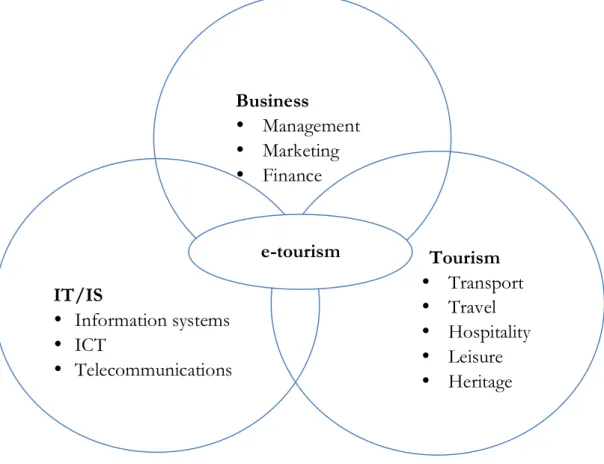
This research will focus on the benefits of e-business in the travel business, the attractive features of e-business for customers. This part of the paper presents in more detail what e-commerce is and how it is related to e-business and e-tourism.
E-commerce and E-business
It is difficult to get venture capital because of the failure of many dot-coms. While the technology provides the infrastructure, it is the business applications that create the interest and excitement in e-commerce – the potential for tremendous returns on investment.
Information and Communication Technology in the tourism and travel
The emergence of the Computer Reservation Systems (CRSs) in the 1970s, Global Distribution Systems (GDSs) in the late 1980s and the Internet in the late 1990s dramatically transformed operational and strategic practices in tourism (Buhalis 2003 in Buhalis & Law Buhalis & June 2011 4). The technological revolution experienced by the development of the Internet has dramatically changed the market conditions for tourism organizations.
Features of modern travel e-commerce
In addition, the web storefronts must be regularly renewed and improved according to the requirements of the consumers. Ozon looks a lot like Amazon in terms of homepage and product displays.
Online travel market in Russia
Another question is whether there is room in the online travel market in Russia for new start-ups. The air segment occupies more than half of the online travel market in Russia, and at the same time is not the most profitable type of business.

Consumers behavior and intentions to buy travel online
Consequently, the perceived complexity of online travel shopping would be negatively related to attitudes toward online travel shopping. Trust in online travel shopping has a positive effect on online shopping intention and attitude. At the same time, it negatively affects the perceived risk of online travel shopping.
Following Amaro & Duarte, perceived relative advantage of online travel purchases would be positively related to attitudes toward online travel purchases and intentions to purchase online travel. Furthermore, Amaro & Duarte come to the statement that the perceived relative advantage of online travel shopping would increase trust in online travel shopping.
Russian travellers behavior online
Among the benefits of using the Internet, according to the Data Insight report for Pay Pal (May 19, 2014), 92% of Russians cite saving time. According to the travel trade, the main sources of travel information are print media such as catalogues, brochures and leaflets, outdoor advertising (billboards, hoardings) and radio and television. Price and recommendation from friends were cited in a report by Hotels.com (2014) as the two strongest reasons that lead Russians to choose hotels.
According to research on the spread of online tourism services, shopping dependence on income level and online experience determines the geography of the audience: 48% of buyers are from Moscow and St. According to the report of Hotels.com (2014) most popular activities When asked what were the most important activities that Russian guests inquired about during their stay, respondents report that sightseeing and shopping are the top two priorities, followed by dining and visiting on beaches.
Russian intentions to Finland as a travel destination
The results of the award are important for the participants in relation to assessing the company's perspectives. Finland topped the list of the most popular destinations in 2014 among Russian tourists, according to statistical results provided on the official website of the Ministry of Culture of the Russian Federation and the Federal Tourism Agency. Despite the economic crisis and the exchange rate of the ruble last year, the number of visits from Russia to Finland was 4.8 million.
As stated in the explanatory notes of the Federal State Statistics Service, the counting was carried out using the new method. The research questions of the study dictate the type of research approach and methods used to collect data.
Quantitative approach
Along with the commonly known types of research approaches, to achieve the objective stated in this paper, the most suitable is quantitative research, since we need to measure variables, assess the impact of these variables on an outcome and results on a large number of people.
Conducting a survey research
Methods of quantitative data collection include various forms of surveys, for this study the implementation of survey research was chosen. There are many forms for conducting survey research, an online self-completion questionnaire was chosen as the research instrument to collect data for this study. According to Rea & Parker, the possibility of conducting a questionnaire online has many advantages, such as:
Data collection process
Questionnaire is a form used in a survey design that participants in a survey complete and return to the researcher” (Creswell 2005, 360). In addition, fearing that distribution through the social networks would not provide the necessary coverage of the target group, the link to the survey was placed on the page of Finnloma - company that rents houses in Finland - as an attempt to attract people who do interested in traveling to Finland. An open link to the survey was placed with these three sources once and was open for two weeks.
A sample is a subset of the target population that the researcher plans to study in order to generalize about the target population” (Creswell 2005, 146). Considering that the target group of the research is quite wide, this sampling method seems appropriate.
Questionnaire design
Several assumptions have been developed on the basis of the theoretical part of the thesis and on the basis of the research questions and the purpose of the study. At the end of the questionnaire, questions are asked in connection with trips to Finland. For some questions the field is left for the open answer to have the opportunity to receive opinion from the respondents and as assumed for some questions it was very useful.
The questions related to an importance and trust are done in a form of ranking questions that are answered presented in a Likert scale to get a measure of the relationship. The most difficult questions that required a little more involvement were placed in the middle of the questionnaire.
Data analysis process
After the personal questions, it is block with the questions about planning travel via the Internet. The questionnaire is mostly built from closed questions with the multiple choice of answers. The questionnaire was conducted in Russian language and then the results were translated into English to be announced in the study.
And finally, the comparisons of two groups - those who regularly travel to Finland and those who just plan to, were done to get data for the conclusion and recommendation. Finally, according to the results of the study and following the research questions, conclusions and recommendations were presented.
Reliability and Validity
Based on the above, we can conclude that the level of reliability of this research is good enough for the purpose of the study. Research validity means that the individual's results from the research are significant and allow good conclusions to be drawn from the sample that was studied in the population (Creswell 2005, 162). In the presented study, we try to avoid factors that could threaten the validity of the questionnaire.
Greater reliability and validity of the results is always the goal of the researcher, nevertheless it is important to recognize the limitations of the study. The results are divided into several subjects in order to better answer the survey's questions.
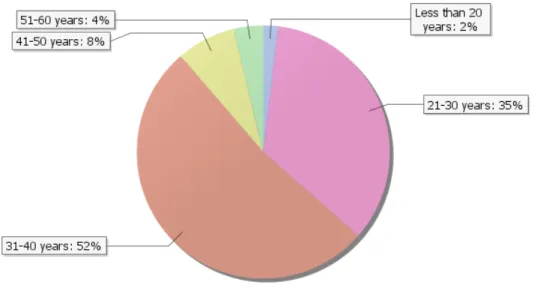
Profile of the respondents
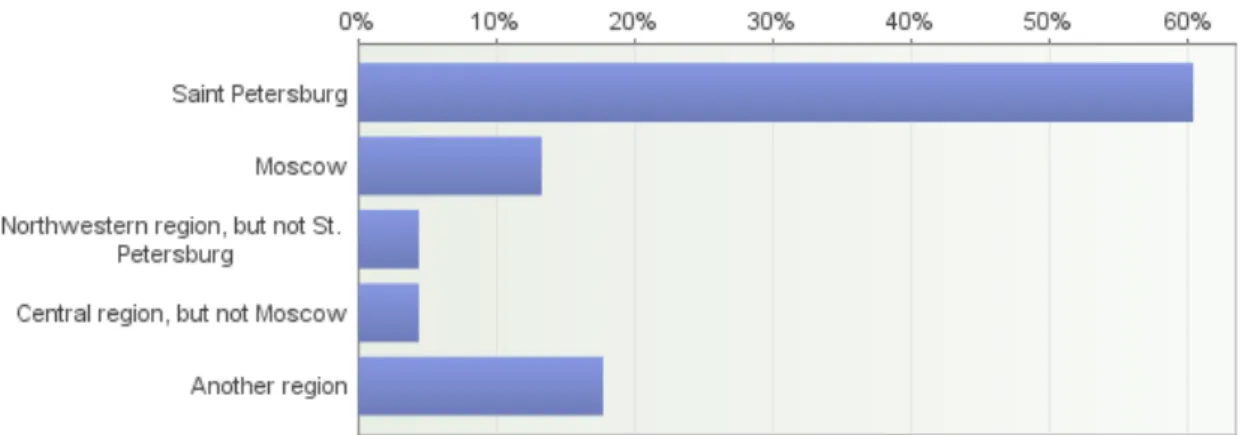
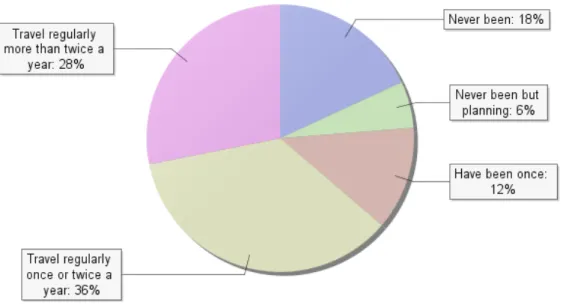
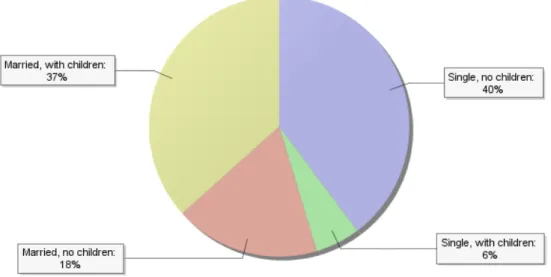
At the same time, 55 percent of respondents are married and 45 percent are single. 13 percent of respondents live in Moscow, plus 4 percent from the Central region, but not from Moscow. 79 percent of respondents travel more than once a year and 55 percent of them travel more than twice a year.
And only 2 percent of respondents never use the internet to plan and book their trips. Of all, 69 percent of respondents indicated that they always use the internet for planning and booking travel.
Russian preferences and behaviour online
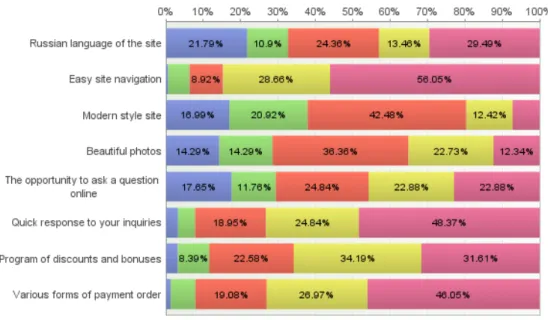
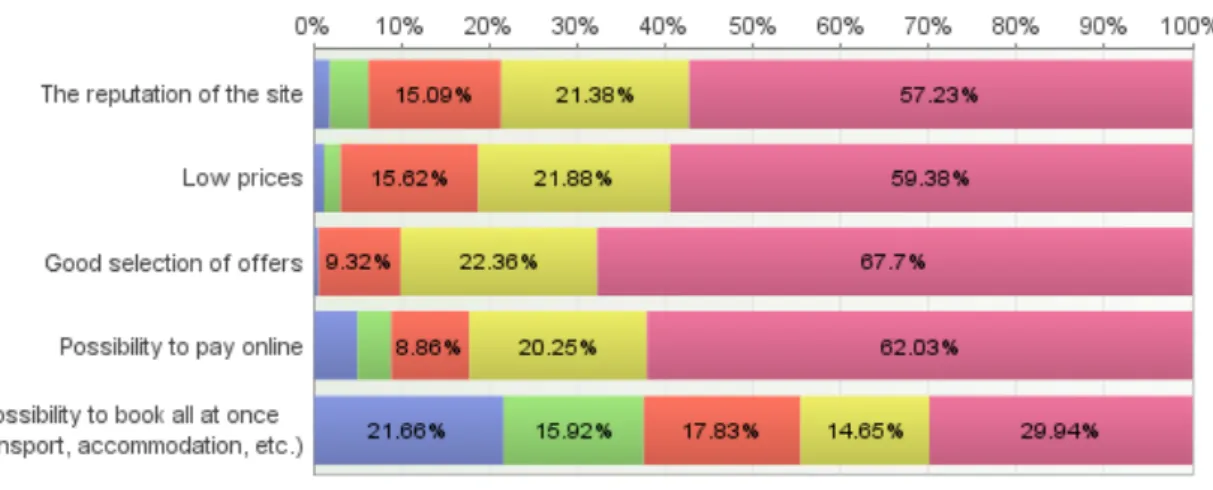
The reputation of the website is also important for the Russian customers and collected 57 percent of the respondents. The easy and clear website navigation is in the first place with the 56 percent of the respondents. Guarantees of money back in case of failure – very important for 76 percent of respondents;.
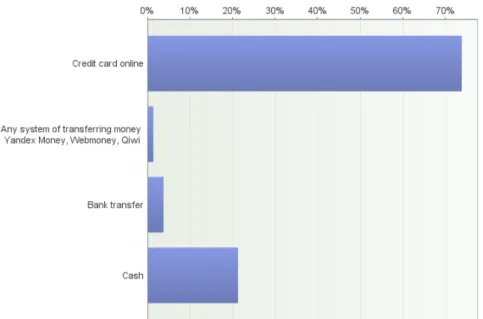
Online credit card is the preferred payment method for 73 percent of respondents (Figure 9). 21 percent of respondents still prefer to pay cash on the spot.
Russians traveling to Finland
European standards are important for 70 percent of respondents and very important for 37 percent. Good shopping is still an important factor for Russians to travel to Finland – 51 percent of respondents consider shopping as an important factor. Family vacations are often or always chosen by 50 percent of respondents when traveling to Finland.
For sports and active types of holidays, 43 percent of the respondents come to Finland. Spa holidays are even less popular and interesting for only 12 percent of those surveyed.
The comparison of the respondents with different travel expirience
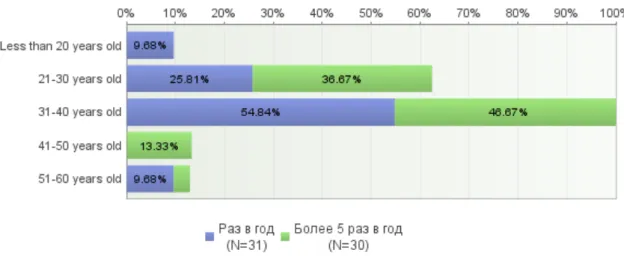
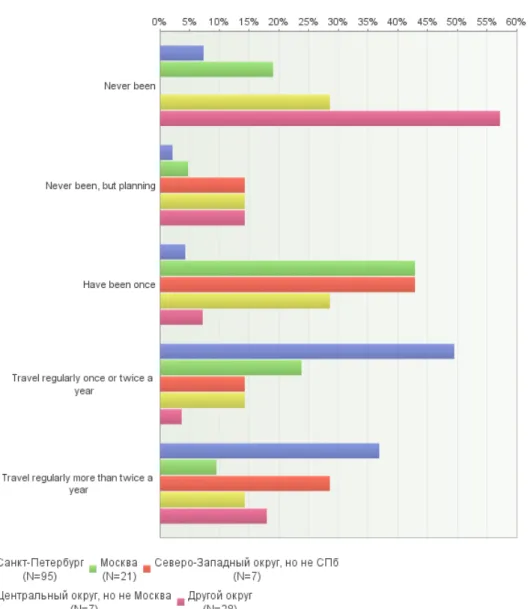
Age distribution of respondents who travel once a year and respondents who travel more than five times a year. Marital status for respondents who travel once a year and respondents who travel more than five times a year. The majority of respondents who travel more than five times a year – 76 percent always use the Internet to book and plan their trips.
The Russian language is cited as a very important feature by 53 percent of respondents from the group that travels once a year. The possibility of giving feedback had a mild effect on the trust of 24 percent of respondents from the group. For the same amount, 42 percent of respondents who travel once a year say cash is still the preferred method of payment.
Russian language service in Finland is not important for 50 percent of respondents who travel more than five times a year.