USE CASE DESCRIPTION: BASELINE AND INFORMATION CONTENT
- G ENERAL
- D OCUMENT CONTENT
- U SE C ASE NAME AND APPLICATION AREA
- S COPE
- Data exchange purpose and general information content
- Parties and applications
- C ONSTRUCTION PROCESS POSITIONING
- P RESUMPTIONS
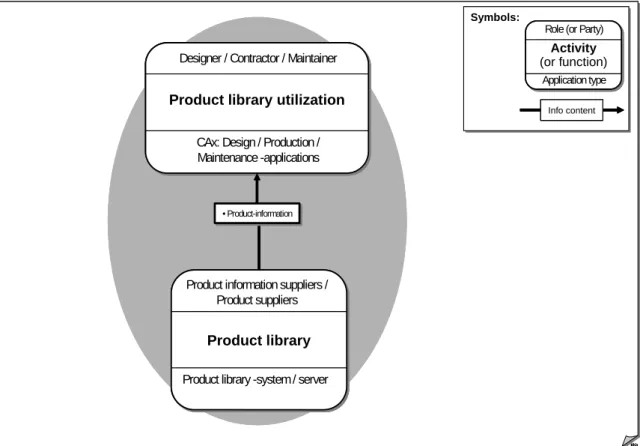
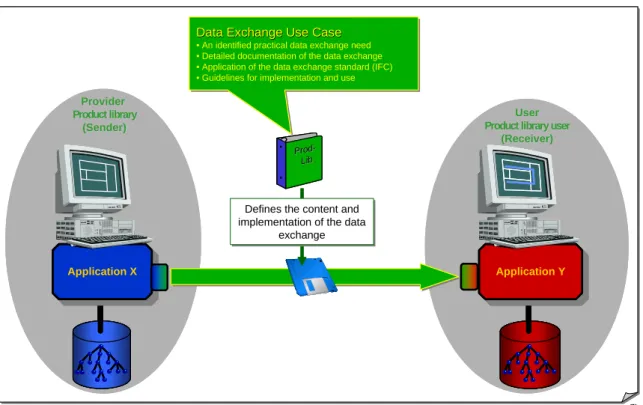
This document contains a generic level Data Exchange Use Case specification for exchanging Product Library Information. This data exchange use case is specifically concerned with the exchange of digital product data between product library systems and software applications. A data exchange use case (Usage for short) is an identified practical need for data exchange, for example in a construction project, where the requirements and implementation of data exchange are documented in detail (Figure 1).
The document describes the purpose, scope and baseline of the Use Case and specifies the information content of the data exchange in an implementation-independent form. In addition, the document describes how the data exchange of the Use Case is implemented using the IFC data exchange standard. The purpose of the Use Case is to define the exchange of product information from digital product libraries to applications that use the product library information.
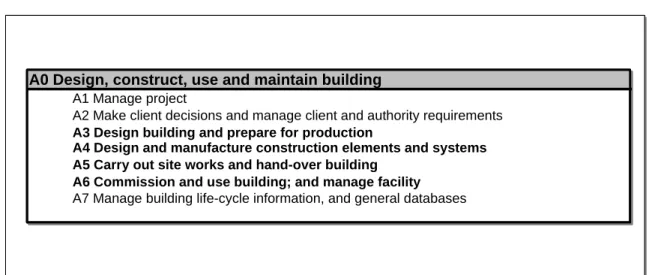
The purpose of the Use Case is to define the key information elements of product library information for the purpose of exchanging them between product library systems and applications. The positioning of the Use Case is done using the Pro IT Process Model for Building Design, Construction and Maintenance [5].
USE CASE IMPLEMENTATION: IFC IMPLEMENTATION
- M INIMUM CONTENT OF THE IFC PRODUCT MODEL
- I MPLEMENTING PRODUCT LIBRARY INFORMATION USING IFC CLASSES
- T HE U SE C ASE IFC A SPECTS
- IFC DATA EXCHANGE FORMATS AND DATA ACCESS INTERFACES
- IFC-tiedonsiirron formaatit
- Data access interfaces
The content specification of the Use Case information presented in Part 1: Section 3 is independent of the method and format used to exchange the information between software applications. The data exchange implementation specifies the means and methods of exchange (data exchange representation and format) for exchanging the information content. For data exchange implementation, the Use Case only defines the representation and format of the implementation, i.e.
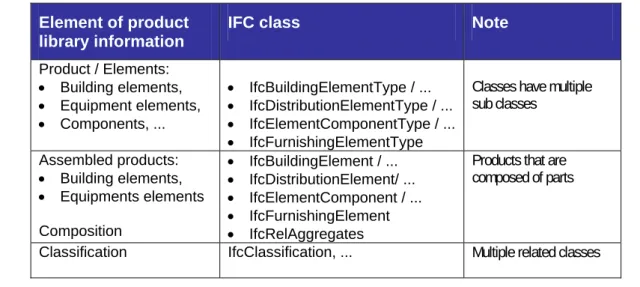
The mapping of the central information elements of product libraries as identified in the Part 1: Section 3 into IFC classes is shown in Table 1. This section describes the different parts of the IFC product data model, IFC Aspects [7], that are required. for implementing the Use Case data exchange. The IFC aspects required for the implementation of the Data Exchange use case are listed in Table 2.
IFC Data Interchange has two alternative formats for exchanging the same information content. The ifcXML format, which is based on an XML schema definition of the IFC product data model [13].
SHORT DICTIONARY
IFC aspect A grouping of the IFC object model together with instantiation instances into subsets, each of which defines a totality to enable the representation of specific aspects or characteristics of objects. IFC aspects support the specification of Data Exchange use cases and their implementation in software applications. Note: Since the scope of IFC covers more than the product (building) itself, the term project data can also be used instead of product data.
IFC Specification The entire IFC release documentation that includes IFC object model in EXPRESS/EXPRESS-G, the semantic definitions and explanations, and IFC Property Set definitions. Maintenance Library A digital library of maintenance information that computer applications can use in product (maintenance) modeling. In object or product modeling, things are modeled as objects that have properties and relationships with other objects.
An idea of rough phasing in development and accumulation of building product model data over time. Product data A representation of information about a product in a formal manner suitable for communication, interpretation or processing by humans or computer applications. For example, information about a building and the construction project stored in an exchange file in IFC format.
For example, the IFC object model is a product data model defined for AEM/FM product data. A product model of a specific building represents product data about the building in a form defined by a product data model. Product library A digital library of product information that computer applications can use to model products.
For example, a furniture manufacturer's product information library for furniture, which designers can access via the Internet and use product information as part of a building model created using a CAD application. Manufacturing library A digital library of manufacturing information that computer applications can use in product (manufacturing) modeling. In IFCs, a defined subset of the IFC Object Model that a number of implementers have agreed to support in their implementation.
IFC ASPECT CARDS FOR THE IFC IMPLEMENTATION OF THE DATA
NOTE: The Aspect Card Code in the header section is for reference purposes only – the numbering has no semantic meaning whatsoever. This aspect describes how component library information can be defined using entity types included in the IFC specification. This attribute points to an IfcOwnerHistory instance that contains information about the state of the instance, the name and organization of the user who created and last modified the instance, the software application that created and last modified the instance , and the date and time the instance was created and modified. copy was created and last modified.
LastModificationDate attributes are of type IfcTimeStamp, which is an indication of the date and time expressed as the number of seconds that have elapsed since the beginning of the year 1970. The instance of the class IfcColumn (#1) has a globally unique ID, which is generated according to the IFC specifications. All objects in a construction project have a relation to an owner history, which provides a snapshot of the most recent changes made to a particular object.
The column has an owner history (#2) with the last change action added, which points to the application (#3) and to the person and organization (#4, #5, and #6) that own the column information. The user owner has a specific Consultant role stored in an instance of the IfcActorRole class (#7). This aspect describes how objects are grouped using the grouping mechanism according to the IFC specification.
Groups are implemented using instances of the IfcGroup class (or more specific subtypes) to which group members are assigned using instances of IfcRelAssignsToGroup. Groups can be defined using instances of specific subtypes of the IfcGroup class found in the IFC object model, or using the generic IfcGroup class and qualifying the group, for example using the inherited ObjectType attribute or the Name or Description attributes. This group (the IfcGroup instance) is a logical collection of ports, and the purpose of the group is given by the IfcGroup.Description attribute, which in this case is set to the value 'Firegate', i.e.
At the bottom of the hierarchy are the format values for columns and beams ('1223' and '1224' respectively). In this case where construction types are handled, the value of the attribute will be 'ConstructionTypeClassification' (see the next page for instantiation instructions). The clear text description of the construction type is given in the value of the Name attribute of instance #11.
Instances of the IfcTypeProduct class (a subtype of IfcTypeObject) can be linked to common geometry through the representation map mechanism (IfcRepresentationMap), which offers the possibility to avoid unnecessary repetitions of the same geometry. The details of the aspect card mechanism are not described here (Aspect Card ProIT-096 gives further details). This aspect describes the sub-hierarchy for the building elements of the IFC object model and how they relate to their type information according to the IFC specification.
The building elements can relate to type information through objectified relationships of the IfcRelDefinesByType class.