Young New Horizons spawned from the original New Horizons game targeting Migrant and Host. In response to a call from the Ministry of Education and Culture, "Meaningful in Finland", students from two high schools in Jyväskylä shared their ideas and experiences on issues that concern them, including bullying, hate speech, racism, homophobia, etc.
Research background and motivation
During the second period of the fall semester, the New Horizons management team welcomed the researcher. As the team's intention was to speed up the creation of new material for the Young New Horizons game, the researcher volunteered to take on the role of session moderator at Jyväskylän Lyseon Lukio (Jyväskylä Lyceum High School) in October 2017.
Research structure
Chapter Three (3), Methodology focuses on the research design behind the article's development process. The fifth chapter (5), Discussion summarizes the research findings and confirms that the quality of the study ensures that the research questions are met.
Gamification
Chapter six (6) Conclusion will summarize the study as a whole, cover limitations, make recommendations and further research suggestions.
New Horizons history overview
Young New Horizons project
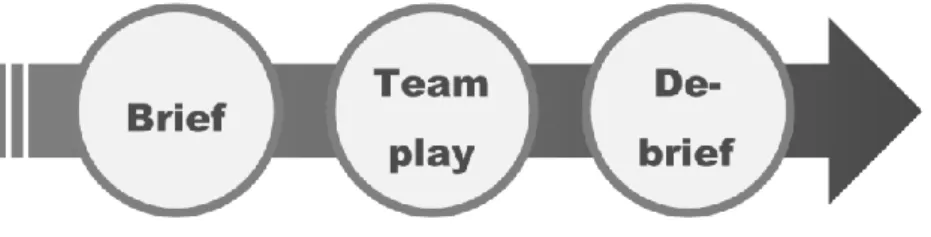
During the "Short" phase, an icebreaker activity is performed to warm up the players, and the game is introduced to the participants. The length of the game is announced and possible questions from players are answered.
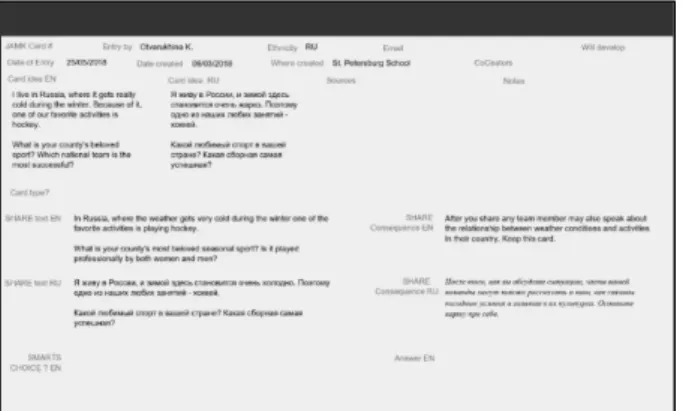
The third step is to categorize the card idea into a draft card of one of the five card types, taking into account the language of the card. It's also worth noting that a further distinction needs to be made between card ideas and card drafts - the two steps of the card development process before the final card stage.
Education for sustainable development and service-learning
Draft cards are usually card ideas processed in the project database and assigned types. As well as a third way, when a formal reflection exercise is used to help students understand how the academic and social learning objectives of the course relate to their group experiences.
Meaningful in Finland
In order to support the new composition of Finnish society and to follow the decisions of the European Union regarding the migration crisis, measures were taken by the Finnish authorities. In spring 2016, the action plan “Meaningful in Finland” was published by the Finnish Ministry of Education and Culture to prevent intolerance and promote social inclusion (The Ministry of Education and Culture of Finland 2016, 1).
Russian youth and its values
According to a recent study following an opinion poll by Fonda Общественного Мнения [Public Opinion Foundation] (2016), Russian youth most value mutual understanding and good family relations, as well as materialistic prosperity and comfort. In this chapter, the methodological choices of the current research are presented in detail, and the reasons for their use are also given.
Research design
The purpose of this research is to explore the contemporary values, views, concerns and interests of the demographic in question; also, expand the Young New Horizons deck by using existing game facilitation and creating card maps from card ideas developed by Russian high school students. The input from the population through card ideas and group interviews provides the foundation for the next generation of New Horizons game content. inductive data analysis moving from specifics to general themes and the researcher's interpretations of the significance of the data. This way of thinking interprets the analyzed phenomenon from the point of view or perspective of the participants using different methods of data collection.
Moreover, the researcher forms meanings from the phenomena under study through their own experience and that of the study participants. Dickson 2016, 5) Due to the large number and variability of these meanings, the researcher is led to explore the complexity of opinions and views, with the aim of making the participants' views dependent on the situation in question (Creswell 2014, 8). In their journey to find the true state of the situation under study, the researcher participates in activities like residents do in natural environments to gain personal experience or see how others experience it (Dickson 2016, 5).
Processing of the speech or text content is recommended to be done by means of content analysis and involves the search for text structures and patterns as the basis for making inferences (Darke et al.
Population and sampling
Non-probability as well as persuasion samples were chosen to serve as data collection techniques as the research aimed to obtain the population in the most affordable and rapid way and to avoid biases in the collection of focus groups. In this type of sampling, it is very likely that the units or potential cases will be more committed to participate in the study, which can help improve attention and ensure the willingness to contribute better and provide a overview on the topic (Sharma 2017, 752). Regarding the content of the focus group interview, several culturally oriented topics were touched upon during the interview.
Data collection, analysis, and implementation
The technique is explained in the section "Young New Horizons project" in the Background chapter (Subchapter 2.3). The opening, as well as the entire facilitation process, took place exclusively in English, as it was embedded in the lesson algorithm. As can be seen from the photographs, a specific spacious room was chosen to accommodate the participants in the facilitation.
In addition to the information left on the cards, primary data consisted of data obtained from thoughts and feelings exchanged during the interview. The purpose of the interview was to gain the population a deeper understanding of the topics that were not expressed on the created cards, but are found in the list of "Topics and topics related to youth cultural content". The draft cards were assigned types, the content language was checked, and the drafts were forwarded to the New Horizons team at JAMK for further development and finally implemented as final cards.
The cards that were created as a result of the current study brought about sufficient improvements in the deck and expanded its thematic scope.
Research timescale
An oral consent form was used at the beginning of the interview to ensure the integrity and quality of the process. Therefore, scholars conducting an ethnographic study will utilize the maximum potential of the native language when conducting interviews. The information from the interviews was used in a format of topical opinion in the form of informants' direct quotes which were categorized according to each theme.
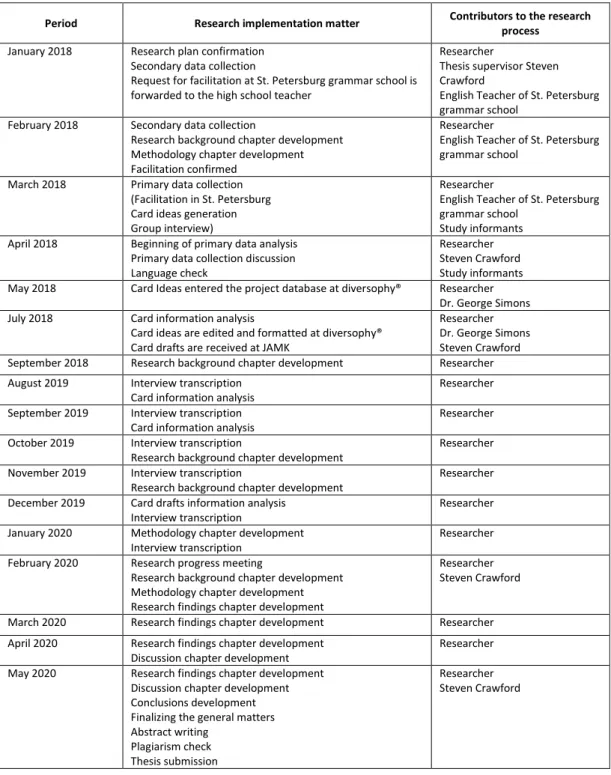
In May 2018, the card ideas were entered into the database at diversophy® and later analyzed through a content analysis method, determining the main and subtopics. As of spring 2020, the cards have been successfully included in the Young New Horizons game, which consists of 450 different types of playing cards. Researcher Steven Crawford Study Informants May 2018 Card ideas have been entered into the project database at diversophy® Researcher.
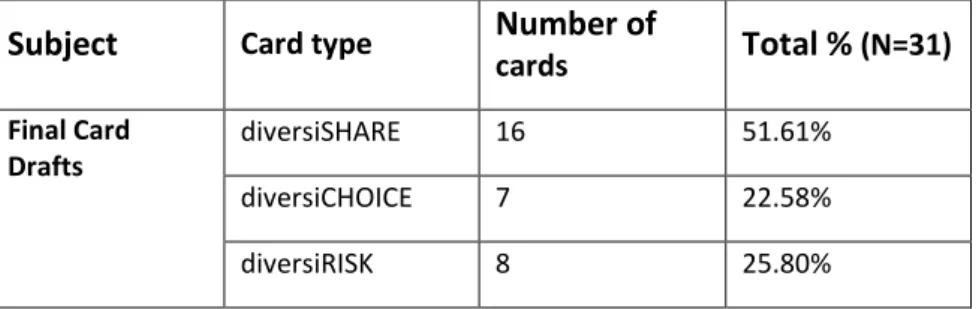
This chapter focuses on demonstrating the results of the research in the form of the draft model of the cards obtained through the processing and classification of the card ideas; and will feature interview transcripts that demonstrate new insights gathered in the research process and organized by overarching themes.
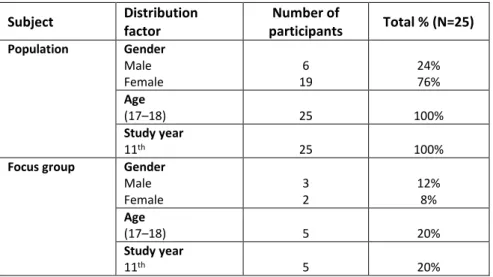
Demographics summarized
The section will also provide an overview of demographics as well as generated map types and themes.
Card findings
Interview findings
- Relationships and dating culture
- University studies and work
- Contemporary world situation
- School uniform and self-expression
- LGBT+
- Mental health
- Recycling
- Equality
- Existential worries
- Public display of emotions
- Future kids’ life
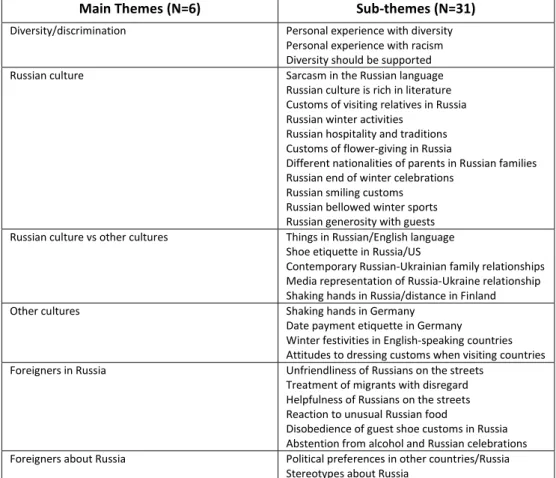
In terms of themes, generated by the population during the card-making session, there were six main ones, as well as 31 sub-themes. Informant M1 answered as follows on the topic of family finances: "In the family, the one who earns more pays for everything. Informant M3 added the following on the subject: “There are always two voices fighting in my head about this.
What do you think about the global state of the world and how would you feel if Russia opened its borders to the migrants?. In addition to their first point, informant M1 expressed anger and frustration at the current restrictive situation in Russia: "The environment here causes depression. Regarding the lower wages, they could get responsibilities and tasks similar to men, but then they will underperform.
Similar to the logic expressed in an opinion by Informant M1, Informant F2 shared their view of female role hierarchy. Male informants showed a willingness to.. answer the majority of questions as soon as they were expressed. The researcher connected the study to the project in a logical way and the nature of the project led him well to the discovery.
Reliability of the research approach, data collection and conclusions
The opinions of students about inequality within Russian society visibly differed from men to women, which is considered important by the researcher. However, most students expressed a willingness to contribute to the future of Russian society, and also said that they felt challenged by reality but sought to excel in personally relevant activities. When looking at the study as a whole, the Young New Horizons project also becomes . well intertwined with the research.
The research demonstrates cross-cultural relevance and could be of interest and benefit to any community or organization working with young people or conducting research into said demographics. All activities of the study worked together holistically in an easily integrated way to arrive at the end result. George Simons at diversophy® and the fieldwork with the high school in Russia, collecting the data and processing the data created a robust system.
This type of system has worked productively and managed to take the research from start to finish.
Recommendations and suggestions for future research
A significant insight into modern Russian youth culture was gleaned from the semi-structured interview. Retrieved from https://www.researchgate.net/publication/309413398_CONSTRUCTIVISM_PHILOSO PHICAL_PARADIGM_IMPLICATION_FOR_RESEARCH_TEACHING_AND_LEARNING Finnish Immigration Service. The Gamification of Learning and Instruction: Game-Based Methods and Strategies for Training and Education.
Using Generic Inductive Approach in Qualitative Educational Research: A Case Study Analysis Journal of Education and Learning, 5. Retrieved from https://files.eric.ed.gov/fulltext/EJ1097415.pdf Ministry of Education and Culture.
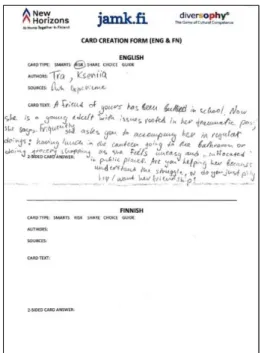
Card Creation Template
Final card drafts for the Young New Horizons game
Facilitation process photographs
Card creation process photographs
Interview oral consent script
Themes and Topics Related to Youth Culture Content” list