In addition, the goal was to uncover how the report could be further improved to meet customer expectations. The goal was also to gain knowledge about how the report is used by customers.
Company presentation
The topic was chosen because the author's employer, DHL Global Forwarding (Finland) Oy, was looking for new ways to understand the needs of its customers. The purpose of this research is discussed after the company presentation where a starting point for this research is introduced, as well as the objectives of this research.
Purpose of the study and research objectives
Conceptual Framework
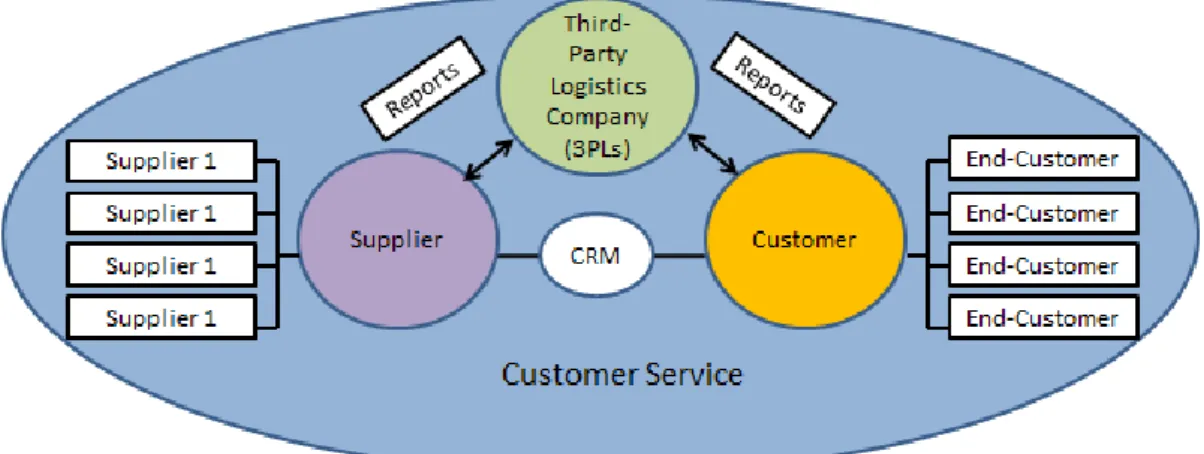
Defining Customer Service
Since accessibility is an aspect of customer service, customer service is paramount in a situation where the customer is faced with an abundance of products or services to choose from. The strength of customer service as a determining factor for purchase also applies to industrial markets.
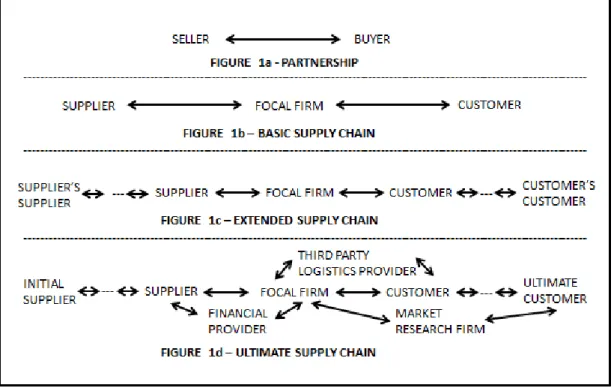
Defining Supply Chain
A basic supply chain consists of a firm, a direct supplier, and a direct buyer that are directly connected to one or more upstream and downstream in the flows of products, services, finance, and information” (Mentzer 2001, 6). Supply chain management is defined as the management of all key processes between members of the supply chain.
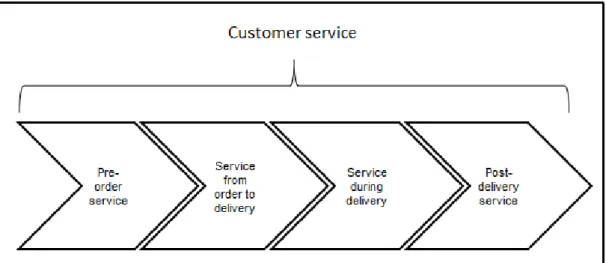
Customer service in supply chain management context
The transactional elements of customer service often receive the most attention because they are the most immediate and obvious to the customer. The post-transaction elements of customer service generally support the product after the customer receives the product and while it is in use.
Customers and customer life cycle
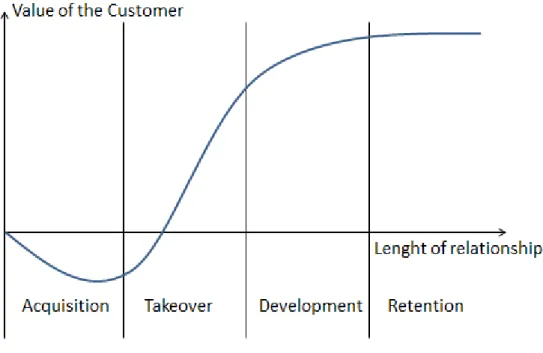
The level of customer service to customers determines whether the organization is able to retain existing customers and how many new customers it will attract. Customer relationships are first and foremost interaction, and from a value-creating perspective, it is in the interaction where value is created for the customer. The interaction varies in different phases of the customer life cycle because the relationship with the customer develops and the interaction changes and deepens over time.
During the activation phase, the entire portfolio of products and services is used to meet the customer's needs. The goal is to increase the customer's purchase volume to a greater level so that the company does not have to sit back and wait to see if the customer needs to buy more. When the customer is in the mature stage of the life cycle, the focus should be on customer retention and recovery.
CRM in customer life cycle
The interaction varies during different phases of the customer life cycle because the relationship with the customer develops and the interaction changes and deepens over time. recognizes an ongoing business concern, where the emphasis is too often on winning new customers and acquiring new accounts, while successful implementation of the marketing concept requires companies to both win and retain customers. The goal is to increase the number of customer purchases, and on the other hand also give a feeling that there is a genuine interest in them as a customer. However, the main objective is to commit the customer to buy and return to the company and to act as a referral to their inner circle.
Carrying the customer relationship through the life cycle and its different phases could be considered a CRM challenge. First, a customer is acquired, and then an attempt is made to increase the customer's purchases in order to turn the relationship into a profitable one. An attempt is then made to strengthen the customer relationship by actively emphasizing customer loyalty.
Customer evolution and retention
The goal is to increase the amount of customer purchases with discounts and other targeted actions. In the more mature stage of the customer life cycle, the effort is to retain the most profitable customers. Although the goal is to achieve sales and profitability targets, the company must remember to increase the value of customer relationships.
Conclusions can be made such as, how much should be invested in customer relations for it to maintain. By examining the purchase history of the entire customer base, customers who meet the best criteria can be identified. Investing in activities related to customer satisfaction and customer retention can be considered the most important factors in extending the duration of the customer relationship as well as customer loyalty.
Argument for the method selection
Qualitative research is not aimed at generalization, but is intended, for example, to question 'old' ways of thinking and also to explain phenomena in a way that makes it possible to think differently. If qualitative research is all about quality, quantitative research, which is about quantity, is its opposite. The results obtained from the data are intended to generalize to a wider set and they can be illustrated with figures and tables.
The nature of a qualitative research is a comprehensive acquisition of information and the data is collected in both natural and real situations. Qualitative methods are used in the acquisition of material, in which the views and voices of those being studied can be expressed. Testing a theory or a hypothesis is not the starting point, but a complex and detailed study of the material.
Data gathering and analysis
The last question about the report wanted the interviewees to rate the importance or usefulness of the report on a scale of 1 to 5. This question sought to provide an unequivocal result for the need for the report and in addition to comparing the results with interviewees'. The companies chosen to be interviewed receive the report on a monthly or quarterly basis, eliciting a stronger need for the report compared to the customers who receive the report twice a year.
The interview started with a question about the opinion of the interviewee on the contents and prospects of the report. The second main question wanted to know how the interviewee's company used the report and for what purpose. Finally, the interviewees were asked to rate the importance or usefulness of the report to their company on a scale of 1 to 5, where a score of 5 meant very important or very useful.
Perceived Experience and Areas of Improvement – Theme 1
We are satisfied with the content and prospects, the report is easy to understand and the information is easy to find. One interviewee pointed out that the report could look different if it included more data (shipments). Such a scenario occurred during an interview where the interviewer had an opportunity to provide a tutorial of the report.
It is good to have a lot of data so that the report can be used for many purposes. One absence that is but practically can be difficult to add to the report is our purchase number. The customer was active on the reporting list, but the error was a typo in the customer's email address.
Usage of the report – Theme 2
The report is only used for tracking, that is the shipping trend is going where we thought it would go. The report is sent to our claims department and also to our owners.” (Interviewee 10). I take care of logistics and procurement, so I look at trends from the report.
We keep track of the ratio between air and sea freight and easily compare this with the reporting. The report is for my use only and I summarize its contents in our key performance indicators.” (Interviewee 5). The report is mainly in my use, although sometimes my boss (logistics manager) may look at it.
Summary of Research Findings
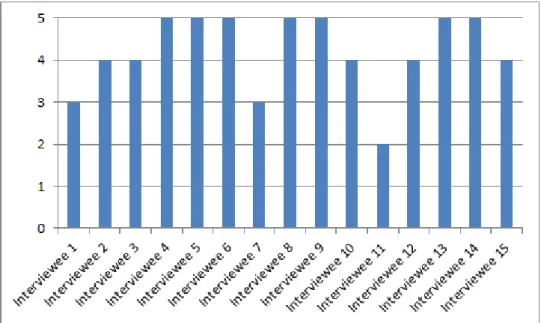
Questioning how the customer uses the report revealed that its primary two functions are to track shipments and compare shipments to other shipments. The final question was a mild rating of the report's importance and/or usefulness to the client on a scale of 1 to 5, where 5 represents very important or useful. As shown in the figure 5, the report was rated as a 5 by 7 respondents, which means that the report is very important or useful to them.
No further explanation was asked because interviewee 11 has already explained that the report is just nice to get information that you see. Below are a few of the comments made by the interviewees after they rated the report. Although the report contains unnecessary information for our company, it is still very valuable to us.” (Interviewee 8).
Conclusion and Recommendations
She could not say what kind of reports they might be, but that the client would appreciate it if information about the availability of the new reports was shared with them.
Reliability and Validity
The time of the calls was during working hours, so it did not interfere with the interviewees. Also, none of the interviewees asked to see the questions beforehand, which of course would have been done. Because the interviewees answered the questions on the spot, their answers were honest and truthful.
The interviews were an open conversation in which the interviewees were given plenty of time to think and answer the questions. All of the above and the fact that the interviewees remained anonymous improve both the reliability and validity of the study. The interviewees also did not know and were not told that the author was involved in the production of the report.
Discursion
The review was well received by the customers and for most the content of the report is sufficient. The report achieved an average score of 4.2 on the rating question, which means that it is considered important and useful by the customers. Furthermore, the knowledge about the different ways customers use the report helps DGF to improve the report in the future.
Although the report received generally positive feedback, the survey raised questions about whether all customers who receive the report find it important. A suggestion for further investigation is to expand the investigation to also include other customers who receive the report. Although some generalizations could be drawn from this research, the research also showed that customers have different needs for the report.