The purpose of my thesis was to study the current state of destination induction in Ylläs. As a result of the meeting, the thesis idea was formed to study the current state of destination induction in Ylläs.
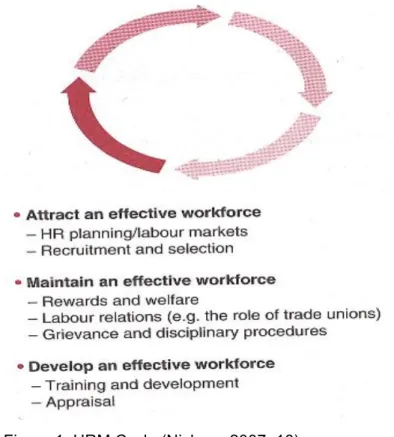
H UMAN R ESOURCE M ANAGEMENT IN T OURISM
The best fit is aligning HRM with the company's product market strategy. The division of HRM policies into hard and soft approaches or best approach and best practice approaches is fairly theoretical.
H UMAN R ESOURCE D EVELOPMENT (HRD) AND T RAINING
H UMAN R ESOURCE D EVELOPMENT
In addition to introducing the employee to the events of the organization as well as providing a source of entertainment. The focus on increasing training and carrying out proper training results positively to the productivity, profits and quality of enterprises as well as the development of employee skills and the increase of organizational capacity (Grugulis 2007, 7).
Conducting Training
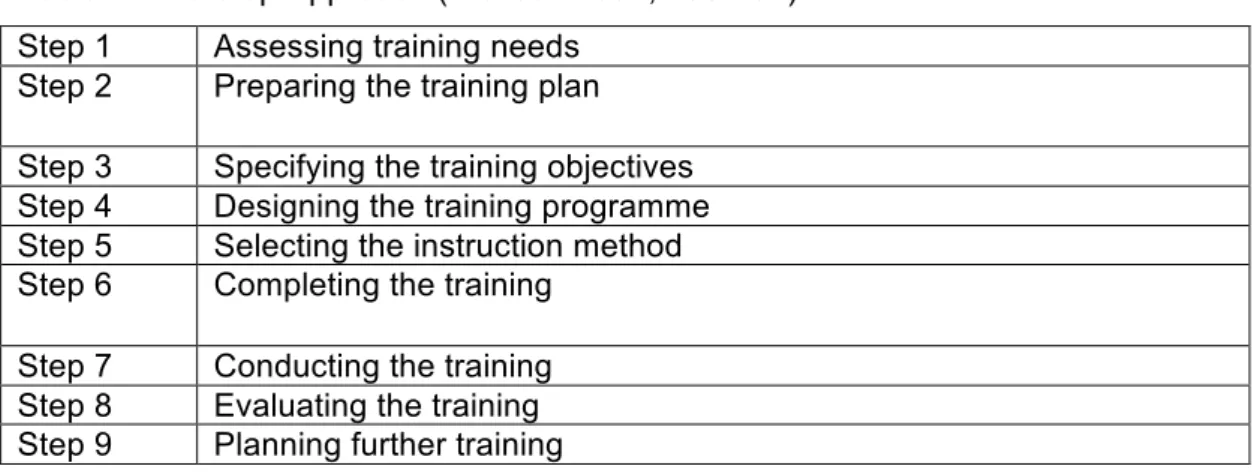
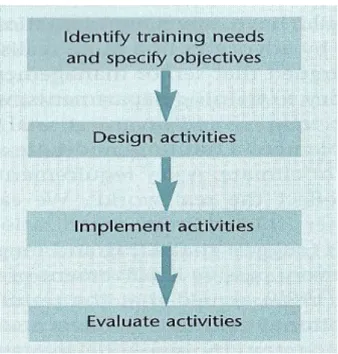
The planned and structured development process enables management and employees to participate in all phases of training. The nine-step approach in Table 1 presents the stages that should be considered when planning training.
C HALLENGES OF H UMAN R ESOURCE M ANAGEMENT IN T OURISM
Also, another challenge for the application of responsible HRM in the tourism sector is the general attitude of employers. The resort believes that the main factors of its success are the employees of the area.
Y LLÄS AS A T OURISM D ESTINATION
Y LLÄS T RAVEL A SSOCIATION
In May 2010, the development team went on a comparison trip to Pyhä-Luosto and Levi, which are both part of the Destination Quality Network Program. As a result of the trip, it was agreed that for the future the quality teams from the three tourist centers would meet once a year to increase cooperation.
D ESTINATION INDUCTION IN Y LLÄS PART OF D ESTINATION Q UALITY N ET
Ylläs winter and summer brochures are distributed in the bus, as well as the local newspaper Kuukkeli. The member companies of the Ylläs travel association are informed by e-mail about the destination induction bus.
I NDUCTION
Applying destination induction to all employees working in the area undoubtedly results in similar benefits to organizational level induction. In the ski area of Whistler and Blackcomb, the resort strives to create a family feeling among its employees.
C ONDUCTING I NDUCTION
Each destination probably has a lot of information to include in the induction content. One challenge, when planning the duration of the induction at the destination, is that it involves many companies in the area and their workers. However, some general truths should be considered when planning the duration and timing of induction.
In planning the material, the same principle as when planning the induction content should be kept in mind: "keep it short and simple". This is due to the fact that the induction target group is so broad and large. Two factors of induction are measured: Analysis of the trainee situation and the functionality of the induction process.
Analyzing the functionality of the induction process focuses on evaluating trainees and trainers and their operations in the induction situation.
R OLE OF L EARNING IN I NDUCTION
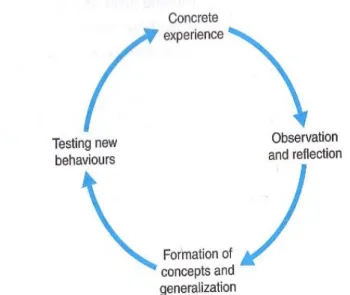
Comprehensive learning requires active participation by the learner to ensure overall understanding of the problem being taught. Creative learning takes place when the learning situation contains a lot of conversations and reflections on the issues being taught. In the case of an introduction, this will mean that the trainee has an active role in the introduction situation and gives feedback on the new working environment.
In order to reach the level of creative learning, it requires a critical view of the trainee on the issues taught. In order to provide effective and pleasant training, the trainee must be aware that he/she has an influencing role in the learning process. Ultimately, the learning process and the implementation of the training takes place in the trainee himself.
Ultimately, the structure of the training should be logical and follow the step-by-step principle.
T HESIS P ROCESS
M ETHODS U SED
A survey for seasonal workers in the destination induction bus was conducted in the 7th week of February 2010. The survey was aimed at entrepreneurs in the Ylläs area in order to find out the attitude and attitude of entrepreneurs towards destination induction in Ylläs. The survey was sent by e-mail to all 235 members of the Ylläs Travel Association.
However, as the survey targeted those entrepreneurs who had seasonal workers in their businesses, it was roughly estimated that there were approximately 50 businesses that would be in the segment to complete the survey. Although it is not required for each interview to cover exactly the same questions, it is expected to follow the specific themes of the interview (Tuomi–Sarajärvi 2002, 77). The interviewees were the participants in the induction bus who had left their contact details in case further investigations were needed.
Interviews were conducted to find out the opinions of seasonal workers after the season and whether the information provided in the target induction bus was useful throughout the season.
C URRENT STATE OF DESTINATION INDUCTION IN Y LLÄS
Educator, Education Method, Informing and Point of Time of Induction
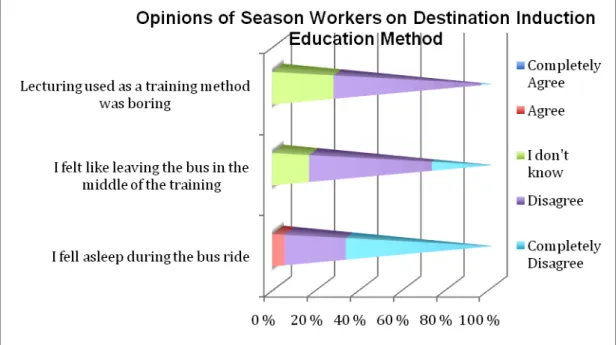
Almost half of the season's workers would have preferred company visits to be included in the destination induction. Also the results of the interviews for the seasonal workers indicate that the method of education lacked action. More than 50 percent of the entrepreneurs also reported that their employees benefited from participating in the induction bus tour.
The interviewed seasonal workers also agreed with the bad point about the training period. However, the part that did answer thought that the frequency of realization of the induction bus was too little. The seasonal workers felt that the destination induction bus was to improve their knowledge of the area.
It was also suggested that at some point during the destination introduction the seasonal workers should be introduced to each other.
Induction Content and Material
The material was considered to be significantly useful for work and leisure, as well as to support learning. It is irrelevant, however, that many would have taken the materials handed out on the bus to work to share with their colleagues. This indicates that the material was not necessary to be read during the bus ride and therefore answer 3 “I don't know” has been checked (Figure 12.).
The interviews also revealed that many of the seasonal workers in the destination induction bus did not have the chance to read the material and some only skimmed the material. A relevant part of the season's workers did not read the material given on the bus at all. The material distributed in the destination induction bus was considered to be aimed at tourists.
A clear leaflet for induction into the Ylläs area for employees, which would be distributed to them in the induction bus..'.
Attitudes and Motivation on Induction
Kuukkeli was seen as an advantageous package from all existing introductory material when it came to work and leisure. Kuukkeli was considered to contain a lot of contact information, information about events in the area and happenings. The summer and winter brochures were seen as information aimed only at the needs of tourists, but useful to some extent for leisure.
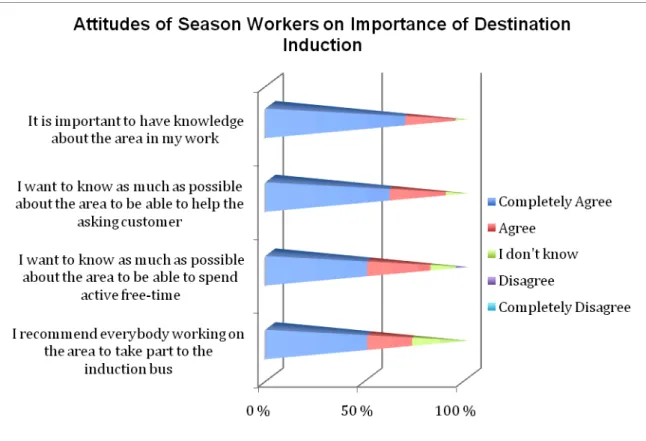
In general, the existing Ylläs material was perceived as vague, slow to use and impractical for work and leisure. The interviewed seasonal workers experienced that the motives for cooperation are self-interest and the possibility of helping customers. In addition, most entrepreneurs recommended the destination induction bus to all their new workers and found it important to know the destination.
Very few thought that participating in the destination induction bus was a waste of time (Figure 16.).
C ONCLUSIONS OF R ESULTS
The interviews for the seasonal workers were used to find out whether the content, material and implementation of the introduction during the season were beneficial. It was clear that the information provided about Ylläs and the content of the introduction did not always serve the interests and needs of the interviewed seasonal workers.
V IRTUAL T OUR IN A UDITORIUM
After the virtual tour, snacks and drinks would be available and the participants would be divided into teams. The teams would be formed with the principle that people working in the same place would not be in the same team. The content of the game will be approximately the same as virtual bus tour has.
By playing the game, the seasonal workers would get to know each other and at the same time strengthen the sense of community. When the seasonal workers have finished playing, they will be given a small feedback/examination form. Each intern must complete the feedback/examination form in order to receive the Ylläs Staff Pass, which entitles to a discount in the area.
By collecting the feedback/examination of all the participants, the organizer can monitor the level of learning and receive improvement suggestions to develop the induction.
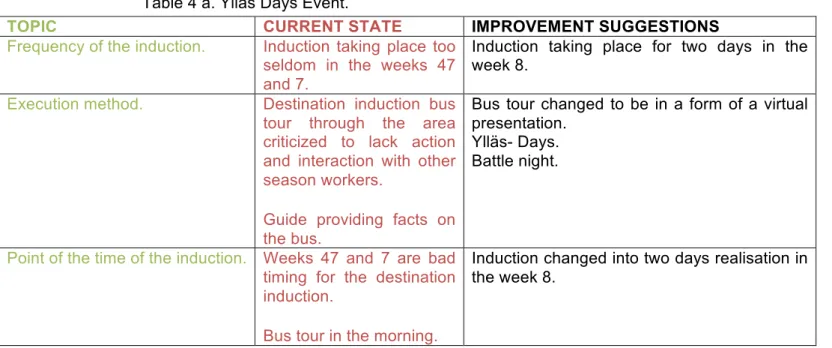
Y LLÄS D AYS E VENT
In addition to both proposals, the induction material would also be in electronic form. The participants in the bus were all, except one, first time in the bus and working in the area. The survey for the entrepreneurs in the area was a good way to get the entrepreneurs' opinions about the destination introduction.
In Ylläs, there are no written descriptions or regular measurement of the results of the destination induction. At the end of the audiovisual presentation of the area, feedback collection and distribution of the induction material would take place. Through the collection of feedback, the continuous development of the destination induction process in Ylläs would be ensured, and the development would take place according to the wishes of the induction target.
This would ensure the functionality of the induction process and result in the successful recruitment of employees at the destination. The training plan should include the training initiative, methods, time and place of the training. A crucial part of the training is to determine and specify the training goals for the trainees.