In addition, this thesis research examines how effective strategy communication can facilitate the execution and alignment of business strategies. Additionally, this Thesis research would not have been implemented without the contributions of the entire Polarica workforce.
Background and Motivation
The case company started a new strategy trajectory in the fall of 2014, when a new CEO was appointed. The researcher has a special interest in communication development and aspires to contribute to the communication strategy in the case company with this research.
Company Polarica
The new owners planned to invest capital in the company to achieve organic growth. The new CEO's first priority task was to plan, formulate and implement the company's new business strategy for a period of three years.
Research Objectives and Questions
The set of the two research questions presented above analyzes the current strategy alignment and commitment to strategy execution in the case company. To answer the third set of research questions, a strategic communication plan for the case company will be prepared.
Limitations of the Research
The communication plan will be designed in accordance with the communication needs of management, business units and individual employees in relation to the company's business strategies. Another limitation arising from the issue of time constraint is that the effects of the development work for the case company will not be revealed in this thesis research.
Structure of the Thesis
However, being a researcher and a member of the research environment at the same time is not an easy task to accomplish. In the last part, chapter 5, qualitative and quantitative research analyzes are triangulated and reflected.
Single Case Study
The theoretical framework helps in planning and conducting the data collection work in this thesis research. In order to combine and integrate the evidence, data triangulation was used in this thesis research.
Data Collection
Several sources of evidence have been used in the data collection and the data has been triangulated to strengthen the construct validity of the case study. Structured employee questionnaires are used as one of the main empirical data collection tools in this research.
Data Analysis
One of the research objectives of this thesis is to clarify the role of middle managers in a concrete company regarding strategy integration. In addition, the analysis of the interviews allowed the researcher to identify which processes are key to the development of strategy alignment and integration in the company in question.
The Importance of Strategy
This chapter focuses on the core concepts of the strategy and on the crucial planning and formulation phase. The strategy planning phase is undoubtedly decisive for the case company's performance and success. It can be said that the building blocks of a strategy define the strategy itself and provide prerequisites for a clear interpretation of the strategy (Bossidy & Charan 2011, 182).
Rumelt (2012, 9) emphasizes the importance of agility, which means that a good strategy must be adaptable to changes in the competitive situation. What's more, solid strategies ensure consistency between all decisions in the company.
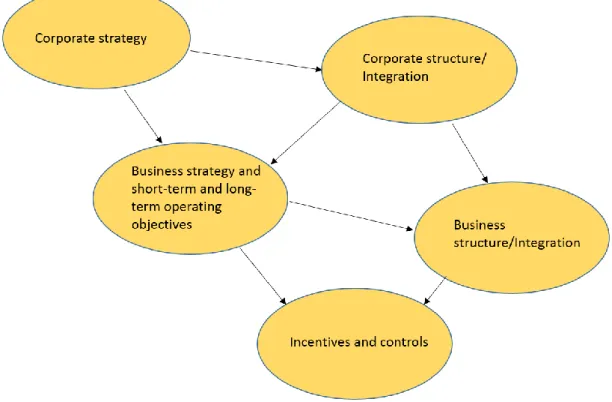
Planning and Integration of Corporate and Business Strategies
The corporate structure, on the other hand, contains the various business units created by the demands of the corporate strategy. To make the new organization function optimally, structural changes are necessary to achieve integration. After creating the most optimal corporate structure, business strategies should be set at the business unit levels.
Consequently, business strategies are essential in themselves because they help achieve competitive advantage and profitability for a company as a whole.

Information Sharing and Communication of Strategies
When companies implement new strategies and establish a mutual vision, it is important that honest two-way communication exists between senior management and key people at operational levels. Hrebeniak, a professor at Wharton University, conducted a leadership study aimed at gaining an understanding of the challenges leaders face when making decisions and executing their companies' strategies. It is clear that companies in general struggle with strategy communication and internal information sharing.
Therefore, it is important to consider the importance of transparency and open communication in the case company. They have the right to know in what ways they can influence the success of their companies.
Executing Strategies
Alignment is the integration of the daily activities of teams and units, directed towards achieving the company's strategic goals. If the case company is unable to implement, align and communicate the meaning of the strategy internally, it is difficult, if not impossible, to lay out strategic plans and achieve short-term and long-term goals and objectives. This in turn requires alignment of values, vision and strategy at all levels of the organization.
By clarifying the common proposal of the company's strategy, employees can work together towards common goals. Total alignment can only take place when there is an environment of absolute trust and open communication, where employees can freely influence and question their agendas for the benefit of the common good (Leibner, Mader & Weiss 2009, 62).
Linking Strategy with Organizational Structure and Operations
It is also crucial to achieve coordination and exchange of information between units in the organization. Alignment between strategy and organizational structure is necessary, as it is not important to have the most optimal strategy if there is no support from the appropriate structure. Therefore, when changing the organizational design, it is important to maintain a focus on integration and exploitation of synergies.
As companies implement organizational changes and develop new strategies that require integration and adaptation, it is critical to ensure that employees at all levels know their purpose in the organization. In the end, it is not the best-laid plans that ensure success; it is execution of the plans.
Linking Strategy to Employee Performance
Integrating HR and Business Strategies
HR can play an important role in detecting knowledge in the company, designing structures and roles, and planning processes and practices that facilitate strategy execution. In addition, HR finds that an ethical approach permeates business practices, leadership behavior and decision-making. case company hired an HR director in the spring of 2015. The goal of the HR director in the case company is to support other functions in the organization.
The Human Resources Director is part of the management team and regularly attends team meetings. In this way, the HR Director can help and influence the execution of strategies in the case company.
Performance Evaluation
By measuring the results of activities related to strategy implementation, companies can assess what knowledge, training, support systems and processes employees need to perform daily tasks and work toward the company's strategic goals.
Employee Commitment and Motivation by Incentives
Furthermore, when employees are engaged, they are more likely to be innovative, willing to share their ideas, more connected to mutual goals, more productive and accountable, and more likely to act as ambassadors. of their company's brands. Employees should be trained in building their work skills and increasing their career development opportunities. Furthermore, the corporate culture should be characterized by a good working environment, cooperation, fair treatment and learning and growth.
Furthermore, incentives should be linked to individuals' contributions, not to seniority or relationships (Khadem 2008, 34). Strategic goals must be reinforced and rewarded for execution to be effective.
Communication as a Tool for Alignment
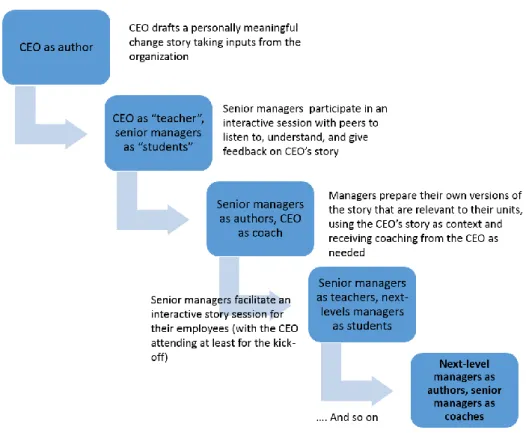
Regardless of the form of incentives in companies, it is crucial that reward systems and incentive programs are aligned with the results of strategy implementation and individual work goals of employees. If employees get a sense of ownership, they will be much more committed to results. The cascading process continues in this way until the message of the strategy is communicated throughout the organization in ways that make the strategy and its meaning understandable to all.
Strategy reviews are a good way to assess whether changes should be made to the communication plan. As strategy and execution are reviewed, changes to the strategy communication plan can be made accordingly.
The Role of Leadership
Managing Change
During mergers and acquisitions, extra attention should be paid to preparing for the emotional responses of employees involved in the transformation. When companies execute strategies or plan change initiatives, several fundamental issues should be kept in mind to reduce potential barriers to change. First, the size and content of the change must be determined and the time available for the change.
It should be clear in which ways changes are to be implemented and who is to be responsible for various aspects of the change process. Furthermore, dialogue and conversation about the process must be transparent, and there should be a relentless focus on values.
Managing Organizational Culture
It is important to demonstrate what the results of the changes will be, that is, what will be different for the employees or their teams when the changes are implemented. The employees must be engaged in the change process, they must be drawn in instead of being pushed. Furthermore, when two organizational cultures merge, managers should analyze the most optimal way to handle the culture clash.
In most cases, one of the two cultures will dominate and eventually convert or exclude the other culture. Clarity of focus, continuous communication and role modeling are qualities that a CEO and other top managers should master when creating new organizational cultures (Holbeche . & Matthews.
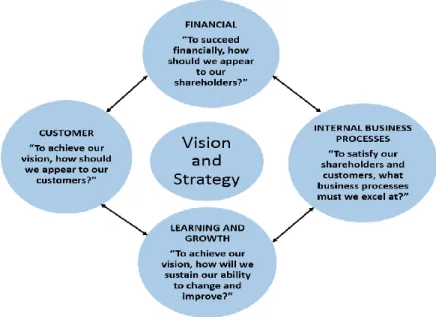
The Balanced Scorecard as a Strategy Performance Tool
The current business strategy of the case company is described in the first part of this chapter. The cornerstones of the company's strategy are discussed, as well as the various initiatives planned for the three-year period. The last part of this chapter presents a holistic SCP that could improve knowledge and understanding of the company's business strategy.
I have full confidence in the success of the company's current business strategies and believe that the company's strategic goals are achievable. My superior directs and supports me accordingly in achieving the company's strategic goals. In your opinion, did you receive enough information and was the communication of the company's current business strategies adequate?
In your opinion, let your subordinates internalize the concept and meaning of the company's business strategies.