The e-mail and instant messenger with the bulletin boards of the SharePoint were created to improve internal communication. The key factors in improving knowledge management of the company were the document libraries that were created.
Background of the thesis
The purpose of the work area is to develop the availability of information and its management, as well as to improve the internal electronic communication in the company. The interviews were conducted with each of the directors to gain access to their views on the problems in the company.
Objectives and scope of the study
The first questionnaire aimed to depict the problems in general, and the second focused on the problems of knowledge management, sharing and accessibility. After the virtual workspace is put into use, it should improve the company's internal communication and information sharing and help employees find information and thus improve their expertise.
Outline of the thesis
Research Questions
Research Methods
- Qualitative research
- Interviews
- Quantitative research
- Survey
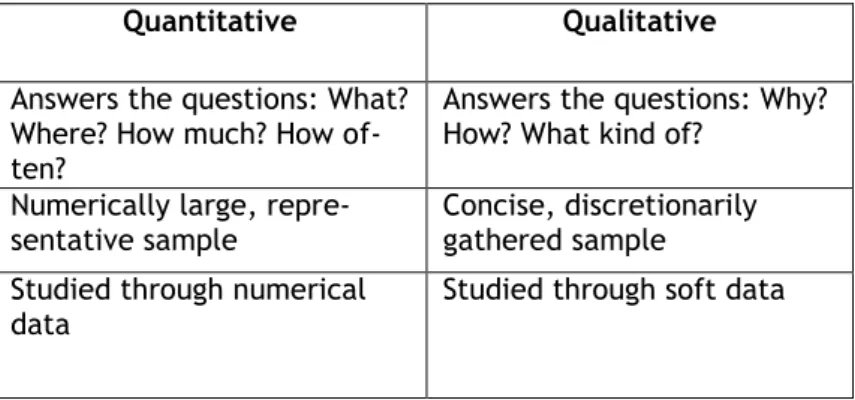
Qualitative research is used to gain an in-depth understanding of the research subject and explain the reasons for his decisions and behavior. It helped to identify the main problems that exist in the company and what the future direction of the company will be.
Knowledge management
One of the fastest growing office trends today is virtual teams and is considered an important part of workflow in modern organizations. Virtual teams are those with “geographically dispersed members who communicate primarily through the use of information and communication technology (ICT)” (Johnson et al. 2001, 1). Staff members working in remote destinations rely exclusively on technologies such as computer video conferencing, collaborative software and Internet/intranet systems allow the existence of virtual teams (Johnson et al. 2001, 2).
This study focuses on a company to which this kind of virtual teamwork applies, and subsequently the terms knowledge management and different types of communication will be explained. These are key elements that must be understood to reach the scope of the study to create a new workspace that will support the idea of working as virtual teams. The development and implementation of knowledge management was previously only undertaken by large corporations, but its importance in small and medium enterprises has now increased (Kuan Yew Wong, 2005).
An additional way that knowledge management is defined is the management of databases, personal knowledge or for example business information. Kaario & Peltola 2008, 3) According to Otala and Pyösti a big part of knowledge management is also finding the information that experts have. In their example, knowledge management involves a system that determines what each employee in an organization knows about each topic, what projects they've been a part of, and what documents they've written.
Organizational communication
External Communication
External communication is the company's outward-directed communication, for example to existing and potential customers. External communication plays a large role in an organization and is often separated into smaller administrative subfields such as marketing communication and public relations (Salin, 2002). Marketing communication is a strong part of external communication and includes advertising, sales and promotion as subfields.
The basic premise is that an organization is most successful when it manages to gain the trust and approval of those around it. Companies must therefore carefully define all the subjects of their communication and decide with which information and how each of these external parties will communicate (Siukosaari Juholin 2009, 88). The goal of external communication in companies is to develop their relations with the public.
It is also a way of providing important information about goals and developments to these external parties.
Internal communication
Multidirectional internal communication is actualized when communication flows freely between all members of the organization, i.e. from superiors to employees, as well as from employees to superiors. According to Åberg, internal communication can be divided into the following three categories: electronic, written and oral communication. By effectively combining these three methods of mutual communication, organizations can create a functional network of internal communication.
Organizations' internal communications include internal marketing and, as mentioned, contact activities and announcements. Orientation of new employees is also considered the most important function of internal communication when companies hire more employees (Siukosaari 2002, 65). Internal communication also plays an important role in the success of external communication because it is at the heart of an organization's communication and external communication is built around it (Isohookana 2007, 15).
According to Juholin, internal communication can be viewed from the perspective of time. Juholin writes that internal communication today is a race against whether the organization is able to inform its staff about things before the information is heard outside the organization. Communication is often thought of as a very broad phenomenon, and internal communication is no exception.
Survey part 1
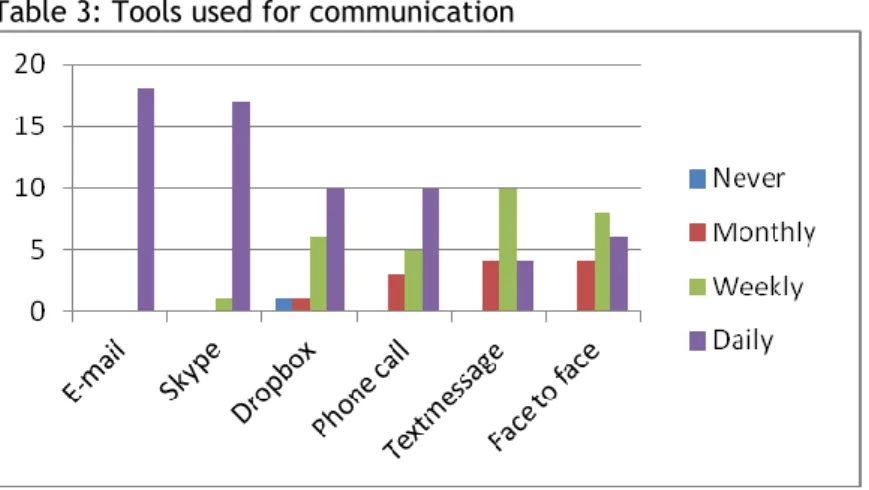
The second most important tools used in the company were phone calls and face-to-face interaction. Dropbox (for sharing files and documents) and phone calls were also used daily by more than half of employees. The comparison of Tables 2 and 3 shows that the company works in a virtual environment, although face-to-face interaction was considered very important by so many, only six employees were able to meet in this way on a daily basis.
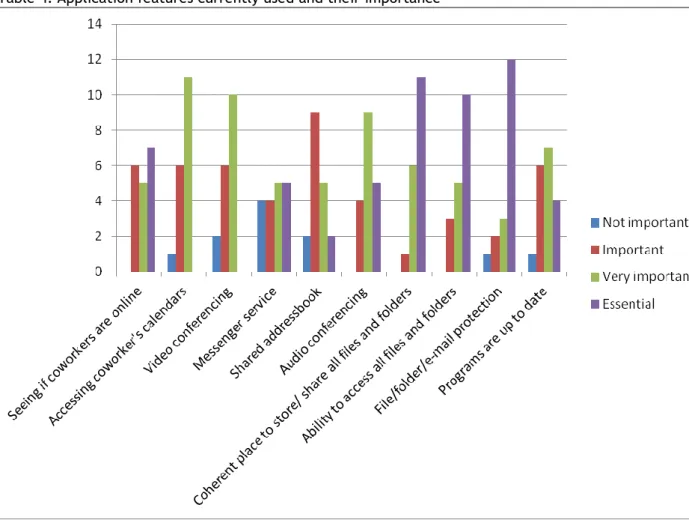
For the final quantitative questions, staff were asked to rate the importance of various features of the tools currently in use. By far the three most important features were file/email protection, the ability to access all files and folders, and a consistent place to store and share those files. The next most important features were access to colleagues' calendars and video and audio conferencing.

Survey Part 2
Knowledge management
It was argued that if there is a direct channel to give development ideas, it should also be possible to follow up. If development ideas were to be implemented, it was hoped that the process and announcement of progress would be clearly visible to all. Channels for links to work-related articles, photos and magazines were also requested, so that they would be easily accessible in one place and would not cause problems to find.
They were considered helpful in everyday work situations and would save time if they were all gathered in one place.
Internal communication
This will allow for a more open atmosphere as well as keep employees up to date on the company's development front. It was intended as a quick and easy way to keep the entire staff updated on important matters from the directors' point of view. In addition, it was also suggested that in addition to the directors' newsletter, the ongoing and new projects would be announced in a specific place visible to all.
Another way suggested to improve the internal flow of information from director to staff was that there could be certain fixed days in a month when all directors would be available and that this would be a specific time when staff could come in. touch them. This would mean that meetings or other non-office work of directors could not be scheduled on those days or times. This rule could also apply to the rest of the company, so it would be the specific day when all employees reach any time during working hours.
Since the company is still so new and growing, these development ideas can become an asset since all employees have different backgrounds and expertise. Finally, a pressing issue raised by staff members was that all teams and departments should come up with and announce their own team rules, so that there would be a general consensus on them. This will allow no misunderstandings among employees about, for example, the use of social media during working hours, the use of company cars or taking breaks.
Interviews
The sharing of the team sites and documents will be the feature of the workspace that will be the biggest asset for users. In addition to the bulletin boards, there is plenty of space for links to important tools and websites in this section of the workspace. The purpose of creating this workspace was to improve the information flow, knowledge management and internal communication of the company.
In this thesis, one of the most popular and current software solutions, Microsoft Office 365, was used because it provides an easily adaptable personalized workspace that does not depend on the size of the company. Due to its flexible nature, the company will be able to adapt it to its own ever-changing needs and as usage of the program evolves. The program is easy to keep abreast of current changes in the world of technology.
The biggest challenge of the workspace in the future will be to keep the information uploaded during this process, as it can become old or even useless unless it is constantly updated. Employees were carefully considered during the process because they are the future users of the workspace and had to be part of the development process. The actual design process of the workspace was done in collaboration with one of the directors, Mr.
It started with the design of the structure using the results of the surveys and the current databases of the company. It would have been helpful to have an expert of the workspace as part of the development and design process.