They all believe that flow is necessary in management communication, flow of information and feedback. The development process of this thesis aims to develop new practices at the organizational level and to support individuals' skills in management communication. The main aim of the thesis was to propose, co-create and agree on the first common practice for management communication in the case organisation.
Topic and objectives of the Thesis
This dissertation presents leadership communication from the aspects of organizational capabilities, practices and from the leader's point of view. Leaders in this thesis are the management team and managers with subordinates in the business organization.
Brief introduction of the case organisation
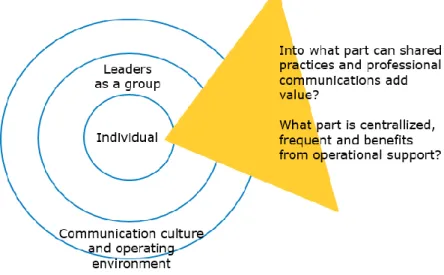
They must be considered when organization or individual leader implements new practices in leadership communication. In addition, case organization chose to apply lean and coaching leadership in its daily management. Case organization has improved its work community communication during the last two years and the current situation is summarized in one visualization.
Thesis work plan
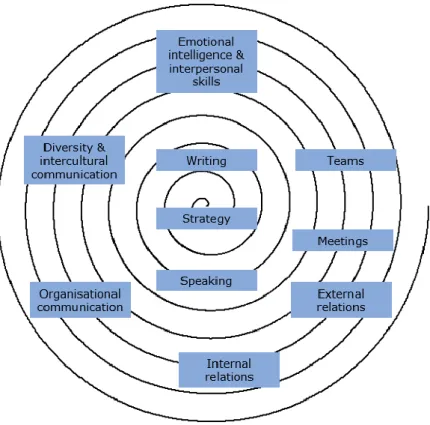
The current situation is that considerable development work has been done in the areas of work community communication which are centralized and responsibilities are very clear. Theoretical framework is gathered from literature on leadership communication theories and which interpersonal skills academic research states that leaders must be able to carry out good and effective leadership communication. I will use the same sources as research material and in this way ensure the alignment of the development proposals for leadership communication.
Leadership communication
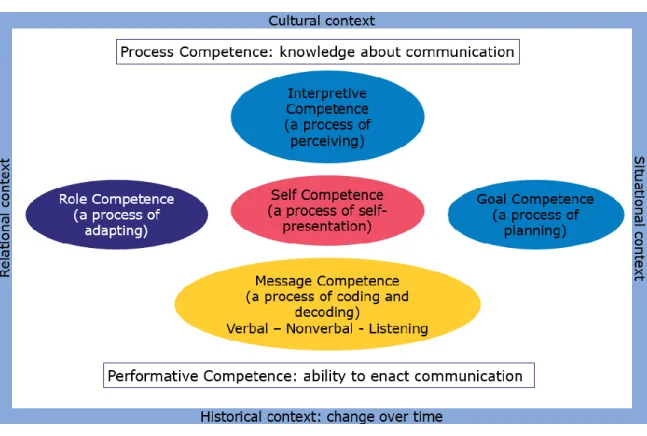
Leadership communication frameworks
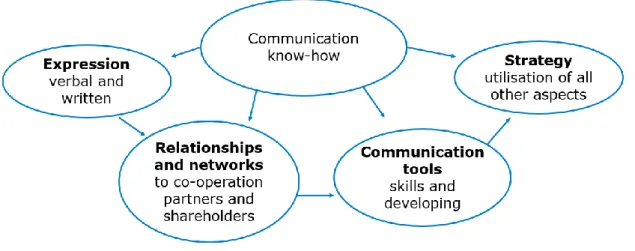
The higher or more extensive leadership the leader has to perform, the more the leader has to expand his/her knowledge of the management and corporate communication skills. Fifth is message competence, which the leader needs to formulate easily understandable and easy-to-follow messages for different audiences. However, the leader needs a comprehensive understanding of the context in which his/her communication activities take place.
Leadership communication culture
Communication is monologue, the one with power and status speaks and working community listens. Juholin states that relevant information and ownership of communications belongs to anyone in work community. Leader needs the ability to understand what visible and silent information means to work community.

Lean
One of the most important resources to succeed in and develop leadership communication is time. In leadership communication this means that practices must focus on maintaining focus and avoiding redundant and interrelated information. The value of leadership communication is the flow of information, transparency in the organization, equality of employees.

Coaching leadership
At the organizational level, it is important to manage the system and avoid teams becoming competitive, independent and selfish units. It is important that the individual has the courage and faith to achieve goals and how persistently they aim for goals. Coaching interaction has goals, and it is a systematic leading tool that aims to achieve the goal and support personal development.
The purpose of the coaching dialogue is the flow of information and feedback from the team member to the leader. Coaching dialogue maintains focus and work mode (adapted from Parppei 2018, 82) Regular coaching dialogue helps maintain focus and work mode. Every day there are many distractions and sometimes it is difficult to focus on the goal and stay in a good working mode.
For organization it is important that the achievement of goals is on time and for employees the support for personal development gives valuable feedback and impact on well-being. This means that, at least in theory, they should have the necessary skills to coach dialogue. This is often presented from top to bottom, but it will be important to show objectives as well. horizontal perspective: what are different functions in organization what do and why.
It takes a plan to stay focused, but it's just as important to make progress as you've planned.

Summary
This dissertation aims to solve practical problems and increase a shared understanding of the subject in the organization of affairs. Different parts of the development process all support and help the development work progress. Development work is often described as a project, starting with objectives, explanation of working methods, progression of the process and ending with summary of results.
In this thesis, knowledge is gathered from the literature and materials of organizations and observations about its current situation. In this topic, the options are inspired by the theoretical framework and best practices found in the literature. The leadership communication development process that this thesis presents will be prepared and presented to the leaders whose support and tool would be in the organization of the occasion.
The development process of this thesis aims to develop new practices at the organizational level and to support individuals' capabilities. This was considered such a time-consuming job that some of the facilitation work was outsourced. All options have been suggested based on the theoretical framework of this thesis and authors' own work experience.
One important element in the development process was getting leaders to try new things and to immediately set goals for their own leadership communication.

Insights
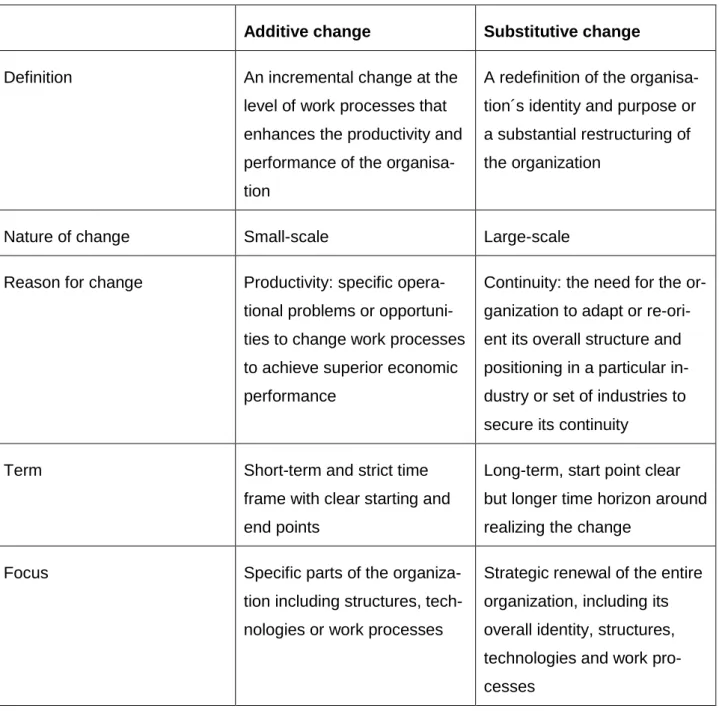
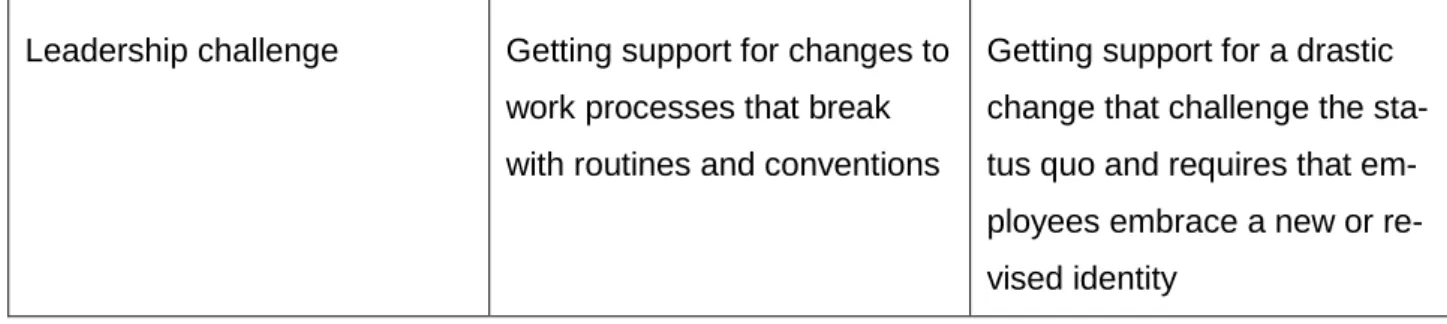
Development process followed a lean change cycle, so each phase is collected under its three phases: insights, options and experiments. It prevents cultures from evolving if organizations cannot renew their current ways of communicating and working. Images indicating that they work in Howspace are also in Finnish and names of the case organization and participants are hidden under white colored squares.
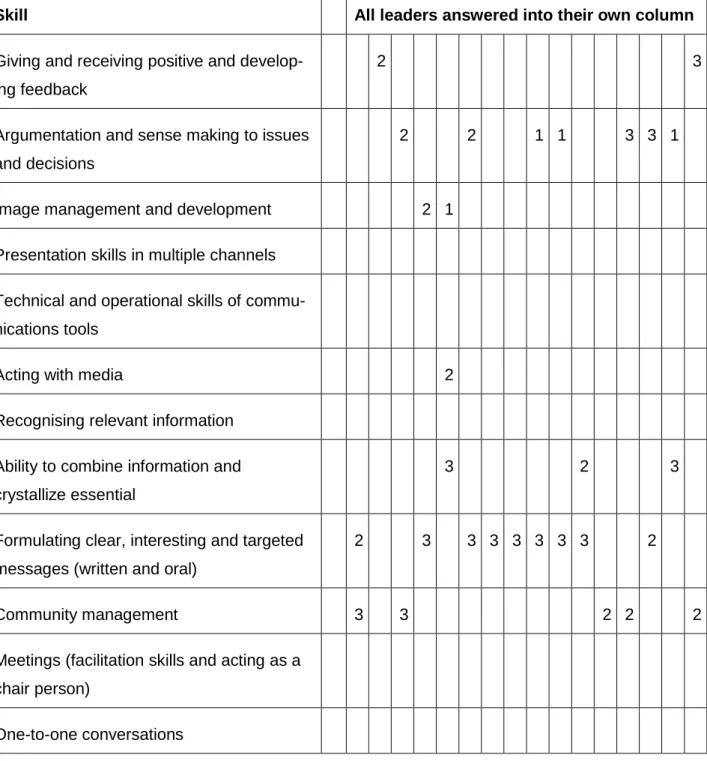
The introductory task and Module 1 gave the participants the opportunity to orientate themselves in leadership communication as a topic, to think about their relationship to the topic and what personal motives they might have in improving their own competence. The presentation of the theoretical framework and development proposals in Module 2 summarized the insights and provided an overview of options. Feedback on the options was also collected in Module 2 and during the reflection period afterwards.
It was to set a personal goal for their leadership communication that they wanted to achieve in the next 6 months. One question in the workshop was: "How do you think the employees of the case organization experience our leadership communication at this moment?". The list of adjectives shows that leaders did not have a very positive opinion of how successful leadership communication was.
In the dialogue, leaders recognized the need for improvement and they were all willing to improve both ways of acting and their personal communication skills.
Options
Summary of feedback about options
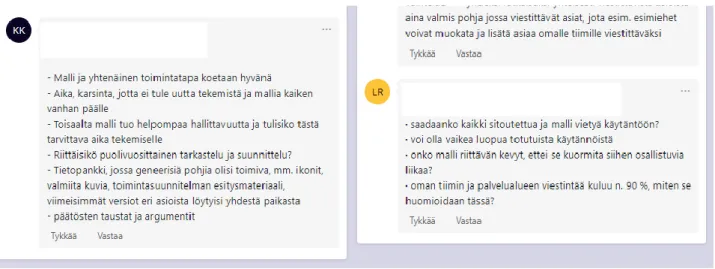
Feedback on the benefits, opportunities and how to see opportunities to support leaders' work was encouraging. Managers said that having a common model of management communication in itself would be a positive development and they felt it would support their work. Managers' feedback was that change communication would become more standard, and they very much welcomed the opportunity to have materials as a service.
It would help to find always up-to-date information, the so-called master data would be in a specific place. About the roles, they noted that if the manager is both a member of the management team and a supervisor, he/she has a lot of communication responsibilities according to the organizational responsibility plan of the case. Managers believed that the whole is easy enough that the case organization could also really implement it.
They were thinking about how to apply the suggestions when most of the content in their current leadership communication is about their business units and teams. This time was provided to ensure that all participants had the opportunity to fully consider how the options would support their leadership and management communication. At the workshop, the leaders also suggested what kind of metrics the case organization could use in the future to measure how well leadership communication is working.
In this way, the case organization could better see that development work is focused on the right things.
Experiments
Managers of the case organization prepared by informing themselves about the management communication topic in the pre-task and with active participation in module 1. The result is that the case organization has managers who are willing to improve their management communication skills and want to have an influence on the further development of management. communication practices in case organization. The result is that the case organization now has tools to visualize the current situation and helps the dialogue on management communication.
The result is that leaders have shown proactivity and a willingness to improve their leadership communication skills. The content of the learning path and working methods were designed to support the entire development process towards more coordinated and culture-appropriate management communication in the case organization. Pauliina provided peer feedback on the Module 2 process and workshop, which presented opportunities for management communication in case organization.
As part of this program, Terhi led and facilitated a workshop aimed at further developing the leadership communication model for the case organization. Using this approach, Terhi gained important input for further development of the leadership communication practices. Third sub-goal was to find out how case organization can best support leader improvement in leadership communication.
The time period during which this thesis was processed was the right time to reconsider what kind of communication management the case organization needs and how it will be organized in practice.
Trustworthiness of the study
Virtual facilitation and learning platform can also be used in the future to improve development. When there are new experiments or case organizations want to co-create new opportunities to improve management communication, the platform will be a natural place to gather information, ideas and collaboration. It would be interesting to get more frequent feedback also at the level of the entire organization.
Better managing leadership communications with data could be an area of research in the future. In the future, it would be interesting to investigate whether it is related to the willingness of employees of case organizations to recommend case organizations as employers or whether it has other correlations with employer image.
Reflection of own learning
I have talked openly about the thesis process at work, with my team and also with my friends. All the discussions have advanced my learning process and helped me focus and make choices.