Tommy Litonius
Developing Orientation for Financial Advisors
Metropolia University of Applied Sciences Master’s Degree in Business Administration Business Informatics
Thesis 11.11.2019
Abstract
Author(s) Title
Tommy Litonius
Developing Orientation for Financial Advisors Number of Pages
Date
64 pages
11 November 2019
Degree Master’s Degree in Business Administration Degree Programme Business Informatics
Instructor(s) Pia Hellman, Dr.Sc.(Econ.), Senior Lecturer
The objective of this Master’s thesis was to develop the current orientation process for fi- nancial advisors at the target company, which is a large Scandinavian agent in the financial industry.
The target company’s orientation process was restructured recently and as a result the ef- fectiveness of the orientation had deteriorated. The aim of the research was to identify which areas of the process were in most acute need of improvements and what actions could be done in order to develop the current orientation of the financial advisors.
The research approach used in the thesis was action research and the strategy implemented was a qualitative research method. Data was collected through interviews and the method was semi-structured. All the chosen interviewees worked within the company and in posi- tions that were found to be most suitable to advance the research.
The key finding of the research was that the various areas of the orientation were neither well-structured nor connected to each other. Based on the findings from the interviews as well as information gathered from the literature research, a thirteen-step action plan was designed for the company. All the steps in the action plan were created to provide structure in the orientation process.
The proposed action plan was presented to and validated by the target company. The ori- entation process of the financial advisors is currently under review and it is possible that several of the development ideas will be incorporated into the future orientation model.
Keywords Orientation, development plan, new employee, financial advisor, action research
Contents
1 Introduction 1
1.1 Overview 1
1.2 Business challenge 1
1.3 The target company 2
1.4 Objective, scope and thesis outcome 2
1.5 Key terms 3
1.6 About the researcher 3
2 Research design 4
2.1 Action research as a research approach 4
2.2 Data collection and analysis 5
2.2.1 Research strategy 6
2.2.2 Interviews as a data collection method 7
2.2.3 How the interviews were done 8
2.3 Interviews 9
2.3.1 First interview 9
2.3.2 Second interview 10
2.3.3 Third interview 10
2.3.4 Fourth interview 11
2.3.5 Fifth interview 12
2.3.6 Sixth interview 12
2.3.7 Seventh interview 13
2.4 Validity and reliability 13
2.4.1 What are validity and reliability? 13
2.4.2 Reliability and validity of the data collection 14
3 Conceptual framework 14
3.1 Employee orientation 14
3.1.1 What is employee orientation? 14
3.1.2 Subcategories of employee orientation 15
3.1.3 Orientation to the work 16
3.1.4 What are the goals and benefits of orientation? 17
3.2 Biggest parts of the puzzle 19
3.2.1 Whole work community as an orientator 19
3.2.2 Whole work community as a learner 20
3.2.3 Named orientator 21
3.2.4 Choosing an orientator 22
3.2.5 A small company vs. a large company 23
3.3 Orientation methods 23
3.3.1 Hands-on-orientation 24
3.3.2 Model orientation 25
3.3.3 Quality orientation 26
3.3.4 Customized orientation 26
3.3.5 Dialogical orientation 27
3.4 About learning 28
3.5 Handling emotions 28
3.6 Planning the orientation 29
3.6.1 Socialization 31
3.6.2 Work safety law 34
3.7 Possible setbacks 34
3.7.1 Rush 35
3.7.2 Lack of support 35
3.7.3 Information overload 36
3.7.4 Too organization-focused orientation 36
3.8 What more to know about orientation 37
3.8.1 Orientation programs 37
3.8.2 External material 37
3.9 The ABC for a successful orientation 38
4 Current state analysis 39
4.1 How the current orientation process is done 39
4.2 What works 39
4.2.1 The organization knows what the employee needs to learn 39
4.2.2 Given time for the new employee 40
4.2.3 Hands-on-orientation 40
4.2.4 A team that orientates through Skype is a great asset 41
4.2.5 Individuals are doing a remarkable job 41
4.3 What does not work? 41
4.3.1 Organizing the orientation 42
4.3.2 Not enough support for the orientators 43
4.3.3 Skype-orientation does not reflect the daily work 43 4.3.4 Skype-orientation is too long and intensive 43 4.3.5 No networks are being built between the new employees or between
the orientators 44
4.3.6 No written or pre-existing back-up-plans 44
4.3.7 Not clear enough responsibilities for the orientators 44 4.3.8 Systems for the new employees are not working straightaway 45
4.3.9 Orientation takes too long 46
5 Proposed action plan 46
5.1 Needs analysis 46
5.2 Proposition 47
5.2.1 Skype-orientation to different parts with pauses in-between 47
5.2.2 Customize the Skype-orientation 47
5.2.3 Determine the new employees' daily schedule on a prior week 49 5.2.4 Organize the daily schedule in advance by switching the meetings 49 5.2.5 No more individual goals, just team goals 50
5.2.6 Specialization 50
5.2.7 Make back-up-plans in prior 51
5.2.8 Define the work and focus on choosing the right orientator 51
5.2.9 Better education for the orientators 52
5.2.10 Better networking for the new employees and the orientators 53
5.2.11 Start the practice as soon as possible 53
5.2.12 Create a supportive channel for the orientators 54 5.2.13 Quality of the orientation to the top priorities 55
6 Validation 56
6.1 How the validation was done 56
6.2 Testing and implementing 56
6.2.1 Skype-orientation to different parts with pauses in-between 56
6.2.2 Customize the Skype-orientation 57
6.2.3 Determine the new employees’ daily schedule on a prior week 57 6.2.4 Organize the daily schedule in advance by switching the meetings 58 6.2.5 No more individual goals, just team goals 58
6.2.6 Specialization 58
6.2.7 Make back-up plans in prior 58
6.2.8 Define the work and focus on choosing the right orientator 59
6.2.9 Better education for the orientators 59
6.2.10 Better networking for the new employees and the orientators 59
6.2.11 Start the practice as soon as possible 60
6.2.12 Create a supportive channel for the orientators 60 6.2.13 Quality of the orientation to the top priorities 60
7 Conclusions 61
7.1 The goal of the thesis 61
7.2 Results 61
7.3 Summary and where to go from here 62
References 64
1 (64)
1 Introduction
1.1 Overview
The objective of this study is to create an orientation development plan for financial ad- visors at the target company. The orientation program has recently gone through some changes, which has led it to its current form. The challenge is that the current way of orienting is too unorganized. Too much of the learning has been left to be managed by the new employee, by trusting that the employee is capable of adapting plentiful of new information and then after this use the information in practice, even if a situation where this information can be used might not occur in months. The company has a well-orga- nized team of professionals who are teaching the knowledge by Skype, but unfortunately, it is not connected to the daily work. The meetings that the new employees take part in after their scheduled Skype-orientations can concern a wide range of topics.
The current way of orienting needs to be improved because, at the moment, the target company wastes its resources by extending the orientation time tremendously with an unorganized orientation program. This can result in discontent employees and to an in- creased risk for the company’s image.
1.2 Business challenge
Based on the current state analysis presented later in chapter 4, the orientation in the target company is done through three different phases. The challenge with this is that none of the three phases communicate with each other. The first two phases are well structured, but they do not work smoothly with phase three, which is the orientation to the work and takes place at the office. The first phase can be separate, as it is only for the new employees to get to know the company and its values. The second phase, which is teaching knowledge through Skype-orientation, on the other hand, should take into consideration what is happening at the office. The same goes for phase three, as the orientation to the work should take into account what has been learned through Skype- orientations.
2 (64) Another challenge comes from the fact that the orientators have their own work to be done and, therefore, cannot focus solely on the new employees’ orientation. Also, in the current model, all the teams must have a designated orientator when a new employee arrives. This might be a challenge, especially at smaller offices, as there might not be a skilled enough or motivated enough orientator, which weakens the quality of the orienta- tion tremendously.
1.3 The target company
The target company is a big financial service offering agent that operates especially in Nordic countries. In this thesis, I concentrate on how the introduction should be done nationally, but I cannot see any reason why it could not be applied globally as well.
1.4 Objective, scope and thesis outcome
The objective is to develop the orientation for the financial advisors within the target company.
The scope of the study will be limited to improving the current ways of orienting. I will create a plan that specifies how the target company should do its orientation based on the needs and realities of the company. I will try to find out what are the main issues in the current model and create a plan on how to solve them based on the interviews and literature that I will find. The focus is on the ways of orienting; it is not about creating instructions for the orientator or the new employee, but about improving the current model. I will aim to identify different aspects that should be developed and based on this, I will create the plan.
The outcome will be a plan to improve the current orientation for financial advisors at the target company. It will be in a written form that contains a list of the most significant changes and improvements that should be done to improve the process. I will seek the answer to these central questions:
- How could the different parts of the orientation process be better connected to one and other?
3 (64) - How can the orientator focus on orienting besides his/her primary job as a finan-
cial advisor and how do the additional duties affect the work?
- What are the responsibilities of an orientator and superior?
- How can the use of the Skype-orientation be improved?
- Is it possible to add any customization in the job description?
1.5 Key terms
Banking advisor = An advisor that works mainly with daily banking errands i.e. offers advice and opens cards, accounts, internet banks, new customer ships, etc.
Financial advisor = An advisor who is mainly focused on finance and/or investments. At the same time, he/she focuses more on the customers’ overall banking errands, and the meetings are longer and more customer-oriented than with banking advisors. In this the- sis, it means an advisor who focuses on finance instead of investments.
Orientator = The person who orientates (ie. teaches new skills to a new employee), refers to an orientator whose primary work is to orientate, but also to an orientator, whose pri- mary job is to be a financial advisor, but who has been designated to be an orientator besides his/her own work.
New employee/newcomer = New employee, but it also refers to a worker whose job description has changed or who comes back after a long absence.
All the persons that I talk about will be referred to so that their identity will not be revealed.
That is why I use a lot of “he/she” rendition.
1.6 About the researcher
I have experience of orienting from two different instances. The first time was when I became recruited to an orientation team whose work was to focus on orienting. The team was oriented new and returning (from example, after a long absence) financial advisors.
The orientators on the team could focus solely on the orientation as there were no other goals than to orientate the new employees as well as possible. In my opinion, the team worked quite well and could focus exceptionally well on the individual’s own development areas. I got a confirmation for this also from the interviews as one of my previous team members from the orientation team (a current superior) told me that nowadays, the
4 (64) results are weaker, and it takes a lot longer to get the orientation done. The team was shut down in early 2018.
The second time I got to be involved with orienting happened surprisingly after the thesis was already almost done. A new team was built to orientate the new financial advisors, also as the team's main work, on a pilot that would last through the summer, and I was asked to be one of the orientators.
2 Research design
2.1 Action research as a research approach
The research approach used in this thesis was action research. Action research is an approach that combines practical development work with research. While traditionally, the researches have wanted to find out how things are, within action research, it is about finding information in order to improve the current practices. (Heikkinen, Rovio & Syrjälä 2006, cited Valli & Aaltola 2015, 204) The research wants to find out how things should be instead of how they are. The information is gathered to improve current practices.
(Valli & Aaltola 2015, 209)
The word “action” within the research method comes from the peoples' social interaction within each other. Action research starts with the idea that the theory is within practices and vice versa. (Valli & Aaltola 2015, 205)
It is good to acknowledge that while in traditional research methods the investigator keeps him/herself apart from the object, in action research the investigator is a part of the community which he/she investigates. This causes the research not to be completely objective within the word’s most usual meaning. (Valli & Aaltola 2015, 214)
The action research process should consist of a few elements. The first stage is gather- ing the material out of a systematic literature review. Previous empirical research and theories are being reviewed within this framework. Bit by bit the focus is being allocated towards the focal point of the research, which pinpoints what exactly is the main goal of the research. Based on that, the research objective and research problems are being
5 (64) formed. When the material has been gathered and results analyzed, the process ad- vances to pondering and conclusions. At this point, the conclusion should tell what this research has given to its audience or the development of practices. (Valli & Aaltola 2015, 209)
In my thesis, the research was done pretty much the same way. After coming up with an idea of what was needed to be developed at the company I worked for, I started search- ing for information on the subject. This opened up the different aspects of orientation and gave me insight into what the orientation could be and how it differentiated from what I knew it was within the company. It clarified the objective as well as some of the problems within the organization's current orientation model. Even more importantly, I got to know which questions would be needed to ask in order to achieve the wanted outcome. I was able to pick certain questions that I knew would likely point out problems or give me developmental ideas.
The interviews then confirmed some of my thoughts about the orientation and also gave acknowledgment of many of the problems which I did not know about. The phase helped me to build a proposal on developing the orientation process. Validation was done by sending the proposal to a person who manages the development of the financial advi- sors’ current orientation, and after the validation, I was able to make the conclusions about my research.
2.2 Data collection and analysis
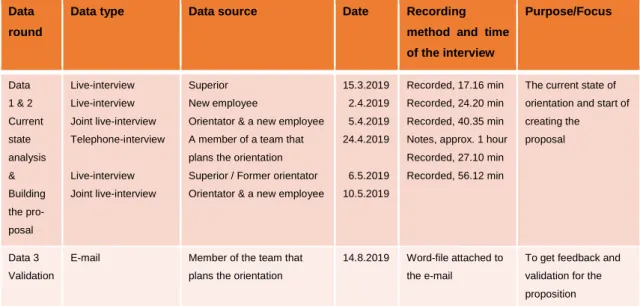
I collected all the data from the interviews. The research consisted of meetings, in which I interviewed eight people plus sent the results to get validation for the research project.
In addition to the e-mail, I had five live interviews and one telephone interview, from which I only took notes. All the other interviews were recorded. I also transcribed the outline of the transcripts as an attachment to this thesis.
6 (64)
Data round
Data type Data source Date Recording
method and time of the interview
Purpose/Focus
Data 1 & 2 Current state analysis
&
Building the pro- posal
Live-interview Live-interview Joint live-interview Telephone-interview
Live-interview Joint live-interview
Superior New employee
Orientator & a new employee A member of a team that plans the orientation Superior / Former orientator Orientator & a new employee
15.3.2019 2.4.2019 5.4.2019 24.4.2019
6.5.2019 10.5.2019
Recorded, 17.16 min Recorded, 24.20 min Recorded, 40.35 min Notes, approx. 1 hour Recorded, 27.10 min Recorded, 56.12 min
The current state of orientation and start of creating the proposal
Data 3 Validation
E-mail Member of the team that
plans the orientation
14.8.2019 Word-file attached to the e-mail
To get feedback and validation for the proposition
Table 1 Data Collection
Table 1 shows how and where the data was collected.
2.2.1 Research strategy
The strategy applied in this thesis is done as qualitative research. The baseline for qual- itative research is to describe real life. It includes the thought of reality being variable. It is essential to take to note that it is not possible to shape reality into arbitrary pieces. The subject of qualitative research needs to be investigated as comprehensively as possible.
(Hirsjärvi, Remes, Sajavaara 2007, 157)
There are multiple subtypes in qualitative orientation, but the following seven are typical to any qualitative research:
1. The nature of research is about a comprehensive gathering of information and the material is being gathered through real and natural situations.
2. Prefer human as a source of information.
3. Use inductive analysis, where the researcher tries to find new, unexpected as- pects. The researcher does not define what is important.
4. Use of qualitative methods in the gathering of information. This means methods where the ones being investigated get to use their voice.
5. Choose the investigated people on purpose, not by random sample.
6. The research plan gets shaped when the research progresses. Research is done flexibly, and the plans can be changed throughout the process.
7 (64) 7. Handle the incidents as unique and interpret the material according to it.
(Hirsjärvi etc. 2007, 158, 160)
The biggest weakness within qualitative research is that people interpret the questions from their own view and with their own understanding of the subject. The same answer can be described in many ways. (Hirsjärvi etc. 2007, 156)
2.2.2 Interviews as a data collection method
I chose interviews to be the method for gathering material. Interviews are one sort of conversation, but in a normal conversation, both parties are quite equal. In interviews, the interviewer is in charge of it. As a research method, interviews are a systematic way of gathering information. It has objectives and the purpose of getting as trustworthy and valid information as possible. There are several different ways to do the interviews. I chose a semi-structured way to interview. It is an interview method where the thematics are well known in advance, but the exact order and way of asking the questions is not yet decided. The results can be analyzed and interpreted in many ways. (Hirsjärvi etc.
2007, 202-203)
From several different interview methods, I chose the semi-structured way of interview- ing because I wanted to have a real conversation with the interviewees so that it would not feel intimidating for the persons I interview. Still, I do not have enough experience from interviewing to have an open interview where the interviewer interviews without any solid body. In an open interview, the interviewer figures out the interviewee’s thoughts, opinions, emotions, and apprehensions when they come up during a normal conversa- tion. It requires more skills from the interviewer than the other interview methods.
(Hirsjärvi etc. 2007, 204) Even with this semi-structured way of interviewing, I was able to create an open environment, which did not feel too much like an interrogation. The interviewees were allowed to voice their opinions in a more straight-forward manner than perhaps by having a stricter order in questions. The semi-structured interview method also worked to my benefit as I was able to shape my work as the research progressed and also develop future interviews based on the insights I had gained from previous interviews. Without having the possibility to change the interview-questions, I would have lacked many answers I was now able to get. I also received positive feedback from the way the interviews were conducted.
8 (64) The interviews also gave me the possibility to make some observations. With interviews, it is possible to get to know what people think, feel, and believe in, but they do not nec- essarily tell what is really happening. With observations, it is possible to discover if the persons truly act like they say they do. (Hirsjärvi etc. 2007, 207) I did the observations loosely while interviewing, but I could, for example, tell how genuine the persons were and what subjects they truly felt were important. This helped me to pick up the most relevant subjects and create a proposition for improving the target company’s orientation.
2.2.3 How the interviews were done
I created the interviews based on the research I made about the orientation. The re- search helped me to know what is essential and what I needed to ask. I wanted to find answers on how the orientation should be organized to make the training time more consistent and the learning easier. I ended up creating around 15-20 questions for each interview but used many same questions in them. When I interviewed people with the same title, I used more of the same questions so that I could get more sides to every story. After each interview, I also came up with a couple of new questions that I realized I needed answers to. As the interviews progressed, I felt that my questions got more beneficial and that I was able to already come up with some ideas on how to develop the current orientation process and discuss those ideas with the interviewees. Also, the in- terviewees expressed their opinions about what needed to change.
I interviewed two orientators, three new employees who were still being oriented, one person who worked in a developmental team and two superiors. One of the superiors was also a former orientator, who had done the orienting as a full-time job. After creating a plan on how to improve the orientation, I also sent the results to another person from an orientation development team to get validation for the plan.
I did two of the interviews as a joint-interview with the orientator and the employee, whom the person was orienting. I let the interviewees decide if they prefer to get interviewed alone or together, and in both cases, they picked the joint-interview. In these interviews, I felt that the atmosphere was even more relaxed and open as the interviewees probably got support from being there together and the discussion went maybe a bit further as the other person could add some more value to what the first interviewee said.
9 (64) Based on the data I collected from the interviews and conceptual framework I was able to pick up the main discoveries and address those in chapters 4.2 What works, 4.3 What does not work and in 5.2 Proposition.
2.3 Interviews
In this chapter, I will be going through each interview I did. I will tell briefly where the interview took place and how exactly they were conducted.
2.3.1 First interview
My first interviewee was a superior to a team of financial advisors. The person I chose to interview has a long experience from working with the company. The respondent has worked as a superior for a long time but has previously worked also as a financial advi- sor. I chose a superior to be my first interviewee as I figured that the respondent would be able to tell widely about the current state of the orientation and give me the best understanding of the current model of orienting. The atmosphere was quite unrelaxed when I started to record the interview. I could notice that the respondent wanted to be much more businesslike when the recording started. The interview was relatively satis- factory, but I got a feeling that the superior did not want to express his/her own opinions too openly because it was recorded. I probably had much to do with building the tension as well, as this was my first interview. The interview was done and recorded in a branch that the superior works in and it took only 17 minutes 16 seconds.
The first two questions were about getting to know the general goals of the orientation.
With the question 3-6, I wanted to find out how the orientation was done, but also to get to understand the superior’s own opinions about the current state of orientation. The questions 7-10 were about the systematicity of the orientation. I wanted to find out how systematically the orientation is done and how does the follow-ups of the orientation work.
In the questions 11-18, I was eager to find out about the quality and methods of the orientation. The questions 19-20 were rather straightforward questions, from which I hoped to gain some concrete ideas on how to improve the orientation process. I also wanted to know (question 21) if the orientation was in-line with the company strategy, as
10 (64) according to Kupias & Peltola this is necessary for the orientation-process to be suc- cessful (2009, 52).
2.3.2 Second interview
For the second interview, I chose a new employee as I wanted to understand the process from a newcomer’s perspective. My goal was to find out what the interviewee, an em- ployee with a couple of months of experience working for the company, thought about the current orientation methods, and how his orientation had gone. I recorded the inter- view with my phone, but this time the atmosphere was clearly more relaxed than the last time. I received positive feedback from the interviewee, who said that the interview felt conversation-like. I tried to make the atmosphere comfortable and build trust towards the interviewee, whom I did not previously know by telling about my work history and show- ing that I am on the interviewee’s side. Despite the positive atmosphere, I left the inter- view feeling that the employee still did not want to be too straightforward about the ori- entation. I felt that even though the interviewee did not admit this in the interview, the respondent had not received enough support during the orientation period. The interview was recorded with my phone and lasted for 24 minutes 20 seconds.
The first six questions were about the implementation of the orientation. I wanted to es- pecially find out more about the Skype-orientation as that did not exist at the time I used to orientate. With the next three questions (7-9), I was aiming to understand the structure of the orientation.
The question 10-13 were about the ways to orientate as well as about the orientator. I also included a question about the values, as according to Kupias & Peltola the values should be inlined with the orientation just as the strategy (2009, 52). The last two ques- tions were again about the pros and cons of the current orientation model.
2.3.3 Third interview
The third interview was done again in the office of the interviewees. This time I inter- viewed both the orientator and a new financial advisor who was at the time being oriented by the other interviewee. I felt the atmosphere in this interview was the most comfortable thus far. There was no tension, but the excitement could be felt, as both the orientator,
11 (64) and the newcomer were eager to tell their opinions about the current way of orientation.
I got straightforward answers and was truly happy with the results. I recorded the orien- tation with my phone, and it ended up lasting 40 minutes 35 seconds.
I started the interview by asking how the orientation is done and with some questions about the orientator’s role (questions 1-3). The next questions (4-6) gave me insight into the organization's role in supporting the orientator. The answers to these questions were also the first ones clearly in contradiction with what the other superior had previously told me in the first interview about organizing the orientation. The questions 7-11 involved questions about the Skype-orientation. I was keen on comparing the Skype-orientation method to the hands-on-orientation method.
The next questions 12-18 I picked because, according to the literature I have read, sub- jects around the questions are important in orientation. The subjects are also handled in my conceptual framework. Lastly, I asked the same two questions about the pros and cons.
2.3.4 Fourth interview
For the fourth interview, I wanted to interview a person that was in charge of the current orientation model. I contacted the head of the developmental department, who sug- gested I book a meeting with one other person from the same team. I had a telephone interview with that person. The respondent works in a team that plans the financial advi- sors' orientation around the country. We talked on the phone for nearly an hour and I took notes of the most important subjects. The respondent seemed to be aware of the problems with the current model and we had a good conversation. Still, I might not have gotten as concrete answers on developing the orientation as I hoped for, as after the phone call, I was still unsure of how the company would continue to develop the orienta- tion.
When I did the interview, first I wanted to find out the respondent’s job description more precisely and also what is the planner's opinion on how the orientation should be done.
The questions 3-9 involved modifying the work, responsibilities and supporting the ori- entator, which are errands that are all handled on the conceptual framework. The next three questions 10-12 were about the observations I had done in the previous interviews
12 (64) and the last two questions concerned once again what the interviewee thought should be kept and improved within the current orientation.
2.3.5 Fifth interview
In the fifth interview, I was able to get more clarity on the problems within the current orientation model than in any of the previous interviews. This was to be expected as the interviewee was superior to a financial advisors’ team who had previously worked as an orientator. The orientator-work was back when the orientation was done as a primary job. We did the interview on a terrace of a fitness center and the mood was very good and developmental. It was evident that the respondent truly wanted to improve the cur- rent orientation process. I recorded the interview with my phone, and it took 27 min 10 seconds.
My aim was to start with general questions in the beginning, but as I already got a pro- found and much broader answer to the first question than I had anticipated, the next question got already right to the point. I wanted confirmation that the former orientator had seen the difference between the new orientation method and the older one. The questions 3-5 and 15-17 were all about getting confirmation on how to improve the cur- rent model. The questions 6-7 were about responsibilities and involving the team, which can both be found from the conceptual framework. The question 8-9 was about the use of time, which according to the literature I read, might be the biggest challenge preventing a successful orientation. The questions 10 and 12-13 were asked in most of the inter- views to help to create the development plan. Question 11 was mostly out of curiosity, but it also validated the significance of this interviewee.
2.3.6 Sixth interview
This interview was another joint-interview, which included an orientator who had started as a financial advisor just a little over six months ago and a new employee who had never worked in the financial industry before.
The interview had the best atmosphere I had in any of my interviews; the respondents felt genuine and had had some struggles that they wanted to share with me. Even despite
13 (64) the struggles, the excitement of the orientator was overwhelming. The interview took for 56 minutes 12 seconds and it was held in the branch of the two interviewees.
The first questions to the new employee (2-6 & 12) concerned the experiences of the respondent thus far. The aim of these questions was to help me to understand how the orientation had gone in practice. The questions for the orientator (questions 1 & 6-11) were at this point already quite specific as I had already found out so much from the previous interviews that I now wanted to get more specific answers and confirmation to some of the issues I had identified as possibly needing improvement. Also, the next questions for the new employee (questions 13-14) were aimed to get confirmation on the aspects that needed improvement in the Skype-orientation. The questions 15-19 were based on the conceptual framework as they once again handled about getting support and modifying the role.
This time we did not have time to ask about what to keep with the current orientation;
however, I gained great insights on what to improve.
2.3.7 Seventh interview
The seventh interview was the validation part of the development plan. I sent an e-mail with the current state analysis and the development plan proposition to another person that plans the current orientation. As a response, I got a word-file attached to an e-mail that had an answer to each developmental step I had proposed. The person works closer to the Financial advisors at the moment than the fourth interviewee as the respondent is currently leading the planning of a new orientation team pilot, where I had the chance to orientate financial advisors recently.
2.4 Validity and reliability
2.4.1 What are validity and reliability?
Validity means the ability of the research to measure what it is supposed to measure (Hirsjärvi etc. 2007, 226). Reliability means the ability of the research to give non-coinci- dental results. The reliability of qualitative research comes from explaining how the re- search is done. In interviews, reliability can be increased by telling about the
14 (64) circumstances and places where the material was gathered as well as the possible dis- tractions, misinterpretations, self-evaluation and the used time. (Hirsjärvi etc. 2007, 226- 227)
2.4.2 Reliability and validity of the data collection
In my research, the reliability was built by telling about how and when the interviews happened as well as about my own feelings and the atmosphere around the interview.
The persons I chose to interview, enhance the validity as they represent the financial advisors' team from a wide variety of different organizational levels. Having interviewed superiors, orientators and new employees, as well as people from the orientation plan- ning, gave me enough data to form an unbiased opinion on the developmental areas.
Also, the chosen interview questions improved validity because they were largely based on literature research.
3 Conceptual framework
3.1 Employee orientation
Development and changes happen constantly all-around society. Whether it is about a new job, ownerships changing or new principles, orientation is always needed in a time of a change. For the employer it is very important that a new employee gets in touch with his/her work as soon as possible and that way he/she can be just as efficient to the employer as the more experienced employees. (Kangas & Hämäläinen 2008, 1)
3.1.1 What is employee orientation?
Employee orientation is mostly seen as a wide concept which involves the orientation for the work and for the company itself. Besides introducing the employee to his/her job, orientation should consist of different practical actions that are meant to improve the employee’s skills and knowledge and introducing the workplace and the whole organi- zation. Usually, a new job or a new work description brings out a need for orientation, but it is also provided when the work tasks change within the company or when one returns after a long absence. The goal is to help the employee so that he/she learns what
15 (64) the work is about and can manage the work independently. A good orientation takes into consideration the skills that the employee has and tries to utilize these existing skills throughout the orientation. (Kupias & Peltola 2009, 9, 18-19).
Orientation is not only about improving skills and knowledge, but can also be about help- ing the employee to notice, use and improve skills that he/she already has. Orientation is always unique. The company’s way of acting and standard rules need to be considered just like the new employee's own experience and background. (Kupias & Peltola 2009, 20) According to Juuti & Vuorela (2002, 34), the most important goal of orientation is to make the employee feel that he/she is an important part of the work community.
Employee orientation is a standard procedure in nearly every organization, but unfortu- nately, the quality varies a lot. Labour code obligates the employer to conduct the em- ployee orientation well, but in many cases, other urgent tasks may seem more critical to the employer, and the orientation is completed in a hurry or not planned well enough.
(Kupias & Peltola 2009, 9).
It is important to keep in mind that the new employee can not receive or adopt a large amount of information at once. Only the most necessary aspects should be addressed during the first days. After this, the orientation can be deepened step by step. (Piili 2006, 125) The first days and weeks are crucial for the beginner as they create the foundation for work motivation and attitude. At this point, everything is still new, and nothing is defi- nite, this includes all the little things like where the meeting room is or where can you get more paper, etc. (Piili 2006, 184)
A systematic orientation guides the personnel to work according to the objectives of the company. It helps to utilize the conventional ways of acting, knowledge and the com- pany’s language and at the same time, creates a foundation for good collaboration and job satisfaction. (Piili 2006, 125)
3.1.2 Subcategories of employee orientation
There are four subcategories to orientation: general orientation, company orientation, workplace orientation and work orientation (Helsilä 2009, 48).
16 (64) General orientation means the actions that the company takes in order to get the em- ployee to adapt to the work and the work environment as flexibly as possible. The job description then defines the magnitude of the orientation, although in every orientation there are still some common subjects. (Helsilä 2009, 48) Company orientation is about going through the most important aspects of the company: its business idea, strategies, visions and company policies. Workplace orientation, on the other hand, is about getting to know the people whom the new employee will work with. This includes the closest co- workers as well as the possible clients. Finally, there is the work itself. Orientation to the work should always include introducing the commitments, hopes, and expectations that the company has for a new employee or for an employee changing their job description.
(Helsilä 2009, 48) Orientation to the work is the area that my thesis mainly focuses on.
In my opinion, this is the most important part of orientation and therefore, I will dedicate an entire chapter (3.1.3) for this subject.
Previously the other aspects of orientation (company orientation and workplace orienta- tion) were not considered that necessary while the orientation to the work was regarded to be sufficient. When the organizations and job descriptions became more complicated, the orientation covering only the work itself was not enough anymore. Today the em- ployee needs to understand the organizational structure and why the company exists.
As a result, the orientation needs to be broader than before. (Peltola & Kupias 2009, 13.)
3.1.3 Orientation to the work
Orientation to the work needs to be planned carefully. The trainee will need to be able to learn by training, experimenting and doing. The trainee must evaluate him/herself con- stantly as well as get feedback from the superior. (Helsilä 2009, 49) In my opinion, the feedback can also come from an orientator or even from more experienced colleagues.
Through the feedback, the trainee finds out what he/she is good at and what still needs to be learned as well as some possible critical issues that need to be addressed imme- diately. The trainee is able to understand the demands of the company and by trying some new methods, his/her knowledge and perception evolves. The orientation must be done by stages and offer the trainee a possibility to discuss the experiences with the trainer or the superior. (Helsilä 2009, 49)
17 (64) It is notably the orientation to the work that separates good companies from weaker companies. If the company invests in orientation at a later stage, it is not as beneficial anymore if the employees are non-motivated or frustrated due to previous lack of orien- tation. (Helsilä 2009, 50)
3.1.4 What are the goals and benefits of orientation?
The economic benefits of orientation are significant as the orientation can reduce staff turnover. If the new employee leaves the organization already at the start of his/her new work, the company loses all the investment made during the recruiting and orientation processes and needs to also repeat the entire recruiting process. At its best, the new employee can bring great relief to the current workload and increase the company’s ef- ficiency. (Eklund 2018, 20) Only the immediate costs from recruiting are easily two or three times the costs that an employee earns per year (Kjelin & Kuusisto 2003, 73). The orientation creates the basis for the employee to be more satisfied, less absent and more committed to work productiveness. There is no economic reason to leave the new em- ployee without orientation. The immediate costs from orientation should not be consid- ered as a reason to not invest in orienting, because the indirect costs of lack of orienting are much higher. (Kjelin & Kuusisto 2003, 22)
The company’s ability to compete against other organizations is mostly based on the employees’ competence, use of the competence and time that it takes to be able to learn new skills. It is still not enough to develop personnel if the skills being developed are not connected to the company’s goals. Sure, this helps the employee to be more pursued in the labor markets, but it does not help to achieve the company’s goals or objectives.
(Viitala 2007, 170)
Orientation is still just a beginning; the effectiveness of work and employees' own devel- opment possibilities need to be cherished ever after. (Kupias & Peltola 2009, 20) The employee him/herself learns the job much faster with a good orientation and more im- portantly, learns it the correct way right from the start. Mistakes and incidents occur less and consequently less time is spent on correcting them. (Kangas & Hämäläinen 2008, 4) Often correcting mistakes requires time from several people; hence the time saved can be noticeable (Joki 2018, 111).
18 (64) Orientation can build up a solid ground for the employee to commit to the company for a long time. Giving a good first impression is essential, and proper orientation is precisely that and can carry on over rough times that may come in the future. (Hietala, Kaivanto &
Valvisto 2017, 162) With proper orientation, the employee’s attitude towards the work and the company is positive and collaboration with the superior and teammates gets easy. This also creates a positive employer image even outside of the workplace (Piili 2006, 184).
On the other hand, lacking a proper orientation can create a negative employer image, which is always hard to change afterward. Therefore, it is important to have a proper orientation even with part-time employees, trainees, and summer workers. (Joki 2018, 114) Understanding the benefits of orientation often results in developing the orientation process and allocating the resources in it, which is necessary in order to plan and exe- cute well-working orientation. (Eklund 2018, 25)
From the company’s point of view, orientation is, in the end, a way to make the employee efficient for the company earlier, so that the return on invested capital is faster (Kjelin &
Kuusisto 2003, 14). With an excellent orientation, the company can create a competitive advantage (Kjelin & Kuusisto 2003, 20).
One of the main responsibilities of a superior is to take care of the competence of his/her employees. A cautious orientation is a conscious choice, but the same way a badly done or an insufficient orientation is a choice – even if it is done because of hurry or lack of personnel. It is just a choice that contains many more risks. Taking responsibility out of orientation means offering the possibilities, but also following the process. This is an important part of a superior’s job description that should not be taken lightly. (Kupias &
Peltola 2009, 53-54) It is also beneficial for the new employee to know when the next follow-up meeting will take place, as this creates assurance for the employee that his/her orientation is being taken seriously. Beyond this, it offers an opportunity for the employee to express some possible thoughts and concerns that might be more difficult to express within the regular work. (Joki 2018, 121)
One goal of the orientation should be to increase the company’s own development pos- sibilities (Hietala etc. 2017, 163). A new employee always brings some perspective from his/her previous experiences. The new person's opinions are often valuable and fresh and should be listened to carefully. It is vital to be open to these opinions. If the company
19 (64) is aware, it can pick the best and most suitable ideas from the new employee and de- velop the whole organization (Hietala, etc. 2017, 162). Many times, the old work pro- cesses are stuck in the company, when it would be beneficial and efficient to take a look at the current ways from an outsider’s perspective. Giving feedback and opinions both ways makes an efficient orientation possible and it is also the only way to connect the organization’s and individual's goals closer together. Commitment to the work gets much more likely when the employee has some possibilities to develop it by himself/herself.
(Eklund 2018, 38-40) It creates a good spiral for development, if the company makes it a goal to change even one thing based on the feedback by a new employee after every orientation (Hietala, etc. 2017, 171).
3.2 Biggest parts of the puzzle
Good orientation can be done in many different ways. In some organizations, the orien- tation is mostly in the hands of HR-professionals, while a growing number of organiza- tions have started to involve the whole work community and even the new employee in the orientation. In other organizations, the superior is responsible for almost all of the orientation and in some organizations, the orientation is almost completely done within the named orientators. The orientators job descriptions might be extensive and involve also orienting the more experienced employees. (Kupias & Peltola 2009, 46) I have per- sonally worked with the previous kind of responsibility. We were almost completely re- sponsible for the new employees’ orientation, and we did get occasionally different tasks to help the other employees as well. At times, we did nationwide Skype-conferences for all the new employees or to the whole personnel. At those, we taught about some changes in procedures or on how to use some tools for example.
3.2.1 Whole work community as an orientator
Learning and orienting always involves the whole work community, even if we would not plan so. What the new employee sees and hears affects his/her thoughts. This is why it would be important to have the whole work unit someway connected to the newcomers learning. (Kupias & Peltola 2009, 76) In an optimal situation, the whole team would have some part in the orientation process. This way all of the employees would feel responsi- ble for the new employees’ orientation and get to know them already from the start. Still, there is a risk that not every employee of the work unit is interested in orienting or knows
20 (64) their tasks as well as they should. Also, when having so many orientators, that are not precisely picked for the orientation job, there raises the question if everyone can keep their own thoughts about the work, organization or co-workers aside. (Kupias & Peltola 2009, 81-82)
3.2.2 Whole work community as a learner
Having a new employee starting at a company gives many learning opportunities for both the work unit as well as the new employee. Taking a note out of these is a harder thing.
It is not easy to question the ways the company is currently acting. The new employee must be actively stirred up into it and offered the possibility of questioning. That is not still enough if the work unit is not eager to make any changes based on the feedback.
Principally, all the way of acting that does not have a good reason why it is done a certain way should be changed. An explanation: “This is the way it has always been”, is never good enough, and will not convince the newcomer either. Then again, some of the things, like values, for example, are written in the stone, and it is hard to change these even with a longer period. It is not completely inappropriate to make notes on these, but it is fair to let the newcomer know which things he/she can change and in which things he/she should be able to adapt. (Kupias & Peltola 2009, 78-80)
Being from outside of the organization can be easiest utilized when the orientation pro- cess is customized or dialogical (more about these in chapters 3.3.4 and 3.3.5). Still, despite the orientation models, in a single orientation situation, there should always be left room for two-way feedback. The things that can quite easily be changed are usually about the work unit's way of acting. Those are also commonly sensitive subjects that require gentle feedback. The new employee, on the other hand, can easily feel him/her- self let down if the feedback he/she has given is not taken seriously or is being offended about. It is a delicate subject that can cause conflicts either way. It is not enough if the company asks feedback from the newcomer if the work unit’s own skills of taking feed- back are not on a good enough level. Being open and accepting of feedback should become a way of acting in any organization. (Kupias & Peltola 2009, 78-80)
21 (64) 3.2.3 Named orientator
A suitable method for orienting is to name an orientator from the team whose responsi- bility is to introduce the new employee to his/her new work environment. Ideally, this would help the employee to learn the team’s ways of working as well as all the “silent knowledge” that is not written on the orientation programs. (Hietala etc. 2017, 165) The named orientators should be trained and given the proper tools for the orientation to make sure that the orientation quality is equal for everyone. (Hietala, etc. 2017, 167).
For a company, giving a proper and high-class orientation does not just happen by itself.
Improving and implementing orientation takes many different special skills. A named ori- entator might be the channel that brings these skills for the work unit. The orientation is usually done alongside with own work, but it can still take a lot of time and effort. Named orientator works in a team by collaborating with the superior, who has the final responsi- bility of the orientation. Some parts of the responsibility might still be given to the named orientator. It is essential to agree on these precisely on every occasion because the lines between orienting the new employee and having a supervisory responsibility with power are many times thin. Still, the orientator will not usually have supervisory power and, therefore, cannot have its responsibility. (Kupias & Peltola 2009, 82)
In some companies, there are named orientators that tear themselves away from their own job every time a new employee starts and focus intensively only on the new em- ployee’s orientation. This is only possible if many workers do the same job within the company. It is also possible that the orientators only job is to orientate. Then the danger is that they might get too loosen from the job itself. (Kupias & Peltola 2009, 83) In my opinion that should not be a problem at least in a customer service job, where you take customers together with the new employee. There you try to make the best possible example for the new employee and later on follow up intensively when he/she take the customers. Therefore you are always on the field.
In many companies, the named orientators role is even bigger. They work alongside the bosses and are involved already in the stage of recruiting. They are meant to coordinate the new employees’ orientation in its entirety and involve other orientators in it as well.
The job might also involve current employees’ orientation when new ways of working are introduced. The role of the orientator might eventually change more to a work unit's inner developer. A good and versatile orientation does not happen by itself; it requires a lot of
22 (64) work. A named orientator and the superior can create excellent orientation practices to- gether to help the team. (Kupias & Peltola 2009, 83-84)
In any larger company, it is good to create and maintain an orientator-network, where the named orientators have a meeting regularly in order to exchange thoughts about new and important aspects of the orientation. This can be a big motivation boost for the ori- entators as well. (Kupias & Peltola 2009, 84)
3.2.4 Choosing an orientator
It is crucial to choose the right person for orienting, someone who is enthusiastic and has not just the professional skills, but also skills to steer the new employee in the right di- rection. Besides finding the most suitable person, the superior must support the orienta- tor throughout the orientation process. The orientator needs to be trusted, listened to and given enough mandate and resources. Especially a new orientator needs a lot of supe- rior’s support and also steering in his/her new job. Orientators have a massive role in spreading values and the right practices. (Kupias & Peltola 2009, 57)
An Employee whom have gotten a good orientation will most likely not forget the experi- ence and can motivate others as well. A good orientator is usually someone who has some experience but is not too stuck in his/her habits. Even though one needs to have professional skills to orientate, it brings more significant benefits when the organization’s culture expects each employee to be involved in the orientation at their turn. This divides the workload. (Kjelin & Kuusisto 2003, 195) I would also think a significant benefit comes out of everyone knowing what it takes to orientate properly and how much time it takes, which leads them respecting the orientators time more and not disturbing their time of orienting.
Orientation requires especially time, motivation and understanding of the meaning of orientation. The leading quality of the orientator is the interest to help and guide another.
A good orientator creates a relationship with the new employee and gets to know what the new employee needs to learn. The ability to tell about things easily is important as well as the ability to listen. (Kjelin & Kuusisto 2003, 196-197)
23 (64) 3.2.5 A small company vs. a large company
In a small firm, the orientation is usually simple. A business owner, who hires his/her first employee plans and organizes the orientation by him/herself. The only tool is probably a note list. In a big company, there are usually named orientators, hr-professionals, a unit that is in charge of developing and local superiors. There needs to be a consensus on how the orientation should be organized. With a lack of communication, the result will likely include overlapping work, highly variable practices and essential things that have not been learned. (Kupias & Peltola 2009, 46)
In more prominent organizations where there is much recruiting, it is natural to attach the follow-ups of orientation as a part of regular work (Kjelin & Kuusisto 2003, 246).
3.3 Orientation methods
According to Kupias and Peltola (2009, 36), there are five different approaches that the company can take when considering their orientation. The aspects introduced in the last chapter 3.2 are all assimilated within these methods. The writers seem to look the orien- tation as a developing journey for the company, that starts from basics and can then evolve step by step towards a dialogical orientation model where learning is the whole organization's course of action. (Kupias & Peltola 2009, 36-42) Surely it should not be completely impossible for a company to jump straight from a more basic orientation method to a more advanced one and skip a level or two. Although that would be a lot harder for the company because the level of demand increases throughout the way, adding each time something more on the previous one. That is why the companies will not probably try to “reach for the stars“ right from the start, and the development is more likely to be done step by step. Especially when the more advanced orientation methods seem truly hard to conquer.
It is good to notice that the company’s type and size affect hugely on which of the follow- ing orientation methods the company can use. Also, the steps can be taken back while having changes or cuts in the organization, so the development is not always straight- forward. (Kupias & Peltola 2009, 36-42)
Companies tend to start the orientation by letting the new employee follow a more expe- rienced colleague. Every new employee is taken into orientation individually and oriented
24 (64) by hands-on-orientation. When the company grows or the turnover of staff increases, some rebuilding is needed. The next step is to have a more mass-production type of orientation. The third step is to get the whole team or the work community involved in the orientation. This way the orientation process is continuously evolving. When the new employee is also involved within the orientation, then we are talking about customized orientation, and the final step is where the orientation is not even thought about anymore because constant learning has become the way of working for the company. (Kupias &
Peltola 2009, 36)
The following orientation methods are freely translated from the Finnish sentences Ku- pias and Peltola used.
3.3.1 Hands-on-orientation
As mentioned earlier, hands-on-orientation is the simplest model. This does not mean that it would not be good or efficient. It should be in fact, a part of all of the different orientation methods. In most of the firms, it just happens to be also the only way of ori- enting. Hands-ono-orientation means a way of learning where the new employee follows a more experienced worker doing his/her job. Usually, the superior or some other suita- ble person takes responsibility for telling the newcomer about the company, work com- munity and the tasks that the new employee is hired to do. Orientation is done alongside while working. It gives a chance to get to know each other well and find the right methods for orienting the specific employee. As all of us are individuals, the orientation is different with each employee. (Kupias & Peltola 2009, 36-37)
The results from hands-on-orientation can be excellent or terrible. It all depends on the orientator. If the orientator knows the things he/she is orienting and can lead the new- comer in the right direction by truly delving into helping the new employee, the orientation can be exceptional. A good orientator makes the new employee not just learn well, but also feel very welcomed in the job. A bad orientator, on the other hand, does not care about the new employee, which can quickly end in a distant relationship, where the new- comer has to learn by himself/herself. Orientator can also fail by not knowing how to guide the employee or by being too insecure. It is crucial that the orientator has time to do the orientation. (Kupias & Peltola 2009, 37)
25 (64) When the orientation is only on one person’s hands, his/her unique skills and process of allocating time for various tasks becomes essential. Orientator should be able to see the needs of the company, as well as the employees and, have know-how on how to guide the employee on ups and downs. He/she needs to also filter the opinions and thoughts he/she might have so that he/she would not influence the employee too much. The em- ployee needs to develop his/her own opinions. Overall the model benefits from clear responsibilities, but the quality is also too depending on the skills of one person. (Kupias
& Peltola 2009, 37)
I believe that in many cases where the orientation has failed, it has not been because of a lack of interest from the orientators side, but because of the lack of time that the orien- tator has been given for the job. If the orientator gets a side job to orientate while still having the same regular tasks as before, the person might tend to priorities his/her own work ahead of the side job, especially if the work is goal-oriented. Orientation can easily be seen as extra work that does not show in any measurable indicators, and if we use too much time for it, we might even hear about it when the goals of our own work are not reached. This is why I think it is crucial to agree on the terms on how to make the orien- tation before accepting to orientate someone.
3.3.2 Model orientation
The model orientation is clearly organized. Work and responsibilities are well defined, and materials provided by another department. The materials might include orientation and development programs or new employees’ checklists and requirements. The HR- department tends to take a more significant role within the orientation by providing the materials and by developing it. This role is usually hooked up with the general orientation (including company orientation), which can be implemented and organized the same way throughout the organization. The orientation itself, alongside the orientation to the work- place, will usually still be done within the workplace. The risk here is that the general orientation and the orientation to the work will be too divided. Even though it is very beneficial for the organization to unify its orientation processes, it is important to keep in mind that even the best models have no use if the orientator is not skilled or motivated enough. Therefore, the hands-on-orientation must be included in the model orientation just as seriously as in the previous orientation model. (Kupias & Peltola 2009, 38) Model orientation shines on providing tools for the orientator but might stiffen the orientation process as well. (Kupias & Peltola 2009, 38-39)
26 (64) 3.3.3 Quality orientation
Quality orientation is in question when the orientation has developed to a point where it has become too centralized. The need for improvements around the organization can not be observed well enough, and as a result, some parts of orientation is returned to the work units and teams who can develop the orientation to become much more flexible.
When the responsibilities are given to the team or a work unit, the company needs to choose if it is only the superior, both superior and a named orientator together or the whole team that carries the responsibility of the orientation. Whoever has the responsi- bility, needs to consider the orientation as a process and be willing to develop it contin- uously further. (Kupias & Peltola 2009, 39)
As the superior most likely have many other tasks to do at the same time, it is recom- mended to give some of the orientation responsibilities to a named orientator or the team.
(Kupias & Peltola 2009, 39) If the boss is the only one who is orienting, it can cause an excellent relationship within the employee and the boss, but it can also easily result in leaving the employee entirely alone, while the boss's priorities might be in other tasks than in orienting. (Kupias & Peltola 2009, 47) In quality orientation, the whole orientation process must be well portrait and the process needs to be followed intensively, so that it can be constantly developed further. (Kupias & Peltola 2009, 39)
Quality orientation should include all the best aspects of the prior two models. Its most significant upside is the team, which can be very flexible and product orientation that is up-to-date. The biggest concern within the quality orientation comes when the team has been given all the responsibility of the orientation altogether, which can easily mean that no one has a real responsibility of it. (Kupias & Peltola 2009, 39)
3.3.4 Customized orientation
In a customized orientation, all the services or products that are connected to the orien- tation, are divided into different modules. HR and different work units provide these mod- ules and create a unique combination that suits the needs of a newcomer. Someone has to be the coordinator of the whole orientation process and combine all the different mod- ules. The coordinator's role is significant because that person must have an understand- ing of all the different aspects of orientation as well as the skills to combine those ac- cording to the employees’ own needs. The coordinator is usually a superior or some
27 (64) other person who knows the field of orientation and is able to create an orientation plan based on a dialogue with the employee. (Kupias & Peltola 2009, 40)
In a customized orientation, the orientation process is not determined beforehand. The need for orientation is handled with each newcomer differently, based on the employees’
own needs and skills. The dialogue determines how the orientation is done. To be able to use a customized orientation, the orientation needs to be already well-structured and in the process of constant improvement by the whole work unit. (Kupias & Peltola 2009, 41)
Customized orientation is an advanced orientation method that can create a truly com- mitted employee that learns precisely the skills that are needed. Of course, this requires the newcomer to be firmly committed to creating and following the orientation plan. It can not be done without a coordinator that has specialized skills for the job. (Kupias & Peltola 2009, 41)
3.3.5 Dialogical orientation
Sometimes a new employee might come to a job that's job description is not precisely specified beforehand. The employee’s work tasks can be determined based on his/her own skills and the company’s needs. In dialogical orientation, the plans for the orientation are done completely together with the newcomer. Responsibility and execution are mostly assigned to the new employee. Listening to him/her and trusting in his/her own expertise is crucial. Even though the orientation is done based on the newcomer’s vision, some things always need to be taught, like company values, etc. Orienting and learning are the company’s way of acting; all the employees and clients are involved in it. (Kupias
& Peltola 2009, 41-42)
In dialogical orientation the employee must have already quite some expertise and skills to be able to determine his/her own job description in order to benefit the company the most. The risks in recruiting must be a lot more significant than within a more general orientation process.