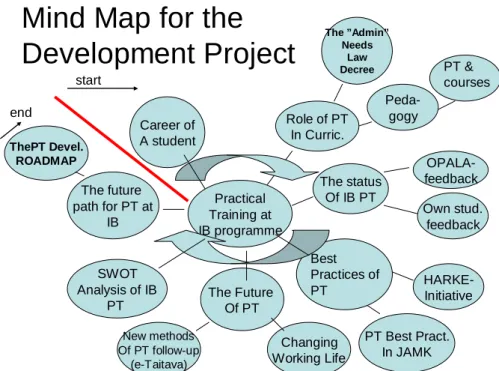
The role of practical training in the pedagogical strategy of the school Special challenges in mentoring Practical training in. Hands-on training – process of the international business program and create a clear and time-planned action plan to improve the process. The report touches on an area in the Jyväskylä University of Applied Sciences curriculum entitled "Practical Training".
THE DEVELOPMENT PROJECT MISSION, MOTIVATION AND METHODOLOGY
The published guidelines of the highest education authorities in Finland state that the Finnish university sector will also be developed in the future on the basis of the so-called dual model, where the. Universities of Applied Sciences have their teaching strengths based on practical working life needs, while the "Science Universities" are. Both sides of the dual model will in any case need structural innovations - also in the number of institutions.
THE THEORETICAL FRAMEWORK –ROLE OF PRACTICAL TRAINING IN CAREER DEVELOPMENT AND WORKING LIFE
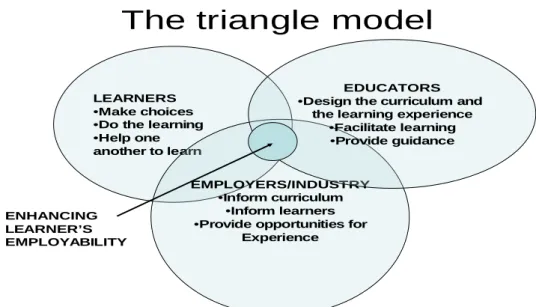
Be contextualized and reflect knowledge of the organization's career context and other potential contexts. The "learning stakeholders", including the authorities responsible for education policy making and quality monitoring, should share the same view on the role of on-the-job training and its role in employability. Learning at Work” initiative proposes an “Iceberg” model, showing the two separate sets of skills related to the interests of the learning stakeholders.
THE EFFECT OF LEGISLATION, PEDAGOGICAL STRATEGY AND CURRICULUM TO PRACTICAL TRAINING
The Act on Universities of Applied Sciences even states that part of the teaching leading to the target degree can be organized at the workplace (§ 17). In order to avoid too many strategies at the organizational level, I do not go into the details of the (pedagogical) strategy of the entire JUAS. In the opening paragraph of the pedagogical strategy of the JUAS School of Business Administration, there is a reference that shows.
The Pedagogical Strategy of the BA School also lists some concrete ones. strategic goals to be achieved by 2008. School mission statement (under renewal, this is a tentative version): BA School educates competent business professionals, capable of developing regional business life and solving problems. The cross-cultural structure of the students as a group (an asset!) which also means somewhat different cultural backgrounds ie.
So, what opportunities and challenges do those facts that come from the nature of the program and also the way the academic year is organized give to the Practical Training Tutoring process. Of course, at the same time the visits serve as a source of up-to-date information about working life for the teacher, which then helps to maintain the relevance of working life and the "street credibility" of teaching. Instead of teaching the Practical Training when it is active (the student is already in the company), the role of the PT Tutor in our program is to prepare people very much for the period, and collect feedback and reflect it to the "next generation ” of student exit - Permanent relationships with several companies would support a lot.
Active PT teaching will both improve relations with companies (networks) and support the development of the subject teaching.
THE IMPLEMENTATION OF THE PRACTICAL TRAINING - PROCESS IN THE IB-PROGRAMME
The existing process description available from the ASIO system of the University of Applied Sciences is as shown in Appendix 1. Instead, a PowerPoint presentation about our PT process has been kept available on the School's L drive, unfortunately only accessible from two campuses of the school (any computer at these locations). The method of benchmarking was to follow their process descriptions, results via the OPALA feedback and above all – to conduct interviews with the people in charge of the process in the organization.
Interviewer: – head of the programme, international logistics engineering (also the Practical Training coordinator of the programme). As a result, some parts of the process have been more formalized and made part of the department's routine. Facilities Management – the English-speaking program of the School of Tourism, Catering and Home Economics.
The internal distribution of tasks is centralized in the hands of the international coordinator in terms of administrative work, plans/agreements etc. An example of the application was a discussion area for peer support, sharing of feelings and learning during the Internship was made possible. Comment: All the programs seem to have fairly good – and improving – applicability of the teaching.
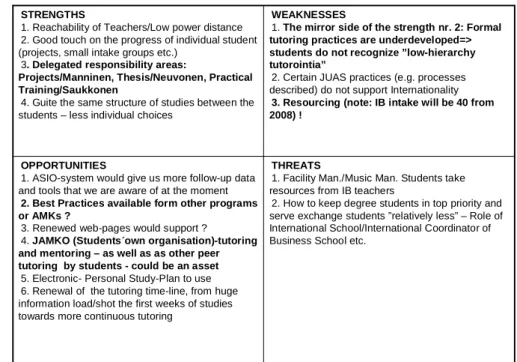
Comment: The process must be seen by the faculty to be long enough, and the last point ("Sharing experiences..") must also be part of the first point ("Preparation"..). As in question 4: The student clearly wants to be part of the organization where the PT period takes place - outside enough of the context of the school - and too many contacts can be seen as "over-guidance". So there is a need for a one-to-one discussion of internship offers and available learning between student and supervisor.
NEW TOOLS AVAILABLE TO IMPROVE PRACTICAL TRAINING PROCESS? – EXAMPLE E-TAITAVA
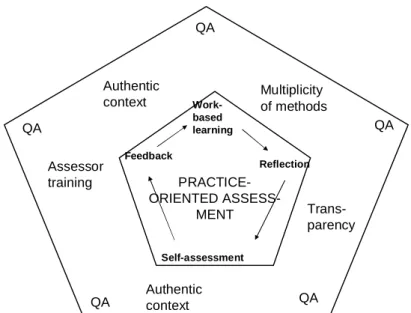
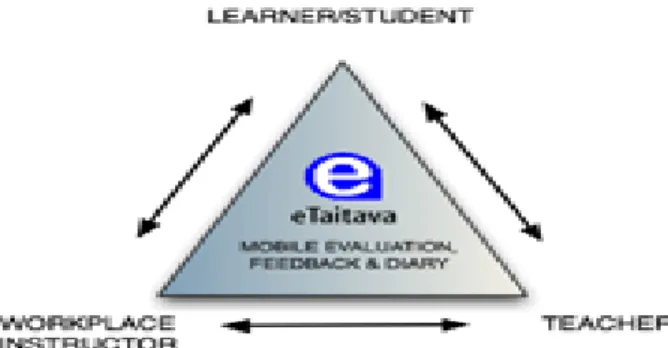
Comment: The latter part may have been left with less weight, as the great variation between the internships and the scarcity of deep enough contacts with the workplace supervisors have limited the evaluation to be largely based on the student's assessment, primarily via self-reflection. The system requirements are that all parties in their use have a mobile phone that supports Java operating system, has GPRS data transfer capability and a color display - according to the company (Pirttiaho of the new phones currently sold meet these criteria. During the Practical Training period, the server (managed by Mobiletools) automatically sends the questions to the respondent, by simply clicking on the visual display of questions (see Figure X) the student e.g.
The web application enables the supervising teacher to see in time scale the development of the training period and also to make statistical summaries from different participants. Within the University of Applied Sciences, the Schools of Nursing and Tourism also participated in piloting the application during spring 2008, based on the available resources conc. Here are my views as I get to know the application and also pilot it with a student who doing his practical training abroad and using the e-Taitava application – purely from the point of view of my own programme.
Some support for my views emerged in the discussions/meetings within the TOVE project - peer teachers who also tested the app with their own. Now the report is written at the very end of the training and what happened along the way is forgotten and the report is written in a very general way to fulfill the study credit criteria. With a weekly comment log, all it would take is a good summary/cover page.
Although answering the same questions weekly starts to make you feel a bit "tired" at some point, on the other hand it is good to keep the set of questions simple and quick to answer.
THE PLAN AND SCHEDULE FOR A PRACTICAL TRAINING
Your answers serve as a good basis for the learning report that you write about your practical training after the training period is over. Although no larger conclusions can be drawn from the responses of a single recipient, virtual PT learning applications have the potential to help students recognize learning and structure the learning experience. This can be seen in OPALA's results of the IB programme, where due to changes in personnel there was a period when the role of active PT tutor was not taken by anyone.
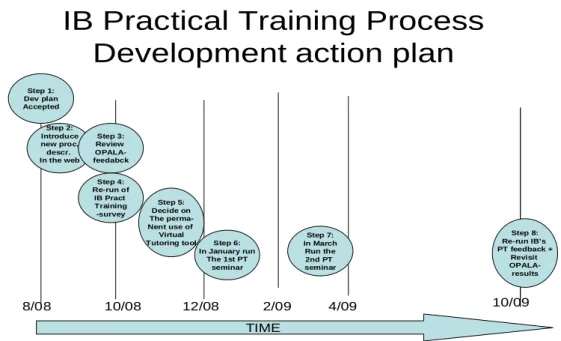
The survey among IB students who followed their OT period in the summer of 2007 also showed that the different parts of the PT process are of different importance to students. It was remarkable that sharing experiences with other students was not seen as such an important point, even though it would be an essential part of the preparation phase of the next exchange students and preparing the students for the PT period was seen as an important point in PT Process. In Figure 9, I have gathered the things that need to be done for an action plan, a time-based step-by-step plan for the next 1-1.5 years from the date of writing this last chapter in the summer of 2006.
This is the only way we can leverage the learning of the experienced students and also help them better reflect and assess their own PT learning experience. Formalizing the PT process is also likely to lead to better recognition of the guidance obtained by the students, something that the OPALA results reflect. Depending on the upcoming structural changes, these tools may be shared with some other programs.
To really develop the proposed ideal Triangle Model of Learning at Work in the context of an international program, a virtual tool of the e-Taitava type should be used, and clear decisions about its scope (broad enough rather than individual users, the decision is based on schools within the university by programs/institutions?) and the way in which data collected by such applications are used will be necessary for the decision-making bodies of JUAS.
CONCLUSIONS AND IDEAS FOR FURTHER DISCUSSION
The maximum credits for internship is 30 ECTS in total, the minimum depends on the amount of project credits you plan to accumulate (if you plan to have 10 ECTS in project credits, the minimum for practical training is 20 ECTS, but you can still do it de full 30 ECTS, as most do). When you have an idea, contact Internship coordinator - teacher Juha Saukkonen Planning and application: Find the company and negotiate your terms. Complete the required documents (available at www.jypoly.fi/lita/ib) Contracts, aids and learning objectives: Complete the documentation.
Plan your further studies according to your Personal Learning Plan (PLP) and register for the relevant courses. Once your Internship Coordinator has signed the paperwork, you are ready to go and collect your credits from the Office of Students.