Identifying and recognizing the mental health problems in order to provide culturally appropriate care can present professional challenges. The results show that it is important to know and understand how the immigration process affects mental health and to take this into account when planning care for immigrants. Training and education for cultural competence and transnational competence for professionals and organization can provide the knowledge and skills needed in immigrant mental health care. integration, immigrants, health professionals, mental health, culturally sensitive care, transnational competence, cultural competence.
According to Castaneda et al, the organization of preventive and corrective mental health services for immigrants in Finland is not consistent. The YOUME project aims to support the integration and participation of immigrants by promoting mental health and early access to care when mental health problems arise. The MEAE is responsible for "immigrant integration, integration legislation and the promotion of employment among immigrants".
Mental health
The promoting factors for integration include e.g. learn the new language, get a job or an education and make connections in the community. Although immigrants are integrated into Finnish society, their cultures, languages and religions may continue to be a part of their lives. There are many associations founded by immigrants in Finland, which can help the immigrants maintain and develop their culture in Finnish society and be part of the association's activities.
The concept of positive functioning used in definitions and theories of mental health can lead to a misconception that "an individual of a certain age or in a physical condition" prevents them from functioning "productively" is not in "a good mental health". Mental health can be seen as "a process of biological-psychological-social" (Lavikainen et al), which determines the level of mental health (WHO 2014). A positive sense of well-being, individual resources, personal relationships and coping with difficulties are part of the positive mental health dimension.
3 THE AIMS AND THE PURPOSE OF THIS STUDY, AND THE RESEARCH QUESTIONS
4 METHODOLOGY
Literature review
Data collection
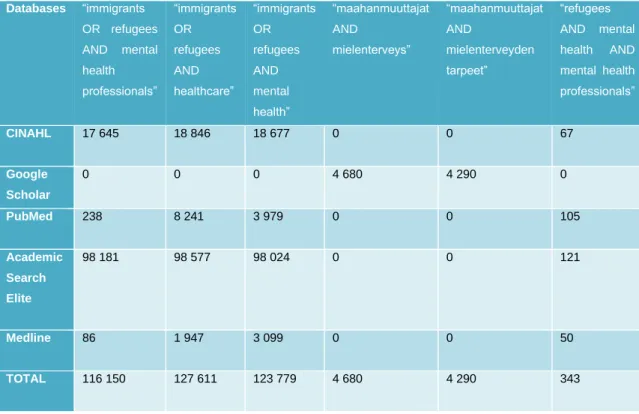
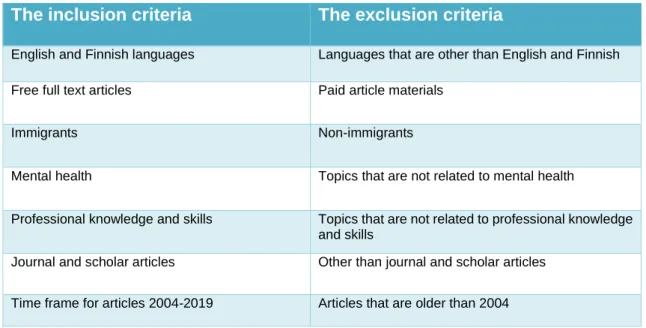
Using the keyword “immigrants OR refugees AND mental health professionals” to search for articles across all chosen databases without filtering, there were 17,645 article results from CINAHL, 238 from PubMed, 98,181 from Academic Search Elite, and 86 from Medline. For “immigrants OR refugees AND health care” keyword search for articles without filters, 18 846 articles from CINAHL, 8 241 from PubMed, 98 577 from Academic Search Elite, and 1 947 from Medline. From using keywords “immigrants OR refugees AND mental health,” 18,677 articles from CINAHL, 3,979 from PubMed, 98,024 articles from Academic Search Elite, and 3,099 articles from Medline.
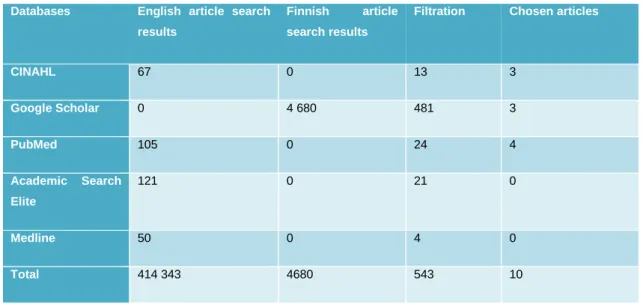
Finally, for searching Finnish articles, "maahanmuuttajat AND mielenterveys" for the Google Scholar database only 4680 and 4290 articles resulted from using the keyword "maahanmuuttajat AND mielenterveyden tarpeet". The goal of the screening methodology is to weed out studies that are clearly unrelated to the topic. At the end, after completing the filtration process, the number of articles was limited and 10 articles were included in the study, as shown in Table 3.
Data analysis
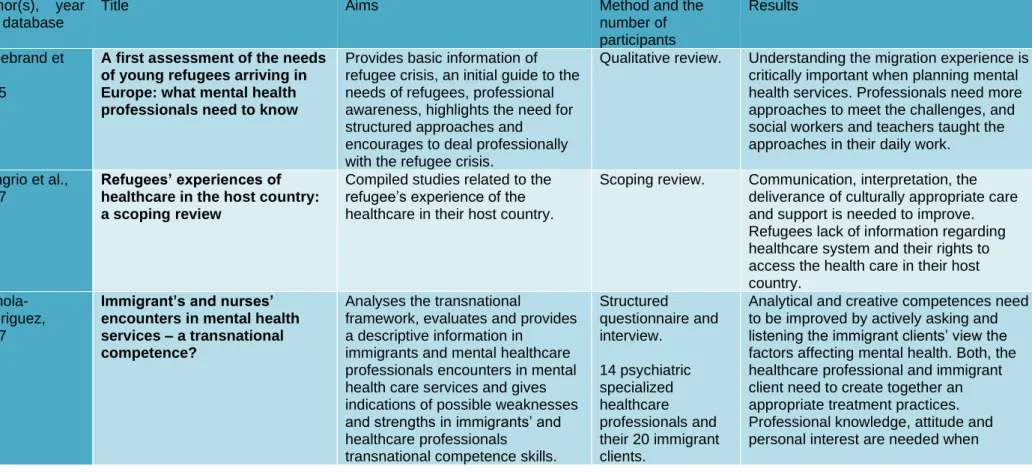
See Appendix 2, which includes Table 5, for a summary of the content analysis of the 10 articles included in this study. The content analysis of the articles revealed seven themes: immigrants and mental health problems, the six sources of resilience, culturally appropriate care, encounters with immigrant patients, cultural competences, transnational competences, identification of immigrants' mental health needs.
5 RESULTS
- Immigrants and mental health problems
- The six sources of resilience
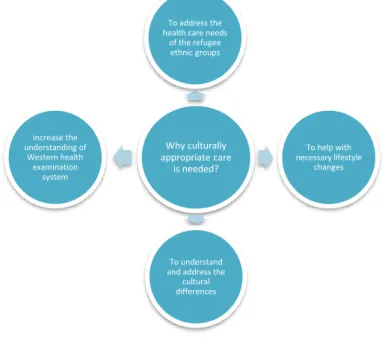
- Culturally appropriate care
- Immigrant patients encounters
- Cultural competence
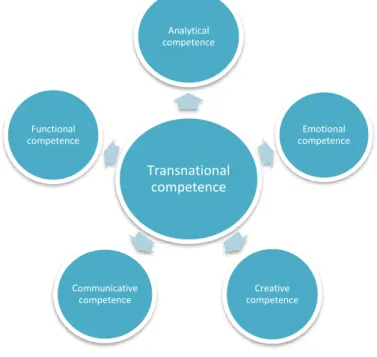
- Transnational competences
- Identifying the mental health needs of immigrants
For mental health professionals, it is critically important when planning mental health care to understand the potentially traumatic experiences in the migration stages because they are relevant to the mental health outcomes. Health care professionals need to understand and familiarize themselves with the culture and the migration experiences. They felt that they were not considered trustworthy by their refugee patients compared to the other healthcare professionals, e.g.
The support of health care professionals is seen as important for refugees because it allows them to have a positive experience with health care. The increase in the number of refugees presents a major challenge to the health care system of the host countries due to the lack of readiness in the treatment and understanding of the health care needs of refugees among health care professionals (Mangrio & Fross 2017, 1). So it is important for health care professionals to support their immigrant patients who come into the health care system for a variety of reasons (Mangrio & Fross 2017, 14).
Healthcare professionals and the performance of immigrant patient care are affected by both the skills and knowledge of healthcare professionals and their lack thereof. It was found that training can help health professionals to solve problems. Cultural competence refers to the ability of health professionals and organizations to provide culturally appropriate and effective health services to people of different cultural backgrounds based on their individual needs.
It is required of the healthcare system, even when assessing psychiatric care for immigrant patients, e.g. Reflexive thinking means being aware of how a culture influences the relationship between a patient and a healthcare professional. The themes related to emotional competence are the basic principles of the professional work of health professionals (Sainola-Rodriguez 2007 as cited in Sarvimäki &.
In the Sainola-Rodriguez study, the healthcare professionals realized that the communication is successful if an interpreter is present, even though other factors influencing the situation, e.g. The primary health workers and the reception center's doctors and nurses have a primary role in identifying the mental health needs of asylum seekers and immigrants. Patient who comes from another culture and who has experienced a traumatic and discrimination, premigration and postmigration stages can pose challenges for the health care professionals to evaluate immigrant patient's mental health needs.
6 DISCUSSION
In the study of Sainola-Rodriguez and Koehn (2006) mental health differences between asylum seekers and FRNs were highlighted. Asylum seekers were reported to have more mental health problems than INFs e.g. Women and men expressed their mental health differently. Many of the emigrants experience mental and somatic problems before their emigration and upon their arrival in the host country.
Every immigration process affects and triggers the mental health of the immigrant. It is important for professionals to consider what the immigrant went through upon arrival in the host country and the situation after migration when planning mental health care. In Majumder's study (2019), many refugee children denied having mental health problems due to fear of social consequences, including abandonment and rejection by family and friends.
To avoid these fears, mental health problems are interpreted as physical problems (Sleijpen et al. 2016.). Perceptions and stigma of mental health and mental illness affect immigrants' engagement with mental health professionals, mental health services, treatment outcomes, and the effectiveness of services provided to them. It requires great professional competence, a caring attitude and a. a personal interest in speaking about the situation of a refugee with mental health problems.
Immigrant patients who came from a different culture and have traumatic and discriminatory experiences before and after their arrival in the host country pose challenges for health professionals in evaluating the mental health needs of immigrant patients. The primary health professionals and the professionals at the reception centers reported that it is difficult to feel and identify the psychological needs of asylum seekers and RFNs. It is important to take into account the immigrant patients' self-described problems when identifying the mental health problems and to pay more attention to the immigrants individually and how they describe their mental health needs and their immigration experiences.
Health care professionals should be aware of the factors influencing the background of mental health problems and should be able to meet immigrant patients from different cultural backgrounds and have the ability to address the challenges of caring for immigrants improve themselves through education and training.
7 CONCLUSION
8 REFERENCES
Exploring stigma and its effect on access to mental health care among unaccompanied refugee children. A file review of refugee children referred to specialized mental health care; from individual diagnostic to ecological perspective. An art therapy intervention for symptoms of posttraumatic stress, depression and anxiety in Syrian refugee children.
APPENDICES
Analyzes the mental health needs of asylum seekers and resident foreign nationals in Finland and identifies them. Health professionals who increase their transnational skills are likely to promote awareness of the individual specific ways in which immigrants define their mental health needs and express their experiences and increase the chances that asylum seekers and permanent foreign nationals will receive effective mental health care. Looking at reasons why refugee children are referred to specialist psychiatry and diagnostic observation results after assessment.
Mental health professionals need to be aware of the variety of challenges to refugee children's well-being. Pay attention to what helps or hinders mental health practitioners in delivering culturally competent mental health care. A cultural competence training is required by all mental health professionals that is "specific to different professional needs, health settings and practice locations".
Six sources of resilience: social support, acculturation strategies, education, religion, avoidance, and hope, which have negative and positive aspects. Numerous refugees and asylum seekers are exposed to both physical and psychological stress in their country of origin, as well as during the transition to and upon arrival in the host country, which can increase their risk of developing psychological problems" Mangrio & Fross 2017. An understanding of the individual refugee's flight experience is also of crucial importance for the planning of mental health services in the post-flight context.” Hebebrand et al.
Engagement with mental health services can be hindered by people's own perceptions and understanding of mental illness, and stigma and embarrassment can prevent people from seeking help” Majumder 2019. The most cited sources of support were (1) family, (2 ) people from the same cultural background, (3) peers, and (4) professionals.” Sleijpen et al. Learning the new language, studying the new culture, and joining peers from the new country were seen as essential acculturation strategies.” Sleijpen et al.
Many young refugees had clear goals and some refugees were hopeful for the future” Sleijpen et al.