DEVELOPING REVERSE LOGISTICS IN RENTAL RETURNS MANAGEMENT
Case: 3 Step IT Group Oy
LAHTI UNIVERSITY OF APPLIED SCIENCES
Faculty of Business Studies
Master's Degree Programme in Entrepreneur- ship and Business Management
Thesis May 2009 Kivelä Eija
KIVELÄ, EIJA: Developing reverse logistics in rental returns management Case: 3 Step IT Group Oy
Master’s Thesis in Entrepreneurship and Business Management, 79 pages, 4 ap- pendices
Spring 2009 ABSTRACT
This research deals with developing reverse logistics in the field of managing ren- tal returns.
The theoretical background covered in the research is based on services manage- ment, supply chain management and developing reverse logistics. Reverse logis- tics can be shortly described as moving a product backwards through the logistics channel. The products or materials are transferred backwards in the distribution channel either due to customer returns or removal of wastes and by-products. De- veloping reverse logistics taking into account requirements of rental returns man- agement requires details from managing services and supply chains and the attributes of reverse logistics concept itself. To include the customer perspective into developing reverse logistics, this study reflects the balance between service standardization and customization and also the balance between perceived service quality and productivity.
The empirical part of the research project consists of developing the rental returns management system at 3 Step IT Group Oy. The target was to develop the compa- ny’s reverse logistics operations and hence intensify the performance of order- supply chains. The research project included process, IT systems, training, and instructions changes made during a period of one year. The data retrieved by func- tional observation, group interviews, observations from customer trainings and the studied topic literature was used as a basis for the improved rental returns man- agement system for 3 Step IT Group Oy.
3 Step IT’s improved rental returns management system has been defined to in- clude three main sections: ending option management, returning devices manage- ment and process support and training. These three parts form a unity which, in co-operation with earlier steps of 3 Step IT’s IT lifecycle management process, creates additional value to customers and enables both companies to develop their operations to correct direction. The company’s rental returns management system can not function merely as a returning devices management system. An efficient rental returns management system requires support from an efficient ending option management and applicable process support and training functionalities.
Key words: reverse logistics, supply chain management, services management, service productivity, 3 Step IT Group Oy
KIVELÄ, EIJA: Palautuslogistiikan kehittäminen palautuvien vuokralaitteiden hallinnassa
Case: 3 Step IT Group Oy Yrittäjyyden ja liiketoimintaosaamisen opinnäytetyö, 79 sivua, 4 liitesivua Kevät 2009
TIIVISTELMÄ
Tämä opinnäytetyö käsittelee palautuslogistiikan kehittämistä palautuvien vuokra- laitteiden käsittelyssä.
Teoriaosa perustuu palveluiden hallintaan, toimitusketjujen hallintaan ja palautus- logistiikan kehittämiseen. Lyhyesti kuvattuna palautuslogistiikka on tuotteiden siirtämistä takaisinpäin logistiikkaketjussa. Tuotteet tai materiaalit siirretään ta- kaisinpäin jakelukanavassa joko asiakaspalautusten tai jätteiden ja sivutuotteiden poistamisen vuoksi. Palautuslogistiikan kehittäminen ottaen huomioon vuokralait- teiden palautusjärjestelmän vaatimukset tarvitsee tietoja palveluiden ja toimitus- ketjujen ja itse palautuslogistiikan ominaispiirteistä. Sisällyttääkseen asiakasnäkö- kulman palautuslogistiikan kehittämiseen, tämä tutkimus käsittelee palveluiden standardisoinnin ja räätälöinnin ja myös koetun palvelulaadun ja palvelun tuotta- vuuden välistä tasapainoa.
Opinnäytetyön empiriaosuus koostuu 3 Step IT Group Oy:n vuokralaitteiden pa- lautusjärjestelmän kehittämisestä. Tavoitteena oli kehittää yrityksen palautuslogis- tiikkatoimintoja ja täten tehostaa tilaus-toimitusketjun suorituskykyä. Tutkimus- projekti sisälsi yhden vuoden aikana tehtyjä muutoksia prosesseihin, tietojärjes- telmiin, koulutukseen ja ohjeistuksiin. Tutkimustieto kerättiin toiminnallisen ha- vainnoinnin, ryhmähaastatteluiden, asiakaskoulutuksissa tehtyjen havaintojen sekä tutkimusaiheeseen liittyvän kirjallisen aineiston avulla. Näiden pohjalta rakennet- tiin parannettu vuokralaitteiden palautusjärjestelmä 3 Step IT Group Oy:lle.
3 Step IT:n parannettu vuokralaitteiden palautusjärjestelmä sisältää kolme pääosa- aluetta: päättymistapojen hallinnan, palautuvien laitteiden hallinnan sekä prosessi- tuen ja koulutuksen. Nämä kolme osa-aluetta muodostavat kokonaisuuden, joka yhteistyössä muiden IT-laitteiden elinkaarenhallinnan vaiheiden kanssa, luo lisä- arvoa asiakkaille ja mahdollistaa molempia yrityksiä kehittämään toimintojaan oikeaan suuntaan. Yrityksen vuokralaitteiden palautusjärjestelmä ei voi toimia ainoastaan palautuvien laitteiden hallintajärjestelmänä. Tehokas vuokralaitteiden palautusjärjestelmä tarvitsee tukea tehokkaalta päättymistapojen hallinnalta ja tarkoituksenmukaiselta prosessituelta ja koulutustoiminnoilta.
Avainsanat: palautuslogistiikka, toimitusketjujen hallinta, palveluiden hallinta, palveluiden tuottavuus, 3 Step IT Group Oy
1 INTRODUCTION 1
1.1 Case company presentation 1
1.2 Objectives and research questions 4
1.3 Limitations 5
1.4 The research project and risk analysis 5
1.5 Structure of the report 6
2 RESEARCH METHODOLOGY AND RESEARCH PROJECT 8
2.1 Research methodology 8
2.2 Development project 10
3 SERVICES AND SUPPLY CHAIN MANAGEMENT 14
3.1 Managing services for business markets 14
3.1.1 Managing the service offering 14
3.1.2 Services standardization vs. customization 18
3.1.3 Supporting service productivity 20
3.2 Supply chain management 25
3.2.1 Definition and benefits 25
3.2.2 Challenges in managing supply chains in service
organizations 28
3.2.3 Supply chain security 30
3.2.4 IT support to supply chain management 32
4 DEVELOPING REVERSE LOGISTICS 35
4.1 Reverse Logistics - Definition and background 35 4.2 Reverse logistics as a tool to increase competitive performance 37
4.3 Managing reverse logistics 38
4.3.1 Reverse logistics process 39
4.3.2 Managing the reverse supply chain relationships 42 4.3.3 Challenges in developing a reverse logistics model 44 5 CURRENT RETURNS MANAGEMENT SYSTEM AT 3 STEP IT
GROUP OY 48
5.1 Customers’ process and instructions 48
5.2 Customer service process and instructions 49
5.3 IT System support to returns management 50
5.4 Requirements from development project 53
6 DEVELOPING 3 STEP IT’S RETURNS MANAGEMENT SYSTEM 54 6.1 Implementation and timetable of the development project 54
6.2 Target groups and aimed results 55
6.3 Mapping of initial situation and gathering development data 56
6.3.1 Starting development project 56
6.3.2 Group interviews 56
6.3.3 Data from customer trainings 58
6.4.2 Process development 63
6.4.3 IT Systems development 69
6.4.4 Summary of achieved development tasks 72
6.5 Improved rental returns management system for 3 Step IT 74
6.6 Future developments 75
7 SUMMARY 77
LIST OF SOURCES 80
APPENDICES 84
Figure 1 3 Step IT’s general process for returning rental equipment 3
Figure 2 Research project structure and goal 6
Figure 3 Structure of the report 7
Figure 4 The augmented service offering 17
Figure 5 Productivity, quality, customer and provider participation
and demand as productivity factors in service contexts 21 Figure 6 The multiple enterprises of the supply chain 26 Figure 7 3 Step IT’s detailed process for returning rental equipment 27 Figure 8 The concept of the information system 33 Figure 9 Logistics manages the flow through the distribution channel 39
Figure 10 Logistics Flow for 3 Step IT 42
Figure 11 Creating closer supply chain relationships 43
Figure 12 Logistics future challenges 45
Figure 13 Summary of development tasks from January 2007 to
January 2009 73
Figure 14 Contents of 3 Step IT’s Returns Management System 74
LIST OF TABLES:
Table 1 3 Step IT Group’s key figures from year 2004 to year 2008 2
Reverse logistics Reverse logistics process. Products are moved backwards through the logistics channel. The products or materials are transferred backwards in the distribution channel either due to customer returns or removal of wastes and by-products EOL End-Of-Lease or End-Of-Lifecycle services. Operations
conducted after lease contract end date NS 4 ERP system in use at 3 Step IT Group Oy
Asset Management Asset Management reporting system where customers are able to manage their rented assets and own assets. Directly linked to 3 Step IT’s ERP system, NS 4.
KaPula Warehouse management system used at 3 Step IT
CRM team Customer relationship management team that handles all customer service for rental customers including rental
contracts, process support, pick-ups for ended equipment etc.
FIFO First in, First out principle. With inventory management implies to handling inventory for the first arrived devices first, secondly arrived second etc.
1 INTRODUCTION
Reverse logistics has very quickly moved from an undesirable back office activity to a significant opportunity to enhance corporate profit. In this study the researcher will reflect reverse logistics as a procedure, not merely as handling product returns which has been considered to be the main purpose for reverse logistics. As the environmental thinking has grown in significance, also the shipments of wastes and by-products have raised the importance of reverse logistics. Reverse logistics can be defined as all activities associated with a product or service after the point of sale, the ultimate goal being to optimize or make more efficient aftermarket activities, thus saving money and environmental resources (Pollock 2007, 12).
Reverse logistics, as reflected in this study, is also a tool to handle returning rental equipment after lease contract time expires. The subject for the research was cho- sen as the efficient operations for rental returns management are growing increa- singly important for the research company.
1.1 Case company presentation
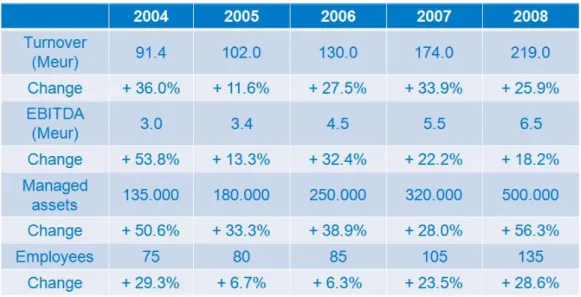
The business idea of the case company for this research, 3 Step IT Group Oy, is to facilitate the management of the entire lifecycle of IT equipment. Basically this means three phases: flexible rental (Step 1), on-line Asset Management (Step 2) and environmentally sound remarketing services (Step 3). Company presentation for 3 Step IT can be found from appendix 1. 3 Step IT was founded in 1997 and operates at the moment in nine countries: Finland, Sweden, Norway, Denmark, Estonia, Latvia, Lithuania, United Kingdom and Russia. 3 Step IT headquarters are located in Vantaa, Finland. Annual turnover in year 2007 was 174 million Euros and increased to 219 million Euros in 2008. The amount of personnel in year 2007 was 107 whereas the personnel count in 2008 was 135. Growth has been significant both in terms of turnover but also with amount of personnel. Key figures for 3 Step IT Group’s operations are described in table 1.
Table 1. 3 Step IT Group’s key figures from year 2004 to year 2008 (3 Step IT Company presentation 2009)
The customer portfolio for 3 Step IT consists mainly of small and medium sized companies but also of a large number of community customers. 3 Step IT has a strategy to build growth by efficient teams specialized for their own aspects of the operations, e.g. customer service management, IT systems development or trading sales of returned IT equipment. The teams effected by and contributed to the re- search are described later in chapter 6.2.
The target of the research, step 3 of 3 Step IT’s operations begins when the lease time expires. At this time the customers generally have three options to choose from. The customers have the option to return the equipment, purchase them for their own use (buy-out) or extend the lease period further. The terms for the buy- out prices are determined in the lease contracts as well as the terms for lease ex- tension. The lease extension periods are restricted to maximum 12 months, after which the customer has only the two remaining options; return or buy-out. In some contracts there are restrictions regarding available options. The returning option may for example be outlined from the contract or specified product groups.
Approximately 40 per cent of all leased equipment is returned immediately after the lease term periods end. Services for the returned equipment consist of collec- tion and packing services at the customer’s premises and secure data erasure for all returned devices with hard discs.
The company’s and its customers’ rental devices are managed in an ERP system and a asset register system both developed solely for the company’s own purposes by the company’s own IT department. As the company’s business operations have grown rapidly, yearly growth of returning rental device amounts 20 – 30 %, the need to improve and unify company’s operational processes is clear. The purpose of this research is, therefore, to identify the next steps for systems and process development from both customer and company’s own perspective. Taking into account researcher’s own role with responsibility for company’s operational logis- tics and Step 3 processes, this research gives significant benefits to both re-
searcher’s own work and the case company.
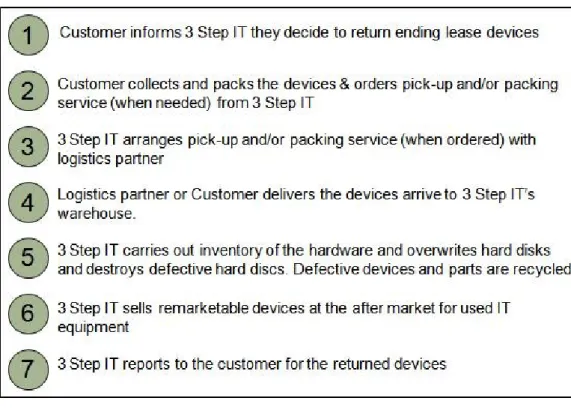
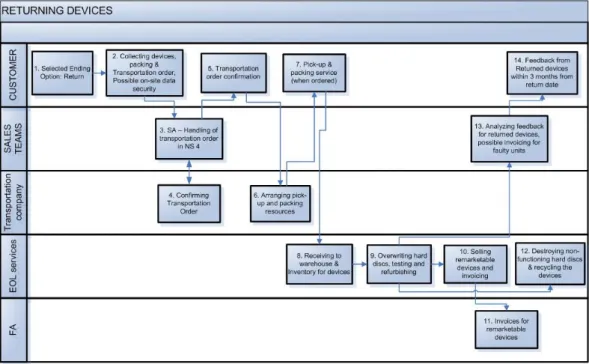
Figure 1 describes 3 Step IT’s process for handling returning devices. The process is described from the point where the customer chooses to return the devices to selling the returned devices in the after market and handling required recycling for non-functioning parts and/or devices. The research will cover points 1 to 5 in the figure. The covered process starts with choosing the ending option and ends with the equipment’s arrival to warehouse and inventory for returned devices. A more detailed process description can be found from appendix 2.
Figure 1. 3 Step IT’s general process for returning rental equipment
Since beginning of year 2007 customers have had the opportunity to make trans- portation orders for all returning devices directly from the Asset Management re- porting system. The orders are then handled and forwarded to the transportation company from 3 Step IT’s own operational system, NS 4. This process was earlier handled totally by MS Excel and e-mail, and can now be totally handled from the company’s own IT systems. After using the developed functionalities for over a year, this research project aims to collect experiences and understanding from both customer and company’s inner perspective.
The business concept of 3 Step IT is challenging as the company operates as a service company but has also taken the responsibility for the physical process after lease contract expiration date. Most of the company’s competitors use partners to handle the physical process. The only part of the physical process 3 Step IT out- sources is the transportation process. Also this process is monitored closely and 3 Step IT has a strategy to use only confirmed and trusted partners.
1.2 Objectives and research questions
The goal of the research project is to study the means of developing companies’
reverse logistics processes and to therefore intensify the performance of order- supply chains. This research will take a clear customer-perspective to developing reverse logistics. The goal is to develop reverse logistics both from customer- perspective but naturally also from the perspective of the case company itself. This research also aims to determine the needed measurement tools to ensure the fur- ther development of a reverse logistics system.
Taking all this into account, the basic research question for this project is:
• What are the most efficient operational procedures for reverse logistics?
To better be able to answer the questions, the following additional support ques- tions have been summarized:
• What are the customers’ expectations from an efficient reverse logistics process?
• How to include the customer perspective to process development at the same time keeping in mind the final goal of a cost efficient reverse logis- tics process?
• How to measure the process to ensure further development and improve- ment of reverse logistics processes?
1.3 Limitations
Although reverse logistics generally creates discussion regarding environmental issues, this research will not cover the aspect of protecting the environment with the help of reverse logistics related activities. Also organizational matters will be addressed only from the aspect of personnel requirements. The transportation process will be reflected to only from process perspective in the research project.
Developing the transportation process will be carried out separately in co- operation with company’s logistics partners.
Developing 3 Step IT’s rental returns management system is an ongoing and con- tinuous process. Therefore, the development will be continued also after this re- search to correspond with the market and strategic requirements. The development aspect covered by this research is restricted to development tasks conducted be- tween January - December 2008. Topics for further development scheduled to be conducted separately after this research project, are reviewed in chapter 6.6.
1.4 The research project and risk analysis
The research project was started with planning and choosing the best-suited data retrieval methods and studying the corresponding literature. The group interviews
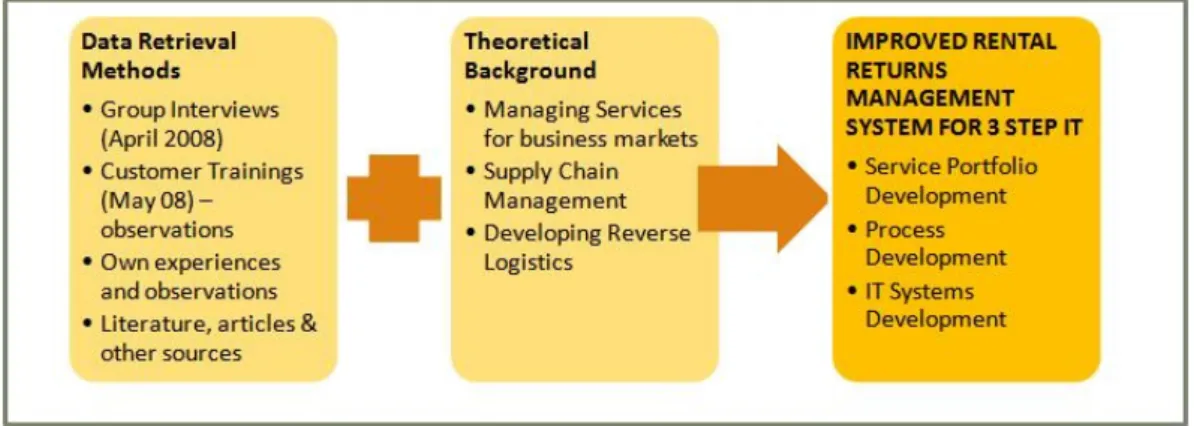
and customer trainings were conducted during April – May 2008 and the devel- opment tasks during summer and autumn 2008. More details on the research pro- ject can be found in chapter 6.1. The general structure and goal of the research project are described in figure 2.
Figure 2. Research project structure and goal
The largest risks related to the research project are involved with the organization and available resources. When developing inner processes and services structure, the development tasks must be validated to the organization to ensure successful implementation. The presumption of minor internal resistance proved true as there is a clear inner demand for developing the rental returns management system fur- ther. A major risk for the development project was involved with available re- sources. The development has been conducted in connection with normal daily operations which has caused some delay in the project timetable. The development project has, however, been conducted during a satisfactory time period, during one year.
1.5 Structure of the report
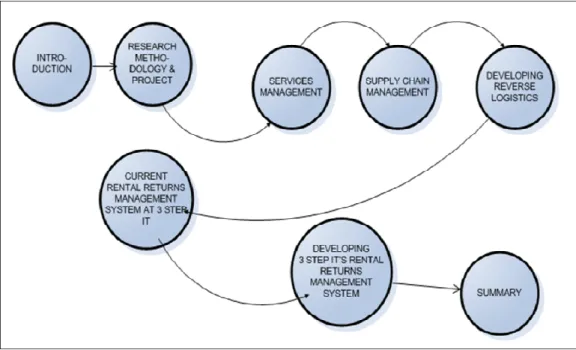
The report has not been divided strictly into theoretical and practical sections. In- stead, I have chosen to handle theoretical and practical matters alongside each other. Chapters 3 and 4 covering issues of services and supply chain management and developing reverse logistics are structured with first the theoretical part and the practical, case company related objectives have been included to each chapter
immediately after the theoretical part. This method has been chosen to bring the- ory closer to practise and to ease creation of general view on the subjects. The structure of the report is described in figure 3 below.
Figure 3. Structure of the report
After introducing the research subject, the used research methodology will be de- scribed and the contents of the research project outlined. The theoretical back- ground and practical issues will be started by matters related to services manage- ment, following supply chain management matters and finally the developing of reverse logistics. Going further to the case company’s operations, the current rental returns management system is described next in chapter 5. The developing and improving of 3 Step IT’s rental returns management system is covered in chapter 6 with details on the results of the development project and changes made to the rental returns management system. Finally, the report is closed by the sum- mary chapter.
2 RESEARCH METHODOLOGY AND RESEARCH PROJECT
This research has mainly been based on qualitative research methodology. The applied research methodologies will be outlined in the next chapter. The course and structure of the research project will be described. A short review on the data retrieval methods applied during the course of the research project will also be covered.
2.1 Research methodology
This research has been conducted as a case study and is mainly based on qualita- tive research methodology. Some aspects of the research have, however, charac- teristics from quantitative research. When discussing a case study research, one should understand that it does not refer to a technique. A case study does not take a qualitative or quantitative approach. With case studies, we are directed towards understanding the uniqueness, characteristics and functions of a particular case in all its complexity. A case study research can take many forms. It may rely on pre- existing information or observing the process or on in-depth interviews. The data gathering methods are, however, related to the research using either qualitative or quantitative approach. (Hackley 2003, 95 – 97; Welman 2001, 182 – 183.)
According to Hackley (2003, 9) most research studies are described to be a mix- ture of both research methodologies with an emphasis on one or the other. In this case the emphasis is mostly on qualitative research. As a combination of qualita- tive and quantitative research, the goal for this research has been to create some- thing new and solve actual problems that are faced in the world of rental returns management, hence reverse logistics. The choice of using either structured or un- structured approach and of quantitative or qualitative mode of enquiry should de- pend upon the aim of the enquiry and use of the findings. (Ranjit 2005, 12.) Both methodologies have been shortly summarized in the next chapter.
Qualitative research methodology
Qualitative research methodology can be described as an exploratory research aiming to describe a situation, phenomenon, problem or event. If in qualitative research analysis is done to establish a variation in the situation, phenomenon or problem, the vital difference when compared to quantitative research is that quali- tative research has no aim to quantify the variation. Examples of qualitative re- search are descriptions of observed situations, the historical enumeration of events, an account of the different opinions people have about an issue, and a de- scription of the living conditions of a community. Unlike quantitative research, qualitative research relies on reasons behind various aspects of behaviour. Simply put, it investigates the why and how of decision making, as compared to what, where, and when of quantitative research. Taking all this into account, qualitative research relies on smaller but focused samples rather than large random samples.
(Ranjit 2005, 12 – 22.)
Qualitative researchers typically rely on four methods for gathering information:
participation in the setting, direct observation, in depth interviews and analysis of related documents and materials. When addressing types of qualitative data, they consist of different non-numerical material. The non-numerical data may be for example transcripts or audio-recordings of interviews, field notes of researcher observations, records of conservations, and any kinds of social texts such as books, articles, newspapers, advertisements or related company presentation and process material. (Hackley 2003, 25; Ranjit 2005, 12 – 22.)
Quantitative research methodology
Compared to qualitative research, when applying quantitative research methodol- ogy, the data consists of numerical information. Questionnaires are often used in business and management to gather data that can be quantified. After collecting the quantitative data, a statistical analysis is performed on the data. (Hackley 2003, 25.)
Quantitative research methodology is the systematic scientific investigation of properties and phenomena and their relationships. The objective of quantitative research is to develop and employ mathematical models, theories and/or hypothe- ses connecting to natural phenomena. The process of measurement is central to quantitative research because it provides the fundamental connection between empirical observation and mathematical expression of quantitative relationships.
Quantitative research is widely used in both the natural sciences and social sci- ences, from physics and biology to sociology and journalism. It is also used as a way to research different aspects of education. The term quantitative research is most often used in the social sciences in contrast to qualitative research. (Ranjit 2005, 12 .)
2.2 Development project
Basic structure for the development project is described in figure 2 in chapter 1.4 including used data retrieval methods, chosen theoretical background and finally the ultimate goal of a new rental returns management system for 3 Step IT Group Oy. The data for the research was acquired from group interviews, customer train- ings, own experiences and observations as well as current literature, articles and internet sources. Use of functional observation has great significance in the devel- opment project as a large part of the developing has been carried during the course of researcher’s work.
Applied data retrieval methods
Large part of the data was retrieved from group interviews to customer service and sales personnel. Conducting interviews is a good data retrieval method irrespec- tive of the applied method of research. Even with problem based researches inter- views with practitioners can give a valuable insight into practical issues. With more theoretically informed research project, the so called in-depth interviews are used. When conducting interviews, there are some important aspects to consider.
The interviewer must prepare well for the interview and aim to achieve as relaxed
atmosphere as possible for the interview. The interviewer must also choose be- tween passive and active interview styles. In some cases, when determined appro- priate in preliminary planning phase, the interviewer may lead the interviewees to a specific direction. In general, however, best results are often achieved when the interviewees are allowed to discuss the matter freely. Audio-recording the inter- views is recommended. (Hackley 2003, 76 – 77.)
The four group interviews were conducted during April 2008. The groups for the interviews were formed according to personnel group. Sales assistants handling the daily rental returns management work formed the first group. Second group consisted of customer service specialists who do not handle the basic work but in stead are responsible for the process support and training offered to the customers.
Third group interview formed the perspective of the key account managers who are in charge of the total customer portfolios. Finally, the fourth group interview studied the perspective of the sales and customer service management. The under- lying assumption that these four groups would have different interests and motiva- tions proved itself true. All groups concentrated on the matters closest to their own job descriptions and responsibilities with the sales assistants concentrating more on practical matters concerning daily work whereas the sales management concen- trated mostly on the service portfolio matters and total development of customer relationships. The execution and results of the group interviews are reviewed more closely in chapter 6.3.2.
Large part of the research data has been retrieved from researcher’s personal ex- periences and observations during customer trainings and normal end-of-lease work. Observation is a research technique that is often implicit in data-gathering approaches. Our observations provide the social context that informs our judge- ments on the surroundings, operational procedures and people. Informal observa- tion forms an integral part of interpretive research. More formal uses of observa- tion in social research include action research and participant or non-participant observation. Each of these techniques involves the researcher in the process that is being studied. A challenge in using observation as a data gathering method is to
remain as invisible as possible in the process and among the people to be ob- served. (Hackley 2003, 85.)
Customer trainings regarding best practise procedures for End-of-lease were con- ducted in end of May 2008. Good observations regarding customers’ own proc- esses and expectations were made during the 14 different workshop trainings where the researcher acted as a primary trainer. More information on the data re- trieved during customer trainings in chapter 6.3.3. Researcher’s own background with responsibility for the company’s operative logistics has also brought an im- portant aspect to the research. Own observations and experiences have been used as basic data for the research.
Literature and article sources have been gathered from the fields of the chosen theoretical background. The theoretical background has been formed from fields of reverse logistics, supply chain management and management of services. The materials have been gathered to best suit the purposes of returns management sys- tems taking into account that reverse logistics from 3 Step IT’s perspective is much more than handling of customer returns.
The original project plan included also personal interviews with company’s logis- tics partners. These interviews were, however, decided to be carried out after in- ternal functions have first been developed. Concentration will be first made to correcting the process inside 3 Step IT and focus more on external development at later stage of the development. During the course of the research and development project the project was divided into two phases. The first phase including devel- opments inside the company’s own processes and systems, and the second phase which will be carried out after receiving experiences from the changes conducted after first project phase is completed. Therefore the originally planned customer survey was decided to be carried out only after phase one. This will enable us to get the customers’ opinions heard when making the more specific developments to the process and systems. To ensure customer perspective also in phase one, the research relies on the group interviews conducted with the customer service per-
sonnel of 3 Step IT as well as observations from customer trainings and the daily end-of-lease work.
3 SERVICES AND SUPPLY CHAIN MANAGEMENT
The next chapters will guideline matters related to managing services and the overall supply chain. In each chapter, the theoretical background will be outlined first and each chapter will be concluded by describing how the individual matter is handled with regards to 3 Step IT’s rental returns management system.
3.1 Managing services for business markets
When talking about managing services, it is important to recognize that not all services are the same. The variation between different services can be wide and will affect also the services management process. This study will take a very li- mited look into services management to best benefit the study in question. The researcher will first take a look into managing the service offering and secondly the required choice or balance between services standardization and differentia- tion. Thirdly, the opportunities to support service productivity will be gone through.
3.1.1 Managing the service offering
Customers deserve more than just a good service package. It also has to be made into a functioning service process. (Grönroos 2007, 183.) The first step in service business is to establish the needs of the customer segment they wish to serve.
These needs must address the product, if there is a product, the customer trans- formation, and finally the customer perception. According to this information, a service strategy must be formed. (Sadler 2007, 79-80.) A key stage is, therefore, to determine what the company is selling and which customers they want to reach.
In the traditional product-centric mind-set services were seen as an afterthought – a way to make the product more attractive. With the growing competition, compa-
nies are giving increased attention to services management, particularly in the so- lutions-centric mind-set. As services management is often started with the actual product the company is offering to its customers, the solution-centered approach begins with an analysis of the customer problem and ends by identifying the prod- ucts and services required to solve the problem. (Hutt & Speh 2007, 267.)
Whereas the traditional model has been transaction based, in the solution-centered model the exchange process is interaction based, and the value is created in coop- eration with the customer. This will result in customer offering becoming inte- grated combination of products and services designed especially for determined customer segments. Therefore, services, as a critical part of the total solution, be- come a valuable basis for competitive advantage and an important driver of profit- ability. (Hutt & Speh 2007, 267-268.)
When developing solutions, business marketing companies must define their unique capabilities and determine how to use them to help customers reduce costs, increase responsiveness, or improve quality. In some cases, this may mean taking in some of the work the customer has now performed. Taking in some extra work in these cases will most likely also prove to be financially beneficial in the larger picture. Taking all this into account, there are two key elements and benefits for successful solution marketing: first, creating growth opportunities and secondly sustaining differentiation and customer loyalty. (Hutt & Speh 2007, 268-269.)
Managing service interactions effectively is a task that must be approached syste- matically. Several key service management decisions impact the overall product strategy starting from initial product planning through to end-of-life factors, and naturally in a global service network. In determining the overall success and prof- itability of a product, product planning plays a key role. It must be tightly aligned with marketing and engineering to ensure the product is designed to be serviceable and that the long-term cost implications of service decisions are understood. (An- dreae 2007, 18 – 19.)
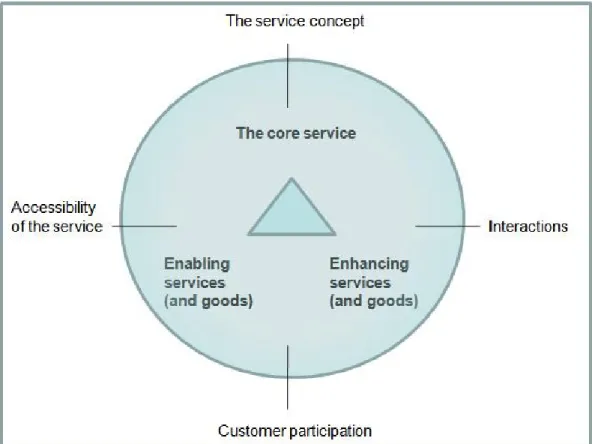
When developing the service package, it is useful to distinguish between three groups of services: the core services, the enabling services (and goods) and the enhancing services (and goods). The core service is the reason for the company being on the market. In order to make it possible for customers to use the core service, enabling services are required. These may also, in some cases, be enabling goods. Examples of enabling services are for example check-in services at the airport or reception service at a hotel. The third type of services, enhancing or supporting services, are similarly to the enabling services, auxiliary services, but they fulfill another function. Enhancing services do not facilitate the consumption or use of the core service but are used to increase value of the service or to diffe- rentiate the service from those of the competitors. Hotel restaurants and airport lounges are examples of enhancing services. When considering the different types of services, the distinction must be made that enabling services are mandatory, enhancing services are used for competition purpose only. (Grönroos 2007, 185- 186.)
There are many ways to perceive the service process, or in other words buyer- seller interactions or service encounters. Due to the characteristics of most servic- es, there are, however, three basic elements, which from a managerial point of view constitute the process. These basic elements are (1) the accessibility of the service, (2) the interaction with the service organization and (3) the customer par- ticipation. These elements are combined with the basic package, thus forming an augmented service offering which is described in Figure 4. (Grönroos 2007, 187- 188.)
Figure 4. The augmented service offering (Grönroos, C. 2007. 187.)
It is important that the three elements of the service offering are directed at cus- tomer benefits according to the service concept developed for the company. Em- phasis must be paid to guaranteeing the accessibility of the service and the func- tionality of the interactions. The clear importance of the customer participation also needs to be acknowledged. The customer has an impact of the service he perceives. Thus, he becomes a co-producer of the service and therefore also is involved in creating value for himself. (Grönroos, C. 2007. 187-190.)
As the business model of 3 Step IT is strongly based on making customer’s IT lifecycle management easier, service management plays an important key role in the company. Concerning end-of-lease management, the service provided in Step 3 of the entire leasing process is one of the key competitive factors of the compa- ny. The company’s functions are based on handling customers’ product returns in an effective and environmentally friendly manner. Compared to many competi- tors, the main differentiating factor of 3 Step IT’s concept is the fact that the re- turning rental equipment have real value to 3 Step IT. 3 Step IT finds new homes
to the returning IT equipment by selling them in the after market for used IT equipment. Only a small portion of the returning equipment, equipment that are defective or too old and hence have no after market value, are transferred to recy- cling according to the company’s ISO 14001 certified environmental system.
From the main IT equipment product groups, only 5 % of the total returning vo- lume are transferred to recycling. As 95 % of the returned equipment can be sold at the after market, and the equipment have actual value to 3 Step IT, this has also been compensated for the customers in lower rental prices.
Based on all these matters, 3 Step IT has a strong interest and motivation to make rental returning as easy as possible to the customers therefore enabling customers to return as much IT equipment as possible. Analysis of customers’ processes and needs have been taken into account when developing 3 Step IT’s own processes and systems. One aspect of this study has also been to analyze the customer needs and solving at least part of the customer’s problems. The ultimate goal is to offer a service that brings benefits to both customers and 3 Step IT and creates additional value to the customer.
3.1.2 Services standardization vs. customization
Whether a service is standard or customized makes substantial difference to ser- vices management. Generally speaking, the less the service includes customer contact, the more standard the service becomes. (Leenders, Johnson, Flynn & Fea- ron 2006, 454.) When talking about standardization, the clear difference between standardization and simplification must be made. Standardization does not auto- matically result in simplification. It merely requires definite decisions on what the company offers and in what kind of processes. The challenge is to find the balance between standard and simplified.
One factor affecting the degree of standardization is the type of business. Some business and service providers use standardization to improve their service quali- ty, some merely to reduce costs. Specification procedure for standardized services
is often easier than with customized services. The specification process for highly customized services can become more difficult and the different options more difficult to understand. In these cases the involvement of the end consumers be- comes also more important and the possibility of trade-offs in various make-or- buy sub-options needs to be explored before the final specifications are agreed on.
The more customized the service, the more factors to evaluate when making speci- fications and also the more factors affecting the entire service management
process. (Leenders etc. 2006, 454 – 455.)
When making the decision between standardization and customization, the per- sonnel requirements are a key element to consider. The more customized the ser- vice, the more personnel is required and the more skills are required from the per- sonnel. (Leenders etc. 2006, 455.)
The customer base of 3 Step IT is very wide in both size and customer type. Con- cerning the product and service offer, some variation has been made taking into account the customer’s size and mode of business. The process matters for han- dling rental returns have, however, been standardized to a very large extent. The main restrictions to the offered service have already been stated in the cooperation and rental contracts made with the customer. An important factor when consider- ing the service concept is the service description of 3 Step IT which is available to all customers in the on-line Asset Management system. The service description is the always valid source of information regarding customer process.
As rental returns management is handled in the company’s own operational sys- tem, the system itself has been built in a manner to restrict the process. Decisions on the main process restrictions have been made before the new operational sys- tem was created in January 2007. The end-of-lease service has been specified as a standard procedure for all customers. All exceptions to the process require manual work from both the customer and 3 Step IT. There are a number of customers that have certain process exceptions stated in contracts. The variety of the exceptions needs to be handled manually. Standardizing the system and avoiding exceptions has proven beneficial also to customers as the process is clearer and follow-up is
easier. The need to customize has, however, risen as the sales management would prefer to differentiate also the services related to end-of-lease.
As stated earlier, the amount of equipment leased through 3 Step IT has grown significantly in the past years, yearly growth 20 – 30 %. This has brought pressure especially to personnel requirements. As the target is to facilitate the management of ending lease equipment, standardization and improvements in process descrip- tions and instructions also grows in importance. The target is to reduce the need for personnel and also to simplify the handling of the process itself. As the process becomes more standard and better described, it becomes easier to handle the daily work and to train the hired new personnel.
3.1.3 Supporting service productivity
When discussing services, productivity and quality can’t be separated. The cus- tomer’s role in productivity is also more important than in manufacturing industry.
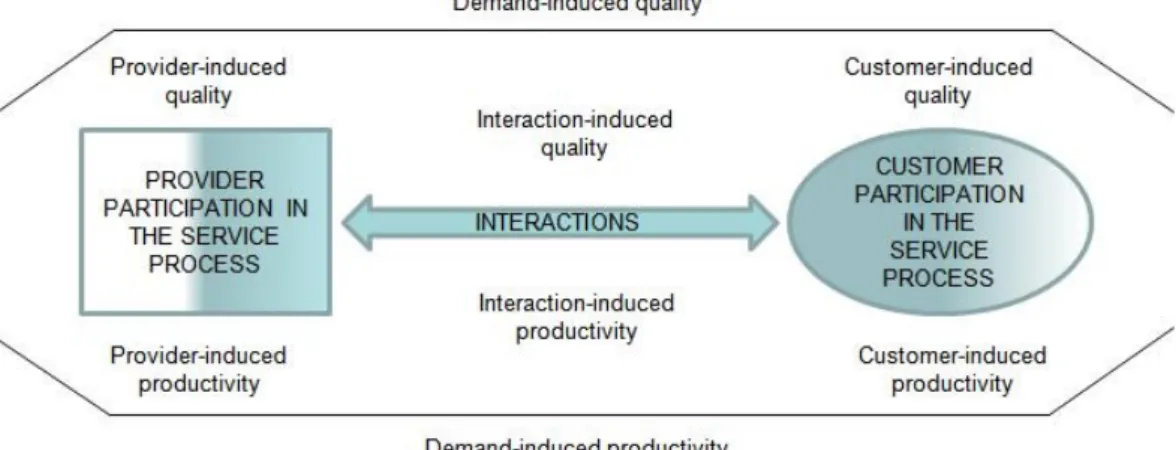
This is because customers are perceived as co-producers in the service process and therefore also influence the progress of its outcome. The service producer itself uses resources in the service process which can be labeled as provider-induced contribution to productivity. The customers, on the other hand, provide some in- puts such as information, self-service activities, inquiries and complaints. These are customer-induced contributions to productivity. The customers don’t only give the input needed to produce the service but also influence the way the employees and technologies in the service process function. In other words, interactions created by customers influence the efficiency of the service process. This can be called the interaction-induced contribution to productivity. (Grönroos 2007, 238 – 239.)
Depending on how well the service provider and customer can relate to and con- tribute with each other, the interactions that occur will contribute more or less to the perceived quality of the process. Simultaneously and as a result of the same resources contributing to productivity, depending on how well these resources
interact and perform, there are provider-induced, customer-induced and interac- tion-induced contributions to quality. Quality and productivity are thus two sides of the same coin. In addition to these factors, productivity is also influenced by demand. When there is a demand that meets the provider-induced resources in the service process, internal efficiency improves and a positive effect on productivity is created. When demand starts to exceed what can be managed with existing re- sources, external efficiency decreases, which has a negative effect on perceived service quality and hence on revenues and profitability. This means that demand is also a critical productivity factor. Figure 5 demonstrates the different interrelated factors in a service productivity context. (Grönroos 2007, 238 – 239; Parasuraman 2002, 6 – 9.)
Figure 5. Productivity, quality, customer and provider participation and demand as productivity factors in service contexts (Grönroos 2007, 239.)
From a managerial point of view, there are four important aspects to consider when managing productivity in services. Firstly, there needs to be an optimal bal- ance between perceived service quality and the company’s external efficiency and cost efficiency must be maintained when designing the service provider’s input into the process. Secondly, the service provider’s resources must contribute to interactions with customers in the service process in a way that creates an optimal balance between perceived quality and internal efficiency. Thirdly, customers must be chosen, educated, motivated and informed in a way to, through their par- ticipation in the service process, contribute positively to customer-induced quality
and productivity as well as to interaction-induced quality and productivity. Finally and fourthly, the demand must be managed in a manner to maintain balance be- tween perceived quality and internal efficiency and thus also between revenues and costs. (Grönroos 2007, 240; Johnston & Jones 2004, 211 – 212.)
Cost efficiency and managing costs form an important part of the management of productivity in services, as they also do in the manufacturing industry. However, due to the characteristics of services, cost efficiency is a more complicated issue in service contexts. (Grönroos 2007, 240.) In the next chapters attention will be paid to how productivity and quality can be improved in service organizations.
Improving productivity and increasing service quality are tasks that can’t be car- ried out simultaneously. All steps to improve service productivity should be based on (1) a thorough understanding of what constitutes good service quality as per- ceived by customers and (2) an equally thorough analysis of how the company operates to produce that quality; which resources (human, physical, technological and customer) are needed and which are unnecessary, and how effective or inef- fective the used routines and systems are. Good costs, bad costs and mandatory costs must be identified and kept separate. When external and internal researches are compared, you will have established a strong basis for improving productivity and quality simultaneously. (Grönroos 2007, 248.)
I will now discuss some ways to improve service quality and productivity simulta- neously. A clear method is to improve employees’ technical skills. If the personnel have inadequate technical skills, the service process quality perceived by custom- ers may be damaged. Any lack of skills and the need for corrective action and the repetition of activities affect productivity and hence quality. Productivity and qual- ity can also be improved by service orientation of attitudes and employee behavior as well as making internal values supportive to good service productivity. (Grön- roos 2007, 248-249.)
From technology point of view, the systems and technology must be made more supportive to employee and/or customer co-production. The service production
itself may be industrialized, that is substituting technology and automation for people. The Internet and information technology offer many opportunities of creating service processes that require fewer resources from the service provider and at the same are perceived as improved service quality by the customers.
Another way to improve productivity and quality is to examine the customer par- ticipation in the service process. You can introduce more self-service elements to the service process, or you can improve the participation skills of customers. Bet- ter-informed and better-trainer customers feel more secure, make fewer mistakes and need less unnecessary attention from the employees. The customers can speed up the service production process. By their input into the process they improve productivity, and employees are able to serve more customers, which also en- hances productivity. Last discussed method to improve productivity and quality is to reduce the mismatch between supply and demand. Compared with manufactur- ing industry, service companies are not able to stock products when demand is low. If the demand peaks have high peaks and corresponding troughs, the service quality will most likely deteriorate during the troughs. Reducing the mismatch between supply and demand is a way of making quality more consistent and of improving productivity. Using part-time employees may be one way of doing this but is not always successful. Another way of matching supply and demand is to attempt to manage the customer flow but e.g. offering better prices during troughs.
(Grönroos 2007, 249-251; Parasuraman 2002, 6 – 9.)
When discussing ways to improve productivity at 3 Step IT’s rental returns man- agement system, one key factor would be to improve the interaction between 3 Step IT and the customers. With IT systems development, parts of the rental re- turns management has been transferred to the customers, or with the help of auto- mation the personal interaction has been decreased. Shifting the responsibility for making the transportation orders to the customers by decreasing personal contact and increasing automatic reminders has altered the interaction between customers and CRM teams.
Developing the service process into a more controlled and stringent service has enabled 3 Step IT to release resources into developing the customer portfolios and
process. The strong growth at 3 Step IT’s operations has, on the other hand, caused pressure to improve processes and therefore reduce pressure of recruiting new personnel. The challenge is to find the balance between automating processes and at the same time offering customers better service. Automating processes such as transportation orders, gives customers the freedom to handle their part of the process at the most convenient time and also gives the customers the possibility to monitor the situation with their rental returns directly from Asset Management reporting system. A discussion on which services it is reasonable to automate and which customers need more personal service is on-going and will be carried fur- ther with sales management of 3 Step IT.
As the rental contracts end once a quarter and therefore the rental devices are re- turned to 3 Step IT mostly during a period of one month, there are high peaks in handling returning devices. Although many process parts have been automated, there are still many different tasks for the customer service personnel. This creates pressure for resources and work load planning. There are improvement issues re- lated to leveling the mismatch between demand and supply but also related to em- ployee skills, customer participation and use of technology. The customer partici- pation to the process requires developments in IT systems and also customer in- structions and trainings. When developing the IT systems, the advantages of better interaction between 3 Step IT and customer must be evaluated. In certain aspects it may prove more beneficial to handle the development issue with improved in- structions and training than developing the IT systems. The processes should sup- port the IT systems and vice versa. A controlled balance is important also here.
As stated earlier, the rental returns management system requires many skills from the customer service personnel. In addition to handling the transportation orders for the returning devices, the sales assistants handle all incoherence with the re- turned batches detected at product inventory at the warehouse. Related to end-of- lease tasks, the customer service personnel also controls the invoicing requests for the other ending options, buy-outs and lease extensions. And naturally handle all other customer service tasks during the same period. A discussion has been started
in using other resources for some parts of the end-of-lease process. This discus- sion will be continued after the research project.
3.2 Supply chain management
The following chapters will focus on the overall management of supply chains.
The basic features for supply chains and supply chain management will be out- lined first, then going deeper into managing supply chains in service organiza- tions, managing the supply chain security issues and finally the aspect of IT sup- port to supply chain management.
3.2.1 Definition and benefits
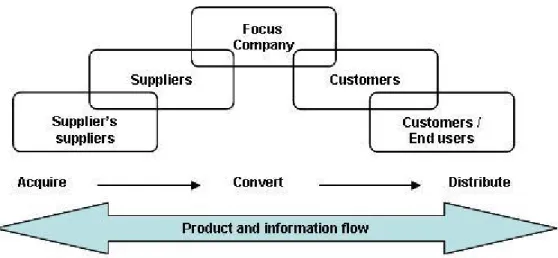
The role of supply chain management (SCM), is to plan, organize and coordinate all the supply chain’s activities. In today’s business world, the concept of supply chain management refers to a total systems approach to managing the entire sup- ply chain. Going deeper, a supply chain refers to the flow of materials, informa- tion, payments, and services from the raw materials, through factories and ware- houses, to the end customers. A supply chain also includes the organizations and processes that create and deliver products, information, and services to the end customers. This meaning that such tasks as purchasing, payment flow, material handling, production planning and control, logistics and warehousing inventory control, as well as distribution and delivery are all included in the supply chains.
(Turban, McLean & Wetherbe 2002, 242.)
It is important to notice that supply chain management also includes the coordina- tion and collaboration with different channel partners. Channel partners can be suppliers, intermediaries, third-party service providers, and customers. Fundamen- tally, supply chain management integrates supply and demand management within and also across companies. Different types of products require different supply chain structures and also different number of operators inside the supply chain.
(Ballou 2007, 338; Waters 2009, 113.)
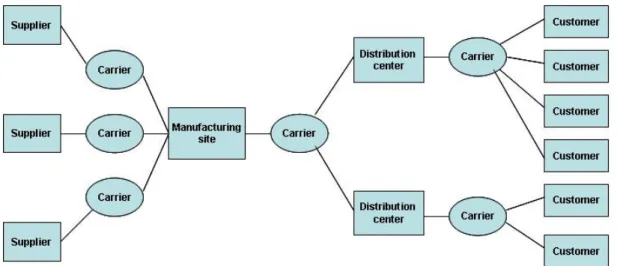
Figure 6. The multiple enterprises of the supply chain (Ballou 2007, 339.)
All the multiple enterprises that are included in the management of supply chains are presented in figure 6. Although there has been much discussion on the benefits of collaboration among channel members and expanding the scope of product flow management to include the entire supply chain channel, the extent to which this has really been practiced is limited. Around one-half of companies are work- ing towards integration inside their own company and approximately one third of the companies focus their integration efforts to their first-tier suppliers. Beyond these limitations there is little attempt of integration. (Ballou 2007. 339 – 340.)
The main goal of modern supply chain management is to reduce uncertainty and risks in the supply chain. By doing this, you create positive affects on inventory levels, cycle time, business processes, and customer service. And as a result, you increase profitability and competitiveness. In today’s competitive business world, the effectiveness and efficiency of supply chains is critical to organizations. The success of supply chains is often strongly dependent upon the supporting informa- tion systems. By constantly improving supply chain efficiency, supply chain man- agers simultaneously also increase the levels of risk. (Turban etc. 2002, 242 – 243;
Waters 2009, 484 – 485.)
The basic supply chain for reverse logistics in 3 Step IT is described in Figure 7.
The main parties of the 3 Step IT supply chain are customers, customer service management teams, EOL services team and operators, transportation companies
and financial department. All the parties and steps in the process are vital for the reverse logistics operations as are all the support functions and processes. This study is mainly focused on the main process of return goods handling. The support processes are reflected to only partly. The complexity of 3 Step IT’s supply chain can be easily understood when reflecting the fact that there are approximately 550 individual returns each quarter. Amount of customers with returning equipment is approximately 400 pcs each quarter.
Figure 7. 3 Step IT’s process for returning rental equipment (3 Step IT Intra pages)
More often the supply chain of 3 Step IT also includes subcontractors that the rental customers use. They can use subcontractors either for the entire IT man- agement or alternatively only for e.g. collecting and packing the equipment. The presence of subcontractors must always be taken into account when developing the supply chains and also when developing company’s IT systems. Any delays caused by subcontractors affect directly or indirectly 3 Step IT’s own supply chains.
The tasks, responsibilities and risks related to subcontractors and their effect to 3 Step IT’s supply chain should be studied more closely. This could be a topic for further research after this research project. 3 Step IT’s customers often restrict
their own subcontractors by offering them only limited access and opportunities to use Asset Management reporting system. The role of 3 Step IT is to instruct and guide customers on the best practices when using subcontractors. Naturally it would always be more beneficial for 3 Step IT to offer the same services to the customers without the customers needing to acquire the services from their current subcontractors. The main goal is, however, to manage the supply chain effectively taking into account all affecting factors.
3.2.2 Challenges in managing supply chains in service organizations
The supply chain concept is important in most service organizations although the range of different services from personal services, such as banking, to mass ser- vices, e.g. retail stores, is really wide. Service organizations, with the exception of professional services, require materials and goods to provide to customers or to use in their service processes. Service organizations require a sophisticated and efficient information system to receive all the data and information enabling them to handle the numerous required decisions. Such companies require management coordination and strategic leadership along the entire supply chain to ensure a joint effort of all inner components to provide the promised services. The basic goal is to efficiently handle the supply chain, therefore being able to respond to market demands and deliver the market promise to end customers. (Sadler 2007, 70.)
Especially in service organizations customer satisfaction must be kept in mind.
Although reducing costs is a prime motivator to strategic supply chain manage- ment, customer satisfaction and service portfolio should be counted as the leading goal for supply chain managers. This can be difficult to validate as it must be proved that short-term gains may cause losses in long-term value of strategic sup- ply chains. (Fawcett, Magnan & McCarter 2008, 45.) When comparing the profit logic in service organizations and manufacturing industry, there are clear differ- ences with regards to the internal and external efficiency, drivers of revenues and costs and on how decisions on internal and external efficiency are taken. In service
organizations internal and external efficiency can not be separated whereas in manufacturing industry different efficiencies are separate. Also revenues and costs are driven by separate processes in the manufacturing industry whereas in service organizations they are largely driven by the same processes. All this causes that in service organizations internal and external efficiency have to be managed in an integrated process. (Grönroos 2007, 217.) These differences need to be taken into consideration when managing and developing supply chains in service organiza- tions.
In cases with problems in supply chain management, technology, information and measurement systems are often recognized by management as barriers to success- ful supply chain collaboration. However, managers should not overlook organiza- tional culture and structure, as well as management styles when designing reme- dies to supply chain problems. The key to successful supply chain development are the people. Companies continue to invest in technology, information and measurement systems. However, management must not overlook the importance of training, educating and bringing together the right people to use the systems and interact with each other. By forming the right teams for the right tasks companies will achieve successful operations and positive commitment also from other or- ganizations members thus increasing their commitment to supply chain collabora- tion. Most important is to keep a realistic view of the challenges found embedded in the very human and mechanical links of the supply chain and at the same time stay optimistic. By doing so, companies have the best chance of achieving their strategic goals. (Fawcett etc. 2008, 45.)
3 Step IT has addressed the need for an efficient and sophisticated information system by creating and developing own systems by the company’s own IT de- partment. More information on IT support to supply chain management in chapter 3.2.4. This has also enabled the company to better respond to customer needs and therefore give better customer service. The goal is to keep developing the informa- tion systems to suit the business model and also to respond to the strategy goals set by the management. 3 Step IT’s basic goal of always offering customers some- thing extra requires continuous development.
A basic challenge in a service company is involved with attitude. Also service organizations must understand that supply chains exist also in their operations.
Every company has a diversity of different supply chains and a number of differ- ent supply chain contributors. To develop 3 Step IT’s supply chains, the internal and external processes must be developed side by side. A balance must be found between offering strategy-based services to customer, being cost-efficient and cre- ating revenue for the company at the same time. A discussion on building the right teams to handle individual parts of the process must be continued.
3.2.3 Supply chain security
When considering the total service chain, the security of modern supply chain op- eration must be evaluated. This requires that risks are identified and reduced so that disruption, be it from any source, is minimized. All businesses are susceptible to disruption. (Sadler 2007, 90.) Supply chain security can be defined as the appli- cation of policies, procedures and technology to protect assets, facilities, informa- tion and personnel from e.g. theft, damage or terrorism. Basically supply chain security is a question of being prepared for the unexpected. The supply chain must be formed in a manner to sustain close to normal processes when confronting un- expected events. (Bowersox, Closs & Cooper 2007, 290.)
Whereas supply chain security was addressed earlier, another important term, sup- ply chain resiliency, should also be considered. Supply chain resiliency refers to a supply chain’s ability to withstand and recover from an incident. A resilient supply chain is proactive in anticipating and establishing planned steps to prevent and respond to security incidents. Resilient supply chains can quickly establish substi- tute ways of operation when experiencing a security incident. (Bowersox etc.
2007, 290.)
The security issues must be addressed taking into account all parts of the supply chain process, both internal and external matters. Internal processes, personnel matters and infrastructure must be evaluated from risk perspective. External proc-
esses are harder to control and therefore the risks should be evaluated even more closely. One important, in most cases external, part of the supply chain is the transportation process. Carriers, freight forwarders, and terminal operators each have responsibilities for critical stages of the supply chain process. The best pro- cedures of a trusted trading partner are meaningless unless supported by effective carrier security procedures to secure goods while in transit. Supply chain security requires that logistics management work cross-functionally with their transporta- tion partners to guarantee the required security level. (Bowersox etc. 2007, 292- 293.)
The security of 3 Step IT’s supply chain also needs to be addressed both for inter- nal and external aspect. As this research concentrates on the process from ending option choice to the goods’ arrival to warehouse, the main external security issues are involved with transportation and data security risk. The returning products are transported to the warehouse either by the customer or by 3 Step IT’s forwarder. 3 Step IT has a strategy to operate only with longer established and preferably certi- fied transportation companies. This study will address the transportation process only shortly but in stead concentrates on the inner processes. The transportation order process is controlled by the CRM teams and end-of-lease team. The link and process with the transportation company are controlled on a quarterly basis and will be developed further at later stage and is therefore not included in this re- search project. Also the aspect with data security will not be included into this project but is a subject of an own research.
The main inner security risks are involved with the process of handling returning equipment. The inner risks address the situation with following the agreed process and instructions. One part of ensuring the functionality of the process is dividing customer service workload efficiently. Also the use of temporary staff can be con- sidered a security risk to the process. In cases where the workload is too high, there is a severe risk that the process will be affected and therefore also the cus- tomer service level.
The personnel aspect and the tailored operational systems have made 3 Step IT’s rental returns management strongly dependant on IT. The system itself restricts, monitors and controls the personnel in many ways and offers the management opportunities to control the operations. Due to the strong dependence on IT, the customer service personnel is a key factor also when developing the IT systems.
Quarterly training sessions are held for sales assistants and customer service spe- cialists to keep them updated on the current situation, to inform them of new func- tions or instructions and also to collect feedback and development ideas from the teams.
3.2.4 IT support to supply chain management
Information technology both enables and dominates the supply chains. It has changed business operations through the flow of information, control over opera- tions remote in distance and across organizational boundaries and by automation of processes. Information technology is also shaping the future of supply chain development by use of Internet. Information technology is no longer merely a search of efficiency but an enabler of new opportunities. No business can ignore the importance of information technology to their operations and implementation of chosen strategy. Perhaps the most important contribution is information tech- nology’s ability to bring visibility to the entire supply chain. (Schary & Skjøtt- Larsen 2001, 291.)
Information systems and information technology enable a supply organization to contribute efficiently and effectively to organizational goals and strategies (Leend- ers, Johnson, Flynn & Fearon 2006, 106.). We have come far from the days when many of the supply chain activities were managed with paper transactions. The use of computers and information systems has gradually become more and more im- portant to companies and their profitability. (Turban, McLean & Wetherbe 2002, 250 – 251.)
The essential role of the supply chain information system is to bind the entire chain together as a single integrated unit. The underlying framework is described in Figure 8. It has both an intra-firm dimension that is largely vertical and hierar- chical and inter-functional and inter-firm dimensions that are horizontal, following the transaction flow. The intra-firm system is highly developed, following a tradi- tional management orientation. The inter-firm system is emerging slowly, re- strained not by technology as much as by relationships among organizations in the supply chain. (Schary & Skjøtt-Larsen 2001, 295.)
Figure 8. The concept of the information system (Schary & Skjøtt-Larsen 2001, 296.)
Management mostly recognizes the strategic importance of information and knowledge management and the possibilities underlying with technology. The most important factor for management and developers to consider, is when and where the application of the technology is most appropriate and what technology should be selected. If the process itself has flaws, the process needs to be corrected before any automation through technology can be carried out. (Leenders etc. 2006, 91.)
One of 3 Step IT’s key competitive elements is a sophisticated asset management register (Asset Management NG) which is directly linked with the company’s own
operational system, NS 4. Strong dependency on the operational systems has in- creased during last two years. This is due to the system launch made in January 2007. After the system upgrade the CRM teams have been able to handle all phases of the customers’ IT management from handling the rental contracts after equipment purchase to asset management phase and finally to equipment renewal phase in the company’s operational systems with comparison to the old MS Excel sheets.
The company’s IT systems are developed continuously. A system upgrade consist- ing of either new functionalities or corrections to the old functionalities is nor- mally conducted once a quarter. System upgrades to rental returns management is therefore also conducted once a quarter. The aim is to achieve efficient processes.
The decision on what end-of-lease related processes are automated is evaluated and plans made taken into account inner resources and requirements as well as the customers’ requirements. As stated earlier in this chapter, one key challenge is to determine which processes should be automated and also which processes are in good enough condition to be automated. The work for defining and refining com- pany’s end-of-lease processes carried out during last years also works as basis for automation through IT systems.