This thesis investigated the possibilities of communication, brand development and customer engagement in social media environments for a brand called Golla. Creating a profile on a social media platform is easy, but creating the content and publishing it consistently is not.
Defining the problem
To spread the news about the new brand and products, Golla wants to use social media to communicate and market the brand. Subsequently, the text is discussed in public relations, marketing communication and social media.
What is a brand?
A brand is more than just the visual representation or reputation of the product, service or a company. A brand is a result of a marketer's activities, the input, but also as a result of consumer's reading of and response to activities, the output.
Brand identity gives direction
This is the meaning that the marketer would like the brand to have in the mind of the consumer. A brand identity based on the perspectives of the brand as an organization, a persona, a symbol in addition to product.
Relationship between the brand and the customer
The advantage of the brand is that the customers create a deeper relationship with a brand the longer the relationship lasts. A sub-brand can help the brand break out of a box and expand into new product classes.
Development of public relations
Sub-brands have different roles, but the role of the sub-brand in this thesis is to change associations and change brand identity. With a sub-brand, a company can engage in strategic opportunism, which enables it to react quickly to opportunities that appear on the market.
Development of marketing communications
Integrating marketing and communication
In the process perspective, the emphasis is on a structural realignment of the communication disciplines within organizations (ibid., 265). Although the goal is to create engagement and cohesive brand experience across multiple channels, this thesis focuses only on social media as an environment, and does not involve other means of communication or marketing.
Social media changing the communication field
They do not just take in what they are told and this has huge implications in the ways in which brands communicate (Brown, 2009, 3). Getting the right information into the hands of key influencers requires a dialogue.
Engagement generates user related content
To attract people's attention and interest, engage them and drive action, a brand needs a communication and marketing communication strategy that is based on the overall business strategies of the company. SMART definition helps a practitioner to do this: Specific - what the communicator wants to achieve, Measurable - clear indicators that show whether the goals are being achieved or not, Achievable - in the light of current stakeholder reputation of the organization and the competitive landscape , Realistic - in light of resources and budget and timely - time frame for the goals to be achieved.
Content strategy
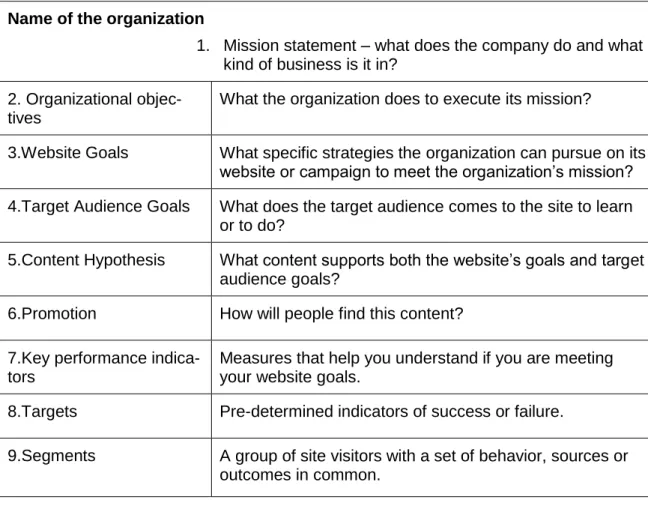
Traditionally most of the money has been spent on it. media buying and content production. Mission statement – what the company does and what kind of business it is. As a different approach and option, Tanni & Kerosuo suggest a FIGA model, which is an abbreviation of the words Find, Identify, EnGagement and Action.
A brand needs a story
In this thesis, communication is business-to-consumer, B-to-C, and the content should activate consumer-to-consumer, C-to-C communication, such as recommendations and word-of-mouth activation, as well as . Therefore, there are slight differences in how this thesis approaches channel-related content sharing. Finally, to distinguish content marketing from the term native marketing, it is important to remember that native marketing gives the same experience as the media in which it is presented.
Key messages for the audience
Stories can be shared through social media channels, but to stand out the content must be interesting, useful and engaging (Rauhala . & Vikström 2014, 206). When content is created for the specific needs of the audience, they are more likely to share it. It is more common to share content created by professionals, such as news or entertainment media content, than content created by other users.
Measuring results
People can be strong advocates for brands, and word-of-mouth marketing can be more powerful than advertising. Villi (in Malmelin & Villi state that it is much more common to share and distribute content, for example by tweeting on Twitter or sharing on Facebook. Instead of clicks and likes, the more interesting information can be how many viewers became familiar with the content and how they ultimately found or what the consumer did with the content during viewing (Hurme 2015).
Choosing the channels
It is the most popular social network used as a marketing tool because it is the most likely channel to reach the majority of target groups worldwide, and organizations can connect directly with communities and people. One can post a profile photo, cover photo, interesting information about the owner or the content of the page. One of the best features of Facebook is the ability to like and tag (identify someone within a post) the things one does on the page.
Facebook is a good way to provide information and ideas to a network of people who are interested in the brand and its products. A brand can search for hashtags and use them in hopes of finding new people interested in the brand's values. It's a step towards users, and they can start following the brand in return.
It should be emphasized that a brand should be linked to the Twitter Search Engine to see what people are saying about you, organization, products and services, and perhaps the competition and a category of products you sell. Some brands use Twitter to inform customers about special offers, but spamming the community is not appreciated. A good rule to remember is that a brand should function as a member of the community and have something to say.
Other presence in social media
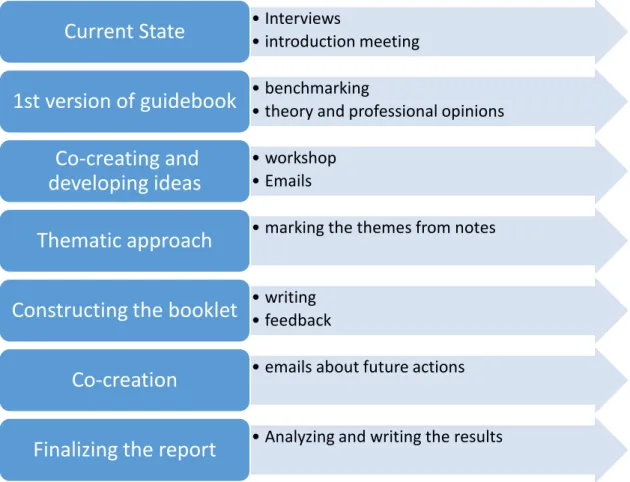
The constructive research approach has been developed in business research, although it can also be used in many other areas. The constructive investigation method is suitable, for example, when there is a need for a concrete product such as a plan, measurement system or a format. In terms of research questions, the constructive research question can be phenomenon-driven or theory-driven or a combination of the two.

Phases of the study
In the constructive approach, it is essential to tie the problem and its solution together with accumulated theoretical knowledge. The core element of the constructive approach is the innovation or design construction phase, which is often heuristic in nature with more rigorous theoretical justification. Lukka's guide to a constructive research approach is to find a research question that has a relevant issue and an opportunity for theoretical contribution (Lukka 2011).
Interviews and current state analysis
The interview was conducted in a semi-structured manner, meaning that the researcher listed questions and themes, but the interview was conducted in a relaxed manner and the participants were free to express their thoughts. After the interviews, the researcher made a list of the themes and words that emerged in the interviews. These words indicated what theoretical knowledge or practical insight could be useful to the team members in Golla, and what should be discussed in the guide booklet.
Benchmarking and constructing the first draft
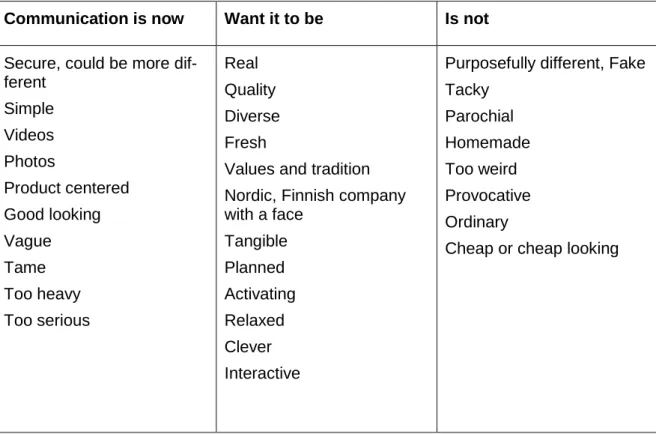
It was interesting to follow the brand as a consumer and observe the reactions and thoughts that the actions and content of Golla, as well as other brands, brought to the observer. The idea had to somehow incorporate Golla's values: travel, work on the go, Nordic roots, urban and active lifestyle, positive outlook on life. The first draft was not intended to be a version to be given to the Golla staff as a final guide.
Co-creation in workshops and via emails
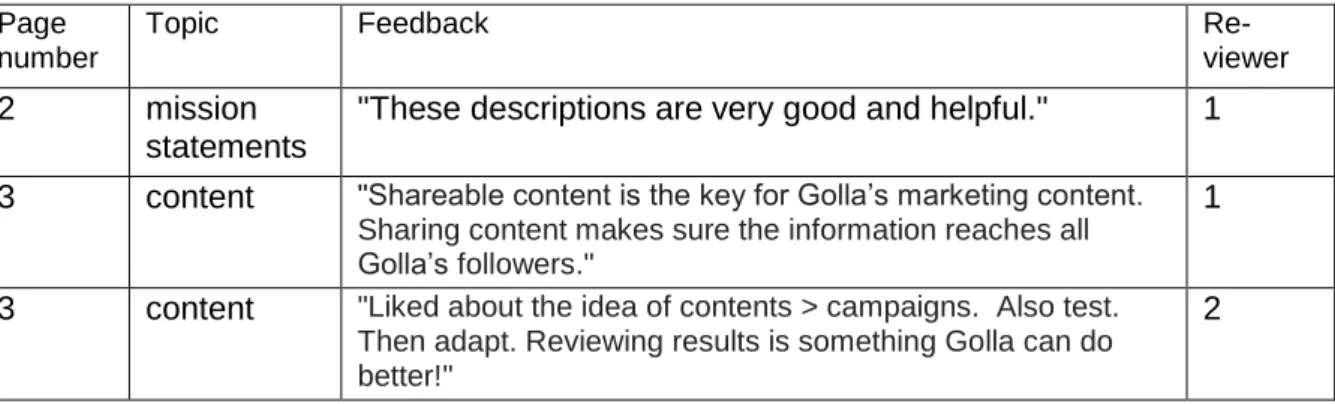
That first version was used as a basis for discussion in the January workshop. This was partly because half of the participants were not familiar with the channels and did not like to participate in the conversation. The researcher took notes and also collected some notes from the participants after the workshop.
Campaign planning
The promotion did not find the target group because the contest was promoted on Golla channels, which individuals in the target group had not yet found. 34; To activate followers to think of original motives for the photos, Golla can try to promote the contest with writings such as: Do you love the work you do. The contest might have worked better later on, as Golla had gotten more followers on that channel and then activated them with a contest.
Suggestions for Golla’s team
FF is a way to recommend profiles to other users and get them more followers. Direct questions have proven to be quite an effective way to get followers to respond (Anttonen 2015c). It was also suggested that Golla could reward the best story once a month with a price or discount.
Thematic approach
How many Golla uploaded numbers are increased before / after the post - How many comments we get from the post. How many likes we get from the post, and the percentage of it that Golla liked completely. Among others, Hiila (2012) and Tanni & Kerosuo gave insight into the outside-in approach to communication.
Constructing the booklet
It had three sub-brands and product lines that would reposition the brand and the company in the global market. Audience research is required to know what kind of people the brand wants to reach. The creation of content is based on the needs of the audience and the values for which the brand stands, not feeding the audience with messages, the organization wants to say.
Content marketing
Content categories and rules of thumb
There should be some concepts that guide content production so that tone of voice and brand personality remain consistent across channels and audience encounters, even when there are changes in staff and other circumstances.
Editorial calendar and sharing knowledge
Focus on few channels
Finding the tone of voice and keeping it sustained
Defining a unique tone of voice that differentiates brands from others on social media channels helps the brand build a personality and thus become a trusted member of a community.
Outsourcing is not a bad idea
Measuring helps targeting
If goals are not specified and defined, they remain more like wishes, not goals. Measurable goals are those that leave no question as to whether or not they have been met. Realistic goals are those that can be achieved with feasible actions and within a predetermined time frame.
Discussion
Some organizations think that communicating the brand in social media channels can be done with little effort and cost. The business strategy was clear, but the strategy for communication in social media was not. The contribution of this thesis to the contractor is the development of tools, frameworks and principles as well as questions that must be answered when making a strategy for content marketing and communication in a social media environment.
Content compliments audience’s needs
The goal was to identify the needs of Golla's social media team, and find solutions to their problems in communicating the brand in the social media channels they chose. What tools and insight will help Golla create a long-lasting content strategy to communicate its brand in social media channels, tell its story in an interesting way, engage and activate target groups.
Suggestions
Also audience research and the measurement of the results could have been given more attention in the booklet. Better and more accurate results could be achieved if the researcher could collaborate more closely with the team in the creative process and the production of the content. The line had to be drawn somewhere, and the focus of the study remained in the content.
Reliability and validity of the study.......................... Error! Bookmark not defined