The main findings of the research show that the organization has succeeded well in its stakeholder communication. This thesis seeks to develop stakeholder communication of the target organization by investigating how satisfied the individual members and some other external stakeholders are with the current communication and marketing activities.
Organization A
The goals and objectives, as well as the research problem and research questions, are also discussed.
Background situation
Research was needed to clarify the communication operations and to ascertain the expectations and needs of key audiences. Instead of many conflicting demands from different internal stakeholder groups, it was important to find out the needs, expectations and interests of the individual members.
Aims and objectives of the research
The research problem was to determine how satisfied individual members and other external stakeholders are with the communication and marketing of Organization A. How member organizations perceive the communication and marketing of Organization A according to the results of a survey among members.
Communication
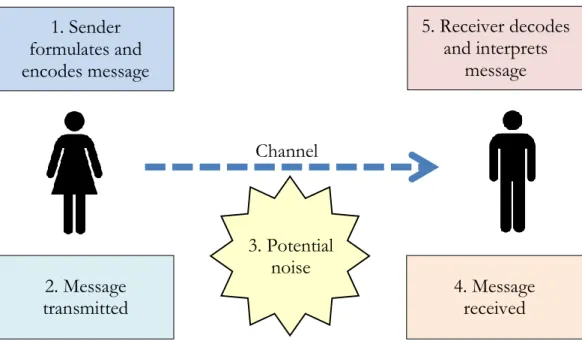
Communication process
Communication and marketing in practice, as well as details about communication and marketing in non-profit organizations, are covered in Chapter 4.
Organizational communication
The form of the organization creates a basis for its communication. organizations, both commercial and non-profit, need to communicate with different people and groups. Internal communication is shared within the organization, while external communication involves the organization and people outside the organization.
Changes in the communication landscape
For organizations, this has meant a clear change from traditional communication models to more interactive and free-flowing conversations between members of an organization and between. communication practitioners and people outside the organization. Focusing only on shareholders can lead to negative outcomes for other stakeholders, such as employees and consumers.
Marketing
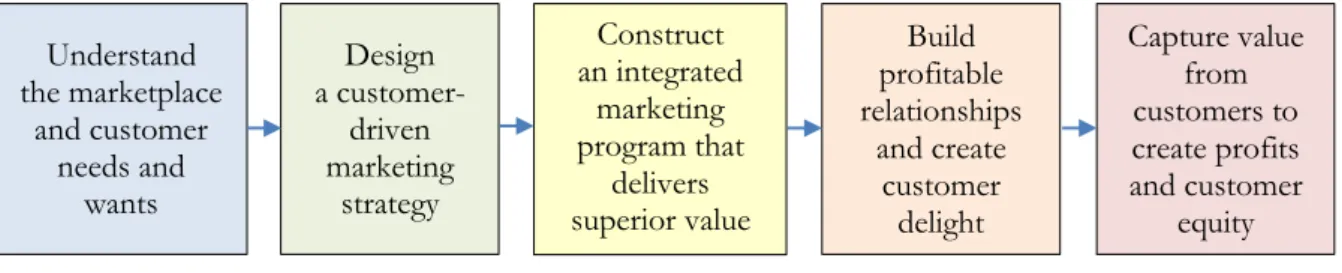
- Marketing process
- Marketing communication
- Integrated marketing communication
- Changes in the marketing landscape
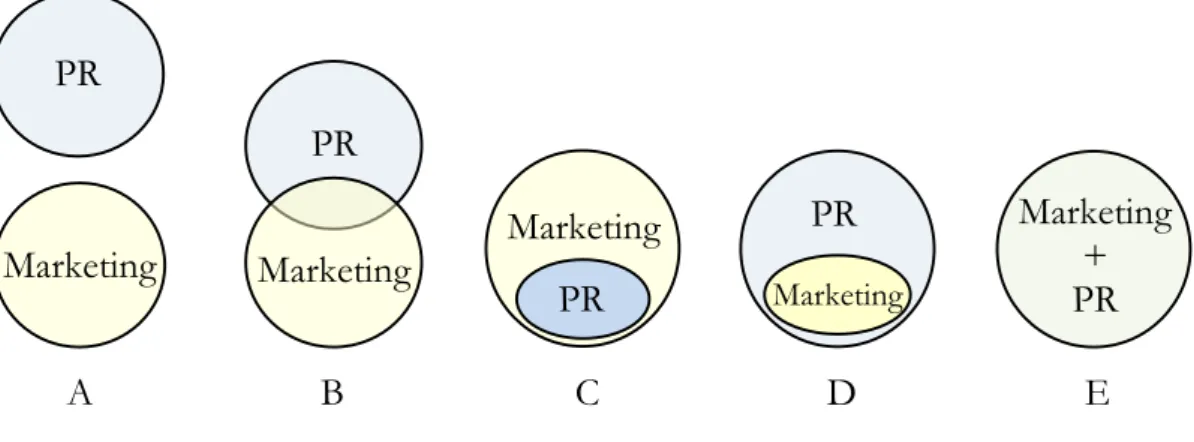
Marketing communication's role is to help the organization achieve its vision, retain current members, attract potential members and raise awareness of the organization. Finally, model E represents integrated marketing communication where marketing and PR are merged into one external communication function.
Stakeholder relationships
Stakeholder identification
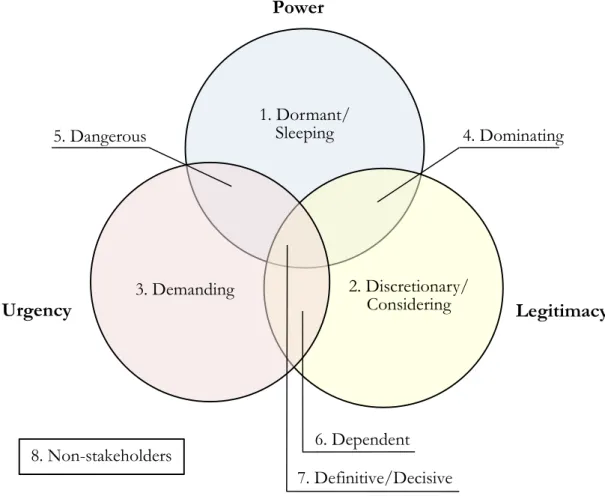
Mitchell, Agle and Wood introduced the stakeholder salience model in their theory of stakeholder identification and salience. identification and categorization is done according to stakeholder prominence, which is defined as visibility and prominence for an organization. the stakeholder group, the more actively it must be communicated with. Discretionary stakeholders constitute the second group of latent stakeholders. are legitimate but not urgent and they do not have the power to influence the organization.
Stakeholder communication
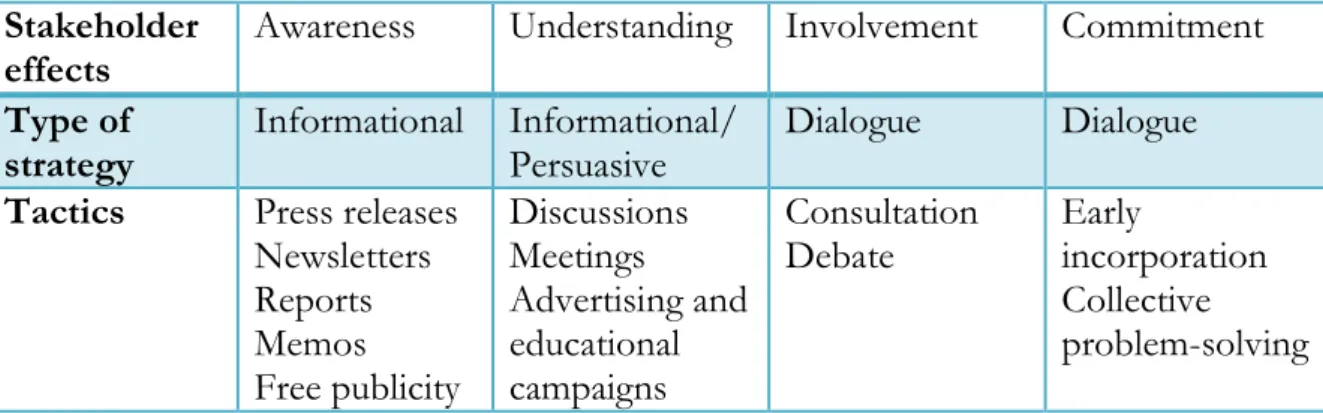
This thesis provides information about individual members' and other external stakeholders' needs, and can be used when planning communications for these groups. However, the dialogue strategy can be explained as a two-way symmetrical model, where communication is a dialogue instead of a monologue, and where views are mutually shared to achieve mutual understanding between an organization and its stakeholders.
Stakeholder engagement
Cornelissen notes that when organizations create relationships between stakeholders based on trust, stakeholders are more likely to share information that can create innovation; more likely to continue doing business with the organization; and more likely to become advocates who promote the organization to others. Costs, time and other resources must be balanced with the results of stakeholder relations.
Image
Corporate personality and identity
Corporate identity is defined as an image about an organization that it wants to convey to its external stakeholders. Corporate identity should be developed from an understanding of an organisation's mission, vision and culture. Corporate identity is close to the term 'profile', which Juholin defines as a target image that an organization wants to achieve.
Image and reputation
Building and managing reputation
A potential misalignment can show that employees do not understand or support a strategic direction of the organization. In the third part of the analysis, the interface between vision and image is examined to see if leaders are leading the organization in a direction that external stakeholders support. In organization A, one of the strategic objectives of communication and marketing is to raise awareness of the organization among its current and potential members, partners, media representatives and decision makers.
Communication channels
Social media offers organizations new ways to engage with stakeholders and build reputational capital and brand equity. The best benefits of the social media tools can be reaped when communications professionals use them to engage transparently and authentically with stakeholders in a way that encourages them to become organizational advocates. Social media requires organizations to move from one-way communication to an interactive process that emphasizes community, sharing, stories and dialogue (Juholin 2013, 334).
Marketing communication tools and channels
When used properly, it enables organizations to regularly send highly targeted and personalized relationship-building messages via email, such as e-newsletters. Mobile marketing is carried out through mobile phones, smartphones, tablets and other mobile communication devices by placing advertisements, such as search ads, banner ads, display ads and videos, on internet sites and social media. The marketing channels used are magazines, radio, internet, social media and events such as trade shows.
Communication and marketing in non-profit organizations
According to Vuokko, improving the meaning of all stakeholder groups is essential for nonprofit organizations, and therefore they must direct their communications and marketing to all stakeholders. Out of the different types of nonprofit organizations introduced above, Organization A represents a combination of a member organization and an interest group. It will also describe the research process used in the different parts of the research.
Target groups
This section will explain how the research was conducted by introducing the target groups and the research and data collection methods.
Research method
In qualitative research, the researcher is subjectively and actively involved in the research to improve the credibility of the study. Since the research required both quantitative and qualitative strategies, the research method was mixed methods. The research design was sequential explanatory design, as the quantitative method was carried out before the qualitative phase, and the qualitative method was used to gain a deeper understanding of the quantitative results.
Data collection methods
The qualitative phase of the communication and marketing study was conducted with two semi-structured focus group interviews for the member organisations. The purpose was to collect thoughts and opinions from the member organizations about the results of the member survey and to get deeper information about the satisfaction with Organization A's communication. Therefore, involving the member organizations in the focus group interviews helped to interpret the results of the member survey, as well as engaging the member organizations in the results.
Research process
Member survey
In the member survey, special attention was paid to the representativeness of the sample in order to guarantee the reliability of the survey. The sample was obtained by organization A, which sent the contact details of the sample to the researcher. In January 2014, the sample size was doubled to get enough responses from each member organization.
External stakeholder survey
The same questionnaire, which was used in the member survey, was applied to the stakeholder survey according to the purpose of the research and relevance to the target group. Most of the questions were closed multiple choice questions on the same 1-4 Likert scale than in the member survey. The full version of the questions is attached to the research report (appendix 3 in attachment 1).
Focus group interviews for the member organizations
Member survey
A table of the response rates and the membership structure is presented in the separate research report. According to the different age groups, the results show that the content of the magazine is most useful for members under the age of 25. When analyzed according to the age groups, the results show that the members of the age group 35-44 years and 45-55 years saw marketing a little less than the others.
External stakeholder survey
Comparing the results of the external stakeholder survey with the results of the member survey, it appears that external stakeholders are slightly more satisfied with the journal than individual members. The majority of external stakeholders believe that websites contain useful information and important news. Comparing the results of the external stakeholder survey with the results of the member survey, external stakeholders notice more magazine and Facebook marketing than individual members.
Focus group interviews for the member organizations
In the focus group interviews, the results of the membership survey were presented, and the member organisations' opinions on communication and marketing were collected. First, the preliminary results of the individual members' perceptions of communication in organization A were introduced to the member organisations. Finally, the member organizations were provided with the results on visibility and perceptions of marketing.
Perceptions of Organization A and its communication
The purpose of the communication and marketing research was to examine how well the communication and marketing channels of Organization A are working. As the research focused on the channels used in communicating with external stakeholders, the research was directed at individual members and stakeholders. other significant external stakeholders. However, since the organization also wants to be seen as humane, approachable and safe, these attributes should be reflected more in communication and marketing.
Perceptions of communication channels
Instead, since members under 25 and 25-34 are more interested in a dialogue on social media than older age groups, they should be reached through social media channels. Therefore, the social media and especially social networking sites could help Organization A reach younger members and potential members and create stronger ties with them. The social media could also make Organization A look more humane, since, according to Cornelissen, organizations in the social media can have a more humane image and have a conversational voice, which creates positive feelings, a favorable image and strong stakeholder relations.
Perceptions of marketing
Internal processes and communication
Validity and reliability of the research
Internal validity means the extent to which the results and the research report accurately reflect the social world of the participants and the phenomenon under investigation. While generalizing in qualitative methods is difficult and the findings may not generalize, the research procedures may be. However, the research procedure, in which the participants were first presented with the results and then asked to interpret them and share their views, can be generalized.
The stakeholder magazine
The goal is also to develop the overall image of communication by increasing the speed, attractiveness and humanity of communication.
The newsletter
Organization A can use more colors and pictures in the newsletter to make it look more attractive. A table of contents with article titles can be added to the beginning of the newsletter. This can be done in collaboration with member organizations to ensure that both parties have the same information.
The websites
The headings and texts should be as short and sharp as possible to keep the text short and the content quick to read. Organization A must ensure that lists of members' email addresses are up-to-date in order to reach each member. All email messages sent by Organization A must have the same sender name and address to help the recipients identify Organization A's messages from spam email.
Social media
Instead of illustrations, the use of photographs of real people, demonstrating the diverse membership, should be increased.
Marketing
Internal communication
A workshop memo of Haaga-Helia and Organization A. The use of focus groups in program development and evaluation. Where you have seen or heard of Organization A's marketing, such as advertisements, campaigns or social media appearances.
The research report (confidential)
The questions used in the member survey
The questions used in the stakeholder survey