
This project is part of the European Climate Initiative (EUKI) of the German Federal Ministry of Environment, Nature Conservation and Nuclear Safety (BMU). Most notable was the revision of the EU Energy Performance of Buildings Directive (EPBD) (Directive (EU) 2018/844). This now sets a clear direction for the full decarbonisation of the European building stock by 2050.
Policies and actions targeting the worst-performing segments of the national building stock, split-incentive dilemmas and market failures.
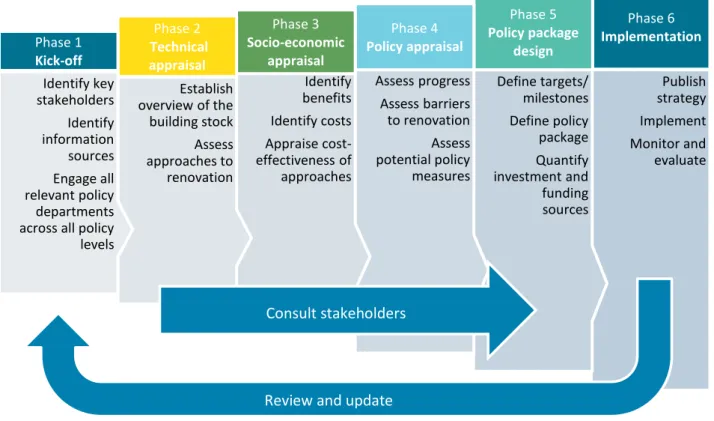
Kick-off
Guidance from the EmBuild project provided an overview of the links between SE(C)APs and national renovation strategies under the EED [6]. It is important to ensure that consultation is not a one-off event during the development phase of the strategy. Assess the length of the consultation based on the nature and effect of the proposal.
The choice of format also depends on the length of the entire process and the tasks set.
Technical appraisal
It is important for Romania that the latest data on energy consumption in buildings is reflected in the next version of the strategy. A wider range of energy efficiency measures, such as building envelope insulation, and renewable energy measures, such as solar hot water, should be explored. For Bulgaria it is necessary to look for the most efficient use of the available information from different sources.
The next national census (in 2021) should be used to collect all the necessary data regarding the energy performance and characteristics of the building stock.
Socio-economic appraisal
There is a clear relationship between the quality of a building (office, school, factory, etc.) and the number of reported sick days (absenteeism). Research shows that a better building can result in 0.4-1.5 fewer sick days per employee per year [11], while another study concluded that every €1 invested in insulation generates €0.78 benefits in less sick days [12]. A better building can also improve performance by 11-16% in offices and 13-20% in schools thanks to better air quality, thermal comfort, light (electric and natural), acoustics and control [13].
Promoting the environmental benefits of energy efficiency improvements, including reductions in carbon emissions and energy use, can also improve public relations and organizational reputation [ 14 ]. Many studies looking at the many benefits of retrofitting and broader energy efficiency improvements can provide additional inspiration for this section. The phase should culminate in the determination of a priority package of renovation measures for each building category based on their cost-effectiveness.
The new version of the strategy for Bulgaria requires better identification and quantification of benefits, including energy, CO2, jobs created, health benefits and air quality improvements. Specific benefits of particular value for Bulgaria are the alleviation of energy poverty, and thereby improved air quality and health benefits (nearly BGN 100 million is given as direct support to energy poor households for the purchase of (mainly) coal and wood, while at the same time BGN 100 million invested in municipal programs to improve outdoor air quality); the urban landscape and living conditions; stimulating the construction industry and local economies; Economic benefits: saving on energy costs; increase in GDP; impact on economic activity, increase in property values; impact on public finances; reduction of the energy import bill.
Social benefits: reduction in fuel poverty; health benefits; increased comfort/productivity - Environmental benefits: reduced greenhouse gas emissions; air quality improvements. Determine prioritized renovation packages for each building category (based on the cost and benefit assessment).
Policy appraisal
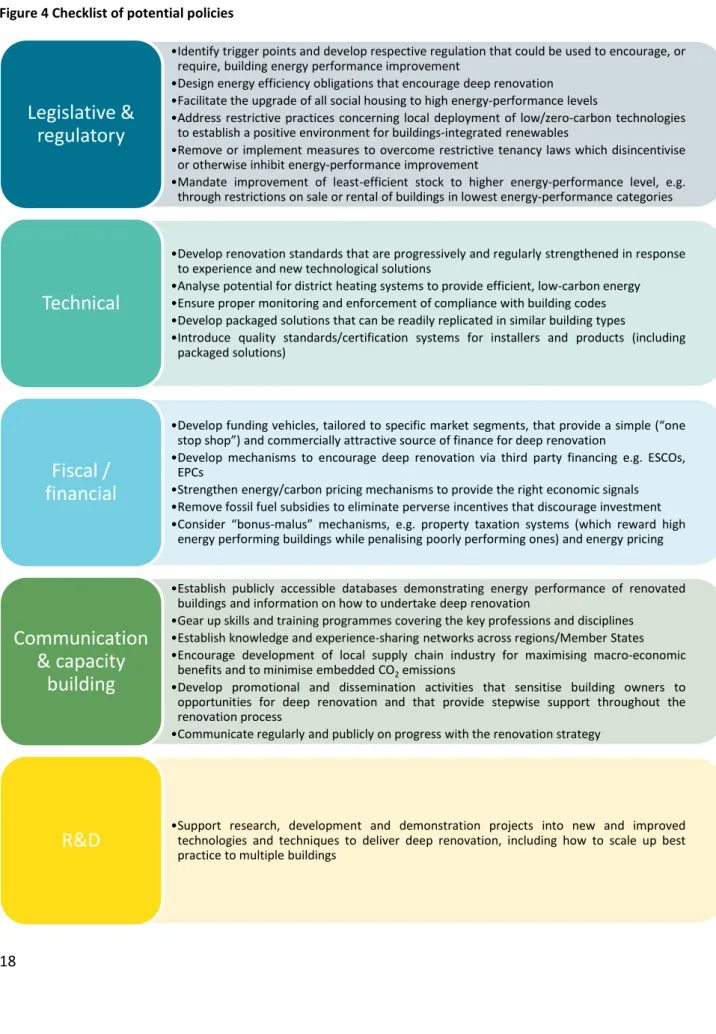
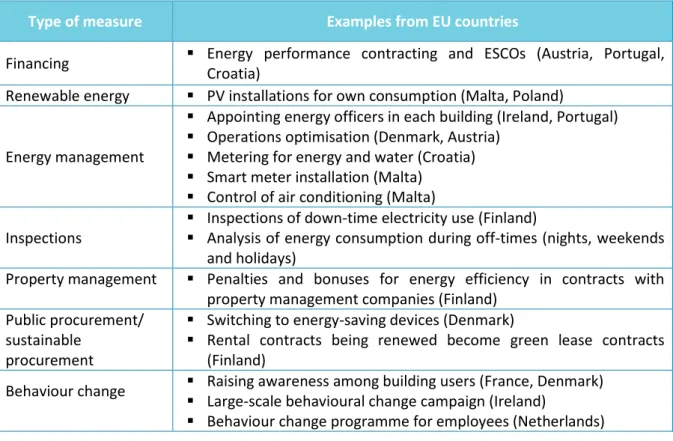
Once all policy options have been explored (Table 6), this completes Phase 4 of the strategy. Capacity building programs are needed for municipal employees (including technical staff and clients) to plan, implement and supervise the building renovation process and to communicate with citizens. Some Member States have also developed inventories of buildings owned and used by the central government as part of the Article 5 requirement.
This list of measures derives from the reports that Member States submitted to the European Commission in 2015 on how they would achieve Article 5 of the EED (requiring either 3% renovation of government buildings each year or taking measures to achieve the equivalent savings ). The Horizon 2020-funded iBRoad project5 explores the introduction of the passport concept for building renovation in Bulgaria and Romania. As one of the pilot countries in the project, iBRoad has explored the needs, preferences and trust of potential users in Bulgaria.
These insights should be used to enable a more efficient design of the individual building renovation roadmaps in Bulgaria. In Romania, there is a mandatory energy audit at national level, which can cover part of the building renovation pass. A stricter implementation could enable the market introduction of the building renovation passport concept, especially if it is combined with appropriate incentive instruments and integrated into the legal procedure for creating an EPC.
In Germany, the building owner is put at the center of the process, and the individual approach, including in-depth dialogues between the building owner and the energy auditors, is key. One of the key measures envisaged in the Renovation Pact is to develop Woningpas (a logbook) and EPC+ (a more user-friendly version of the EPC, including a clear overview of measures, sorted by priority, needed to reach the 2050 target ). The Horizon 2020-funded iBRoad project6 has reviewed the schemes in Flanders, France and Germany (as well as the BetterHome scheme in Denmark) and developed an overview of the process to create an individual building renovation roadmap.
Regardless of the nature of the developer (private, public or a combination of both) or its geographic coverage (municipal, regional or national), presenting a building renovation passport requires careful planning.
Policy package design
To achieve these goals, a comprehensive policy package needs to be defined, based on the potential policies and approaches identified in the policy assessment. At this stage, it is also crucial to define the scope of investments needed to implement the strategy and the possible sources of the necessary investments. Due to the long-term nature of the strategy, covering the period up to 2050, it must be resilient to fluctuating market conditions that will emerge over time.
At the same time as maximizing the allocation of EU and other public funding sources to the renovation of buildings, it is important for member states to identify ways to leverage high levels of private funding, either building owners' own resources or those of the investment community. It is essential that this is included in the new strategy with quantifiable indicators, targeting a zero carbon building stock by 2050. However, at local level, some municipalities have set their own milestones for 2020 and 2030, in the context of their Sustainable Energy Action Plans (SEAPs) and Sustainable Energy and Climate Action Plans (SECAPs) as part of their obligations under the League of Mayors.
It is clear that targets for 2030 will be set in the energy and climate plan published at the end of 2018 (as a draft). Define the policy's contribution to achieving the EU's 2030 energy efficiency target. Quantify the total annual investment needs up to 2050 to achieve a policy package. Identify existing funding sources for energy renovation of buildings: .. i) Local public funds ii) National public funds. iii) EU Structural Funds/Cohesion Funds . iv) Banks and other funding sources, e.g. In Bulgaria, there is a trend that grants finance 100% of the costs of renovation measures.
There is a stated intention to move from 100% grants in the National Energy Efficiency Program to more sustainable financial mechanisms for financing energy efficiency in the residential sector. In the 2019 national budget proposal, there is no sign of funding for the National Energy Efficiency Program and there is no discussion of its continuation, which casts serious doubt on its lasting effect.
Implementation and ongoing review and update
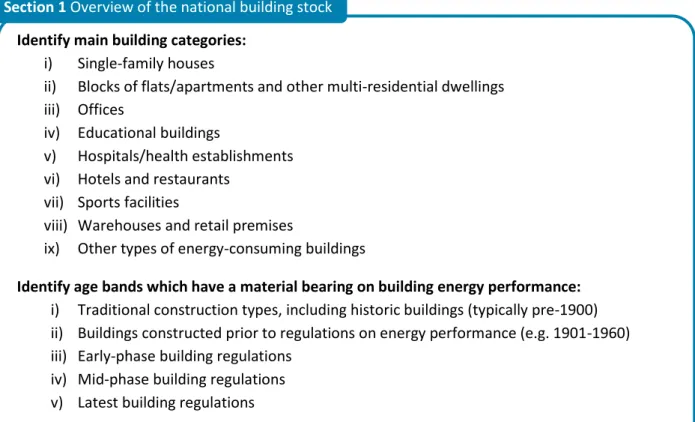
Following the first redesign strategy, which is requested by 10 March 2020, the strategy is due to be updated by 30 June 2024 as part of the Comprehensive National Energy and Climate Plan (NECP) under the Management Regulation. Identify the age groups that have material that affects the energy performance of the building: .. i) Traditional types of construction, including historic buildings (typically pre-1900) ii) Buildings built before energy efficiency regulations (eg iii) Building Regulations at an early stage. iv) Mid-stage Building Regulations v) Latest Building Regulations. This is particularly important for stakeholders who closely monitor implementation, as they would gain a better understanding of the impact of the strategy.
Identify opportunities for retrofit of renewable energy measures: .. i) Passive solar energy ii) Shade . iii) Solar energy for hot water production .. iv) Solar energy for electricity production (photovoltaics) v) Wind energy . vi) Heat pump vii) Biomass viii) Biogas . ix) Geothermal hot water. 37 Identify barriers to deep renovation: .. ii) Fiscal and financial barriers, including split-incentive dilemmas and market failures iii) Communication and capacity barriers .. iv) Technical barriers v) R&D barriers. Assess the potential role of the following measures/policies/approaches: .. i) Measures to target all public buildings .. ii) Targeting the worst performing segments of the national building stock iii) Policies to address energy poverty .. iv) Measures to utilization trigger points for renovation in the life cycle of buildings .. v) Policies and actions to stimulate cost-effective deep renovation of buildings, including staged deep renovation . we). vii) National initiatives to promote intelligent technologies and well-connected buildings and communities viii) National initiatives to promote skills and training in the building and energy efficiency sectors Section 4 Policy assessment.
3] Buildings Performance Institute Europe (BPIE), “Building 4: Quantifying the benefits of energy retrofit investments in schools, offices and hospitals”, BPIE, Brussels, 2018. 7] Buildings Performance Institute Europe (BPIE), “ The Danish Way - How Denmark Takes a Leading Role in Europe to Renovate Its Building Stock,” 2015. 16] Buildings Performance Institute Europe (BPIE), “Alleviating Fuel Poverty in the EU – Investing in Home Renovation, a sustainable and comprehensive solution", 2015.
17] Buildings Performance Institute Europe (BPIE), “Reducing energy poverty with national renovation strategies: a unique opportunity - Fact Sheet”, 2017. 19] iBROAD, “Understanding the needs of potential users – analysis of market surveys for the individual building renovation guide," 2018. 22] Republic of Bulgaria, "Long-term national program for the promotion of investments in measures aimed at improving the energy performance of the national stock of public and private residential and commercial buildings June 2017.
26] Building Performance Institute Europe (BPIE), "Renovating Romania - A Strategy for the Energy Renovation of Romania's Building Stock," 2014.
![Figure 5 Process for creating an individual building renovation roadmap (Source: [21])](https://thumb-eu.123doks.com/thumbv2/9pdfco/19319799.0/30.892.116.783.197.733/figure-process-creating-individual-building-renovation-roadmap-source.webp)
