
With this background, this thesis explored new ways to improve the diagnosis of initial periodontitis. In addition, the aMMP-8 PoC mouthwash test showed better accuracy in the identification of clinical signs of initial periodontitis (periodontal pocket formation, at least 4 mm) than BOP levels.
Periodontal disease diagnostics
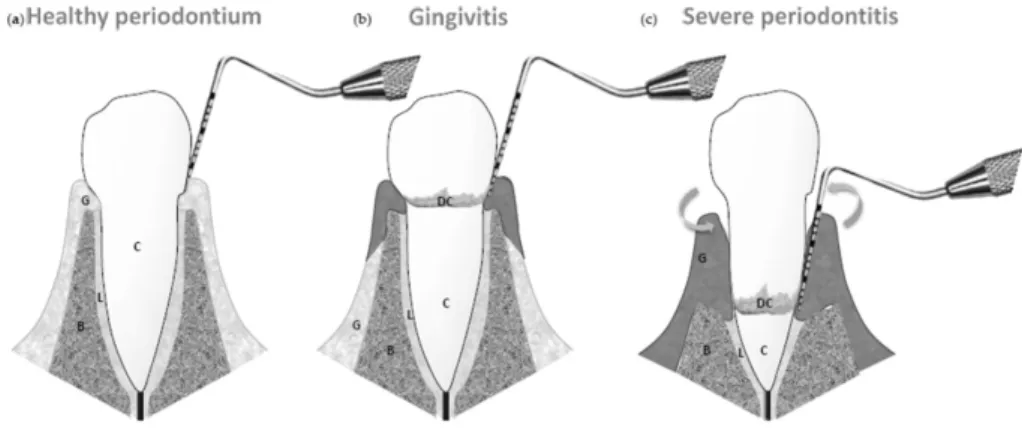
Healthy periodontium
There is a balance in a clinically healthy state between the bacterial biofilm and host defense mechanisms (Van Dyke et al., 2020). Probing depths are measured with a periodontal probe as the distance between the gingival margin and the bottom of the gingival sulcus (Armitage, 2004).
Classification of periodontal diseases
- Case definitions of periodontal health, gingivitis, and
In that regard, Heikkinen et al (2022) suggested that the measurement of disease activity based on biomarkers (aMMP-8) could help to identify potential antecedent stages before stage I periodontitis (initial periodontitis). Grading of periodontitis relies mainly on direct and indirect evidence of the progression of periodontitis (radiographic bone loss or CAL) (Tonetti et al., 2018).
Oral fluid diagnostics for periodontal diseases
- Saliva
- Gingival crevicular fluid (GCF)
- Mouthrinse, oral rinse or mouthwash
This ensures that the natural biological properties can be preserved in the samples until the biomarker analysis is performed (Gug et al., 2019). Previous studies have investigated more than 90 different components in GCF for periodontal diagnosis (Loos et al., 2005).
Etiology of periodontitis
Modifiable and non-modifiable risk factors for
These factors can be categorized into modifiable and non-modifiable risk factors (Borrell & Papapanou, 2005; Van Dyke & Sheilesh, 2005; Kinane et al., 2017). Smoking is known to have a negative effect on the onset and progression of periodontitis (Kinane et al., 2017; Leite et al., 2018). Men have been documented to have a higher prevalence of periodontitis compared to women (Borrell & Papapanou, 2005; Kassebaum et al., 2014;.
Several genes and single nucleotide polymorphisms (SNPs) have been found to be associated with periodontitis (Nibali et al., 2017).
Pathogenesis of periodontitis
Periodontal inflammation with dysbiosis transforms
The influence of genetic factors and gene polymorphisms can be as large as 33-50% of the overall susceptibility to periodontitis (Chapple et al., 2017; Loos & Van Dyke, 2020). Thus, the management of gingivitis plays an important role in the primary and secondary prevention of periodontitis (Murakami et al., 2018). Gingivitis is considered a major risk factor for periodontitis and a precursor to periodontitis (Lang et al., 2009).
Whether dysbiosis is a consequence or an initiating factor for periodontitis remains to be confirmed (Van dyke et al., 2020).
Innate and adaptive immunity network in the pathogenesis
But it seems to be related to the disruption of the bidirectional equilibrium (homeostasis) between the host inflammatory response and the subgingival biofilm (Curtis et al., 2020). But it appears that in the later stages of periodontitis, specific periodontal pathogens may come to play a role in dysregulation of host defenses and increased attachment loss and disease progression (Van Dyke et al. 2020). The complement system is an important mediator in neutrophil-mediated inflammation involving neutrophil recruitment into tissues and effector functions, but it also modulates T-cell and B-cell differentiation (Hajishengallis et al., 2020; Uriarte & Hajishengallis., 2022).
There appear to be significantly higher levels of complement activation products in the gingival tissue and gingival crevicular fluid of patients with periodontitis compared to healthy subjects (Hajishengallis et al., 2020).

Many roles of neutrophils in the pathogenesis of
In addition to killing microbial challenge with granule-secreted molecules and enzymes, neutrophils appear to have pro-inflammatory, anti-inflammatory and immunoregulatory roles, interacting with resident cells in the periodontium and other leukocytes (Uriarte & Hajishengallis, 2022). Neutrophil hyperactivity and hyperreactivity as well as imprecise chemotaxis leading to increased recruitment of neutrophils have been associated with chronic periodontitis by increasing the release of inflammatory and cytotoxic mediators and enzymes that cause increased collateral damage to the tissues (Hajishengallis & Korostoff, 2017). Additionally, there are age-related changes in the recruited neutrophil function, causing unfocused or imprecise chemotaxis, as well as increased release of tissue-destroying proteases in aged subjects ( Sapey et al., 2014 ).
These inflammatory changes and hyperactivity in neutrophil functions seem to persist despite successful periodontal treatment (Hajishengallis & Korostoff, 2017).
Matrix metalloproteinases (MMPs)
Introduction to MMPs
In harmful pathological conditions, this balance (tissue homeostasis) is disturbed, leading to disease (Verma & Hansch, 2007; Cui et al., 2017). That makes MMPs and their regulators potential therapeutic targets and biomarker candidates for many pathological conditions (Verma & Hansch, 2007; Cui et al., 2017).
MMP-8, its activation, and its role in periodontal diseases
Similarly, chlorhexidine (CHX), with antiseptic and anti-gingival inflammation properties, has been shown to reduce the collagenolytic activity of MMP-8 (Gendron et al., 1999). In addition, a significant association was found between aMMP-8 POCT and periodontitis grading and progression (2017 periodontitis classification system) (Tonetti et al., 2018; Sorsa et al., 2020). In this regard, aMMP-8 has been proposed to be used as a biomarker for a periodontitis classification system (Sorsa et al., 2020; Sorsa et al., 2022).
A new MMP-8 detection method based on specific antibodies and surface acoustic waves (SAW) biosensor technology has also been introduced (Taylor et al., 2019).
Study Population
Clinical examination (Studies I-IV)
AL was recorded if the distance between the ridge bone edge and the cemento-enamel junction (CEJ) was more than 2 mm.
Subgingival pooled plaque samples and analysis (Studies I
Salivary aMMP-8 levels were analyzed by a time-resolved immunofluorometric assay (IFMA) using the MMP-8-specific monoclonal antibodies 8708 (capture antibody) and 8706 (tracker antibody), where the specificity of the anti-MMP-8 monoclonal antibodies corresponds to the polyclonal MMP-8 (Hanemaaijer et al., 1997). PMN elastase activity was measured using the difference in optical density (OD) unit values before and after one hour incubation, detected by a spectrophotometer at 405 nm as described by Nieminen et al (1993). The optical intensity of the yellow color was measured at a wavelength of 405 nm in correlation with PMN elastase activity as a function of time.
Total protein was measured by the Lowry colorimetric method (Lowry et al., 1951) as described and performed by Helenius et al (2005).
It can be approximated that as the number of sites with a depth of ≥ 4 mm increases, the risk for incipient periodontitis similarly increases. Here, initial periodontitis (or subclinical periodontitis) was defined as having low clinical and X-ray manifestations of deterioration of periodontal health, in other words, an early stage of the disease corresponding to stage I or even a subclinical state (before stage I) of periodontitis according to the new 2017 classification of periodontal diseases (Tonetti et al., 2018; Tonetti et al., 2019). Finally, the classification performance of the aMMP-8 and BOP 20% test was evaluated by receiver operating characteristic (ROC) curves and area under the ROC curve (AUC) in each of the four cases.
A box plot was constructed and salivary aMMP-8 levels measured by IFMA were plotted against the two categories of periodontal pocket status.

Risk factors for initial periodontitis in adolescents (Study I) 34
The sensitivity of the aMMP-8 PoC test for initial periodontitis was at least two times greater compared to the BOP 20% test, the rate of false negatives was 17-52% less for the aMMP-8 PoC test, while both tests had the same specificity of 100% and false positives of 0%. Finally, among the 47 adolescents in this study, there were 11 adolescents who had 6-32 at least 4 mm deep periodontal pockets. Multivariable ordinal logistic regression analysis model of risk factors for deterioration of periodontitis toward initial periodontitis by the targeted variable selection process of Hosmer and Lemeshow (2000) (N = 252).
PD1 = the number of adolescents who have at least one ≥4 mm periodontal pocket; PD2 = the number of adolescents who have at least two ≥4 mm periodontal pockets; PD3 = the number of adolescents who have at least three ≥4 mm periodontal pockets; PD4 = the number of adolescents who have at least four ≥4 mm periodontal pockets; Healthy = the number of adolescents who do not have any ≥4 mm periodontal pockets.
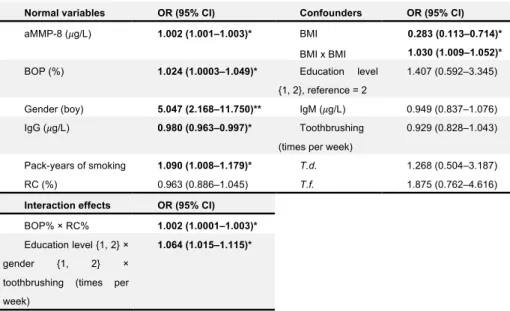
Bacterial challenge confounds the association between
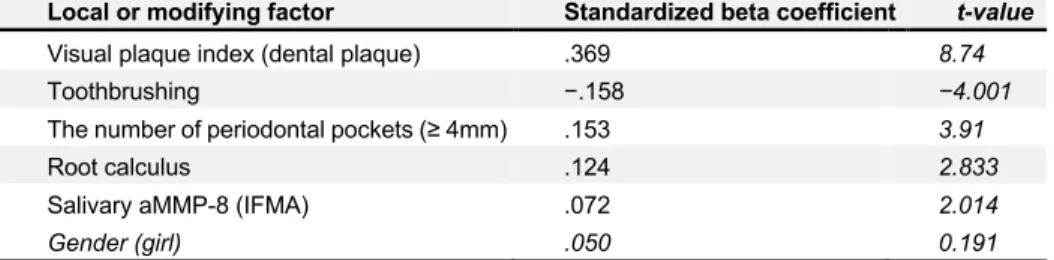
Diagnostic accuracy of active MMP-8 (aMMP-8) tests at the point of care (PoC) and bleeding on probing (BOP 20%) (cut-off value 20% for positive results) among Finnish adolescents from Kotka (N = 47) with four baseline cases of periodontitis or subclinical periodontitis (PD1–PD4). Acc = accuracy; FN = percentage of false negative results; FP = percentage of false positive results; AUC = area under the receiver operating curve; MCC = Matthews correlation coefficient. Relative influence (adjusted for other variables) of local and modifying factors for bleeding on propensity to probe as assessed by standardized beta coefficients and t-values.
The greater the absolute value of the t-value or standardized beta coefficient, the greater the impact.
Mouthrinse in aMMP-8 testing improves the diagnostic
The sensitivity of aMMP-8 PoC test for initial periodontitis was at least two times greater compared to BOP (Räisänen et al., 2019a). This thesis showed that gingival bacterial biofilm can confound and weaken the association between BOP and initial periodontitis in young people (Räisänen et al., 2021a). Likewise, poor oral hygiene (high levels of bacterial biofilm) appears to increase the amount of gingival bleeding regardless of the number of periodontal pockets (Räisänen et al., 2021a).
Therefore, the level of oral hygiene and the amount of bacterial biofilm appear to ultimately be the main determinant of the degree of gingival bleeding rather than active collagenolysis (aMMP-8 levels) (Räisänen et al., 2021a).
Previous studies have shown a connection between periodontal disease and obesity in adults, adolescents and children (Khan et al., 2018; Jepsen et al., 2020; Tegelberg et al., 2021). Sorsa et al (2020) were the first to show a significant correlation between aMMP-8 POCT (mouthwash) and staging and grading of periodontitis (Tonetti et al., 2018). A comparison between the study populations in Deng et al (2021a) and Sorsa et al (2020) (Hong Kong and Greece, respectively) showed that the Hong Kong population appeared to have less gingivitis (BOP) and lower mean periodontal probing depth than the Greek population (Sorsa et al., 2021).
In that respect, Deng et al (2021a) could markedly improve the aMMP-8 POCT diagnostic performance by combining it with periodontitis risk factors (age and smoking).
Potential pitfalls in the interpretation of aMMP-8 studies
Furthermore, recent studies have shown that oral fluid biomarkers in addition to an interview/questionnaire can increase the precision of identification of asymptomatic and undiagnosed periodontitis patients (Verhulst et al., 2019; Räisänen et al., 2021b). Measurements of salivary biomarker concentration may also be influenced by several patient-related factors, such as xerostomia/hyposalivation and viscoelastic properties (Deng et al., 2022). Mouthwash collection is not affected by variability in salivary flow rate and volume (Deng et al., 2022), providing much-needed patient-level calibration and standardization for whole-mouth aMMP-8 testing.
Therefore, the impact of the selection of correct antibodies and oral fluid type is potentially large on the diagnostic accuracy of aMMP-8 testing and should be carefully considered when evaluating the various MMP-8 assays and the diagnostic utility of aMMP-8.
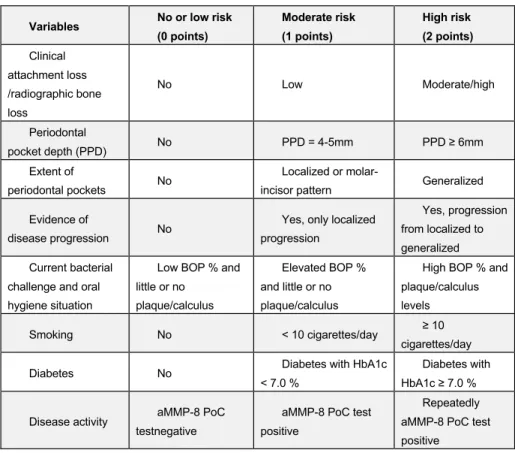
Another recent study found in a longitudinal data that aMMP-8 levels in PISF have good reliability to predict future peri-implantitis in dental implants (Guarnieri et al., 2022). In this regard, multidimensional periodontitis risk assessment tools have been previously studied and reported (Lang et al., 2015; Ferraiolo, 2016). As recently pointed out by Heikkinen et al (2022) there may be one or more preceding stages before periodontitis stage I (initial periodontitis), such as the subclinical stage (Raivisto et al., 2020c).
Similar measures should be taken in adolescents with stage I periodontitis (initial periodontitis) while their response to the treatment is monitored (Sanz et al., 2020).
Strengths and limitations

![Figure 4 Salivary aMMP-8 IFMA (ng/mL) levels against periodontal pocket (≥4 mm) status (zero [PD#=0], one [PD#=1], and at least two [PD# ≥ 2] periodontal pockets) where IFMA levels are categorized by the corresponding aMMP-8 PoC test result measured fr](https://thumb-eu.123doks.com/thumbv2/9pdfco/1891235.267401/52.748.111.581.89.484/figure-salivary-periodontal-periodontal-pockets-categorized-corresponding-measured.webp)