Title of the thesis: Control mechanisms and measurements for digital platform workers: Multiple case studies of digital work platforms. The findings reveal what and how governance mechanisms and metrics are used in digital work platforms to manage platform workers. Tutkielman nimi: Control mechanisms and metrics for digital platform workers: Multiple case study of digital work platforms.
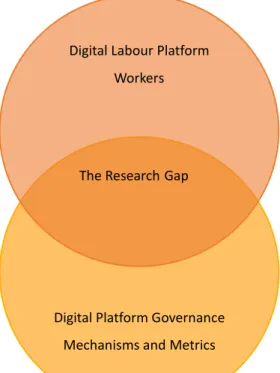
2 Literature review
Digital platform
- Definition of digital platform
- Actors
- Digital Platform Value Creation Through Actors
- Business models
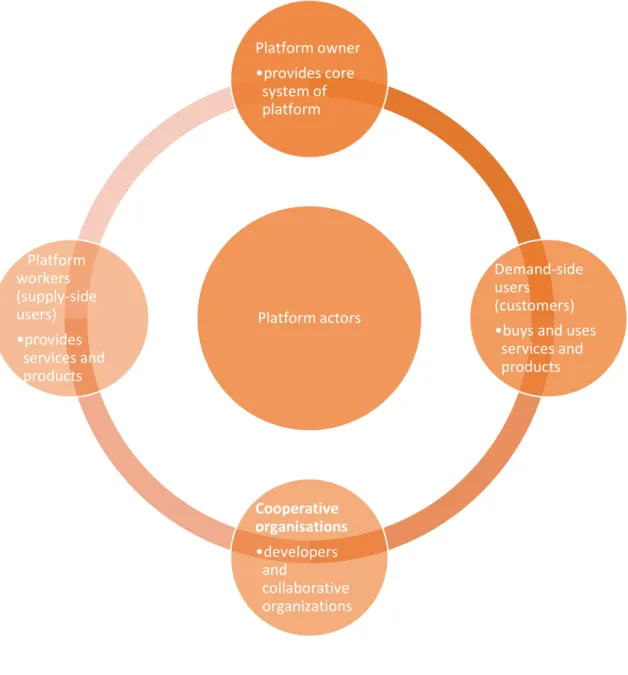
According to Kääriäinen et al. 2021), the platform owner aims to enable maximum value creation between the actors. According to Viitanen et al. 2017), the platform owner enables the platform to manage and collect data. According to de Reuver et al. 2018), digital platforms can be such as operating system platforms (iOS and Android), payment platforms (Apple Pay, Pay-Pal and Square), peer-to-peer digital platforms (Uber and TaskRabbit) and social media platforms (Facebook and Instagram).
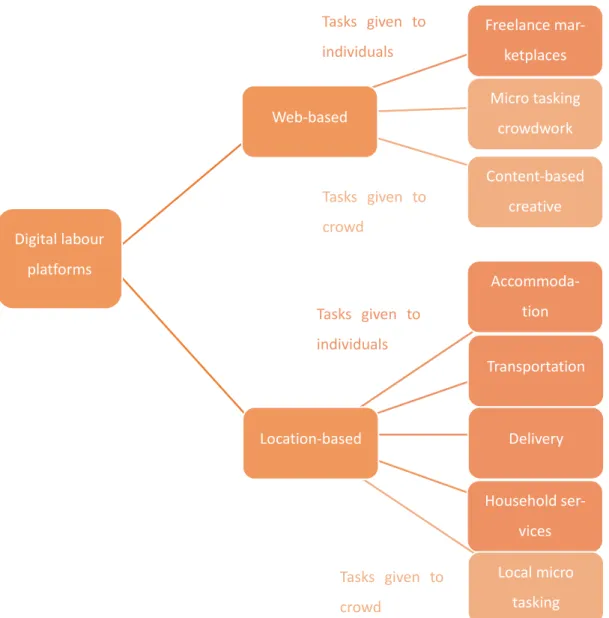
Crowdwork mechanisms
- Definition of crowdwork governance
- Governance mechanisms
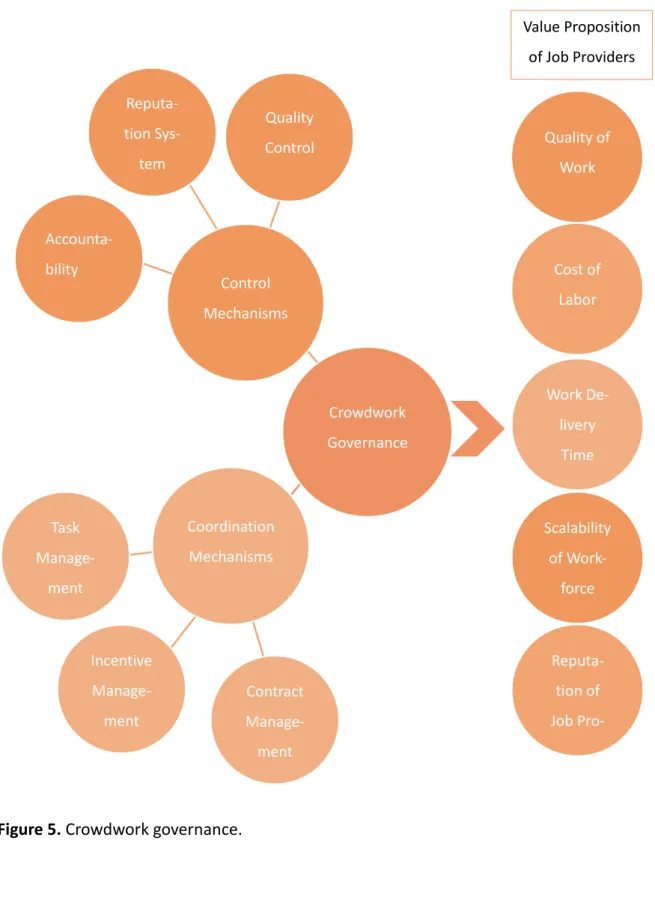
It is an administrative control that motivates job providers to behave accordingly (Gol et al., 2019). It refers to the coordination of agreements consisting of working conditions between workers and employment providers (Gol et al., 2019). There is currently no known function to capture the reputation of job providers (Gol et al., 2019).
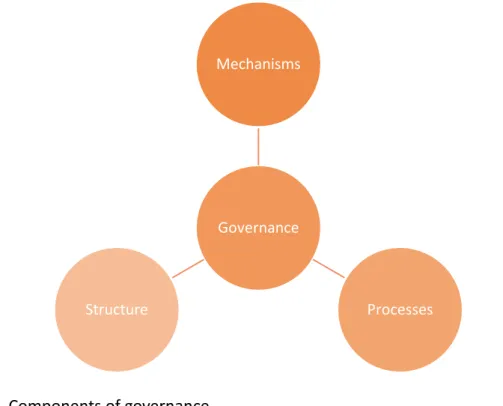
Theoretical framework: Platform Workers Governance Mechanisms in Digital Platforms
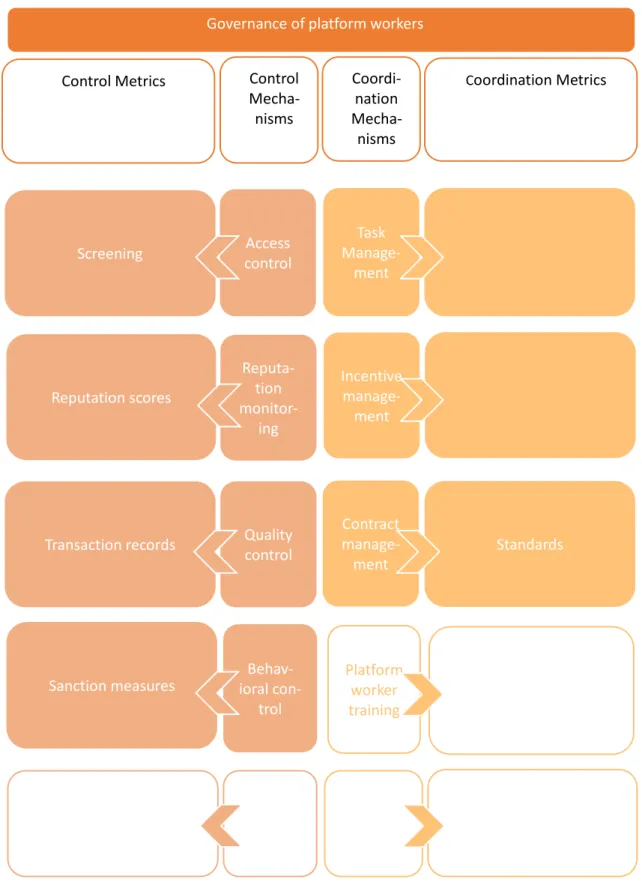
In addition, platform owners may have specific tools or architectural features to achieve the desired outcomes of platform governance (Chen et al., 2022). According to Li et al. 2019), company-specific benefits are critical, both in platforms and traditional companies. Access control is an important part of digital platform governance (Chen et al., 2022), so it is added to the framework of governance mechanisms.
Access control refers to the mechanisms that determine who can join the platform (Chen et al., 2022). Reputation monitoring is related to output control, which refers to evaluating and monitoring. monitoring the outputs and outcomes of users on the supply side, according to Chen et al. Several studies consider the effectiveness of effective platform owner evaluation feedback systems for the performance of users on the supply side (Bolton et al., 2013; Yi et al., 2019).
If a supply-side user receives negative feedback due to low quality, platform owners may downplay the supply-side user (Chen et al., 2022). The buyer views supply-side users negatively with poor ratings (Huang et al., 2017), so those supply-side users are likely trying to correct their actions (Siering & Janze, 2019). According to Kääriäinen et al. 2021), users usually relate the platform quality to the ease of use of the service.
Metrics to evaluate supply side users' work quality could include transaction records (order error rate, cancellation rate, and late shipment rate (Chen et al., 2022).
3 Methodology
- Research philosophy
- Research strategy and methods
- Case selection
- Data collection
- Data analysis
- Validity
- Reliability
According to Eriksson and Kovalainen (2015, p.15), epistemology considers the nature of knowledge and its sources and boundaries. According to Saunders et al. 2009, p.124-127) and Eriksson and Kovalainen (2015, p. 22), there are different reasoning approaches to the development of theory, including inductive, deductive and abductive approaches. Merriam and Tisdell (2015, p. 109) note that interviews can range from structured to unstructured and in between.
According to Merriam and Tisdell (2015, p. 242), internal validity refers to the findings that capture what is and observe and measure what is supposed to measure. The study used common strategies to check the validity of the results using recommendations from Merriam and Tisdell (2015, p.245) and Eriksson and Kovalainen (2015, p.306), including multiple data collection methods. According to Merriam and Tisdell (2015, p.246), respondent validation refers to asking for feedback on preliminary findings from the people who were interviewed.
According to Merriam and Tisdell (2015, p. 249), data saturation means that the same things come up and no new information comes up when collecting data. Also, as Merriam and Tisdell (2015, p.249) note, a researcher position strategy was used in this study. Likewise, according to Merriam and Tisdell (2015, p. 253), it refers to the ability of the findings to be applied to other cases.
According to Merriam and Tisdell (2015, p. 253), the audit trail describes how the author arrived at the results.
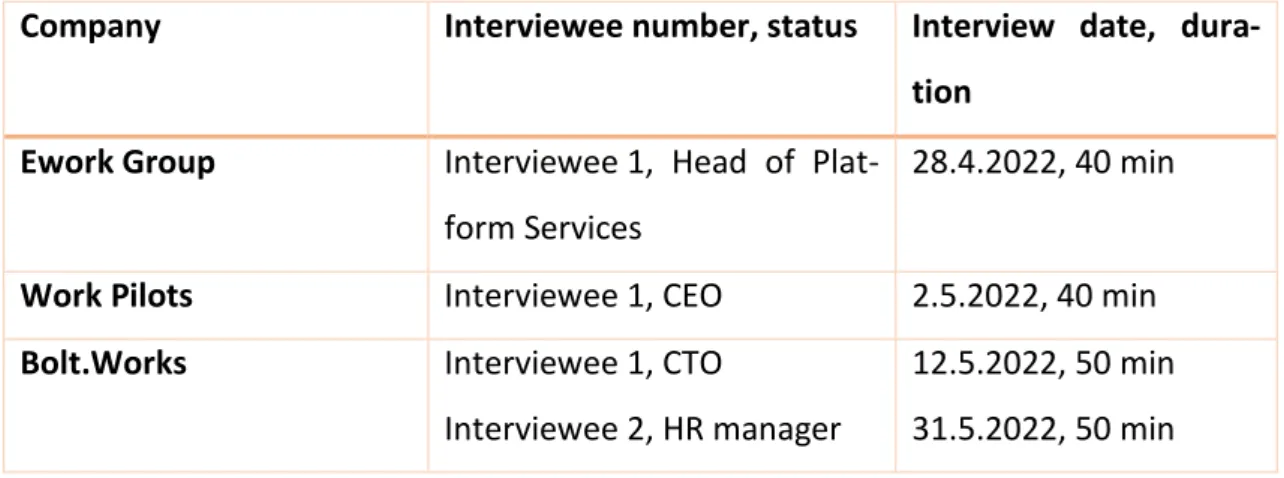
4 Findings
Company 1 Ework Group
- Control mechanisms and metrics of Ework Group
- Coordination mechanisms and metrics of Ework Group
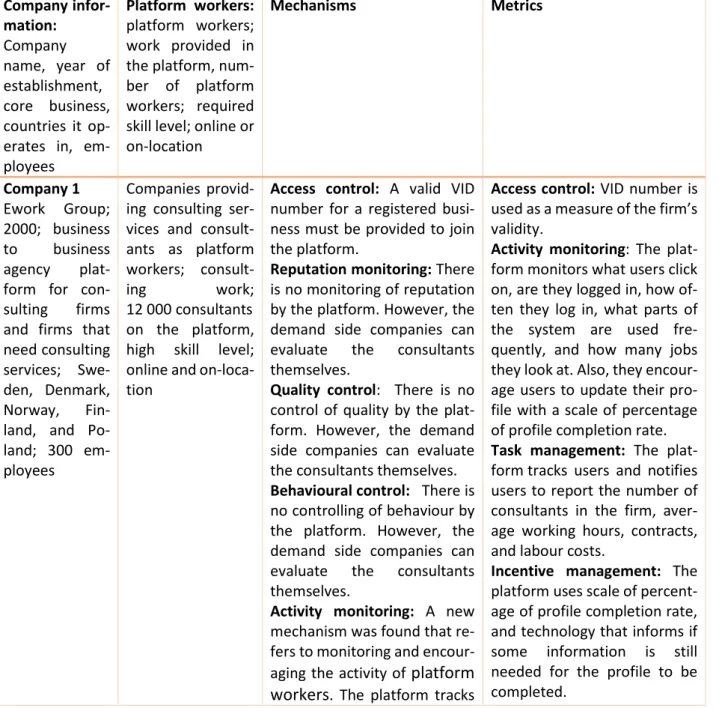
According to the interviewee, there are 12,000 consultants from small and large companies on the platform. According to the interviewee, “[the supply-side company] can measure and see how those [platform worker] companies are performing”. Quality control was not used on the platform based on the interview, but according to the interviewee, "I know a lot of customers do it themselves."
Incentive management was used on the platform based on the interview to encourage users to activity. According to the interviewee, gamification encourages users to update their profile and keep it active on the platform. Based on the interview, it can be said that contract management was also a mechanism in the platform.
According to the interviewee, the platform's technology enables the signing of contracts through the platform, thus facilitating the process. In addition, according to the interviewee, there are also GDPR laws with regard to personal data on the platform. Based on the interview, it can be said that the platform uses training as a coordination mechanism.
According to the interviewee, the platform provides training with the help of the customer success team.
Company 2 Work Pilots
- Control mechanisms and metrics of Work Pilots
- Coordination mechanisms and metrics of Work Pilots
If the audit is unfair, the worker on the platform can submit it to the owner of the platform, and the owner of the platform assesses the situation in the complaints procedure, notes the interlocutor. If the rating based on the platform owner's rating is unfair, the platform may ask the user on the offer page to change the rating. Based on the interview, it can be determined that behavior control is used on the platform.
If the platform owner chooses, the platform worker can be blocked from the platform, although that is rarely the case. The platform worker is allowed to enter the platform if he gives permission about the situation, says the interviewee. Although the interviewee says that besides getting work and payment, there are no incentives on the platform.
The platform uses standard contracts that the system automatically sends for the workers to sign. Based on the interview, training can be set as a management mechanism on the platform. Collaborating organizations can also provide training, fairs and support functions for the platform workers, according to the interviewee.
According to interviewee 1, the platform works in such a way that the customers place an order, employees apply for it and the customer accepts it.
Synthesising the mechanisms and metrics
Contract management: The platform needs to keep up with the times as there is legislation dealing with employment relationships. Training: The platform measures the number of support cases as an indicator of training success. Reputation Monitoring: Both demand-side users and platform workers can provide feedback on each other through the platform.
Reputation Monitoring: Demand side users can give up to 4 smileys and a written rating to a worker on the platform. Access control: The platform measures the amount of profile information and employment status. Reputation Monitoring: The platform uses star ratings on a scale of 1 to 5, as well as verbal and written reviews.
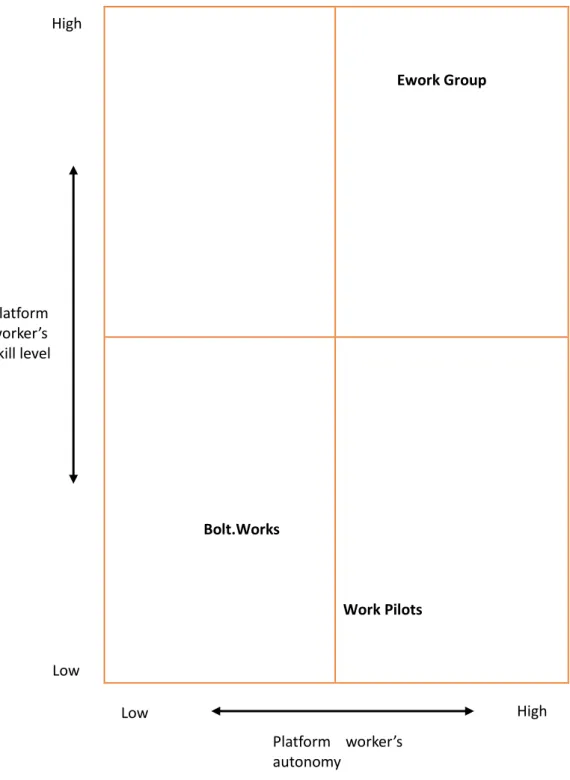
Contract management: The platform has a system for modeling agreements, TES, signing and handling contracts digitally. Likewise, wage rates are determined for the platform employees in case company 2 and case company 3, whereas the wage rates in case company 1 were not defined by the platform. Furthermore, the skill level of the platform employees varies between the case companies, as shown in Figure 8.
Contract signing can be used for clients to accept the platform worker's work.
5 Discussion
- Theoretical implications
- Managerial implications
- Suggestions for future research
- Limitations
In contrast, tasks were primarily managed through the platform interface with notifications to platform workers. It refers to monitoring and encouraging the activity of platform workers on the digital platform. Thus, this study brings value to the understanding of governance measurement data used in monitoring platform workers.
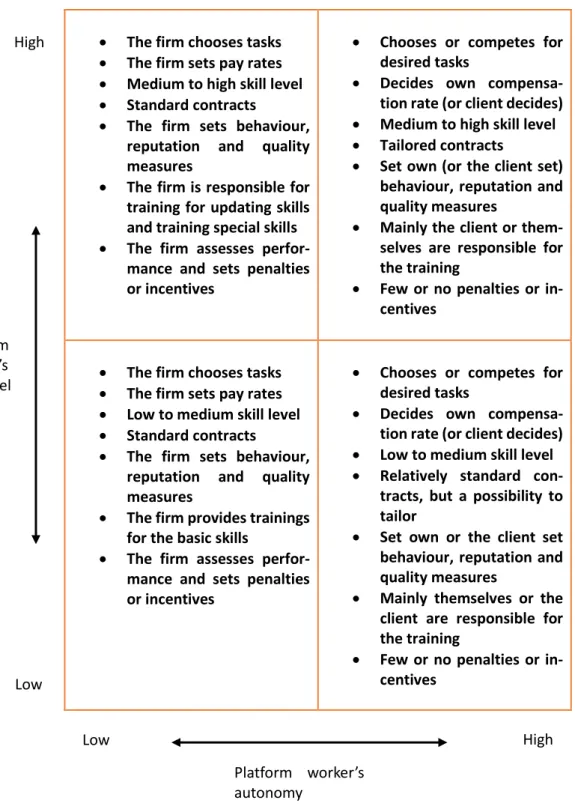
Fifth, the case companies' differences in the use of management mechanisms and measurements were found to be justified by the level of autonomy and skill level of the platform workers. Different types of businesses may need different mechanisms based on their relationship with the platform workers. Competition in the markets for the quantity and quality of platform workers may increase the need for better incentives.
If the platform workers are highly skilled, they will require special training rather than basic training to keep their knowledge up to date. The tool can help managers adjust the level of governance to the autonomy or skill level of the platform workers. Suggestion requires informing and hearing the platform workers about the decisions based on algorithm management (Euroopan Komissio, 2021).
Whether the platform employees were aware of this did not come up in the interviews, but this would be a topic for further study.
Cross-border movement by digital platform-based sharing economy ventures: The case of Uber Technologies. In Proceedings of the 18th ACM conference on collaborative work and computer-supported social computing (p. 10 from https://www.ilo.org/global/topics/non-standard-employ-ment/crowd-work/lang--en/index.htm.
Retrieved from https://www.vttresearch.com/sites/de-fault/files/pdf/whitepapers/Keko_SEED_White_paper_suoma-. The effect of fake reviews on online visibility: A vulnerability assessment of the hotel industry. Capturing the dynamics of the sharing economy: Institutional research into the plural forms and practices of sharing economy organisations.
Retrieved from https://www.platform-economy.de/wp-content/uploads/2020/11/GOVERNANCE-FOR-MOBILE-SERVICE-PLAT- FORMS_-A-LITERATURE-REVIEW-AND.pdf. Digital labor markets in the platform economy: Mapping the political challenges of crowdwork and gig work. Retrieved from https://www.platform- economy.de/wp-content/uploads/2020/11/Design-and-governance-of- platform-ecosystems–key-concepts-and-issues-for-future-research.pdf Siering, M., & Janze, C.
In Proceedings of the 2017 ACM Conference on Computer Supported Cooperative Work and Social Computing (pp.
Appendices
Interview questions