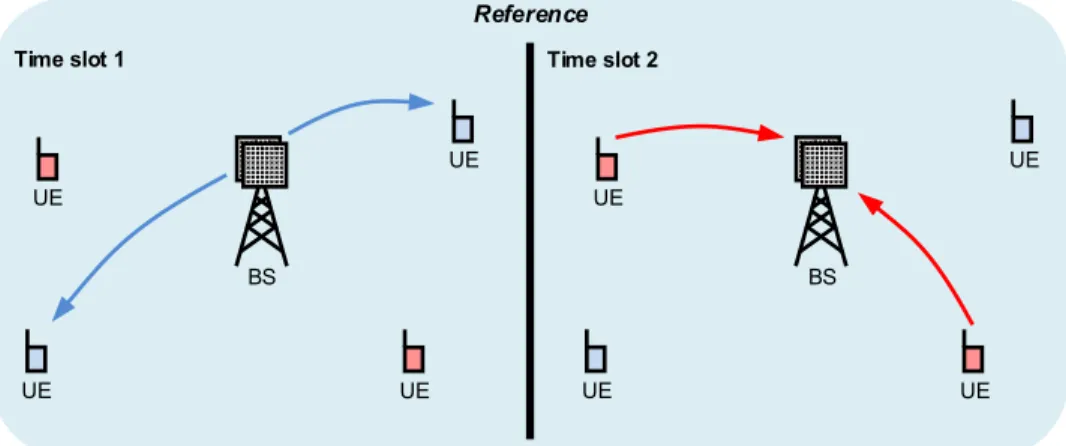
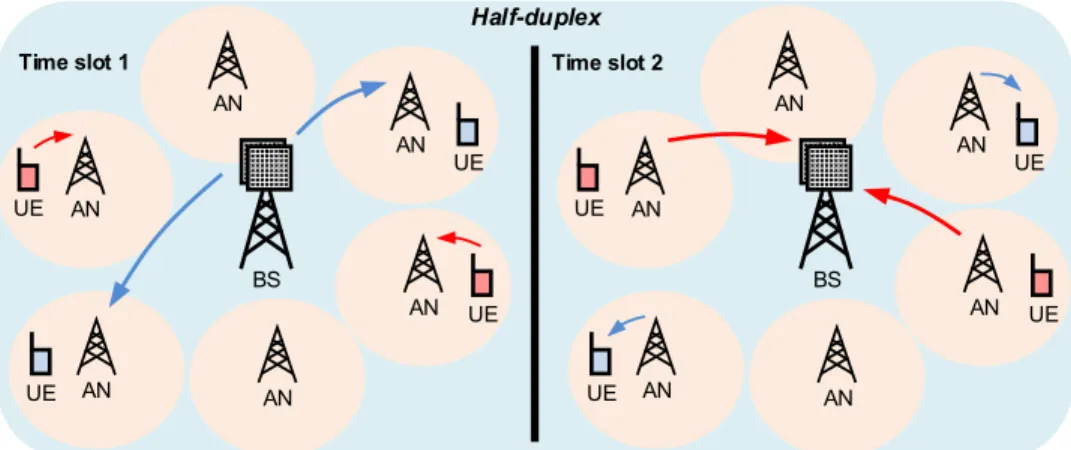
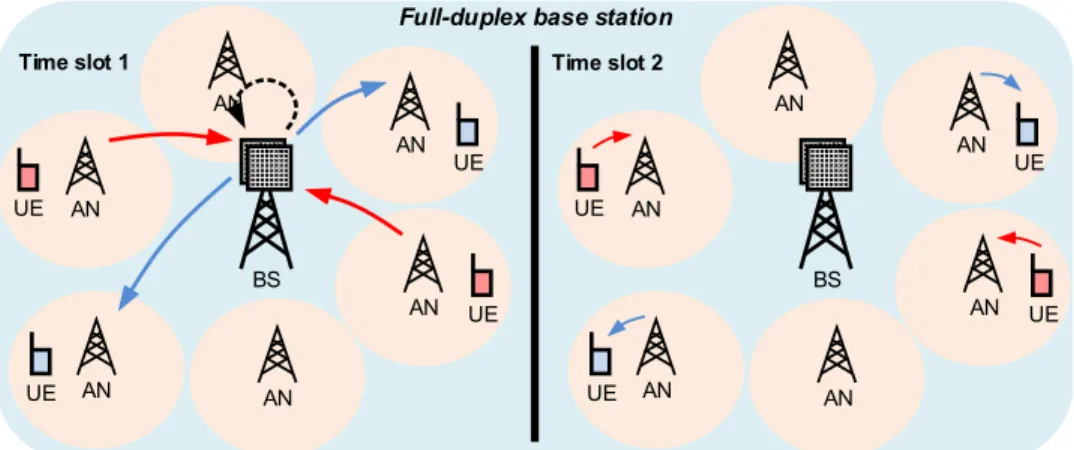
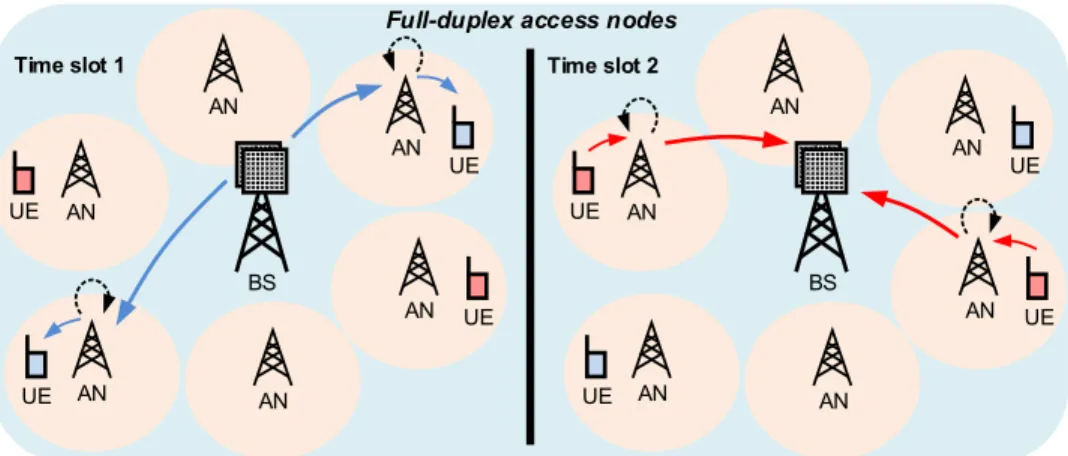
Such self-backhauling radio access systems are an integral part of implementing commercially feasible ultra-dense networks as they significantly reduce the cost of the backhaul link. While the power distribution is solved in closed form for the HD case, only an algorithm for optimizing the transmission powers of the IBFD scenario is proposed. The work in [4], on the other hand, maximizes user rates for ANs using frequency division doubling (FDD) by optimizing the bandwidth allocation of the backhaul link.
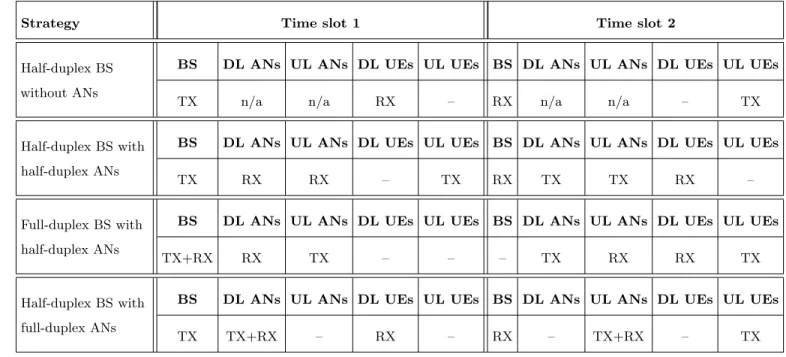
Moreover, two of the strategies rely on IBFD technology: one uses IBFD-capable AN while the other assumes an IBFD-capable BS. Furthermore, in two of the backhauling strategies, either BSs or ANs must be IBFD capable, while one of the schemes has no such requirement. That is, this assumption means that, except for the SI, none of the signals received or transmitted by the BS interfere with each other, which represents the best case scenario.
All the alternative solutions presented in this section will be compared to this basic reference scheme. Half-duplex base station with half-duplex access nodes In all the upcoming alternative strategies, the basic idea is to introduce so-called ANs into the network to act as intermediate nodes between the UEs and the BSs. 1.2 the UL UEs in the first time window interfere with the reception of the DL ANs, while in the second time window the DL ANs interfere with each other and the DL UEs.
In particular, in the first time slot UL AN interferes with the reception of DL AN, while in the second time slot.
Transmit Power Optimization under QoS Re- quirements
Since this analysis considers a very dense deployment of the ANs, it is crucial to manage such interference within the network. The transmission power allocation scheme discussed subsequently in Section 1.4 takes these interference links into account and aims to reduce their harmful effects. Rd,ANi is the data rate of the backhaul link between the BS and the ith DL AN in bps/Hz;.
Ru,ANj is the data rate of the backhaul link between the BS and the jth UL AN in bps/Hz;. The constraints C1 and C2 ensure the QoS of the UEs, while the constraints C3 and C4 ensure sufficient retrieval capability in the ANs. Due to the ultra-dense deployment of the ANs, this type of optimization procedure.
Therefore, determining the optimal transmission power allocation, and consequently minimizing the effect of interference, ensures that QoS requirements can be met. The alternative self-backhauling strategies mainly differ in the structure of the interference terms, as each distributes the transmissions differently over the two time slots. As a result, the exact form of the optimization problem is different for each self-backhauling strategy.
In principle, the optimization procedure involves first determining the minimum transmission powers for a given duplex parameter η. Then, the obtained optimal transmit powers for any given duplex parameter are used to form another objective function with respect to η, the solution of which provides the global optimal solution of the complete optimization problem. It should be noted that this formulation of the optimization problem minimizes the total transmit power consumption of the entire cell without taking into account the transmit powers of the individual nodes.
Or, to give another example, if the transmit power of the BS is of no concern, it can be completely removed from the objective function. However, in some cases the required QoS requirements cannot be met with finite transmit powers. Such scenarios are called unfeasible network geometries because the required minimum data rates cannot be achieved due to the strength of the various interference links.
Performance Analysis
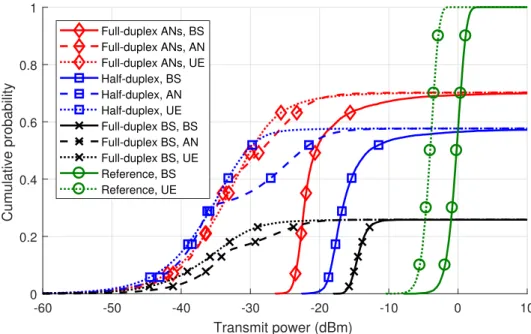
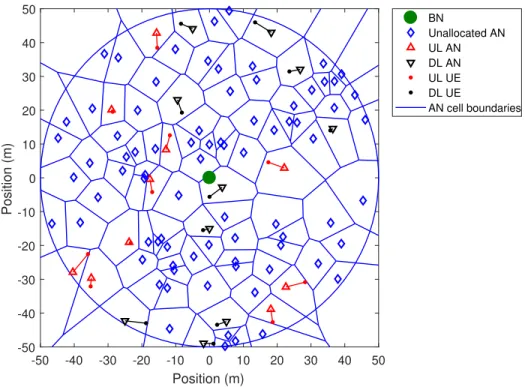
The DL and UL positions of the UE are also shown, along with the AN assignment. By calculating the optimal transmission powers in different random realizations of the network, the cumulative distribution functions (CDFs) of the corresponding quantities can then be obtained. In addition, to ensure a fair comparison between different schemes, the transmit power of the different schemes is weighted by the proportion of time spent in the corresponding time slot, as this more realistically illustrates their total transmit power consumption.
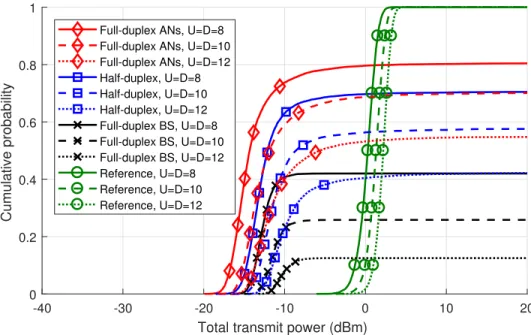
However, having full-duplex capable ANs significantly reduces the transmission power requirements of the BS, making it the preferred option in terms of the total power consumption. This is evident from the CDFs that saturate to a value below 1, indicating that about 75% of the random network geometries are such that the QoS requirements cannot be met with any finite transmission powers. To analyze the effect of the UE density, Figure 1.7 illustrates the self-retrieval solutions from another perspective, showing the CDFs of their total transmission power consumption for different amounts of UEs.
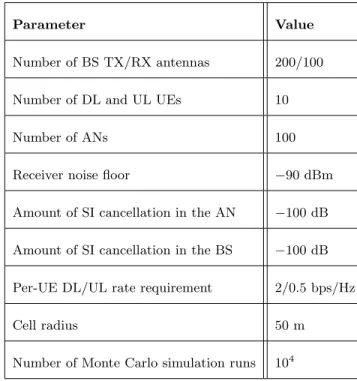
In terms of total transmission power, the full dual ANs solution is clearly the preferred option, as it outperforms the other solutions in both reception. However, it should be noted that with 24 UEs per cell in total, even this solution cannot obtain the required data rates for more than 55% of network geometries. For reference, the total transmission powers of the other solutions are also shown, using the default system parameters.
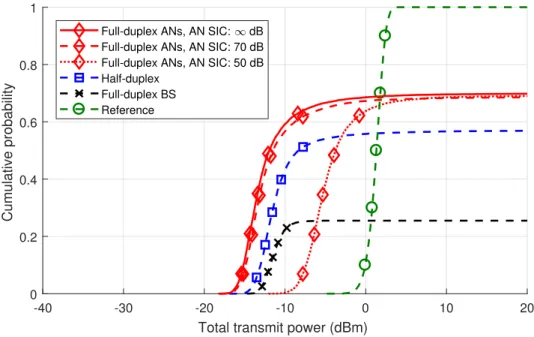
Therefore, such full-duplex ANs can be implemented without a significant cost increase over half-duplex ANs. As might be expected, the lower data rate requirements translate into lower transmission power consumption, the full dual AN system still offers the highest performance. This shows that the limiting factor of the considered system is the interference between different communicating parties, the effect of which decreases when the cell radius increases.
The only exceptions are the scenarios where the number of UEs approaches the limit, after which more than 50% of the network geometries are infeasible. Overall, using full-duplex ANs to provide radio access appears to be the most preferred option in terms of transmit power consumption and number of supported UEs, as long as steps are taken to ensure the feasibility of the network geometry. Further, again, the case of full-duplex ANs achieves the highest probability of feasibility among the self-backhauling strategies considered, especially with the higher data rate requirements.
However, if the number of ANs is very small, the transmission energy consumption of AN-based strategies may be higher than that of the reference scheme. The most extreme example of this is a full-duplex BS network, as its median transmit power tends to infinity regardless of the number of ANs when the data rate requirements are ρd= 2 and ρu = 0.5.
Summary
Using ANs to transmit traffic between UEs and the BS reduces transmission energy consumption in most circumstances compared to a case where the BS directly serves the UEs. Full-duplex ANs can obtain QoS with lower overall transmission power consumption than half-duplex ANs, requiring only 70 dB of SI cancellation to do so. The AN density should be significantly higher than the UE density to ensure that the interference links remain weak enough compared to the data links.
The optimal transmit power allocations under minimum QoS requirements were then determined for all these strategies as well as for a reference scheme without any ANs. The results indicate that using full-duplex ANs is the most transmit power efficient solution and it also outperforms the case where the BS communicates directly with the UEs. However, the disadvantage of using the ANs as intermediate nodes is the fact that the QoS requirements cannot be achieved at all under some network geometries due to the interference connections.
Nevertheless, as long as the system is designed so that the network geometry remains favorable, the findings of this chapter clearly demonstrate the benefits of densely deploying the ANs to minimize the transmit power consumption of ultra-dense wireless networks. Rong, “A full-duplex self-recovery scheme for small cell networks with massive MIMO,” in Proc. Hossain, “Analysis of massive MIMO-enabled downlink wireless backhaul for full-duplex small cells,” IEEE Transactions on Communications, vol.
Bhargava, "Joint downlink cell aggregation and bandwidth allocation for wireless backhauling in two-layer hetnets with large-scale antenna arrays," IEEE Transactions on Wireless Communications, vol. Hossain, "Downlink spectrum allocation for in-band and out-band wireless backhauling of full duplex. Milleth, "Joint backhaul-access analysis of full duplex self-backhauling heterogeneous networks," IEEE Transactions on Wireless Communications, vol.
Leng, “Power control for extended full-duplex relay cellular networks with QoS guarantees,” IEEE Access , vol. Tafazolli, “Dual antenna selection in multiple self-backhauling small cell networks,” IEEE Communications Letters, vol. Mogensen, "Path loss estimation for urban microcell scenarios at 3.5 GHz compared to 1.9 GHz," in Proc.