Independent game development – Developers’ reflections in postmortems
Noora Suorsa
University of Tampere Faculty of Communication Information Studies and Inter- active Media
Master's thesis November 2017
UNIVERSITY OF TAMPERE, Faculty of Communication Sciences Information Studies and Interactive Media
MDP in Internet and Game Studies
SUORSA, NOORA: Independent game development – Developers’ reflections in post- mortems
M. Sc. Thesis, 56 pages, 9 appendix pages November 2017
Independent computer games have gained a lot of popularity in the past few years. Digi- tal distribution methods and networks have made it possible for indie games to find more players, and get an easier access to markets, and get noticed by the consumers, than it was during the traditional brick and mortar shop based retail and console game dominant era. The increased popularity and number of indie games and developers has made indie games an interesting research area. Research of independent games has fo- cused on very specific research topics; this study aims to gain a broader view of inde- pendent game development with the developers’ perspectives.
The objective of this thesis is twofold. First we take a closer look at the indie games through academic literature: how independent games are being defined and described in academic game studies, we also describe and map out some of the other phenomena such as digital distribution and crowdfunding that have significantly aided in their entry to the game markets. Then we analyse indie game development postmortems using con- tent analysis. What are the most common problems and success factors of indie game development in these postmortems? Are these success and failure factors similar to the defining features and aspects of indie game development outlined by academic litera- ture?
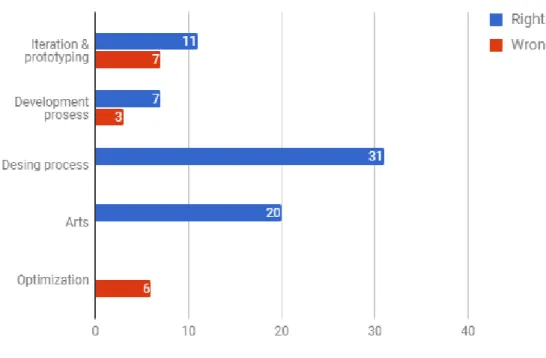
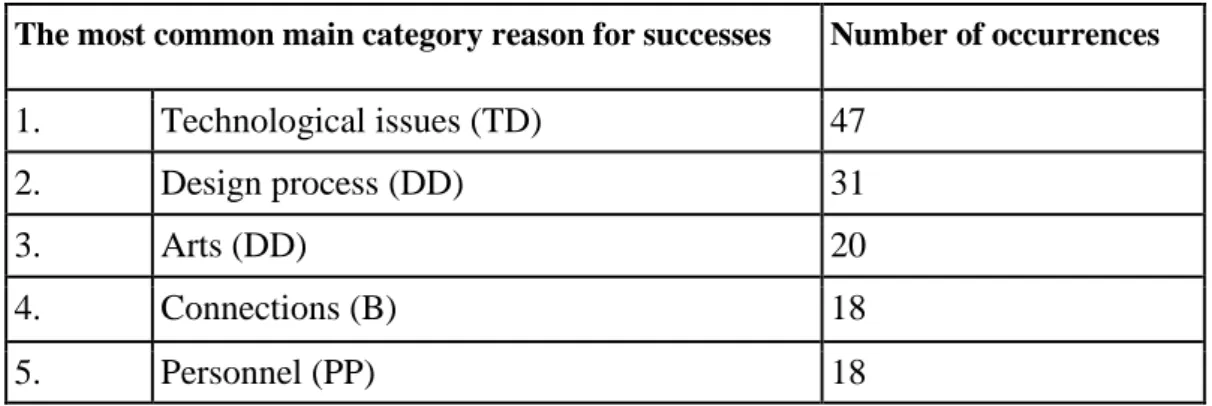
Design & development process was the most common theme in the perceived reasons for success in the postmortems. The most common general reasons for success were technological issues, design process, art, connection and personnel. Production process
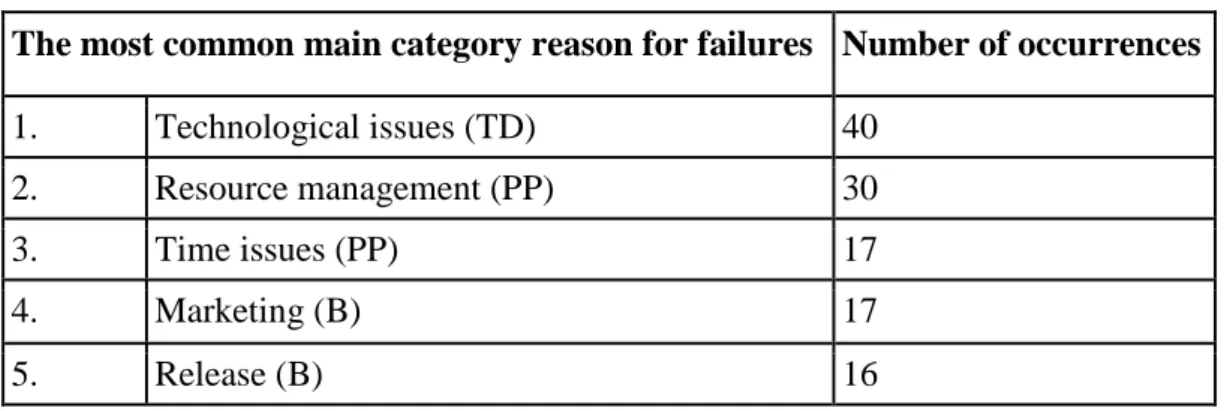
& project management was the most common theme in the perceived reason for failure, while the most common general reasons for failures were technological issues, resource management, time issues, marketing and release. In general indie developers often suc- ceed in arts and design, but business, process and project management causes problems in the development.
The postmortem analysis results were quite similar to other studies that have analysed postmortem wrongs and rights. The analysis showed that academic literature’s defining features and aspects of independent games can be seen in the postmortem analysis re- sults, but often they are not directly the reasons for failures or successes.
Key words and terms: independent game, postmortem, game development, content analysis
Table of contents
1 INTRODUCTION ... 1
2 BACKGROUND ... 3
2.1 Independent games as a part of game studies ... 3
2.2 Three perspectives of independence ... 4
3 LITERATURE REVIEW ... 6
3.1 Independent games ... 6
3.1.1 Political-economic position opposite mainstream ... 8
3.1.2 Aspects of style, creativity and aesthetics ... 10
3.1.3 Part of a community, participatory culture and service orientation 12 3.2 The roles of digital distribution and crowdfunding ... 14
3.2.1 Crowdfunding ... 14
3.2.2 Digital distribution ... 16
3.3 Using postmortems to analyse game development ... 18
4 RESEARCH MATERIAL AND METHODS ... 21
4.1 Research material ... 21
4.2 Selection of the postmortems ... 22
4.3 Research methods ... 23
4.4 Analysis of the research material ... 25
5 RESULTS OF THE POSTMORTEM ANALYSIS ... 27
5.1 What kind of rights and wrongs there are in indie game development ... 27
5.1.1 Technological development ... 28
5.1.2 Production process and project management ... 30
5.1.3 Business ... 33
5.1.4 Design & development process ... 35
5.1.5 The game ... 37
5.2 The most common reasons for success... 40
5.3 The most common reasons for failure ... 41
5.4 Are postmortems highlighting same aspects as academic literature?... 42
6 DISCUSSION AND CONCLUSIONS ... 47
REFERENCES ... 53 APPENDICES
1 INTRODUCTION
Video game industry seems to be the fastest growing mass media, that is also character- ized by innovations and high dynamics (Marchand & Hennig-Thurau 2013). Independ- ent computer games have gained a lot of popularity in the past few years and some indie games have broken into mainstream. Digital distribution methods and networks have made it possible for indie games to find more players, get an easier access to markets, and get noticed by the consumers, than it was during the traditional brick and mortar shop based retail and console game dominant era. Various sales concepts like Humble Bundle’s Humle Indie Bundle have brought new valuable promotion for indie games.
Game industry has had publisher dominant production, where the financier has had the ultimate power (Martin & Deuze 2009) and the industry is still centred around few ma- jor corporate publishers, even though nowadays there is a larger variety of publishers and developers. Game creation and development does not require as much work, skill and knowledge as it did before; the accessible and easy to use development softwares and new casual game types have brought more independent games to the market. This increased popularity and number of independent games makes them an interesting re- search topic.
Studies of independent games and independent game development have often tended to focus on very specific area or topic in independent games or their production. This the- sis aims to gather a broad perspective of indie games and their development as they are seen in academic literature. Game development postmortems, in which the developers discuss what they think they did right in the production and what were their shortcom- ings, have been used to analyse game development before, however there has not been a study that has focused on indie game development specifically. This thesis aims to gain an indie developers perspective on their development process.
This thesis takes a closer look at how independent games are being defined and de- scribed in academic game research. It also describes and maps out some of the other phenomena such as digital distribution and crowdfunding that have significantly in- creased the number of indie productions and aided their in entry to the game markets.
The second part is an empiric study of independent games’ postmortems. In postmor-
perceive went wrong. In this study there are 53 independent game postmortems that have been published 2004-2014 in Gamasutra1/Game Developer Magazine. Postmor- tems are analysed by using content analysis in order to find out what kinds of problems and successes there are in indie development and the most common reason for success and failure in indie game development.
The main research questions are:
- What kinds of problems and success factors indie developers discuss in postmor- tems and what are the most common problems or success factors?
- Are the factors that are used to define and explain indie games in academic liter- ature also visible in post mortems wrongs and rights that are written by the indie game developers
The International Game Journalist Association And Game Press’ The videogame style guide and reference manual defines independent games as “Any game or company not affiliated with a major publisher.” Financial issues also define independent games as
“These games often have small budgets and/or are funded solely by the developer.” (Or- land, Thomas, Steinberg 2007: 37.)
In this paper indie games are addressed as a very broad, not fixed, concept. They are mainly viewed from the context of production; independent production of games out- side the traditional big publisher-producer studios, whether it is by a single individual or a small company. Here indie can be seen as the opposite to mainstream game produc- tion with big budgets and big development teams.
1 http://www.gamasutra.com
2 BACKGROUND
In this chapter we first take a brief look at independent games as part of game studies;
what is their role in game studies, how they have been studied, and from what perspec- tives. Then we explore two separate sets of three different perspectives that can be used to examine and define the meaning of independence in game development.
Independent games as a part of game studies 2.1
Independent games are not a fixed entity, and there has been relatively little academic research done about them. Indie games are mentioned in other game studies but they have rarely been the main focus. Only in recent years have there been more studies that have focused on independent games. The topic still remains relative scarcely re- searched. This might partly be because independent games and independent game pro- duction is somewhat vague concept that has no strict definitions and is still quite a mi- nor movement compared to the whole game industry. As indie games are becoming more popular and breaking into the public awareness, they are becoming a richer subject of academic research.
Canadian digital game studies magazine Loading… dedicated an entire special issue to indie game studies in 2013. Apart from this special issue, indie game studies have been quite infrequent and have focused on the game industry perspective; the production and political economy of indie games, for example the ongoing change of what is consid- ered to be indie; the movement from production economics to genre and style, ideolo- gies behind indie movement and what these changes mean to the indie developer com- munity (Lipkin 2003). One of the most popular perspectives has been to compare indie game production to other cultural fields indies, for example comparing similarities and differences between indie game economics and aesthetics with indie films (Jahn- Sudman 2008). Jahn-Sudman explores whether indie games share the same distribution, funding and market chances, aesthetical alternatives and controversial, provocative top- ics that indie films do. Some other popular perspectives have been gender political is- sues (Harvey & Fisher 2013, Harvey & Shepherd 2016) and indie as form of arts and crafts (Westecott 2013, Parker 2013a, Oliver 2003).
In the article “Indie Game Studies Year Eleven” Felan Parker (2013b) briefly goes through some the studies done on independent games and discusses the challenges and opportunities related to the subject of indie games. According to Parker (2013b) there are four different main focuses in the study of independent game studies; theoretical, which aims to conceptualize indie games, historical research, political economy and socio-cultural context focuses.
Three perspectives of independence 2.2
Kemppainen (2009) states that there are three different perspectives in which independ- ent game production and games can be examined from. These are: the production, the product and the producer. Games can be independent in all or only in some of these perspectives. The production viewpoint can be divided into three subcategories based on their financial independence: non-independent, semi-independent and independent.
A non-independent game production basically means the big companies that such as Nintendo, Sony and their studios. Semi-independent productions do not have a perma- nent contract with a single publisher; often they do subcontracting work for bigger stu- dios. Fully independent production is done completely without money from publishers.
(Kemppainen 2009.)
By independent product viewpoint, Kemppainen (2009) refers to style and content. In- die game’s content often differs from mainstream in some aspects. Lack of resources is often compensated with their creative use; as graphics, animations are more toned down. Indie games’ retro style partly derives from lack of resources, but it is also a fashion phenomenon in the game industry. Independent style can also be new mechan- ics and the use of old ones in new ways or that game themes may derive from personal values. (Kemppainen 2009.)
With producer independence, Kemppainen (2009) refers to indie spirit and auther- theory, the freedom to do how oneself likes. While there is no set definition on indie spirit, according to Kemppainen (2009), it means doing things more freely and from personal premises. Indie spirit is often related with artistic independence, but while in- die spirit can be related to visual content, Kemppainen (2009) stated that it can also be related to entrepreneurship and business thinking. This means that you stick to your principles whether they are artistic or other goals. Indie spirit is not only content that is
different from mainstream, but also related to the business side and innovational use of technology in game making.
Also, Garda & Grabarczyk (2016) state that there is a disjunction of three separate types of independence that can be used to define independent games; financial, creative and publisher independence. Financial independence refers to the relationship between the developer and the investor, creative independence to the relationship between developer and the intended audience and the publishing independence to the relationship between developer and the publisher. To be independent the game has to be independent at least in one these relationships. All of these are extrinsic properties so the term independent game refers to extrinsic property. (Garda & Grabarczyk 2016.)
Financial independence means that the developer is independent, funding its own game with no outside finance from any third party. Creative independence means that “the game is independent whenever the developers is the intended audience”, making the game for himself, not to any other audience. This means that for example crowdfunded games are not independent neither financially nor creatively, as the intended audience is also the financier. Lastly in publishing independence means self-publishing, where the developer is also the publisher. (Garda & Grabarczyk 2016.)
While Kemppainen (2009) and Garda & Grabarczyk (2016) both have three separate types of independence that are quite similar in some aspects, they are not comparable with each other. Garda & Grabarczyk (2016) have very exclusive types of independence were as Kemppainen’s (2009) independence type definitions are more inclusive and loose.
3 LITERATURE REVIEW
This literature review chapter aims to examine some of the literature related to indie games. The first part will focus on independent games, how they are defined in existing research and some of their key characteristics. The second part addresses some of the key changes in game industry that have allowed and facilitated the rise of indie games:
digital distribution and crowdfunding. In the third part, we take a look at how postmor- tems are used to analyse game development and what kind of results these studies have had.
Independent games 3.1
This section will outline independent games through existing research and academic literature, what are their key features and defining factors according to this literature.
First indie games are examined in general, focusing mainly on their definition. The rest of this section has been divided into three subsections, based on key aspects that arise from the literature: political-economic position opposite to the mainstream; aspects of style, creativity and aesthetics; and being part of a community, participatory culture and service orientation.
According to, Parker (2013b) there is no established definition for indie game, nor should there be. The concept of indie is ambivalent and varies in where and for what purpose it is used. The same is stated by many other researchers, for example Simon (2013), Guevara-Villalobos (2011), Lipkin (2013) and Rufino (2013). Grace (2011: 3) makes a valid notion that “the borders that define independent games are not rigid. They are like art, evolving and interpreted.” Most of the research papers do not tend to define indie games as rigorously as the general gaming public and only make loose definitions.
For example Kayali and Schuh (2001: 1) define independent games simply as “games created by mostly small publisher-independent teams”. There is no consensus on what indie is in the indie development community. Being indie means different things to dif- ferent developers as Guevara-Villalobos’ (2015) study shows. He states that:
“The identities of independent development are embedded within the eco- nomic and cultural structures that harness specific forms to understand and embody their sense of autonomy”. (Guevara-Villalobos 2015:1)
Although independent games often have their own category in distribution platforms and gaming magazines, Simon (2013) points out that indie games are not a genre. Even though indie may be seen as a design style, it usually signifies the context of produc- tion: Indie often refers to the game development culture. On the other hand, indie is about the “authorship, creativity and authenticity” as well as “political, economic and cultural contexts of production”. (Simon 2013.) As Grace (2011) contemplates:
“It is then perhaps more accurate to define independent games as play ex- periences designed and implemented with a self-governed goal outside the status quo. Independence is a declaration of deviation. It acknowledges a standard, and attempts to ratify a space of its own.” (Grace 2011:3)
Ruffino (2013:116) sees indie in game industry as a “justification of a series of changes in the production process of video game” which results in greater expression and free- dom for the designers, alternative game forms and design leading to more varied games in the market. Indie development can, in a way, be seen as a cultural movement in the game industry.
Instead of explaining indie with “technological revolution allegedly oriented towards the democratization of the processes of game development“ and developers self- expression without the industry restrictions, Ruffino (2013:106) suggests that indie de- velopment phenomenon should be seen from three perspectives that have affected the change in the industry and can explain the phenomenon. First of these perspectives is cultural, which includes political and socio-cultural changes. The second is economics and forming new business models and the third is technological factors. However, ac- cording to Ruffino (2013) the most important feature that the growth of independent games has brought is the collaboration and narratives of co-operation in game develop- ment. Seeking out different methods of commercialisation is also ingrained in being an independent developer as these developers are often critical to traditional retail models of game industry and digital distribution has made it possible to have financial success
O’Donnell (2012b:21) points out that even though indie development is often seen as a nostalgic idea of small development teams, the reality is that developers have to “wear multiple hats in the process of production” whereas in bigger companies people have a very specific role. O’Donnell (2012b) also states, that the game industry is now more interdisciplinary rather than engineering based software industry, therefore it should be seen more as art production.
Garda & Grabarczyk (2016) claim that in games indie is not an abbreviation for inde- pendent game, but rather a casual set of properties they call “indie markers” that certain independent games have, that were produced in a specific time and place, in this case the mid 2000 in Northern America. According to Garda & Grabarczyk (2016), the most important of these contingent properties are digital distribution, experimental nature, small budget and low price, retro style, small size, small team, indie mindset, indie sce- ne and lastly middleware.
3.1.1 Political-economic position opposite mainstream
The division between mainstream and independent games is not a clear line but rather a constantly evolving concept and there are several opinions of what can be considered indie. Parker (2013b) states that scholars should not try to make strict juxtapositioning between mainstream and indie game development, since neither are fixed concepts.
However, some kind of division is needed, even if there are no set definitions and oppo- sitions, just to understand what is meant in broad and general nature when discussing indie and mainstream in the game industry.
Mainstream often means corporate and capital nature, and those values are the focus point of the development that is done with large development teams, with large budgets by large publishing companies. While indie games are often viewed as artistic and crea- tive, mainstream games can be seen focusing on gaining profit and gaining popularity.
(Lipkin 2013.)
Similar to the film industry, mainstream games can be seen imitating other successful games and in many cases can focus on visual and graphical aspects and have almost standardized narratives. They can also have franchise and license titles and recurring genre games (Jahn-Sudmann 2008). Most revenue in the game industry is gained from these big budget games, franchises or licensed products, which are both financially im-
possible for indie producers. This however has led to a certain lack of supply of new games as studios have sought hits and favored proven game types and franchises. This is where independent production is filling a market void. (Martin & Deuze 2009). The amount of games that actually make revenue is very limited, top twenty games make 80% of the total the game industry revenue and the remaining 20% is created by the next 100 games (Fullerton 2008: 423, as cited in Whitson 2013).
Martin and Deuze (2009) point out that many larger publishers are outsourcing parts of their game production to smaller second and third party studios; these studios are in fact indies, in the sense that they run their business beyond corporate systems. Outsourcing large title work to smaller companies allows more independent production. Independent production is in no way homogenous, there are various kinds of organizational struc- tures. (Martin & Deuze 2009.)
The general game industry has been hierarchical and workers have very specific roles and areas of expertise. Indie game authors are often professionals that have worked in the game industry and have desired more control and artistic and creative freedom over their work, or amateurs that have no previous experience in the game industry. (Martin
& Deuze 2009.) When crunch time increases and creative autonomy decreases, devel- opers burn out and seek alternative employment (Whitson 2013).
Egenfeldt-Nielsen, Smith and Tosca suggest that independent game productions are a counter-trend to the growing budget of AAA-games, large-scale commercial games, that sometimes are seen “as a potential threat to creativity and innovation in the industry”.
(Egenfeldt-Nielsen, Smith, Tosca 2016 : 15-16.) However, Wright’s (2015: 38-39) study suggests that the creative control and freedom of independent development is of- ten contrasted with the need to make a game that meest market demands.
Despite many definitions, one thing that is commonly agreed upon is that indie games are created outside creative or significant financial control of other parties, such as cor- porate developers, publishers and distributors. In some idealized notion, there should not be commercial sponsorship or market orientation influencing indie development.
(Martin & Deuze 2009.) This is similar to the concept of financial independence that Garda & Grabarczyk (2006) propose, that there should be no third party money in-
would shrink out most of the games that are considered independent. Yet, definitions like these are not uncommon.
Traditionally, publishers own most of the intellectual property rights of the game, which also creates most of the value of the game product. Usually, games are not considered independent if the property rights are owned by a third party sponsor. In many cases, independent production is bought out by the publisher in order to control the distribu- tion or expand the product. (Martin & Deuze 2009). Now that production tools are be- coming more commoditized, game audiences are able to create their own games. How- ever, these tools are financially important to their owners and the owners still regulate what they can be used for. (Martin & Deuze 2009.)
Indies are not operating outside the game industry, as many of these presented relation- ships point out. Even though indie development differs from mainstream game produc- tion, it is still tied to the industry as whole and in many ways is dependent on main- stream game industry.
3.1.2 Aspects of style, creativity and aesthetics
According to Jahn-Sudmann (2008), even non-commercial, aesthetical and artistic games do not have set expressions that would oppose traditional aesthetics or logic, since aesthetic conventions of games are not established. Game aesthetics are meant to be accessible, so it is not necessarily relevant for indie games to be visually or aestheti- cally different from popular games. In the game markets, the authenticity of indies is constantly being judged against the general state of the game market (Martin & Deuze 2009).
While some indie games have distinct product characteristics that make them alternative games, Jahn-Sudmann (2008) sees indie games largely as casual games, which have minimalistic graphics and are easy and intuitively operable, due to the financial and the market limitations of the indie companies. He states that indie games are often played online, within browser, or are downloaded digitally. Similar to this, Lipkin (2013) also notes that lots of indie games are nostalgic and retro style, using similar game mechan- ics to earlier games. Indie creators are reminiscing their own youth and childhood, and according to Lipkin (2013) this is an implication that they are dissatisfied with the cur- rent game design approaches. The same is stated by Guillard et al. (2013). They see that
there are niches that are not supplied by the major game publishing industry, and most of these niches have nostalgia factors in them.
Some researches include games with purpose, and those games that break the traditional game patterns as indie games. Serious games, persuasive games and alternative games that can be inspected as a form of independent games have similar characteristics where the game actions are not only made for gaming purposes, but appear with functions that have other agendas (Jahns-Sudmann 2008).
Juul (2014) analyzed winning works of the Independent Game Festival from years 2001-2013 to identify ‘Independent Style’. He defines this style as “a representation of a representation. It uses contemporary technology to emulate low-tech and usually
“cheap” graphical materials and visual styles, signaling that a game with this style is more immediate, authentic and honest than are big-budget titles with high-end 3- dimensional graphics.” (Juul 2014:4.) According to Juul (2014) ‘Independent Style’ can promote small budget games, because they now have a category they can belong to, though he remarks that ‘Independent Style’ is not equivalent of independent games, but more of a collection of features that have been well represented among indie games and can be used in big production as well. It is “a style deliberately designed to signal a par- ticular small-team ethos”(Juul 2014:13). Kayali and Schuh (2011) studied the role of level design and its evolution over time in creating what they call “contemporary retro games” which they strongly associate with indies.
Indie is partly defined by the subcultures that support it, its game aesthetics and me- chanics and working conditions. Creators aim for artistic freedom and a desire to work with their own timetables, production and distribution structures that differ from the industry mainstream. (Lipkin 2013.) Fisher and Harvey (2013) note that indie can be referenced as working outside major studios, but more comprehensively, it can be seen as a resistance to mainstream; alternative to dominant practices, especially in artistic and design decisions. Conditions of creation are the major reason for the specific style that is often associated with indie games. Often this means selecting an aesthetic that is cheaper to create; therefore, nostalgic style is partly due to economic limitations, but also rejecting the current dominant style of games. (Lipkin 2013.) Indie games can be created on a smaller scale than average game studio because they often have less and
have made certain types of production less expensive and easier to make (Guillaud et al.
2013) allowing them to become more popular amongst the indie developers.
Social and mobile game development has been seen to have flattened corporate hierar- chy structure, enabling smaller and more agile teams. They also offer lower barriers to markets and higher royalties, which has made the casual and mobile industry more ap- pealing to the developers compared to the console game industry. There is now intense competition in social and mobile game markets that makes market entries harder as the number of games increases in these markets. (Whitson 2013.)
3.1.3 Part of a community, participatory culture and service orientation One major factor in making independent development more prominent is the communi- ty behind and around the indie development and the fans surrounding it. There are pub- lications specializing in indie games. Many game magazines and other online game publishers have separate sections dedicated to indie games. There are several festivals, various events, developers’ conferences and game jams that revolve around indie devel- opment and production.
Guevara-Villalobos (2011) sees indie games as forming “communities of production”.
Community networks and community events are formed to counteract social problems of individual and small team work, and to create common ethos among indie develop- ers. Communities, related to indie game development, offer infrastructure for handling collective challenges, gaining knowledge, learning from each other and for peer support.
(Guevara-Villalobos 2011.) Guevara-Villalobos (2014:730-731) states that social worlds that are related to independent production, especially artisanal and local net- works, can help independent developers with technical, creative and motivational as- pects of the production. Wright’s study of self-employed game developers (2015) also shows that the independent developers actively seek out networking opportunities, share their experiences and have strong occupational community.
Social networks within indie distribution channels have offered forums for developers, players and critics to form communities that promote and stimulate indie game devel- opment. Indie games also allow their audience to engage in cultural identity. They cre- ate interactive relationships between the industry, developers, and audiences. Even
though independent development mostly occurs in small scale markets, they also affect the greater game industry and community (Martin & Deuze 2009).
Parker (2013a) also notes that indie development consists of social structures that em- phasize community. Various community activities formalize the community and pro- vide support and resources to games that exist outside commercial development. Be- sides easier access to development tools and distribution, the community is what has allowed different game forms and sub-genres to rise from indie development. (Parker 2013a.)
Another change in game industry that is directly related to digital distribution, and is changing the value chains of game industry, is considering games as services and part of the current trend of participatory development, where consumers are involved in the development processes. Lowthorpe et al. (2013) state that these recent changes; viewing games as services rather than products, and also popularization of free-to-play business models force indie developers to rethink their processes. Focus is not on the physical product, but in the customer experience and co-creation of the developer and the cus- tomer. The value is customers using the service, not in the actual product. Indie devel- opers need to expand and alter their game design methods as well as take on new devel- opment processes in order to make gaming services that are able to make revenue in different ways than before when game were seen as just products. Customers are be- coming more and more co-creators of their own play experiences. (Lowthorpe et al.
2013.) This co-creation concept seems particularly suited for indie development, since it has very tight roots in hobbyist game making and modding cultures.
Jöckel, Will & Schwarzer’s (2008) study showed that including user-generated content and addressing players as “prosumers” (that have both roles as the producer of user- created content and as the consumer of the game content) created more value in the ser- vice oriented digital distribution platforms. These “prosumers” may even turn into pro- fessional indie developers. A more service oriented digital distribution platforms attracts both professional game developers as well as consumer created content. (Jöckel & al.
2008.)
The roles of digital distribution and crowdfunding 3.2
The most important technical improvement, or a change, that has affected the rise of independent game development is digital distribution. Digital distribution means that the digital product is delivered online in digital format from an online service, as op- posed to traditional distribution where the game is stored on a physical disc, which is often bought in a retail store (Jöckel et al. 2008). Another significant factor is the new way of getting financial support in the form of crowdfunding. Crowdfunding means that anyone can present his idea of a project or a product, and common people who are in- terested in it and willing to support it, can invest money in that project often with the promise of getting the product early or with discount (Guillaud, Hänninen, Mariot &
Perret 2013). In this part these two phenomena and their effects to indie development will be discussed in more detail. Section 3.2.1 will focus on crowdfunding and how it has changed the game industry and what kinds of elements affect proposed projects’
crowdfunding success. Section 3.2.2 examines the role of digital distribution in games industry and indie games, and points out some other important issues that arise with digital distribution.
3.2.1 Crowdfunding
In recent years crowdfunding has gained significant momentum in supporting projects in various fields, including game productions, which may have had a hard time finding finance through traditional channels. With these improved services for attracting and gathering crowdfunding like Kickstarter, the indie game industry has found an alterna- tive method to find funding for their projects.
Guillaud et al. (2013) argue that crowdfunding has affected the game industry signifi- cantly, especially indie development. It has shifted the focus to PC games, because they are cheaper to create and have wider audiences than console games, and this might eventually even affect console sales. Now the customers are a part of the production and have their say in what they want to play and pay for in advance. Crowdfunding also affects popularity of game genres as the publishers are not the only ones determining what gets published anymore. There already is a standardized type of crowdfunding for games. It is closely related to pre-order model, where customer pays the game in ad- vance and receives various merchandise at discount price. (Guillaud et al. 2013.)
It seems that game industry has neglected to satisfy demand in certain genres and game styles. Crowdfunding has attracted lot of RPG genre games and games that are legacy projects, sequels to old games which the industry has stopped supporting even though there is demand for them. Nostalgia is a significant factor for many crowdfunded pro- jects as many of these projects are similar to older games. Industry might have deemed them too risky of an investment or the profit prospects haven’t been high enough. As game productions have grown larger and more expensive, publishers are not willing to take risks with the games they produce. (Guillaud et al. 2013.)
The success of attracting crowdfunding has several influencing factors, but the most important of them are the legacy of the project, legitimacy of the developers and the way the project it presented. RPGs are the one genre that has had the most successful crowdfunding projects. Adventure genre had the second most successes. Legitimacy of the developers who run the project is affected by whether they are know from the indus- try, whether they have a reputation. Legacy is how the project is situated between previ- ous games, explaining the game idea through existing games. Well-presented project page that has concept art, videos, graphics, explanation of gameplay and other material is crucial for attracting attention. If the creators aren’t legitimated by their previous work, well presented and strong pitch with accompanied good quality project page can legitimize the project enough to attract crowdfunding. Projects legacy and reputation are key factors affecting crowdfunding success. (Guillaud et al. 2013.)
Planells (2015) states that crowdfunding is enabling prosumers to be actively participat- ing in decision-making and productive structures. While previously publishers control the access to the gaming platforms and thus control the contents and finance the devel- opment. This affects the creativity of the developers as well as their participation to the value chain negatively as games are homogenous and don’t take much risks. According to Planells (2015) prosumer-investor has a three statues: a consumer, producer and in- vestor. Prosumer-investor aims to enjoys the the product, the outcome, expects to con- tribute in determining the content by financial participation and expect return of invest- ment with the success of the project. The role of the player is highlighted in crowdfund- ing as it connects the creators and players and thus empowers consumers. (Planells 2005.)
3.2.2 Digital distribution
In the past decades game industry has evolved to be highly hierarchically structured and controlled by few large corporations, markets are hit game driven and the game industry is co-operating with other entertainment and cultural industries. (Johns 2006 as cited in Martin & Deuze 2009.) Digital distribution and new platforms are changing the industry structure to global, networked and constantly evolving market that needs a diversity of adaptive production methods. Entry risks are considered lower in a more diverse market and bubbling under it is an artist driven independent production. (Martin & Deuze 2009.)
Technological improvements in networks and digital distribution are allowing new game content and market entries to game markets. Digital distribution has shaped the structure and identity of independent games. Digitally distributed contents have previ- ously needed to have been small in file size because of network speed restrictions. This has guided or even forced indie games to focus more on gameplay than visually realistic graphics and audio. (Martin & Deuze, 2009.)
Indie scene can be seen as an objection to the status-quo of game industries control of production and distribution (Lipkin 2013). Technological innovations in delivery of games (digital distribution) as well as new game platforms of mobile devices like smartphones and tablets can be seen as disruptive innovation regarding game industry, where new technologies offer "a capability to a niche of consumers in the value chain."
As this “capability” advances, it gains a better position in the value chain, thus threaten- ing market leaders. Downloadable games and the disruption of traditional delivery channels, in other words digital distribution, have affected the entire game industry eco- nomics. Traditionally the industry economics was divided in three separate parts; devel- oper, publisher and technologists. (Lowthorpe et al. 2013.) Digital distribution has changed the whole game industry value creation. Traditional game value chain has con- sisted of development, publishing, manufacturing, distribution and retail. With digital distribution and participatory media culture new value chain for digital games consists of software, content, value-added services, servers, net services and prosumer/consumer. (Jöckel et al. 2008.)
Digital distribution has been and is an essential factor for indie games. Game developers have the possibility to keep more of the profit margins for themselves and thus can keep
lower prices on their products, allowing various kinds of non-traditional games to be published, for example shorter games and more experimental forms of games. Gradual game development can be done by small additions. Also industry controls and limita- tions regarding more traditional distribution are now not playing a role in game devel- opment. (Lipkin 2013.)
Digital distribution platforms and social media services that support game contents can be seen to have democratized game market and radically made it easier to get games into the market. However, game market is the most competitive software market and it is saturated with products. Digital distribution and social network services have also popularized new business models for games, mostly freemium and free-to-play. Rapid increase of these models is a major disruption in the independent game development scene. (Lowthorpe et al. 2013.) According to Lowthorpe et al. (2013) this may be a dis- advantage to indie developers as customers might favor larger and better established developers. However, indie developers value creative freedom, with content as well as in choosing business models, that is gained by self-publishing (Lowthorpe et al. 2013).
Many digital distribution channels are still controlled by the same publishing companies that have controlled the game market as a whole, for example closed console digital distribution channels’ online game store services. In addition many of the game engines have been controlled by large corporations having substantial licensing fees that have taken their use for indie developers out of the equation. (Martin & Deuze 2009.)
Martin & Deuze (2009) state that even though digital distribution allows games to enter market more easily, it makes it harder to gain revenue as consumers must be won over in the highly competed market. Indie developers can sell their products easier if they address their audiences’ needs and interest, co-create with audience. Also Jöckel et al.
(2008) include user-created content to independent game production via digital distribu- tion: Where small company can benefit from user created content by creating their own content, then adding user created content to their product and distributing it back to market via digital distribution platform. According to O’Donnell (2012) indie develop- ers are able gain more revenue to themselves and thus fund new games because of digi- tal distribution.
Using postmortems to analyse game development 3.3
According to Collins Dictionary2 one definition of postmortem means analysis that is done after a completed event. In gaming it refers to game developers own analysis and reflections of what went right and wrong during the game development cycle, what they would have done differently (Sheffield 2009). According to Game Developer Maga- zine3 “A postmortem is a look at a recently finished game, written by its leads” where
“you talk about the game and team’s initial goals, and explain what went right and wrong during the development and roll out of the game.” Most commonly postmortems are a description on what went wrong and what went right, but it also may be a short summary or description of the game development process. Grossmann (2003) describes postmortems: “They follow projects from start to finish, talking about mistakes as well as good decisions, giving candid accounts, rather than just trying to abstract general guidelines”.
Postmortems are most commonly used as research material in studies related to game development process and game design research. There are multiple studies that compare game development to traditional software engineering industry using postmortems as research material such as Lewis & Whitehead (2011). Many studies, for example Pe- trillo, Pimenta, Trindade & Dietrich (2008), O’Donnell (2012b) and Lewis & White- head (2011), state that the main difference between traditional software development and game development is the requirement of the product being fun, the creativity that is present in game development and heterogeneous production teams of artists and pro- grammers.
During the writing of this theses Washburn, Sathiyanarayanan, Nagappan, Zimmer- mann, and Bird (2016) published a study that analysed 155 game postmortems pub- lished in Gamasutra.com between the 1998-2014 to identify positive and negative char- acteristics of game development process in order to form best practices and identify common pitfalls and to provide recommendation for developers. This study gathered
2 http://www.collinsdictionary.com/dictionary/english/postmortem (cited 7.11.2016) 3 http://v2.gdmag.com/contribute/ (cited 5.2.2017)
post mortems from all over the website including blogs and conference presentations and included productions of all sizes from major studio developers to small independent project. In their analysis they had altogether 22 categories that they divided into five main categories: product, development, resources, customer facing and other, and their subcategories. They found out that the most common factors that went right, were game design, development process, team and art. The most common factors that went wrong were obstacles, schedule, development process and game design.
According to Petrillo, Pimenta, Trindade & Dietrich (2008) postmortems and the knowledge base they create can be useful for project planning and sharing knowledge as they can be used by anyone and they have real development experiences and examples.
Petrillo, Pimenta, Trindade & Dietrich (2008) studied what are actual problems in game development. In their study they analysed 20 postmortems and compared those findings to software industry’s common problems and game development problems that are cited in game development literature. They found out that common software industry prob- lems are also found in game industry. Especially the scope and optimism issues are highlighted in both. The main difference is that game development is multidisciplinary with artist and engineers and the explanation of the requirements is more complex, where traditional requirement engineering techniques don’t meet the creative process of game's development. (Petrillo et al. 2008.) Similar to the Washburn & al. (2016) study the most common problems in Petrillo et al. (2008) postmortem analysis were feature creep, and unreal or too ambitious scope issues. Other problems were cutting features, design problems and delays or too optimistic schedules. While crunch time was a major issue in game development literature it was not so common problem in postmortems.
Callele, Neufeld & Schneider (2005) studied 50 Game Developer postmortems that were published 1999-2005, in order to identify factors that either lead to failure or suc- cess in game development. They used five categories: preproduction, internal, external, technology and schedule. Internal issues, such as project management and personnel, were by far the most common. They concluded that project management issues were the main contributor to both success and failures. The weakest point of the game develop- ment process was the transition from preproduction to production as most failures hap- pened during this transition phase and a formal process during this transition would in-
Tschang (2005) went through 65 Game Developer postmortems in order to analyse the development process of video games focusing on product development. He studied how the interactive nature of the product affects the development and how game develop- ment processes differs from more conventional product development processes. Accord- ing to Tschang video games consist of three main components: the programming code, the videogame design and the content. He developed categories that contain key ele- ments of games and features of game development process: design, product develop- ment, project management, technology, external relations and content. (Tschang 2005.) In his study the most common pitfalls were project management, process and design.
The most common positive aspects were technology, design and project management.
He also concluded that gameplay, engines, tools, team related issues and concurrency are the most often cited issues altogether (in both wrongs and rights) and thus are the core issues with the game development process. (Tschang 2005.) Tschang (2007) also analysed 76 postmortems as secondary information in a study that analysed what forces influences creativity in game industry.
In these postmortem studies project management seems to be “the double edged sword”: it is simultaneously common as a reason for failure as well as reason for suc- cess. Also, game design was mentioned simultaneously as a project wrong as well as project right. Besides project management, personnel, development, game design and art seem to be factors that have gone right according to these studies. While factors that have gone wrong are project management, feature creep, unrealistic scope, schedule, various obstacles, development process and the game design.
4 RESEARCH MATERIAL AND METHODS
In this chapter we address the research material and research methods used in this study.
In the first part the research material is introduced and the reasons behind its selection are laid out. The second part explains how the data was gathered and its limitations. The research methods are described in the third part of this chapter. Lastly, the method for analysing of the research material is explained.
Research material 4.1
Game postmortems can be viewed as valuable research material: as they are written by the developers, they reflect their opinions. They can be seen as the learning diary of the developer that is written after the work is done. They bring out the voice of the develop- ers. Postmortems are developers own reflections on their now finished work. Dingsøyr (2005) describes postmortems as “a collective learning activity”. Similar research mate- rial could be gathered by interviewing developers or asking them to analyze their work and write down their views about it. Postmortems are commonly written by the mem- bers of the development team together or by a single or a couple of the development team members and their role in the development process vary; naturally this may affect what is discussed in the post mortem and from what point-of-view.
Independent game development is not a homogenous process and there are many differ- ent kinds of indie developers with a variety of external situations. Indie game developer may be a single person, a small team or a studio. Some of them may have external fund- ing from various sources, such as crowdfunding, the game might be commissioned, they may do outsourced work for a bigger studio, some are doing the development on their own expense, whether otherwise employed or not, or in their spare time. Because indie game development circumstances vary greatly, it may not be possible to draw unified conclusions what causes problems or success in the development process, but most common problems and success factors can be found.
Selection of the postmortems 4.2
In this study there are 53 indie game postmortems, that have been published between the years 2004 and 2014 in game development website4 Gamasutra.com5 and it’s earlier print publication Game Developer magazine, that appear in Gamasutra’s feature-section for postmortems6. The full list of postmortems is presented in appendix 1. There are more postmortems in various sections of the website such as developer blogs and news, but these were excluded from this study. In Gamasutra most of the postmortems follow a particular form, and that is why Gamasutra was chosen as the collection point of postmortems for this theses. Gamasutra and its predecessor and sister publication Game Developers Magazines guidelines7 state that a postmortem should have an introduction, five rights, five wrongs, and a conclusion. The rights should be five things that went right in the development process, and the wrongs five things that could have been done better. These points should be titled and discussed with concrete examples. Postmortem should also include some game art and separate databox that has details about the de- velopment.
Postmortems that were written by the editorial staff based on interview or a speech done in conference or in another event were excluded, as well as postmortems that were writ- ten by students or voluntary teams, not the actual game developer. To separate indie game postmortems from other postmortems, the selected postmortems were either tagged as indie or it stated in the postmortem itself that they were indie. In unclear cases the game was also cross-referenced to Pixelprospector.com8 list of indie game postmor- tems, Wikipedia and Steam to confirm that the game is generally cast as an indie game in the eyes of the large public.
Some of the postmortems were excluded due to deviations in their form or topic. For example, postmortems that did not list the rights and wrongs, but were more of a narra-
4 https://en.wikipedia.org/wiki/Gamasutra (cited 4.4.2017) 5 http://www.gamasutra.com (cited 4.4.2017)
6 http://www.gamasutra.com/features/postmortem/ (cited 4.4.2017) 7 http://v2.gdmag.com/contribute/ (cited 4.4.2017)
8 http://www.pixelprospector.com/the-big-list-of-postmortems/ (cited 4.4.2017)
tive into the development, were cut out, as well as postmortems focusing on a single separate topic, such as creating an AI, managing kickstarter campaign or map editor creation, rather than the whole game development process. Some of the indie postmor- tems were also cut out because they discussed too many rights and wrongs. For exam- ple, a game with nine right or wrong points would deviate the results by giving a single game too much influence over the overall results. As the large majority of the postmor- tems have five rights and wrongs, only postmortems with five plus or minus one rights and wrongs were chosen.
The analysis is based on the year of the postmortem publication, not the year of the game publication. In most cases the games release year is either the same as the post- mortems publication year or the game might have been published the year prior to the postmortem. This is due to the fact that the games publication year might not be includ- ed in the postmortem. In the table below the number of postmortem that are published between 2004-2014 are shown by the year of the publication. As can be expected the earlier years generally have less postmortems published than the later years of this re- search period of eleven years.
Table 1. The number of indie postmortems published by year, 2004-2014
Year 2004 2005 2006 2007 2008 2009 2010 2011 2012 2013 2014
No. 3 2 5 2 2 8 6 6 10 7 2
Research methods 4.3
In this study content analysis is used as a qualitative research method, in order to achieve a constrict description of the perceived successes and failures in indie game development. The two main uses of content analysis are quantitative and qualitative approach (Graneheim & Lundman 2004). Quantitative content analysis is more com- monly used to test hypotheses and its coding frames are concept driven, whereas in qualitative content analysis the coding frame is data-driven. In qualitative research con- tent analysis is used as a data analysis method, while in quantitative tradition, it is more of a data collection method. (Schreier 2014.)
Content analysis can be used in nearly all qualitative research. According to Tuomi &
Sarajärvi (2009) it can be used as a separate method but also as a theoretical framework that can be used in combination with different analysis methods. As a method, qualita- tive content analysis has three distinctive characterising features: it reduces the data, it is systematic, and flexible (Schreier 2014). Content analysis aims to create a clear descrip- tion of the study subject by organizing and reducing the data to a clear and concise form without losing any of the information. (Tuomi & Sarajärvi 2009.) According to Elo &
Kyngäs (2008) the purpose of content analysis is to achieve a compressed description of the phenomenon with the outcome of concepts or categories.
Leech & Onwuegbuzie (2007) state that constant comparison analysis in probably the most used qualitative data analysis method. This analysis is also called coding. It can be done deductively, inductively or abductively (Leech & Onwuegbuzie 2007). In this the- sis inductive coding is utilized. This means that “codes emerge from the data” rather than being identified prior (Leech & Onwuegbuzie 2007). According to Patton: (2002:
453) “Inductive analysis involves discovering patterns, themes, and categories in one's data. Findings emerge out of the data, through the analysis interaction with the data".
Inductive analysis is more suitable than deductive when there aren’t enough of prior studies or the information is fragmented (Elo & Kyngäs 2008)
Organising qualitative data in inductive content analysis consist of three main steps:
open coding, creation of categories and abstraction (Elo & Kyngäs 2008). Open coding means going through the text and giving them headings that describe the content. Cate- gories are formed from these headings. Then these categories are grouped under higher tier headings. In abstraction generating categories aims to devise a general description of the research subject, so the categories are labeled with content-characteristic words.
Similar subcategories form categories and these categories are grouped together to main categories. Abstraction process can, for example, consist of sub-category, generic cate- gory and main category. (Elo & Kyngäs 2008.)
In constant comparison analysis or coding, a subset of data is read, then divided into meaningful smaller sets that are each labeled with a code or descriptive title and second subset of data is read and compared to the previous data subset; all similar sets are grouped under the same label or a new label is formed. When all the data has been ana- lysed and coded, the similar grouping is done with the codes. From these code group-
ings a theme is identified. (Leech & Onwuegbuzie 2007.) Graneheim & Lundman (2004) use different terms, but the steps are basically the same. The unit of analysis is the original text, in this case the separate postmortem. The text is then sorted into con- tent areas and divided to meaning units that are condensed. The meaning units are then abstracted and given a code. Codes are compared to each other in their differences and similarities and then divided into subcategories and categories. The latent content of the categories then forms the theme. (Graneheim & Lundman 2004). A code can fit into multiple themes and themes can be formed by sub-themes or be broken into them. They state that “the manifest content, that is, what the text says, is often presented in catego- ries, while themes are seen as expressions of the latent content, that is, what the text is talking about.“ (Graneheim & Lundman 2004: 111.) Content analysis emphasises dif- ferences and similarities of the codes and categories (Graneheim & Lundman 2004).
Content analysis can be continued by quantification of the analysed data (Tuomi & Sa- rajärvi 2009). According to Leech & Onwuegbuzie (2007) classical content analysis is basically the same as constant comparison analysis, but you count the times the codes are utilized. This study combines both constant comparison analysis, as the codes emerge from the data and themes are formed, as well as classical content analysis since the occurrence of the codes is also valued. Schreier (2014) states that the coding frame can be the main result of qualitative content analysis but “findings can also be presented in quantitative style” which means for example percentages or reporting coding fre- quencies. Reporting the results is done by describing the process (Elo & Kyngäs, 2008).
There is always some level of interpretation involved when analysing texts which affect the trustworthiness of the results (Graneheim & Lundman 2004).
Analysis of the research material 4.4
The analysis was done by first reading through all the chosen postmortems, then making a table of their rights and wrongs titles making a brief description (meaning unit) of the actual content of these titles. Then these were given a category or a code that describes what that point is related to. Categorisation is based on the content of the right or wrong, but also the title given by the writer of the postmortem influenced the chosen category. This was done because in many cases titles and content may be slightly differ-
versa. Some of the given titles may contain several aspect of the development such as Barrel-aged Design and Gourmet Prototypes (39) Character Animation and Controls (13). In such cases the focus of the content influenced to which category the given point is assigned to. The titles are given clout because they are the things the developers have chosen to use to describe the right or wrong of the development. Some of the titles are quite self-exploratory while others are quite canny such as An Over-Worked Chainsaw (33). Close reading of the post mortem content does reveal many more rights and wrongs in the postmortems than just the one chosen title gives out, but in this study only one thing per right and wrong was chosen.
After all the categorisations were done in this first level, the categories were again grouped under broader categories. Finally, these categories were combined to broad general categories, the main themes. Main categories or themes have the same rights and wrongs, but lower level categorisation was done separately for the rights and wrongs as the issues were quite different in them. Five main categories or themes and 30 subcategories were identified with 148 specific reasons, codes. While many of the categories could be part of several main themes the emphasis is on what is the thing that it affects the most. For example game design can be found in the theme of design and development process as well as the game category, but the design in design and devel- opment process is related to the design that is done during the development process, whereas in the game theme it refers to issues with final product that were caused by design choices. As Graneheim & Lundman (2004) state a code can belong to multiple themes and themes can be formed by sub-themes or be broken into them.
5 RESULTS OF THE POSTMORTEM ANALYSIS
In this chapter the findings of the postmortems content analysis are reported. First we identify the main categories, the themes that were found. Then we go through them in- dividually, introducing the subcategories and reporting the number of occurrences of what went right in the project and what went wrong in the project and explain the con- tent of the subcategories using the codes. The content analysis main frame can be found in appendix 2. Then the most common reasons for successes and failures discussed in the postmortems are illustrated and discussed. Lastly these findings are compared to academic literature on the subject.
What kind of rights and wrongs there are in indie game devel- 5.1
opment
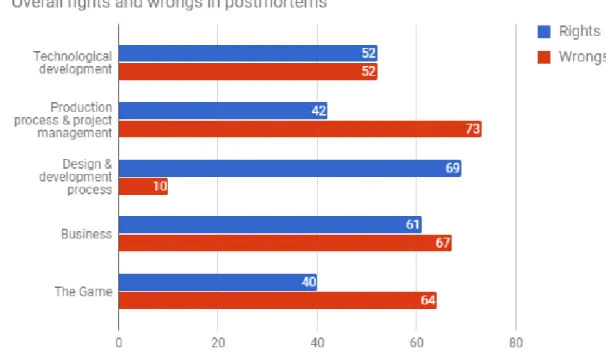
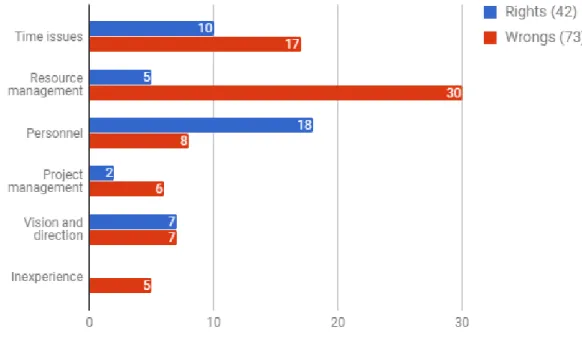
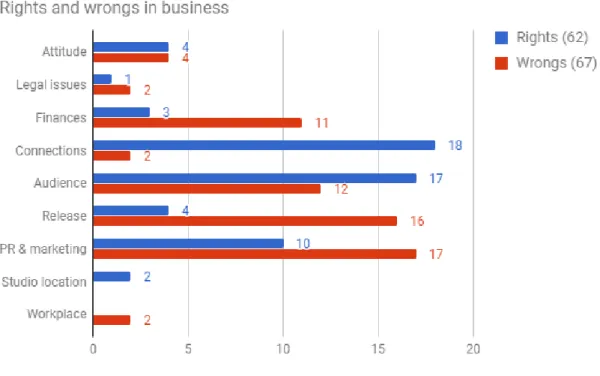
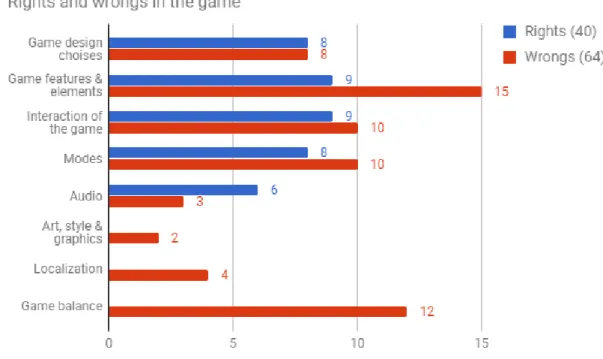
The five main categories, or themes, of the analysis are technological development, pro- ject management and production process, business, design & development process and the game. Technological development includes two subcategories of platform issues and technical issues. Production process and project management includes resource man- agement, vision and direction, personnel, time and scope related issues. Business theme includes things that are affiliated to the business side, such as PR & marketing, finan- cial, legal, release issues as well as connections, audience and attitude. Design and de- velopment process theme focuses on design choices, prototyping and development pro- cess; things that are associated directly with the product development rather than pro- duction process. The game theme includes problems and successes that are related to the finished product. It also includes game design issues that have affected the end product such as modes, game elements and interaction in game. Figure 1. shows the overall oc- currence of the rights and wrong in these five main categories.
Figure 1. Overall occurrence of the rights and wrongs in postmortems 5.1.1 Technological development
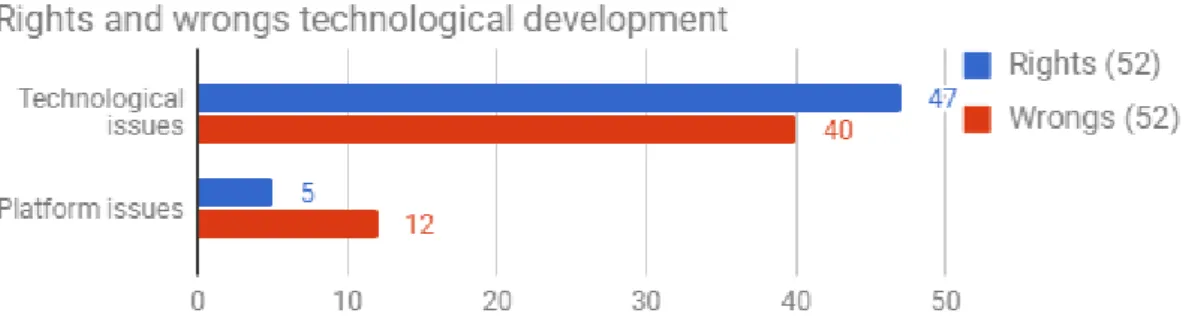
Technological development was a reason for success and failure in equal numbers. It had two main categories: technological issues and platform. The distribution between rights and wrongs in these categories is illustrated in figure 2. The rights and wrongs of technological issues shared subcategories of bugs, coding, testing & QA (quality assur- ance) and development tools. However, the categories of AI and adapting to smaller device were only found in rights, and underestimating technical challenges and lack of an updater were only found in wrongs. Technological issues were more frequently a reason for success in the project. Development tools and technological choices covered nearly half (48%) of the technological development rights. The reasons behind these rights were similar; using the right tools and a good engine makes the development eas- ier, whether it means using own tools, choosing the right engine or discarding old tools.
Testing and QA was the second most common reason for the rights (26%), mostly this meant playtesting, doing iteration and listening the feedback. Coding rights (17%) meant choosing a coding language that allowed rapid development, different platforms or libraries. Also, bugs were mentioned a few times as a project right, such as fixing the bugs immediately and having a good bug tracking systems.
The most common technological development wrong was testing and QA (33%). Most- ly, this was due to the fact that there was either too little testing done or it was done too late in the project. Also, testing with niche audience and ignoring testing feedback were mentioned as a reason for testing and QA failures. Coding issues (23%) and develop- ment tools and technological choices (23%) shared the place being the second most common reason for postmortem wrongs in technological issues. Coding issues meant, for example, compatibility problems, problems converting to target platform or coding database issues. Wrongs in the development tools and technological choices meant is- sues with chosen tools, such as making a too big game with flash or a bad choice of engine. Another issue with a few mentions was underestimating technical challenges (15%). Also, bugs and lack of an updater were mentioned as a project wrongs in tech- nological issues.
Platform issues were more a reason of failures in the postmortems, especially relating to meeting platform requirements (42%), such as meeting technical certification re- quirements. Platforms app size limit (33%) was solely listed in the wrongs. General platform wrongs (25%) meant problems with the game in another platform version such as pc or mobile. Platform rights were mostly due to Steam (40%),which was solely mentioned in the rights and general platform (40%) rights. Steam allowed to circumvent censorship and enabled easy updates, while general platform rights meant choosing a good platform or making a quick transition to another platform. Meeting platform re- quirements was also mentioned as a platform related right.
Figure 2. Technological development issues in rights and wrongs