The originality of this thesis has been checked using the Turnitin OriginalityCheck service in accordance with Tampere University's quality management system. While the contract is a mandatory part of the arrangement, the city can decide on the ownership and competitive aspect of providing the service.
Framing the Research Area
The basic idea of the quasi-market is to combine the benefits of public authorities to compensate for market failure with mechanisms that protect against government failure (ibid.). It was quickly discovered that the quasi-market and the general success of the reforms depended on the organizational state.
Previous studies in the area
Haatainen (2003) and Haatainen and Sihvonen (2006) focused on the situation of drivers in Helsinki and how the change in competitive bidding affected them, as did Harisalo et al. Barth's analysis of the legal situation from 2000 is worth mentioning in order to understand where the German way of organizing the LPT comes from.
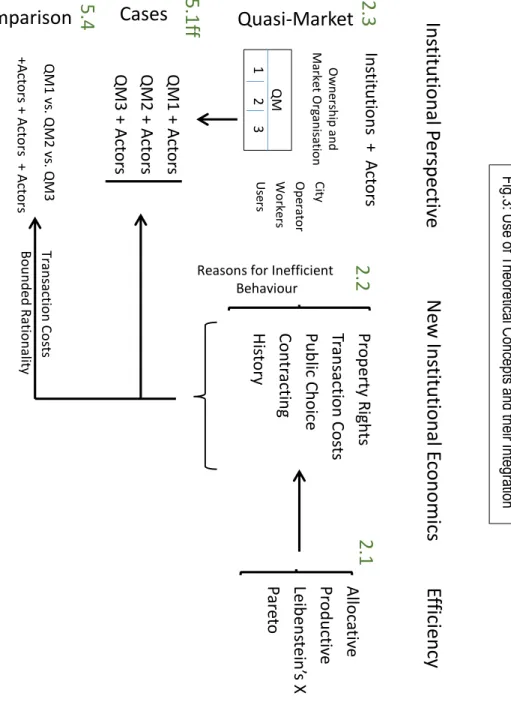
Forming the research question, structure for the study, and
To summarize this literature review, a number of publications on the regulatory framework dominate descriptive case studies on the administrative side both qualitatively and quantitatively without a theoretical connection. What is missing, however, is an approach where economic theory is combined with case studies.
Relevance of the study
The case studies were conducted on the premise of finding efficiency problems with the knowledge that, according to the Greenwald-Stiglitz theorem, no system can be a perfect fit for everyone at the same time (Greenwald and Stiglitz, 1986). At the same time, about 50% of all short-haul journeys were made by bus, accounting for 38 billion passenger kilometres.
Theoretical framework
Basic concepts of efficiency
It is important to ensure that the quality of a service is comparable to different approaches to services in the quasi-market. For this reason, the Pareto efficiency only needs to be taken into account when it is violated.
Tools of understanding institutions and actors: New institutional
While the NIE story provides insight into why choices are made, it does not analyze what is happening in terms of efficiency, other than what is already covered by transaction cost theory ("the costs of changing a system", see above ) and bounded rationality. (“fear of transaction costs”, see below). As described by Laffont and Martimort (2002), the reason lies in the fact that "the principal and the agent had (not) the same objective function" (ibid., p. 146).
The Quasi-market narrative
- Introduction
- The term quasi-market from an institutional perspective
- Elements of the quasi-market
- Decisions and alternatives in the quasi-market
- Summary: The characteristics and alternatives of quasi-
- Application of the efficiency concept in this study
However, this contract is an agreement between the provider and the buyer rather than the user. To assess potential inefficiencies, the organization of the service must be considered.

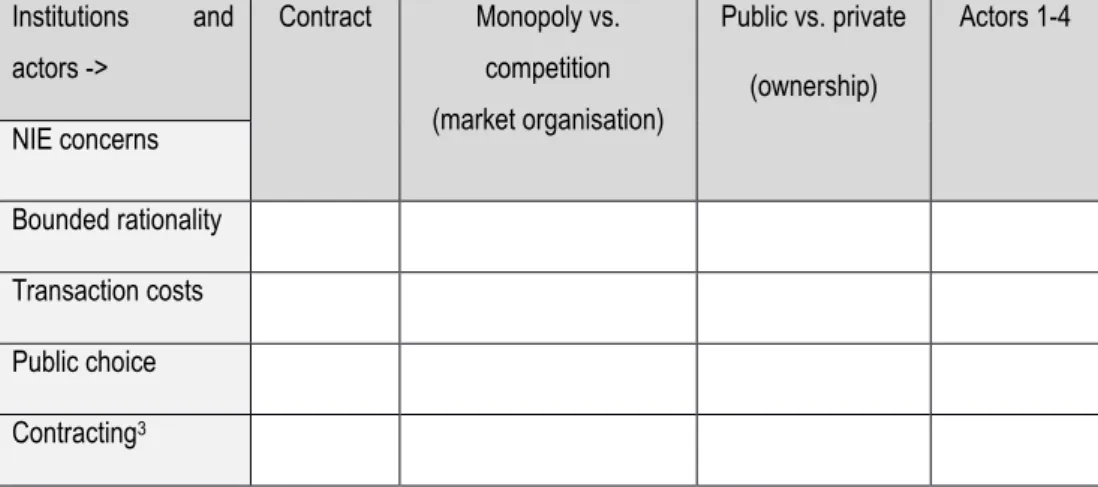
Methodological choice for a qualitative case study comparison
Intensive case study research focuses on understanding the case by providing a holistic and contextual approach. In two cases, the informant explicitly stated that the answers would be more candid without the device.
Regulatory framework and administrative background in the context of
European Regulations
Parameters describing the amount transferred to the company must be defined and published before the competition starts. The amount of money must be based on an analysis of costs that would appear in an average, well-run business. Parameters that define the amount of money transferred to the company must be defined and published in advance and published, which prohibits secret negotiations between a monopolist and grantor.
The amount of support should be based on an analysis of the costs that would be incurred in an average, well-run business. As a result, a direct contract without competition is still possible; however, it is difficult to "compare" indicators for subsidies. 5 states that services must generally be put out to tender if the services are provided by external entities.
9 further regulates that it complies with regulations to support infrastructure costs, research and development.
National level
- Germany
- Finland
In this area, the structure of payments to operators has not changed very much. In the federal state of Hesse, which is linked to the Frankfurt case, most of the competent authorities for local transport services have formed Lokale Nahverkehrsgesellschaften (local transport planning and contracting authorities) co-. The Public Traffic Act and Order was amended in 1994 to meet the requirements of EU legislation.
In addition, the new law contained the termination of the obligation to provide non-profit services. In the Helsinki and Turku regions, for example, transport services are in the hands of the public transport authority, with public and private actors having a contract with the authorities. In medium-sized cities, private operators have the initiative and full responsibility for mandated services (Rosenberg, 2005).
12 of the Act defines transport authorities, all of which now extend beyond the city limits.
Case study introduction
Pforzheim is a city in Baden-Württemberg in the south of Germany and houses about 120,000 inhabitants; 19.7 million passengers used the local bus system in the year 2013. The company has 250 employees and manages 76 buses that have provided 4.7 million vehicle kilometers, a total of 242 million passenger kilometers.20 The city plays the main role in the regional transport network Verkehrsverbund Pforzheim Enzkreis (VPE). A total of 6.1 million journeys were undertaken.22 Jyväskylän Liikenne, which is part of the Koiviston Auto Company, provided the local.
Frankfurt in central Germany has a population of 700,000 people within the city limits, with the urban agglomeration accounting for over 1.5 million people. In 2012, 63 local bus lines expanded to a network of 567,000 km; 278 vehicles were responsible for 16.7 million vehicle kilometers, where 53.3 million passengers traveled 196.8 million passenger km.24 Frankfurt plays the main role in the regional planning association Verkehrsverbund Rhein-Main (VRM). As a result, Helsinki Regional Transport (HRT) serves more than 1.1 million people in the entire urban area and is the only coordinating structure of its kind in Finland.
According to the annual report for 2012, 1,345 buses carried 176.7 million passengers in the metropolitan region.27 In 1993, Helsinki decided to open the bus service to competition, with public and private providers winning.

Case studies
Public monopolies
- Wuppertal
- Tampere
- Comparison of the public monopolies Wuppertal-Tampere
There will be high demand for the profitable parts, whereas no one usually wants to take the other lines in the first place – the typical whipped cream dilemma. Also, "the proclaimed crystal-clear accountability may only exist on paper, but not in reality. While the owners (i.e. the politicians) have the final say, the management can influence the owner and express to them what is or is not possible when there is a relationship of trust apart from the official negotiations and votes.
Overall satisfaction was 2.3 in 2007 and rose slightly the following year to 2.2 on a scale of one to six. The relationship between workers and management is also increasingly difficult, as workers have the feeling that they are being treated as "inherited problems". Driver representatives are under the impression that the city is cutting costs and not considering the effects of those cuts; he doesn't care how he saves (FRA5). In essence, public operators have higher unit costs and win competitions only with artificially low prices, which then "spoil" the market.
Further research in this direction can help to refine the property aspect to smaller components and to understand the importance of individual arrangements for the whole organizational system and is therefore encouraged.
Private monopolies
- Pforzheim
- Jyväskylä
- Comparison of the private monopolies
Competitive Tendering
- Frankfurt
- Helsinki
- Comparison of competitive tendering
The question "when do they represent which part of the company?" it seems to be difficult for them. In order to give incentives to the operators, a system of bonuses has been established in the contracts. Another example of this is the frequent failure of the electronic information system on buses.
Also because of this, Veolia had to subcontract half of the service to the public operator. Veolia's development is a reflection of the situation in the Helsinki region during the past two decades. One rather unsatisfactory point in the quality assessment from the perspective of HSL was the condition of the vehicles.
The relationship between the organizing body and the operator appears to be unproblematic in Helsinki, independent of the operator.
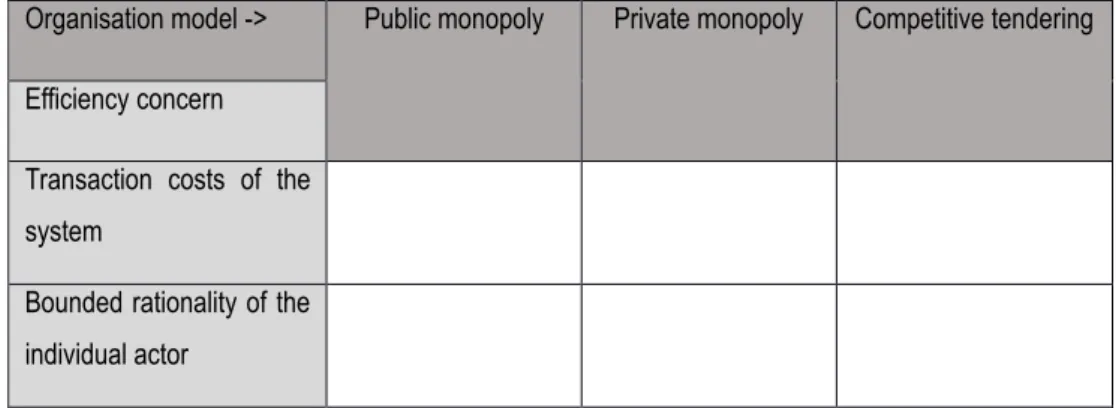
Institutional comparison of the three organisational regimes
- Bounded rationality of actors
- Transaction costs of the system
- Summary: Main aspects of the case study comparison
This trend shows that the city values the added value of the public operator as higher than the market disruption caused by the operator and the exploitation of the true first best offer. The city administration believes that institutionalized incentives would certainly contribute to greater efficiency of the system. However, the bonus depends on many factors beyond the operator's control, especially the general financial situation in the city.
Incentives are also used to establish standards, which will benefit the customer throughout the city, regardless of the operator. In the competitive tender group, the amount of transaction costs is likely to be the highest. However, the lower unit costs for the city were reinvested in the network and so the customers won.
Finally, there is a question about possible collusion between the buyer and the supplier in the public procurement scenario.
Conclusion: Discussion and outlook
On the other hand, all of them are negatively impacted by the increased redemption of the use of public services. In general, an important result of the quasi-market reforms in the local public transport sector is the violation of Pareto efficiency for the people who work in the service sector. It is important to note that this study focused on inefficiency (i.e. negative outcomes of the quasi-market reforms) and did not generally assess or disqualify this mode of public service delivery.
However, if one wants to assess the value of the quasi-market to improve efficiency, this positive side must also be included. This study also does not suggest that any of the three organizational forms studied are superior to others. In the competitive version of the quasi-market, the public authority takes responsibility for planning the network and coordinating it; free competition naturally leads to coordination problems with negatives.
This study used Finland and Germany as case countries and thus falls within the regulatory framework of the EU.