The frequency of informal social control reflects the extent of drinking-related problems in society. The research culminates in the description of the social control of drinking in Finland in the light of international comparisons.
Historical background
It was a common practice in the Sweden of the 1920s and 1930s for married women to receive special forms. Social development and alcohol policy issues have been strongly linked in the Nordic countries.
Formal and informal control of drinking
Changes in Finnish alcohol policy in 2004 have led to lower taxes and prices on alcohol. The transition of alcohol policy measures from state to local level has emphasized the importance of informal and internal control of drinking.
The controllers and the controlled
Social pressure studies have reported that wives' control over their husbands' drinking is an integrated part of family life (Holmila Holmila, Mustonen & Rannik, 1990; Room, Greenfield & Weisner, 1991). Women were more likely than men to report trying to control their partner's drinking, while the target of men's control attempts was usually a male friend.
Target reactions
Theoretical perspectives on social control of drinking
- Social control
- Norms
- Gender roles
- Individualistic vs. collectivistic cultures
In alcohol research, the concept of social control has been used mainly in the context of alcohol policy (Gusfield. Norms are also related to the social control of drinking and definitions of drinking-related problems and the means of dealing with them.
Validity of the research
General aim
Specific objectives
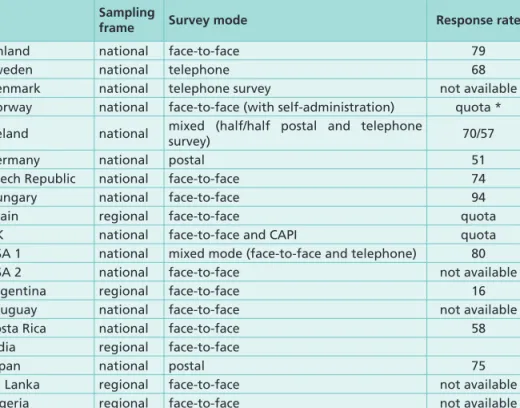
Data and sampling
Norway was also included in Article III, and the United States in Article IV. Norwegian face-to-face national quota (with self-governance) * Icelandic national mixed (half/half postal and telephone survey) 0/.
Measurements
- Measurement of understanding of survey questions
- Measurement of informal control of drinking
- Measurement of drinking and drinking-related problems
- Measurement of socioeconomic differences
The questions about the frequency of drinking were: "Over the past 12 months, how often have you drunk beer/cider/wine/spirits?" The questions about the amount were: "When you drink beer/cider/wine/spirits, how many bottles approx. / glasses etc. The questions about frequency of drinking to intoxication were: 'During the last 12 months, how often have you had at least six drinks at a time?'.
Analyses
In the GENACIS survey there was also a question about the number of people living in the same household as the respondent. The average number of persons in the same household was calculated for each country.
Defining informal control of drinking in survey research
More informal and unstructured interviews, where the interaction between the respondent and the interviewer is likely to have an effect on the results, may prove better than structured survey interviews in collecting data on threatening or sensitive topics. However, with unstructured qualitative interviews, there is a danger that the researcher will cause respondents to think about problems they would otherwise not think about.
The relationship of drinking and control
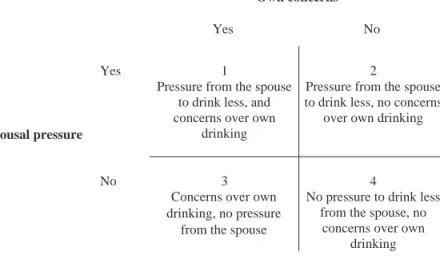
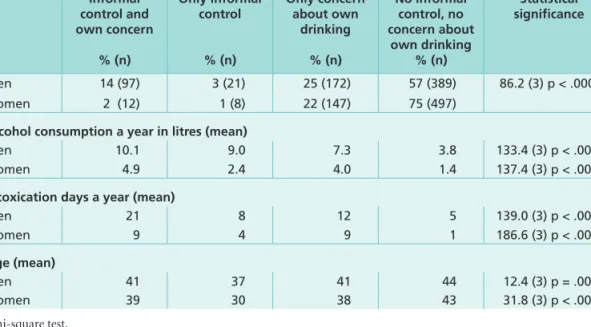
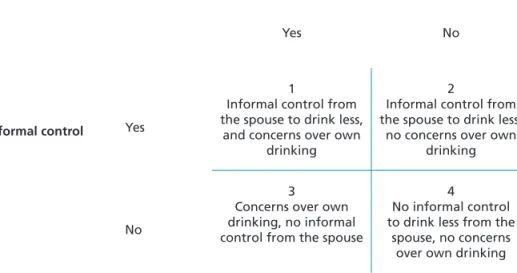
It appears that drinking habits are related to experiences of drinking control from the spouse and to concerns about own drinking in this group. Typology of relationships between concerns about one's own drinking and the external control from the spouse to drink less.
Cultural variation in informal control of drinking
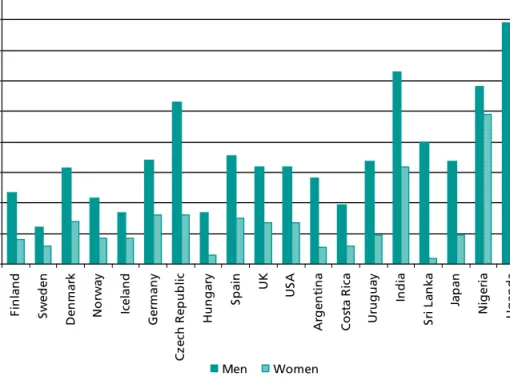
The experience of being controlled by alcohol consumption was related to women's country-specific abstinence rate, but not to women's level of drinking. Average drinking volume in liters of alcohol per year in the study sites for men and women. Means of drinking-related harm measured by Audit-5 across study sites for men and women.
Correlations between the level of drinking (Volume) and Audit-5 scores with different sources of drinking control in the Finnish data. The frequency of informal control of drinking was also related to the socio-economic conditions of the country. 2003) 'Somebody's gonna get their head kicked in tonight'. 2001) Social context and "natural recovery": The role of social capital in the resolution of drug-related problems.
Social context and "natural recovery": The role of social capital in solving drug-related problems. Substance use and misuse. Social context and "natural recovery": the role of social capital in solving drug-related problems. Therefore, although some widely used alcoholism screeners such as the CAGE (Ewing, 1998) include defining items with a negative valence such as: "Have people ever annoyed you by criticizing your drinking?" evidence suggests that concerted social pressure is not necessarily perceived negatively, at least by those who are forced to seek help.
Help-seeking was assessed by a question "Have you ever considered seeking help for your own drinking or alcohol-related problems?" The response options were.
Cultural variation in drinking-related harms and control
Main findings
The first aim was to study how survey research participants define the concept of drinking control. The second aim was to analyze how control over drinking from the spouse is related to one's own concern about drinking and how these two occur according to the level of drinking and harm associated with it. The fourth aim was to discuss further how drinking control is related to levels of drinking and harm related to it, and also to ideas about help seeking on a cultural level.
In Finland there is on average more formal drinking control than in other Western European countries. In Finland the level of drinking and especially the harms associated with it are quite high compared to other Western European countries (Knibbe et al., 2006). However, the frequency of informal drinking control is lower in Finland than in most other study countries, even though it is in the middle of European countries in this respect.
Validity of the study
Understanding of survey questions
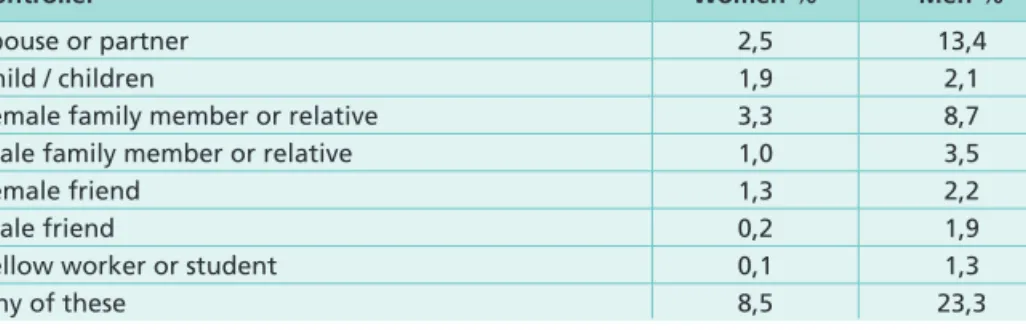
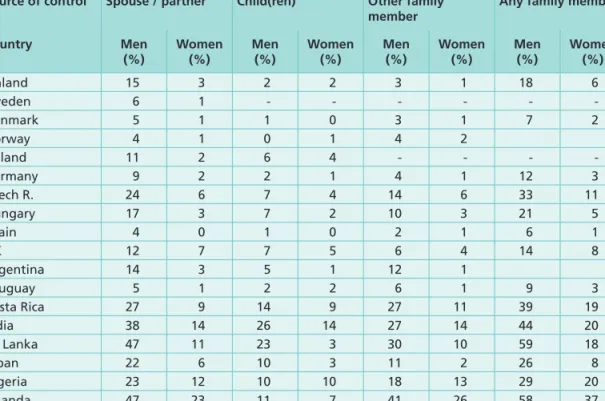
In all countries studied, informal pressure most often comes from the spouse or partner, but also from other family members. The relationship between both degree of drinking and degree of harm (AUDIT-5 score) was strongest when controlled by the partner, implying that the most likely person to try to control drinking is the partner. The harm done to the drinker provokes more control attempts than just the amount of drinking.
Ideas to seek help are rare in European countries, as well as in South American countries and Japan, which are somewhat more like European countries. However, it should be noted that seeking help can have very different meanings in different societies. In terms of the frequency of social control of drinking, the profile of European countries is very different from that of developing countries.
Other methodological issues
Attitudes toward control of drinking
However, according to the articles of this study, informal control of drinking is mainly aimed at this specific group. The negative attitudes of heavy drinking men may be due to their experience of being controlled, and this experience is especially negative because the purpose of control is to limit drinkers' freedom to decide about their own alcohol consumption. Those who have a more positive attitude toward control have not been objects of direct control over drinking and thus have no personal experience with it.
They do not drink as much as the control subjects and believe that others should behave as they do, i.e. not drink heavily. They may have their own past experiences with the negative consequences of drinking, or their opinion may have been formed as a result of the surrounding society's attitude towards drinking.
Consequences of drinking control to the controller
It is good if it leads to fewer drink-related problems that entail costs for society. The seriousness of problems can be real, but it can also be in people's heads. The frequency of informal drinking control in a society reflects the frequency of problems surrounding controlling individuals.
Awareness of the problems causes stress or strain in persons living in conditions where they must act as controllers of others' drinking. It can be related to health - whether mental or physical - or it can be reflected in work and other activities. This is one reason why understanding the mechanisms and reasons for controlling drinking is important.
Challenges for future research
6 Discussion . Costa, 1986; Scazufca & Kuipers, 1998) Thus, in the context of controlling family members' drinking, it would be more effective to use supportive means that are expressed in positive ways to achieve some results and also to cope with the situation. On the other hand, it is bad when it places too great a burden on those who act as controllers and leads to problems that again need to be remedied through the help of society. Before taking action to control another person's drinking, one must have the idea that it is somehow problematic.
The situation of the woman is particularly interesting, both in the role of the controller and in the role of the drinker. Children can be important in the recovery process of a heavy drinking parent. On the other hand, it is extremely difficult for children to take on the responsibility of caring for their alcoholic parents.
Conclusions
Most of the respondents were in the group where no control efforts from the spouse or concern about his or her own drinking were experienced. Gender appeared to be independently related to experiences of spousal pressure to drink less. We expect to find clear gender differences in the prevalence of informal control in all the countries studied, such that women report less informal pressure than men.
In the GENACIS questionnaire, a question asked about the experience of pressure to drink less from family members (spouse/partner, child(ren), other family members). These indicators were the percentage of drinkers in the country and the average annual amount of drinking per person). Correlation analysis shows that the more abstinents in a country, the greater the informal pressure to drink less (Table 4).
The higher the average consumption among male drinkers in the country, the more often family members try to pressure the drinkers to drink less. Correlations between proportion of abstainers and the average volume of drinking in the country and drinking control of family standardized by social indicators one at a time. The more abstainers there are in the country, the more informal pressure there is to drink less.
Considering seeking help also seems to be the most prevalent for both men and women in the African countries (Uganda and Nigeria) and is at an intermediate level for men in other low- and middle-income countries (India, Sri Lanka and Costa Rica).