Academic Thesis Submitted with permission from the board of the Department of Information Science. Järvelin contributed to the revisions of the papers and supervised all phases of the study.
Background and scope
Borlund (2000) and Kelly (2004) and their subsequent works have played an important role in the field of information retrieval. Usually, the concept of information-intensive work does not exclude routine tasks (cf. knowledge work).
Research questions and objective
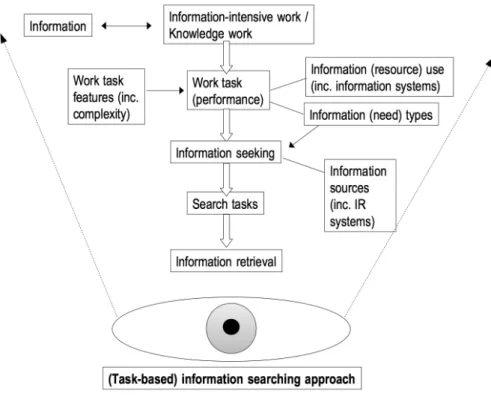
The structure of the thesis is as follows: In Chapter 2, I discuss the various terms used to study phenomena related to information seeking. I also go deeper into the thesis' most important concepts and research approaches to task-based information retrieval.
How to name it?
Information seeking covers human actions to find information using all types of information sources; and is a subset of information behavior (Ingwersen & Järvelin, 2005; Wilson, 1999). However, IIR is more likely to lose the audience and focus of information seeking that is constantly present.
Work tasks and information searching
The focus on the task is explicit and in this research the tasks are genuine work tasks. have always described their tasks, i.e. the specific processes they perform. The types of information (needs) used in this thesis are further discussed and compared to previous classifications in the Results section.
Information searching as research object
For example, Pharo and Järvelin (2004) studied information seeking on the Web to develop and test a new analysis method. The study is designed to support understanding of task-based information seeking in real-life contexts.
Participants
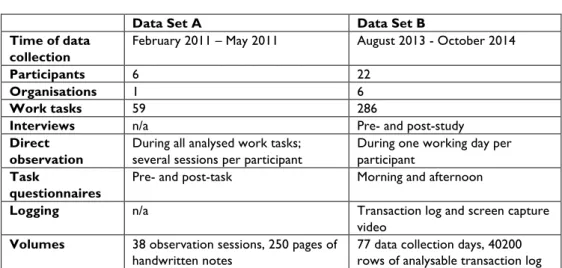
The quantitative aspect of data analysis was considered crucial to the aims of the study, so the more participants, the better. It is clear that organizations differ in several ways: they are of different sizes, have different operational goals, work roles and thus work tasks, etc.
Data collection methods
Direct observation
Each participant was interviewed before the data collection phase, and those who had participated for more than one day were also interviewed afterwards. A few weeks after the data collection phase had ended, I met with the participants for the exit interview.
Questionnaires
There were nine of these interviews, together we conducted nine interviews and the rest I did alone, as four participants only participated in my graduation project. As mentioned above, I only met those who had participated for more than a day, because if the data collection phase lasted only one day, it involved direct observation and so no further interviewing was necessary.
Transaction log data and screen capture video
Transaction logs were also modifiable: participants could delete events or rename them. The screen recording video was saved as a single unstructured video file, making its editing more difficult and therefore not performed by the participants.
Analysis methods
The participants were given detailed instructions on how to use the software and were encouraged to call or email at any time for further instructions if needed. Although the participants had the option to pause the recording, sometimes they wanted the videos to be cut or blurred afterwards, and it was done according to what they wanted.
Introduction to the original research papers
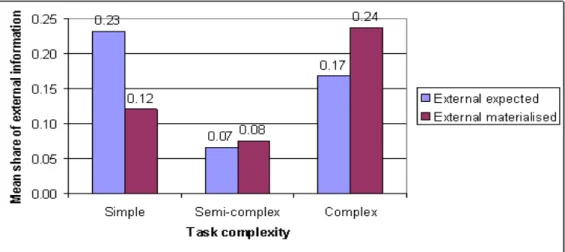
III The actual use of organizational information systems is decreasing, and the use of Web and other sources is increasing with increasing task complexity. Resource use in support and intellectual tasks is more prone to the effects of task complexity than in other tasks.
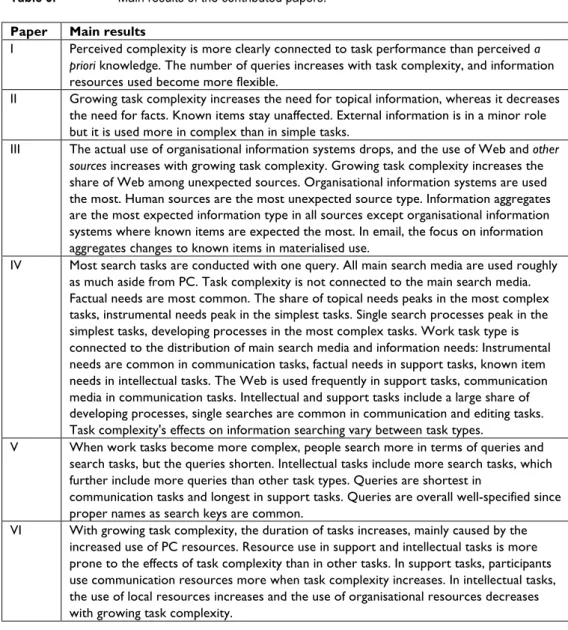
Overview of work task features and performance (RQ 1)
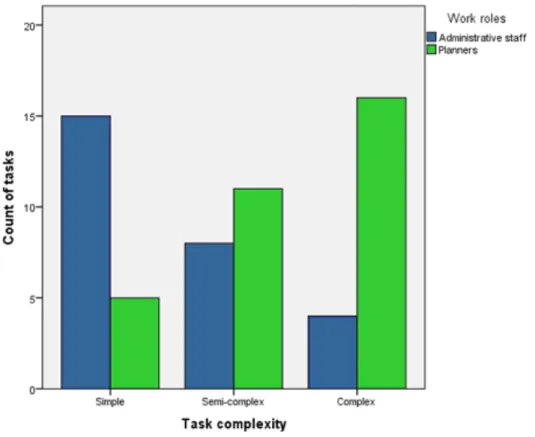
The work tasks in the data were rather simple than complex; truly complex tasks were rare. Intellectual work assignments show a greater number of research tasks and unique research media than other types of assignments.
Information needs in work tasks (RQ 2)
Data set A showed that the proportions of abandoned initial information needs were not related to the complexity of work tasks. Nevertheless, even in Data Set A, the information needs for inquiries (Paper I; my own assessment of needs) were predominantly factual.
Information resource use in work tasks (RQ 3)
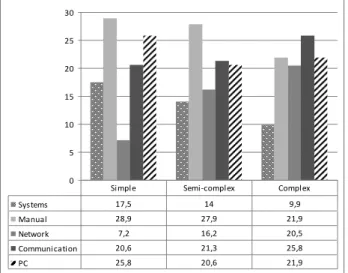
In communication tasks, there is no correlation between work task complexity and information need complexity. In data set A, participants estimated the availability and adequacy of the information found, which were generally good, but both decreased with increasing work task complexity. In terms of time spent using a resource (Paper VI), PC has the largest absolute dwell time on average across all categories of work task complexity.
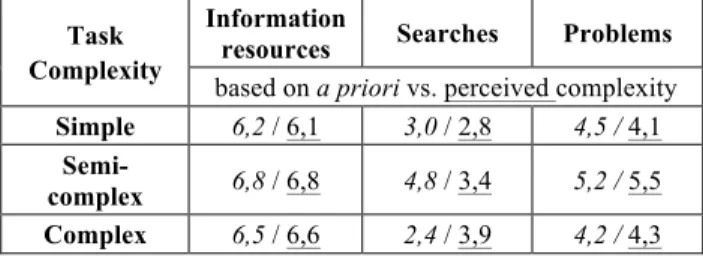
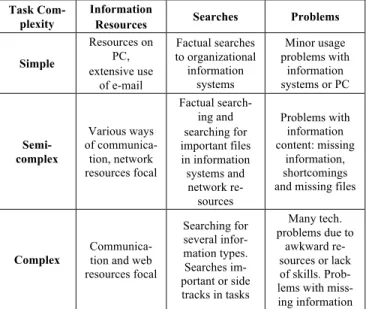
The number of PC resources used does not change much with the complexity of the work task (Paper I). Both datasets suggest that organizational information systems are used less when the complexity of the work task increases. The relative usage of the major search media does not change remarkably with the complexity of the work task.
Major search media changes are small between job complexity categories (Paper IV). Among the types of work tasks, the web is the most popular main search medium, except for communication tasks, where communication tools are more popular. Within task types, the Web is most susceptible to changes in use as a primary search medium as the complexity of work tasks increases: its use decreases in other task types, but increases in intellectual tasks.
Queries in work tasks (RQ 4)
The goal is not to succeed with the search task, but with the work task. Forming an inquiry is typically only one option to proceed in the work task; and the selection of this option may indicate that it is considered to be the best option available. However, the search itself was rarely the main interest in a work task or a search task.
The latter means that even search tasks mainly served purposes other than actual information gathering; the idea was to get on with the work task. Both data sets showed a small increase in the number of queries as the perceived complexity of the work task increases. In intellectual tasks, there are on average more queries per search task than in other work task types.
However, there is a positive but not statistically significant correlation between the number of queries in search tasks and task complexity in support tasks. I did not analyze perceived search task difficulty, but it is likely to be influenced by similar factors as perceived job task complexity. Furthermore, increasing task complexity tends to increase the number of query types in search tasks.
Information searching in work task context
First, the discussion section briefly addresses the most important and interesting empirical findings and observations made about real-life information seeking as an object of study. This is promising: perhaps the types of tasks applied here are more universally applicable and more useful in future research, as they have been found to affect information seeking. Defining objective complexity in terms of complex performance (which can be calculated in advance in studies using set tasks) can lead to circular reasoning where findings always show that research is complex if the larger task is complex.
Searching for information within a single work task or search task may be simple, but the variation between tasks is large, making search a complex phenomenon in practice. While the web is often interesting from a search engine and IR point of view, and despite its apparent popularity, it is far from the only search medium for seeking job-related information. Current data also queried organizational information systems, local directory and software, and communications resources.
This may indicate that findings from server-side log analyzes on web search may be of limited applicability considering task-based information search in knowledge work. Search tasks in the studied environments were spontaneously formed to directly solve a problem or otherwise continue with the work task. In the work tasks studied here, there were no assignments to which the participants could return when assessing the relevance of found information objects.
Studying information searching in authentic environments
Limitations
Despite these limitations, I have no reason to believe that the studied work tasks were somehow “exceptional”. On the contrary, based on discussions with the participants and observations in the field, tasks seemed quite representative. The participants sometimes reported that it felt strange to be an object of observation, but they also reported that they functioned quite normally, perhaps a little more effectively under the pressure of being observed.
In any case, they were observed in their completely normal work environment and had to fulfill their duties.
Implications for future research
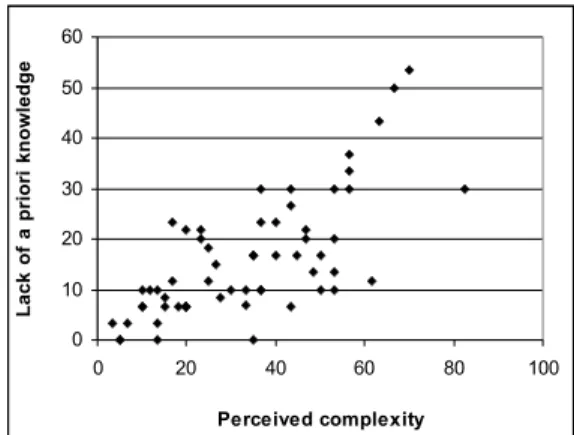
The perceived task complexity is based on the information in the task initiation and task termination forms. Compl.begin" is the subjective estimate of task complexity before task completion, and "compl.end" is the same after task completion. The weighted values were exactly equal in 68% of cases and exactly or nearly equal in 97% the difference is +/- one point from the original weights).
Our types of information (facts, known items, and information aggregates) are based on the extent or techniques of information, while Byström's (1999) types (task, domain, and task-solving information) are based more on the content of the information object. . At the beginning / In the middle / At the end How much of the task performance was involved in shading. Classes are facts (eg, a noun), known items (eg, the minutes of yesterday's meeting), and aggregates of information (larger topics, eg, the state of municipal health care).
In other words, the use of external literature increases in the same way as the use of the Web in our data. Design/methodology/approach – Participants were 22 professionals working in municipal administration, scientific research and university education, and commercial companies. Findings – The analysis included the effects of WT type and complexity on the number of STs, questions, search keys, and question types.
Originality/value – The study is an attempt to bring together traditional IR studies and realist research institutions. The purpose of the exit interview was to clarify possible unclear parts in the data to the researcher. Moreover, 45 % of the longest STs (with more than three queries) occur in the most complex WTs (IV).
Common nouns as match types in STs became more common along this continuum, which may imply that information needs became more vague (see the section above).