Scientific research into the therapeutic potential of psychedelics has re-emerged in the 2000s with promising results. The origin of patient autonomy is in the Declaration of Helsinki, from which modern clinical guidelines for research ethics have been derived. This can happen by environmental objects changing their properties in the subject's mind or by the subject's mental constructions taking a visual form.
The most common forms of visual hallucinations are various repeating geometric patterns (tunnels, spirals, honeycombs and spider webs) in the field of vision, sometimes.
Research of psychedelics with human subjects
- Therapeutic research
- Neurobiology
- non-therapeutic effects and other findings
- Safety and risks
Several studies have been conducted on patients with life-threatening cancer who suffer from symptoms of anxiety and/or depression. The results were generally very promising, with large effect sizes for treatment with psilocybin or LSD (Ross et al, 2016; . Gasser et al, 2014; Grob et al, 2011).
Patient autonomy
History
Declaration of Helsinki
In any case, almost everyone agrees that respect for autonomy is important in biomedical research, and patient autonomy is codified in law and clinical guidelines for research (Beauchamp & Childress, 2001; . Gillon, 2003; Varelius, 2006). Most bioethical theories of autonomy agree that at least two conditions, freedom and liberty, are essential to autonomy. What exactly these ideals represent and whether they are sufficient for an individual to be autonomous is debated.
In this definition, understanding and absence of controlling influences are seen as conditions that actualize to some extent on a continuum. The degree of autonomy that is considered sufficient (or “substantial”) depends on the situation and the specific action in question and the potential, ethically relevant outcomes of the chosen action (Beauchamp & Childress, 2001). The first meaning describes the rule-based or legal requirements for obtaining consent from an individual, for example, through a written informed consent form prior to a medical procedure.
The latter meaning describes consent given unambiguously by an individual acting autonomously according to an ethical standard. An influential model by Beauchamp and Childress provides 3 necessary elements required for informed consent: (1) Prerequisites, (2) elements of information, and (3) elements of consent. This model together with DH has influenced modern clinical practice guidelines, such as ICH (The International Council for Harmonization of Technical Requirements for Pharmaceuticals for Human Use) Good Clinical Practice, which present more precise and practical requirements for research .
Special considerations in research with psychedelics
In order for the informed consent to be informed, all reasonably foreseeable risks and inconveniences must be disclosed to the patient/subject. However, given how intense the experiences under the effects of psychedelics are, it is important that these effects are discussed very thoroughly with the patient. Published information should undoubtedly include detailed descriptions of psychedelic states (hallucinations, synesthesia, etc.), challenging emotions that may arise (paranoia, fear, etc.) and current knowledge about the long-term effects of psychedelic drugs (changes in personality, worldview, etc. ).
Appropriate medical care must be provided for participants' existing medical conditions, as well as any adverse effects associated with the study. Participants in the psychedelic therapeutic trials often suffer from psychological/psychiatric conditions and often use medication(s) that need to be paused during the trial. Therefore, the continuation of appropriate medical treatment and therapeutic support before and after the drug intervention should be ensured.
In particular, while the participant may be fully competent to give or refuse consent, withdrawal may be extremely difficult under the effects of psychedelics. The design of the intervention should consider these challenges and, for example, design multiple alternative simple ways for participants to express their unwillingness to continue the experiment. In addition, medications that relieve psychological distress and reverse the effects of psychedelics (benzodiazepines, antipsychotics, etc.) should be available and the participant should be informed in advance of their availability.
Practices in current therapeutic studies with psychedelics
Background
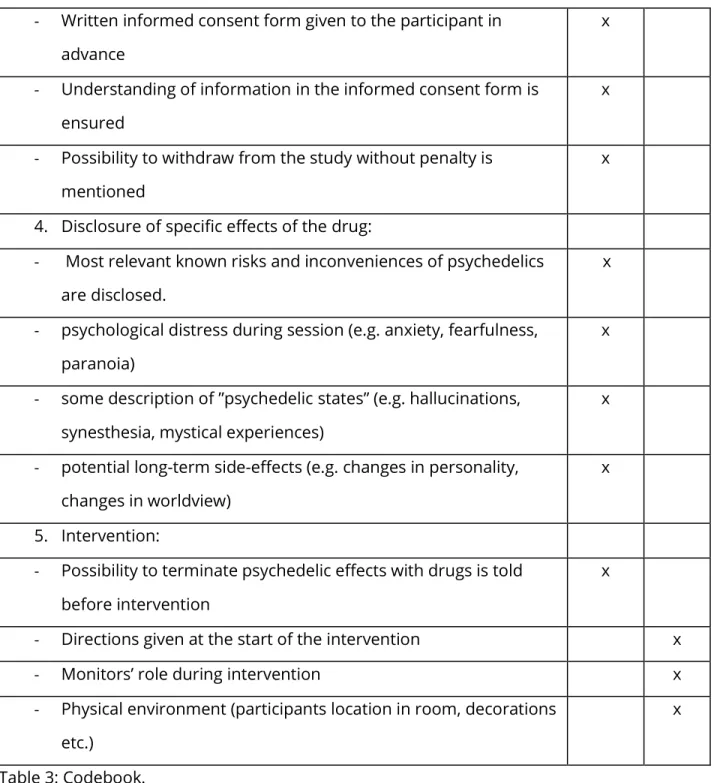
At least 8 hours of meetings with the therapists/monitors prior to the medication session is recommended to establish rapport and discuss meaningful aspects of the volunteer's life. Table Y presents the information found in guidelines by Johnson et al (2008) that correspond to elements of informed consent as defined by Beauchamp and Childress in Principles of Biomedical Ethics (2001). However, even in modern clinical trials, the inclusion of specially formulated competence tests is rare, and the assurance of the participant's competence is usually addressed in (often several) indirect ways.
One of the main purposes of preparatory meetings is to ensure a proper understanding of the psychedelic intervention. Johnson et al (2008) recommend a thorough review of the range of unique effects that hallucinogens can produce. Additionally, the recommendation includes informing the participant of the small risk of long-term adverse effects.
This addresses parts of the very central ethical topic of informed consent discussed in the previous chapter. However, the Johnson et al (2008) guidelines do not include a recommendation to disclose the possibility of changes in personality and worldview, which are likely to be relevant information. The Johnson et al (2008) guidelines also address the issue of increased suggestibility caused by psychedelics.

Systematic review
Aims
Materials and methods
To be included in the review, the purpose of the study had to be to evaluate the effectiveness of psychedelic-assisted therapy for the mental illness(es) in question. A codebook is a form developed to assist in the systematic collection of information from the research studies. The first version of the codebook was created and used to collect information from 3 randomly selected studies to evaluate the completeness of the codebook.
After discussion in the group, some additional modifications were made after which the codebook was found complete by all group members and considered finalized. If the article contained a link to another website for additional information regarding the study, such as a study registration website, the content of the linked website was also included in the data collection. The sections of each study relating to the research questions (including summary, methods, discussion and supplementary material) were
If the published research article did not contain a link to the informed consent form used in the study, access to the informed consent form was requested from a member of the group via email. The codebook item “number of counseling/therapy sessions” recorded the exact amount of time and/or number of sessions. Qualitative data on research questions were recorded in the codebook as direct quotes from the studies before further analysis was performed.
Results
Of the 7 remaining studies, 2 studies (29%) contained a clear treatment plan for existing psychiatric conditions. 5 of the 7 remaining studies did not present a clear treatment plan for existing psychiatric conditions. The remaining studies required participants to stop or reduce their psychiatric medication before the study.
3 of the 10 (30%) studies reported that the study protocol included relevant therapy training for the staff members. The availability of the written informed consent form was searched from the published research article and the trial registration page. 40% of the studies clearly stated that understanding of the content of the informed consent form was ensured by the participants.
In 5 of 10 (50%) studies, it was clearly stated that the participant had been informed of the possibility to withdraw from the study at any time without penalty. One of these six studies reported that the patient was informed during the session about the possibility of mental health problems. In all studies describing the setting of a drug session, the comfort of the session room was considered.
Discussion
In all studies, the participant lied on a sofa, couch, mattress, or a bed, and some studies specifically mention the possibility of switching between different body positions during the session. 4 studies (40%) mentioned brief discussions or “checking in” with the participant to ask how they are doing. In addition to the setting of the psychedelic session, availability and information about "rescue drugs" (e.g., benzodiazepines) that end or alleviate the psychedelic effects during the intervention were of particular interest in terms of patient autonomy.
Possibility of ending the psychedelic effect with drugs was informed to the participant in 3 of 10 studies (30%). Most (90%) studies provided an exact number of therapy/counseling sessions, and most (80%) studies included a minimum of 3 sessions before the drug treatment session. The studies for which the informed consent form was not available contained almost no information about the disclosure of the unique effects of the psychedelic drug.
An important limitation in this review is the fact that many studies did not include information on several research questions analyzed using the codebook. In all studies, multiple meetings were arranged with the participant and the content of the information discussed at these meetings could not be fully included in the published articles. As discussed in Section 4.2, the Johns Hopkins guidelines do address most of the concerns surrounding the issue of informed consent.
Conclusion
From the cover: Neural correlates of the psychedelic state as determined by fMRI studies with psilocybin. Psilocybin-induced mystical-type experiences mediate the attribution of personal meaning and spiritual meaning 14 months later. The Abuse Potential of Medical Psilocybin According to the 8 Factors of the Controlled Substances Act.
Factor analysis of the mystical experience questionnaire: An investigation of experiences with the hallucinogen psilocybin. Peak experiences and the afterglow phenomenon: when and how therapeutic effects of hallucinogens depend on psychedelic experiences. Safety and efficacy of lysergic acid diethylamide-assisted psychotherapy for anxiety associated with life-threatening illnesses.
Rapid and sustained symptom reduction after psilocybin treatment for anxiety and depression in patients with life-threatening cancer: a randomized. Acute, subacute and long-term subjective effects of psilocybin in healthy humans: a pooled analysis of experimental studies: Journal of Psychopharmacology 2010.