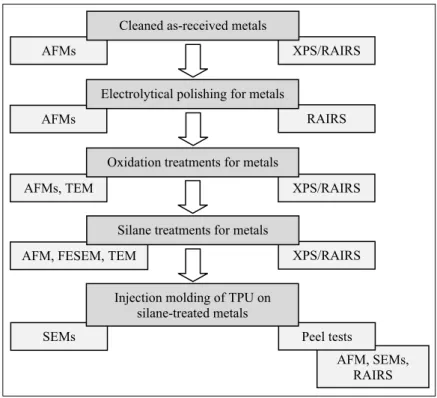
The fabrication of the metal-plastic hybrids consisted of three steps: (1) surface modification of metal, (2) silane treatment of modified metal, and (3) injection molding of plastic on silane-treated metal. The completed hybrid parts were characterized by SEM and the adhesion strengths of the hybrids were measured by peel tests. AFM, SEM and RAIRS were used to find out the failure types of the hybrids in peeling.
So the metal surface before silane treatment had a significant effect on the silane layer formation and thus the adhesion strength values of the related hybrids; similar strength values were obtained with similar pretreatments of the metal surfaces regardless of the metal used. Jyrki Vuorinen from the Laboratory of Plastics and Elastomer Technology in DMS for their valuable collaboration and fruitful discussions during the investigations of the hybrid structures. In Mari Honkanen, Minnamari Vippola and Toivo Lepistö, Characterization of stainless steel surfaces – Modified in air at 350C, Surface Engineering.
III Mari Honkanen, Maija Hoikkanen, Minnamari Vippola, Jyrki Vuorinen, Toivo Lepistö, Petri Jussila, Harri Ali-Löytty, Markus Lampimäki ja Mika Valden, Silaanikerrosten karakterisointi modifioiduilla ruostumattomilla teräspinnoilla ja niihin liittyvät ruostumattoman teräs-muovipinnan hybridit, Appli tiede.
INTRODUCTION
METAL-PLASTIC HYBRIDS
- Manufacturing of metal-plastic hybrids
- Joining of metal and plastic with silane
- Silane structure
- Silane bonding to metallic substrate
- Silane treatment
- Characterization of silane layer on metallic substrate
- Metal surface pre-treatment
- Oxide structure on metal surface
- Oxide structure on stainless steel
- Oxide structure on copper
When a substrate is immersed in the hydrolyzed silane solution, silanol groups react with hydroxyl groups (MeOH) on the metal surface shown on the left side of the figure. Organofunctional groups at the ends of the silane chains can form bonds with organic materials. An example of the reaction between a silane-treated (APS) fiber and a polyvinyl chloride (PVC) matrix is shown in Fig.
Contaminants on the metal surface can block the reaction sites of the surface's active SiOH group [42]. The oxidation of metals depends on the physical, chemical and structural characteristics of the metal surface, as well as oxides formed and oxidation conditions. Schematic representation of the initial oxidation phase of metal surfaces and the growth of the three-dimensional oxide layer are presented in Fig.
The presence of oxygen is essential for the formation of the protective oxide layer on the stainless steel surface.
![Figure 2. Manufacturing process of metal-plastic hybrid in automotive industry, (a) open mold, (b) perforated metal insert in mold, and (c) finished injection-molded metal-plastic hybrid, modified from [1]](https://thumb-eu.123doks.com/thumbv2/9pdfco/1890700.266866/14.748.110.640.486.657/figure-manufacturing-automotive-industry-perforated-finished-injection-modified.webp)
AIM OF PRESENT STUDY
The effect of alloying elements on the oxidation of copper is complicated and still not fully understood. Based on their studies, in the case of high-purity copper, a thin and uniform CuO layer formed on the Cu2O layer, which was impermeable to oxygen. However, alloying elements can cause porous and non-protective CuO layers and increase the oxidation rate.
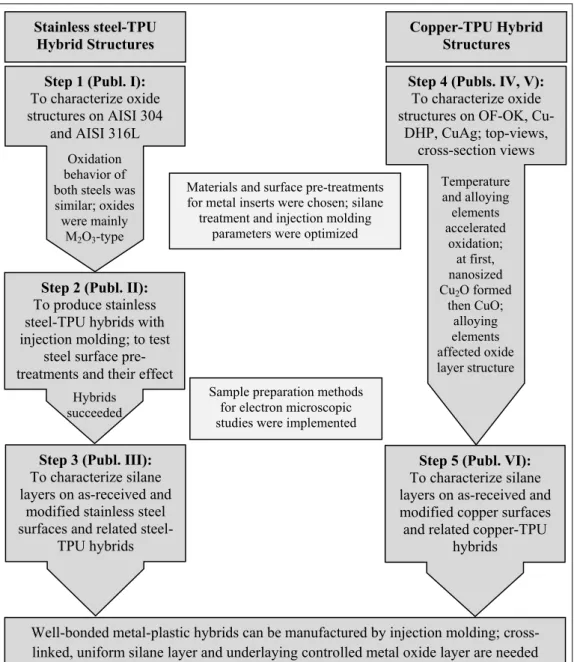
On the other hand, alloying elements can slow down the initial oxidation rate because alloying elements can hinder the movement of copper atoms at the Cu2O/Cu; interface. Well-bonded metal-plastic hybrids can be produced by injection molding; a cross-linked uniform silane layer and an underlying controlled metal oxide layer are required.
Publ. III)
Publ. II)
Publ. VI)
EXPERIMENTAL PROCEDURES
- Materials
- Metals
- Silane
- Plastic
- Manufacturing of metal-plastic hybrid
- Oxidation treatments for stainless steel and copper
- Silane treatment
- Injection molding
- Characterization
- Atomic force microscopy
- Scanning electron microscopy
- Transmission electron microscopy
- X-ray photoelectron spectroscopy
- Reflection absorption infrared spectroscopy
- Peel test
Subsequently, the manufacturing process of the metal-plastic hybrids is introduced and finally the characterization methods used after different manufacturing steps of the hybrids are described. The most commonly used stainless steel AISI 304 was chosen for further studies of the metal-plastic hybrids (publication II and III). OFE-OK and Cu-DHP were chosen for the further studies of the copper-plastic hybrids (publication VI).
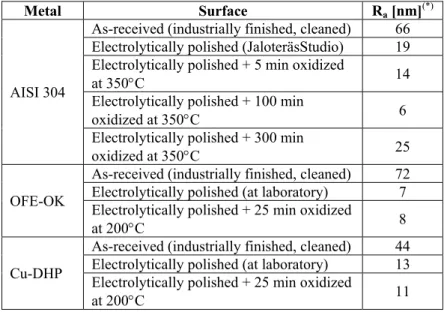
The best peel strength values of the metal-plastic hybrids were, however, achieved with -AEAPS. The production process of the metal-plastic hybrids consisted of three steps: (1) surface modification of the metal, (2) silane treatment of the metal, and (3) injection molding of the plastic into the silane-treated metal. Metals obtained with industrially finished surfaces were used as reference surfaces on metal-plastic hybrids to compare the effect of surface modifications on the formation of silane layers and on the adhesive strengths of the hybrids.
Oxide layers on electrolytically polished copper surfaces, silane layers on various metal surfaces and peeled surfaces of metal-plastic hybrids were studied with AFM (Nanoscope E AFM/STM, Veeco Instruments Inc., USA) at the Department of Science of Materials at TUT (editions II, III, IV and VI). The silane layers, the finished metal-plastic hybrids and the peeled surfaces of the hybrids were studied by scanning electron microscopy (SEM). In the studies of edition II, SEM XL 30 (Philips, Netherlands) equipped with energy dispersive X-ray spectrometer (EDS, DX-4, EDAX, USA) was used.
A cross-section image of the silane-treated metal substrate attached to the SEM stub is shown in Fig. Electrolytically polished TEM specimens have been used for oxidation treatments to study top views of oxide layers on metals (publications I and V). The chemical compositions of the peeled sample surfaces (copper sides) were also studied with RAIRS.
The peel strength values of the injection molded metal-plastic hybrids were measured using a 180° peel test (publications II, III and VI). As a conclusion of the experimental part, the fabrication steps of the metal-plastic hybrids and characterization methods within each fabrication step are presented in Fig.
RESULTS AND DISCUSSION
- Stainless steel-TPU hybrid
- Oxide structure on stainless steel
- Silane layer on stainless steel
- Hybrid structure
- Copper-TPU hybrid
- Oxide structure on copper
- Silane layer on copper
- Hybrid structure
Industrially finished stainless steel inserts as received were used as a reference surface to study the effect of the surface modifications on the formation of the silane layer. The topographies of the stainless steel surfaces before and after the silane treatment were studied by AFM. The images of the received and oxidized stainless steel surfaces with and without silane are presented in Fig.
Thickness and uniformity of the silane layers on the stainless steel surfaces were studied by FESEM and TEM. The images of the thick and thin silane layers on the 100 minute oxidized stainless steel insert are shown in Fig. both transverse and longitudinal directions) is shown in Fig.
The peel strength values of hybrids produced with different surface finishes of stainless steel inserts are shown in Fig. Surface modifications improved the bond strength of the hybrids compared to hybrids produced with stainless steel inserts. The FESEM image of the side of the peeled stainless steel (100 min oxidized) from the edge area of the insert in the transverse direction with a thin layer of silane is shown in Fig.
FESEM and AFM images of the side of the peeled stainless steel (oxidized 5 min) from the middle region of the crosswise insertion with a thicker silane layer (150 nm) are shown in Fig. In the areas of silane/silane failure, most of the silane layer was detected on the TPU side (not shown) indicating that the silane/silane failure occurred very close to the stainless steel surface [Publication III]. FESEM images of silane layers, grown from a solution concentration of 0.5 vol%, on as-received and oxidized OFE-OK are shown in Figs.
Images of the oxidized OFE-OK surface with silane layer, grown from the solution concentration of 0.25 vol%, are shown in Fig. in Fig. In the middle area of the copper grain, the silane layer thickness is ~40 nm and it is uniform (Fig.
The spectra of silane-treated Cu-DHP with a silane solution concentration of 0.5 vol% are presented in Figure 1.

CONCLUDING REMARKS
While hybrids made with oxidized stainless steel or copper inserts failed mainly cohesively in TPU with high peel strength values. Consequently, a modified metal surface with a controlled oxide layer overlaying a uniform, thin and cross-linked silane layer is required to achieve well-bonded metal-plastic hybrids. AFM, SEM and TEM are good methods for the quantitative and qualitative characterization of metal-plastic hybrids in different manufacturing steps.
Furthermore, the effect of the oxide and silane layer on the electrical conductivity, especially in the case of OFE-OK-TPU hybrids, should be tested.
Boerio, Relating the mechanical properties of silanes to their chemical structure: an analytical study of -GPS solutions and films, Progress in Organic Coatings. Watts, Understanding the relationship between silane application conditions, bond strength and failure location, International Journal of Adhesion & Adhesives. Burkstrand, Structure of films formed by - aminopropyltriethoxysilane adsorbed on copper, Journal of Colloid and Interface Science.
Valden, Effect of surface hydroxyl concentration on the bonding and morphology of aminopropylsilane thin films on austenitic stainless steel, Surface and Interface Analysis. Vereecken, Thickness determination of silane thin films on aluminum surfaces by spectroscopic ellipsometry, Solid Thin Films. Zheng, Fabrication and adhesion properties of organosilane thin films coated on low carbon steel substrates, Surface and Coating Technol.
Jussila, Advances in nanoscale functionalization of stainless steel surfaces, Ph.D thesis, Tampere University of Technology, Tampere, 2009. Aggen, Wrought stainless steels, properties and selection: iron, steel and high performance alloys, in: ASM Handbooks Online Vol 1, ASM International, 1990, pp Kurzydlowski, TEM studies of the oxide scales formed on type 316 stainless steel during annealing at 600C in vacuum and air, Scripta Materialia.
Farley, Spectroscopic and microscopic investigation of the corrosion of 316/316L stainless steel by lead-bismuth eutectic (LBE) at elevated temperatures: importance of surface preparation, Journal of Nuclear Materials. Tyler and W Black, Introduction to copper and copper alloys, properties and selection: non-ferrous alloys and special-purpose materials, in: ASM handbooks online Vol 2, ASM International, 1990, pp. Assman, Deposition of thin films of different oxides of copper by RF-reactive sputtering and their characterization, Vakuum.
Lahtonen, Oxygen adsorption-induced nanostructures on copper and silver-copper alloy surfaces investigated by scanning tunneling microscopy and electron spectroscopy, PhD thesis, Tampere University of Technology, Tampere, 2008. Isshiki, A study of the initial oxidation of copper in 0.1 MPa oxygen and the effect of purity on metallographic methods, Corrosion Science.
![Table 1. Typical commercial coupling agents, their functional groups with polymer and substrate, and suitability with polymers [8]](https://thumb-eu.123doks.com/thumbv2/9pdfco/1890700.266866/16.748.135.613.139.490/typical-commercial-coupling-functional-polymer-substrate-suitability-polymers.webp)
![Figure 4. Silane on metal substrates, (a) left side: silane bonding immediately after treatment with hydrogen-bonded interface, right side: silane bonding after condensation with covalent-bonded interface [24], (b) cured 3-aminopropyltriethoxysilane (APS](https://thumb-eu.123doks.com/thumbv2/9pdfco/1890700.266866/18.748.139.612.102.514/substrates-immediately-treatment-hydrogen-interface-condensation-interface-aminopropyltriethoxysilane.webp)
![Figure 9. Oxidation stages of metal surfaces, (a) dissociation and adsorption of O 2 onto metal surface, oxide nucleation, and oxide island growth, (b) growth of three-dimensional oxide layer [48]](https://thumb-eu.123doks.com/thumbv2/9pdfco/1890700.266866/24.748.142.609.86.431/figure-oxidation-surfaces-dissociation-adsorption-surface-nucleation-dimensional.webp)