The elements of the INNORISK model were also evaluated in a web survey sent both to research groups and companies in the Tekes Liito program to achieve the project objectives, which focused on new solutions both in practice in the near future as in the future beyond. Chapter 1 presents the objectives and focus of the project according to the original research plan written by Tarja Meristö and Pekka Maijala in late 2005. At the beginning of the project, Riitta Molarius from VTT was also involved in the INNORISK research team and her contribution is reported in the previous research papers.
We would like to thank all the contributors in the academic community and business life who helped us work through this long road to the end. Challenge management Management and control of an innovation process in order to create business operations in a way that takes into account changes in the operating environment (threats or opportunities). The purpose of the PESTE analysis is to collect the likely driving forces, signs of change and weak signals to map the changes in the future operational environment.
Strategic focus Selecting a product, service, technology or business model from among all alternatives in a way that meets the requirements of the future operating environment and strategic directions. Visionary concept Forward-looking concepts based on future market needs defined in scenarios.
Introduction
Connections to strategic decision making
Applying Excellent SWOT to a set of alternative scenarios is a convenient way to link the future and foresight activities with the company's strategy work. The innovation process must be linked to the strategy, and furthermore strategy must be linked to the future operating environment and its challenges. When implementing the strategy, it is important to build up a monitoring system for the operating environment.
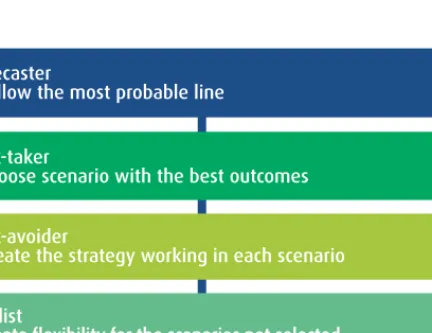
The choice of the most desirable scenario depends on the actor's ability and willingness to take risks and the actor's vision of the future. Regardless of the choice of scenario, it is important to keep in mind that the other scenarios do not persist. On the contrary, the actor must follow up the realization of the other scenarios.
An innovation, by definition, is a new idea that has been applied to the market because of its superior ability compared to previous solutions. These include not only consequences in a specific field of use, but also unpredictable new uses and, of course, the timing of exits. It gives the company an unrivaled competitive position - at least for a short time before competitors follow suit and adopt a radical innovation in their use.
At this point, it is no longer a radical innovation, but just part of the normal business environment. For a certain period of time, a radical innovation can secure a unique position in the market and give a tremendous profit to the player having it as a competitive advantage. Radical innovations seem to be the result of many aspects, which are sometimes unclear, without stages or rational paths from beginning to end.
It is important to rationalize the innovation process and coordinate it with the creation of new companies. Process innovation needs a lot of ideas, but a very strict verification system linked to the company's vision of the future. It's not just about what to do, but how and how quickly you can act compared to your competitors.
Foresight tools used in the innovation process
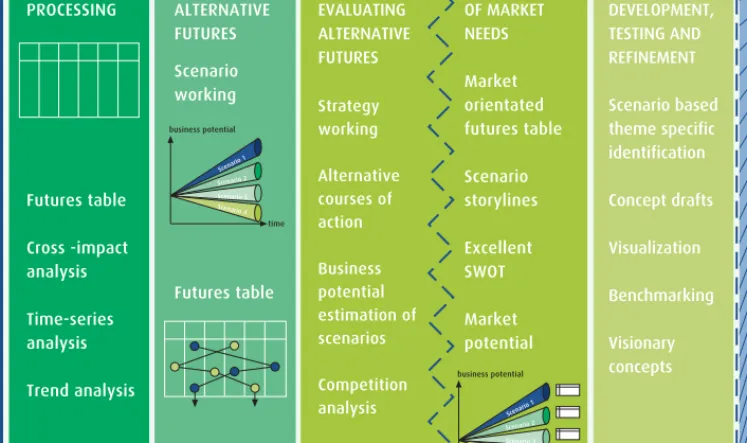
Although extrapolative methods have their limitations when studying long time spans, they are useful in providing a basic understanding of future developments. Scenarios are a way to summarize the results of future research and the entire forecasting process. Scenarios are illustrations of the future that can be used to assess the likelihood, plausibility and desirability of alternative future events.
Scenarios should be internally consistent, plausible and logical stories about the future that illustrate the evolution from the present towards the possible future (usually 10 – 20 years). In the scenarios even those that are neither desirable nor probable, although possible alternative development paths are considered (Van der Heijden, 1996). By using scenarios, it is possible to illustrate a wild range of alternatives and thus form an overall view of the future.
Since scenario building is an action-oriented activity, it helps to link forecasting results directly to the company's strategy process. A successful scenario creation process requires decision support systems including indicators and barometers associated with scenario monitoring. In addition, actual decision makers must be involved in the process for it to be efficient.
The tacit knowledge of key people must be accepted as part of the information base. The disadvantages of scenario building are that it requires development work and long-term commitment (time-consuming). When selecting/evaluating alternative futures, the connections between scenarios, a company's strategy and business areas are evaluated.
The key questions are how a company can survive in each of the scenarios and how it can take advantage of the opportunities embedded in them. The results of scenario building should be detailed enough to be used in concept development. In short, scenarios support the innovation process by illustrating alternative future developments related to market potential and needs, societal demands and technological feasibility (Meristö et. al. 2006).
Precise innovations vs. visionary concepts
19 In general, scenarios and related visionary concepts create the company's awareness of future market needs, societal demands, and technological feasibility. It sees a successfully commercialized innovation as a result of high market value, technological feasibility and social acceptance. Thus, they determine the uncertainty, scale, timing and direction of the future.

Uncertainty management in the front end of innovation development
- Research Methodology
- Cases
- Conceptualisation
- Strategic co-ordination
- Co-ordination of commercialisation
- Conclusions
For the beginning of the process (the front), there is no similar well-established theory. Decisions made in the fuzzy front end are of primary importance: studies have shown that most of the important factors influencing the success of the potential innovation are established before the business idea or concept goes to the new product development phase (Cooper and Edgett , 2005, Kettunen et al, 2007). Role of decision makers: Top management of the company was heavily involved in the process.
Type of innovation and new business: Initially the expectations of the company representatives were that they would focus only on managing product performance issues. In the process, the development of life-cycle services and the delivery channel opened up more and more attractive opportunities for the creation of new businesses. What it actually became was a roadmap for the company's future offering.
Role of decision makers: The work was initiated by the top management of the company. The hard work in creating the offering schedule was carried out by the business leadership team. A practical proactive risk management process for uncertainty management at the front end should drive creativity at the front end using a handful of simple rules and tools that allow for a simultaneous and systematic analysis of the opportunities and threats.
The active involvement of decision-makers in the analysis gave them a broad and realistic picture of the opportunities and risks associated with new (potential) business. At the core of the model are five elements of the new concept development model (Koen et al. 2002). Usually, most decisions happen right out of the gate before new product development.
In our model, part of the crucial decision-making has been passed on to earlier stages of the front end. The goal for the strategic coordination of the portfolio management is quite simple: Make the right projects. What is actually done is a road map for the supply of the company in the future.
The INNORISK model aims to support decision-making in companies at critical points in the innovation process. As a result, the fuzzy front end of the innovation process is no longer so fuzzy.

Usability Evaluation of the INNORISK- model
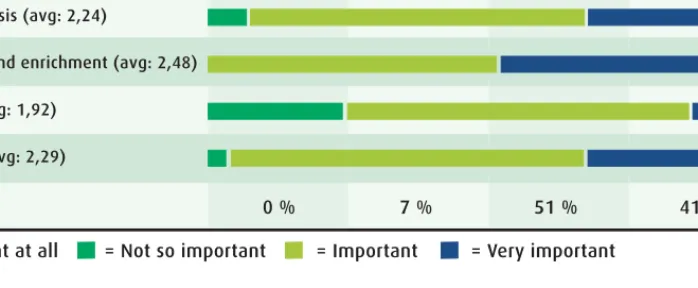
Respondents also estimate the importance of the early phases of the innovation process (Figure 4.2). In this way, the most important source of innovation can continue to be its own staff in the future. The innovations arise from the networks formed by companies, universities, research institutions and other organizations.
The survey conducted in the project supported this notion, as the results showed that the company's customers and suppliers are considered the two most important sources of innovation (Fig. 4.4). The survey results also confirmed the notion that science has an important role as a source of innovation. Although, in the case of a mature industry with low growth, it might be worth considering analogies from other more dynamic industries.
As a result, creating innovation is no longer the sole responsibility of management or product development staff. As the focus of finding new ideas shifts to accurately predicting customer preferences and end-user needs, marketing personnel in particular play an important role in mediating the changes in customer needs in the innovation process of Company. Managing the Uncertainty of the Future in the Business Driven Innovation Process, in Finnish with English summary).
Meristö, T., Molarius, R., Leppimäki, S., Laitinen, J., Tuohimaa, H., (2007) QUALITY SWOT: Työkalu innovaatioihin perustuvan pk-yritysten tulevaisuuden menestyksen varmistamiseen. Erinomainen SWOT: Työkalu innovaatiovetoisille pk-yrityksille tulevaisuuden menestyksen varmistamiseksi, suomeksi englanninkielisellä tiivistelmällä) Turku: Corporate Foresight Group CoFi /Åbo Akademi. Arvot ja teknologiaskenaariot strategisen suunnittelun kontekstissa, julkaisussa Älykkäät koneet ja järjestelmät: Viimeaikaiset mekatroniikan edistysaskeleet Suomessa. Meristö, T., Molarius, R., Leppimäki, S., Laitinen, J., Tuohimaa, H., (2007) INNORISK - QUALITY SWOT: Työkalu innovaatiovetoisten pk-yritysten tulevaisuuden menestyksen varmistamiseksi. 2008) INNORISK osavuosikatsaus: Innovaatio liiketoiminnan uudistajana. 2002).
In The PDMA Toolbook 1 for New Product Development, Belliveau, P., Griffin, A. 2007) Commercialization Success in Innovation Development, in Proc. Managing future uncertainty in the business-driven innovation process (in Finnish with English summary). In Security Analysis Quality Management, Suokas, J. 2004) Innovation Sources of Large and Small: Technology-Based Firms.