(Please cite the further developed version of this article that has been published in The Project Management Journal, ISSN: 8756-9728;
dx.doi.org/10.1002/pmj.21586)
INNOVATION FOR MULTI-PROJECT MANAGEMENT: THE CASE OF COMPONENT COMMONALITY
Tuomas Korhonen1, Teemu Laine1, Jouni Lyly-Yrjänäinen1, Petri Suomala2
1 Cost Management Center, The Department of Industrial Management, Tampere University of Technology
2 The Faculty of Business and Built Environment, Tampere University of Technology
ABSTRACT
Innovation within single projects can significantly influence multi-project R&D. Among other types of innovativeness, suitable end-product components need to be selected or developed. Lowering the amount of different components used, i.e. increasing component commonality, can lower end product costs, and hence contribute to firm-level strategic benefits and profitability. This study provides empirical evidence on the innovative aspects of component commonality using an interventionist case study of a machinery manufacturer in [the country of the study]. The paper suggests that component commonality innovation influences value and management of multi-project operations and vice versa. Findings are summarized as propositions for further research.
KEYWORDS: portfolio management; program management; qualitative research; uncertainty; innovation
INTRODUCTION
Multi-project operations are leveraged to harvest strategic benefits (Cooper et al., 1997), but managing multiple projects in a dynamic context might require context-specific strategic alignment and value measures (Martinsuo, 2013). Indeed, research has identified “a need to delve deeper and continue to find better ways to comprehensively identify and measure strategic value”, especially outside the traditional financially measured benefits (Martinsuo & Killen, 2014, p. 56). However, context-specific uncertainties hamper the estimation of the strategic benefits acquired from multi-project operations (Korhonen et al., 2014; Martinsuo et al. 2014;
Martinsuo, 2013; Petit & Hobbs, 2010).
The multi-project-level uncertainties might stem from single projects (Korhonen et al., 2014;
Martinsuo et al. 2014; Petit & Hobbs, 2010), and among other more generic reasons (e.g. project characteristics, evaluation, time, cost and scope, in Korhonen et al. 2014), they can more specifically originate from the need to customize the end product for different customers (Petit & Hobbs, 2010). In practice, through component standardization and commonality, different end products can be customized for different customers by using a set of common components. Developing feasible common components, however, may not always be an easy and quick decision, but require innovativeness. In platform development and multi-project lineage management it is essential that modularity is emphasized and common components used among a product line to provide cost benefits (Maniak & Midler, 2014). Although recent literature on multi-project management brings up the importance of component standardization or commonality (Maniak & Midler, 2014), too scant attention has been paid on how exactly such component commonality is realized, within multi-project R&D and through innovation. There is room for an in-depth analysis on the impacts of such component commonality innovations and their embeddedness within a firm’s R&D (Maniak & Midler, 2014). With high-technology products, for example, component commonality can become a problem that cannot be solved without thorough understanding of natural sciences. Hence, decisions concerning component commonality can become mysteries to be solved within multi-project operations.
Component commonality is just one example of a real-life phenomenon that influences multi-project management, but this example can be used to provide understanding on implementing general strategic targets, such as profitability, through multi-project management. Component commonality is implemented on lower levels of an organization, in the actual practice of projects and project portfolios. Component commonality can be considered a part of engineer-driven problem solving; and projects can centrally be solving “[a] set of technical challenges” (Engwall et al., 2005, p. 432). However, the aspect of innovation to acquire component commonality is not yet thoroughly examined in the context of multi-project management, although some authors have noticed the portfolio-level effects stemming from the issues of component commonality in multi-project lineage management including retrofitting and preventing “destandardization” (Maniak & Midler, 2014; Midler, 2013), overlapping or sequential technology transfer between single projects (Nobeoka & Cusumano, 1995;
1997) and software product customization needs in single projects (Petit & Hobbs, 2010). More broadly, Martinsuo (2013) directly expresses that “changes at the single project level as well as at the project portfolio level deserve further research” (p. 801). Also the issues of simplicity and practicality in “planning and managing risk in innovative and complex projects” have been seen as venues to address (Conforto & Amaral, 2010, p. 79).
Contemplating component commonality innovation within multi-project management integrates these aforementioned issues. Indeed, this study addresses the issue of innovation in multi-project management, by learning from the case study of innovation underlying increased component commonality within a program and centrally the cost effects of that component commonality innovation. As our research questions, we ask: How does component commonality innovation influence the value and management of multi-project operations? How do the multi-project value and management aspects influence component commonality innovation?
This article provides a real-life view on the “embedded nature” of component commonality and the innovative aspect involved, and hence contributes to the understanding of managing multi-project value and the role of innovation in this value-creation. The embedded nature of component commonality means that cost implications of component commonality cannot be studied in isolation from cost implications of other
development actions underlying increased component commonality. In the project management context “project portfolios are embedded into their context and its cultures” (Unger et al., 2014, s. 38); similarly in the
component design and selection context, individual component selection decisions cannot be made in isolation.
Component decisions can be made, for instance, within multi-project lineages, which require attention from multi-project management (Maniak & Midler, 2014).
The study contributes also to the literature that contemplates the influence of single-projects at the portfolio-level (Korhonen et al., 2014; Martinsuo et al., 2014; Petit & Hobbs, 2010). In its essence, the study provides a novel approach, the approach of innovation to acquire component commonality in the multi-project management context, and hence extends the line of inquiry by Maniak and Midler (2014). As Maniak and Midler state, “[w]e still have few insights about the application of contextual ambidexterity from a multiproject perspective, which could help to better understand the mechanisms of the reuse of concrete knowledge and how it embodies a coherent path towards an expansive range of innovative products” (p. 1149). Contrastingly, literature concerned on the multi-project environment has emphasized the project selection and coordination (Maniak & Midler, 2014, p. 1147), perhaps leaving room for studies on the aspect innovation in relation to multi-project management. The contribution of this study concerning component commonality innovation can add to the literature on innovations in (marketing) strategy that affect a multi-project lineage (for example, Midler, 2013).
This study shows that the development of common components, which is central to component commonality, might not be self-evident, but rather might require significant effort and innovation (or at least transfer to new technologies and platforms). Therefore, this study also contributes to the literature on component
commonality within operations management research. In fact, our literature review largely draws from
operations management literature to acquire a wide knowledge basis for contemplating component commonality and its cost effects. Indeed, this study provides a case study of an area of research, component commonality, of which empirical evidence has been called for (Labro, 2004). Based on our empirical evidence, we also wish to advance the component commonality literature by providing an illustration particularly on the direct cost implications of component commonality. Our empirical evidence shows that component commonality is embedded in the product development activities within an organization, and thus cannot be thoroughly analyzed using only ceteris-paribus analyses. Our empirical evidence allows elaborating on the embedded nature of component commonality, as we show that certain commonality-enabling innovation might be needed in order to actually develop components. Moreover, elaborating on the cost implications of an actual commonality-enabling innovation, the managerial implications of this study show that managers might be interested in cascading suboptimal cost benefits from various commonality-enabling innovations. Such cascade of commonality- enabling innovations could contribute to reaching lower—possibly still suboptimal—costs with regard to the whole production system by changing the whole mode of operations once common components have been developed to cover an adequate amount of different kinds of components and subassemblies within a production system.
Our empirical findings from the Engineering-to-Order (ETO) context might well be suitable to consider in contexts as the Manufacturing-to-Stock (MTS) or Assembly-to-Order (ATO), as the ETO context does not seem to totally explain our findings. In fact, this is among the first academic studies to provide actual direct material and assembly cost data from an actual case of advancing component commonality. Altogether, this study has the potential to contribute to both, the literature on multi-project management and the literature on component commonality.
The Research Setting
To highlight the embedded nature of component commonality, this article provides an interventionist (see Suomala & Lyly-Yrjänäinen, 2012; Suomala et al., 2014; Lukka & Suomala, 2014), in-depth case study in a globally operating Original Equipment Manufacturer (OEM) in [the country of the study].In fact, “OEM”
refers to one division of the Original Equipment Manufacturer, but due to simplicity we call the organization in which the case study took place “OEM”. In October 2011, two interventionist researchers, two of the authors, received an access to an ongoing R&D program in the OEM through previous research collaboration with the company. More particularly, the two interventionist researchers took part in an electrical subassembly
component commonality development project as experts in cost and profitability estimation. Altogether, the interventionist researchers took part in 19 product-development-related meetings at the OEM: one in October 2011, one in January 2012, four in February 2012, four in March 2012, two in April 2012, one in May 2012, two in June 2012, and two in August 2012. These meetings were mainly held with design engineers, but also with business and project controllers, project managers, purchasing engineers, research management, production management and product line management.
During the research collaboration, a technical solution needed to be found to make it possible for the OEM to lower costs incurred by customizing its product to customers located around the world, and hence for different power grids. Using the empirical findings of that project, the necessity of going into the details of the innovation that allowed component commonality to take place was underlined and the usefulness of ceteris- paribus analyses in examining component commonality was questioned. Both of these aspects have influence in multi-project management.
Scope of the Literature Review on Component Commonality
Our literature review on component commonality consists of a comprehensive analysis of contributions on component commonality, published in 1963–2010. Our review consists of articles published in journals focusing on operations research (e.g. Operations Research, Journal of Operations Management, International Journal of Operations & Production Management, Manufacturing & Service Operations Management, International Journal of Production Economics), management science (e.g. Management Science, Decision Science), product innovation (e.g. Journal of Product Innovation Management, Research Policy), and various text book contributions on accounting, for instance. In all, we suggest that our literature review vastly covers the literature on component commonality with such rigor that the following conclusions presented are well-justified.
Previous Research on Component Commonality and Its Cost Implications
In the literature, the embedded nature of component commonality is not adequately acknowledged. In particular, research often suggests that only the number of components would change as a consequence of introducing a hypothetical component and certain cost implications would respectively follow. In such what-if analyses it is often disregarded that the development of these common components might be demanding or even impossible. In the practice of component commonality, of course, common components need to be technically feasible, and developed within research and development (R&D) activities, among projects, programs and portfolios, and as one among many development initiatives. The technical feasibility, and the dimension of
innovativeness are often excluded from models that highlight the importance of indirect cost savings to allow certain cost increase in direct material and assembly costs to break even (e.g. Thyssen et al., 2006).
Component commonality can be defined as the use of the same version of a component across multiple products (Labro, 2004), and it is often considered as a means to combine product variety with cost efficiency.
When discussing component commonality, the concepts of component sharing (Robertson & Ulrich, 1998;
Fisher et al., 1999), component sharing modularity (Pine, 1993) and cross-over parts (Clark & Fujimoto, 1991) have also been used with rather similar definitions. Moreover, some authors (Eynan & Rosenblatt, 1996; Lee &
Tang, 1997; Perera et al., 1999) use the term component standardization when several components are replaced by a single component that can perform the functions of all the different components, meaning more or less component commonality.
In the literature that discusses the cost implications of component commonality, the idea is to analyze the effects of replacing several product-specific components with a common one (see e.g. Gerhack et al., 1988;
Vakharia et al., 1996; Ho & Li, 1997). The literature on cost effects of component commonality has its background in operations research with main focus on optimizing inventory levels with the use of a common component replacing several product-specific ones (Evans, 1963; Rutenberg, 1971; Rutenberg & Shaftel, 1971;
Moscato, 1976; Dogramaci, 1979; Baker et al., 1986; Gerhack & Henig, 1986; Karmarkar & Kubat, 1987;
Adlakha & Singhal, 1988; Gerhack et al., 1988; Jönsson & Silver, 1989; Bagchi & Gutierrez, 1992; Jönsson et al., 1993; Eynan & Rosenblatt, 1996; 1997; Eynan, 1996; Fu & Fong, 1998; Hillier, 1999a; 1999b; 2000;
Mirchandani & Mishra, 2002; Hillier, 2002; Fong et al., 2004; Simpson & D’Souza, 2004; Zhou & Gruppström, 2004; Dong & Chen, 2005; Eynan & Fouque, 2005). Another research stream on cost implications of
component commonality (Guerrero, 1985; Mather, 1986; Thomas, 1992; Tsubone, et al. 1994, Vakharia, et al., 1996; Sheu & Wacker, 1997; Ma et al., 2002; Sale, 2007) focuses on production planning and the optimization of resource use in production scheduling and sourcing. However, this literature is conceptually very close to the classical inventory optimization studies, although the focus is broadened to cover manufacturing and sourcing decisions, too.
Whereas Rutenberg (1971) is often cited as the starting point of literature focusing on cost effects of component commonality, other important genre was initiated by Collier (1981, 1982) when he introduced the idea of commonality index. Commonality index (also called Collier index) basically measures how many components are needed for a certain product family. His work has then been continued with increasingly complex indices (Wacker & Trevelen, 1986; Trevelen & Wacker, 1987; Jiao & Tseng, 2000; Kota et al., 2000;
Desai et al., 2001; Kaski & Heikkilä, 2002; Thevenot & Simpson, 2004; 2006; Blecker & Abdelkafi, 2006;
Thevenot & Simpson, 2007), however mainly elaborating on the ever-sophisticating commonality indices, which at least implicitly assume that a new common component is technically feasible and is only an incremental change to existing production systems. Thus such incremental innovation could incur some costs that could be identified using these ceteris-paribus analyses of only one component changing in vast production system and product architecture.
In all, the work on cost effects of component commonality has emphasized theoretical modeling and the examples of commonality (even the real ones) are not perhaps central units of analysis (see, e.g., Ulrich, 1995; Muffato, 1996; Fixon, 2005; Krisnan & Gupta, 2001; Nobelius & Sundgren, 2002; Perera et al., 1999;
Kim & Chhajed, 2000; 2001). As a matter of fact, the empirical literature on the topic did not appear until in the middle of 1990’s, and even today the amount of published empirical studies remains rather small. The few empirical studies on cost implications of component commonality are not very closely connected the technical prerequisites for increased component commonality, hence underemphasizing the empirical view on cost implications, or the actual realization of component commonality (e.g. McDermott & Stock, 1994; Lee, 1994;
Swaminathan & Tayur, 1998; Ramdas & Shawney, 2001; Ramdas et al., 2003; Park & Simpson, 2005; Thyssen et al., 2006).
As our case study of the OEM is concerned on electrical components, it is noteworthy that the literature on component commonality also deals with electrical components (e.g. Thonemann & Brandeau, 2000), though with not detailed description on what component commonality would mean in practice. However, Marion et al.
(2007) present component commonality being developed within a larger reinvention of a product line, comprising both, the reinvention of product design and the reinvention of the manufacturing at the same time.
Marion et al. (2007) even mention that there had been a scalable electric motor innovation that made component commonality possible, but do not explicitly address the need for such innovation to take place in order for commonality to be possible more generally or the cost implication of the scalable electric motor innovation. Jans et al. (2008) add to the commonality literature stream that has shifted focus from inventory cost savings to development and production cost savings. In Jans et al.'s (2008) study, the motor (kW size) splits were optimized with an analytical model but, the real direct cost implications of commonality are left unexamined, for the ex ante analytical model covers these implications in the paper. Izui et al. (2010) present a case of switchgears, which is the most analogous to our case study of the extant empirical research. Izui et al. (2010) suggest that “individual switchgear customers tend to have unique design requirements concerning electrical
capacity, electrical specifications, available area for equipment installation, and so on, which make the design and production of such systems costly” (p. 2823), as in our empirical case. Izui et al. (2010), however, tell that in their commonality problem, the “switchgear architecture is not subject to alteration” (p. 2826), and present only a case of inventory optimization.
Cost of Overspesifying Components to Acquire Commonality in Different Production Contexts
The underemphasized aspect of innovation in studies of component commonality could be explained by the production contexts in which commonality and its cost implications have been studied. Component commonality literature has focused on make-to-stock (MTS) and assembly-to-order (ATO) production environments (Perera et al., 1999; Fong et al., 2004). MTS environment has standard products made to stock with (rather) stable bills of material (Amaro et al., 1999). ATO environment, on the other hand, is based on standardized product family with well-documented product options and, hence, all the potential end product variants have been engineered beforehand (Amaro et al., 1999). The existing product families with bills of materials make it rather straightforward to simply select common components that have the functionality of several components. The classical example would be to replace two electric motors with the larger, now the common but possible overspesified one, and cost implications would incur, respectively.
When component commonality is increased by replacing several product-specific components with a common one, these common components would have to fulfill the functional requirements of several unique components (Hillier, 2000; Krishnan and Gupta, 2001; Hillier, 2002; Fong et al., 2004; Zhou and Gruppström, 2004). In other words, the common component needs to be capable of fulfilling the functional requirements of all the components it replaces (for different conceptualizations, see, Rutenberg, 1971; Ulrich, 1995; Eynan and Rosenblatt, 1996; Ulrich, 1995; Fisher and Ittner, 1999; Davila and Wouters, 2007; Gupta and Krishnan, 1999;
Perera et al., 1999; Labro, 2004; Thonemann and Brandeau, 2000; Ramdas, 2003; Brun et al., 2006; Thyssen et al., 2006).
The idea that a common component replacing several product-specific components might actually be more expensive (cost of overspecification) emerged in the 1990’s (Gerchak et al., 1988; Ulrich, 1995; Eynan and Rosenblatt, 1996). However, since then the assumption regarding the cost of overspecification has become a rather dominant element in the contemporary literature. However, there are no studies focusing on how to prevent this problem of increasing costs and how innovative approaches to component commonality might impact costs. Thus, even though product development is considered as a key element when implementing component commonality (Ulrich, 1995; Eynan & Rosenblatt, 1996; Feizinger & Lee, 1997; Lee, 1997; Fisher et
al., 1999; Kim & Chhajed, 2000; Davila & Wouters, 2007), the studies focusing on component commonality seldom show the technical prerequisites for increased component commonality. However, even though cost analyses based on ceteris-paribus type of a setting are very good in terms of reliability, their usefulness at least for settings involving innovation may be questioned in practice.
When moving from MTS and ATO contexts into ETO (engineering-to-order) production environment, analyses on the cost implications of component commonality become even more challenging. ETO context is typical for products that need unique engineering or significant amount of customization in order to be manufactured according to customer-specific requirements (Amaro et al., 1999). Thus, each order results in a unique design, part numbers, bill of material (BOM) and routing in the production (McGovern et al., 1999;
Hicks & Braiden, 2000; Hicks et al., 2001). Unlike in ATO environment, products in ETO context are not configured using existing modules and product options, but rather the product (or at least part of it) is engineered individually for each customer.
Standard product families with rather stable BOMs (MTS) or predefined options (ATO) make it easy to analyze component use and try to increase component commonality with overspecification. However, in ETO context the starting point is not that easy. First, managers often need to go through a major process to analyze the ETO products that they have delivered and the ETO products’ customers might be ordering in the future (see Lyly-Yrjänäinen, 2008). In other words, overspecification is not simply done by selecting the most “powerful”
component but such a component may have to be developed and that may require (1) rethinking of the product architecture and (2) sometimes even innovations or at least adoption of new technologies in a certain industry.
Taking into account the role of product development actions and innovations needed to enable commonality in the ETO context, however, makes cost analyses more complex. Hence, the impact and the value of a
development project, ultimately also outside the financial domain at the portfolio level, i.e. in indirect terms (Martinsuo & Killen, 2014), remains a mystery. In the ETO context, component commonality no longer can be studied in a ceteris-paribus situation in which a few components are just assumed to be replaced with one common component. However, the product development and innovation processes tend to result in other cost implications, which are intertwined with the cost implications of commonality itself. To acquire more in-depth understanding of how component commonality innovation influences portfolio impact and its management, R&D project cost implications in terms of product profitability need to addressed from the viewpoint of component innovation.
Empirical Results on Commonality-Enabling Innovation
The Complexity within OEM’s Operational Environment
The OEM’s products were pieces of production equipment, often engineered to order to fit every customer’s specific needs. ETO in this context meant that product design engineers needed to select components to each customer order depending on each customer’s needs. The need for customization influenced the
program, as in Petit and Hobbs’ (2010) study concerning multi-project operations. In the OEM’s case, the varying customer needs were linked to each customer’s processes and preferences. Moreover, the location of each customer’s production site, in which the OEM’s products would be in use, posed a requirement for the OEM’s products to comply with varying voltage and frequency ranges in different national grids, and different regulations in each country. In particular, the distribution board of the product seemed to be of trouble from the viewpoint of compliance. The distribution board was an electrical entity within the OEM’s product—not precisely a module of the product but similar to one—which made all other parts of the product receive electricity. The distribution board also took care that the electrical system of a product was applicable to the national grid and regulations of a customer’s nation, customer preferences and the overall specifications of the product.
Although some basic idea of what a distribution board would be in every customer order, a multiplicity of alternatives existed, due to a lot of components from which to choose from when designing a distribution board according to an order. Hence, often a produced distribution board was a new engineered-to-order combination of known electrical components regardless whether the voltage and frequency ranges were different or not from previous orders. These engineering-to-order tasks would consume the resource pool of the program.
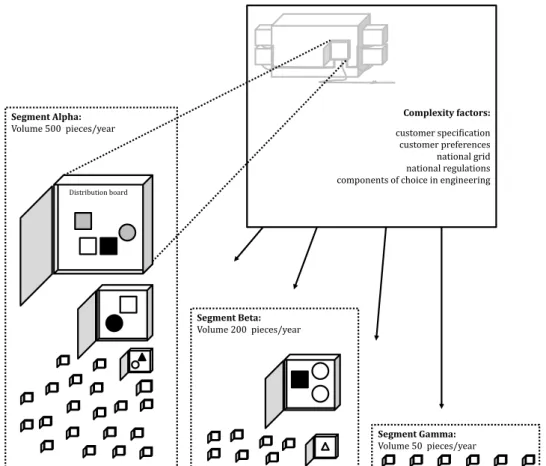
However, electrical engineers in the OEM had identified three major segments of customers of which the distribution boards had some (or adequate) commonality between each other, due to similar voltage and frequency ranges within each segment. These customer segments are called here “Alpha”, “Beta” and
“Gamma”, and each of those segments covered a different geographical market segment with certain volume1. Figure 1 illustrates that each distribution board in Alpha-, Beta-, or Gamma-segments was an outcome of customers’ preferences, specifications and national differences, as well as the electrical engineers’ components of choice. Distribution boards are here visualized as cabinets, which in the OEM usually were different from
1 The exact names and volumes of each segment have been changed due to confidentiality reasons, but the shares of each segment of the total volume are approximately correct.
each other on component level, although they basically looked like the same from outside. The main point was that inside most cabinets, there often was a totally new combination of electrical components.
Segment Alpha:
Volume 500 pieces/year
Segment Beta:
Volume 200 pieces/year
Segment Gamma:
Volume 50 pieces/year Distribution board
Complexity factors:
customer specification customer preferences national grid national regulations components of choice in engineering
Figure 1: Different distribution boards inside Alpha-, Beta and Gamma-segments.
Although the compliance with national grids or regulations might at first seem a small problem to be solved in today’s world, in practice the problem was complicated. The existing product architecture and tons of electricity-system-impacting optional product features to select from caused two major problems. Firstly, the situation was difficult from the viewpoint of order-to-delivery lead time, since naturally only after an order was actually placed an engineer could select the electrical components needed in the distribution board. This meant that components could not be purchased beforehand, since they were indeed not yet designed then. Secondly, electrical engineering to order varied each product on the production line in very early phase—already once the product configuration was de facto engineered to order. A leading electrical engineer stated about the
distribution board:
“At the moment, we need to have electrical engineering done six weeks before start [of manufacturing a customer-ordered product]… you have needed to have everything nailed down, I mean everything nailed down, six weeks before manufacturing. In principle, the
customer might still change very near [to the start of manufacturing]…” –Leading electrical engineer
The OEM’s production system was struggling. In all, having a production mode of ETO caused loads of costly waiting and coordination in manufacturing. Thus, the distribution boards had become a major bottleneck in the OEM’s production process. People in the OEM believed that if they could remove such bottleneck, they could possibly reduce costs and component commonality was seen as one potential cure in that bottleneck removal. A need for component commonality innovation had emerged.
Commonality-Enabling Innovation on Distribution Board Platform
The component commonality efforts in distribution board engineering in the OEM would not, however, have been possible without a clear change in the architecture of the product. Such change in the product
architecture demanded product development, and hence innovativeness. The resources of the R&D program of the OEM were used, as component commonality innovation was sought for as a part of an ongoing product line renewal project. In the OEM, the electrical engineers indeed tried to innovate their way through the problem of continue serving Alpha- Beta- and Gamma-segments but at the same time decrease the amount of components by reaching an acceptable level of component overspesification—in other words, an acceptable increase in material costs. However, the focus of those electrical engineers’ efforts seemed not to be on an optimal number of components in use, but on how to just discover such an innovation that a common distribution board platform would be possible. In meetings with the electrical engineers and applied research engineers, so many natural- scientific and electro-technological equations, electric circuit drawings and component specifications were witnessed that the two participating researchers—though with industrial engineering background—were almost completely puzzled. This small detail of researchers being overwhelmed by the degree of needed technological development is to point out that there actually seemed to be a profound process of innovation going on in the OEM, rather just a quick-and-dirty agreement of a common component.
After the seemingly burdensome effort to solve the electro-technological problem of being able to discover a distribution board with common components, the electrical engineers came up with an innovation2 of using certain expensive commodity component that had not been used before in the OEM. The selection of this new “major electrical component3” was supported by smaller but still burdensome decisions to just favor some
2 Due to immaterial rights the exact character of the innovation cannot be revealed. There will be at least one patent and other immaterial rights related to the solution at hand.
3 The exact purpose and name of the new major electrical component have been disguised here because of confidentiality reasons.
overspecified and hence commonly usable components. The commonality-enabling electro-technological innovation of using that certain “major electrical component”, together with the bunch of overspecified
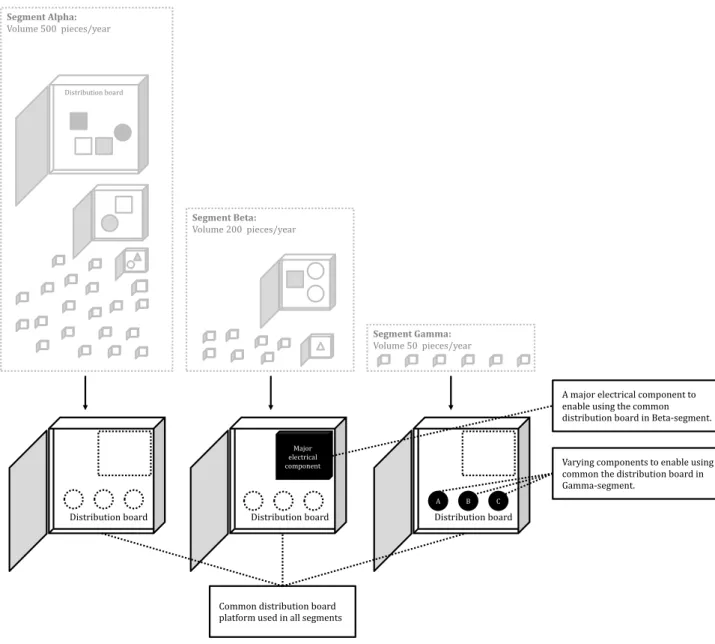
components would make it possible to have one common distribution board platform that could easily be varied to comply with all market segments, Alpha, Beta and Gamma. In practice, customers in segment Alpha would be delivered the one common distribution board platform without modification, Beta would be delivered distribution boards varied with a “major electrical component”, and Gamma would be delivered distribution boards varied using certain “varying components”. Figure 2 illustrates the way in which the number of different distribution boards was reduced through innovation, and thus commonality was enabled.
Segment Alpha:
Volume 500 pieces/year
Segment Beta:
Volume 200 pieces/year
Segment Gamma:
Volume 50 pieces/year Distribution board
Distribution board Distribution board
Major electrical component
Distribution board
A B C
Varying components to enable using common the distribution board in Gamma-segment.
A major electrical component to enable using the common distribution board in Beta-segment.
Common distribution board platform used in all segments
Figure 2: Reducing the amount of distribution boards by an electro-technological innovation.
As can be seen from Figure 2, not all of the theoretical commonality potential was captured in the OEM project. The electrical engineers could have increased commonality even to the point that all segments, Alpha, Beta and Gamma, would have had one common distribution board (not only common platform from which to customize). This was not the case, however, as Figure 2 depicts. In fact, the commonality decision of having three, not one, common distribution boards was perceived a more profitable choice even using mental arithmetic once the component-level mechanisms of cost implications were discussed together with stakeholders from several functions: R&D, finance, operations, and sourcing. In practice, the “major electrical component”
and the “varying components” were so expensive, and needed in that relative small part of the yearly volume, that it seemed unprofitable to overspecify the whole annual volume according to them (and thus have only one distribution board feasible in all segments without any customer-specific modification). The interventionist researchers provided ex ante cost calculations summing up the direct cost implications incurred by the commonality decision of having three different distribution boards. Quite quickly, the practitioners saw that choosing that common platform and those three configurations, one to Alpha, one to Beta and one to Gamma, would be one propitious solution to realize component commonality in practice.
Supporting the Commonality-Enabling Innovation with Accounting Calculations
Indeed, the participating researchers helped the OEM to ex ante estimate the possible cost implications that would occur if the real commonality-enabling innovation would be used in order to create a common distribution board platform used in all segments, Alpha, Beta and Gamma. At this point it was adequate to show only the direct cost implications because indirect cost implications were perceived difficult to quantify in all their complexity. The researchers developed a certain spreadsheet to keep record of estimated cost implications at component level. This spreadsheet would also aggregate the component-level cost implications to a per- annum calculation, to show the cost implications of commonality decisions, and hence the program-level value impact stemming from the single technology project.
The real-life basis for calculating the direct cost implications of component commonality were the following. Distribution boards delivered to segments Beta and Gamma—that together covered roughly one third of the yearly volume—had been completely in-house manufactured before the commonality-enabling
innovation. Only the manufacturing of distribution boards delivered to segment Alpha, which by itself covered most of the yearly production volume, had been mostly outsourced to subcontractors. In addition to direct labor costs (direct in-house labor, external labor and engineering-to-order labor), the distribution boards naturally
incurred material costs (common distribution board platform, “varying components”, “major electrical component”.
It was not clear how engineering-to-order labor would be affected by using the commonality-enabling innovation. An explicit aim was to facilitate engineering-to-order work by using fewer components from which to choose from. This facilitation might decrease the amount engineering-to-order work, but to which extent engineering-to-order work would be decreased was unclear. Hence in the calculation in Figure 3 the amount of engineering-to-order work is kept constant.
In segment Alpha, material costs would see a minor increase, but according to the researchers’ cost estimate, cost savings in labor costs could be acquired. This was because the remaining small amount of direct in-house labor could be outsourced. Of course, outsourcing would increase the amount of external labor costs.
The most significant change in Alpha would be in decreasing direct in-house labor costs. We considered external labor costs to be direct costs, since it was only a matter of deciding whether to assembling the
distribution boards in-house or outsourcing them, once the common distribution board platform was developed.
There was no indirect cost effect taken into account, once in-house labor was included in the calculation as X
€/h, and external labor as Y €/h (here, Y<X). The explanation of why external labor was considered more cost- effective remains a topic for further inquiry in the OEM.
In Beta, material costs would increase little, but the high unit cost incurred by commonality-enabling innovation, the “major electrical component” was almost totally compensated by the cost savings acquired from the common distribution board used in all segments. Adding the new major electrical component to distribution boards in Beta caused certain other components to be to less expensive than before for they could now be specified to a lower level than before. The labor costs would be substantially lower due to external labor coming up less expensive than in-house labor. An important fact was that before the component commonality effort the distribution boards that had been delivered to segment Beta could not have been outsourced, due to too complicated product structure. Now, after rethinking that product structure, outsourcing could be possible. One of the most interesting cost implications in Beta was that although a component itself worth approximately half of the distribution board Beta had before, the material costs in Beta did not increase significantly due to the common platform development that had taken place and lowered material costs.
In Gamma, varying components, “A”, “B”, and “C” were relatively expensive but the overall cost of those components was once again compensated and actually made minuscule by the common distribution board platform that could be varied using the varying components. It was though that the direct labor of assembling
the distribution boards delivered to Gamma-segment would not be outsourced in the future. Once again, it is noteworthy that the expensive “varying components” were subsidized by the less expensive distribution board platform. Such subsidization would not have been possible without innovation and the transfer to a new technology.
In all, the commonality-enabling innovation incurred direct cost savings in the ex ante calculations made by the researchers, and hence program value could be communicated. The stakeholders of the OEM could now communicate this message of component commonality being able to decrease the yearly direct costs to their superiors. The yearly direct costs could be decreased although Beta-segment now used the innovation with a unit cost equal to the original distribution board, and Gamma-segment varying components that also were expensive. Due to the innovation, cost savings in materials and direct labor costs could bring major yearly cost savings without sacrificing customer satisfaction.
Discussion and Conclusions
The OEM’s case shows that in some cases component commonality requires product development, architectural platform development and even technological innovation to even be possible. This phenomenon is left with inadequate attention in empirical literature on component commonality (McDermott and Stock, 1994;
Lee, 1994; Swaminathan and Tayur, 1998; Thonemann & Brandeau, 2000; Ramdas & Shawney, 2001; Ramdas et al., 2003; Thyssen et al., 2006), although some notable efforts towards such mindset have recently been seen (e.g. Marion et al., 2007). Moreover, the issue of the cost (or value) implications of common components has been brought up in the multi-project management literature (e.g., Maniak & Midler, 2014). However, there is still room for more detailed examinations of the actual mechanisms and management of value creation
stemming from the process of component design and selection which, especially within multi-project operations, sometimes requires remarkable innovativeness and product development effort, to reach the objectives set for a specific component selection situation.
The findings of this paper suggest that component commonality innovation affects value and
management of multi-project operations and vice versa. Without the OEM examined in this study having come up with innovations such as the “Major electrical component” or “Varying components”, a common distribution board platform would not have been possible. On the other hand, the context of multi-project management set multiple requirements for a feasible component commonality innovation. In fact, commonality-enabling innovation was not exactly one specific, innovative piece of technology, but rather a burdensome process of product development, within the multi-project context under examination, that needed to be carried out before a
change in component commonality and respective direct costs could be scrutinized, and hence program value gained. Indeed, as one key informant stated:
“[‘Our commonality-enabling innovation’] is not one single component, but rather a sum of many choices.” –Electrical engineer
The choices that the electrical engineer mentioned comprised of ideas to outsource manufacturing after developing a common distribution board platform, decreasing the number of components from which to choose from, and naturally the “Major electrical component” and “Varying components”. There would not have been any absolute value for some specific number of components that would have been more attractive than another number of components. As soon as component commonality was possible—i.e. a commonality-enabling innovation was discovered—and it was somewhat clear that some positive direct cost implications would incur, there was no need for trying to achieve a smaller or greater number of components (whichever would have been more beneficial with regard to costs). The fact that component commonality was embedded in the wider context of a multi-project R&D program, meant also that the component commonality decisions needed to adhere to the common R&D program time-limits.
Indeed, component commonality innovation was embedded in multi-project R&D operations of the OEM. The OEM’s case, together with our literature review, point out that there is a need to identify specific needs for common components (bottleneck items) to harvest value at the program level. Respectively, objectives of value and costs need to be set for single projects (within programs or portfolios) to understand what is actually aspired from component commonality, and hence from component commonality innovation. It is also important to understand that such component commonality and the innovation required will bring uncertainty into multi-project management (as in Korhonen et al., 2014; Martinsuo et al., 2014; Petit & Hobbs, 2010).
As an implication to component commonality research with regard to the commonality-enabling innovation we argue that component-enabling innovation might need to exist before costs can be optimized or before it is useful to calculate these costs. We argue that this might be the case more often than what is
examined in the literature. In our case, it is noteworthy that the commonality-enabling innovation had now made the OEM possible to have exactly one, two or three different distribution boards. The innovation did not make it possible to have, for instance, four or five distribution boards. Indeed, if further innovation had taken place, there could be more numerous and less expensive distribution boards available. Of course, if component number once again had been increased, certain indirect cost implications, possibly negative, could have been seen as well, for instance in sales, purchasing or product development departments. Once again, these issues would have
represented R&D program-level value. The OEM, however, now settled to the commonality level that was attained, i.e. three different distribution boards, and advanced to new bottlenecks in terms of electrical components that would need some kind of component commonality. These multi-project-level impacts were good enough to go forward within the single technology development project. The amount of commonality that was attained was adequate for the OEM, so the firm went on to cut costs elsewhere (not within the scope of our research access). This discussion leads to our first proposition for further research to address:
Proposition 1: Multi-project value can be harvested through finding bottleneck items that can be removed by component commonality.
Furthermore, the previous line of thought leads to an interesting finding. Actually, cascading many component-level analyses into an aggregate-level scrutiny of component commonality in a multi-project environment might contribute to turning the whole production system towards a more standardized operational model. In other words, rather than trying to optimize the number of components with regard to one single functionality of a product, managers might be more interested in cascading numerous cost-cutting component commonality efforts to catch “low-hanging fruit” linked to various product functionalities, as an objective at a multi-project level.
Proposition 2: Multi-project value can be harvested by standardizing operations through multiple component commonality innovations.
Now, building on the idea of cost and profitability estimation in the case study, management
accounting might be one of the most important organizational functions in calculating and visualizing value, like in the OEM, to show the adequate level of component commonality once a commonality-enabling innovation is made. Also the literature on commonality acknowledges the need for cross-functional knowledge integration (as in Jans et al., 2008). Thus, there is still room for research on the social aspects and dimensions of component commonality, and respectively the prerequisites for commonality-enabling innovation to emerge. Such studies would potentially cover the importance of approaching component commonality from the directions of incremental and radical innovation, the former of which is the mindset often seen in previous commonality literature, and the latter of which is what we believe our case illustrates. Similarly, this study paves the way for project, program and project portfolio research that addresses the viewpoint of technological innovation in single projects and how this innovation affects the larger, embedded entity of a firm’s multi-project operations.
Another important implication for further research on component commonality is that the optimization models of costs or profitability might benefit from parameterizing commonality-enabling innovation. If an ex
ante approach was taken in future analytical commonality studies, researchers might be interested in
incorporating the probability of actually discovering a commonality-enabling innovation. Presumably in those studies that focus on incremental innovations that make commonality possible, that probability would be near 100 %. In contrast, in studies where there is a possibility that commonality would require some more radical innovation in order to be possible, that probability of commonality-enabling innovation emerging could be nearer to 0 %. Such uncertainty within projects would again be interesting for researchers interested in the single-project-related influences concerning larger, multi-project operations.
Proposition 3: Component commonality innovation aspects can be parameterized for analytical approaches.
How Does Component Commonality Incur Cost Implications and Value?
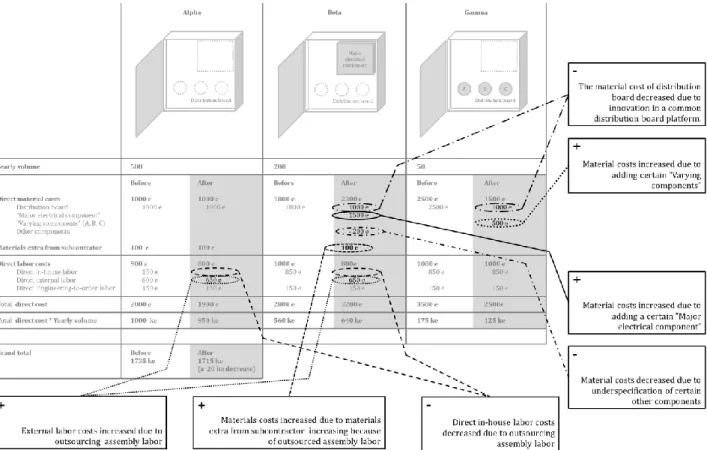
As Labro (2003; 2004) pointed out, we in fact understand little about the mechanisms through which component commonality incurs cost implications. In the OEM’s case, a number of such mechanisms were identified that enrich the existing knowledge of component commonality driving cost by the number of components, i.e. using the commonality indices. Figure 3 depicts the rough ex ante calculations of what would be, in the OEM’s case, the direct cost difference between before and after using the commonality-enabling innovation and having one common distribution board platform that could be varied to three segments4. Figure 3 also sums up the mechanisms through which component commonality incurred cost implications and value in OEM’s case. Figure 3 leads to our fourth proposition:
Proposition 4: The number of components, i.e. the commonality index itself might not drive cost implications, but there can be multiple drivers underlying the cost implications.
4 Exact numerical data from the OEM are disguised using certain multipliers and divisors due to confidentiality reasons. The figures, however, represent real-life direct cost implications of component commonality in the OEM.
Figure 3: The mechanisms through which component commonality incurred cost implications in the OEM’s case.
Further research on component commonality might also be directed to find ways in which accounting might contribute to designers’ understanding of how component commonality incurs costs, and what meaning does such cost data hold for designers. There might also be place for research that disregards the previous research that the number of components is actually a cost driver, and starts more from a tabula rasa on what comes to the cost implications of component commonality.
The mechanisms through which the cost implications of component commonality incurred in the OEM’s case, and illustrated in Figure 3, is one evident finding that might have implications on future research on component commonality. Commonality-enabling innovation might, for instance, compensate the cost of overspefication, as seen in our empirical findings. Nothing but the flexibility need in the ETO context, in the OEM’s case, suggest that the inadequacy of the number of components to explain how and why costs are affected once component commonality is changed would only be a peculiarity of the ETO context. Such need for flexibility, we believe, might also be found from the ATO and MTS contexts as well if researchers gain an in-depth access to such environments, although in the ATO context the problem of a common component might be solved by mass-customization; and in the MTS context by overspecification. However, we claim, such mechanisms of commonality-enabling innovation driving cost implications might well be witnessed in MTS and
ATO contexts as well. The validity of such claim is not questioned by the OEM’s case, but its reliability, however, is left for further research to test.
Proposition 5: Component commonality innovation can drive value creation not only in ETO, but also in MTS and ATO contexts.
What Can Be Learnt from Component Commonality Innovation in the Multi-Project Context?
The central learning point from the presented case study for multi-project management literature is the embeddedness of component commonality decisions within projects, programs and portfolios. Component commonality innovations, with cost and profitability implications respectively, are made in single projects, but their value is harvested within larger multi-project operations. Indeed, component commonality innovations are a central point of creating value when organizational objectives are not aimed at standardized products, but more standardized operational models. As in the OEM’s case, ETO labor was decreased by more standardized electrical components. Developing these common components was, however, a task that required innovation and this innovation realized as a part of an ongoing R&D program. The cost implications, and value of such component commonality innovation are not well known in the scientific literature; hence the value of a component commonality innovation as a part of R&D needs to be examined in the context of multi-project management.
The program value introduced here, stemming from an individual component commonality innovation within an R&D program, is to underline the importance of single projects affecting a larger multi-project operation (continuing the work by, e.g., Korhonen et al., 2014; Martinsuo et al., 2014; Petit & Hobbs, 2010).
Particularly, this paper provides practical hints for the management of customization and component selection within multi-project management (Maniak & Midler, 2014; Petit & Hobbs, 2010). In fact, this study highlights the importance of component commonality innovation in the ETO context, but does not dictate that it is only the ETO context that could benefit from such innovation. It is possible that also in the MTS and ATO context component commonality innovation creates value in the financial terms, even in terms that cover the cost of overspesification often associated with component commonality.
This case study has also implications for operations research. The majority of operations management literature on component commonality is focused on finding theoretically sound tools to manage and optimize costs using component commonality as a parameterized phenomenon (Labro, 2003). In such theoretical efforts it is easily forgotten that component commonality is often realized in environments where, for instance,
technological developments and outsourcing decisions hinder environmental predictability. Indeed, component
commonality is embedded in decisions on production systems, product development and product architecture.
Component commonality is not an island—but more precisely is realized within the wider context of multi- project R&D, which set goals, boundaries and extend control over the real life of a product design engineer.
Component commonality, moreover, is not a hypothetical phenomenon that could always be dealt with in a ceteris-paribus-analytic setting with unquestionable validity.
Thereby, contextual factors around component commonality restrict the applicability of straightforward cost optimization models for guiding component commonality decisions, because the cost implications of component commonality are not yet truly known (Labro, 2003). Oversimplification, we argue based on our findings, might direct commonality decisions towards goals that are not relevant in practice. We stress that disruptions in the operation environment—also due to a commonality decision itself—might hinder predicting the outcome of a commonality effort.
Indeed, managers in real life seek to gain an understanding of when, how and besides which other decisions it is profitable to increase component commonality. Actually, component commonality is realized as a part, and in accordance, of a larger entity of a firm’s multi-project R&D operations, not separately from other decisions and environmental changes (Lyly-Yrjänäinen, 2008). Thereby, with disruptions within context possible, in component commonality decisions as well, we need to admit that straightforward optimization, in particular with inadequate premises, hardly captures the requirements of technological developments, unequivocality of stakeholders, ambiguousness of cost implications or many other complex facets in the diversity of real life of industrial manufacturing. In order to capture some of that complexity, future research is called for to study the dynamic role of and emphasis on decision making tools, i.e. calculations, models etc., in making the commonality decisions that in any case have a potential to influence multi-project R&D more widely. Similarly, researchers might be interested in how these decision-making tools are used, since the practice might reveal significant factors about how suboptimal decision-making aids are used in a managerially- relevant manner. Further, the scope of decision making tools in commonality considerations might be dynamic in nature, since it might be case-dependent how practitioners select appropriate tools to guide their decisions on commonality.
Our account on the embeddedness of component commonality in OEM is an effort to understand the decisions in accordance with which component commonality was realized in one environment. Indeed, we interpreted that commonality was not possible until a commonality-enabling innovation was discovered. We also interpreted that the OEM’s engineers did not base their decisions and communication solely on the
calculations presented. Rather, organizational policy and time limitations of the wider R&D program guided engineers’ action. For the embeddedness of component commonality we also see implications for further research. The embeddedness of component commonality could imply that researchers might be interested in understanding more broadly what certain costs implications or optimization mean or are in different context.
Future research on component commonality might thus be asking questions like: What is commonality optimization? What is optimized when commonality decisions are made? What we perceive optimal when dealing with component commonality? How is commonality optimization embedded in project, program or portfolio management? Moreover, as component commonality is embedded into R&D activities and platform development, commonality researchers might be interested in what management control means within component commonality.
In sum, our empirical evidence gathered from an ETO context gives an illustration refining the extant literature on multi-project management and component commonality. These literatures have not been made to discuss together too vastly before, although the research on multi-project management acknowledges the aspect that customer-driven customization within single projects influences project portfolios (Petit & Hobbs, 2010), issues of commonality are of importance in lineage management (Maniak & Midler, 2014; Midler, 2013), and technology transfer between projects occurs (Nobeoka & Cusumano, 1995; 1997). Vice versa, component commonality has organizational impacts (Lyly-Yrjänäinen, 2008) but this aspect has been inadequately addressed in terms of project portfolios in component commonality literature. By providing empirical evidence of the direct cost implications of commonality-enabling innovation, largely unclear to extant knowledge, we wish to give insights—also in terms of the propositions made—that have potential to elaborate the research on component commonality as part of a firm’s wider multi-project R&D and being influenced by incremental and radical innovation.
Finally, we argue, in line with Labro (2004) that it is too early to predict much on the cost implications of component commonality, before we better understand the mechanisms underpinning those cost implications, embedded with the other business phenomena, e.g. multi-project R&D at hand. This article is one effort towards such understanding of those underpinning mechanisms. However, further research on the social and technical prerequisites for commonality-enabling innovation is still needed, in order to bridge these more qualitative characteristics of commonality to those models that are more quantitative in nature.
References
Adlakha, V. and K. Singhal (1988). Service levels for priority and nonpriority products with a common component. Journal of Operations Management 7(3).
Amaro, G., L. Hendry, et al. (1999). Competitive advantage, customisation and a new taxonomy for non make-to-stock companies. International Journal of Operations & Production Management 19(4): 349–371.
Bagchi, U. and G. Gutierrez (1992). Effect of increasing component commonality on service level and holding cost. Naval Research Logistics 39: 815–832.
Baker, K. R., M. J. Magazine, et al. (1986). The effect of commonality on safety stock in a simple inventory model. Management Science 32(8): 982–988.
Blecker, T. and N. Abdelkafi (2006). Complexity and variety in mass customization systems: analysis and recommendations. Management Decision 44(7): 908–929.
Brun, A., E. Capra, et al. (2006). Behavioural Costs in Manufacturing: How to balance Standardization and Variety Costs. 14th International Working Seminar on Production Economics, Innsbruck, Austria.
Clark, K. B. and T. Fujimoto (1991). Product Development Performance. Strategy, Organization, and Management in the World Auto Industry. Boston, Harvard Business School Press.
Collier, D. (1981). The measurement and operating benefits of component part commonality. Decision Science 12(1): 85–96.
Collier, D. (1982). Aggregate safety stock levels and component part commonality. Decision Science 28(11): 1296–1303.
Conforto, E. C. & Amaral, D. C. (2010), Evaluating an agile method for planning and controlling innovative projects. Project Management Journal, 41(2), 73–80.
Cooper, R., Edgett, S., & Kleinschmidt, E. (1997). Portfolio management in new product development:
Lessons from the leaders I. Research Technology Management, 40(5), 16–28.
Davila, T. and M. Wouters (2007). An empirical test of inventory, service and cost benefits from a postponenement strategy. International Journal of Production Research 45(10): 2245–2267.
Desai, P., S. Kekre, et al. (2001). Product Differentiation and Commonality in Design: Balancing Revenue and Cost Drivers. Management Science 47(1): 37–51.
Dogramaci, A. (1979). Design of common components considering implications on inventory costs and forecasting. AIEE Transactions 11(1): 129–135.
Dong, M. and F. Chen (2005). The impacts of component commonality on integrated supply chain network performance: a state and resource-based simulation study. International Journal of Advanced Manufacturing Technology 27: 397–406.
Engwall, M., Kling, R. and Werr, A. (2005), Models in action: how management models are interpreted in new product development. R&D Management, 35(2), 427–439.
Evans, D. (1963). Modular Design - A Special Case in Nonlinear Programming. Operations Research 11(4): 637-647.
Eynan, A. (1996). The Impact of Demands' Correlation on the Effectiveness of Component Commonality. International Journal of Production Research 34(6): 1581–1602.
Eynan, A. and T. Fouque (2005). Benefiting from the risk-pooling effect: Internal (component commonality) vs. external (demand reshape) efforts. International Journal of Services and Operations Management 1(1).
Eynan, A. and M. J. Rosenblatt (1996). Component commonality effects on inventory costs. IEE Transactions 28(2): 93–104.
Eynan, A. and M. J. Rosenblatt (1997). An analysis of purchasing costs as the number of products' components is reduced. Production and Operations Management 6(4): 388–397.
Feitzinger, E. and H. L. Lee (1997). Mass customization at Hewlett-Packard: The power of postponement. Harvard Business Review 75(1): 116–121.
Fisher, M. and C. Ittner (1999). The Impact of Product Variety on Automobile Assembly Operations:
Empirical Evidence and Simulation Analysis. Management Science 45(6): 771–786.
Fisher, M., K. Ramdas, et al. (1999). Component sharing in the management of product variety: a study of automotive braking systems. Management Science 45(3): 297–315.
Fixon, S. (2005). Product architecture assessment: a tool to link product, process, and supply chain design decisions. Journal of Operations Management 23: 345–369.
Fong, D. K. H., H. Fu, et al. (2004). Efficiency in shortage reduction when using a more expensive common component. Computers & Operations Research 31: 123–138.
Fu, H. and D. K. H. Fong (1998). A note on convexity of the objective function for a simple common component inventory problem. International Journal of Production Economics 55: 143–148.
Gerchak, Y. and M. Henig (1986). An inventory model with component commonality. Operations Research Letters 5(3): 157–160.
Gerchak, Y., M. J. Magazine, et al. (1988). Component commonality with service level requirements.
Management Science 34(6): 753–760.
Guerrero, H. (1985). The effect of various production strategies on product structures with commonality. Journal of Operations Management 5(4): 395–411.
Gupta, S. and V. Krishnan (1999). Integrated Component and Supplier Selection for a Product Family.
Production and Operations Management 8(2): 163–182.
Hicks, C. and P. M. Braiden (2000). Computer aided production management issues in the engineering- to-order production of complex capital goods explored using a simulation approach. International Journal of Production Research 38(18): 4783-4810.
Hicks, C., McGovern, T., et al. (2001). A typology of UK engineer-to-order companies. International Journal of Logistics: Research and Applications 4(1): 43–56.
Hillier, M. (1999a). Component commonality in a multiple-period inventory model with service level constraints. International Journal of Production Research 37(12): 2665–2683.
Hillier, M. (1999b). Product Commonality in Multiple-Period Make-to-Stock Systems. Naval Research Logistics 46.
Hillier, M. (2000). Component commonality in multiple-period, assemble-to-order systems. IEE Transactions 32, 755–766.
Hillier, M. (2002). Using commonality as backup safety stock. European Journal of Operational Research (136), 353-365.
Ho, C. and J. Li (1997). Progressive engineering changes in multi-level product structures. Omega 25(5): 585–594.
Izui, K., S. Nishiwaki, et al. (2010). Switchgear component commonality design based on trade-off analysis among inventory level, delivery lead-time and product performance. International Journal of Production Research, 48(10), 2821–2840.
Jans, R., Z. Degraeve, et al. (2008). Analysis of an industrial component commonality problem.
European Journal of Operational Research, 186(2), 801–811.
Jiao, J. & M. M. Tseng (2000). Understanding product family for mass customization by developing commonality indices. Journal of Engineering Design 11(3): 225–243.
Jönsson, H. and E. A. Silver (1989). Optimal and Heuristic Solutions for a Simple Common Component Inventory Problem. Engineering Costs and Production Economics 16: 257–267.
Jönsson, H., K. Jörnsten, et al. (1993). Application of the scenario aggregation approach to a two-stage, stochastic, common component, inventory problem with a budget constraint. European Journal of Operational Research 68: 196–211.
Karmarkar, U. S and P. Kubat (1987) Modular product design and product support. European Journal of Operational Research, 29(1), 74–82.
Kaski, T. and J. Heikkilä (2002). Measuring Product Structures to Improve Demand-Supply Chain Efficiency. International Journal of Technology Management 23(6).
Kim, K. and D. Chhajed (2000). Commonality in product design: cost saving, valuation change and cannibalization. European Journal of Operational Research 125: 602–621.
Kim, K. and D. Chhajed (2001). An experimental investigation of valuation change due to
commonality in vertical product line extension. Journal of Product Innovation Management 18(4): 219–230.
Korhonen, T., Laine, T.; Martinsuo, M. (2014), Management Control of Project Portfolio Uncertainty:
A Managerial Role Perspective. Project Management Journal, 45(1), 21–37
Kota, S., K. Sethuraman, et al. (2000). A Metric for Evaluating Design Commonality in Product Families. Journal of Mechanical Design 122: 403–410.
Krishnan, V. and S. Gupta (2001). Appropriateness and Impact of Platform-Based Product Development. Management Science 47(1), 52–68.
Labro, E. (2003). The Cost Effects of Component Commonality: A Literature Review through a Management Accounting Lens. 6th International Seminar on Manufacturing Accounting Research, Twente, Netherlands.
Labro, E. (2004). The Cost Effects of Component Commonality: A Literature Review Through a Management Accounting Lens. Manufacturing & Service Operations Management 6(4): 358–367.
Lee, H. (1994). Effective inventory and service management through product and process redesign.
Operations Research, 44(1)
Lee, H. (1997). Effective inventory and service management through product and process redesign.
Operations Research 44(1).
Lee, H. and C. Tang (1997). Modelling the Costs and Benefits of Delayed Product Differentiation.
Management Science 43(1).
Lukka, K. and P. Suomala (2014). Relevant interventionist research: balancing three intellectual virtues. Accounting and Business Research, 44(2), 204–220.