
Finite element models were developed for the axial compression of single-tube and bitubular structures, and the predictions of the models were compared with available experimental results. Studies showed that in example loading situations with fire reduction factor stainless steel columns were 21–46% lighter than unprotected carbon steel column in standard 15 minute fire.
INTRODUCTION
Design rules and codes for stainless steel (such as Eurocode, direct force method) and their accuracy, experimental cross-sectional capacity, bending and fatigue are studied for example in [3, 23-43]. Seismic design also benefits from excellent ductility and strain hardening, and the use of stainless steel in seismic design has been reviewed in [74–77].
STAINLESS STEELS
- Corrosion resistance
- Stress–strain behavior
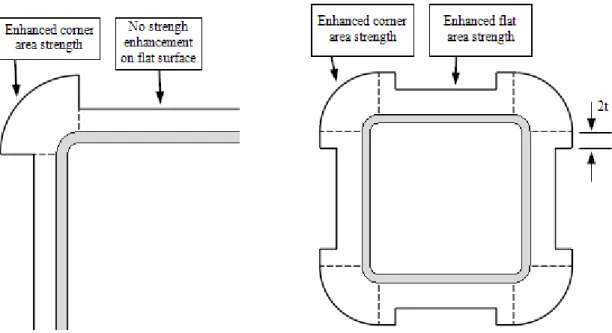
- Strength enhancements by cold forming
- Design methods and design codes
- Welded and bolted connections
- Cyclic loading and fatigue
- Applications in structural design
To facilitate the repairability of the structure, dissipative stainless steel parts were proposed. An advantage of stainless steel over galvanized carbon steel is its appearance.
ENERGY ABSORPTION
Measuring and comparing energy absorption
The area under the stress-strain graph, as the energy absorbed per unit volume, is often used to compare energy absorption properties. Thus, the energy absorption cannot be described only by the stress-strain curve up to the 10% stresses.
Properties affecting energy absorption
Thus, the effect of thickness on bending symmetry and energy absorption is not self-evident. The high sensitivity to strain rate gives EN 1.4318 high work hardening with high strain rates, so energy absorption is good under dynamic loads – even better than EN 1.4301, which performed better under quasi-static loads.
![Figure 4. Folding behavior of A6063 aluminum circular tubes with different thick- thick-nesses [109]](https://thumb-eu.123doks.com/thumbv2/9pdfco/1890759.266925/34.892.212.767.421.728/figure-folding-behavior-aluminum-circular-tubes-different-nesses.webp)
Bitubular structures
The best energy absorption was achieved with 110 mm inner and 120 mm outer tubes while the peak load remained at the level of a single outer tube initial pressure. The combined energy absorption for the 120 mm inner and outer tubes crushed separately was 1291 J, while bitubs in diamond configuration with inner/outer tube lengths of 110/120 had the best energy absorption with 1752 J. The improved energy absorption can be explained with better interaction between the tubes and changed outer tube folding behavior.
At the same time, the peak force of this bitubular structure was only the peak force of the single outer tube (initial crushing force). It is worth noting that in a diamond configuration, an incorrectly sized inner tube can lead to a situation where the maximum peak force of a bitubular structure is not achieved from the initial crushing of the outer tube, but from the point where the inner tube begins to folded. . This can occur when the onset of a secondary outer tube fold and the initial pinching force of the inner tube occur simultaneously.
![Table 3. Some results from [111]. Bitubes were in diamond arrangement. The best energy absorption was obtained with 110 mm inner and 120 mm outer tubes while the peak load remained at the level of a single outer tube initial crush](https://thumb-eu.123doks.com/thumbv2/9pdfco/1890759.266925/38.892.344.636.105.351/results-bitubes-diamond-arrangement-absorption-obtained-remained-initial.webp)
Other ways of improving energy absorption
The differences in the load-displacement curve of the empty and foam-filled tubes were very clear. The behavior of the foam filled tubes was very different because the foam filling reduced the local scratches and ovalization of the tubes. At midspan, the bottom of the foam-filled tube experienced larger tensile plastic strains than the empty tube.
The density of the foam was locally increased at the loading point as it was compressed. In quasi-static bending loading, the force of the 0.9 mm thick foam-filled tube increased somewhat linearly to 10 kN force at approximately 3 mm midspan. In quasi-static bending, the specific energy absorption of the foam-filled tubes with 0.9 mm tube thickness was 2.12 times the value of the 0.9 mm thick empty tubes, and thus a 112% increase in specific energy absorption was obtained with foam filling in bending.
Finite element modelling of axial crush of square hollow section tubes
- Simulation model validation, single tube
- Simulation model validation, bitubular structures
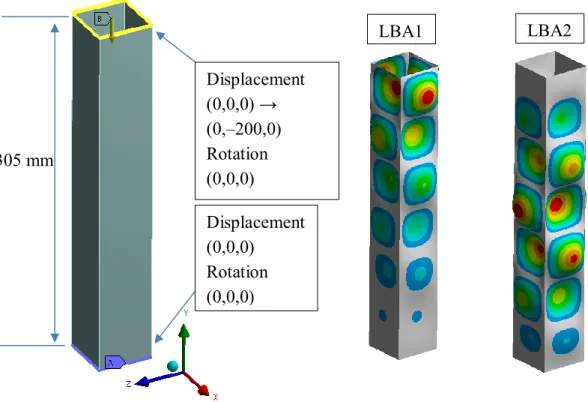
The difference can be seen by the width of the fold (relative to the width of the tube, seen from the front in the figure), which was smaller for the 2nd LBA condition. The results of the current simulation compared to the experimental and numerical results of [111] were somewhat similar. In reference study [111], the folds have very similar heights in both experiments and simulation, whereas the height of the folds in the simulation of this work are remarkably different.
In the simulation of this study, both the top and bottom of the outer tube and the bottom of the inner tube tend to spread outward in opposite directions. After 45 mm axial displacement the force in the simulation of this work started to increase while in the experimental and numerical studies of [111] the force started to decrease. After the initial compression of the shorter inner tube (after 10 mm axial displacement) the force in the simulation of this work remained higher than in the reference simulation.
STRUCTURAL FIRE DESIGN WITH STAINLESS STEELS
Elevated temperature properties of stainless steel
There are some differences in the alloy of the tested sample and EN 1.4301 standard values. At elevated temperatures, the shape of the nonlinear stress-strain curve of stainless steel retains the shape of the room temperature curve [47]. In the second phase, the concrete core began to take most of the load as the temperature increased and the steel tube began to fail.
The difference can be explained by the fact that the strength and stiffness of carbon steel is greatly reduced. The concrete temperature also increased faster in the carbon steel than in the stainless column. The temperature was kept constant until column failure after reaching the oven temperature of 800 °C.
![Figure 16. Reduction factors for carbon steel according to EN 1993-1-2 [106] and for stainless steel according to Design Manual for Structural Stainless steel [3]](https://thumb-eu.123doks.com/thumbv2/9pdfco/1890759.266925/55.892.182.717.174.760/figure-reduction-factors-according-stainless-according-structural-stainless.webp)
Design of compressed carbon and stainless steel members
- Room temperature design of compressed carbon steel members
- Fire design of compressed carbon steel members
- Room temperature design of compressed stainless steel members 55
Strong local buckling along the entire length of the pipe reduced the strength of the pipe and also reduced the support the steel formwork gave to the concrete core. It is ensured that the pressure design load 𝑁𝐸𝑑 does not exceed the pressure resistance of the element. The design at room temperature of the axially compressed stainless steel elements was performed according to the Design Manual for Structural Stainless Steel [3], which presents new, more precise design rules.
The design manual [3] has only the resulting emissivity εres rather than separate emissivity for fire and steel, and can be taken as the emissivity of the steel, 0.4. It should be noted that the design emissivity of stainless steel (0.4) differs from the design emissivity of carbon steel (0.7). The correction factor ksh is neglected and notations for specific heat and density are different from those of carbon steel, so the form of the equation for the temperature rise is 𝛥𝜃𝑎,𝑡 in member.
Mass comparison of axially loaded members in fire design
Design strength for room temperature fy (0.2% resistivity for stainless steel, yield strength for carbon steel), element mass, element final temperature and utilization rate (UR) for room temperature (RT) and fire design are shown. Results for compressed columns at room temperature and 15 min standard fire with load case 2 mentioned earlier (room temperature load 142.5 kN, ηfi = 0.46) are shown in Table 8. Room temperature design strength fy (0.2% yield strength for stainless steel, yield strength for carbon steel ), element mass, element end temperature and utilization rate (UR) for room temperature (RT) and standard fire load are shown.
Calculation results for load case 2 (load at room temperature 142.5 kN, fire reduction factor ηfi 0.46) at room temperature and at standard fire of 30 minutes are shown in Table 10. Lowest mass cross sections for compressive load, case 2 (load at room temperature 142.5 kN , fire reduction factor 0.46), in 30 min standard curve fire. At fire reduction factor 0.3, both EN 1.4301 and EN 1.4571 are dimensioned via the design of the ultimate limit state at room temperature.

Cost comparison of axially loaded members in fire design
Cost comparison of mild steel and stainless steel parts in standard 15 min fire with ULS load 100 kN and fire reduction factor 0.55. Cost comparison of mild steel and stainless steel parts in standard fire 30 min, fire reduction factor was 0.55 and normal load at room temperature 100 kN. Cost comparison of mild steel and stainless steel parts in standard fire 30 min, ηfi = 0.55 and normal load at room temperature 500 kN.
Cost comparison of mild steel and stainless steel elements at a standard 30 minute fire with a fire reduction factor of 0.40 and a normal load of 100 kN at room temperature. It can be noted that in this example the mild steel pipe with the best utilization rate at room temperature and the lowest mass (€80.1) was slightly more expensive than the EN 1.4301 member. Duplex tube was the most expensive with a cost of €105.4, which was 70% more than the cost of the cheapest mild steel member.
![Table 11. 30 min fire protection cost structure according to [120] and values used in calculation examples in this work](https://thumb-eu.123doks.com/thumbv2/9pdfco/1890759.266925/75.892.176.808.327.480/table-protection-cost-structure-according-values-calculation-examples.webp)
DISCUSSION
Energy absorption
After validating the material model with a single-tube model, the simulation was performed for two-tube structures. The comparison showed that the simulation model of this work overpredicted energy absorption by 29% and peak force by 13%. The energy absorption from the results of this study was in all cases higher than the experimental and numerical results in [111].
It was shown that the simulation models for single aluminum or AISI 304 tubes could give good predictions about the energy absorption at axial crush. However, when the bitubular axial crush model was compared to the experimental data, the energy absorption error was 29%. By calculating and varying different calculation parameters, good results of the single-tube simulation models were obtained, but comparable accuracy was not obtained for the bitubular simulation.
Fire design
The price of stainless steel is not stable and may cause the cost to fluctuate. If the profile sizes were freely chosen (for example with an accuracy of 1 mm), the prices of unprotected carbon steel posts and EN 1.4301 stainless steel posts would be even closer to each other. Increasing the bending length also increases the cross-sectional size and thus the difference in cost between mild steel and stainless steel parts.
When the total initial cost is considered, unstabilized austenitic stainless steel EN 1.4301 performs well in 15 min standard fire. Because stainless steel is more expensive than mild steel and without fire protection the total cost is directly related to the price of the steel, high thickness increases the cost of a stainless steel element remarkably. The mass of the element is not as critical for the cheap mild steel as for the more expensive stainless steel.
SUMMARY
Rasmussen, Full range stress-strain curves for stainless steel alloys, Journal of Constructional Steel Research, Vol. Ashraf, Numerical investigation of bending resistance of stainless steel hollow parts, Journal of Constructional Steel Research, Vol. Real, Experiments on cold-formed ferritic stainless steel slender sections, Journal of Constructional Steel Research, Vol.
Abidelah, Analysis of the Behavior of Stainless Steel Bolted Joints, Journal of Constructional Steel Research, Vol. Choo, Design and Analysis of Stainless Steel Profiled Blast Barriers, Journal of Constructional Steel Research, Vol. Bambach, Numerical modeling of stainless steel plates under pressure, Journal of Constructional Steel Research, Vol.
![Figure 2. Concentrically braced moment resistant frame with stainless steel dissipative pins and stainless steel fuses [74]](https://thumb-eu.123doks.com/thumbv2/9pdfco/1890759.266925/28.892.180.804.108.502/figure-concentrically-braced-moment-resistant-stainless-dissipative-stainless.webp)
![Figure 5. Quasi-static folding behavior of ASTM A36, ASTM A513, AISI 316 and AISI 304 square hollow tubes, respectively, in room temperature [64]](https://thumb-eu.123doks.com/thumbv2/9pdfco/1890759.266925/36.892.258.719.106.401/figure-quasi-static-folding-behavior-square-respectively-temperature.webp)
![Figure 6. Rib-style crush initiators [110].](https://thumb-eu.123doks.com/thumbv2/9pdfco/1890759.266925/36.892.261.712.627.1027/figure-rib-style-crush-initiators.webp)
![Table 2. Crush test simulation results from [110] with different rib arrangements. Tube without initiators is given for reference](https://thumb-eu.123doks.com/thumbv2/9pdfco/1890759.266925/37.892.163.826.162.381/table-crush-simulation-results-different-arrangements-initiators-reference.webp)
![Figure 7. Illustration figure for the bitubular specimen arrangement used in [111]. On the left the parallel and on the right the diamond arrangement](https://thumb-eu.123doks.com/thumbv2/9pdfco/1890759.266925/38.892.170.809.953.1094/figure-illustration-bitubular-specimen-arrangement-parallel-diamond-arrangement.webp)
![Figure 9 shows the folding behavior of AISI 304 tubes in experiments [64] and in FEA validation model](https://thumb-eu.123doks.com/thumbv2/9pdfco/1890759.266925/43.892.196.712.104.538/figure-shows-folding-behavior-aisi-tubes-experiments-validation.webp)