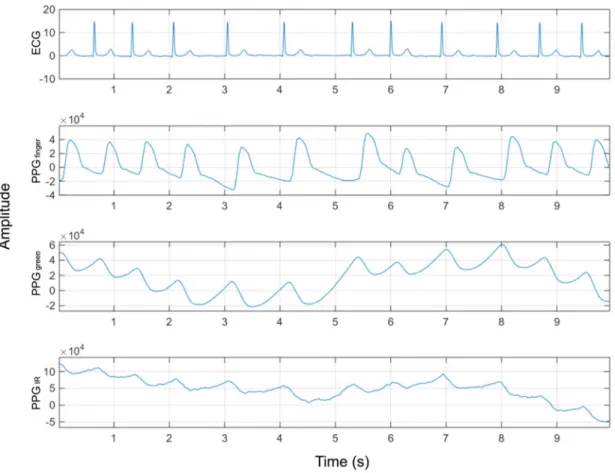
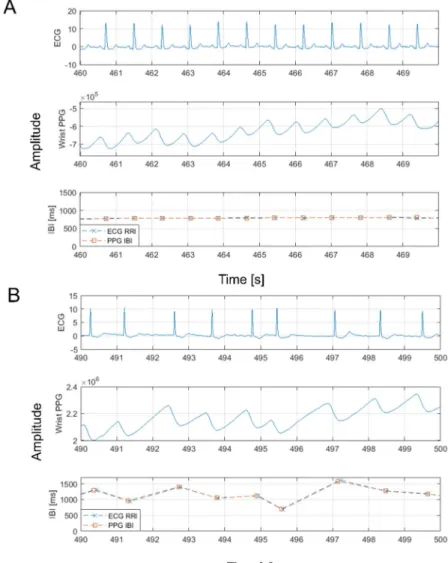
The recognition of AF is based on two characteristic phenomena in the ECG: the absence of the p wave and the irregularity of the heartbeat intervals. Thus, the decision about the rhythm is based on the regularity or irregularity of the heart contractions and is evaluated by the peripheral pulse wave. To better understand the accuracy of this device, fingertip PPG signals (PPGfinger) were also analyzed.
Mean Absolute Error (MAE): The mean of the absolute difference between the reference and estimated heart rate. Root Mean Squared Error (RMSE): The square root of the average of the squared errors between the reference and estimated heart rates. As a first processing step, the derivative of the PPG signal is calculated by taking the difference of successive samples.
Afterwards, IBIs are calculated as the time distance between consecutive local minima of the smoothed PPG derivative. RMSE: the square root of the average of squared errors between the reference RRI and estimated IBI. This corresponds to theoretical maximum performance, but may ignore too much of the collected data.
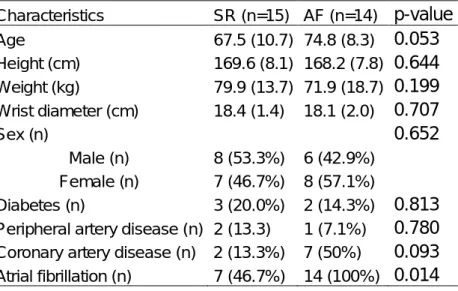
One patient in the AF group initially had AF, which reverted to SR shortly after the start of measurement.

IBI estimation analysis
In addition to ME, MAE and RMSE, the percentage of beats used in the analysis is also shown. For both SR and AF groups, the statistics are better for signals collected from the fingertip. Comparison of ECG values to finger and wrist measurements in patients with sinus rhythm (SR) or atrial fibrillation (AF).
Comparison of ECG-derived values in finger and wrist measurements in patients with sinus rhythm (SR) or atrial fibrillation (AF) compared to ECG. The numbers are calculated for clean one-minute intervals with no extra or missed beats, when you throw +/- 5 beats around each extra or missed beat, when you throw +/- 2 beats around every extra or missed beat, and taking into account all IBIs that have a one-to-one correspondence with an ECG RRI. The IBIs from the wrist and finger sensors were compared to the reference RRIs also through Bland-Altman plots, shown in Figures 4 and 5 for the SR and AF groups, respectively.
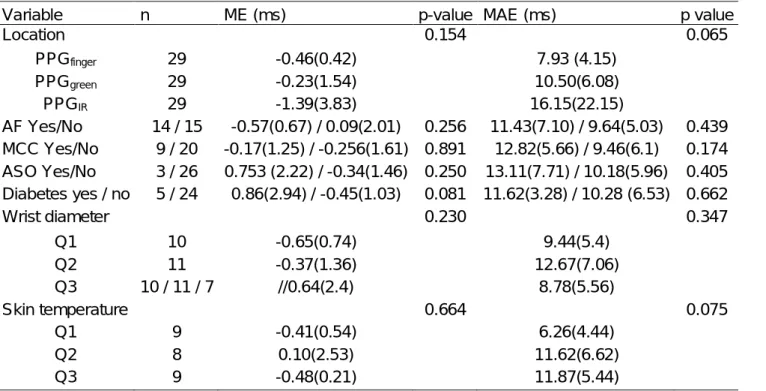
In the SR group the mean difference was 0.22 ms between ECG and PPGgreen, 0.67 ms between ECG and PPGIR and 0.45 ms between ECG and PPGfinger. In the AF group the mean difference was 0.48 ms between ECG and wrist PPGgreen, 0.24 ms between ECG and PPGIR, and 0.52 ms between ECG and PPGfinger. Selected background variables that may affect the accuracy of IBI estimation using clean 1-minute intervals are compared in Table 5 .
There were no statistically significant differences caused by any of the background variables regarding ME or MAE.

AF detection
Because the HR is an average value obtained from a longer segment of the PPG signal, it was not affected by pulse wave artifacts as much as the IBIs and AF detection. This is clearly demonstrated in the detailed analysis of both IBI estimation and AF, where performance or specificity dropped significantly when all IBI were included in the analysis. The measurement on the finger has shown high accuracy and precision (Chuang et al. 2015, Coppetti et al. 2017).
In a study by Kroll et al., the mean difference between HR from ECG and personal fitness tracker was -1.14 bpm (limits of agreement 24 bpm) during intensive care treatment. In a study by Fukushima et al., the mean SD was 8.7 bpm when an acceleration sensor was used to improve the performance of a wrist sensor during movement in healthy subjects (Fukushima et al. 2012). Commercially available wrist-based sensors have also been compared in several studies with healthy subjects, but the results have been mixed and thus cannot be directly applied to hospitalized patients (Terbizan, Dolezal & Albano 2002, Parak & Korhonen 2014, Wang et al. 2017, Hendrikx et al. 2017, Shcherbina et al. 2017).
In the present study, the very good accuracy previously found in healthy subjects (Delgado-Gonzalo et al. 2015) was replicated in patients with marked comorbidities and heart rhythm irregularities. The irregularity in heart contractions changes the cardiac output volume causing changes in pulse amplitude, especially at high HR (Stanton et al. 2008). In the absence of motion, the beat-to-beat estimation accuracy reported in this study is comparable to studies using ECG signals and automatic beat detection (Dash et al. 2009, Stoyan Tanev 2012, Phukpattaranont 2015, Cvikl , Zemva 2010).
Other studies that measured PPG reflectance on the finger showed slightly worse results (Lee, Reyes et al. 2013). With a less sensitive approach, more data were included in the analysis, resulting in a decrease in precision. However, on examination of the ECG waveform, p-waves were missing and the rhythm was defined as AF.
The specificity decreases as we consider more beats for estimation, because more incorrectly estimated beats are considered in the analysis. This is consistent with previous studies showing that although HR can be measured from the wrist region using IR wavelength (Harju et al. 2017), it is associated with increased motion artifacts and poorer accuracy. low when compared to green light (Matsumura et al. 2014, Lee et al. 2013, Maeda, Sekine & Tamura 2011). Interestingly, one study has reported the lowest artifact rate using a differential channel that combines recordings of red and green wavelengths (Zhou et al. 2016).
Limitations
All procedures involving human participants were performed in accordance with the ethical standards of the institutional and/or national research committee, as well as with the 1964 Declaration of Helsinki and its later amendments or comparable ethical standards. 2015, "Photoplethysmography variability as an alternative approach to obtain heart rate variability information in chronic pain patient", Journal of Clinical Monitoring and Computing, vol. 2015, "Evaluation of accuracy and reliability of PulseOn optical heart rate monitoring device", Conference proceedings: ..Annual International .
Conference of the IEEE Engineering in Medicine and Biology Society.IEEE Engineering in Medicine and Biology Society.Annual Conference,vol. 2015, "Are currently available wearable devices for activity monitoring and heart rate monitoring accurate, precise, and medically beneficial?", Healthcare Informatics Research, vol. 2012, "Heart rate estimation using pulse-type photoplethysmography and accelerometer while running", IEEE, United States, pp.
34; Heart rate variability with photoplethysmography as a surrogate measure of heart rate variability during non-stationary conditions", Physiological Measurement, vol. 2017, "Clinical evaluation of the measurement performance of the Philips health watch: a within-person comparison study", JMIR Mhealth Uhealth, vol. 2016, "PULSE-SMART : Heart rate-based arrhythmia discrimination using a novel smartphone application," Journal of cardiovascular electrophysiology, vol.
2013, “A New Application for Irregular Pulse Detection Using an iPhone 4S in Patients with Atrial Fibrillation,” Heart Rhythm: The Official Journal of the Heart Rhythm Society, vol. 2016, “Monitoring and Detection of Atrial Fibrillation Using Wearable Technology,” Conference Report: ..Annual International Conference of the IEEE Engineering in Medicine and Biology Society.IEEE Engineering in Medicine and Biology Society.Annual Conference, vol. 2014, “Evaluation of Consumer Wearable Heart Rate Monitors Based on Photopletysmography,” Conference Report: ..Annual International Conference of the IEEE Engineering in Medicine and Biology.
2015, "Evaluation of Beat-to-Beat Detection Accuracy of the PulseOn Wearable Optical Heart Rate Monitor", Conference Proceedings: ..Annual. 2013, "Validation of a Wrist Monitor for Accurate Estimation of RR Intervals During Sleep", Conference Proceedings: .. Annual International Conference of the IEEE Engineering in Medicine and Biology Society. IEEE Society Engineering in Medicine and Biology. Annual Conference, vol. 2008, "Chronic atrial fibrillation: Incidence, prevalence, and prediction of stroke using the risk stratification scheme of congestive heart failure, hypertension, age >75, diabetes mellitus, and previous stroke or transient ischemic attack (CHADS2)". Am Heart J, vol.