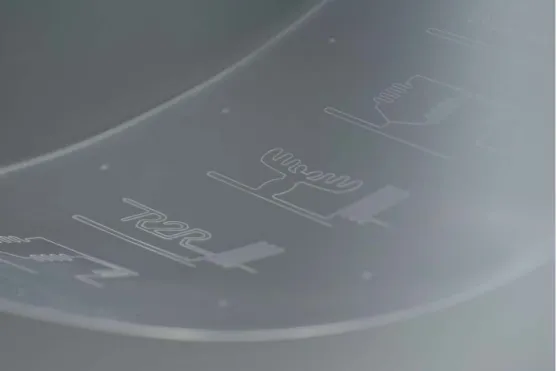
A number of the major consumer brands now have teams working on the application of print intelligence - most operating well below the radar. Recognizing this need, VTT has been a pioneer in investing in manufacturing infrastructure to support the adoption of printed intelligence as a whole.
Proof of cash fl ow
Hafner has worked with industrial innovations for a quarter of a century and now he serves as a scientific expert on VTT's Scientific Advisory Board. Among other things, the board examines the megatrends that exist around the world and how VTT's technology and innovations can help solve the problems that arise from them.
The growing role of energy technology
It has not only been good for the environment, but also for business," says Hafner. According to him, energy technology will also become increasingly important for the chemical industry.
Focus on sustainability
The chemical industry has gone to great lengths to clean its waste water, refine its processes and save energy. OLED screens and self-illuminating screens and light boards are examples of the chemical industry's contribution to the development of energy-saving OLED systems.
R&D services for industry
Enabling technologies and capabilities
The combination of color-changing printed inks and liquid control systems can be used to develop consumer products such as interactive packaging, low-cost indicators, and rapid diagnostic tests. All of these applications can be produced using existing and high-volume production technologies such as roll-to-roll hot stamping, as well as printing fluid control structures and functional inks on paper and plastic substrates.
Potential application markets Our generic platform of technologies can be
Printed electronic components: Printed electronic components such as thin-film transistors, memories, power sources and sensors are important building blocks for system integration. These are based on low-cost, flexible substrates and components that are integrated into injection molded parts, creating new categories of intelligent 3D plastic products.
Win with VTT
Making volume production a reality
VTT has experience and world-class equipment for the development of paper and board from fiber composition to the final printed product, for multiple applications. This, together with the excellent knowledge of biomaterial modification, provides an outstanding basis for the development of new sustainable substrates for new applications (Figure 1).
Cost and environmental advantages
Excellence in R&D for bio-based materials
VTT has the capability to carry out all steps in the piloting of roll-to-roll trials of printed intelligence on a fibre-based basis, from pulping through web forming and to coating and printing of paper or board rolls.
Acknowledgements
VTT is developing an aluminum-based low work function metallic ink as a replacement for printable silver inks and pastes in a wide range of printed electronics applications.
Substitute for silver
Lowering work function, cost and environmental footprint
This manifests itself as high operating voltages and energy consumption in electronic devices that have their operating voltage supplied via conductors made of these materials [1]. When using VTT's new low work function ink, the electron transfer on the printed metal conductor can be improved and the working voltage and high power consumption can be reduced.
High potential application markets The low work function ink fi nds end uses in a
In addition to research and development activities, VTT is also active in the commercialization of the technology. In these efforts, VTT collaborated with Coatema GmbH to demonstrate practical application of the process.
Introduction
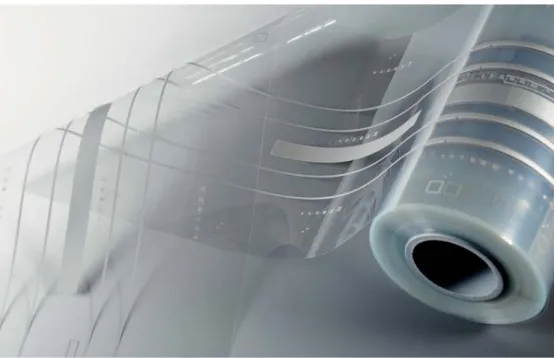
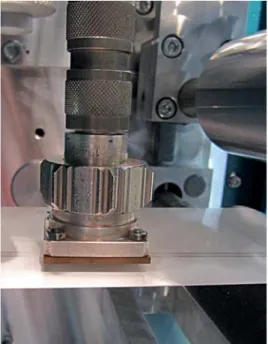
As part of materials and process research conducted in 2010, VTT developed new processes for electrically sintering conductor grids on a range of optoelectronic devices such as photovoltaic (PV) cells, solid-state lighting and displays. Contactless electrical sintering offers great potential as a compact and efficient process; the continuation of the project in 2011 focused on the integration of the conceptually proven device into a real roll-to-roll production line.
Approach
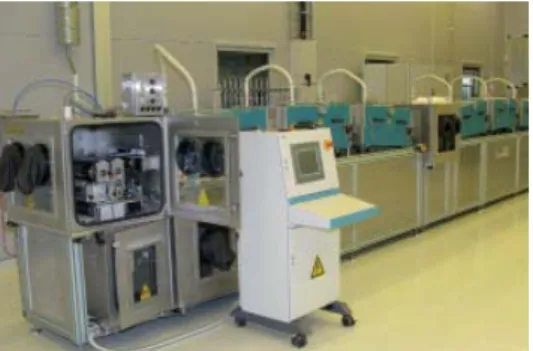
Live demonstration with a roll-to- roll production line
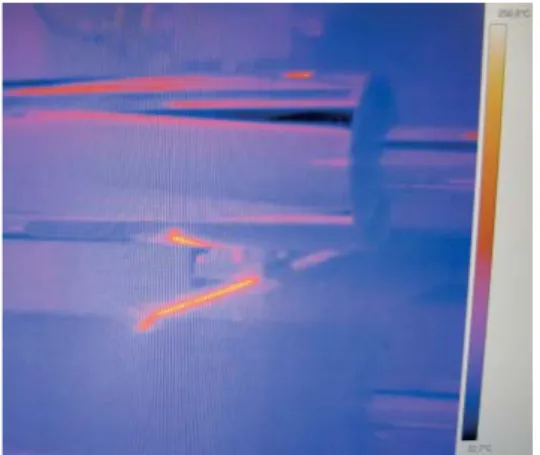
This effect was seen from a snapshot of the process taken with an infrared camera, which clearly shows the overall thermal effect as the track is sintered (Figure 3).
Initial results
Further development and integration into production
The encouraging results show that the process has real potential as an integrated roll-to-roll manufacturing technique that may soon replace traditional furnace-based sintering in some applications. Through VTT, industrial companies and our R&D partners can access the world's leading roll-to-roll pilot production facilities.
Enabling products and business from printed intelligence
Measurements and testing in roll- to-roll environment
Optical measurements
Functional testing
From roll-to-roll to roll-to-product
VTT has unique expertise in the development of low-cost indicators and sensors for consumer and environmental applications. These indicators and sensors are based on chemical and biochemical reactions, which are expressed in functional inks.
Low-cost platform for novel sensing and service concepts
Rapid detection and visual indication
Especially in cosmetics, tests for skin type and treatment effectiveness can also be foreseen as potential applications. For example, in indoor air applications, indication of residues of building materials or cleaning agents can be performed by means of indicators and sensors for volatile substances.
Fast and effi cient solutions
With VTT's pilot roll-to-roll printing capabilities and proven technological competence, the use of this technology is brought to an industrially applicable level. As a practical example, VTT demonstrated the clinical application for the detection of bacterial resistance to antibiotics based on a disposable roll-on-roll, hot-embossed capillary electrophoresis chip [2].
R&D and service offering in microfl uidics
VTT's multidisciplinary teams have developed competencies in the integration of functional elements and in the development of biological tests on microfluidic chips. VTT's core offering for printed microfluidic polymer platforms includes research and development of functional fluidic structures on foils and sheet materials from prototyping to mass production.
An integrated opto-fl uidic platform The development of photonics has been
VTT has extensive experience in developing polymer photonic devices to meet challenges in several application areas, ranging from consumer products such as decorative coatings to high-performance systems such as sensors and optical interconnects.
Multi-technology approach
Monitoring tools for health and environment
The medium-term vision for the use of VTT's polymer optofluidic technology includes enabling the platforms to be used in consumer applications.
The photonics and fl uidics R&D service offering
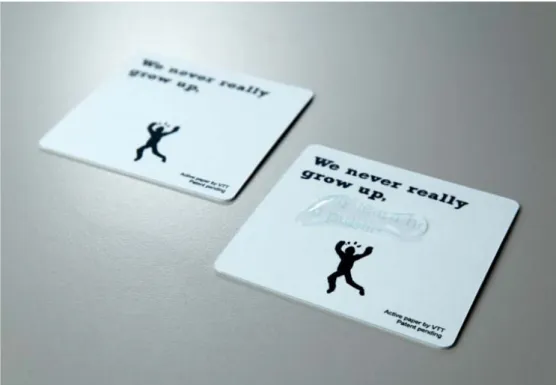
Active Paper is a platform for a variety of new paper-based products, such as diagnostic or promotional devices. Promotional products also open an opportunity to introduce a diagnostic test as an integrated element in packaged consumer goods.
Several years of research into active paper at VTT
These printed hidden features can be used as interactive elements in combination with printed graphics and/or as diagnostic sensors and indicators. This allows brand owners to differentiate their offering from the competition and engage consumers with an affordable new kind of interactive product.
Combining disciplines to bring active paper closer to end
VTT's unique multidisciplinary environment and world-class expertise can help companies develop new products rapidly. VTT's additional offering in the area of active paper technology includes product and business innovation services to support client companies in identifying new product ideas and new business concepts for early market trials and commercial adoption .
Fuelled by renewable chemicals These reactions are catalysed by enzymes
Environment-friendly and biodegradable solutions
Roll-to-roll-compatible production Prior to use, the electrodes of our biobattery
Integration of a biobattery with a printed supercapacitor
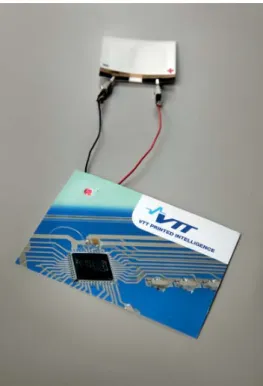
Enzymatic active power source layers printed with VTT's pilot-scale roll-to-roll printing line. The mid-term application potential of VTT's roll-to-roll printed OPV technology can be found in the building-integrated PV sector, where OPV has particular advantages as an architectural design element.
Roll-to-roll processing and direct patterning
Unlike rigid liquid crystal displays or reflective electrophoretic and electrochromic display technologies, VTT's flexible and emissive printed OLED technology enables lean and agile production of specially designed and large display elements and signage (Figure 1) with low operating costs, with low investment costs for capital equipment. Low operating and equipment costs Depending on the application, mains, battery or wireless power can be used to power the printed OLED display and sign elements.

Enabling manufacturing
The long-term application vision for OLED technology is to enable the cost-effective realization of flexible, large-area emissive display and signage elements for communication and architectural lighting.
Material formulation and process development services
VTT is developing printable flexible transistor arrays for use as display backplanes in combination with its fully roll-to-roll printable polymer light-emitting diode frontplane to provide a flexible and robust solution for displays enabling new form-factor devices for cost-sensitive high volume products. Active matrix organic light emitting diode (AMOLED) displays have now become commonplace in smartphones, tablets, media players and other reduced form factor devices.
Meeting the high resolution and registration accuracy
Active-matrix organic light-emitting diode (AMOLED) displays have now become common in smartphones, tablets, media players and other reduced form factors.
Enabling high-performance devices
The gate electrode overlap with the source and drain electrodes must be kept to a minimum to minimize capacitive effects and response delay. The dielectric layer must be void-free and of a uniform thickness for all units in the transistor array to ensure uniform operation of the backplane – the human eye is extremely sensitive to contrast and intensity variations.
Application markets for printable display backplanes
VTT's roll-to-roll printing technologies combined with low-power microelectronics enable the integration of sensing and communication functions on wide, flexible and thin surfaces.
Combining sensing and communication technologies
A versatile application platform Examples of the short-term application poten-
Smart NFC poster
In the poster, interaction with the end user is enhanced by integrating printed touch sensors into the poster. Finally, dynamic interactivity and user experience were enhanced by integrating light sources onto the surface of the poster canvas.
Sensor systems R&D and service offering
In this approach, the communication between the mobile terminal and the smart poster is based on NFC technology. VTT is developing a hybrid in-mould integration technology that enables seamless integration of new optical, electrical and mechanical functions into 3D plastic products.
Freedom of design
In addition, the use of roll-to-roll manufacturing in the printing, assembly and over-molding of flexible hybrid electronic systems enables the cost-competitive production of 3D plastic products. The concept (Figure 1) is based on the seamless combination of roll-to-roll printing, component assembly, lamination, sheet forming and in-mold labeling processes.
Combining fl exibility with performance
Hybrid technology truly combines the best of both worlds – the unique form factor of printed organic electronic components and the high performance of inorganic electronic devices.
Rapid prototyping and pilot manufacturing
Optimisation of user experience and manufacturing costs
VTT has developed a fully roll-to-roll printable electrical memory based on patented nanoparticle sintering technology.
Successful product prototype demonstration
The voting cards were distributed to visitors at the conference Printed Electronics Europe 2011 for the selection of the best exhibition stand. VTT was behind the reading of the votes stored on the cards using a custom-made contact reader.
Enabling data-carrying and programmability by printing
The battery inside the card used for memory programming was made by Enfucell and the ink used for the memory bits came from Advanced Nano Products.
Printed electrical memory for various applications
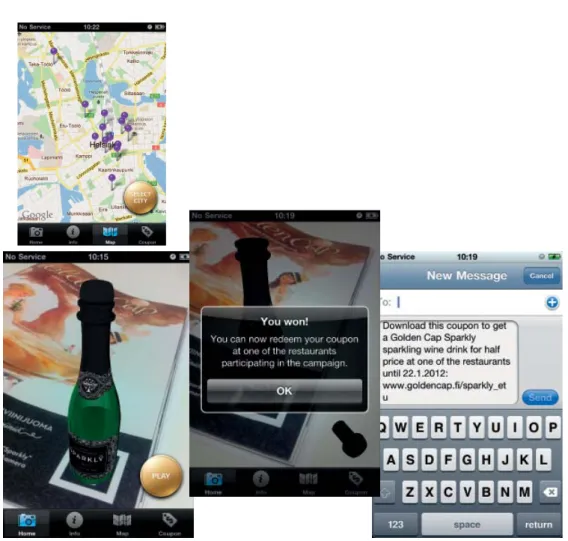
One of the outputs of the project is the commercial AR application created in collaboration by VTT, Sinebrychoff and Aller. The final result of the project, an interactive Golden Cap Sparkly advertisement (Figure 1) by Sinebrychoff, was presented to the readers of the magazine in late November (in the December issue of Elle).
Business from printed intelligence technologies
PrintoCent is joint collaboration in the field of print intelligence and optical measurements. Together in PrintoCent, member companies gain easy access to new business development and lead manufacturing resources for launching printed intelligence components, systems and products, from pilot production to early market trials.
Come and join the PrintoCent ecosystem
Themes for the programme period 2013-15
PrintoCent today
PrintoCent has hosted seminars and produced many demonstrators to promote and stimulate the commercialization and industrialization of printed intelligence technologies. By the end of 2011, companies had invested more than 2 million euros in Printo-Cent and nine new spin-off companies had been created, highlighting how an incubation environment supports the commercialization of printed intelligence technologies.
Ingredients of new spin-offs
Spontaneous
Guided
On-demand
Harvesting of ideas
From the very beginning, the foundations of the program were visionary, and the ambitions for commercialization were just as strong. This insight gave the program good tools to guide research towards successful commercialization.
Nanometre accurate sensors
Positive results from steel industry
Unique measurement accuracy in transparent packages
Next-step global markets
A mobile add-on
Professional products launched fi rst
In the security business, for example, the devices can be used to read microcodes in various logistics systems.
KeepLoop in a nutshell
Light-scattering effects on plastic fi lms and paper
Long history of hot embossing technology at VTT
Market need
Future plans
Innovation for a growing market The global touchscreen market is currently val-
Combining optics with printed electronics
Commercial possibilities were already being investigated in 2008 when printed electronics also appeared. Combining printed electronics with technology was crucial, as it enabled lower costs but good quality.
Licensing and manufacturing
R2R-PILOT printing line
EVA R2R-evaporator
R2R post treatment unit
R2R laser processing
PILOT coating line
Novel conductor ink
CONDUCTIVE INK AND CONDUC- TOR, United States Patent Application
Enabling printed high-quality conductors
Printed logic and memory
Your lab on a chip
VTT PRINTED INTELLIGENCE
Printed Intelligence