KTM, VTT, the Radiation and Nuclear Safety Authority (STUK), and the electricity companies Teollisuuden Voima Oy (TVO) and Fortum Oyj together with the National Technology Agency (Tekes) and Helsinki and Lappeenranta University of Technology are represented in the program's steering group. The program's research areas and focus are defined in the framework proposal for the content and organization of SAFIR. This report has been prepared by the program manager in collaboration with the project managers and members of the program's staff.
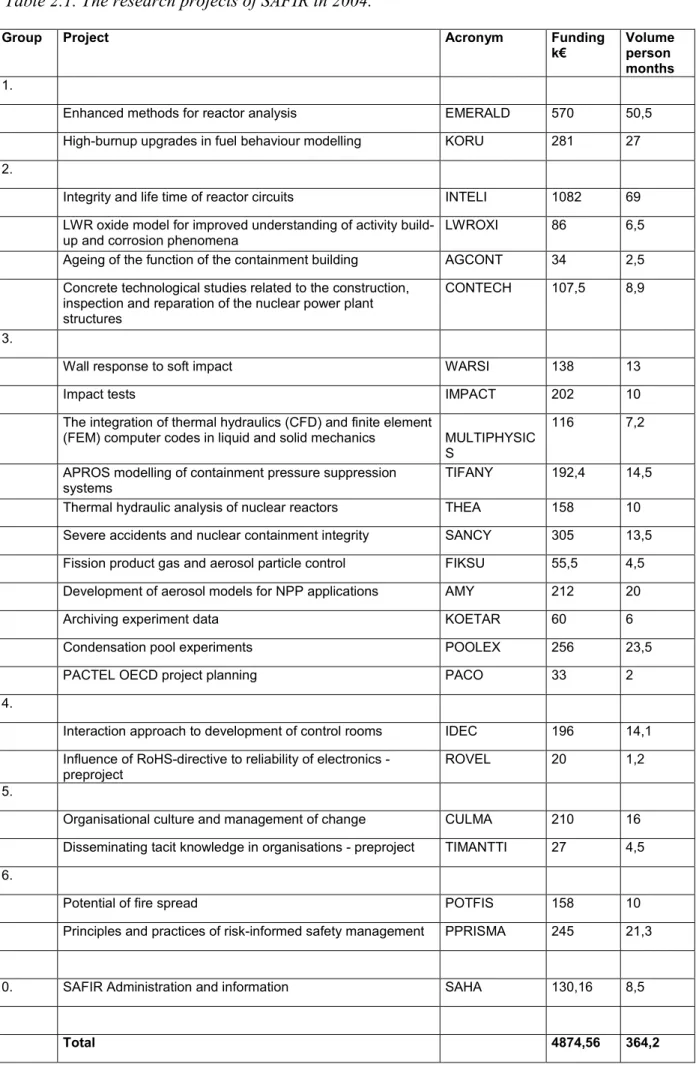
Division of the twelve major future security challenges into six SAFIR research areas [1]. The titles of the projects and their division into six research areas are shown in Table 2.1. Most of the projects were planned to continue throughout the four-year period of the SAFIR program [4].
![Figure 1.1. Main themes of nuclear plant safety [1].](https://thumb-eu.123doks.com/thumbv2/9pdfco/19361000.0/6.892.160.726.482.869/figure-1-1-main-themes-nuclear-plant-safety.webp)
Reactor core and fuel
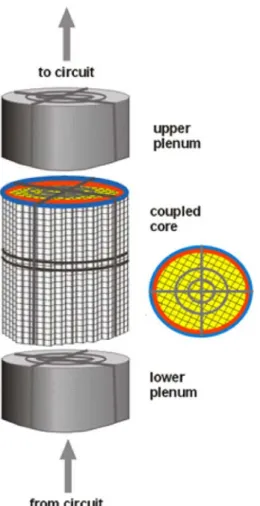
Enhanced methods for reactor analysis (EMERALD)
In addition, it is of particular importance in today's situation, when the use of nuclear power is increasing at the same time as the current generation of nuclear experts is gradually retiring, to maintain competence and train new personnel. Cooperation with the technical and other universities is necessary to get new students interested in this branch of science and thus ensure that the nuclear plants in Finland will also be in the hands of competent people in the future. The tasks of the project also offer excellent possibilities for university students to carry out work for their academic degrees.
High-burnup upgrades in fuel behaviour modelling (KORU)
Reactor circuit and structural safety
- Integrity and life time of reactor circuits (INTELI)
- LWR oxide model for improved understanding of activity build-up and
- Ageing of the function of the containment building (AGCONT)
- Concrete technological studies related to the construction, inspection and
The main aim of the project is to ensure the structural integrity of the main components of the reactor circuit of the nuclear power plant and to study the typical aging mechanisms that affect the integrity of main components during the lifetime of the reactor. To understand and model the aging mechanisms of the reactor pressure vessel, including safe-end nozzles and internal parts. The target is to predict the development of the aging and estimate the effects of aging and the need for corrective actions and possible repairs.
To verify the transferability of the material data based on the Master Curve to the structural analysis of real components. Material models and realistic modeling of residual stresses and loads are necessary for the numerical simulation of the behavior of pipes. The aims of the project are to develop a predictive model for activity build-up in nuclear power plants and to increase the understanding and develop a phenomenological model of the surface film build-up and breakdown.
To achieve these goals, a new generation VTT model for surface films will be developed and integrated with the existing ALARA-ANT radiolysis/activity inclusion model to create a modeling approach that is more deterministic, scaled up. The aim of the project is to ensure the safety of containment and other massive concrete structures, such as seawater tunnels and turbine substructures, in both new and aging power plants. The main output of the AGCONT project will be state-of-the-art knowledge of the risk factors involved in containment aging and the behavior of essential materials in accidents of aging power plants, as well as the lifetime effects.
The aim of the project is to gain knowledge about the structural and durability behavior of both prestressed and non-prestressed concrete structures. The results will be applied to the design of structures, development of inspection and repair methods, control of aging behavior and preparation for and control of accidents.

Containment and process safety functions
- Wall response to soft impact (WARSI)
- Impact tests (IMPACT)
- The integration of thermal-hydraulics (CFD) and finite element (FEM)
- APROS modelling of containment pressure suppression systems (TIFANY) .15
- Severe accidents and nuclear containment integrity (SANCY)
- Fission product gas and aerosol particle control (FIKSU)
- Development of aerosol models for NPP applications (AMY)
- Archiving experiment data (KOETAR)
- Condensation pool experiments (POOLEX)
- PACTEL OECD project planning (PACO)
Three specific goals of the project include, first, new data on the time-varying pressures that arise during such an impact. Thirdly, data on the dumping of the debris caused by the impact is also requested. The aim of the project is to improve the system modeling and analysis capabilities in computational fluid dynamics (CFD) and finite element stress and strain analysis (FEM) for mechanical and structural systems in reactor technology.
The goal of the project is to significantly reduce the effort of physical modeling and increase the efficiency of modeling and analytical work. The aim of the project is to improve the modeling of the containment depressurization system and to develop new APROS modules for bubble condensers and advanced steam generators. A specific goal of the project is to add to the APROS code an improved model for the separation of steam and non-.
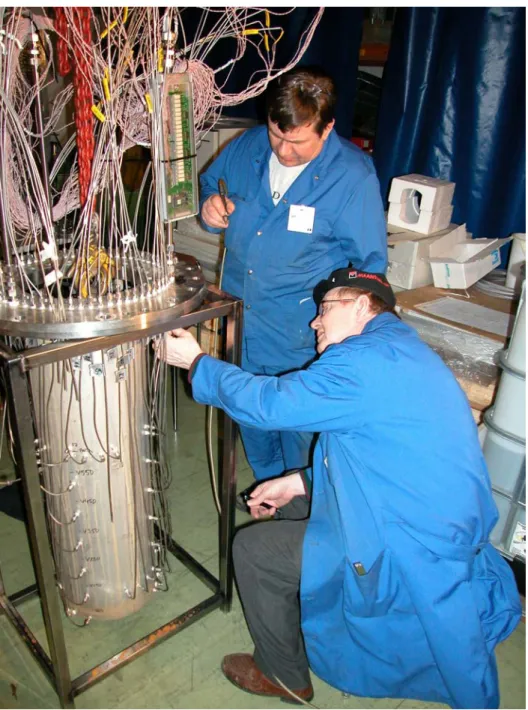
The objective of the SANCY project is to reduce the remaining uncertainties of severe accident phenomena that are relevant for Finnish nuclear power plants. The objective of the work is to interpret the experiments so that the results can be applied to plant scale analysis. The main goal of the project is to increase the understanding of the phenomena in the condensation pool during steam injection.
The final result of the project will be a database that can be used for testing and developing computational methods used for nuclear safety analysis. The aim of the PACO project is to prepare a proposal to the OECD of a research project that will use the PACTEL experimental thermal hydraulic facility of Lappeenranta University of Technology.
Automation, control room and information technology
- Interaction approach to development of control rooms (IDEC)
- Influence of RoHS -directive to reliability of electronics, prestudy (ROVEL) 18
- Organisational culture and management of change (CULMA)
- Disseminating tacit knowledge in organisations, prestudy (TIMANTTI)
These phenomena can be related to bubble dynamics (bubble growth, upward acceleration, discharge, breakup), basin swelling, pressure fluctuations, condensation rate, and vent tube vibration. For example, in order to estimate the loads on pool structures with condensing pressure fluctuations, the frequency and amplitude of the fluctuations must be known. In addition, pool wall deformations should be measured at specific locations to verify the structural analysis.
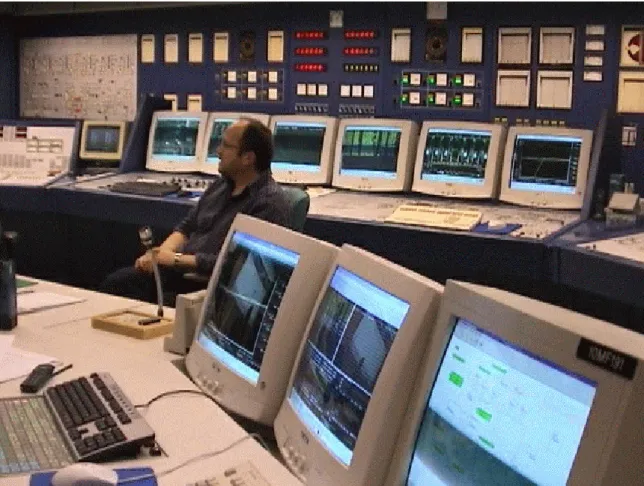
The preparation of the proposal includes preliminary analyzes with computer codes to ensure the relevance of the proposed three-year OECD project. Loviisa and Olkiluoto plant training simulators and experimental control room from Fortum Nuclear Services were used in the IDEC project in 2003. The basis of this framework lies in the existing standards and literature on the evaluation and design of user interfaces of complex systems.
Currently the work in SAFIR in this field is carried out in the project Organizational culture and change management (CulMa) and the pre-project Dissemination of tacit knowledge in organizations (TIMANTTI). In this area, work done beyond SAFIR both in Finland and in international projects will be discussed and reported in the reference group. Organizational culture researchers analyzing data from the TVO maintenance organization research in the CULMA project in 2003.
The purpose of the project is to increase the understanding of the effects of organizational culture and different ways of organizing work on the safety of nuclear energy production. The main goals of the TIMANTTI project are to strengthen, increase and develop the exchange of tacit knowledge between experienced and inexperienced employees, to motivate employees of different ages to share knowledge, and to identify, understand and develop factors that affect the efficiency and effectiveness of knowledge sharing.
Risk-informed safety management
Potential of fire spread (POTFIS)
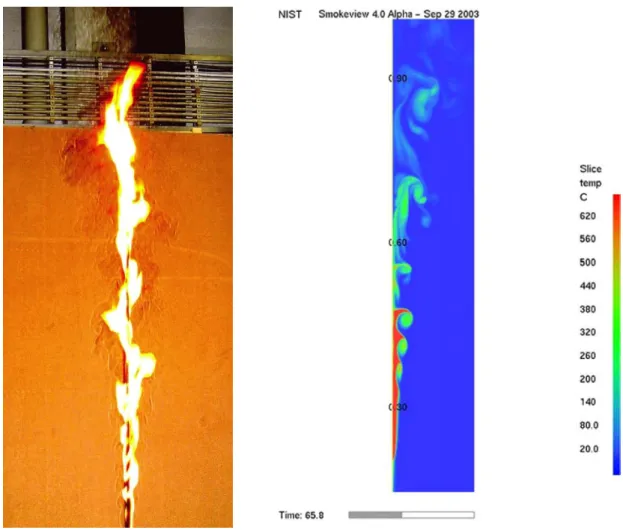
This knowledge gained in the prestudy is planned to be used later as a basis for piloting new methods of knowledge sharing in organizations: new methods are tested by conducting case studies, the methods are then evaluated and finally the most successful methods are implemented on broadly in enabling and enhancing tacit knowledge sharing. To be able to use in practice the knowledge and tools already available, several parallel lines of development are needed: (a) input data and their reliability for fire-PSA, (b) ignition and flame propagation models of fires, (c) fire protection asset reliability models, (d) operational fire protection assessment and (e) special fire topics related to passive systems.
Principles and practices of risk-informed safety management (PPRISMA)
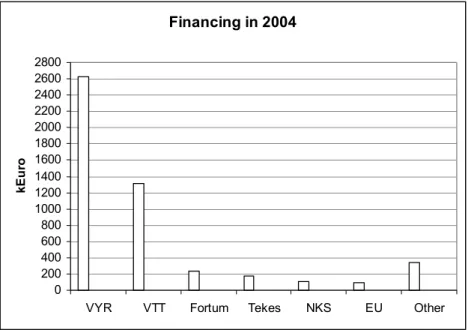
In addition to the projects with VYR financing, two projects TIFANY with Tekes and TVO and Fortum financing and AMY with Tekes and Fortum financing are reported and monitored within the SAFIR program. Volume Staff Mat&sup Travel Ext serv Other Total 2004 VYR % VYR Fortum TVO NKS EU VTT Other per month keuro keuro keuro keuro keuro keuro of total keuro keuro keuro keuro keuro keuro keuro VTT Processes. Figures 3.3 and 3.4 illustrate the distribution of funding and person-years across SAFIR's six research areas respectively.
Fuel and reactor core have the largest percentages, while the remaining three areas with the most connections and applications beyond the nuclear field, namely 4: Automation, control room and information technology, 5: Organizations and safety management and 6: Management of total risk-based security. in 19% of the entire volume of the program. Trends in funding and person-years in different SAFIR research areas are illustrated in Figures 3.5 and 3.6. The figures show both the increase in the total volume of the program from €4.1 million in 2003 to €4.9 million in 2004 and the increase in funding and volume in research areas 1-3.
The program management bodies, steering group and six reference groups will meet regularly 3 to 4 times a year. The list of people involved in the steering and reference groups, as well as the program staff and their main tasks are presented in Appendix 3. The steering group, shown as a blue layer, manages the entire research program and thus keeps the SAFIR "gem" together.
The information about the research carried out in SAFIR will be formally communicated via the quarterly progress reports annually, the annual report of the program and the www pages of the program. The detailed scientific results will be published as articles in scientific journals, conference papers and separate reports. For this purpose, another forum, the forum of projects administered and carried out outside SAFIR, but to be reported and discussed within SAFIR, was established and will also continue in 2004.
Research on the safety of nuclear power plants A proposal for the content and organization of the new research program.
![Figure 1.2. Future safety challenges to be addressed at in the SAFIR programme [1].](https://thumb-eu.123doks.com/thumbv2/9pdfco/19361000.0/7.892.127.749.299.723/figure-1-future-safety-challenges-addressed-safir-programme.webp)