SAFIR is a dynamic research program that allows new projects to be included or existing projects to be expanded during the research year. The construction of the new power plant increases the need for experts in this field in Finland. Distribution of the twelve major future security challenges in the six research areas of SAFIR [1].
The titles of the projects and their division into research areas are shown in Table 1.1. It is intended that most projects will continue throughout the four-year period of the SAFIR programme.
REACTOR CORE AND FUEL
Enhanced methods for reactor analysis (EMERALD)
The hydraulic solution routines of the TRAB code have been modified to calculate pure superheated steam situations. PSG's methods have been further developed and the accuracy of the diffusion constants calculated as a result has now also become reasonable. A new version of the linked code TRAB-3D-SMABRE for three-dimensional analyzes of transients and accidents is available.
The PORFLO code has been modified to allow participation in the OECD/NEA benchmark BFBT (BWR Full Size Fine Mesh Bundle Test), where the first task is to calculate the void distribution within the fuel and compare it to experimental data. As before, several members of the project team participated in the work of the OECD/NEA and AER Committee on Physics and Safety of VVER Reactors.

High-burnup upgrades in fuel behaviour modelling (KORU)
The hydraulic channel calculation subroutines in TRAB, which take care of the calculation of core channels and all BWR pressure vessel internals except the steam separators and steam dome, have been modified to allow superheated steam calculation and to handle unit void fraction, at least locally. The USNRC has incorporated the model, largely developed during a VTT scientist's attachment to the Pacific Northwest Laboratory, into the official future version of the FRAPCON and FRAPTRAN codes. The database applied in the various phases of the correlation finally consists of more than 100 fuel rods.
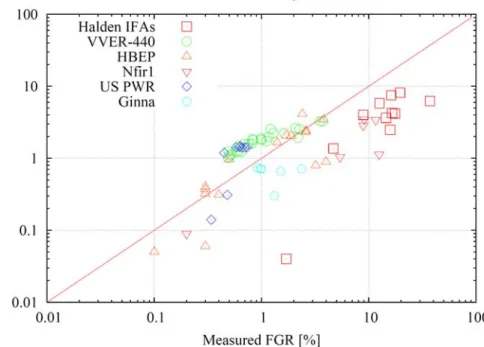
The new model leads to clearly better agreement of the calculated gas emission fractions with those measured. This was confirmed by recalculating the example cases from the IAEA FUMEX II benchmark exercise.
REACTOR CIRCUIT AND STRUCTURAL SAFETY
Integrity and life time of reactor circuits (INTELI)
- Ageing of pressure vessel (INSEL)
- Reactor circuit piping (INPUT)
- Other Components (INCOM)
- Prediction of Irradiation Damage Effects in Reactor Components (INPERF) .24
VTT Processes participates in the Program Committee of the European Working Group on Reactor Dosimetry (EWGRD PC) and in the Working Group on Reactor Dosimetry for VVER Reactors (WGRD-VVER). The development and verification of the risk matrix based RI-ISI analysis concept for NPP piping systems will be completed. The main challenges being worked on are: (i) the accuracy of the two-phase model, (ii) robustness of the two-phase model, (iii) the robustness of the moving and deforming mesh in the CFD calculation.
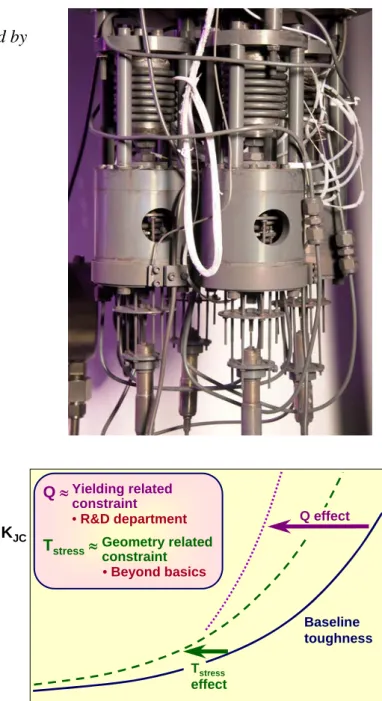
In 2006, research will continue into the role of alloy composition (especially the effect of Nb as an alloying additive) and water chemistry (especially high LiOH concentrations and the effects of KOH) on the initial corrosion performance of a range of fuel cladding materials (Zircaloy). -4, Zr-1%Nb, and possibly also M5). Theoretical justification of the correlation between the irradiation-induced change in the yield point and the shift in the fracture toughness transition temperature.
Concrete technological studies related to the construction, inspection and
A schematic of the various stages and sites of incorporation of Zn cations from the coolant. The operation of embedded RH sensors in 7 bridges built 4 – 10 years ago for continuous RH measurements was verified and the humidity of the bridges was measured. The second objective was to lay the foundation for a safety management system that includes regular inspections, condition prediction, monitoring safety limits, ensuring continuous use, predicting repair actions and managing risks for concrete structures in nuclear power plants.
Description and implementation plan for the safety management system of concrete structures in nuclear power plants. Memorandum of the OECD/NEA/IAGE CONCRETE WG Annual Meeting in Cadarache on 31 March 2006.

CONTAINMENT AND PROCESS SAFETY FUNCTIONS
The integration of thermal-hydraulics (cfd) and structural analyses (fea)
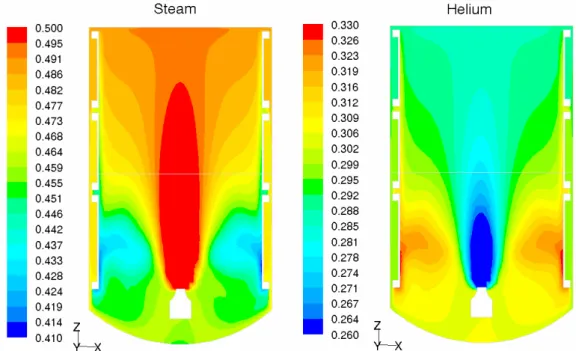
The main task was divided into two sub-tasks, which were 1.1) Linking FLUENT and ABAQUS codes and 1.2) Linking STAR-CD and ABAQUS codes. The second main task included only one subtask, which was the Evaluation of Thermo-Hydraulic Phenomena at the Pipe Break Point and Inside the Reactor After LBLOCA. The third main task included two subtasks, which were 3.1) Mechanics of tube rupture and 3.2) Timing of reactor core barrel peak stresses.
In subtask 3.1, the objective was to briefly study the realistic pipe break phenomena. The subtask 3.2 included studies of the timing of the greatest stresses of the reactor core after the pipe rupture.

Development of APROS containment model (TIFANY)
This new function allows modeling, for example, ventilation systems in containment and adjusting the gas flow to the desired values. This subtask included changes to the source code that were required for verification. The changes mainly related to the output parameters, but minor modeling changes were also made.
The Counter Current Flow Limitation (CCFL) correlations in APROS thermal hydraulic model are not completely valid in BWR and western PWR cores. Simulation of steam condensation experiment (ISP-47) on Mistra facility with the containment model of APROS 5.07.

Thermal Hydraulic Analysis of Nuclear Reactors (THEA)
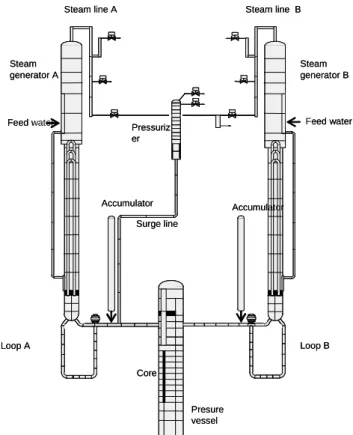
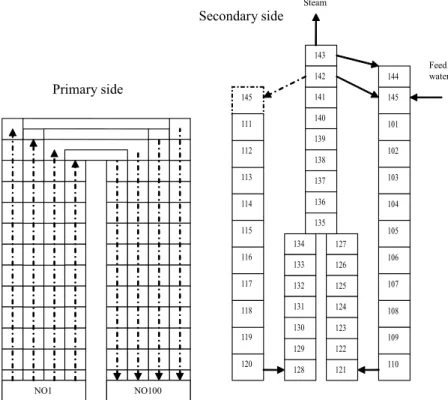
The steam generator U-tubes were divided into four parallel groups in the model to better account for the different flow conditions and non-condensable gas concentration in the tubes (Fig. Countercurrent flow of steam and water in the generator holder U-tubes active vapor-liquid in U-tubes and forms a stratified state Two CCFL correlations available in APROS with different values of the C parameter were tested, but the interfacial friction in the calculations appeared to be too high in all cases.
The reasons for discrepancies in the calculations will be further investigated in the OECD/PKL project. The test simulates the rupture of the penetration nozzle of the control rod drive mechanism, causing a small leak of 1.9% in the upper plenum.
Archiving experiment data (KOETAR)
The checked or scanned data and the documents were archived in the STRESA database maintained by the Nuclear Safety Research Unit of Lappeenranta University of Technology and on CD and DVD discs.
Condensation pool experiments (POOLEX)
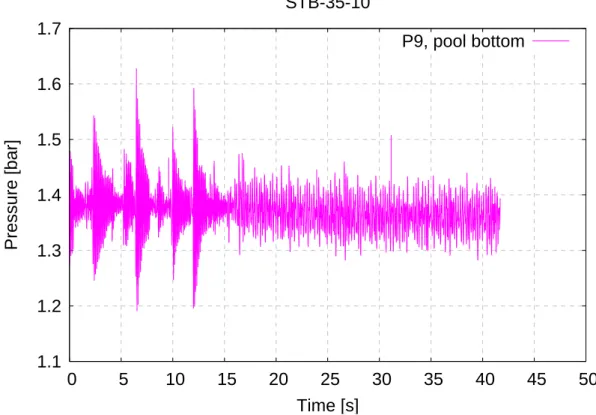
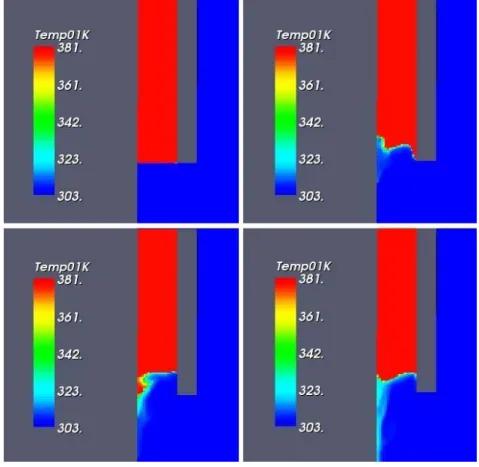
Pressure pulses inside the blowpipe as well as at the bottom of the pool were measured with high-frequency sensors. Improved instruments were used near the outlet of the blowpipe and close to the surface of the water. Peak pressure pulses in the blowpipe as a function of the air mass fraction between the vapor stream.
With non-condensable gas fractions above 3%, the damping of pressure fluctuations inside the blowdown pipe is practically complete. The number, diameter and location of the blowdown tubes can be varied from one test series to another.
Participation in Development of European Calculation Environment (ECE)).46
A possibility for experiments at atmospheric pressure still exists as the vessel head can be removed from the new facility. Measurement results of the experiments in 2006 can be found from the experiment database maintained by the research group. The data processing of the POOLEX test for NURESIM validation (STB-31) was performed and a test report was written.
The task supported the planning of the IMPACT test arrangement to quantify how liquid is released and dispersed from detonated projectiles. The primary purpose of task 3 is to analyze and report the most important results of the IMPACT tests regarding liquid release and dispersion.
Impact tests and testing facility (IMPACT)
At the beginning of the year 2006, the facility was developed to measure force-time function with the help of new force plate, which was firmly supported against the rock with the help of 4 back pipes. The target was concrete wall with bars on the front and back surface of the wall. The deflection of the wall was measured using deflection transducers on the front and back surfaces and also the strains with strain gauges glued to bars inside the wall.
In Figure xx, still figures from high-speed video (1000 frames/second) of aluminum missile during impact with the wall are displayed. The photo of the missile and concrete wall after the test is shown in Figure 25.

CAvity Phenomena and HydrOgen buRNs (CAPHORN)
Figure xx shows the speed measurements of the laser sensors in the above test. And finally, following and participating in major international research projects in the field of severe accidents will be carried out as part of the project. The overall design of the test facility was carried out in the SANCY project as a thesis.
Code performance and “tuning” for factory applications will be performed by calculating selected experiments. In the current COMESTA project, further tests will be carried out with higher melt temperature and mass and varying concrete types.

Behaviour of fission products in air-atmosphere (FIKA)
The abstract "Transport of ruthenium in diverse oxidising conditions" was published in the Proceedings of the International Aerosol Conference. The abstract "Transfer of ruthenium under different oxidizing conditions" was published in the Proceedings of the Nordic Society for Aerosol Research Aerosol Symposium. The abstract "Transport of ruthenium in diverse oxidising conditions" was published in the proceedings of the YoungRad seminar Proceedings of Nordic Nuclear Safety Research YoungRad.
An abstract "Experiments on the behavior of ruthenium in air entry accidents" was accepted at the International Congress on Advances in Nuclear Power Plants. A final report "Experiments on the behavior of ruthenium in air entry accidents - Final Report" was published on 6.2.2007.
AUTOMATION, CONTROL ROOM AND INFORMATION
Interaction approach to development of control rooms (IDEC)
Demands of the core task (as observed in the organization) Actual boundary of effective and safe activity (as defined by the OCT).
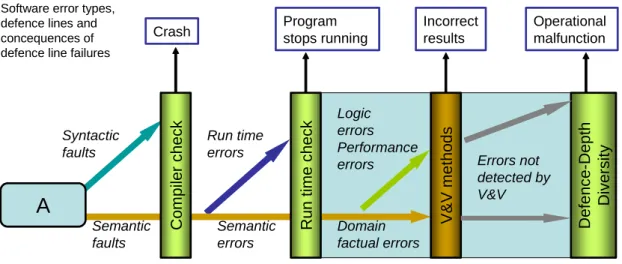
Software qualification – error types and error management in software life-
ORGANISATIONS AND SAFETY MANAGEMENT
Organizational culture and management of change (CULMA)
The main goal of the CulMa project was to increase insight into the effects of organizational factors on nuclear safety. The project aimed to acquire knowledge about the effects of organizational culture, organizational changes and different ways of organizing work in the field of nuclear safety. The two-year case study on the organizational culture at TVO Energiecentrale Engineering was completed and the results and recommendations were presented to staff on several occasions.
The project hosted the first meeting of the Finnish Network for Human Factors and Safety, which had about 70 participants from various safety-critical fields. The project staff participated in the first meeting of the HUSC (Safety Culture Network and MTO of the Finnish and Swedish electricity companies).

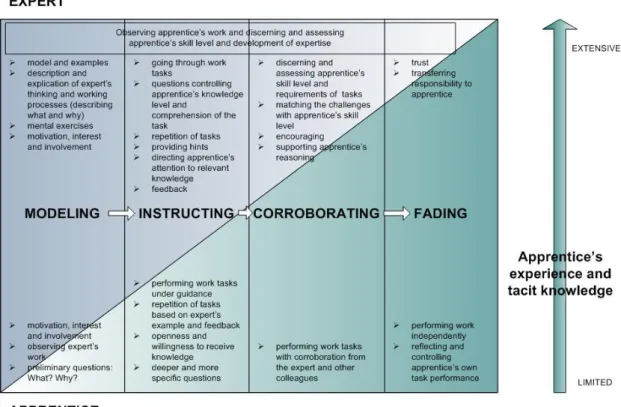
Disseminating Tacit Knowledge and Expertise in Organizations (TIMANTTI)
Both organizational and individual prerequisites for the implementation of tacit knowledge preservation practices were identified and the interrelationship of these prerequisites was described.
RISK-INFORMED SAFETY MANAGEMENT
Potential of fire spread (POTFIS)
To complete the flame spread model elaborated in previous years and implement its algorithms in FDS, check the functionality of the calculations and compare the results with experiments. To participate in the termination of the evaluation project International Collaborative Project for Evaluating Fire Models for Nuclear Power Plant Applications (ICP). Apply non-nuclear related research to the performance of fire brigades and to the movement of people to the nuclear power plant as a pilot study.
A technical report on double cone calorimeter and thermoanalytical experiments, and a procedure for estimating fire model parameters from small-scale experimental data. A technical report on probabilistic fire simulations of a nuclear power plant cable room containing cables of two subsystems. Simulations are also used to assess the conditions under which firefighters must attack the fire.
Technical Report on Numerical Simulations Using the Fire Dynamics Simulator in Axisymmetric DNS Mode to Investigate Vertical Flame Propagation on Charred Material. Travel report from the final meeting of the International Collaborative Project for the Evaluation of Fire Models for Nuclear Power Plant Applications (ICP), held at GRS, Munich, Germany, May 3-5, 2006.
Principles and Practices of Risk-Informed Safety MAnagement (PPRISMA) 70